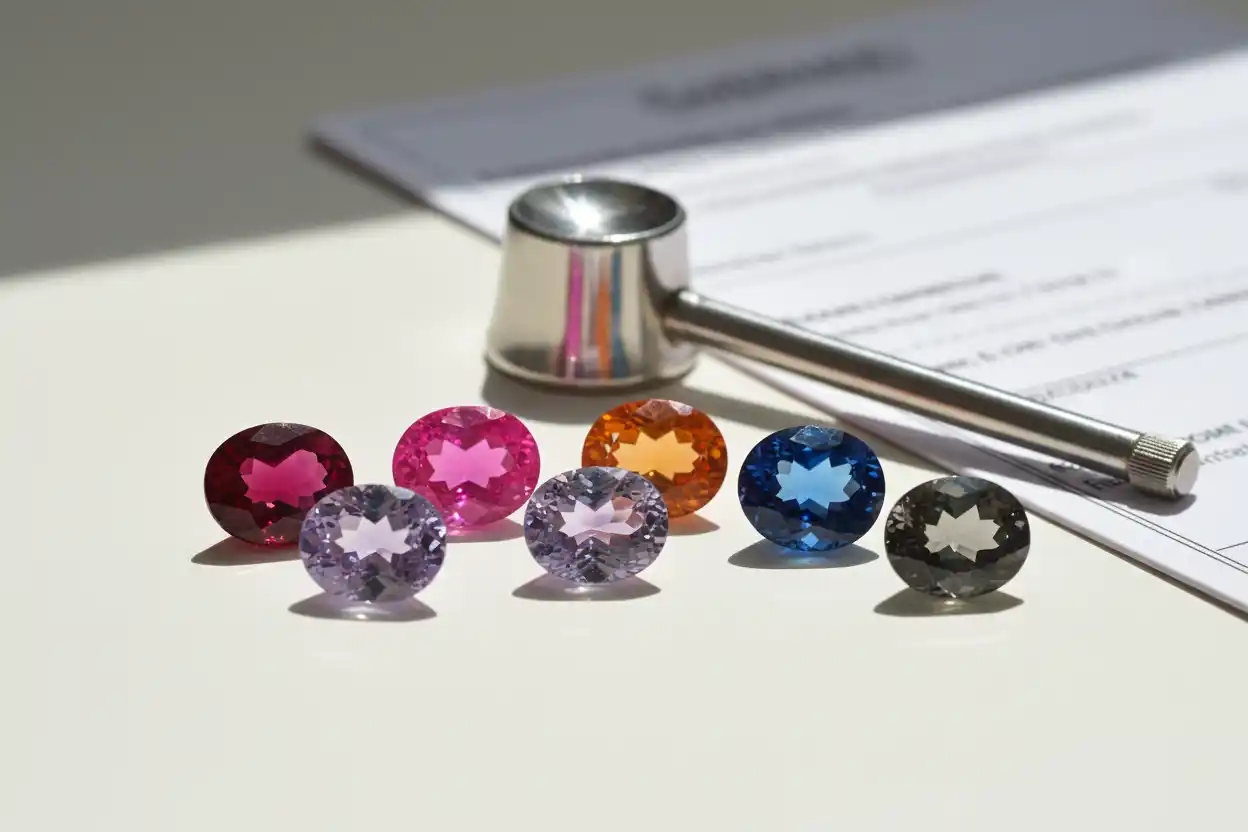
Buy Spinel: Smart Buying Tips & Red Flags
When you buy spinel, color should capture your attention, but identity should control the transaction. Natural spinel occurs in vivid red, pink, orange, purple, violet, blue, gray, black, and other colors, while laboratory-grown spinel has existed for decades and can reproduce many attractive appearances convincingly. Treatment is traditionally less routine than it is for ruby or sapphire, yet heat treatment, fracture filling, and diffusion-treated blue or green material have all been documented, which means the old assumption that every spinel is automatically natural and untreated is no longer a safe buying method.
A strong decision to buy spinel therefore starts by separating four questions that sellers sometimes blur together: Is the stone actually spinel? Is it natural or laboratory-grown? Has its color or clarity been modified? Does its visible quality justify the price? A gemstone can be genuine natural spinel but poorly cut, laboratory-grown spinel but beautifully made, or natural spinel whose attractive blue color has been produced through diffusion treatment. These are different commercial categories and should not be priced as though they were equivalent.
After identity, color normally contributes most strongly to value, followed by clarity, cut, size, treatment, condition, and provenance. Fine vivid red, hot pink, cobalt-blue, and certain saturated orange stones can command substantial premiums, while pastel lavender, gray, purple, and less saturated colors may offer excellent beauty at lower prices. The best way to buy spinel is not to chase the most expensive color category automatically, but to understand why a particular stone belongs in its price tier.
What Should You Judge First When You Buy Spinel?
When you buy spinel, begin with natural-versus-laboratory-grown status, then judge color, clarity, cut, dimensions, treatment, condition, and documentation. Origin should generally come after these fundamentals unless provenance itself is central to the purchase.
Gem spinel is principally magnesium aluminum oxide with the ideal formula MgAl₂O₄. It crystallizes in the cubic system, is normally singly refractive, ranks about 8 on the Mohs scale, and has good toughness with no prominent cleavage, making sound material suitable for most jewelry formats. Its broader mineral identity, geological formation, physical properties, and historical importance are explained in spinel meaning.
The range is much broader than the familiar red stones once confused with ruby. Before you buy spinel, reviewing the major colors, cobalt material, star stones, color-change examples, black varieties, and laboratory-grown material in types of spinel helps prevent you from applying one quality standard to every variety.
| Priority | What to establish | Stronger choice | Main concern |
|---|---|---|---|
| 1 | Origin category | Natural or laboratory-grown status clearly disclosed | “Real spinel” with no origin clarification |
| 2 | Color | Attractive hue with strong saturation and useful brightness | Muddy, gray, brown, overly dark, or weak color sold as premium |
| 3 | Clarity | Eye-clean or inclusions that do not dominate appearance | Large reflective or surface-reaching fractures |
| 4 | Cut | Even brilliance with good face-up spread | Windowing, extinction, poor symmetry, hidden weight |
| 5 | Treatment | Specific heat, filling, or diffusion disclosure | Generic “enhanced” wording |
| 6 | Dimensions | Good visible size for stated weight | Deep pavilion retaining unnecessary weight |
| 7 | Condition | Crisp facets, sound girdle, secure setting | Chips, abrasion, damaged corners |
| 8 | Provenance | Supported if origin materially raises price | Country inferred from color alone |
| 9 | Documentation | Independent report where value justifies it | Seller certificate treated as laboratory proof |
| 10 | Returns | Opportunity to inspect and verify | High-value final sale with no practical recourse |
This sequence keeps the decision to buy spinel focused on attributes that can actually be observed, tested, or documented.
Color Usually Has the Greatest Effect on Value
Once you know what the stone is, color becomes the most important visible factor when you buy spinel. Fine stones should show an attractive hue, enough saturation to look intentional, and enough brightness to remain lively outside intense showcase lighting.
Red and pink spinels are commercially prominent, while exceptional vivid blue material can be especially rare. Orange and flame-colored stones can also be highly attractive, and lavender, violet, purple, gray, and pastel stones have become increasingly popular because they combine excellent durability with colors that are difficult to obtain naturally in some other gem species.
The key is not to select the strongest color name. Instead, buy spinel whose body color remains appealing in the environments where you will actually wear or view it.
Fine Red Spinel Should Look Red, Not Black
Red spinel historically overlapped so strongly with ruby that some famous royal stones were misidentified for centuries. Modern gemology separates them readily, but their visual overlap remains important when you buy spinel.
Fine red material commonly shows vivid red, slightly orangish red, or slightly purplish red with strong saturation and enough brightness to remain open. Excessive darkness can make the stone appear burgundy or nearly black through the center, while obvious brown or gray modifiers generally reduce the classic vivid effect.
When you buy spinel in red, inspect the stone in ordinary reflected light instead of relying solely on illumination designed to maximize fluorescence or saturation. If the stone looks spectacular only under intense direct light, its normal appearance may be less compelling.
The full mineralogical and historical separation from corundum is covered in ruby vs spinel.
“Stoplight Red” Is a Description, Not a Laboratory Grade
Some sellers use terms such as stoplight red, traffic-light red, vivid crimson, Jedi red, neon red, or royal red when marketing strongly saturated material.
When you buy spinel with one of these labels, translate the phrase into actual visual characteristics. Does the gem have vivid saturation? Does it remain bright? Is the red clean rather than brown or overly purple? Is it well cut?
A trade description can communicate a useful color impression, but it should not automatically establish natural origin, geographic provenance, treatment status, or top quality.
Buy spinel for the face-up color you can see, not for the dramatic adjective attached to it.
Hot-Pink Spinel Can Be Exceptional
Hot-pink spinel can show extraordinary saturation, ranging from vivid pink and magenta to red-pink and pinkish red. Some material appears almost fluorescently bright because chromium contributes both body color and red fluorescence.
When you buy spinel in this category, judge whether the intensity survives normal indoor lighting. A stone that appears neon only beneath powerful lighting but turns dark purple-pink indoors may not provide the appearance you expect.
Clarity and cutting also matter because saturated pink rough can be scarce enough that weight-saving cuts are common.
A smaller, bright, eye-clean stone with strong face-up spread can be a much better way to buy spinel than a deeper heavier stone whose center looks dark.
Pastel Pink and Lavender Can Offer Excellent Value
Not every buyer needs the most saturated material. Pale pink, lavender, lilac, and violet spinel can have a delicate open appearance, particularly when clarity and cutting are strong.
When you buy spinel in a pastel color, the main challenge is avoiding grayness, weak saturation, or severe windowing. Pale stones expose cutting problems more readily because there is little body color to hide a transparent center.
Fine pastel spinel should look bright rather than watery.
For buyers who value elegance more than maximum rarity, this category can provide a compelling balance of natural color, durability, and price.
Cobalt-Blue Spinel Requires Stronger Verification
Blue spinel is one of the categories where you should become significantly more evidence-focused. Natural blue stones can owe their color to iron, cobalt, or combinations of trace elements, while fine vivid cobalt-bearing material can be exceptionally desirable.
However, when you buy spinel described as cobalt blue, remember that cobalt presence itself does not automatically make the gemstone valuable. The visible color remains central. A grayish stone containing some cobalt should not outrank a richly saturated blue gem merely because a trace-element result sounds more prestigious.
More importantly, cobalt diffusion treatment has been used to create vivid blue rims or colors in spinel. Laboratory-grown cobalt-colored spinel also exists.
If you buy spinel at a substantial cobalt-blue premium, independent analysis should be considered part of the purchase rather than an optional luxury.
Nickel Diffusion Makes Blue-Green Spinel More Complicated
Blue-to-green spinel deserves another treatment question because nickel diffusion has been documented as a way to create blue, greenish-blue, bluish-green, and green coloration near the surface of suitable spinel.
When you buy spinel with unusually vivid blue-green or green color, do not assume the appearance is naturally caused simply because natural spinel can occur in related hues.
Diffusion can produce a treated natural stone whose mineral identity remains spinel while its valuable color has been modified artificially. That distinction can substantially affect price.
For important blue or green stones, laboratory testing becomes more useful because sophisticated treatment should not be diagnosed from photographs alone.
The broader enhancement vocabulary is explained in gemstone treatments explained.
Natural Green Spinel Is Uncommon
Natural spinel can occur in green and greenish colors, but bright saturated green comparable with fine emerald or tsavorite is unusual.
When you buy spinel represented as vivid natural green, the uncommon color should increase your demand for evidence, particularly because diffusion treatment can also create blue-to-green appearance.
Dark iron-rich greenish stones belong to a different category from bright transparent green gems.
A very unusual color should not persuade you to skip verification. It should do the opposite.
Orange and Flame Spinel Need Careful Color Evaluation
Orange spinel ranges from peach and yellow-orange through saturated orange, reddish orange, and orange-red. “Flame spinel” is a commercial color description commonly used for particularly vivid orange-red or red-orange material.
When you buy spinel in this category, watch for excessive brown and darkness. A vivid medium-tone stone should remain energetic under ordinary lighting rather than looking burnt brown once warm photography is removed.
Also avoid confusing the word flame in a color description with flame-fusion growth. Flame spinel can be natural, while flame-fusion spinel is laboratory-grown material produced through a manufacturing technique.
If you buy spinel labeled “flame,” the invoice should still state natural or laboratory-grown origin clearly.
Purple and Violet Spinel Should Retain Brightness
Purple, violet, plum, lilac, and blue-violet spinels can be attractive alternatives to amethyst and sapphire, but grayness and excessive tone can reduce their face-up liveliness.
When you buy spinel in purple, examine the stone under cooler and warmer lighting because the apparent balance between red and blue components can change.
A medium-tone purple gem with excellent transparency can show more brilliance than a larger dark plum stone.
Do not assume that deeper purple is automatically more valuable. The best color is the one that remains attractive rather than closing into black.
Gray Spinel Should Be Judged for Undertone and Light Return
Gray spinel has developed its own contemporary jewelry market, particularly in minimalist and unconventional engagement-ring designs.
When you buy spinel in gray, determine whether the stone has blue, violet, green, brown, or nearly neutral undertones. These undertones can change significantly with lighting and metal color.
Fine gray material should still look lively. A charcoal stone with broad extinction can appear black through most of its face, while a lighter silver-gray gem can show much stronger brilliance.
Gray is not merely the absence of color; it can be an intentional aesthetic category when the stone is well cut.
Black Spinel Has a Different Quality Hierarchy
Opaque black spinel should not be judged according to transparent red or blue spinel standards.
When you buy spinel in black, prioritize correct identity, surface polish, cutting symmetry, condition, and durability. Because little or no light travels through the material, value comes from sharp surface reflections rather than internal brilliance.
Black spinel can be confused with black onyx, obsidian, hematite, black tourmaline, glass, and other dark materials.
A perfectly polished black stone is not automatically spinel because its color is non-diagnostic.
Color-Change Spinel Requires Controlled Comparison
Some natural spinel shows different apparent colors under daylight-equivalent and warmer incandescent illumination. Changes may involve blue, violet, gray-blue, purple, and reddish-purple combinations.
When you buy spinel specifically for color change, ask for a controlled demonstration using two clearly different light sources rather than photographs taken with unexplained editing.
A minor ordinary lighting shift should not receive the same premium as an obvious attractive change.
The stone should also remain appealing in both states. A dramatic change between two unattractive colors is scientifically interesting but not necessarily a premium jewelry quality.
Star Spinel Has a Different Clarity Standard
Aligned inclusions can create asterism in some spinel when the material is cut as a cabochon.
If you buy spinel because of a star effect, inclusions are essential rather than simply defects. Judge the sharpness, completeness, centering, mobility, body color, translucency, and dome proportions.
A four-rayed or six-rayed star should move logically across the surface as the light or gemstone changes position.
Ask for moving video beneath a small directional light source. One static photograph can exaggerate a weak reflection or hide poor centering.
When you buy spinel with a phenomenon, evaluate the phenomenon separately from ordinary faceted-stone clarity.
Clarity Standards Depend on Color
Pastel spinel is often expected to be relatively clean because inclusions become easy to see in lightly colored transparent material. Fine saturated red and blue stones are scarcer, so some visible inclusions may be tolerated when the color is exceptional.
When you buy spinel, evaluate whether the inclusion distracts from the stone rather than following an inflexible rule.
A tiny crystal near the edge may have almost no effect. A large white reflective fissure beneath the table can dominate the entire face.
The best buy spinel decision balances clarity against color rather than maximizing clarity at any cost.
Natural Inclusions Can Be Attractive
Natural spinel can contain octahedral negative crystals, mineral inclusions, fluid-filled features, healed fissures, fingerprint-like groups, needles, plates, and other internal structures.
When you buy spinel, these features can support gemological interpretation, but no single inclusion should be used as proof that a stone is natural.
Laboratory-grown material can also contain inclusions related to its growth method, while natural spinel can be exceptionally clean.
Use inclusions as part of a complete identity assessment rather than a simplistic “inclusions equal natural” rule.
Surface-Reaching Fractures Need More Scrutiny
Spinel has good toughness and no easy cleavage, but an individual stone with a significant surface-reaching fracture deserves careful evaluation.
When you buy spinel, inspect the crown, girdle, pavilion, corners, and areas near future prongs. A fracture reaching a thin girdle or pointed tip can increase impact risk.
Surface-reaching fissures also matter because fracture filling can reduce their visibility.
A heavily fractured stone can still be a legitimate purchase when priced and disclosed appropriately. What should concern you is a seller describing the gem as flawless or untreated while obvious fissures remain unexplained.
Eye-Clean Spinel Is Highly Desirable
When color and size are comparable, an eye-clean spinel usually deserves a premium over a visibly included stone.
That does not mean you need microscope-level perfection when you buy spinel.
The important test is whether inclusions interrupt the color and brilliance at ordinary viewing distance. Magnification should then help you assess structural condition and natural-versus-synthetic clues rather than become a reason to reject every microscopic feature.
The strongest buy spinel candidate often combines compelling color with enough clarity that your attention remains on the gemstone rather than on its inclusions.
Cut Quality Has a Major Effect on Spinel
Spinel can show excellent brilliance when properly proportioned. Because fine rough is scarce, cutters frequently prioritize weight retention, which means non-standard shapes, slightly deep pavilions, and asymmetry are common in fine stones.
When you buy spinel, some compromise can be acceptable if it preserves exceptional color or avoids a damaging inclusion. What matters is whether the final stone still returns light effectively.
Inspect the complete face rather than demanding geometric perfection.
A slightly asymmetric vivid gem can be far more attractive than a technically symmetrical stone with a large window.
Windowing Should Reduce the Price
A window is a pale or transparent face-up area where light escapes through the pavilion rather than returning toward the viewer.
When you buy spinel, inspect the center against a neutral background. If you can clearly see through a broad region, the gem may be too shallow.
Windowing is especially distracting in pale pink, lavender, gray, and colorless stones because limited body color makes the transparency obvious.
A small amount of leakage at certain angles is normal. A large stationary window occupying much of the center should affect what you are willing to pay.
Extinction Can Make Fine Color Look Black
Extinction creates dark or black-looking areas where little useful light returns.
When you buy spinel in saturated red, blue, purple, or dark gray, rotate it through ordinary lighting and watch whether dark facets move.
Some contrast is necessary for brilliance. A broad area that remains black across many angles can suppress the color you are paying for.
A smaller or slightly lighter gemstone with better cutting may therefore look far more impressive than a heavier dark stone.
Bow Ties Matter in Elongated Shapes
Oval, pear, marquise, and elongated cushion spinels can show bow-tie-shaped dark regions through the center.
When you buy spinel in one of these shapes, use video to determine whether the bow tie creates attractive contrast or dominates the stone.
A mild bow tie is normal in many elongated designs. A severe black band that remains fixed can reduce brilliance substantially.
Do not judge the issue from one still image, because a seller can photograph the stone at the angle where the bow tie is least obvious.
Compare Millimeter Dimensions With Carat Weight
Carat weight measures mass rather than visible size.
When you buy spinel, always request length, width, and depth because cutters often preserve expensive rough through non-standard proportions. A deep stone can weigh considerably more while offering little additional face-up area.
This becomes especially important in fine red, hot-pink, and cobalt-blue stones where larger sizes can carry substantial premiums.
If two gemstones appear nearly identical from above but one weighs much more, determine whether its extra depth improves color or simply retains hidden mass.
Paying for visible performance is usually preferable to paying for pavilion weight.
Fine Spinel Becomes Significantly Rarer in Larger Sizes
Large spinel exists, but fine color combined with high transparency and strong cutting becomes much less available as size increases.
When you buy spinel in larger sizes, therefore, do not focus on weight in isolation. A large dark red stone, cloudy gray spinel, or ordinary black material should not be priced using the scarcity logic of a vivid clean red or cobalt-blue gem.
The relationship among color, size, clarity, provenance, and treatment is explored further in spinel price.
The relevant rarity is not “large spinel.” It is large spinel of the particular quality category you are buying.
Natural Versus Laboratory-Grown Spinel Is a Major Buying Boundary
Laboratory-grown spinel has been produced for many decades. Flame-fusion synthetic material is widespread and can occur in numerous colors, while flux-grown material and other sophisticated products also exist.
When you buy spinel, understand that synthetic spinel is not glass. It is laboratory-grown material whose composition and properties are related closely enough to natural spinel that its identity must be represented accurately.
Some synthetic spinel has historically been used to imitate other gems such as sapphire, aquamarine, zircon, and peridot. Therefore, an old piece described as “synthetic sapphire” can sometimes contain synthetic spinel rather than laboratory-grown corundum.
Natural-versus-laboratory origin matters directly to rarity and price.
Flame-Fusion Synthetic Spinel Can Be Very Convincing
Flame-fusion growth can produce clean, strongly colored spinel efficiently. Depending on the material and cutting, microscopic examination may reveal curved growth structures, gas bubbles, or other manufacturing clues.
However, when you buy spinel, absence of obvious bubbles does not prove natural origin.
A well-cut synthetic stone can look extremely convincing without magnification, especially in blue, red, pink, or colorless forms.
For an inexpensive fashion jewel, clear synthetic disclosure may be entirely sufficient. For a high-value natural spinel, independent confirmation becomes much more important.
Flux-Grown Spinel Requires More Advanced Interpretation
Flux-grown synthetic spinel can contain inclusions that appear less obviously artificial than classic flame-fusion features.
When you buy spinel at a major natural-gem premium, do not assume that a stone must be mined simply because the inclusions do not look like bubbles or curved striae.
Gemological laboratories combine microscopy with spectroscopy, luminescence, chemistry, and other observations when necessary.
The stronger the natural-origin premium, the less appropriate home-level visual guessing becomes.
Heat Treatment Is Uncommon but Real
Spinel traditionally has a reputation for being largely untreated, and many natural stones do indeed enter the market without routine enhancement.
However, heat-treated spinel has been documented.
When you buy spinel, do not assume untreated status simply because the material historically receives less treatment than ruby or sapphire. Heat can modify clarity or color-related characteristics in some stones, and treatment evidence may be subtle.
A disclosed heated spinel can still be beautiful and durable. The question is whether the price and description reflect its actual treatment category.
Fracture Filling Is Rare but Important
Surface-reaching fractures can occasionally be filled with a material whose refractive properties reduce the visibility of the fissure.
When you buy spinel containing obvious fractures, ask specifically about filling.
Filled material may require more conservative cleaning because heat, chemicals, ultrasonic vibration, or age can alter the filler even when the spinel itself remains stable.
A stone represented simply as “natural spinel” has not necessarily answered the filling question. Natural origin and treatment are separate issues.
Cobalt Diffusion Can Create Vivid Blue Spinel
Cobalt diffusion is particularly important when you buy spinel in strongly saturated blue.
The process introduces cobalt-related color into or near the stone’s surface under high-temperature conditions. Because natural cobalt-bearing blue spinel can be exceptionally valuable, treatment disclosure materially changes the price category.
Do not rely on naked-eye color, fluorescence, or a seller’s claim that “only natural cobalt produces this shade.”
For expensive vivid-blue stones, a reputable laboratory is the more proportionate solution.
Nickel Diffusion Can Produce Blue-Green and Green Color
Nickel diffusion adds another reason to verify unusual blue-green or green spinel carefully. Treated stones can show increased nickel near their outer regions and may also exhibit treatment-related fracture healing.
When you buy spinel in this color range, a cheap stone does not automatically indicate treatment, and an expensive stone does not prove natural color.
The relevant question is whether the premium depends on naturally occurring rare color. If it does, documentation matters.
Natural Spinel Should Not Be Assumed Untreated From Tradition
The phrase “spinel is normally untreated” is useful background but should not become a substitute for examination.
When you buy spinel, especially in an expensive blue, green, red, or unusually clean category, ask what treatment conclusions are actually supported for that individual stone.
A tradition of low treatment frequency lowers the prior probability of enhancement. It does not make enhancement impossible.
Good buying decisions separate statistical expectations from evidence about the exact gemstone.
Geographic Origin Can Add Value but Should Come After Quality
Important spinel sources include Myanmar, Vietnam, Tanzania, Tajikistan, Sri Lanka, Afghanistan, Pakistan, Madagascar, and other regions.
When you buy spinel, origin can influence collector interest, particularly for exceptional stones associated with famous deposits. However, every source produces a quality range.
A badly windowed Burmese spinel does not automatically outperform a beautifully cut Tanzanian stone. A pale Vietnamese spinel does not become premium simply because the country has produced exceptional cobalt-blue gems.
Judge the stone first and provenance second.
Myanmar Spinel Has Historic Importance
Myanmar, particularly the Mogok region, is strongly associated with historic red and pink spinel recovered alongside ruby.
Fine stones from this region can have exceptional color and provenance appeal.
When you buy spinel represented as Burmese or Mogok material at a meaningful premium, ask what supports the origin statement. A red color and strong fluorescence are not sufficient by themselves.
A respected laboratory may offer geographic-origin opinions for qualifying stones, while historical provenance can add another layer of evidence.
The premium should correspond to more than a country name in a listing.
Mahenge Spinel Should Be Judged Stone by Stone
Tanzania’s Mahenge region is renowned for vivid pink, red-pink, and neon-like spinel that helped reshape modern collector demand.
When you buy spinel carrying a Mahenge premium, compare actual color, transparency, cut, and size.
Not every stone from the region has elite saturation, and vivid pink material occurs elsewhere too.
Mahenge can be meaningful provenance, but it should add value to a strong stone rather than serve as a universal grade.
Vietnamese Spinel Can Include Exceptional Red, Pink, and Blue Material
Vietnam has produced important red and pink spinel as well as highly prized cobalt-bearing blue material.
When you buy spinel represented as Vietnamese cobalt blue, precise origin and color-cause claims deserve especially careful support because both natural rarity and diffusion treatment can affect the price substantially.
A vivid blue gemstone should be valued for its visible color first, then for its verified natural origin and treatment status.
Country plus cobalt terminology should not be accepted merely from seller confidence.
Tajik Spinel Can Reach Impressive Sizes
Tajikistan has produced attractive pink-to-red spinel, including some substantial transparent gemstones.
When you buy spinel from this market, large size can legitimately contribute to rarity when fine color and transparency remain strong.
However, carat weight should still be compared with dimensions and cut quality.
A large stone is only exceptional when the qualities worth enlarging survive.
Sri Lankan Spinel Has a Broad Color Range
Sri Lanka produces spinel in pink, purple, violet, blue, gray, black, and other colors from its gem gravels.
When you buy spinel represented as Sri Lankan, the origin should not automatically imply one quality tier or one color cause.
Sri Lankan material can be commercially modest or collector quality.
Color, clarity, cut, and documentation should remain more important than provenance for most ordinary jewelry purchases.
Seller-Created Grades Are Not Universal
AAA, AAAA, premium, royal, museum grade, investment grade, collector grade, and similar terms do not belong to one standardized spinel grading system.
When you buy spinel with a proprietary grade, ask what it actually means.
Does AAA refer to color? Clarity? Cut? Natural origin? Absence of treatment? Geographic source?
If the criteria are not defined, ignore the letters and evaluate the individual stone.
A well-cut vivid spinel does not need four As to demonstrate why it is fine.
A Laboratory Report Becomes More Valuable as the Claims Become More Expensive
A modest commercial spinel does not always justify an individual laboratory report.
When you buy spinel at a substantial price, however, documentation becomes increasingly useful when the premium depends on natural origin, cobalt-blue color, unusual green color, no treatment, geographic provenance, large fine size, star or color-change phenomena, or separation from laboratory-grown material.
A colored-stone identification report can establish natural versus laboratory-grown origin and report detectable treatment within the laboratory’s service.
The role and limitations of laboratory documentation are explained in gemstone certification.
GIA Does Not Apply a Universal AAA Spinel Grade
Independent gem laboratories can identify and evaluate spinel without adopting a retailer’s proprietary AAA hierarchy.
When you buy spinel with both a laboratory report and a seller grade, understand what each document does.
The laboratory report provides identification-related evidence. The retailer’s quality grade expresses the seller’s internal commercial assessment.
One should not be mistaken for the other.
When Is a Report Worth Paying For?
The best threshold is the cost of being wrong.
If you buy spinel inexpensively and the stone is clearly disclosed as laboratory-grown, elaborate testing may not add much practical value.
If you buy spinel because it is supposedly a large natural cobalt-blue stone, an incorrect origin or treatment conclusion could change the value dramatically.
That is when laboratory analysis becomes proportionately sensible.
The more claim-dependent the price, the stronger the evidence should be.
Report Versus Appraisal
A laboratory report and an appraisal perform different functions.
When you buy spinel, use a report to establish identity, natural or laboratory-grown origin, detectable treatment, and other supported characteristics. Use an appraisal to estimate monetary value for a defined purpose such as insurance.
A large insurance replacement value does not prove that a blue spinel is naturally cobalt colored, untreated, or from Vietnam.
Likewise, a prestigious laboratory report does not establish that the retail asking price is competitive.
Match Every Report to the Exact Stone
Before you buy spinel with documentation, compare the report with the gemstone.
Check carat weight, length, width, depth, shape, cutting style, color description, report number, and identifying photograph where one is supplied.
A report for another stone from the same parcel is not evidence about yours.
If the stone has been recut after testing, the measurements and weight may have changed, and that should be explained clearly.
Actual-Stone Photography Is Essential for Significant Purchases
Spinel can vary enormously even within one color family, so representative images are inadequate for individually priced fine stones.
When you buy spinel online, request face-up photographs of the exact gemstone, side and pavilion views, close-ups of important inclusions, and rotating video.
The face-up image shows color, windowing, extinction, and clarity. The profile shows depth. The pavilion can reveal chips, fractures, poor polish, or hidden inclusions.
A rotating video reveals how brightness changes as the stone moves.
Neutral Lighting Matters
Saturated red, pink, blue, and purple gemstones are easy to manipulate through lighting and camera settings.
When you buy spinel online, ask for at least one image against a white or neutral-gray background under ordinary reflected light.
Warm illumination can strengthen red and orange. Cool light can emphasize blue and violet. A dark background can increase apparent saturation.
Look at surrounding objects for clues. If white paper is visibly pink or blue, the stone’s color may also be shifted.
Actual Color Should Survive Ordinary Indoor Light
Display lamps can make a fine gemstone look extraordinary, but you will not wear the stone under jewelry-counter lighting continuously.
When you buy spinel, request video under ordinary indoor illumination as well as brighter directional lighting.
Fine color should remain recognizable and attractive even when scintillation decreases.
A vivid red stone that turns black indoors or a cobalt-blue stone that becomes nearly gray may still be natural, but you should know that behavior before paying a premium.
Side Views Reveal Hidden Weight
Many fine spinels are cut in non-standard proportions because cutters preserve scarce rough.
When you buy spinel, a side profile helps you determine whether depth is a reasonable compromise or simply excessive weight retention.
A deep pavilion may support saturation or avoid an inclusion. It may also cause the stone to face up small.
Compare the side view with the visible dimensions and price.
Condition Matters in Previously Worn Spinel
Spinel’s Mohs hardness of about 8 and good toughness make it an excellent jewelry gemstone, but long wear can still produce facet abrasion, chips, and damaged girdles.
When you buy spinel secondhand, inspect the table, facet junctions, corners, culet, and areas beneath prongs.
A small amount of wear can be acceptable when reflected in the price. Deep chips or fractures can affect both appearance and setting security.
Condition matters especially for antique stones because repolishing may reduce weight or alter a historically significant cut.
Spinel Is an Excellent Ring Gemstone
Unlike several collector gems with limited durability, spinel is well suited to rings when the stone is structurally sound.
When you buy spinel for frequent wear, its hardness, good toughness, and absence of prominent cleavage make it a practical alternative to many softer colored stones.
That does not make it indestructible. Sharp impacts can still chip edges, particularly in pointed cuts or stones with existing fractures.
A secure setting and ordinary precautions remain important.
Setting Choice Should Match the Shape
Rounded ovals and cushions are relatively straightforward to protect, while pears, marquises, kites, and other pointed shapes need thoughtful prong or bezel placement.
When you buy spinel loose, inspect the girdle before choosing the mounting.
Avoid positioning intense setting pressure directly over a visible fracture.
A large center stone may also benefit from a setting that keeps the profile lower and reduces leverage during accidental impacts.
Spinel Can Work Well for Engagement Rings
For buyers who want a naturally colored alternative to ruby or sapphire, spinel can be an excellent engagement-ring gemstone.
When you buy spinel for this purpose, prioritize natural or laboratory-grown disclosure, color stability, structural soundness, cut quality, and a setting designed for frequent wear.
Fine red, pink, purple, gray, and blue stones can all produce distinctive engagement jewelry.
Do not assume every rare color is automatically the best practical choice, however. An extremely expensive cobalt-blue stone deserves more documentation than an ordinary gray spinel, even though both are physically durable.
Cleaning Is Straightforward for Sound Spinel
For most sound, unfilled stones, warm water, mild soap, and gentle brushing provide a safe household method.
Detailed treatment-aware instructions are available in how to clean spinel jewelry.
When you buy spinel that contains fractures or possible filling, plan on conservative manual cleaning rather than assuming mechanical equipment will always be appropriate.
High heat should also be avoided during careless repair because some colors can be affected.
Ultrasonic and Steam Cleaning Depend on Condition
Sound, unfilled spinel can generally tolerate more robust cleaning than many fragile gems, but the condition of the exact stone and jewelry must come first.
When you buy spinel with a surface-reaching fracture, filler, glue, antique repair, weak setting, or vulnerable companion gemstone, manual cleaning provides a wider safety margin.
The strongest care plan follows the most sensitive component in the finished jewel.
Resale Expectations Should Stay Realistic
Fine natural spinel has developed a serious collector market, particularly for exceptional red, hot-pink, cobalt-blue, rare larger stones, important provenance, and significant historical pieces.
That does not mean every stone purchased at retail will resell easily.
When you buy spinel, remember that dealer margin, jewelry labor, laboratory reports, metal, design, brand value, and retail overhead may not be recovered in a secondary transaction.
Fine quality and documentation can strengthen resale prospects, but no natural gemstone comes with guaranteed appreciation.
Value Trade-Off: Better Color Versus Better Clarity
Suppose one stone has extraordinary vivid red color with a small visible inclusion while another is completely eye-clean but noticeably darker and browner.
When you buy spinel, the more vivid stone can easily be the stronger choice if the inclusion is not structurally significant.
Color generally has a larger effect on value than small clarity differences.
The trade-off changes if the inclusion is a large white fracture directly beneath the table.
Clarity should modify color value rather than automatically outrank it.
Value Trade-Off: Smaller Fine Stone Versus Larger Commercial Stone
Fine spinel becomes substantially rarer as size increases, yet a large stone is not inherently fine.
When you buy spinel on a fixed budget, a smaller gem with vivid color, high transparency, and competent cutting can look dramatically more valuable than a larger dark or heavily included stone.
Compare the face-up appearance first.
The carat figure should confirm rarity only after quality has been established.
Value Trade-Off: Heated Versus Untreated
Because many natural spinels are untreated, buyers sometimes treat any possible heat treatment as unacceptable.
That is too simplistic.
When you buy spinel, an attractive disclosed heated stone can still be legitimate and wearable. The question is whether its price reflects treatment and whether a similar untreated stone would command a premium.
Do not sacrifice excellent color and cutting merely to obtain an unsupported untreated claim.
Value Trade-Off: Natural Versus Laboratory-Grown
Laboratory-grown spinel can offer attractive color, clarity, durability, and larger size at a much lower cost than rare natural material.
When you buy spinel for appearance rather than geological rarity, a clearly disclosed synthetic stone can be a rational option.
If you buy spinel as a collector gemstone, natural geological origin becomes far more important.
Neither objective is inherently superior. Misrepresentation is the problem.
Value Trade-Off: Origin Versus Better Face-Up Quality
A prestigious locality can add collector value, but jewelry buyers should ask what the same premium could purchase in color, clarity, or cut.
When you buy spinel, an outstanding stone without a famous provenance may provide greater visual satisfaction than a weaker stone from a prestigious source.
Collectors focused on locality may choose differently.
The decision should match your reason for buying.
Practical Buy Spinel Decision Matrix
| Factor | Strong candidate | Reasonable compromise | Serious concern |
|---|---|---|---|
| Origin category | Natural or laboratory-grown clearly established | Modest stone with strong disclosure | “Real” with no natural/synthetic distinction |
| Color | Vivid, attractive, and bright in normal light | Pastel or muted color priced appropriately | Muddy, brown, gray, or almost black while sold as top color |
| Clarity | Eye-clean or minimally included | Minor inclusion compensated by exceptional color | Large central or surface-reaching fracture |
| Cut | Balanced brightness and good spread | Minor asymmetry preserving fine rough | Broad window, severe extinction, excessive depth |
| Dimensions | Appropriate for weight | Some added depth serving color | Major hidden weight |
| Heat | Clearly disclosed if detected | Buyer accepts treatment | Major untreated premium without support |
| Filling | None or specifically disclosed | Minor filling at appropriate price | Concealed fracture enhancement |
| Blue/green diffusion | Laboratory-excluded where premium is substantial | Treated stone knowingly purchased | Rare natural-color premium without testing |
| Synthetic origin | Accurate disclosure | Laboratory-grown chosen deliberately | Synthetic sold as mined |
| Origin | Credibly supported when important | Country unspecified | Famous locality inferred from color |
| Photos | Exact stone under neutral and normal lighting | Clear actual-stone imagery | Stock images or heavily altered color |
| Documentation | Independent report where justified | No report for modest straightforward stone | Seller certificate used as sole proof of high-value claims |
| Condition | Crisp and structurally sound | Minor wear reflected in price | Chips, loose stone, damaged girdle |
| Returns | Practical inspection opportunity | Clear reasonable restrictions | Major purchase with no meaningful recourse |
Use this matrix when you buy spinel to make each premium explicit rather than relying on a seller’s overall grade.
Stone-Specific Red Flags When You Buy Spinel
One of the most important red flags is a seller using “real spinel” without clarifying whether the stone is natural or laboratory-grown. Synthetic spinel is genuine manufactured spinel, so the word real alone does not establish geological origin.
Another major warning is vivid cobalt-blue or blue-green material carrying a natural-rarity premium without appropriate treatment testing. Cobalt and nickel diffusion have both been documented, while synthetic blue spinel is widely known.
Be cautious with unsupported AAAA grades, “stoplight red” labels used as proof of origin, Mahenge or Mogok claims based solely on color, and appraisals presented as though they establish natural origin.
A large carat weight paired with surprisingly small dimensions is another warning because fine rough is commonly cut deeply to preserve mass.
Also investigate broad windows, severe extinction, central reflective fractures, photographs with strongly altered white balance, and return terms that prevent independent examination.
Finally, do not buy spinel simply because the seller says it is untreated. The gemstone still has to possess compelling color, clarity, cutting, condition, and correctly represented origin.
A Better Way to Buy Spinel
Begin your buy spinel comparison with several gemstones of broadly similar color, size, and budget. Ignore retailer-created grades and locality names initially.
First, determine natural or laboratory-grown status when that distinction matters to the price. Then compare face-up color under similar neutral lighting, removing stones that become muddy, overly dark, excessively gray, or weak outside intense illumination.
Next, evaluate clarity. Fine pastel material should often be relatively clean, while an exceptional saturated red or blue can justify a small inclusion. Reject or discount major surface-reaching fractures according to their structural and visual effect.
Then assess the cut. Look for even light return, limited windowing, manageable extinction, sensible symmetry, and face-up dimensions appropriate to the weight.
After the visible quality is established, investigate heat treatment, filling, cobalt or nickel diffusion where relevant, geographic provenance, and laboratory documentation. Expensive unusual colors deserve more evidence than routine commercial material.
Finally, inspect exact-stone photography, side and pavilion views, condition, setting quality, invoice wording, and return terms. The wider Buying & Value section applies the same evidence-first approach across gemstones, but a strong buy spinel decision must give unusual attention to natural-versus-synthetic origin because laboratory-grown spinel is widely established and treatment assumptions can no longer rely only on tradition.
Frequently Asked Questions
What should I check first when I buy spinel?
When you buy spinel, determine whether the material is natural or laboratory-grown, then judge color, clarity, cut, dimensions, treatment, condition, provenance, and documentation.
What spinel color is most valuable?
Fine vivid red and exceptional cobalt-blue material can occupy the highest value tiers, while hot pink and vivid orange can also be highly desirable. When you buy spinel, actual saturation, tone, clarity, cut, and size matter more than a color name alone.
Is red spinel the same as ruby?
No. Spinel is magnesium-aluminum oxide, while ruby is red corundum. When you buy spinel in red, professional testing can distinguish the two through optical and physical properties.
Is natural spinel usually untreated?
Many natural spinels are untreated, but treatment cannot be ruled out automatically. When you buy spinel, remember that heat treatment, rare fracture filling, and diffusion treatments have been documented.
Does synthetic spinel exist?
Yes. Laboratory-grown spinel has existed for decades and is available in numerous colors. When you buy spinel, insist that natural or synthetic origin be stated clearly.
Is synthetic spinel fake?
Synthetic spinel is laboratory-grown material rather than glass, but it should not be sold as natural spinel. If you buy spinel for geological rarity, the distinction materially affects value.
What is cobalt spinel?
Cobalt spinel is blue spinel whose attractive coloration involves cobalt. When you buy spinel described as cobalt blue, remember that visible color matters most and laboratory verification becomes increasingly important at high values.
Can blue spinel be diffusion treated?
Yes. Cobalt diffusion has been documented. If you buy spinel with unusually vivid blue color, treatment testing can be important before paying a natural-color premium.
Can green spinel be diffusion treated?
Yes. Nickel diffusion has produced blue-green and green coloration, while cobalt diffusion can also affect blue material. When you buy spinel in an unusually vivid green range, professional analysis is prudent.
Is heat-treated spinel still natural?
A naturally formed spinel remains natural spinel after heat treatment, but the treatment should be disclosed. When you buy spinel, natural origin and treatment status should be evaluated separately.
Can spinel be fracture filled?
Yes, although it is uncommon. When you buy spinel with surface-reaching fissures, ask whether filler has been used because it can affect value and care.
Should spinel be eye-clean?
Eye-clean spinel is highly desirable, particularly in pastel colors. However, when you buy spinel with exceptional saturated red or blue color, a small harmless inclusion may be an acceptable trade-off.
Are inclusions proof of natural spinel?
No. Natural stones can be clean, while laboratory-grown material can contain growth-related inclusions. When you buy spinel, use complete gemological evidence rather than one inclusion rule.
What is windowing in spinel?
Windowing is a pale or transparent face-up region caused by poor light return. When you buy spinel, a large window should normally reduce the price.
What is extinction in spinel?
Extinction appears as dark or black-looking regions where little light returns. When you buy spinel in dark red, blue, purple, or gray, excessive extinction can suppress otherwise attractive color.
Should I buy spinel based on carat weight?
No. When you buy spinel, compare carat weight with millimeter dimensions, color, clarity, and cut because deep stones can retain significant hidden mass.
Is large spinel rare?
Large fine spinel becomes increasingly scarce when vivid color, transparency, and good cutting are maintained. When you buy spinel, do not confuse large ordinary material with large fine-quality material.
What is Mahenge spinel?
Mahenge refers to material from Tanzania’s Mahenge region, famous particularly for vivid pink and red-pink spinel. When you buy spinel with a Mahenge premium, provenance should be supported.
Is Burmese spinel more valuable?
Fine Myanmar spinel can receive strong collector demand, but origin alone does not establish quality. When you buy spinel, assess the stone before paying a country premium.
Is Vietnamese blue spinel valuable?
Fine naturally colored cobalt-bearing Vietnamese spinel can be exceptionally desirable. When you buy spinel in this category, natural origin and treatment documentation are particularly important.
Can spinel change color?
Some natural spinels show a color-change effect under different lighting. When you buy spinel specifically for this phenomenon, request a controlled comparison using distinct light sources.
Can spinel show a star?
Yes. Some included spinel can display four- or six-rayed asterism when cut as cabochons. When you buy spinel with a star, evaluate the star’s sharpness, completeness, centering, and movement.
Is black spinel transparent?
Black spinel is generally opaque or nearly opaque. When you buy spinel in black, prioritize identity, polish, cutting, and condition rather than transparent-gem clarity.
Is spinel suitable for daily rings?
Yes. With Mohs hardness around 8, good toughness, and no prominent cleavage, sound spinel is suitable for frequent ring wear. When you buy spinel for a ring, still inspect fractures and setting protection.
Is spinel good for engagement rings?
Yes. When you buy spinel for an engagement ring, its durability and broad natural color range make it a strong option, provided natural or laboratory-grown origin and treatment are disclosed correctly.
How should spinel be cleaned?
Warm water, mild soap, and a soft brush are the safest general approach. When you buy spinel that is fractured, filled, or mounted with delicate materials, use more conservative cleaning.
Can spinel go in an ultrasonic cleaner?
Sound, unfilled spinel can usually tolerate ultrasonic cleaning, but fractures, filling, loose settings, glue, or delicate companion stones can make it inappropriate.
Can spinel be steam cleaned?
Sound unfilled spinel may tolerate steam, but high heat, fillings, repairs, coatings, and uncertain treatment create reasons for caution.
Do I need a laboratory report when I buy spinel?
Not for every inexpensive stone. When you buy spinel of significant value, particularly cobalt-blue, unusual green, large fine red, or strongly provenance-dependent material, an independent report can be highly worthwhile.
Does a laboratory grade spinel AAA or AAAA?
There is no universal standardized AAA quality scale for spinel. When you buy spinel, treat such grades as seller-specific descriptions unless the criteria are explained.
Is an appraisal proof that a spinel is natural?
No. An appraisal concerns monetary value. When you buy spinel and natural origin matters, use appropriate gemological identification rather than an appraisal figure.
What pictures should I request before I buy spinel online?
When you buy spinel online, request exact-stone face-up images, side and pavilion views, inclusion close-ups, and rotating video under neutral and ordinary lighting.
Does spinel hold its value?
Exceptional natural spinel can have meaningful collector demand, particularly in fine red, pink, and cobalt-blue categories. However, when you buy spinel, do not assume guaranteed appreciation or easy resale.
What is the biggest red flag when I buy spinel?
A major warning is a large premium based on a claim that has not been demonstrated—such as natural cobalt blue, untreated status, prestigious origin, or natural geological origin—while independent evidence, actual-stone imagery, and meaningful return rights are missing.
Final Buy Spinel Checklist
Before you buy spinel, establish whether the gemstone is natural or laboratory-grown. Synthetic spinel is a long-established manufactured material that can reproduce many colors convincingly, so terms such as real, genuine, or authentic do not replace a clear natural-versus-synthetic statement.
Judge color next. Fine red, hot pink, cobalt blue, orange, purple, violet, gray, and other varieties should remain attractive in ordinary lighting rather than depending on extreme photographic conditions. Evaluate hue, tone, saturation, and brightness together, and do not allow dramatic trade names to override what you actually see.
When you buy spinel, examine clarity according to the specific color category. Eye-clean material is desirable, but small inclusions can be reasonable in scarce vivid colors. Surface-reaching fractures deserve more attention because they can affect durability and may contain filling.
Study the cut through motion. Look for balanced brilliance, limited windowing, manageable extinction, sensible symmetry, and face-up dimensions that justify the carat weight. Fine rough is often cut to conserve mass, but weight retention should not make the stone visibly dull or disproportionately small.
Ask specifically about treatment. Although many natural stones remain untreated, heat treatment, fracture filling, cobalt diffusion, and nickel diffusion have been documented. Unusual vivid blue, green, or blue-green material deserves particularly careful examination when natural color accounts for a large part of the price.
Treat provenance as a separate premium. Myanmar, Tanzania, Vietnam, Tajikistan, Sri Lanka, and other sources have produced important spinel, but no locality automatically guarantees fine quality. Geographic origin should add context to an already desirable gemstone and should receive stronger support when it materially increases the asking price.
For significant purchases, use laboratory documentation proportionately. Confirm that the report matches the exact gemstone, distinguish identification from appraisal, and do not mistake seller-created AAA grades for independent scientific conclusions.
When you buy spinel online, request photographs of the exact stone under neutral lighting, continuous video in ordinary conditions, side and pavilion views, written natural-or-synthetic disclosure, treatment information, dimensions, condition details, and return terms that give you a meaningful opportunity to inspect the gemstone.
Finally, remember why spinel has become important in its own right rather than merely as a historical ruby substitute. It combines vivid natural colors, excellent brilliance, strong durability, broad jewelry versatility, and an increasingly sophisticated collector market.
The strongest way to buy spinel is to pay first for correctly represented origin, compelling color, appropriate clarity, efficient cutting, sound condition, and transparent treatment disclosure. Cobalt terminology, famous provenance, exceptional carat weight, proprietary grades, and rarity stories should increase the price only after the individual gemstone—and the evidence supporting its claims—has genuinely earned that premium.