18 Zircon Benefits for Mental Clarity & Cosmic Grounding
Zircon benefits combine genuine gemological value with modern symbolism involving mental clarity, wisdom, grounded decision-making, confidence, purpose, self-reflection, and what crystal traditions often call cosmic grounding. The gemstone’s intense brilliance, strong dispersion, ancient geological history, and wide range of natural and heat-treated colors make it visually distinctive, while its ability to preserve information about extremely early Earth gives it an unusually meaningful scientific story.
Zircon is a natural zirconium silicate with the chemical formula ZrSiO₄. It is not cubic zirconia, despite the similarity between their names. Natural zircon has high refractive indices and strong dispersion, which can produce brilliant flashes of spectral color in a well-cut stone. GIA describes zircon as a naturally occurring gem with unusually high brilliance and fire and notes that zircon crystals from Australia have been dated to approximately 4.4 billion years, making them among the oldest known minerals on Earth.
The spiritual interpretations require a different standard. Zircon does not scientifically improve memory, clear mental fog, connect someone with cosmic energy, or regulate emotional states. A gemstone can still become a useful reminder to slow down, examine evidence, reconsider assumptions, or remain grounded while dealing with complicated decisions. In that form, zircon benefits come from personal association and deliberate practice rather than a hidden physical force.
18 Zircon Benefits at a Glance
- Mental clarity: encourages careful, evidence-based reflection.
- Grounding: keeps attention on practical reality.
- Wisdom: symbolizes learning from accumulated experience.
- Focus: supports deliberate attention to priorities.
- Confidence: represents preparation-based self-trust.
- Perspective: encourages viewing problems from several angles.
- Purpose: symbolizes directing effort toward meaningful goals.
- Patience: reflects the value of long-term development.
- Resilience: represents adapting without losing direction.
- Self-awareness: encourages examination of personal assumptions.
- Creativity: inspires through brilliance and varied color.
- Gratitude: highlights experiences that deserve appreciation.
- Discernment: separates evidence from wishful thinking.
- Geological learning: reveals extraordinary early-Earth history.
- Collector appeal: offers diverse colors and optical effects.
- Jewelry versatility: provides brilliance across many designs.
- Responsible spirituality: preserves symbolism without medical claims.
- Cosmic grounding: connects wonder with scientific reality.
What Zircon Actually Is
Zircon is a distinct mineral species belonging to the tetragonal crystal system. Its chemistry is relatively simple compared with minerals such as tourmaline, yet trace elements can strongly affect its color, crystal structure, and physical properties.
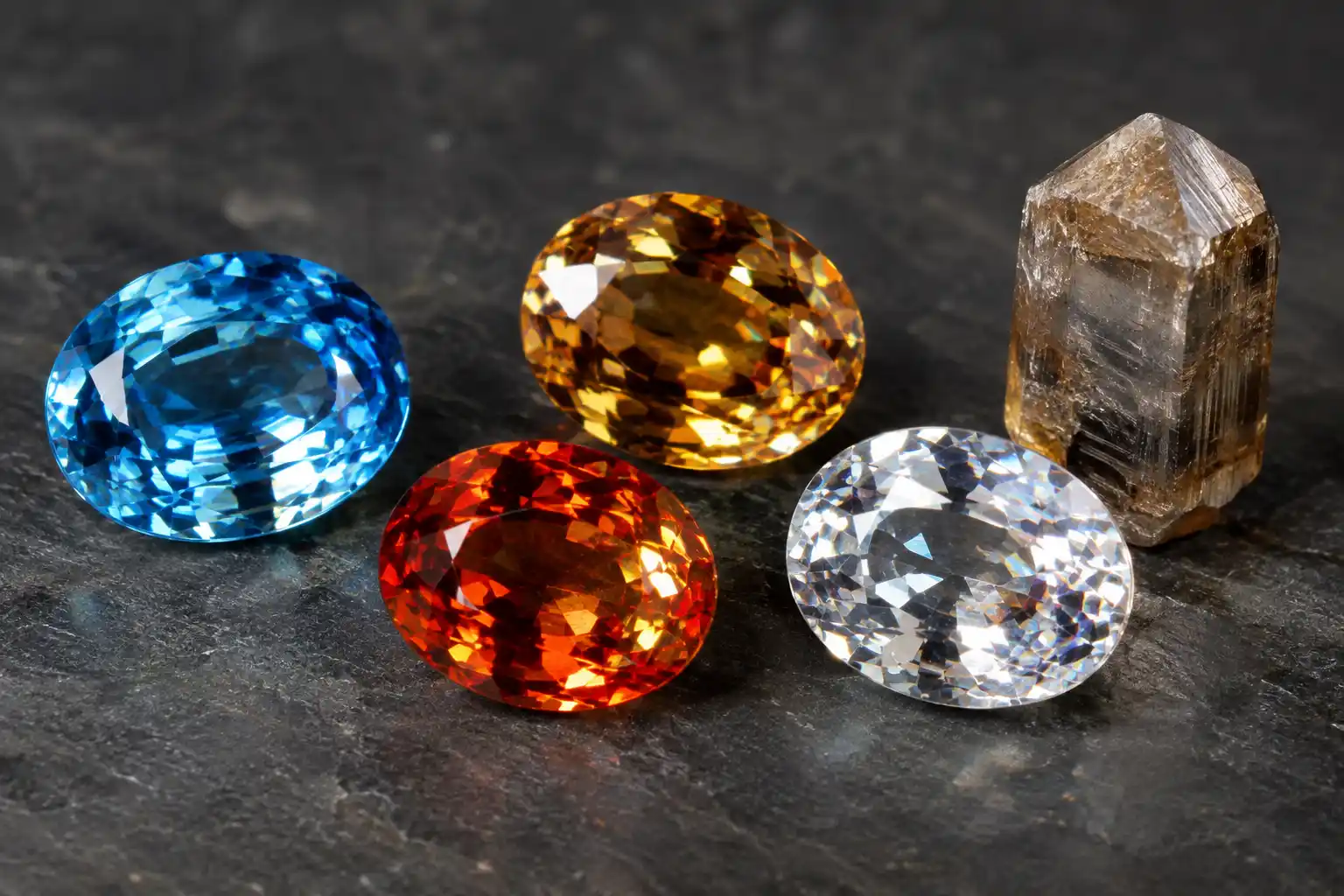
Natural zircon occurs in blue, brown, yellow, orange, reddish, red, green, and colorless forms. Brown zircon is common in nature, while many commercially important blue and near-colorless stones have been heat treated. GIA reports that nearly all blue and near-colorless zircons have been heated because those colors are comparatively rare naturally.
| Gemological Characteristic | Zircon |
|---|---|
| Chemical formula | ZrSiO₄ |
| Crystal system | Tetragonal |
| Mohs hardness | About 6 to 7.5 |
| Specific gravity | Approximately 3.90 to 4.73 |
| Refractive index | Varies significantly by structural condition |
| Birefringence | Can be strong in high zircon |
| Typical colors | Blue, brown, yellow, orange, red, green, colorless |
| Important optical qualities | High brilliance, dispersion, facet doubling |
| Common treatment | Heat treatment for blue and colorless varieties |
| December birthstone | Yes |
GIA classifies zircon into high, intermediate, and low types according to how much radiation-induced structural damage has occurred. High zircon retains an ordered crystal structure, while low or metamict zircon has experienced substantial disruption over geological time from trace radioactive elements within the crystal. Most zircon used in jewelry is high zircon.
Mental Clarity as a Practice of Better Thinking
Mental clarity is one of the most useful symbolic zircon benefits because it can be translated into concrete behavior without making a medical claim.
Clarity does not mean having immediate answers. It means understanding what is known, what remains uncertain, and which assumptions are influencing a decision.
Someone considering a career change, major purchase, relationship decision, or professional project might associate zircon with slowing down enough to separate facts from expectations.
A simple reflective exercise is to divide a page into three parts: evidence, assumptions, and unanswered questions. This often reveals that a difficult decision feels confusing because facts and predictions have been mixed together.
The gemstone does not create clearer thinking biologically. It becomes a cue to use a clearer process.
Cosmic Grounding Through Zircon’s Ancient Geological History
The phrase cosmic grounding sounds metaphysical, but zircon’s real geological history gives it a powerful connection with planetary time.
Some Australian zircon crystals have ages near 4.4 billion years, meaning they formed relatively early in Earth’s history. Their trace elements and isotopic systems allow geoscientists to reconstruct ancient geological processes and investigate conditions on the early planet. GIA describes zircon as a geological clock because radioactive trace elements can be used to determine age.
This offers a useful form of grounding.
A person can hold a gemstone whose mineral family includes crystals older than nearly every familiar landscape, mountain range, or living species. That scale can encourage perspective without requiring a supernatural explanation.
Cosmic grounding can therefore mean recognizing that human life takes place within a planetary history far older than individual worries.
Zircon, Wisdom, and Learning From Experience
Wisdom is different from intelligence.
A person may understand many facts yet repeatedly make poor decisions because knowledge is not being integrated with experience.
Zircon’s extraordinary age makes wisdom a natural symbolic theme. Some zircon crystals have survived erosion, burial, metamorphism, sediment transport, and repeated geological cycles while preserving valuable chemical information.
That does not make the mineral conscious or spiritually wise.
It creates a meaningful metaphor for learning from accumulated experience.
Someone may use zircon as a reminder to ask whether a current problem resembles something encountered before. The important question is not merely what happened previously, but what was learned from it.
High Brilliance and the Symbolism of Clear Perception
Colorless zircon can show intense brilliance and strong spectral fire. Historically, this appearance led to confusion with diamond, particularly before modern gemological testing became widely available.
Its brilliance comes from high refractive indices and dispersion rather than from being diamond-like in chemistry.
The visual effect naturally encourages symbolism involving illumination and perception.
Clear perception means paying attention to reality even when it conflicts with preference. A person may want a particular outcome and still recognize evidence that suggests another direction.
Zircon symbolism is most useful when light becomes a metaphor for seeing more accurately rather than assuming that the stone literally illuminates the mind.
Zircon Is Not Cubic Zirconia
One of the most important practical zircon benefits is educational because the gem teaches a common lesson about mineral names.
Zircon is natural zirconium silicate, while cubic zirconia is manufactured zirconium dioxide produced primarily as a diamond simulant. They have different chemistry, crystal structures, densities, optical properties, origins, and commercial histories.
The confusion is understandable because the names sound similar, but they describe completely different substances.
The symbolic traditions surrounding cubic zirconia therefore should not be transferred automatically to natural zircon simply because both names contain the word zircon.
Correct identification matters more than name similarity.
Blue Zircon and Calm Communication Symbolism
Blue is the most commercially popular zircon color and has become especially important because zircon is one of December’s recognized birthstones. GIA identifies zircon, turquoise, and tanzanite as December birthstones.
Modern spiritual interpretations often associate blue gemstones with communication, mental calm, honesty, and thoughtful expression. Similar color symbolism appears across many blue crystals, even though their mineral chemistry can be completely unrelated.
For zircon, these meanings are cultural associations rather than physical effects.
A blue zircon ring might nevertheless become a reminder to speak carefully during an important meeting or difficult conversation.
That meaning can be personally useful without suggesting that the gemstone changes communication ability neurologically.
Focus Without Magical Concentration Claims
Zircon is sometimes described as a stone that improves concentration or clears mental fog.
There is no reliable evidence that wearing zircon changes attention, memory, executive function, or neurological performance.
Focus can still be part of zircon benefits when the stone becomes associated with a behavioral routine.
A person might place a zircon beside a notebook and connect it with one rule: finish the current task before opening another one.
Repeated association may make the gemstone a familiar cue for that habit.
The benefit comes from structure and attention management, not mineral radiation or spiritual vibration.
Structural Change and the Symbolism of Resilience
Zircon has an unusual scientific property that adds depth to its symbolic interpretation.
Some crystals contain traces of uranium and thorium. Over immense periods, radiation emitted during natural radioactive decay can damage the crystal lattice. This process is called metamictization.
High zircon remains relatively crystalline, intermediate zircon shows partial damage, and low zircon may become extensively disordered. GIA notes that high-temperature treatment can partially restore damaged crystal structure in some zircon.
Resilience is therefore a tempting symbolic theme, but the analogy should remain an analogy.
Human resilience develops through biology, support, behavior, environment, healthcare, relationships, and experience. Zircon’s changing structure simply provides an interesting visual and scientific metaphor for surviving alteration over time.
Is Zircon Radioactive?
Some zircon contains trace uranium and thorium, which naturally undergo radioactive decay.
This fact can sound alarming when separated from scale. GIA states that some zircon can be very slightly radioactive but that the levels encountered in jewelry do not pose a health risk during normal wear.
The more important gemological consequence is that radiation damage accumulated over geological time can change zircon’s physical and optical properties.
This distinction matters because metaphysical discussions sometimes use radioactivity as evidence of powerful crystal energy.
It is not.
Ionizing radiation is a measurable physical phenomenon with specific scientific meaning. It should not be confused with spiritual energy, aura strength, or healing vibration.
Perspective and the Double Refraction Effect
High zircon can display noticeable birefringence. When a faceted gemstone is viewed through certain directions, rear facet edges can appear doubled.
For gemologists, this optical effect can aid identification.
Symbolically, it offers a useful metaphor for perspective. One issue can appear differently depending on how it is examined.
Perspective does not mean that all interpretations are equally correct.
It means that one viewpoint may reveal only part of the available information.
Someone using zircon for reflection might deliberately ask how another person would describe the same disagreement or decision.
The goal is not to abandon judgment but to improve it.
Creativity and Collector Value
Zircon offers genuine creative advantages through its color range, brilliance, dispersion, crystal structure, and cutting possibilities.
Colorless zircon can appear exceptionally bright. Blue stones range from pale sky colors to stronger greenish or electric blues. Yellow, orange, reddish brown, and rare green gems provide additional choices for collectors.
Fine stones can show pronounced facet doubling and flashes of spectral fire.
Collectors may also value untreated color, provenance, unusually large size, distinctive crystal forms, or low-type green zircon for mineralogical interest.
These qualities make zircon rewarding even without any spiritual interpretation.
Buying Zircon Without Confusing Beauty With Identity
Zircon should be evaluated as zircon rather than as an inexpensive substitute for another gemstone.
When preparing to buy zircon, color, treatment, transparency, cutting, abrasion, durability, seller disclosure, and correct identification deserve attention.
Strong brilliance alone does not prove diamond, and a blue stone should not automatically be assumed untreated.
GIA notes that blue and colorless zircon are commonly heat treated. Treatment is accepted when disclosed accurately, but it can matter for color stability and value.
Buyers should also examine facet edges because zircon can abrade more easily than its bright appearance might suggest.
Zircon Price and What Actually Creates Value
The factors affecting zircon price include color, clarity, cut, carat weight, treatment, condition, rarity, and market demand.
Blue is especially popular commercially, while bright red and green can also be desirable. Fine large stones are less common than smaller gems. GIA identifies blue, bright red, and green among the most valued zircon colors.
Value also depends on cutting.
Poorly proportioned zircon can lose much of the brilliance that makes the gemstone attractive in the first place, while a skillfully cut stone can emphasize fire and brightness.
Price should therefore be based on the actual gem rather than claims that one specimen has stronger spiritual energy than another.
Jewelry Durability Requires More Care Than the Brilliance Suggests
Zircon’s durability varies because its physical properties change with structural condition.
GIA gives a Mohs hardness range of approximately 6 to 7.5 and describes toughness as fair to good. Zircon can also be brittle and may show abrasion along facet edges.
This makes careful wear important.
Earrings and pendants generally face less impact than rings or bracelets. Rings can still be enjoyed, but they should be removed before gardening, sports, heavy cleaning, or other activities involving hard contact.
Warm soapy water is recommended for cleaning. Steam and ultrasonic cleaners are not advised.
Heat Treatment and Color Stability
Heat treatment plays a major role in the zircon market.
Brown zircon can be heated under different atmospheric conditions to create blue or near-colorless gems. Some treatments can also produce yellow, orange, or red colors.
GIA notes that certain heat-treated stones may gradually revert toward lighter brown after prolonged exposure to strong light and that additional heat can alter color.
Treatment does not make zircon fake.
It means the natural gemstone has undergone a process that changed its appearance.
Accurate disclosure allows buyers to decide whether treatment matters to them.
Zircon for Meditation and Intentional Reflection
Zircon can work well as a meditation object because its strong brilliance naturally attracts visual attention.
Instead of trying to absorb energy from the gemstone, a person can choose one theme, such as clarity or perspective, and connect it with one question.
For clarity: What fact matters most?
For perspective: What am I overlooking?
For grounding: What can I control now?
For wisdom: What have previous experiences already taught me?
The stone becomes a consistent reminder of the question.
The answers come from reflection, evidence, memory, and experience.
Conclusion
Zircon benefits include genuine brilliance, strong dispersion, extraordinary geological significance, collector appeal, color diversity, December birthstone status, and valuable lessons about mineral structure and treatment.
Mental clarity, wisdom, grounding, confidence, purpose, and cosmic connection are symbolic interpretations rather than scientifically demonstrated psychological effects. Zircon becomes most meaningful when its ancient geological history encourages perspective, its brilliance represents clear observation, and its personal symbolism supports thoughtful action instead of replacing evidence.
FAQs
What are the main zircon benefits?
Zircon’s practical benefits include brilliant optical performance, collector interest, color diversity, geological importance, birthstone significance, and jewelry appeal. Modern spiritual traditions also associate it with clarity, wisdom, grounding, focus, confidence, perspective, and purposeful action.
Is zircon the same as cubic zirconia?
No. Zircon is a natural zirconium silicate mineral, while cubic zirconia is manufactured zirconium dioxide. Their chemistry, crystal structures, physical properties, origins, and commercial identities are different.
Does zircon improve mental clarity?
There is no scientific evidence that zircon changes cognitive function or concentration. It may be used symbolically as a reminder to slow down, examine evidence, and make decisions more deliberately.
Why is zircon called an ancient gemstone?
Some zircon crystals have ages close to 4.4 billion years, making them among the oldest known minerals on Earth. Their chemistry provides valuable information about early planetary history.
Is blue zircon natural?
Blue zircon is natural zircon, but the strong blue color seen in most jewelry has been produced through heat treatment of naturally occurring rough. GIA reports that nearly all blue zircon is heated.
Is zircon radioactive?
Some zircon contains trace uranium and can be very slightly radioactive. GIA states that levels found in zircon jewelry do not present a health risk during normal use.
Is zircon durable enough for rings?
Zircon can be worn in rings with care, but it is less resistant to abrasion and impact than sapphire. Protective settings and removal during rough activity help preserve facet edges.
How should zircon be cleaned?
Warm soapy water is recommended. GIA advises against steam and ultrasonic cleaning because zircon can be brittle and some stones may have treatment-related concerns.
Is zircon a December birthstone?
Yes. Zircon is one of December’s recognized birthstones together with turquoise and tanzanite.
Disclaimer: Spiritual, emotional, energetic, grounding, cosmic, chakra, manifestation, clarity, and healing interpretations associated with zircon reflect beliefs and personal practices rather than established medical or psychological effects. Zircon should not replace professional healthcare, diagnosis, therapy, prescribed treatment, or evidence-based decision-making.