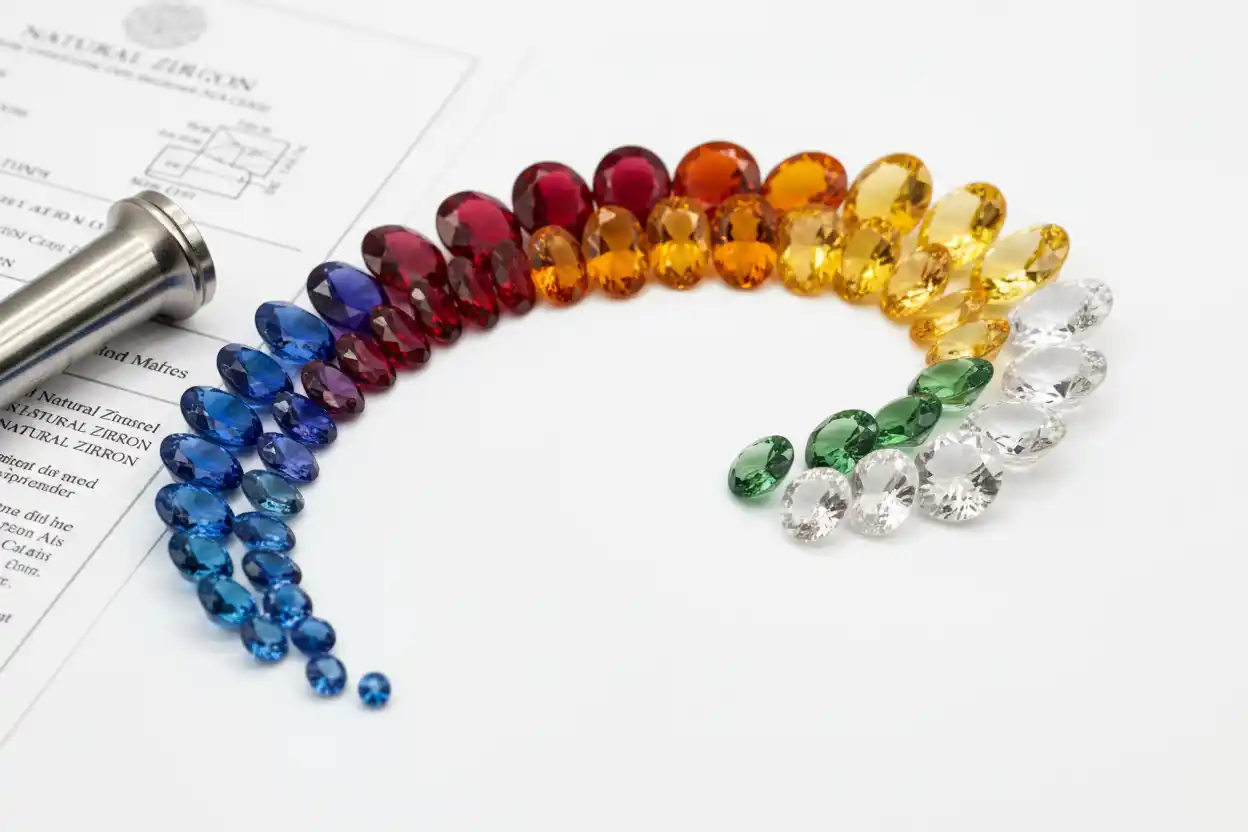
Zircon Price Guide: Value and Cost in 2026
Natural Zircon prices in 2026 commonly range from approximately $15 to $400 per carat. Commercial brown, yellow and colorless stones usually sit below $100 per carat, while fine blue, red, orange and green gems may reach $100 to $500 per carat.
Exceptional rare-color stones, large clean gems and precision cuts can exceed $500 per carat. Zircon is a natural gemstone and should not be confused with laboratory-made Cubic Zirconia.
Zircon Prices by Color in 2026
| Zircon variety | Broad 2026 retail range | Main value factors |
|---|---|---|
| Brown Zircon | $10–$80 per carat | Transparency, warmth and cutting |
| Yellow or Golden Zircon | $20–$150 per carat | Saturation, clarity and fire |
| Orange or Hyacinth Zircon | $50–$300 per carat | Orange-red color, clarity and rarity |
| Red Zircon | $100–$600+ per carat | Natural red color, transparency and size |
| Blue Zircon | $50–$400 per carat | Intense blue color, clarity and heat treatment |
| Green Zircon | $100–$800+ per carat | Natural color, structure, clarity and rarity |
| Colorless Zircon | $20–$150 per carat | Brilliance, fire, cut and size |
| Exceptional collector Zircon | $500–$1,500+ per carat | Rare color, unusual size and provenance |
Most blue Zircon is heat treated. The treatment is accepted and normally incorporated into commercial pricing rather than creating a major discount.
The general interaction among color, clarity, cut and size appears in How Gemstone Prices Are Determined.
What Is Zircon?
Zircon is a natural zirconium silicate mineral.
It occurs in brown, yellow, orange, red, green, blue, gray and colorless varieties. Its high refractive index and dispersion can produce intense brilliance and spectral fire.
Zircon forms in igneous, metamorphic and sedimentary environments and can survive geological processes for immense periods.
Some crystals contain uranium and thorium at trace levels. Over geological time, internal radiation can damage the crystal structure, producing different structural categories.
The completed Zircon guide owns its mineralogy, formation, history and traditional symbolism.
This article focuses on gemstone pricing and commercial quality.
Zircon Is Not Cubic Zirconia
Zircon is a natural mineral. Cubic Zirconia is a manufactured zirconium-oxide material.
The names sound similar, but their chemistry, crystal structure, optical behavior and market value differ.
Natural Zircon can be millions or billions of years old. Cubic Zirconia is produced in a laboratory and has repeatable supply.
Commercial Cubic Zirconia commonly costs only a few dollars per carat. Fine natural Zircon can cost hundreds per carat.
Current manufactured-stone pricing belongs to the Cubic Zirconia Price Guide.
A seller should never abbreviate Zircon as CZ because that abbreviation normally refers to Cubic Zirconia.
Blue Zircon Prices
Blue Zircon is the most commercially important variety and represents a large share of jewelry-market Zircon.
Commercial stones commonly cost approximately $50 to $150 per carat.
Fine vivid blue or greenish-blue gems may reach $150 to $400 per carat.
Exceptional clean stones above five or ten carats can cost more, particularly when color, cutting and brilliance remain strong.
The preferred color ranges from vivid blue to slightly greenish blue. Pale gray-blue stones occupy lower tiers, while extremely dark material can lose brilliance.
Most intense blue color results from heat treatment of brownish rough.
Blue Zircon should remain visibly different from treated Blue Topaz, which is usually less expensive and has lower dispersion. Current Topaz pricing appears in the Topaz Price Guide.
Red Zircon Prices
Natural red Zircon is rarer than blue commercial material.
Fine stones can range from orange-red and brick red to purplish red and deep reddish brown.
Commercial reddish stones may cost approximately $50 to $200 per carat. Fine transparent red Zircon commonly reaches $200 to $600 per carat.
Exceptional vivid stones with rare clean size may cost more.
Brown modifiers reduce value when they overwhelm the red. However, warm cinnamon and reddish-orange appearances can remain attractive.
Red Zircon should be distinguished from Ruby, Spinel and Garnet through professional testing rather than color alone.
Orange and Hyacinth Zircon
Orange, orange-red and reddish-brown Zircon is sometimes called Hyacinth or Jacinth.
The historical term is used inconsistently and should not function as a formal quality grade.
Commercial orange Zircon may cost approximately $50 to $150 per carat.
Fine intense orange and red-orange stones commonly range from $150 to $300 per carat, with exceptional examples reaching higher prices.
Brightness is important because a dark orange-brown stone can appear almost opaque indoors.
Natural warm color may attract collectors who prefer untreated Zircon over the more familiar heated blue market.
Yellow and Golden Zircon
Yellow Zircon ranges from pale straw and lemon to golden, honey and brownish yellow.
Commercial stones commonly cost approximately $20 to $100 per carat.
Fine saturated golden gems with strong transparency and cutting can reach $100 to $250 per carat.
Green or brown secondary hues generally lower value unless they create an unusual collector appearance.
Golden Zircon can display more fire than Citrine or many yellow Topazes, though its brittle facet edges require greater care.
The broader visual category appears in Yellow Gemstones.
Green Zircon Prices
Natural green Zircon is uncommon and can occupy a specialist collector market.
Color ranges from pale yellow-green and olive to deeper forest green.
Some green Zircon has a radiation-damaged or metamict structure. This can lower refractive properties, hardness and transparency.
Commercial green stones may cost approximately $100 to $300 per carat. Fine transparent high-type green Zircon can reach $300 to $800 per carat or more.
A rare color does not automatically create high value. Dark, cloudy or structurally damaged green stones may remain less desirable than fine blue Zircon.
Laboratory documentation becomes more useful when a natural green claim creates a significant premium.
Colorless Zircon
Colorless Zircon has strong brilliance and dispersion and was historically used as a Diamond substitute.
Commercial stones commonly cost approximately $20 to $100 per carat.
Fine clean, well-cut gems may reach $100 to $200 per carat, particularly in large sizes.
The strongest value comes from cutting. A shallow stone develops a window, while excessive facet doubling can make the interior look blurred.
Colorless Zircon should not be marketed as Diamond, though it can provide a natural high-fire alternative at a much lower price.
Its brittle edges and lower hardness make it less suitable for rough daily wear than Diamond.
High, Intermediate and Low Zircon
Zircon can be classified structurally as high, intermediate or low type.
High Zircon retains a relatively intact crystal structure and commonly shows stronger refractive index, dispersion, density and hardness.
Low Zircon has experienced more radiation-related structural damage over geological time. It may appear cloudy, greenish or less brilliant.
Intermediate material falls between those categories.
The terms do not directly correspond to retail quality grades. A beautiful green low-type collector gem can still be valuable.
However, structural condition affects cutting, polishing, durability and optical performance and should be considered in premium stones.
Brilliance, Fire and Facet Doubling
Zircon has strong brilliance and dispersion.
A well-cut stone can show vivid rainbow flashes, especially in colorless, golden and blue varieties.
Zircon also has strong birefringence. Back facet edges may appear doubled when viewed through the crown.
Skilled cutters orient the optical axis to reduce distracting doubling. Poor orientation can make the stone appear fuzzy or visually busy.
Facet size also matters. Broad facets can display strong flashes, while excessively complex cutting may create a crowded interior.
A premium stone should balance fire, crispness and color rather than maximize one effect at the expense of the others.
Clarity and Transparency
Faceted Zircon is generally expected to appear eye-clean.
Natural untreated brown and green stones may show haze or cloudiness, particularly when their crystal structures have been affected by internal radiation.
Minor inclusions can be acceptable, but prominent fractures and dense clouds reduce brilliance.
Surface-reaching fissures increase durability concerns because Zircon is brittle.
A clean stone with poor cutting can still look lifeless. Clarity should therefore be judged alongside color and proportions.
Cut Quality
Zircon’s high refractive index requires suitable pavilion angles.
A shallow pavilion creates a transparent window. Excessive depth hides weight and can darken strongly colored material.
Rounds, ovals and cushions are common. Zircon-specific variations of the brilliant cut may add extra facets to maximize fire.
Rounds require more rough loss and may receive premiums in rare colors.
Facet junctions should be crisp, though abrasion is common in older jewelry because Zircon edges can chip.
The full stone-selection process belongs to the Zircon Buying Guide.
Zircon Prices by Carat Weight
| Carat weight | Commercial brown, yellow or colorless | Fine blue, orange or red | Exceptional green or rare color |
|---|---|---|---|
| Under 1 ct | $15–$80 per carat | $50–$200 per carat | $150–$500 per carat |
| 1–3 ct | $20–$100 per carat | $75–$300 per carat | $200–$650 per carat |
| 3–5 ct | $25–$125 per carat | $100–$400 per carat | $250–$800 per carat |
| 5–10 ct | $30–$150 per carat | $150–$500 per carat | $300–$1,000 per carat |
| Above 10 ct | Color and cutting dominate | Fine stones gain premiums | Individually evaluated |
Blue Zircon receives stronger size premiums when vivid color continues into large clean gems.
Large brown and pale-yellow material remains comparatively affordable.
Cambodia and Blue Zircon
Cambodia, particularly the Ratanakiri region, is closely associated with rough that can be heated to produce blue Zircon.
Brown or reddish-brown crystals are treated under controlled conditions to create blue-to-greenish-blue color.
Fine Cambodian blue Zircon can display strong saturation and excellent brilliance.
Origin generally matters less than the finished color and cutting, though traceable Cambodian material has established trade recognition.
A seller should disclose heat treatment even though it is customary.
Sri Lanka
Sri Lanka produces Zircon in brown, yellow, green, red and colorless varieties.
Alluvial deposits can yield high-, intermediate- and low-type material.
Natural warm-color and green Sri Lankan stones have collector appeal, especially when transparent and well cut.
The country is also a source of pale or cloudy material that occupies lower tiers.
Origin alone does not create value. Structural condition, color and brilliance remain central.
Tanzania, Madagascar and Other Sources
Tanzania produces red, orange, yellow, brown and colorless Zircon.
Madagascar yields a similarly broad range, including large clean crystals.
Myanmar, Vietnam, Australia and several other countries also supply gem Zircon.
For ordinary commercial stones, origin has limited price impact.
Mine provenance becomes more relevant for unusual natural green, red or collector-quality specimens.
Heat Treatment
Heat is the most important Zircon treatment.
Brown rough may be heated in reducing or oxidizing environments to create blue, colorless, yellow or other appearances.
Blue Zircon is almost always heat treated. The process is widely accepted and normally stable in ordinary wear.
Some treated stones can show color changes after intense ultraviolet exposure or extreme heat, so repair and prolonged high-energy exposure should be approached cautiously.
Treatment should be disclosed, but routine heating does not make the stone synthetic.
Detailed treatment identification belongs to the site’s broader Gemstone Treatments Explained guide.
Zircon Jewelry Prices in 2026
| Jewelry type | Broad U.S. retail range |
|---|---|
| Silver Zircon earrings or pendant | $75–$500 |
| Silver or gold-plated ring | $100–$600 |
| Gold Blue Zircon jewelry | $500–$4,000 |
| Gold ring with fine red or green Zircon | $1,000–$6,000 |
| Large precision-cut or designer jewel | $3,000–$15,000+ |
Matched earrings command premiums because color, dimensions and brilliance must align.
Style-specific guidance belongs to the Zircon Ring Guide, Zircon Earrings Guide, Zircon Necklace Guide and Zircon Bracelet Guide.
Zircon’s birthstone context belongs to the December Birthstone Guide and December Birthstone Jewelry Guide.
Durability and Care
Zircon has reasonable hardness but is brittle.
Facet junctions can chip or abrade when stored against harder jewelry. Older stones frequently show worn edges even when the main facets remain bright.
Rings should use protective settings and be removed before impact-prone activity.
Warm water, mild soap and a soft brush provide the safest cleaning method.
Steam and ultrasonic cleaning should be avoided, especially for fractured stones.
Complete maintenance guidance belongs to How to Clean Zircon Jewelry Safely.
Certification and Resale Value
Most ordinary blue Zircon does not require a major laboratory report.
Documentation becomes more useful when:
- Natural red or green color creates a premium
- Treatment disclosure is unclear
- The stone may be Cubic Zirconia, Diamond or another simulant
- Structural type affects collector value
- A large rare-color stone requires insurance documentation
A laboratory can confirm natural Zircon and provide information about color and treatment within its testing scope.
Commercial heated blue stones generally resell below retail. Fine rare-color and large collector gems have stronger specialist potential.
The broader secondary-market framework appears in Do Gemstones Hold Their Value?.
Online purchasers should verify the gemstone name carefully and use How to Buy Gemstones Online Without Getting Scammed to review reports, return terms and seller claims.
The Buying & Value hub connects Zircon pricing with treatment, certification and comparison content.
Frequently Asked Questions
1. How much is Zircon worth per carat in 2026?
Most natural Zircon costs approximately $15 to $400 per carat. Exceptional red, green and rare-color stones may reach $500 to $1,500 per carat.
2. What Zircon color is most valuable?
Blue has the strongest mainstream demand, while fine natural red and green Zircon can be rarer and more valuable.
3. How much is Blue Zircon?
Most Blue Zircon costs approximately $50 to $400 per carat, depending on saturation, clarity, cut and size.
4. How much is Red Zircon?
Fine Red Zircon commonly ranges from $100 to $600 per carat. Exceptional stones can cost more.
5. Is Zircon the same as Cubic Zirconia?
No. Zircon is a natural zirconium-silicate mineral, while Cubic Zirconia is a manufactured zirconium-oxide material.
6. Is Blue Zircon naturally blue?
Strong blue is almost always produced through heat treatment of brownish natural Zircon.
7. Does heating reduce Zircon’s value?
Routine heat is accepted in Blue Zircon and normally causes only a modest discount compared with a hypothetical natural-color equivalent.
8. Why do Zircon facets look doubled?
Zircon has strong birefringence, which can make back-facet edges appear doubled through the crown.
9. Does large Zircon cost more per carat?
Fine blue and rare-color stones gain premiums at large sizes. Common brown and pale material increases more slowly.
10. Is Zircon durable enough for a ring?
It can be worn in a protective setting, but its brittle facet edges require more care than Sapphire or Spinel.
11. Does Zircon need a laboratory report?
Commercial blue stones usually do not. Testing is useful for rare natural colors, expensive stones and confusion with Cubic Zirconia.
12. Is Zircon a good investment?
Rare natural-color and large collector stones may retain specialist interest, but ordinary heated blue Zircon has limited resale liquidity.
Zircon Value Comes From Natural Fire, Not a Similar Name
Zircon is frequently undervalued because buyers confuse it with inexpensive Cubic Zirconia. In reality, fine natural Zircon combines high brilliance, strong dispersion and colors that range from heated blue to rare natural red and green.
In 2026, attractive jewelry-quality stones generally fall between $50 and $300 per carat. Higher prices should correspond to exceptional saturation, rare natural color, large clean size or cutting that controls facet doubling while preserving Zircon’s distinctive fire.