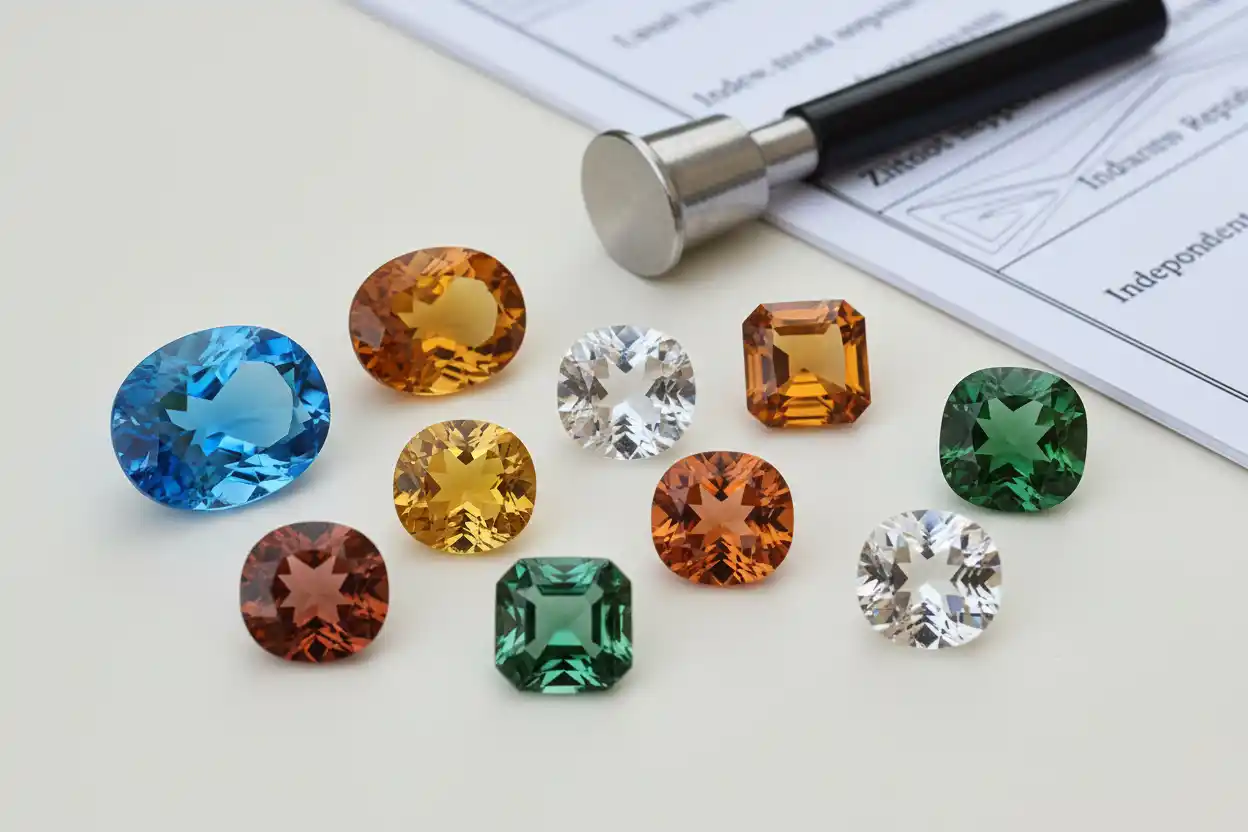
Buy Zircon: Smart Buying Tips & Red Flags
When you buy zircon, the first thing to establish is that you are purchasing natural zircon rather than cubic zirconia, because the similar names conceal two completely different gem materials. Zircon is a naturally occurring zirconium silicate mineral with high refractive index, strong dispersion, pronounced double refraction, and a geological history that can alter its crystal structure over immense periods, whereas cubic zirconia is a manufactured zirconium oxide used extensively as a diamond simulant.
That identity difference is only the beginning. When you buy zircon, you may encounter vivid blue, greenish blue, colorless, golden yellow, orange, reddish orange, red, brown, green, and less common intermediate colors, with each category carrying different rarity, treatment, clarity, and structural considerations. Strong blue and near-colorless material is commonly produced through heat treatment, while attractive natural red and green stones can occupy more specialized collector markets.
Zircon also has an unusual property that materially affects buying decisions: its crystal structure can range from relatively intact “high” zircon through intermediate material to heavily radiation-damaged “low” or metamict zircon. These terms do not describe commercial grades such as good, better, and best. Instead, they describe structural condition created over geological time by radiation from trace radioactive elements naturally present within some crystals, and that structural condition can influence refractive properties, density, hardness, transparency, cutting behavior, and overall appearance.
A reliable way to buy zircon is therefore to confirm identity first, determine the color and treatment category second, then evaluate transparency, facet doubling, brilliance, dispersion, cut, structural condition, face-up dimensions, inclusions, surface wear, documentation, and intended jewelry use. Carat weight should come later because zircon is relatively dense, and a deep stone can carry considerable weight below the girdle without appearing proportionately larger.
The broader mineralogical background appears in zircon meaning, but the purchasing question is more practical: does the exact gemstone deliver enough color, brilliance, cut quality, structural integrity, and evidence to justify the price?
What Should You Judge First When You Buy Zircon?
When you buy zircon, begin with a hierarchy designed specifically for this gemstone rather than applying a diamond or sapphire checklist. Identity comes first because zircon is frequently confused by name with cubic zirconia, then color and treatment establish the appropriate commercial category, while clarity, cut, structural type, condition, dimensions, and documentation determine whether the individual stone is a strong example within that category.
| Priority | What to evaluate | Stronger choice | Main red flag |
|---|---|---|---|
| 1 | Identity | Natural zircon represented accurately | Zircon and cubic zirconia treated as the same material |
| 2 | Color | Attractive blue, red, green, orange, yellow, brown, or colorless appearance | Color name used as proof of rarity |
| 3 | Treatment | Heat and other enhancements disclosed where relevant | Strong blue sold as obviously untreated |
| 4 | Transparency | Eye-clean, transparent faceting quality | Heavy haze or cloudiness sold as fine material |
| 5 | Structural condition | Optical performance appropriate to a sound jewelry gem | Metamict character ignored in an expensive stone |
| 6 | Cut | Strong brilliance and controlled doubling | Large window, severe extinction, visually confused cutting |
| 7 | Dimensions | Good face-up spread for the stated weight | Deep pavilion and hidden weight |
| 8 | Condition | Crisp facets and sound girdle | Rounded junctions, chips, abrasion, open fissures |
| 9 | Documentation | Evidence proportionate to value and claims | Seller certificate treated as conclusive proof |
| 10 | Jewelry use | Setting protects brittle facet edges | Rough-wear ring promoted as maintenance-free |
Use this sequence whenever you buy zircon, and the most common sources of confusion become much easier to separate.
Zircon Is Natural; Cubic Zirconia Is Manufactured
The most important concept to understand before you buy zircon is that zircon and cubic zirconia are not natural and synthetic versions of the same gemstone.
Natural zircon is zirconium silicate, ZrSiO₄, and crystallizes in the tetragonal system. Cubic zirconia is manufactured zirconium oxide with a cubic crystal structure.
The similarity in their names causes enormous confusion.
When you buy zircon, never accept a seller who uses CZ as an abbreviation for zircon, because CZ conventionally refers to cubic zirconia. Likewise, a product described vaguely as “zirconia zircon” should be clarified before purchase.
The detailed material-by-material comparison appears in zircon vs cubic zirconia.
Both materials can be attractive.
They simply should not be priced or represented as though they possess the same origin, chemistry, optical properties, or rarity.
Zircon’s Fire Is Real and Exceptionally Strong
A well-cut zircon can display intense spectral flashes because the mineral combines relatively high refractive index with strong dispersion.
When you buy zircon, especially in colorless, pale blue, golden, or lightly colored material, rainbow flashes can be among the stone’s most striking features.
This fire is intrinsic to zircon rather than evidence that the stone must be diamond or cubic zirconia.
However, dispersion should be evaluated together with cutting. A poorly proportioned stone can possess excellent theoretical dispersion while displaying weak fire because light escapes through a broad window or becomes trapped in dark areas.
The better way to buy zircon for optical performance is to rotate the stone continuously and look for repeated flashes across multiple facets rather than admiring one perfectly positioned rainbow in a photograph.
Facet Doubling Is One of Zircon’s Signature Optical Features
Zircon is strongly doubly refractive, meaning a light ray passing through the crystal can split into two rays.
When you look through the crown of many well-oriented stones, rear facet junctions can appear doubled.
This is one of the most recognizable clues when you buy zircon, particularly in colorless, blue, yellow, and other transparent high-type material.
The effect can sometimes make the interior appear extremely lively, while in poorly oriented or overly complex cuts it can make the facet pattern look fuzzy or visually crowded.
Facet doubling is therefore both an identification clue and a cutting consideration.
Doubling Does Not Automatically Mean Better Quality
A seller may emphasize extreme doubling as proof that you should buy zircon, but greater visible doubling is not a universal quality grade.
Cut orientation can reduce or emphasize the effect.
A skilled cutter usually tries to balance brilliance, fire, color, and visual crispness rather than maximizing doubled facet images.
When you buy zircon, look for an interior that appears lively without becoming confusing.
A stone whose facet junctions look excessively blurred can be less visually appealing even though its optical behavior is completely natural.
Color Is the Largest Visible Value Factor
After identity, color usually has the greatest influence when you buy zircon.
The gemstone occurs in a wide range that includes:
- Vivid blue.
- Greenish blue.
- Pale blue.
- Colorless.
- Yellow.
- Golden yellow.
- Orange.
- Reddish orange.
- Red.
- Brown.
- Green.
- Less common purple or related colors.
Blue receives the strongest mainstream jewelry demand, while fine red and green stones can attract substantial collector interest because attractive natural examples are scarce.
The important point is that rarity differs by color.
A vivid heated blue zircon and a rare natural green zircon should not be valued through exactly the same hierarchy.
Blue Zircon Is the Dominant Jewelry-Market Variety
When you buy zircon in mainstream jewelry, blue is the color you are most likely to encounter.
Fine blue can range from medium blue through vivid blue and slightly greenish blue, with some material showing an almost tropical blue-green appearance.
A strong stone should remain recognizably blue under ordinary neutral lighting rather than turning heavily gray, muddy, or dark once showcase illumination disappears.
Blue zircon combines attractive body color with strong brilliance and dispersion, which explains its enduring popularity even though the color is usually treatment-created.
Most Strong Blue Zircon Is Heat Treated
This is a normal part of the market and should not be treated as a scandal.
When you buy zircon in strong blue, the color is generally produced by heating suitable brownish natural zircon under controlled conditions. Heat changes color-related defects in the crystal and can also alter the structural order of some material.
The resulting gemstone remains natural zircon because the crystal itself formed geologically.
The distinction is:
Natural zircon describes origin.
Heat-treated zircon describes post-growth modification.
Cubic zirconia describes an entirely different manufactured material.
Keeping those categories separate eliminates much of the confusion surrounding blue zircon.
Heated Blue Zircon Can Still Be Fine Quality
A common mistake is assuming untreated automatically means superior.
When you buy zircon in blue, routine heat is already built into the normal commercial category. Fine color, excellent clarity, skilled cutting, crisp condition, and attractive size can make a heated gemstone highly desirable.
An untreated brown stone does not automatically outrank a beautifully cut vivid blue stone simply because it avoided treatment.
The treatment vocabulary is explained more broadly in gemstone treatments explained.
The practical concern is disclosure, not rejecting treatment automatically.
Be Skeptical of “Natural Untreated Electric Blue” Claims
Strong naturally blue zircon is unusual enough that an expensive untreated-color claim deserves serious evidence.
When you buy zircon advertised as exceptionally vivid natural blue with no heat, do not accept appearance as proof.
The stronger the rarity premium, the stronger the documentation should become.
A listing that charges collector prices for an untreated electric-blue claim while providing no independent evidence creates unnecessary risk.
Greenish Blue Is Completely Normal
Blue zircon does not need to resemble pure blue sapphire.
When you buy zircon, slightly greenish-blue material can be attractive and characteristic, particularly when the color remains vivid and transparent.
Avoid assuming a green modifier automatically reduces quality.
A bright greenish-blue gemstone can be much more compelling than a pure-looking blue stone that is pale, gray, or poorly cut.
Judge the entire appearance.
Very Dark Blue Can Lose Brilliance
The deepest blue is not always the strongest purchase.
When you buy zircon, rotate a dark stone under ordinary indoor light and check whether its center remains visibly blue.
Excessive tone can create broad extinction that makes much of the gemstone appear black.
A somewhat lighter blue zircon with strong brilliance can look considerably more impressive in normal wear.
Color saturation and darkness are different qualities.
Colorless Zircon Is a Natural High-Fire Alternative
Colorless zircon has historically been used as a lower-cost natural alternative to diamond because of its brilliance and dispersion.
When you buy zircon in colorless form, cutting and surface condition become especially important because there is no body color to distract from windowing, extinction, facet doubling, abrasion, or inclusions.
The stone should look bright and crisp.
A badly abraded colorless zircon can lose much of the sparkle that makes the material appealing.
Colorless Zircon Is Not Diamond
The visual overlap does not make the minerals equivalent.
Diamond is carbon, is singly refractive, is dramatically harder, and has a different refractive and durability profile. Zircon is zirconium silicate, strongly doubly refractive, and significantly more prone to facet-edge abrasion.
When you buy zircon as a colorless center stone, choose it because you appreciate natural zircon’s high fire and lower price—not because a seller claims it is indistinguishable from diamond.
Red Zircon Deserves Collector Attention
Fine red zircon is comparatively scarce and can occupy a much stronger collector category than ordinary brown or commercial blue material.
When you buy zircon in red, examine whether red remains the dominant face-up hue rather than appearing only as a weak modifier within brown.
Reddish orange and warm cinnamon material can still be beautiful, but those categories should be priced according to their actual appearance.
A strong red premium deserves neutral-light imagery and appropriate documentation.
Orange and Reddish-Orange Zircon Can Be Excellent
Orange zircon can range from yellow-orange through fiery orange and red-orange to brownish orange.
Historical trade terms such as hyacinth or jacinth may appear in older jewelry descriptions, but these names are used inconsistently.
When you buy zircon in warm colors, evaluate hue, brightness, transparency, and cut rather than assuming an old trade term establishes top quality.
A vivid transparent orange gemstone can show spectacular fire.
A dark brown-orange stone may show much less.
Golden and Yellow Zircon Can Offer Strong Value
Yellow zircon ranges from pale straw through lemon, honey, golden yellow, and brownish yellow.
When you buy zircon in these colors, lighter body color often allows the stone’s dispersion to remain particularly visible.
A well-cut golden zircon can produce strong spectral flashes while costing less than rarer red or green material.
Watch for brown or gray modifiers that reduce brightness unless you specifically prefer an earthy appearance.
Brown Zircon Should Not Be Dismissed Automatically
Brown is common in natural zircon rough and often serves as the starting material for heat-treated blue or colorless stones.
However, attractive cinnamon, cognac, sherry, reddish-brown, and golden-brown gems can make distinctive jewelry without further color modification.
When you buy zircon in brown, focus on warmth, transparency, brilliance, and cutting.
An attractive untreated brown stone can appeal strongly to collectors who prefer natural-color material.
Green Zircon Is a Specialized Category
Natural green zircon can be rare and scientifically interesting, but green color requires additional context because it may correlate with radiation-related damage to the crystal lattice.
When you buy zircon in green, do not assume rare color automatically means top structural or optical quality.
Some green material can be relatively low or intermediate zircon, with reduced refractive index, lower density, altered hardness, greater cloudiness, and less brilliance than high zircon.
Other green gems can be transparent and attractive.
The exact stone matters more than the rarity label.
High, Intermediate, and Low Zircon Explain Structural Condition
Zircon is unusual because trace uranium and thorium within the crystal can gradually damage its own lattice through natural radiation over geological time.
When you buy zircon, you may therefore encounter the terms:
High zircon, with relatively intact crystal structure.
Intermediate zircon, with partial structural damage.
Low or metamict zircon, with much greater disruption.
These are structural categories, not a direct commercial grading scale.
A high zircon is not automatically beautiful, and a low zircon is not automatically worthless.
High Zircon Usually Shows the Classic Optical Performance
Most transparent faceted zircon used in conventional jewelry belongs to the high structural category.
When you buy zircon of this type, expect the stronger refractive index, dispersion, density, and hardness commonly associated with the mineral.
This is where zircon’s high brilliance and facet doubling become particularly obvious.
A well-cut high zircon can look exceptionally lively.
Low Zircon Can Look More Subdued
Extensive radiation-related damage reduces crystal order.
When you buy zircon in low or metamict form, the stone may show reduced brilliance, lower density, weaker refractive properties, greater cloudiness, altered hardness, or a more resinous visual character.
Green is often associated with structurally altered material, although color alone cannot determine the precise structural category.
Collectors may still value unusual low zircon because of its mineralogical interest.
It simply should not be evaluated like an ordinary brilliant blue jewelry stone.
Structural Type Is Not a Home Identification Project
You cannot reliably classify zircon as high, intermediate, or low merely by looking at a photograph.
When you buy zircon whose structural condition materially affects the price, gemological testing becomes more useful.
Refractive index, specific gravity, spectroscopy, Raman analysis, and other laboratory observations can contribute to the classification.
A seller should not assign a premium structural type merely from color.
Heat Can Affect Crystal Structure as Well as Color
High-temperature treatment can partly restore order in radiation-damaged zircon while simultaneously changing its color.
When you buy zircon, this means heat treatment can influence more than appearance.
However, the relationship among original structural condition, temperature, atmosphere, duration, and final result is complex.
A buyer does not need to reconstruct the full treatment history from appearance.
The practical requirement is accurate disclosure and appropriate testing when the distinction carries substantial value.
Clarity Expectations Should Generally Be High
Most faceted zircon used in jewelry is expected to appear eye-clean.
When you buy zircon, conspicuous inclusions, dense haze, large white fissures, or obvious clouds should generally reduce the price.
Untreated brown or structurally altered material can display more cloudiness, but a premium faceted gemstone should still look sufficiently transparent for brilliance and fire to remain visible.
Eye-clean does not mean flawless under magnification.
It means inclusions do not dominate normal viewing.
A Smoky or Cloudy Appearance Needs Context
Some untreated zircon naturally displays a smoky or cloudy interior.
When you buy zircon, determine whether the effect is subtle enough to preserve transparency or strong enough to suppress brilliance.
A collector may appreciate an unusual natural structural appearance.
A jewelry buyer paying for a high-fire faceted gemstone will usually prefer greater transparency.
The same feature can therefore have different value depending on the intended market.
Inclusions Can Be Natural Without Being Desirable
Zircon may contain mineral inclusions, fluid-related features, healed fissures, growth structures, and other natural internal characteristics.
When you buy zircon, these features can support gemological interpretation but should not be treated as proof of authenticity by themselves.
Natural zircon can be exceptionally clean.
Imitations can contain inclusions too.
Evaluate an inclusion first for its effect on beauty and durability.
Surface-Reaching Fractures Need More Attention
Zircon can be brittle, so open fissures deserve special scrutiny.
When you buy zircon, inspect fractures intersecting the table, crown, girdle, pavilion, or pointed corners.
A surface-reaching fracture can:
- Reduce brilliance.
- Reflect strongly.
- Collect dirt.
- Increase chipping risk.
- Contain filler.
- Complicate setting.
- Reduce resale appeal.
A small internal inclusion is not equivalent to an open fracture.
Fracture Filling Is Rare but Possible
Fracture filling is not central to the zircon market, but transparent gemstones can potentially receive filler to reduce the visibility of surface-reaching cracks.
When you buy zircon with obvious fissures, ask whether any clarity enhancement is known.
Filler can alter care requirements because heat, vibration, solvents, and jewelry repair may affect it.
A filled zircon can still be genuine natural zircon.
Its condition and treatment category simply differ from an intact untreated stone.
Cut Quality Is Critical Because Zircon Has So Much Optical Potential
Zircon’s high refractive index and dispersion reward good cutting, but its brittleness makes cutting more demanding.
When you buy zircon, rounds, ovals, cushions, step cuts, mixed cuts, and custom designs can all perform well when proportioned properly.
Historically, some cutters used a zircon-specific brilliant variation with extra pavilion facets to intensify light return and fire.
Modern precision cutting can accomplish similar goals through a variety of designs.
The objective is not maximum facet count.
It is controlled brilliance.
Rounds and Ovals Are Common for a Reason
Round and oval designs can produce excellent light return while displaying zircon’s dispersion effectively.
When you buy zircon in these shapes, compare symmetry, face-up spread, bow ties, facet doubling, and extinction rather than assuming a standard outline guarantees a good cut.
A well-proportioned oval can be excellent.
A poorly proportioned round can still have a large window.
Shape and cut quality are separate.
Windowing Weakens Zircon Dramatically
A window appears as a pale or transparent region where light escapes through the pavilion.
When you buy zircon, inspect the center over a neutral background.
If you can see clearly through a broad stationary portion of the gemstone, the pavilion is probably not returning light efficiently.
Windowing is particularly damaging in colorless and lightly colored stones because nothing disguises the transparent center.
A high-dispersion gem should look lively, not empty.
Extinction Can Hide Fine Color
Extinction appears as dark or black-looking regions where little useful light returns.
When you buy zircon in blue, green, red, orange, or brown, rotate it under ordinary lighting and check whether the dark regions move.
Some contrast is necessary for scintillation.
A large persistent black area is different.
Excessive extinction can make an attractive body color appear much darker than it really is.
Bow Ties Matter in Elongated Shapes
Oval, pear, marquise, and elongated cushion zircons can show bow-tie-shaped dark regions.
When you buy zircon in these shapes, use continuous video to determine whether the bow tie is mild and dynamic or broad and stationary.
A little central contrast can be visually acceptable.
A severe dark band should reduce the price.
Still photographs can conceal the issue easily.
Facet Doubling Should Be Controlled by Orientation
A skilled cutter can orient zircon to reduce distracting doubled facet images in the normal face-up direction.
When you buy zircon, compare stones not only for maximum fire but also for visual sharpness.
One gem may show enormous spectral flashes but appear internally chaotic.
Another may show slightly less visible doubling while retaining excellent brilliance and a cleaner pattern.
The second can be the stronger cut.
Facet Junctions Need Close Inspection
Zircon’s facet edges can abrade or chip through wear.
When you buy zircon, particularly vintage or previously mounted material, inspect the junctions around the crown and girdle under magnification or high-resolution video.
Look for:
- Rounded edges.
- Small chips.
- Surface scratches.
- Dull polish.
- Abraded corners.
- Girdle damage.
Strong brilliance can distract from surface wear in face-up photographs.
Tilt the stone.
Older Zircon Can Show Significant Abrasion
A vintage zircon may still flash brightly while its facet edges have become noticeably worn.
When you buy zircon secondhand, condition should therefore be evaluated separately from color and brilliance.
Repolishing may improve the appearance, but it removes weight and can alter an antique or historically significant cut.
A worn stone can still be worthwhile when the condition is reflected honestly in the price.
Compare Carat Weight With Millimeter Dimensions
Zircon is relatively dense.
When you buy zircon, an equal-diameter stone can weigh more than many other familiar gemstones, and a deep pavilion can increase the difference further.
Always request:
- Length.
- Width.
- Depth.
- Carat weight.
If two stones have similar face-up dimensions but one weighs significantly more, determine whether the extra depth strengthens color or simply hides mass below the girdle.
Pay for visible performance rather than the scale alone.
Zircon Can Face Up Smaller Than Expected
Buyers accustomed to quartz or other less dense gems can be surprised by zircon’s dimensions at a given weight.
When you buy zircon, compare millimeters rather than imagining size from the carat figure.
This matters particularly for rings, where face-up area determines visual presence.
A lighter efficiently cut stone can sometimes look larger than a heavier deep gemstone.
Large Fine Zircon Deserves a Premium Only When Quality Survives
Zircon occurs in a broad size range, but fine transparent material becomes more difficult to obtain as desirable color and size combine.
When you buy zircon in larger weights, make sure strong color, clarity, brilliance, cutting, and condition remain intact.
A large brown or cloudy stone belongs to a different rarity category from a large clean red, green, or vivid blue gem.
The detailed valuation framework appears in zircon price.
Size multiplies quality.
It does not replace it.
Blue and Green Zircon Can Occur in Useful Jewelry Sizes
Blue and green faceted stones are encountered across a meaningful size range, but exceptional large fine examples become increasingly notable.
When you buy zircon above ordinary jewelry dimensions, compare the stone against similar color categories rather than one generic zircon price.
A large heated blue gem should not automatically receive the rarity premium of a comparably large fine natural red or collector-quality green zircon.
Red and Purple Material Is Often Smaller
Fine red and purple zircon tends to be less available in substantial clean sizes.
When you buy zircon in these colors, a small size should not automatically be considered a weakness.
A compact vivid transparent red gemstone can be considerably rarer than a much larger commercial brown stone.
Color-specific availability matters.
Heat Treatment Is the Most Important Enhancement
When you buy zircon, heat is the treatment you are most likely to encounter.
Suitable brown material can be heated under different atmospheric conditions to create blue, near-colorless, yellow, orange, or related appearances.
Blue and near-colorless zircon are particularly associated with treatment.
Routine treatment should be disclosed but should not be confused with synthetic origin.
The material-specific treatment risks are covered further in treated zircon.
Some Heat-Treated Zircon Can Show Color Instability
Most commercial treated zircon performs well in normal jewelry use, but some heated stones can shift back toward lighter brown or change appearance after prolonged exposure to intense light.
When you buy zircon, this does not mean ordinary daylight exposure during normal wear is automatically dangerous.
It means you should avoid unnecessary prolonged exposure to powerful light sources or high heat, particularly for valuable treated blue material.
Do not leave a zircon permanently in a hot display window or attempt to test color stability yourself.
Repair Heat Can Change Zircon Color
A jeweler’s torch can create temperatures far beyond ordinary wear conditions.
When you buy zircon jewelry, inform the jeweler about the gemstone before soldering, resizing, retipping, or other heat-intensive repair.
The stone may need to be removed or protected from the repair area.
The fact that heat created a commercial blue color does not mean uncontrolled reheating is harmless.
Natural Color Should Not Be Assumed From Brown or Green Either
Blue treatment is so well known that buyers sometimes assume every non-blue stone must be natural color.
That conclusion is too broad.
When you buy zircon, heat can influence multiple colors and structural characteristics.
An expensive natural-color or untreated claim should be evaluated on its own evidence rather than inferred because the gemstone happens to be red, orange, yellow, brown, green, or colorless.
Synthetic Zircon Is Not the Main Consumer Confusion
Laboratory-grown zircon can exist, but it is not the dominant synthetic jewelry material encountered by most shoppers.
When you buy zircon, the much larger practical confusion is cubic zirconia, followed by glass, synthetic spinel, synthetic sapphire, and other natural or manufactured gemstones sold incorrectly as zircon.
Therefore, ask what the stone actually is instead of accepting vague language such as simulated zircon.
Cubic Zirconia Is Heavier for the Same Volume
Cubic zirconia has considerably greater density than zircon.
When you buy zircon loose and compare it with a same-sized CZ, the manufactured stone can feel unexpectedly heavy.
However, hand feel is not a precise test because differences in pavilion depth change volume substantially.
Use density only as a screening clue.
Proper specific-gravity or gemological testing is much stronger evidence.
Cubic Zirconia Is Singly Refractive
CZ is cubic and therefore singly refractive under normal gemological conditions, whereas zircon is strongly doubly refractive.
When you buy zircon, facet doubling viewed through the crown can therefore help distinguish the materials.
But do not make one observation the entire authentication method.
Cut orientation, structural condition, size, and viewing angle can make doubling more or less obvious.
White Zircon and Cubic Zirconia Have Different Fire Patterns
Both materials can display strong dispersion.
When you buy zircon in colorless form, the combination of doubled back facets, natural inclusions where present, refractive behavior, density, and spectroscopy provides a much stronger identification framework than simply comparing rainbow flashes.
The full separation is covered in real vs fake zircon.
Blue Topaz Can Look Similar to Blue Zircon
Blue topaz is another common comparison because both gems can occur in large clean treated blue stones.
When you buy zircon in blue, look beyond body color.
Zircon generally displays stronger dispersion and more pronounced doubling, while topaz has a different refractive index, density, cleavage, and optical profile.
A photograph alone may not show those differences reliably.
If the stone is expensive, proper identification is easier than guessing from shade.
Sapphire Can Overlap With Some Blue Zircon
Blue sapphire can resemble certain deeper zircon colors, particularly in photographs.
Sapphire is much harder, belongs to corundum, and has a different refractive and density profile.
When you buy zircon, unusual price differences can provide context but should never be used as proof.
A genuine blue sapphire being sold cheaply is just as possible as a zircon being misidentified in the other direction.
Testing resolves the issue.
Diamond Can Be Confused With Colorless Zircon
Historical jewelry sometimes contains colorless zircon that was used deliberately as a diamond alternative.
When you buy zircon in antique jewelry, do not assume every brilliant colorless stone is diamond because of the setting or age.
Likewise, do not assume a vintage “zircon” description is necessarily correct without testing.
Old jewelry terminology can be imprecise.
Do Not Use Scratch Tests
Zircon’s hardness varies with structural condition, generally falling around Mohs 6–7.5.
When you buy zircon, scratching glass, quartz, or another material does not provide a safe or complete identity test.
You can damage a polished facet, chip a brittle edge, or obtain ambiguous results.
A gemstone should not need to survive intentional damage to prove what it is.
Do Not Test Zircon With Heat
Heating a stone with a flame, lighter, hot needle, or household appliance is particularly inappropriate.
When you buy zircon, deliberate heating can change color, worsen fractures, damage filling, disturb settings, or permanently reduce value.
Treatment history belongs in a laboratory, not a home experiment.
Cambodia Is Closely Associated With Blue Zircon Rough
Cambodia, particularly the Ratanakiri region, is well known in the zircon trade for brownish rough that can be heated to produce vivid blue or greenish-blue gemstones.
When you buy zircon represented as Cambodian, remember that the country name does not imply untreated color.
In fact, the commercial importance of Cambodian material is closely connected with heat-treated blue stones.
Judge finished color, clarity, cutting, condition, and disclosure.
Cambodian Origin Is Not a Quality Grade
A fine Cambodian blue zircon can be exceptional.
A poorly cut or pale Cambodian stone can be ordinary.
When you buy zircon, do not pay extra simply because Ratanakiri or Cambodia appears in the description unless provenance itself matters to your collection.
Origin should add context.
It should not replace gemstone quality.
Sri Lanka Produces a Broad Zircon Range
Sri Lankan gem gravels can contain zircon in green, brown, yellow, red, colorless, and related colors, spanning different structural conditions.
When you buy zircon represented as Sri Lankan, expect quality to vary widely.
Fine transparent warm-color or green stones can be collectible, while cloudy or heavily altered material belongs to different tiers.
Country alone does not establish structural type.
Myanmar, Vietnam, and Australia Are Also Important
Zircon occurs in several major gem-bearing regions, often alongside sapphire in alluvial deposits.
When you buy zircon with one of these country claims, the same principle applies: the source does not guarantee one color, one structural condition, or one quality tier.
For most ordinary jewelry purchases, visible performance and treatment disclosure matter more than geographic origin.
Tanzania and Madagascar Produce Attractive Warm Colors
Both regions can produce brown, yellow, orange, reddish, and colorless zircon, among other varieties.
When you buy zircon in these colors, provenance may interest collectors, but color, transparency, cut, and condition normally have a stronger effect on jewelry value.
A country name should never compensate for a broad window or heavily worn facets.
Exact Mine Origin Is Usually Less Important Than Treatment
For ordinary blue zircon, the most commercially important information is generally natural zircon identity, heat-treatment disclosure, color, cut, clarity, and condition.
When you buy zircon, exact mine provenance may matter to a locality collector but often has limited practical importance for normal jewelry.
Do not let a speculative mine story increase the price more than observable quality.
Seller-Created Grades Are Not Universal
AAA, AAAA, premium blue, royal zircon, museum grade, investment grade, top fire, and similar terms do not belong to one standardized zircon grading system.
When you buy zircon under one of these labels, ask what the grade actually measures.
Is it based on:
- Hue?
- Saturation?
- Clarity?
- Cutting?
- Structural type?
- Treatment?
- Size?
- Condition?
- Provenance?
If the seller cannot define the grade clearly, ignore it.
GIA Evaluates Zircon but Does Not Apply a Universal Quality Grade
A gemological laboratory can identify zircon, record its weight, dimensions, shape, cutting style, color, natural or laboratory-grown origin, and detectable treatments within the scope of its testing.
That is different from issuing a universal AAA quality score.
When you buy zircon with a laboratory report, use the document for identification and treatment questions.
Judge commercial quality yourself through color, clarity, cut, size, and condition.
When Does a Laboratory Report Make Sense?
Most ordinary heated blue zircon does not need an expensive report.
When you buy zircon, independent documentation becomes more valuable when:
- Natural red color carries a large premium.
- Natural green or unusual structural type is important.
- The gemstone is unusually large.
- An untreated claim materially affects price.
- Cubic zirconia or another simulant is possible.
- The stone has important provenance.
- Treatment disclosure is unclear.
- A collector-level transaction makes misidentification expensive.
The threshold should follow the cost of being wrong.
A Report Is More Important for Rare Natural Colors
If you buy zircon because the gemstone is represented as a rare natural green, vivid red, unusual purple, or another collector color, identity and treatment evidence can represent a meaningful part of the purchase.
A small commercial blue stone carries much less identification risk because the category is widely available and routinely heated.
Evidence should scale with the rarity premium.
A Report Is Not an Appraisal
A laboratory report identifies material and supported characteristics.
An appraisal estimates monetary value for a stated purpose.
When you buy zircon, a large insurance appraisal does not prove natural color, treatment status, structural type, or geographic provenance.
Likewise, a laboratory report does not prove that a retailer’s asking price is competitive.
Authenticate first.
Value second.
Match the Report to the Exact Zircon
Before you buy zircon with documentation, compare the report against the exact stone.
Check:
- Carat weight.
- Length.
- Width.
- Depth.
- Shape.
- Cutting style.
- Color.
- Report number.
- Photograph where supplied.
A report for another blue zircon from the same parcel is not evidence for yours.
If a stone was recut or repolished after reporting, its measurements may have changed.
Use Report Verification When Available
When you buy zircon of meaningful value, verify the document through the issuing laboratory’s own report-checking service where available.
A genuine report number can be copied into a fraudulent listing.
After verifying the document, you still need to match it to the actual gemstone.
The broader distinctions among reports, laboratories, and appraisals are covered in gemstone certification.
Seller Certificates Have Limited Evidentiary Weight
A retailer can create an attractive certificate stating natural zircon, top color, premium grade, or untreated.
When you buy zircon, ask who performed the identification.
A seller’s certificate can document the seller’s representation, which is useful, but it should not automatically be treated as independent laboratory evidence.
The higher the rarity premium, the stronger the case for independent confirmation.
Actual-Stone Photography Is Essential
Zircon’s brilliance can make almost any stone look impressive in a carefully chosen photograph.
When you buy zircon online, request actual-stone images rather than representative photographs for individually priced gems.
A useful set includes:
- Face-up view.
- Side profile.
- Pavilion view.
- Neutral background.
- Inclusion close-up.
- Girdle close-up.
- Continuous rotating video.
The side and girdle images are particularly important because surface abrasion is easy to miss from the front.
Request Neutral and Ordinary Lighting
A blue zircon photographed under cool LEDs can appear more saturated and less greenish than it does in normal indoor conditions.
Warm lighting can strengthen golden, orange, and red colors.
When you buy zircon, ask for neutral-light video and an ordinary indoor view.
A fine gemstone should remain attractive without requiring one carefully engineered illumination environment.
Side Views Reveal Hidden Weight
When you buy zircon, a profile photograph allows you to compare pavilion depth with face-up dimensions.
Because zircon is dense, deep cutting can produce a surprisingly large carat number.
A deep pavilion can be justified if it improves color or saves rare material.
If it merely hides mass, the heavier stone may provide worse value than a lighter well-proportioned alternative.
Side Views Also Reveal Facet Abrasion
Tilted light across the crown and girdle makes rounded facet junctions, chips, and scratches easier to see.
When you buy zircon secondhand, do not rely exclusively on top-down photographs.
A brilliant face-up image can hide considerable edge wear.
Condition belongs in the price.
Pavilion Images Can Reveal Fractures
The underside can expose fissures that are difficult to see through the crown because zircon’s brilliance masks them.
When you buy zircon at significant value, ask for rear photographs whenever the stone is loose.
Look for:
- Open cracks.
- Chips.
- Poor polish.
- Abraded culet.
- Excessive pavilion depth.
- Large dark inclusions.
- Surface-reaching fissures.
Return Terms Are Part of a Strong Online Purchase
When you buy zircon remotely, your ability to inspect the delivered stone under your own lighting reduces uncertainty substantially.
Check whether:
- The exact gemstone can be returned.
- Independent examination is permitted.
- Tags must remain attached.
- Mounting a loose stone ends return rights.
- Resizing jewelry makes it final sale.
- Insured return shipping is required.
- Restocking charges apply.
- Misidentification or treatment disagreement receives a remedy.
An expensive rare-color stone with no practical verification period transfers too much risk to the buyer.
Put Important Claims in Writing
When you buy zircon at meaningful value, the invoice should preserve the claims that influenced the price.
Useful information can include:
- Natural zircon.
- Color.
- Heat treatment.
- Other known treatment.
- Carat weight.
- Dimensions.
- Geographic provenance if represented.
- Laboratory report number.
- Condition or repolishing history where relevant.
A vague receipt saying only blue gemstone is inadequate if the transaction depended on natural zircon identity.
Zircon Is Harder Than Many Collectors Assume, but It Is Brittle
Zircon’s hardness varies roughly from Mohs 6 to 7.5 depending partly on structural condition.
When you buy zircon for jewelry, this means scratch resistance can range from moderate to reasonably good.
However, toughness is only fair to good, and facet edges can abrade or chip.
A gemstone can retain strong brilliance while developing rounded junctions after repeated rough contact.
Hardness and toughness should therefore be considered separately.
Rings Require More Care Than the Brilliance Suggests
A highly brilliant zircon can look robust, but hand jewelry receives frequent impact.
When you buy zircon for a ring, inspect the girdle carefully and choose a setting that reduces exposed edges.
Remove the ring during:
- Gardening.
- Heavy cleaning.
- Gym activity.
- Construction or repair work.
- Dishwashing.
- Sports.
- Activities involving repeated impact.
The objective is to preserve crisp facet edges.
Protective Settings Can Extend Ring Life
A halo, partial bezel, full bezel, or substantial prong arrangement can reduce direct impact.
When you buy zircon for a ring, the right design depends on shape, girdle thickness, fractures, and stone size.
A bezel provides broad edge protection but must be installed without excessive pressure.
A fine old zircon with existing abrasion may need a different mounting strategy from a newly cut stone.
Pointed Shapes Need Additional Protection
Pears, marquises, triangles, and other pointed shapes concentrate impact at vulnerable corners.
When you buy zircon in one of these forms, inspect the points closely.
A tiny existing chip can grow after another strike.
Protective V-prongs or equivalent structures can reduce risk.
Earrings Are a Lower-Risk Choice
When you buy zircon primarily for brilliance and color, earrings provide an excellent format because they receive much less abrasion than rings or bracelets.
Blue zircon earrings can display strong sparkle without repeated contact with desks, sinks, and hard surfaces.
Matching is the main quality challenge.
A fine pair should coordinate in color, size, brilliance, and visible cut.
Pendants Also Suit Larger Zircon Well
Zircon’s relatively high density means a large stone can create meaningful weight in a pendant.
When you buy zircon for a necklace, inspect the bail, jump ring, and setting security in addition to the gem.
A pendant receives less impact than a ring but can still strike hard surfaces when the wearer leans forward.
A secure low-movement design protects larger stones better.
Bracelets Need Greater Caution
Bracelets repeatedly encounter desks, chair arms, door frames, and neighboring jewelry.
When you buy zircon for a bracelet, protected settings and careful wear are important because multiple facet edges are exposed to potential abrasion.
A tennis-style design should hold each stone securely without allowing neighboring zircons to rub against one another.
Store Zircon Separately
Harder stones such as sapphire, ruby, topaz, spinel, and diamond can scratch or abrade zircon.
When you buy zircon, plan for individual padded storage rather than placing it loose in a jewelry box with harder gemstones.
Even two zircons rubbing repeatedly can contribute to facet wear.
A soft pouch or compartment is inexpensive protection for a stone whose beauty depends heavily on crisp polish.
Warm Soapy Water Is the Safest Cleaning Method
When you buy zircon, routine maintenance should remain simple.
Use lukewarm water, a small amount of mild soap, and a soft brush or cloth to remove skin oil, cosmetics, and residue.
The complete care sequence appears in how to clean zircon jewelry.
Avoid aggressive brushing around worn facet edges or open fractures.
Do Not Use Ultrasonic Cleaning
Ultrasonic vibration is not recommended for zircon.
When you buy zircon with fractures, structural alteration, filler, worn facets, or an older setting, vibration creates unnecessary risk.
Manual cleaning is sufficient to restore brilliance without introducing mechanical stress.
Do Not Steam Clean Zircon
Steam combines high heat with rapid thermal change.
When you buy zircon, that combination is unnecessary because heat can modify some treated colors and can stress fractures or fillers.
Use warm—not hot—water instead.
Value Trade-Off: Blue Color Versus Natural Color Rarity
A vivid heated blue zircon can offer spectacular jewelry appearance at an accessible price.
A smaller natural red or green stone can possess greater geological rarity but may not provide the same mainstream color preference.
When you buy zircon, decide whether your priority is vivid visual impact or rare natural color.
The two markets overlap but are not identical.
Value Trade-Off: Fire Versus Visual Crispness
One zircon may show extraordinary doubling and rainbow flashes, while another has a cleaner, more controlled facet pattern.
When you buy zircon, more optical activity is not automatically better.
Choose the balance that looks most attractive to you.
A stone should appear lively without becoming visually chaotic.
Value Trade-Off: Better Cut Versus More Weight
Suppose two blue zircons have comparable color and clarity, but one weighs more because of a deep pavilion while the other faces up larger and brighter.
When you buy zircon for jewelry, the lighter better-proportioned stone can provide stronger value.
The scale records mass.
Your eye sees the face-up gem.
Value Trade-Off: Fine Color Versus Perfect Clarity
Most faceted zircon is expected to be eye-clean, so obvious inclusions should normally reduce value.
However, a rare vivid red or green stone may justify a minor inclusion when the color difference is substantial.
When you buy zircon, compare how visible the inclusion is in ordinary viewing rather than demanding microscopic perfection.
A small crystal is different from a broad reflective fracture.
Value Trade-Off: Large Commercial Blue Versus Smaller Rare Color
A large heated blue zircon can cost less than a significantly smaller rare natural-color gemstone.
When you buy zircon, do not interpret that price difference as inconsistency.
The supply structures are different.
Large size creates a premium only within the rarity of the particular color and quality category.
Value Trade-Off: Report Versus Extra Carat Weight
For ordinary inexpensive blue zircon, putting more budget into color and cutting often makes more sense than buying a report.
For a rare natural-color or high-value collector stone, documentation can be worth more than adding another fraction of a carat.
When you buy zircon, use the financial consequence of misidentification to decide where the budget belongs.
Value Trade-Off: New Cut Versus Antique Character
An antique zircon with some facet-edge wear can possess historical charm even when a newly cut stone has better optical crispness.
When you buy zircon in vintage jewelry, decide whether original cutting and period character matter to you.
Repolishing can improve brilliance but may remove weight and historical character.
Condition should be understood rather than automatically corrected.
Value Trade-Off: Zircon Versus Cubic Zirconia
If your priority is inexpensive flawless-looking sparkle, cubic zirconia can provide a rational manufactured option.
If you want a naturally formed gemstone with distinct optical behavior, geological rarity, and collector value, buy zircon instead.
Neither decision requires pretending that the materials are equivalent.
Accurate identity allows each to compete on its own strengths.
Practical Buy Zircon Decision Matrix
| Factor | Strong candidate | Reasonable compromise | Serious concern |
|---|---|---|---|
| Identity | Natural zircon established appropriately | Modest purchase with clear disclosure and returns | Zircon confused with CZ |
| Blue color | Bright vivid or attractive greenish blue | Lighter or darker blue priced appropriately | Strong blue claimed untreated without evidence |
| Rare colors | Attractive natural red, green, orange, or other collector hue | Small inclusion compensated by rarity | Rare-color premium based on appearance alone |
| Clarity | Eye-clean transparent faceting quality | Minor unobtrusive inclusion | Heavy haze or large central fissure |
| Structural condition | Good brilliance and appropriate gemological properties | Interesting collector low/intermediate material | Structural weakness ignored in premium jewelry stone |
| Cut | Strong light return with controlled doubling | Minor asymmetry preserving rare rough | Broad window or severe extinction |
| Dimensions | Good visible size for weight | Some depth supporting color | Major hidden pavilion mass |
| Treatment | Heat or filling disclosed where relevant | Routine heated blue bought knowingly | Vague treatment wording |
| Condition | Crisp facets and sound girdle | Minor antique wear reflected in price | Severe abrasion or chips hidden in photos |
| Documentation | Appropriate to value and rarity | No report for routine blue stone | Generic certificate used as proof of major claims |
| Photos | Exact stone from multiple angles | Clear actual-item imagery | Stock images or only face-up hero photo |
| Jewelry | Protective design matched to condition | Careful ordinary wear | Exposed brittle stone promoted for rough use |
| Returns | Meaningful inspection opportunity | Reasonable restrictions | High-value final sale with no verification path |
Use this framework when you buy zircon to distinguish genuine material-specific value from generic gemstone marketing.
Stone-Specific Red Flags When You Buy Zircon
One of the strongest red flags is a seller using zircon and cubic zirconia interchangeably. The two materials have different chemistry, origin, optical behavior, and value, so a seller who cannot distinguish them should not be trusted with a high-value zircon description.
Another warning is an intense blue stone advertised as exceptionally rare because the seller claims the color is obviously natural. Most strong blue zircon is heat treated, and an untreated premium should require meaningful evidence rather than confidence alone.
Be cautious with a green zircon priced solely on rarity while the stone is heavily cloudy, structurally weak, or visually dull. Green color can occur alongside significant radiation-related lattice damage, so rarity does not automatically equal fine jewelry quality.
Surface condition is another zircon-specific issue. Strong fire can distract from rounded facet junctions, chips, and abrasion, particularly in vintage jewelry. Always inspect the stone at an angle.
Other red flags include:
- CZ abbreviated as zircon.
- “Synthetic zircon” used when the material is actually cubic zirconia.
- Large carat weight without millimeter dimensions.
- Deep cutting with poor face-up spread.
- Severe facet doubling used as the only quality claim.
- A broad transparent window hidden by a dark background.
- Extinction described as rich saturation.
- Visible girdle chips omitted from the description.
- Major facet abrasion hidden by bright lighting.
- Natural green or red rarity claims without appropriate evidence.
- Heat-treated blue sold as though treatment makes it rarer.
- A report that does not match the gemstone.
- An appraisal presented as authenticity proof.
- Mine origin inferred from color alone.
- No treatment information on an expensive stone.
- High-value final-sale terms that prevent reasonable examination.
- Claims that zircon is as durable as diamond merely because both can sparkle strongly.
A Better Way to Buy Zircon
Start your buy zircon comparison by separating stones into comparable color and treatment categories. Do not compare an ordinary heated blue zircon directly with a rare natural green collector stone and conclude that the cheaper one must be fake.
First, verify identity and remove any listing that confuses zircon with cubic zirconia.
Next, judge color under neutral and ordinary indoor lighting. For blue zircon, look for an attractive balance of saturation and brightness rather than maximum darkness. For red, green, yellow, orange, brown, or colorless stones, evaluate how the hue interacts with brilliance and transparency.
Then inspect clarity and structural appearance. Most faceted jewelry zircon should look eye-clean, while haze and cloudiness deserve more scrutiny in expensive material.
Study the cut in motion. When you buy zircon, look for strong brilliance, recurring spectral fire, controlled facet doubling, limited windowing, manageable extinction, and useful face-up dimensions.
After that, inspect facet edges closely. Zircon can retain enough brilliance to disguise substantial abrasion, so condition should be judged from side and angled photographs rather than only from the face.
Compare millimeter measurements with weight. Zircon’s density and deep cutting can create a larger carat figure without equivalent visual size.
Then investigate treatment. Routine heat in blue and colorless zircon is normal, while rare natural-color or untreated claims deserve proportionately stronger evidence. Ask specifically about filling when open fractures are present.
For higher-value purchases, use independent documentation where the financial consequence of being wrong justifies it. Match the report to the exact gemstone rather than merely confirming that the report number itself exists.
Finally, evaluate the setting, return terms, written disclosure, and intended wear.
The strongest way to buy zircon is not to search for a flawless checklist winner. It is to understand what creates value within the exact zircon category you want.
Frequently Asked Questions
What should I check first when I buy zircon?
When you buy zircon, confirm that the gemstone is natural zircon rather than cubic zirconia or another imitation, then evaluate color, treatment, clarity, structural condition, cut, dimensions, condition, and documentation.
Is zircon the same as cubic zirconia?
No. Zircon is a naturally occurring zirconium silicate mineral, while cubic zirconia is manufactured zirconium oxide.
Is zircon fake diamond?
No. Zircon is a natural gemstone in its own right. Colorless zircon has historically been used as a diamond alternative because of its brilliance and fire.
Why is zircon confused with cubic zirconia?
The names sound similar, and both can be highly brilliant. Their chemistry, crystal structure, natural origin, optical properties, and market value are completely different.
What zircon color is most valuable?
Blue has the strongest broad jewelry demand, while fine bright red and green stones can be particularly scarce and valuable to collectors. Individual quality still matters.
Is blue zircon naturally blue?
Strong blue zircon is usually produced by heating suitable natural brownish zircon.
Is heat-treated blue zircon still natural?
Yes. The crystal formed naturally and later received color treatment. Treatment does not convert natural zircon into cubic zirconia or another synthetic material.
Is heated zircon fake?
No. A heated natural zircon remains natural zircon, provided the treatment is represented accurately.
Should heat treatment reduce the price?
Routine heat is expected in commercial blue zircon and is already reflected in that market. Treatment matters more when a seller claims rare untreated color.
Can blue zircon fade?
Some heat-treated zircon can shift toward lighter brown after prolonged exposure to intense light. Ordinary responsible wear is different from sustained high-intensity exposure.
Can heat change zircon color?
Yes. High temperature can alter zircon color and can also affect structural order in some material.
What is high zircon?
High zircon has a relatively intact crystal lattice and displays the stronger optical and physical properties normally associated with the mineral.
What is low zircon?
Low or metamict zircon has experienced substantial natural radiation damage to its crystal structure, which can reduce refractive properties, density, hardness, and brilliance.
Is low zircon fake?
No. Low zircon is natural zircon whose lattice has been altered over geological time.
Is green zircon always low zircon?
No. Green color and structural condition can be related, but color alone does not establish whether an individual gemstone is high, intermediate, or low zircon.
Why does zircon show doubled facets?
Zircon is strongly doubly refractive, causing rear facet junctions to appear doubled when viewed through the gemstone in suitable orientations.
Does facet doubling prove a stone is zircon?
It is a strong clue but should not be the only test. Proper identification combines several optical and physical properties.
Does more facet doubling mean better zircon?
No. Excessive visible doubling can make the stone appear fuzzy. Skilled cutting aims to balance brilliance, fire, and visual crispness.
Does zircon have more fire than diamond?
Zircon has strong dispersion and can produce exceptional spectral fire. The two gemstones still differ greatly in refractive behavior, hardness, toughness, and other physical properties.
Is zircon suitable for rings?
Yes, with reasonable care. When you buy zircon for a ring, choose a sound stone, protect exposed edges, and avoid rough activities because zircon can be brittle and its facets can abrade.
Is zircon suitable for an engagement ring?
It can be used when the wearer accepts more careful handling than diamond, sapphire, or spinel generally require. Protective setting design is important.
How hard is zircon?
Zircon ranges approximately from Mohs 6 to 7.5 depending partly on structural condition.
Why does zircon hardness vary?
Radiation-related damage to the crystal structure can alter physical properties, including hardness.
Is zircon brittle?
Yes. Zircon can be brittle even when it has respectable scratch resistance.
Why do old zircons have worn facet edges?
Repeated contact and abrasion can round or chip facet junctions. When you buy zircon secondhand, inspect the stone from side angles rather than relying only on face-up brilliance.
Should zircon be eye-clean?
Most faceted jewelry zircon is expected to be free of obvious eye-visible inclusions. Noticeable inclusions or cloudiness generally reduce value.
Are inclusions proof that zircon is natural?
No. Natural zircon can be extremely clean, while manufactured or imitation materials can contain inclusions.
What is cloudy zircon?
Some untreated or structurally altered zircon can appear smoky or cloudy. Heavy cloudiness generally reduces brilliance in faceted jewelry material.
Can zircon be fracture filled?
Yes, although the treatment is uncommon. Surface-reaching fissures should be examined and any filling disclosed.
What is windowing in zircon?
Windowing is a pale or transparent face-up region caused by inadequate pavilion light return. When you buy zircon, a large window should reduce the price.
What is extinction in zircon?
Extinction appears as dark or black-looking regions where little useful light returns. Excessive extinction can hide otherwise attractive color.
What cuts are best for zircon?
Rounds, ovals, cushions, mixed cuts, and carefully designed custom cuts can all work well. The best cut balances brilliance, dispersion, color, and controlled doubling.
What is a zircon cut?
Historically, some round brilliant zircons were fashioned with additional pavilion facets to intensify brilliance and fire. Modern cutters use several approaches to achieve similar optical goals.
Should I buy zircon based on carat weight?
No. Compare millimeter dimensions with weight because zircon is dense and deep cutting can hide substantial mass below the girdle.
Is large zircon rare?
Large zircon exists, but fine transparent material with desirable color, strong cutting, and good condition becomes more valuable as quality survives into larger size.
Why does zircon look small for its carat weight?
Zircon is relatively dense, so an equal-weight zircon can have smaller dimensions than a less dense gemstone.
Is red zircon rare?
Fine transparent red zircon is relatively scarce and can attract collector premiums.
Is green zircon rare?
Fine natural green zircon can be uncommon and collectible, but structural condition, transparency, color, and cut remain important.
Is brown zircon valuable?
Attractive cinnamon, sherry, reddish-brown, and golden-brown zircon can have jewelry and collector value, although common brown material generally occupies a lower tier than fine blue, red, or green.
Is yellow zircon the same as yellow topaz?
No. Zircon and topaz are different minerals with different refractive, density, cleavage, and optical properties.
Is blue zircon the same as blue topaz?
No. They are different minerals. Blue topaz generally displays lower dispersion, different density and refractive properties, while zircon often shows stronger facet doubling.
Can zircon look like sapphire?
Some blue zircons can overlap visually with sapphire, particularly in photographs. Professional testing separates them reliably.
Can zircon look like diamond?
Colorless zircon can resemble diamond because of its high brilliance and fire, but its strong double refraction and other physical properties distinguish it.
Can glass imitate zircon?
Yes. Glass can imitate zircon colors, but refractive properties, dispersion, density, inclusions, and other measurements differ.
Does synthetic zircon exist?
Laboratory-grown zircon can exist, but it is not the principal source of consumer confusion. Cubic zirconia and other simulants are much more common.
Is synthetic zircon the same as cubic zirconia?
No. Cubic zirconia has different chemistry and crystal structure and should not be described as synthetic zircon.
Where does blue zircon come from?
Several regions produce zircon rough, with Cambodia particularly well known for brown material that can be heat treated to vivid blue.
Is Cambodian zircon better?
Not automatically. When you buy zircon from Cambodia, judge color, clarity, cutting, condition, treatment, and dimensions rather than using the country as a quality grade.
Does Sri Lanka produce zircon?
Yes. Sri Lanka produces zircon in multiple colors and structural conditions, including green, brown, yellow, red, and colorless material.
Can zircon origin be identified from color?
No. Similar colors can occur from several regions, and treatment further weakens visual origin assumptions.
Do I need a laboratory report when I buy zircon?
Routine commercial blue stones generally do not require one. A report becomes more useful for valuable rare colors, unusually large stones, important untreated claims, treatment uncertainty, or possible confusion with cubic zirconia and other materials.
Does a laboratory grade zircon as AAA?
There is no universal AAA or AAAA laboratory quality grade for zircon. Such terms are generally seller-defined.
Is an appraisal proof that zircon is genuine?
No. An appraisal estimates monetary value. Appropriate gemological examination establishes identity and treatment.
What photographs should I request before I buy zircon online?
Request exact-stone face-up photographs, neutral-light video, side and pavilion views, close-ups of inclusions, and angled images showing the girdle and facet junctions.
How should zircon be cleaned?
Use lukewarm water, mild soap, and gentle manual cleaning, then rinse and dry carefully.
Can zircon go in an ultrasonic cleaner?
Ultrasonic cleaning is not recommended because vibration can aggravate fractures, facet damage, structural weakness, or rare filling.
Can zircon be steam cleaned?
Steam cleaning is not recommended because heat can alter some zircon colors and can stress fractures or treatments.
Should zircon be stored separately?
Yes. Store zircon away from harder gemstones and prevent loose jewelry pieces from rubbing against its facet edges.
Does zircon hold its value?
Fine rare-color, large, well-cut, well-documented zircon can attract specialist demand, while ordinary heated blue material generally has a broader but less scarce market. Resale is not guaranteed.
Is zircon a good investment?
Zircon is better purchased for its natural beauty, fire, color, and collector interest than for guaranteed financial appreciation.
What is the biggest red flag when I buy zircon?
The biggest warning is a seller who cannot clearly distinguish natural zircon from cubic zirconia, followed closely by unsupported untreated-blue or rare-color claims, severe facet wear hidden by bright photography, and high carat weight used to distract from poor cutting.
Final Buy Zircon Checklist
Before you buy zircon, establish the gemstone’s identity clearly. Natural zircon is zirconium silicate and should never be confused with cubic zirconia, a manufactured zirconium oxide material whose similar name has created decades of consumer confusion.
Next, determine the color and treatment category. When you buy zircon in strong blue or near-colorless form, expect heat treatment to be common and judge the stone accordingly. For rare red, green, or unusually represented natural colors, increase the documentation standard when the rarity claim materially affects price.
Evaluate color under neutral and ordinary lighting. Fine blue should remain visibly blue rather than gray or nearly black, while red, orange, yellow, brown, green, and colorless stones should combine attractive body appearance with enough transparency for zircon’s brilliance and dispersion to remain visible.
Inspect clarity next. Most faceted jewelry zircon should appear eye-clean, although untreated or structurally altered material can contain haze or cloudiness. Large reflective or surface-reaching fractures deserve far more scrutiny than small enclosed inclusions.
Then study zircon’s structural and optical behavior. Strong double refraction can produce visible facet doubling, while high, intermediate, and low zircon reflect different levels of radiation-related lattice damage. These structural categories should not be confused with commercial quality grades.
Study the cut through movement. When you buy zircon, look for repeated spectral fire, strong overall brilliance, controlled doubling, limited windowing, manageable extinction, good symmetry, and face-up dimensions that make sense for the weight.
Examine the surface carefully. Zircon’s brilliance can hide rounded facet junctions, girdle chips, and abrasion, especially in older jewelry. Side-angle photographs and rotating video are essential when condition affects the price.
Compare carat weight with millimeter dimensions. Zircon is relatively dense, so substantial weight can fit into modest dimensions, while deep cutting can hide even more mass beneath the girdle. Pay for visible quality rather than carats alone.
Ask about treatment specifically. Routine heat is accepted in blue zircon, while rare filling or unusual color claims need clearer disclosure. Do not accept the word natural as though it automatically means untreated.
For high-value purchases, use independent laboratory documentation when misidentification, unusual natural color, structural type, treatment, or provenance creates meaningful financial risk. Match every report to the exact gemstone and distinguish laboratory identification from appraisal.
When you buy zircon online, request actual-stone neutral-light photographs, continuous rotating video, side and pavilion views, dimensions, treatment disclosure, condition details, and return rights that allow reasonable inspection.
Finally, match the gemstone to the way it will be worn. Zircon’s brilliance and fire can rival much more expensive-looking gems, but variable Mohs hardness, brittle behavior, and facet-edge abrasion mean it deserves more physical care than diamond, sapphire, or spinel.
The strongest way to buy zircon is to pay first for correctly represented natural identity, attractive color, suitable transparency, controlled optical performance, intelligent cutting, sound facet condition, useful face-up dimensions, and transparent treatment disclosure. Large carat weight, electric-blue terminology, rare-color labels, provenance, seller-created grades, and investment claims should increase the price only after the exact gemstone—and the evidence supporting it—has genuinely earned that premium.