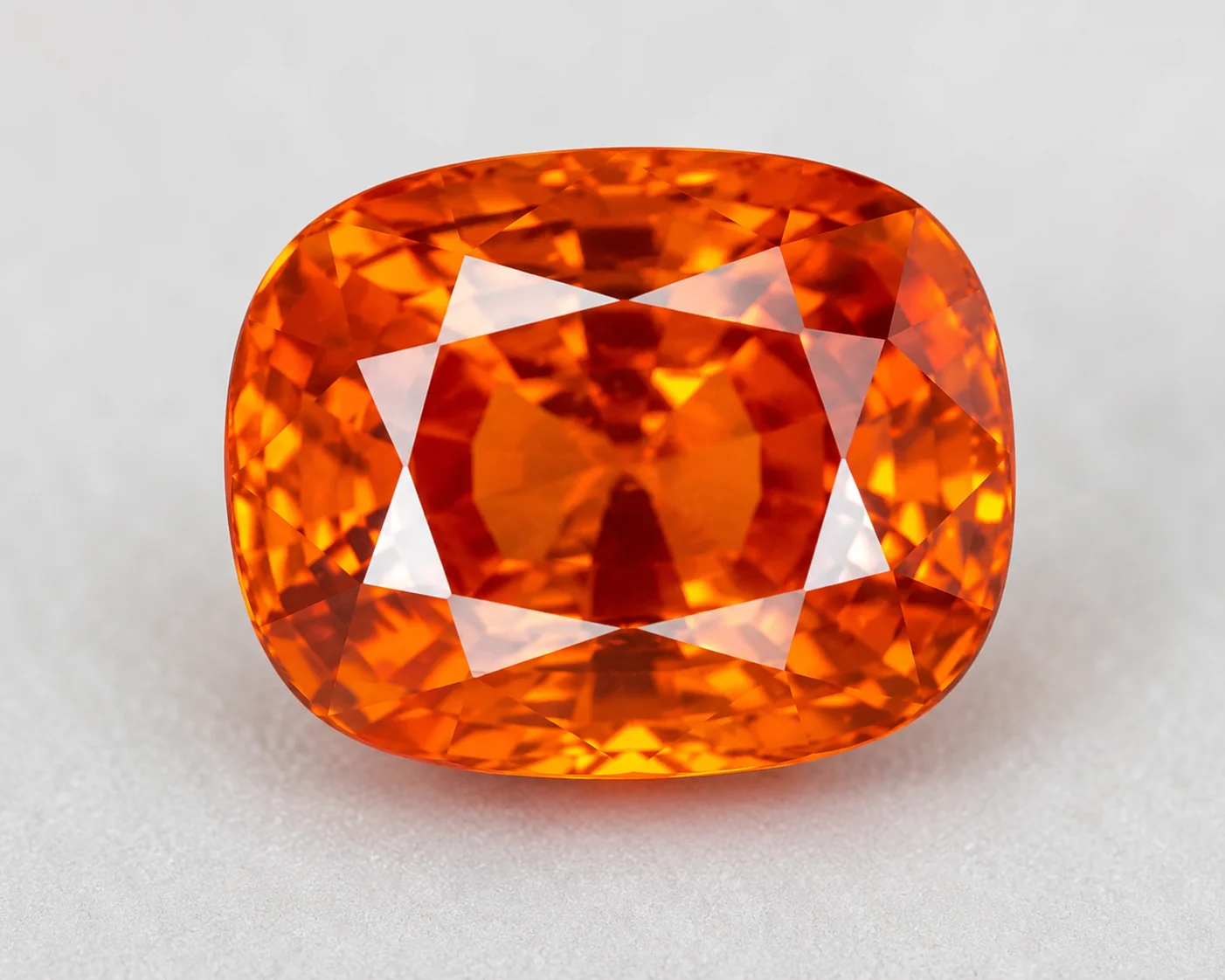
Spessartite Garnet: Meaning, Properties and Symbolism
Spessartite Garnet is the orange-to-reddish-orange manganese-aluminum member of the Garnet group. Mineralogists generally call the species Spessartine, while Spessartite remains a familiar jewelry and trade spelling.
Fine gem material can show electric mandarin orange, tangerine, yellow-orange or warm reddish orange. Its lively color, relatively high refractive index and practical hardness make it one of the most recognizable non-red Garnets.
Spessartite Garnet at a Glance
| Property | Spessartite Garnet |
|---|---|
| Mineral species | Spessartine |
| Common alternate spelling | Spessartite |
| Mineral group | Garnet |
| Ideal composition | Mn₃Al₂(SiO₄)₃ |
| Mineral class | Nesosilicate |
| Crystal system | Cubic |
| Typical color | Yellow, orange, reddish orange, red-brown and brown |
| Luster | Vitreous |
| Transparency | Transparent to translucent |
| Mohs hardness | Approximately 7–7.5 |
| Cleavage | None |
| Fracture | Uneven to conchoidal |
| Specific gravity | Approximately 4.1–4.2 |
| Common uses | Faceted gems, cabochons, jewelry and mineral specimens |
| Main care concern | Chipping from impacts and damage to filled fractures |
What Is Spessartite Garnet?
Spessartite is a gem and mineral variety belonging to the wider Garnet family. Garnets share the same basic cubic crystal structure, but different chemical elements occupy positions within that structure.
In Spessartine, manganese is the principal element in one structural site, while aluminum occupies another. Its ideal end-member formula is Mn₃Al₂(SiO₄)₃.
Natural Garnets rarely match a chemically pure end member. Spessartine commonly contains portions of Almandine, Pyrope or other Garnet components. These mixtures influence color, refractive index, density and the way a gem is classified.
The guide to types of Garnet explains how Spessartine relates to the other major species and mixed varieties.
Spessartine or Spessartite?
Spessartine is the mineralogically preferred species name. It was named after the Spessart region of Bavaria, Germany, where early material was studied.
Spessartite became an established alternative spelling in gem and jewelry usage. Both terms usually refer to the manganese-aluminum Garnet.
However, “spessartite” can also name a type of lamprophyre igneous rock. Context therefore matters. In jewelry, Spessartite Garnet almost always means the orange Garnet species rather than the rock.
Using “Spessartite Garnet” in a commercial title is reasonable, provided the article or seller clarifies that Spessartine is the formal mineral name.
The Garnet Group
Garnet is not a single mineral. It is a group of related silicates that share a structural framework while varying in chemistry.
Almandine Garnet is iron-aluminum rich and commonly deep red to brownish red. Pyrope Garnet is magnesium-aluminum rich and often red.
Grossular Garnet contains calcium and aluminum, producing colors from colorless and yellow to orange, pink and green. Demantoid Garnet is a green variety of Andradite.
Hessonite Garnet can overlap visually with brownish orange Spessartite, but Hessonite is Grossular-rich and often has a different internal appearance.
Rhodolite Garnet is typically a Pyrope-Almandine mixture with purple-red or raspberry color. Uvarovite Garnet is chromium-rich and normally forms small green crystals rather than facetable orange gems.
Spessartine also forms a continuous series with Almandine. Many natural orange-red Garnets contain meaningful proportions of both species.
How Spessartite Garnet Forms
Spessartine forms in several geological environments where manganese, aluminum and silica are available under suitable temperature and pressure conditions.
Granite pegmatites are one important setting. These coarse-grained igneous bodies concentrate unusual elements during the final stages of magma crystallization. Spessartine may occur with Quartz, Feldspar, Mica, Tourmaline, Beryl, Topaz and other pegmatite minerals.
It also develops in granites, rhyolites and manganese-rich metamorphic or metasomatic rocks. Skarns and altered rocks near igneous intrusions can produce Spessartine when manganese-bearing material reacts with hot fluids.
Crystals often form as dodecahedra, trapezohedra or combinations of cubic-system forms. Transparent gem rough may occur as isolated crystals, crystal fragments or alluvial pebbles weathered from the original host rock.
Color and Manganese
Manganese plays the central role in Spessartine’s orange color, although iron and mixed Garnet components can modify the final appearance.
Yellow-orange material contains a lighter, sunnier tone. Vivid orange stones may display the saturated “mandarin” appearance most strongly associated with the variety.
Reddish orange stones contain a warmer red component, while increased iron can push the color toward red-brown, brownish orange or dark brown.
Color quality depends on more than saturation. A gem also needs enough brightness to avoid looking burnt or black in ordinary light.
The Garnet color meaning guide discusses how different Garnet colors developed distinct cultural associations. Related warm-colored stones appear in the orange gemstones guide and orange crystals list.
Mandarin Garnet
Mandarin Garnet is a trade name for bright, strongly saturated orange Spessartite. It does not represent a formally separate mineral species.
The term became closely associated with vivid material from African deposits, particularly stones that showed intense orange without excessive brown.
Because no single international rule defines the exact color required, buyers should evaluate the gem itself rather than pay for the name alone. Some sellers use “mandarin” broadly for almost any orange Spessartite.
An attractive gem should remain lively in normal lighting, show balanced cutting and avoid severe extinction. The Spessartite Garnet buying guide provides a fuller buying process.
Important Sources
The Spessart region of Germany gave the species its name, although it is better known historically and mineralogically than as a major modern source of fine commercial gems.
Namibia has produced bright orange Spessartite, including material historically associated with the Kunene region. Nigeria became an important source of vivid and sometimes relatively large orange gems.
Tanzania and Madagascar have also supplied orange-to-reddish-orange material. Mozambique has produced Garnets with Spessartine components, including stones that may show orange, red or color-change behavior depending on their chemistry.
Brazil is known for pegmatite Spessartine crystals and gem rough. Pakistan and Afghanistan have produced crystal specimens and facetable material from mountainous pegmatite regions.
In the United States, California is known for orange-yellow Spessartine from pegmatites, while Colorado, Virginia and several other states have produced crystals or mixed Garnet material.
Locality alone does not establish quality. Each source produces a range of color, clarity and size, and origin claims should be supported by credible documentation.
Physical Properties
Spessartine crystallizes in the cubic system. Well-developed crystals may form dodecahedra or trapezohedra with multiple symmetrical faces.
Its hardness is approximately 7–7.5 on the Mohs scale. This makes it resistant to many ordinary scratches, although harder gemstones and Quartz-rich dust can still abrade a polished surface.
Like other Garnets, it has no cleavage. Nevertheless, it is brittle and may chip or fracture after a hard blow.
Its relatively high density means a one-carat Spessartite generally looks smaller than a one-carat gem of lower specific gravity.
The luster is vitreous, and transparent stones can display strong brilliance when cut well. Their dispersion is less dramatic than Demantoid’s, but saturated orange color often provides the main visual appeal.
Clarity and Inclusions
Spessartite can contain mineral crystals, needles, fluid inclusions, veils and partially healed fractures. Eye-clean stones occur, but they are less common when color, size and transparency are also exceptional.
Inclusions may help a gemologist understand formation conditions, but most do not identify a precise geographic source by themselves.
Minor crystals or needles can remain acceptable if they do not disrupt the face-up appearance. Surface-reaching fractures deserve more caution because they may weaken the stone or permit filling.
A highly transparent, vivid and well-cut stone with few visible inclusions can command a significant premium.
Cutting Behavior
Cutters must balance color, brightness and retained weight. Deep rough may tempt a cutter to preserve carats, but an overly deep pavilion can create extinction and make the gem look smaller.
Round, oval and cushion cuts are common because they distribute orange color effectively. Pears, trillions and fancy shapes appear when rough shape or design justifies them.
Dark material may require a shallower or more open design to return enough light. Pale material can benefit from cuts that concentrate color without creating a dead center.
Facet junctions should be crisp, and the polish should remain even across the crown. Windowing, uneven girdles and excessive depth can reduce both appearance and value.
Spessartite Garnet Meaning and Symbolism
Modern crystal traditions associate orange Spessartite with creativity, confidence, vitality and purposeful action. Its warm color encourages symbolic connections with enthusiasm, independence and the willingness to begin.
Some practitioners interpret the gem as a bridge between inspiration and execution. An idea may originate through imagination, but personal discipline gives it form.
Spessartite is also linked with joy and social confidence in contemporary spiritual writing. A wearer may use it as a reminder to speak openly, share creative work or approach an unfamiliar situation with curiosity.
These meanings are cultural and personal interpretations rather than scientifically measurable properties of manganese-aluminum Garnet.
Healing Properties in Crystal Traditions
Crystal practitioners sometimes use Spessartite as a symbolic stone for motivation and emotional warmth. It may be held while setting goals, beginning a creative project or preparing for an activity that requires visible participation.
Some traditions connect orange Garnets with the sacral chakra because of their color and creative symbolism. Others associate their confidence themes with the solar plexus chakra.
The broader Garnet healing properties guide covers family-level spiritual practices. The Garnet spiritual meaning guide explores symbolism separately, while the Garnet chakra guide addresses chakra associations.
These practices should support reflection rather than replace medical, psychological or practical assistance.
How Spessartite Garnet Is Used
Transparent material is usually faceted for fine jewelry. Smaller calibrated stones may form matched earrings, line bracelets or multi-stone necklaces.
Included or translucent rough can be cut into cabochons, beads and carvings. Well-formed natural crystals are collected as mineral specimens, especially when they retain sharp faces and attractive matrix associations.
A bright orange center stone can become a statement ring, while smaller gems work effectively as accents around Diamonds or contrasting colored stones.
The jewelry format should suit the wearer. Dedicated guides cover Spessartite Garnet earrings, Spessartite Garnet necklaces, Spessartite Garnet bracelets and Spessartite Garnet rings.
Jewelry Suitability
Spessartite Garnet is suitable for most jewelry when the stone has sound structure and a secure setting.
Earrings and necklaces face the lowest impact risk. Bracelets receive more surface contact, while rings need protection around the girdle and vulnerable corners.
A bezel can provide strong edge protection. Prongs allow more light around the stone but need periodic inspection.
The general guide to whether Garnet is durable enough for everyday wear explains the relationship between hardness, toughness and jewelry design.
Identification
Spessartite shares Garnet’s single-refractive cubic structure and commonly has a refractive index and density higher than many orange lookalikes.
Color alone cannot establish identity. Hessonite, orange Sapphire, Fire Opal, Zircon, Tourmaline, Spinel and glass may overlap visually.
Hessonite often has lower refractive properties and may display a characteristic roiled or granular internal appearance. Orange Sapphire is harder and belongs to Corundum, while Zircon can show stronger doubling and dispersion.
Gemological identification may use refractive index, specific gravity, spectroscopy, magnification and other tests. Scratch testing should not be performed on a finished gem.
The guide to real versus fake Garnet explains common imitations and the limits of home testing.
Treatments
Most Spessartite Garnet receives no routine heat treatment. Its natural orange color is one reason buyers value the variety.
Rare stones may be fracture filled to reduce the visibility of surface-reaching breaks. Filling can affect value, durability, cleaning and repair.
Coatings or assembled imitations may also appear in the wider market, although they are not standard treatments for fine Spessartine.
A seller should disclose all known enhancement and describe the stone as natural, synthetic or imitation accurately.
Value Factors
Color generally has the greatest effect on gem Spessartite value. Strong orange or orangy red with high saturation and good brightness attracts the most attention.
Clarity matters because eye-clean examples can be scarce. However, a clean stone with weak brown color may remain less desirable than a lively orange gem containing minor inclusions.
Cut controls face-up brightness, visible size and color distribution. Larger stones rise in price when they preserve strong color and clarity rather than becoming dark or heavily included.
Origin can add context but does not replace visible quality. Fine gems from several countries can command strong prices.
The dedicated Spessartite Garnet price guide covers current market factors, while the buying guide handles practical comparison and seller questions.
Birthstone Connection
Garnet is January’s modern birthstone. Spessartite offers a vivid orange alternative to the dark red Garnets most commonly associated with the month.
The January birthstone guide explains the history, colors and calendar tradition.
Orange Garnet can also be chosen without a birthstone connection. Its color may commemorate creativity, an autumn event or a recipient who simply prefers warm gems.
Cleaning and Care
Clean sound Spessartite Garnet with lukewarm water, mild soap and a soft brush. Rinse briefly and dry with a lint-free cloth.
Steam cleaning is not recommended. Ultrasonic machines should be avoided when a gem contains significant fractures, has been fracture filled or sits in a delicate setting.
Although Garnet is generally stable in normal light, avoid extreme heat and sudden temperature changes. These conditions can place stress on inclusions and settings.
The dedicated guide to cleaning Spessartite Garnet jewelry covers specific jewelry procedures. Questions about water and sunlight appear in the guide to whether Garnet is safe in water.
For belief-based maintenance, the guide to cleansing and charging Garnet explains dry spiritual methods. The practical Garnet uses guide separates ordinary handling from symbolic practice.
Storage
Keep faceted Spessartite separate from Diamonds, Sapphires and other harder gemstones. A lined compartment or fabric pouch reduces scratches and impact.
Natural crystals should be supported beneath their full weight rather than stored with fragile points bearing against a hard surface.
Avoid crowded jewelry boxes where Garnets can strike metal edges or harder stones. Remove rings and bracelets before physical work, exercise or household cleaning.
Spessartite is included in both the crystals beginning with S and gemstones beginning with S directories.
Final Perspective
Spessartite Garnet stands apart through chemistry and color rather than through a completely separate crystal structure. Manganese gives the Garnet framework its characteristic orange range, while natural mixing with other Garnet components creates further variation.
A fine example combines vivid color, enough transparency to return light and cutting that avoids excessive darkness. Understanding its formal name, geological settings and realistic durability makes the gem more compelling than any trade label alone.
Frequently Asked Questions
1. Is the correct name Spessartite or Spessartine?
Spessartine is the preferred mineralogical species name. Spessartite is a widely established alternative in jewelry and gem trading.
2. What is Spessartite Garnet made of?
Its ideal formula is Mn₃Al₂(SiO₄)₃, making it a manganese-aluminum silicate within the Garnet group.
3. What gives Spessartite Garnet its orange color?
Manganese is the principal cause of its orange coloration. Iron and mixing with other Garnet components can modify the hue toward red or brown.
4. Is Mandarin Garnet a separate variety?
It is a trade description for vivid orange Spessartite rather than a separate mineral species or universally standardized grade.
5. Is Spessartite rare?
It is less abundant as a fine transparent gem than common red Almandine, but commercial availability varies by color, clarity, size and mining supply.
6. Where is Spessartite Garnet found?
Important material has come from Namibia, Nigeria, Tanzania, Madagascar, Mozambique, Brazil, Pakistan, Afghanistan, Germany and the United States.
7. Is Spessartite Garnet suitable for rings?
Yes, when the stone is structurally sound and the setting protects it from hard blows. Earrings and necklaces remain lower-risk formats.
8. Is Spessartite Garnet usually treated?
Most material is sold without routine heat treatment. Rare fracture filling should be disclosed because it affects care and value.
9. How can Spessartite be distinguished from Hessonite?
The two can overlap in color, but they have different chemical compositions, refractive properties and characteristic inclusions. Professional gemological testing is the safest method.
10. What does Spessartite Garnet symbolize?
Modern crystal traditions associate it with creativity, confidence, vitality, enthusiasm and purposeful action. These are cultural interpretations rather than scientific effects.
11. Can Spessartite Garnet go in water?
Brief cleaning in lukewarm water is normally safe for sound, untreated stones. Avoid soaking filled, heavily fractured or mounted material with vulnerable components.
12. Is Spessartite a January birthstone?
Yes. Spessartite belongs to the Garnet group, which is January’s modern birthstone, although red Garnet remains the most familiar traditional image.
Spessartite Garnet’s healing, chakra and motivational associations belong to spiritual and cultural traditions and are not scientifically established medical effects. Do not use crystals instead of professional healthcare. Avoid steam, extreme heat and aggressive cleaning, especially when treatment or fracture status is uncertain.