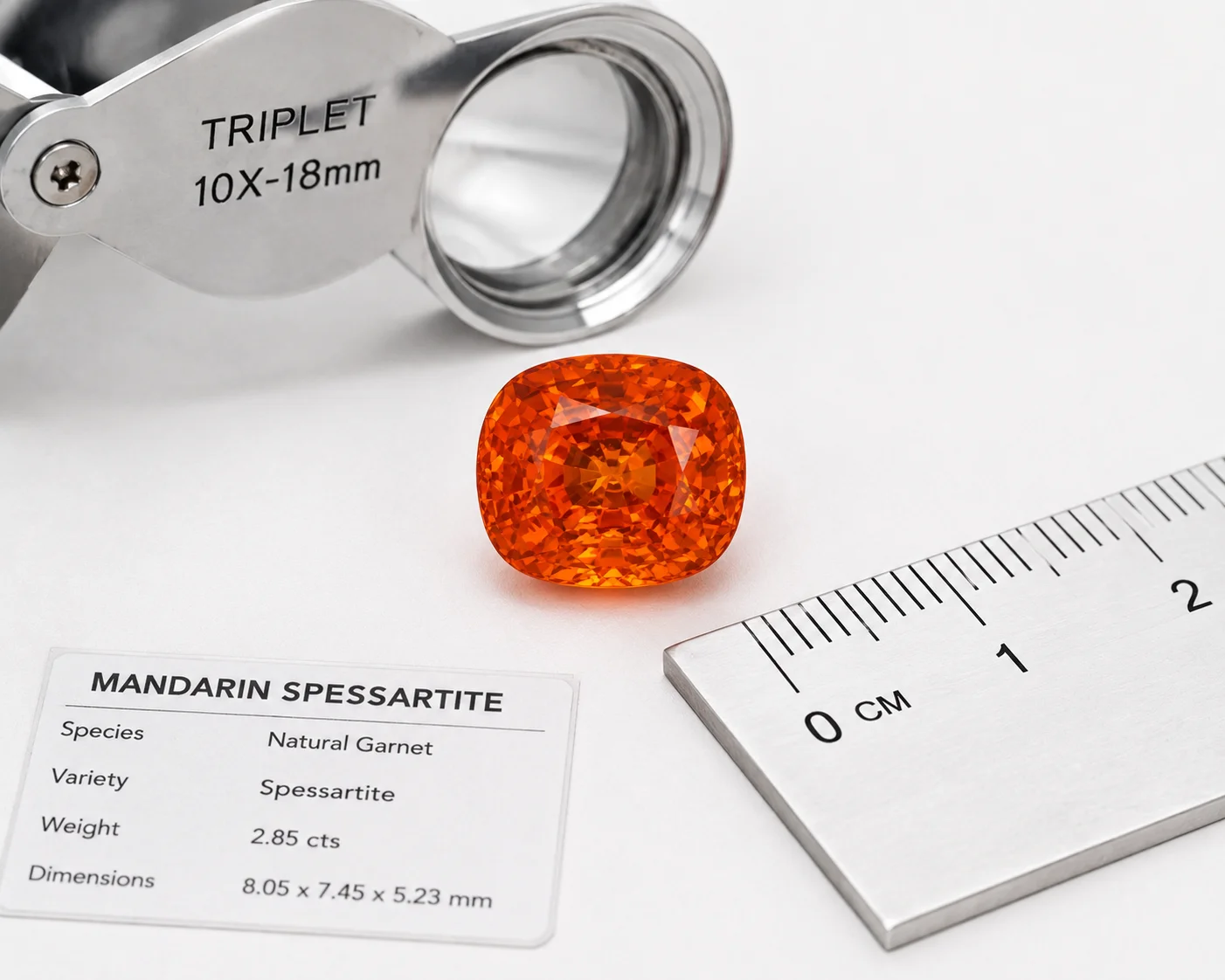
Spessartite Garnet Price Guide: Value and Cost in 2026
Spessartite Garnet prices in 2026 commonly range from approximately $50 to $1,000 per carat. Brownish-orange or visibly included commercial stones often sit below $300 per carat, while vivid mandarin and Fanta-orange gems commonly reach $400 to $1,000 per carat.
Exceptional eye-clean stones above five or ten carats can exceed $1,000 per carat. Rare pure-orange material, precision cutting and important locality provenance may push individual gems into the $1,500-to-$3,000-per-carat market.
Spessartite Garnet Price per Carat in 2026
The following ranges represent broad U.S. and European specialist-retail expectations for natural loose Spessartite Garnet.
| Spessartite quality | Typical characteristics | Approximate 2026 retail price |
|---|---|---|
| Entry commercial | Brownish orange, pale yellow-orange, heavily included or poorly cut | $25–$100 per carat |
| Good commercial | Attractive reddish orange, moderate inclusions and competent cutting | $100–$300 per carat |
| Fine | Bright orange to mandarin-orange, strong brilliance and good transparency | $300–$700 per carat |
| Premium | Vivid Fanta orange, eye-clean appearance, rare size and excellent proportions | $700–$1,500 per carat |
| Exceptional collector quality | Pure saturated orange, rare clean size above 10 ct and major provenance | $1,500–$3,000+ per carat |
Current European retail examples include four- to eight-carat stones priced at approximately $500 to $1,200 per carat equivalent. Larger Nigerian gems and premium Namibian-style color may sit near or above the upper end.
The general relationship among color, clarity, cut, size and demand appears in How Gemstone Prices Are Determined.
What Is Spessartite Garnet?
Spessartite, also called Spessartine, is the manganese-aluminum member of the Garnet group.
Its ideal composition is manganese aluminum silicate, although natural gems commonly contain components from Almandine, Pyrope and other Garnet species.
The material ranges from yellow and yellow-orange to vivid orange, reddish orange and orange-red.
Manganese creates the characteristic orange color. Increasing iron-related components can make the gem darker, redder or browner.
The completed Spessartite Garnet guide owns its mineralogy, deposits and traditional symbolism.
The completed Types of Garnet page explains the wider family.
Color Is the Main Value Factor
Fine Spessartite should show bright orange, yellowish orange or reddish orange without looking muddy or brown.
Pure vivid orange receives the strongest premium. The market often describes this appearance as mandarin or Fanta orange.
Medium tone normally provides the best balance between saturation and brilliance.
Very pale yellow-orange stones lack impact. Dark red-brown material may still be attractive but belongs to a lower commercial category.
The color should remain vivid under ordinary indoor lighting. A stone that looks brilliant only under a concentrated spotlight should not receive a premium based on photographs alone.
The tracker’s Garnet Quality and Grading Guide owns family-wide quality principles.
Mandarin Garnet
Mandarin Garnet was originally associated with vivid orange Spessartite discovered in Namibia during the 1990s.
The name is now used more broadly for bright orange Spessartite from Namibia, Nigeria, Tanzania and other sources.
Fine Mandarin Garnet should look distinctly orange rather than brownish orange or red-brown.
The most valuable material combines vivid color, high transparency, good cutting and minimal inclusions.
A seller should not apply the Mandarin name to every orange Garnet. The premium belongs to the visual quality rather than the word on the listing.
Fanta Garnet
Fanta Garnet is a modern trade name comparing the stone’s color with an orange soft drink.
It generally refers to intense, bright and highly saturated orange Spessartite.
The term has no universal laboratory definition. Different sellers may use it for pure orange, yellow-orange or reddish-orange material.
A premium Fanta-colored stone should remain bright and open rather than dark, brown or over-saturated.
One strong photograph cannot establish the color. Buyers should request rotating videos against white and gray backgrounds under daylight-equivalent and warm indoor light.
Orange vs Reddish-Orange Spessartite
Pure orange normally receives the highest broad demand.
Reddish-orange stones can remain valuable, particularly when they show strong brilliance and avoid brown modifiers.
Some historical American Spessartites are valued for vivid orange-red or reddish-orange color rather than the modern Namibian mandarin appearance.
Yellow-orange material can be bright and attractive but usually costs less unless the color is unusually saturated.
A stone’s market category should follow its complete appearance rather than a strict single-hue hierarchy.
Clarity and Inclusion Tolerance
Spessartite can range from eye-clean to visibly included.
Fine needles, crystals, fingerprints and fluid inclusions may be present. The market accepts some inclusions because vivid orange material is rare.
However, top prices require good transparency. Dense clouds, black crystals and open fractures reduce brilliance and value.
Namibian Mandarin Garnet can contain characteristic inclusions, while Nigerian and Tanzanian material may range from very clean to visibly included.
A small inclusion near the edge has less effect than a dark feature beneath the table.
Surface-reaching fractures also create setting and cleaning risks. They should reduce price even when color is fine.
Cut Quality and Brilliance
Spessartite has a relatively high refractive index and can show strong brilliance.
Ovals, cushions, pears and rounds are common. Elongated shapes often follow the rough efficiently.
A shallow pavilion creates windowing, while excessive depth can darken the stone and hide weight.
Fine cutting should distribute bright orange reflections across most of the face.
Rounds require greater rough loss and may receive premiums, especially above three or five carats.
Precision cutting can elevate lighter material by improving brilliance, although cutting cannot remove brown body color.
Detailed stone inspection belongs to the Spessartite Garnet Buying Guide.
Spessartite Prices by Carat Weight
Spessartite receives stronger size premiums when vivid color and clarity continue above five or ten carats.
| Carat weight | Commercial quality | Fine quality | Exceptional quality |
|---|---|---|---|
| Under 1 ct | $25–$150 per carat | $150–$400 per carat | $350–$750 per carat |
| 1–3 ct | $50–$250 per carat | $250–$600 per carat | $500–$1,000 per carat |
| 3–5 ct | $75–$300 per carat | $300–$750 per carat | $600–$1,250 per carat |
| 5–10 ct | $100–$400 per carat | $400–$1,000 per carat | $800–$1,750 per carat |
| Above 10 ct | $125–$500 per carat | $500–$1,200 per carat | $1,000–$3,000+ per carat |
Large included or brownish stones can remain affordable. The premium applies when vivid orange color and transparency survive at the larger size.
Mandarin Garnets above ten carats are rare enough to attract collector attention.
Namibia Spessartite
Namibia’s Kunene Region produced the original material most closely associated with Mandarin Garnet.
The finest stones display pure bright orange color and strong internal glow.
Original Namibian production was limited, and fine documented stones can command provenance premiums.
Much material is below five carats, while clean stones above ten carats are particularly scarce.
However, the word Namibian should not replace visual quality. A dark or heavily included stone remains lower grade regardless of locality.
Nigeria Spessartite
Nigeria has produced substantial quantities of orange and reddish-orange Spessartite, including stones in large sizes.
Fine Nigerian gems can show vivid Fanta-orange color, good transparency and strong brilliance.
Larger stones are more available than original Namibian Mandarin Garnets, helping create a broader high-quality jewelry market.
Current four- to eight-carat Nigerian gems commonly retail from several hundred to more than $1,000 per carat, depending on color and clarity.
Exceptional clean stones above ten carats can receive significant premiums.
Tanzania Spessartite
Tanzania supplies orange, red-orange and mixed Garnets from several mining regions.
Some stones are close to pure Spessartite, while others contain substantial Pyrope, Almandine or Grossular components.
Fine Tanzanian material can show vivid orange color and strong transparency.
Trade names such as Mandarin, Malaya and color-change Garnet should not be interchanged without composition and appearance evidence.
Tanzania’s diverse Garnet deposits make laboratory or gemological identification useful for unusual colors.
Mozambique and Madagascar
Mozambique produces substantial reddish-orange and orange Spessartite, including large stones used in fine jewelry.
Madagascar has supplied orange, yellow-orange and mixed Garnets from pegmatite and alluvial deposits.
Both origins can produce high-quality material. Visible color and clarity matter more than the country name for most retail stones.
Madagascar is also associated with Malaya and color-change Garnets that contain varying Spessartite components. Those stones belong to different commercial categories.
California and Virginia Spessartite
Historic American Spessartite comes from Ramona, California, Amelia County, Virginia and other pegmatite regions.
Ramona material is known for vivid orange-red color and strong collector interest.
Facet-grade production was limited, making fine clean stones and crystals valuable among locality collectors.
A documented American specimen or faceted stone may receive a provenance premium even when its color differs from Namibian Mandarin material.
Old mine labels and credible collection history are important. The name of a famous locality should not be accepted without documentation.
Spessartite vs Hessonite Garnet
Hessonite is orange-to-brownish-orange Grossular Garnet.
It commonly shows a softer, more granular or treacly internal appearance. Spessartite can display brighter orange color and greater brilliance.
Commercial Hessonite usually costs less than fine Mandarin Garnet.
The completed Hessonite Garnet guide owns the Grossular variety’s identity.
The family-wide Garnet Price Guide owns broader comparisons rather than duplicating all Garnet price tiers here.
Spessartite vs Fire Opal and Orange Sapphire
Fire Opal can show transparent yellow, orange or red body color. Some stones also display play-of-color.
Current Fire Opal pricing belongs to the Fire Opal Price Guide.
Orange Sapphire is corundum and can be more durable, although treatment and diffusion strongly affect its market.
Spessartite normally offers stronger brilliance than Fire Opal and does not require routine treatment to create orange color.
Identity should be established before comparing prices because the three materials have very different durability and treatment concerns.
Spessartite vs Rhodolite and Demantoid
Rhodolite is a red-purple Garnet variety. Its current market appears in the Rhodolite Garnet Price Guide.
Demantoid is green Andradite and normally occupies a higher market when color, dispersion and Russian provenance are exceptional. Its pricing appears in the Demantoid Garnet Price Guide.
Spessartite’s main premium comes from vivid orange color. It generally costs more than ordinary red Garnet but less than the finest Russian Demantoid.
The separate Garnet Price per Carat Guide owns family-wide weight calculations.
Treatment and Synthetic Material
Most Spessartite reaches the market without routine heat treatment.
Natural untreated color is therefore expected rather than exceptionally rare.
Surface coatings and other modifications have occasionally been applied to Garnet, but they are not standard Spessartite practice.
Synthetic Garnet materials used in technology and imitation jewelry may have different compositions from natural Spessartite.
Orange glass, synthetic Sapphire and other materials can imitate the appearance.
A high-value stone should be identified as natural Garnet, especially when its color and size appear exceptional.
The broader enhancement framework appears in Gemstone Treatments Explained.
Certification and Appraisal
Most commercial one- or two-carat Spessartite does not require a major laboratory report.
Testing becomes more useful when:
- The stone exceeds five or ten carats
- The color is represented as exceptional Mandarin or Fanta orange
- Historic Namibian or American provenance creates a premium
- The gem may be Hessonite, Sapphire or another orange stone
- Treatment or synthetic origin is uncertain
- The jewel requires insurance documentation
A laboratory can identify natural Garnet and establish its compositional position within the Garnet group.
The report may not use Mandarin or Fanta as formal quality grades.
The Gemstone Certification Labs comparison explains report scope.
Spessartite Garnet Jewelry Prices in 2026
| Jewelry type | Broad U.S. retail range |
|---|---|
| Silver earrings or pendant with commercial stones | $100–$800 |
| Gold pendant with a one- to three-carat gem | $700–$5,000 |
| Gold Spessartite ring | $1,000–$8,000 |
| Fine five-carat Mandarin Garnet jewel | $4,000–$15,000+ |
| Large premium or designer piece | $10,000–$75,000+ |
Matched earrings can command substantial premiums because the stones must align in color, dimensions, clarity and cutting.
Style-specific selection belongs to the Spessartite Garnet Ring Guide, Spessartite Garnet Earrings Guide, Spessartite Garnet Necklace Guide and Spessartite Garnet Bracelet Guide.
Durability and Care
Spessartite has enough hardness and toughness for rings, earrings, necklaces and bracelets.
It can still chip at a thin girdle, pointed corner or existing fracture.
Warm water, mild detergent and a soft brush provide the safest routine.
Steam and ultrasonic cleaning should be avoided for heavily included or fractured stones.
Complete maintenance guidance belongs to How to Clean Spessartite Garnet Jewelry Safely.
Does Spessartite Hold Its Value?
Fine Mandarin and Fanta-orange Spessartite has stronger collector demand than ordinary brownish-orange Garnet.
The best secondary-market position belongs to vivid, eye-clean stones above five or ten carats with respected provenance.
Commercial material generally resells below retail. Dealer margin, setting cost and limited buyer awareness reduce recoverable value.
Historic Namibian stones and important American locality gems may appeal to collectors independently of mainstream jewelry demand.
The broader resale framework appears in Do Gemstones Hold Their Value?.
Price Guide vs Buying Guide
This page owns Spessartite Garnet’s 2026 prices and value factors. Detailed color comparison, inclusion inspection and seller questions belong to the dedicated buying guide.
Online buyers should request neutral-light video, exact dimensions, natural-origin disclosure and a return period using How to Buy Gemstones Online Without Getting Scammed.
The Buying & Value hub connects Spessartite pricing with Garnet grading, treatment, certification and resale guidance.
Frequently Asked Questions
1. How much is Spessartite Garnet worth per carat in 2026?
Most Spessartite costs approximately $50 to $1,000 per carat. Exceptional vivid-orange stones can reach $1,000 to $3,000 per carat or more.
2. What Spessartite color is most valuable?
Pure vivid orange and highly saturated Mandarin or Fanta orange generally receive the strongest prices.
3. What is Mandarin Garnet?
It is a trade name originally associated with vivid orange Namibian Spessartite and now used more broadly for fine orange material.
4. What is Fanta Garnet?
Fanta Garnet is a nonstandard trade name for intense bright-orange Spessartite resembling the color of orange soda.
5. How much is a three-carat Spessartite?
A three-carat stone may cost approximately $225 to $2,250 in total, depending on color, clarity and cut.
6. How much is a ten-carat Mandarin Garnet?
A fine ten-carat stone may cost approximately $5,000 to $15,000 or more. Exceptional clean gems can rise higher.
7. Does Spessartite become more expensive at larger sizes?
Yes, when vivid orange color and good transparency continue above five or ten carats.
8. Is Nigerian Spessartite valuable?
Yes. Nigeria produces vivid orange and reddish-orange stones, including rare clean gems in substantial sizes.
9. Is Namibian Mandarin Garnet more valuable?
Fine documented Namibian material can receive a provenance premium because the original production was limited.
10. Is Spessartite normally treated?
Most material is sold without routine treatment. Known coatings or other modification should still be disclosed.
11. Does Spessartite need a laboratory report?
Ordinary stones generally do not. Reports are useful for rare size, exceptional color, provenance or identity questions.
12. Is Spessartite Garnet a good investment?
Fine large Mandarin Garnets may retain collector demand, but ordinary commercial stones are not liquid investments.
Spessartite Value Comes From Orange Without Brown
Spessartite’s strongest market is not built on the Garnet name alone. The premium belongs to a bright, open orange that remains lively under ordinary lighting and is not overwhelmed by brown or excessive inclusions.
In 2026, good jewelry stones commonly fall between $100 and $700 per carat. Prices above that range should correspond to vivid Mandarin or Fanta color, rare clean size, excellent cutting or documented provenance that clearly separates the gem from ordinary orange Garnet.