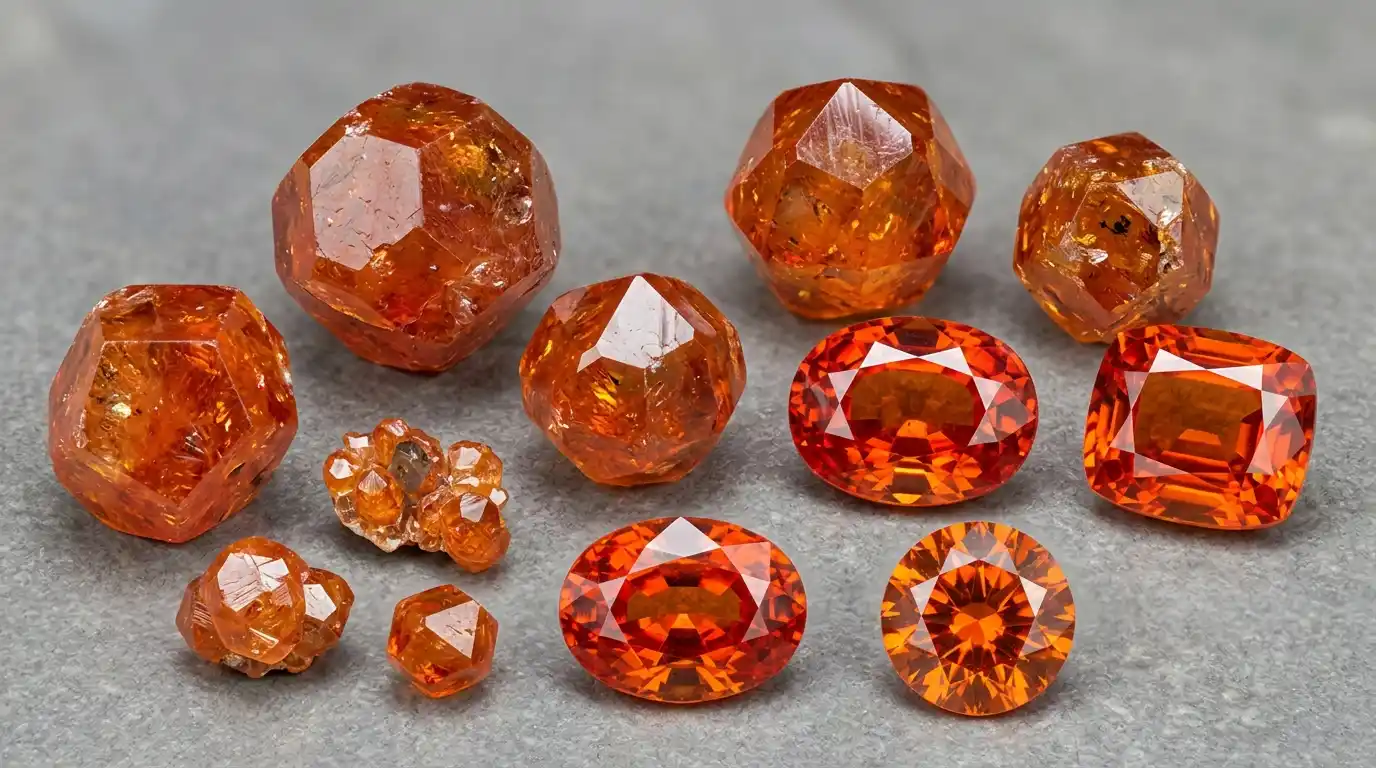
7 Real Spessartite Garnet Benefits: Gentle Traditions, Evidence, Safe Use & Clear Limits
Spessartite garnet benefits begin with one of the most vivid orange members of the garnet group. The recognized mineral name is spessartine, while spessartite remains widely used in the gem trade. Its ideal formula is Mn3Al2(SiO4)3, making manganese the defining major element and the main reason fine stones can display yellow-orange, vivid orange, reddish-orange, and deeper red-brown colors.
Like other garnets, spessartine crystallizes in the isometric system and normally falls around 6.5 to 7.5 on the Mohs scale. It has no true cleavage, takes a bright vitreous polish, and can produce exceptionally lively faceted gems when color, transparency, cutting, and clarity work together. These characteristics give spessartite garnet benefits that are practical for jewelry, collecting, gemological study, and mineral education before any spiritual symbolism is considered.
Modern traditions add creativity, enthusiasm, confidence, motivation, emotional warmth, and personal energy to spessartite garnet benefits. These ideas can give an orange gemstone personal meaning, but spessartine has not been shown to increase metabolism, alter hormones, treat depression, improve fertility, or produce measurable biological energy through ordinary skin contact.
7 Spessartite Garnet Benefits at a Glance
The seven points below focus first on measurable gemological qualities and then on symbolic traditions that can be used responsibly. The distinction is especially important with bright orange gems because visual intensity is often converted too easily into unsupported claims about physical energy.
- Vivid orange to reddish-orange color gives spessartine exceptional jewelry and collector appeal.
- Mohs hardness around 6.5 to 7.5 and lack of true cleavage support practical jewelry use when strong impacts are avoided.
- Manganese-rich garnet chemistry provides a clear example of how major elements control gemstone color and mineral identity.
- High refractive index and vitreous luster allow well-cut stones to display strong brightness and lively internal reflections.
- Pegmatite and metamorphic occurrences add geological interest and connect individual gems with distinctive mining regions.
- Modern creativity and motivation symbolism can provide personal meaning without implying direct neurological or hormonal effects.
- Straightforward care, treatment awareness, and realistic expectations allow spessartite to be enjoyed safely as a natural garnet.
Spessartite Garnet Benefits Begin With Manganese-Rich Garnet Chemistry
The strongest scientific spessartite garnet benefits come from its place within the garnet group. Spessartine has the ideal composition Mn3Al2(SiO4)3, with manganese occupying the structural position that iron fills in almandine, magnesium fills in pyrope, and calcium occupies in several other garnet species. Natural stones rarely match a perfect end-member formula because garnets readily form solid solutions and can contain meaningful proportions of neighboring garnet components.
Spessartine crystallizes in the isometric system and generally has a hardness between 6.5 and 7.5, specific gravity around 4.1 to 4.3, vitreous luster, brittle tenacity, and no true cleavage. Its relatively high refractive index contributes to strong surface reflections and attractive brilliance in well-cut gems, while the lack of cleavage removes one common splitting weakness found in minerals such as topaz or fluorite.
The term spessartite is familiar in jewelry, but spessartine is the formal mineral name. It was named after the Spessart Mountains of Germany, where early specimens helped establish its identity, and the name has remained connected with manganese-rich orange garnet ever since.
Spessartite Garnet Technical Properties
A compact technical summary helps explain why this garnet is both visually attractive and useful in jewelry.
| Property | Spessartine Garnet |
|---|---|
| Mineral group | Garnet |
| Ideal formula | Mn3Al2(SiO4)3 |
| Crystal system | Isometric |
| Mohs hardness | About 6.5–7.5 |
| Cleavage | None |
| Tenacity | Brittle |
| Typical luster | Vitreous |
| Main color range | Yellow-orange, orange, reddish-orange, red-brown |
| Major coloring element | Manganese, with iron influencing some hues |
| Common uses | Faceted gems, rings, earrings, pendants, collector crystals |
These properties explain why spessartite works well in jewelry while still needing ordinary colored-stone care. Its hardness is useful, but a brittle gemstone can chip after a strong impact even when the surface resists ordinary scratching.
Manganese Creates the Famous Orange Color
Color is the most obvious of all spessartite garnet benefits. Manganese in the garnet structure strongly contributes to yellow, orange, and reddish-orange absorption patterns, while iron can shift some stones toward redder, browner, or darker tones. Fine examples with strong orange saturation and limited brown can appear exceptionally bright after skilled cutting.
GIA notes that spessartine represents the orange part of the garnet family, and studies of stones from California, Namibia, and Tanzania have shown strong Mn2+ spectral features connected with their characteristic coloration. Some bright Namibian and Tanzanian stones contain significant pyrope components while remaining commercially associated with spessartine because manganese-rich chemistry and orange appearance dominate the gem identity.
The well-known trade term “Mandarin garnet” is commonly associated with especially vivid orange spessartine or spessartine-rich garnet. It is a commercial color description rather than a separate mineral species, so buyers should judge the actual gem rather than assuming the trade name guarantees a specific composition, locality, or quality level.
Bright Color and High Luster Support Fine Faceting
Transparent spessartine can produce exceptional faceted gems because its high refractive index and vitreous luster create bright reflections. Ovals, cushions, rounds, pears, emerald-style outlines, and custom cuts can all work well, provided the cutter balances color, brilliance, weight retention, and any internal fractures or inclusions.
Cut quality matters because deep stones can become dark in the center, while excessively shallow cuts may show windowing. The principles behind spessartite garnet quality grading therefore involve color, clarity, cut, size, transparency, inclusions, and overall face-up appearance rather than one simple orange-color test.
Fine orange garnets can tolerate some inclusions, particularly because spessartine often contains visible internal features. GIA notes that orange garnets such as spessartine and hessonite frequently show eye-visible inclusions, which means clarity expectations should be appropriate to the garnet variety rather than copied directly from diamonds or very clean red garnets.
Spessartite Garnet Benefits for Everyday Jewelry
A hardness range around 6.5 to 7.5 gives spessartite useful scratch resistance for earrings, pendants, necklaces, brooches, and many rings. The absence of true cleavage also means the gem does not have one preferred plane along which it readily splits, but brittleness still allows chips or fractures when enough force reaches an exposed edge.
Rings deserve the most thought because they receive repeated impact against desks, doors, countertops, gym equipment, and other hard surfaces. A well-protected setting can make spessartite practical for regular wear, while particularly included or valuable stones may be better suited to occasional rings, pendants, or earrings.
The garnet benefits of good polishability, useful hardness, diverse color, and jewelry versatility all apply here, but spessartine adds a distinctive orange palette that few other garnet species reproduce in exactly the same way.
Geological Origin Adds Collector and Scientific Value
Spessartine forms in several geological environments, including granitic pegmatites and manganese-rich metamorphic rocks. Pegmatites can produce well-formed crystals and transparent gem rough because slowly evolving granitic systems concentrate unusual elements and give crystals room to grow, while metamorphic occurrences may produce different inclusion patterns, chemistry, and crystal associations.
Historically important gem sources include southern California, Brazil, Sri Lanka, Madagascar, Mozambique, and several African localities. Namibia became especially influential in the modern market after vivid orange stones appeared in the early 1990s, while Nigerian and Tanzanian discoveries later added significant quantities of attractive orange garnet. GIA also identifies Namibia and Tanzania as important modern sources and notes important occurrences in Pakistan, Afghanistan, India, Myanmar, and other countries.
The Little Three mining area near Ramona, California, was particularly important during much of the twentieth century. GIA reports that pegmatites there produced tens of thousands of carats of facet-grade rough, with bright orangy-yellow to yellowish-orange stones and characteristic inclusions such as partially healed fractures, negative crystals, needles, tubes, and growth structures.
Inclusions Can Add Identification and Locality Clues
Internal features are another useful spessartite garnet benefit because they provide information about crystal growth and geological origin. Depending on locality, stones may contain healed fractures, negative crystals, fine needles, fluid inclusions, growth zoning, mineral crystals, or other microscopic structures.
Inclusions should not automatically be treated as defects. A minor internal feature that does not affect durability or face-up appearance may have little negative impact, while an inclusion pattern can sometimes give a gemologist clues about natural origin or the environment in which the crystal formed.
Large surface-reaching fractures deserve more attention because they can affect durability and polish. When choosing an important gem, magnification and professional examination provide much more useful information than assuming every eye-clean stone is automatically superior.
Value Comes From More Than Size
Spessartine value depends heavily on color, transparency, clarity, cutting, size, and overall attractiveness. Vivid orange stones with strong brightness and limited brown are generally highly desirable, but exceptional crystals, unusual localities, and attractive collector specimens can follow different value rules from conventional faceted jewelry.
The spessartite garnet price can increase significantly as stones become larger while retaining strong color, transparency, and good cutting. Large clean gems are less common than small included stones, so carat weight becomes more important only when the other quality factors remain attractive.
Anyone planning to buy spessartite garnet should therefore compare actual face-up color and cutting rather than relying only on labels such as Mandarin, vivid, premium, or collector grade. Trade language can be useful, but the physical gemstone should support the description.
Creativity as a Gentle Modern Tradition
Creativity is one of the most common symbolic spessartite garnet benefits because bright orange is widely associated with enthusiasm, movement, warmth, and expressive energy. A designer, writer, musician, entrepreneur, or student may choose the gemstone because its color feels active and visually stimulating.
A practical symbolic use might involve keeping a small stone near a workspace as a reminder to begin rather than waiting for inspiration to feel perfect. Another person may associate an orange ring with completing a creative project or taking a professional risk that required persistence.
The gemstone does not neurologically generate creativity or alter dopamine, attention, or cognitive flexibility through skin contact. Creative work still develops through practice, ideas, experience, experimentation, rest, and the willingness to continue after imperfect attempts.
Motivation and Confidence Without Biological Claims
Motivation and confidence also appear frequently among spessartite garnet benefits. The vivid orange color can make the stone a natural symbol for action, courage, sociability, or willingness to move forward with a goal.
A person may connect the gemstone with applying for a position, giving a presentation, starting a course, or returning to a difficult task. The visual reminder can be meaningful because it represents a commitment already chosen by the wearer.
Spessartine does not increase testosterone, adrenaline, metabolism, stamina, or another physiological marker. Confidence and motivation depend on circumstances, preparation, habits, health, support, and experience, while the gemstone can only represent the qualities someone wants to practice.
Emotional Warmth and Relationship Symbolism
Orange gemstones often receive modern symbolism involving warmth, friendship, affection, openness, and optimism. Spessartite’s rich color can therefore make it meaningful as a gift celebrating a relationship, achievement, birthday, or important period of personal change.
This symbolism does not mean the stone controls another person’s emotions. A relationship cannot be made more loyal, affectionate, or compatible through the presence of manganese-rich garnet.
Personal meaning works differently. A ring received during a meaningful event can become emotionally valuable because of the memory attached to it, and that value can remain strong even when the owner does not believe in crystal energy.
Healing Claims Need Clear Evidence Limits
Crystal traditions sometimes expand spessartite garnet benefits into claims involving fertility, reproductive health, digestion, circulation, depression, sexual energy, metabolism, or physical vitality. The presence of manganese inside the garnet does not provide a nutritional dose through normal skin contact, and the stone has not been established as a treatment for these conditions.
A person may still use an orange garnet during meditation, journaling, or a confidence-building routine. The gemstone can provide continuity and symbolic meaning while healthcare decisions remain grounded in qualified medical advice.
This evidence-safe distinction also prevents mineral chemistry from being misused. Manganese is an essential element in human nutrition, but manganese locked inside a durable silicate crystal is not equivalent to dietary manganese and should not be treated as a supplement.
Treatment and Identification Considerations
Garnets are generally less heavily treated than many other colored gemstones, which can make natural spessartine particularly appealing. Treatments and unusual enhancements are still possible, so significant stones deserve accurate disclosure and professional examination when value justifies it.
Color alone cannot establish identity. Orange sapphire, hessonite garnet, fire opal, zircon, tourmaline, glass, and other gems can overlap visually with spessartine. Refractive properties, specific gravity, absorption spectra, magnification, chemistry, and other gemological tests provide stronger identification than an orange appearance.
The word garnet itself also covers a group rather than one fixed chemistry. Spessartine can contain almandine, pyrope, grossular, or other components through solid solution, making professional classification more precise than relying on a rigid ideal formula alone.
Safe Cleaning and Long-Term Care
Warm water, mild soap, and a soft brush are appropriate for most sound spessartite garnets. This method removes ordinary skin oils and dirt without creating unnecessary heat or vibration, and it is especially sensible when the internal condition of an older gemstone is unknown.
Ultrasonic cleaning may be suitable for some clean, untreated garnets, but stones with significant fractures should be treated more cautiously. Steam is unnecessary for routine care, and abrupt temperature changes should be avoided because any included gemstone can be more vulnerable to thermal stress.
Store spessartite away from harder stones such as sapphire, ruby, and diamond, which can scratch polished facets. The garnet itself can also scratch softer gems, so separate compartments protect the whole jewelry collection rather than only the orange stone.
Conclusion
Spessartite garnet benefits include vivid manganese-driven orange color, useful Mohs hardness, lack of true cleavage, bright faceting potential, interesting inclusions, diverse geological origins, and strong collector appeal. Creativity, motivation, confidence, and emotional warmth can provide meaningful personal symbolism when they remain separate from claims about hormones, fertility, neurological function, metabolism, or medical healing.
FAQs
What are the main spessartite garnet benefits?
Spessartite garnet benefits include vivid orange color, good jewelry hardness, lack of true cleavage, bright vitreous luster, collector appeal, and interesting manganese-rich mineralogy. Modern traditions also connect the gem with creativity, motivation, confidence, and emotional warmth.
Is spessartite the same as spessartine?
Yes. Spessartine is the formal mineral name, while spessartite is a widely used gem-trade term for the same manganese-rich garnet species.
What gives spessartite garnet its orange color?
Manganese is the main element responsible for the yellow-orange to reddish-orange appearance of spessartine. Iron and other garnet components can influence tone and shift some stones toward redder or browner colors.
Is Mandarin garnet a separate mineral?
No. Mandarin garnet is a commercial term commonly used for vivid orange spessartine or spessartine-rich garnet. The label does not represent a separate mineral species.
Is spessartite garnet durable enough for rings?
Generally, yes, with reasonable care. Its hardness of about 6.5 to 7.5 and lack of true cleavage make it suitable for many rings, although brittle stones can still chip if struck hard and heavily included gems may need additional protection.
Does spessartite increase creativity or motivation?
There is no scientific evidence that spessartite directly changes creativity, motivation, hormones, or neurological function. It can be used as a personal symbol connected with creative work, confidence, or a chosen goal.
Does spessartite garnet have healing effects?
Spessartite has not been shown to treat fertility, circulation, depression, digestion, hormonal conditions, or other medical problems. Spiritual and emotional interpretations can remain personal practices without replacing professional healthcare.
Disclaimer: Creativity, motivation, confidence, emotional-warmth, healing, chakra, fertility, vitality, and energetic descriptions of spessartite garnet reflect spiritual beliefs and personal practices. Spessartite garnet is not a medical or psychological treatment and should not replace professional healthcare.