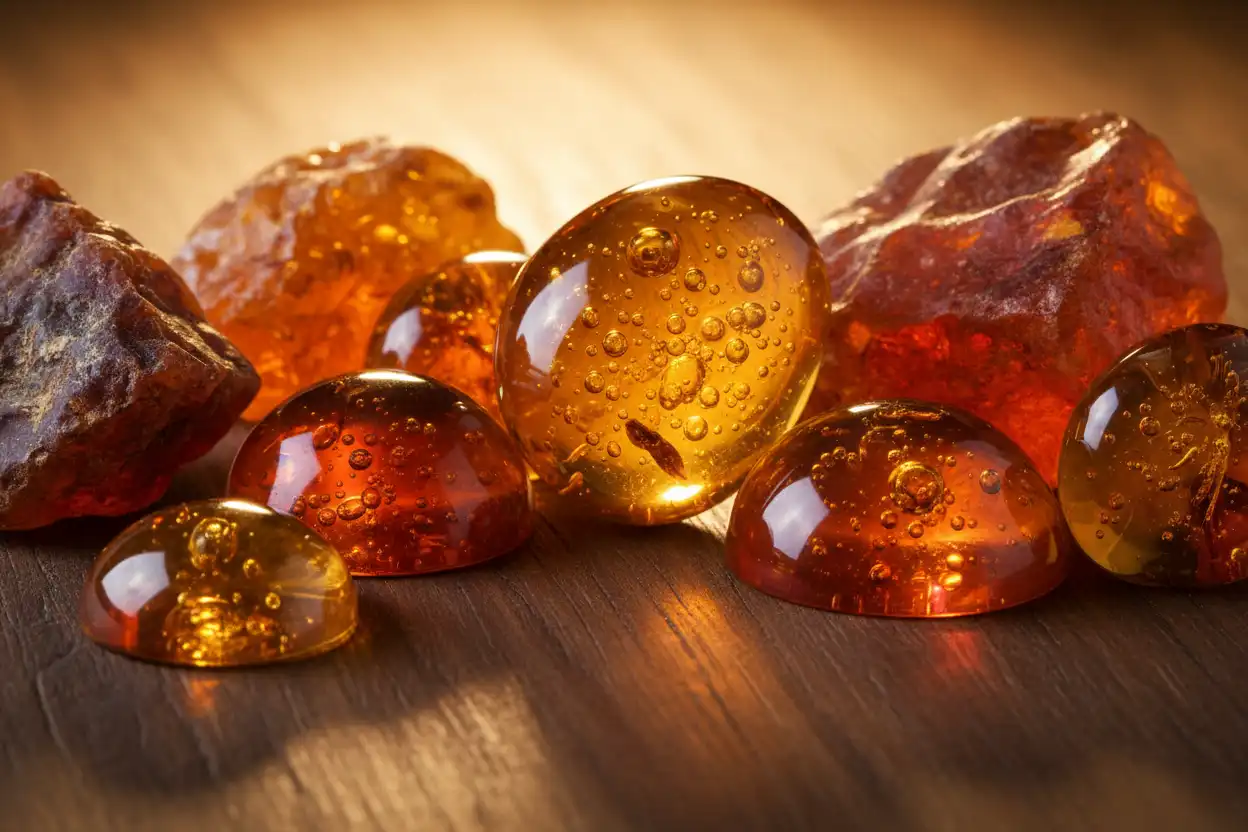
Amber Meaning: Fossil Resin Facts, History & Symbolism
Amber is fossilized plant resin—an organic gem material produced from once-living plants rather than a mineral that crystallized from geological fluids or magma. Its familiar golden appearance, unusually low density, soft resinous surface, preserved biological inclusions, and long archaeological record give amber a character unlike crystalline gemstones, yet those same qualities have also encouraged inaccurate descriptions ranging from “crystallized tree sap” to claims that every insect-bearing piece is ancient and natural.
A defensible explanation of amber meaning therefore begins with material identity. Amber is resin, not sap; it has no crystal system; it does not possess one universally exact mineral formula; and different amber deposits represent fossil resins produced by different plant groups and altered through different geological histories. Only after those distinctions are clear does its historical symbolism—warmth, preservation, memory, protection, continuity, and sunlight—have useful context.
This page treats amber as a material first. Detailed pricing belongs in the amber price guide, treatments are handled separately in treated amber, authentication questions belong in real vs fake amber, and the broader range of commercial and geological varieties is covered in types of amber.
Amber Identity at a Glance
| Property | Amber |
|---|---|
| Material type | Organic gem material |
| Origin | Fossilized plant resin |
| Mineral species | None; amber is not a mineral |
| Crystal system | None; amorphous |
| Chemistry | Complex fossilized organic polymers; composition varies with botanical source and alteration history |
| Common colors | Yellow, golden, orange, brown, reddish brown, white; rarer blue- or green-appearing material occurs |
| Transparency | Transparent to opaque |
| Luster | Resinous |
| Refractive index | Approximately 1.54 |
| Specific gravity | Commonly around 1.08, with natural variation |
| Mohs hardness | About 2–2.5 |
| Optical character | Generally isotropic because it lacks a crystal lattice |
| Typical inclusions | Plant fragments, arthropods, bubbles, debris, flow structures and other trapped material |
| Main durability concerns | Scratching, poor toughness, heat, prolonged light exposure and chemicals |
| Important manufactured form | Pressed or reconstructed amber |
| Common imitations | Plastics, synthetic resins, composites and younger resinous materials |
| Key laboratory method | FTIR spectroscopy is particularly useful for resin characterization |
Calling amber an organic gemstone does not mean it is biologically active today. The term describes its origin from material once produced by living organisms, much as pearl and mother of pearl are organic gem materials derived through biological processes.
Amber nevertheless differs from those materials profoundly. Pearl and nacre are largely mineralized calcium-carbonate structures produced by mollusks, while amber begins as plant resin and becomes a complex fossil organic material.
The distinction is similarly important when comparing amber with abalone shell or ammolite. All can appear in jewelry and all have biological origins somewhere in their history, but they are structurally different materials that require different identification and care.
Amber Is Fossil Resin, Not Tree Sap
“Fossilized tree sap” is one of the most common descriptions of amber, but resin and sap perform different functions in plants.
Sap is primarily the fluid involved in transporting water, dissolved minerals, sugars and other compounds through vascular tissues. Resin is a chemically different secretion rich in organic compounds that many plants produce as part of their defense against injury, insects and pathogens.
Amber derives from resin.
When resin flows from a plant, it can coat bark, fill cracks, drip onto nearby surfaces or trap small organisms and plant fragments. Exposure to air begins chemical changes within the resin, while continued hardening and polymerization increase its resistance to breakdown.
Most resin disappears rather than becoming amber. For fossil preservation to occur, hardened resin must escape extensive weathering, microbial decomposition, fire and physical destruction, then enter geological conditions capable of preserving and progressively altering it.
Burial within sediment is especially important. Continued chemical maturation can further polymerize, cross-link and transform the resin until the material behaves very differently from the original secretion.
The transition is not a single instant at which resin suddenly becomes amber. Fossilization is a continuum, which is one reason the boundary between amber and less mature resinous materials can be scientifically awkward.
Amber Versus Copal Is Not Always a Simple Age Test
Copal is commonly described as younger or less mature resin than amber, but treating one fixed age as the universal boundary creates more confidence than the science supports.
The more useful distinction concerns degree of chemical maturation. Copal retains more characteristics of relatively recent resin and is generally less completely polymerized than mature amber. It can be softer, more soluble and more reactive to certain solvents.
Scientific references themselves acknowledge that the amber–copal boundary is imperfect.
For collectors, the consequence is important: a seller should not establish “amber” merely by stating that a resin is old, while a home solvent test should not be treated as the definitive alternative. Acetone, alcohol and related spot tests can affect resin surfaces and are inappropriate for valuable, polished or historically important specimens.
When the distinction matters, spectroscopic or other physicochemical analysis is preferable.
The dedicated real vs fake amber guide owns the detailed authentication workflow rather than reducing the problem to one destructive test.
How Amber Forms
Amber formation can be understood as a sequence rather than as a recipe.
A resin-producing plant first secretes sticky organic material. The resin may flow repeatedly, forming layers and trapping bark fragments, pollen, leaves, fungal material, arthropods, air bubbles, soil particles or other environmental debris.
The material then hardens through loss of volatile components and chemical reactions among its organic molecules. Polymerization and cross-linking make the resin progressively less soluble and more resistant.
If the hardened resin enters a depositional environment where it survives erosion and decomposition, sediment may bury it. Chemical maturation continues during burial, modifying the original resin into fossil resin.
Later geological processes can expose the amber again.
This last stage explains why amber found on a shoreline did not necessarily form there. Resistant pieces can erode out of sedimentary deposits, move through rivers or coastal processes, and become concentrated elsewhere.
The Baltic region is the most historically important example of extensive secondary distribution. Amber-bearing sediments and later transport processes spread material across a broad area, allowing pieces to be recovered both from terrestrial deposits and along coastlines.
That geological history is one reason a beach-found specimen should not receive a precise provenance solely from where someone picked it up.
Amber Does Not Have One Universal Chemical Formula
Some gem references give amber a simplified composition such as C₁₀H₁₆O. That notation is convenient for introductory identification tables, but amber is not a mineral with a fixed repeating crystal chemistry comparable with quartz or garnet.
Natural amber is a complex mixture and polymeric network of organic compounds whose chemistry depends on the resin-producing plant and subsequent fossilization.
This matters because amber from different geological deposits can be chemically distinguishable.
Baltic amber, for example, exhibits characteristic infrared absorption behavior useful in gemological laboratories. A well-known feature known as the Baltic shoulder can help distinguish Baltic-region material from many other fossil resins through Fourier-transform infrared spectroscopy.
A formula printed beside the word amber should therefore be read as simplified shorthand, not as a universal stoichiometric definition.
A Source-Reconciliation Table for Amber Claims
| Common statement | More precise interpretation | Unsupported conclusion to avoid |
|---|---|---|
| “Amber is a crystal” | Amber is an amorphous organic gem | It has a crystal lattice or crystal system |
| “Amber is fossilized sap” | Amber originates from fossilized plant resin | Sap and resin are chemically interchangeable |
| “Amber has the formula C₁₀H₁₆O” | This can serve as simplified reference shorthand | Every amber deposit has one fixed chemical formula |
| “Copal is just young amber” | Copal is less mature resinous material; the practical boundary can be chemically complex | One visual or arbitrary age rule always separates them |
| “Succinite means all amber” | Succinite is strongly associated with Baltic amber terminology | Every fossil resin worldwide is succinite |
| “Pressed amber is fake plastic” | Pressed amber can be manufactured from genuine amber fragments under heat and pressure | It is equivalent to an untouched natural piece |
| “An insect proves the amber is natural” | Natural amber can preserve organisms | Every insect inclusion is naturally entrapped |
| “Blue amber is naturally blue throughout” | Some amber shows strong blue fluorescence or surface-dominated optical effects | Every blue photograph represents blue body color |
| “Green amber is always natural color” | Naturally greenish appearances occur, but treatment can also create or modify green color | Green appearance establishes untreated status |
| “Sun spangles prove natural clarity” | Discoid stress features can be created during heat clarification | Every decorative spangle formed naturally |
| “Amber floats, so a float test proves it” | Amber has unusually low density and can float in sufficiently dense salt solution | Floating uniquely identifies amber |
| “Rubbing amber proves authenticity” | Amber can develop static charge through friction | Plastics and other materials cannot behave similarly |
| “Amber preserves DNA intact” | Amber can preserve extraordinary morphological fossils | Every inclusion retains usable genetic material |
| “Amber heals the body” | Healing uses occur in historical and modern belief traditions | Medical efficacy has been scientifically established |
The table shows why amber identification benefits from evidence layering. Many popular statements contain a small factual core, but the conclusion attached to that fact is often too broad.
What Makes Amber Yellow, Orange, Red, White, Green or Blue?
Amber’s color depends on its original resin chemistry, chemical alteration, oxidation, microscopic structure, inclusions, weathering and, in some commercial material, treatment.
Yellow, golden and orange are its most familiar colors. Brown and reddish-brown appearances can develop through natural compositional differences and continued oxidation, particularly near surfaces exposed to environmental conditions.
Opaque or whitish amber often contains microscopic structures that scatter light. Tiny bubbles, internal particles and complex flow textures can prevent light from traveling cleanly through the material, creating cream, bone-white or cloudy appearances.
Reddish material can occur naturally, but amber can also be darkened by heating.
Green requires particular caution because both naturally appearing and treated green amber exist. Heat and pressure processing can modify amber’s appearance, so color alone cannot establish an untreated origin.
Blue amber is another source of confusion. Some material, particularly from certain deposits, can display an unusually strong bluish fluorescence when illuminated by suitable shorter-wavelength light. Under other conditions, the same piece may appear yellowish or brownish.
That is not the same optical mechanism as the genuine light-source-dependent color change explained for alexandrite.
A photograph labeled “blue amber” should therefore document illumination conditions before its color is interpreted as a simple body-color description.
Oxidation Changes Amber After It Forms
Amber is not visually frozen forever.
Exposure to oxygen and light can alter its surface chemistry, causing transparent yellow or orange material to deepen toward reddish brown over time. Weathered surfaces may develop a darker crust, fine cracking or reduced transparency.
Polishing removes part of the naturally weathered exterior and exposes fresher material beneath it. That can temporarily make a piece appear lighter and clearer, while also placing a newly polished organic surface directly into the environment.
For old artifacts, this distinction becomes a conservation issue rather than a routine jewelry-cleaning problem. Historical surfaces, oxidation layers and tool marks can contain evidence that should not be removed merely to make the amber look brighter.
Modern jewelry maintenance is covered separately in how to clean amber jewelry.
Diagnostic Characteristics That Actually Help
Amber’s physical properties make it unusual among gem materials, but no single property is infallible.
Very Low Density
Amber commonly has a specific gravity near 1.08, making it surprisingly light for its apparent size.
A large amber bead can therefore feel much lighter than a similarly sized glass or mineral bead. Amber can also float in a sufficiently concentrated salt solution.
That observation is useful but not diagnostic by itself. Some plastics have similarly low density, treatments or inclusions can alter measured values, and an incorrectly prepared salt solution can produce misleading results.
Low Hardness
With a Mohs hardness around 2–2.5, amber scratches much more readily than quartz, garnet, feldspar and most familiar crystalline gemstones.
The property explains its care requirements but should not be deliberately tested on a finished piece.
A scratch obtained by damaging a gem is still weak evidence when numerous plastics and organic materials can also be soft.
Refractive Index
An approximate refractive index around 1.54 is useful on suitably polished material, although curved beads, irregular surfaces and some composites complicate measurement.
Again, the value becomes powerful only when combined with other observations.
Amorphous Structure
Amber lacks a crystalline lattice and is generally isotropic in routine optical examination.
That provides a fundamental separation from birefringent crystalline gems, although molded plastics and glasses can also lack conventional crystal structures.
Fluorescence
Many ambers fluoresce under ultraviolet illumination, but intensity and color vary according to deposit, chemistry, weathering and treatment.
Strong fluorescence can be informative, especially alongside spectroscopy, but fluorescence alone does not prove amber or geographic origin.
Inclusions Are Evidence—Not Automatic Proof
Amber is famous for preserving insects, spiders, plant fragments, pollen, feathers, fungal structures and other biological material. Its inclusions make it scientifically exceptional because resin can preserve three-dimensional morphology with extraordinary detail.
The presence of an insect, however, does not prove that a specimen is natural amber.
Artificial insects can be embedded in modern resins. Genuine amber can be combined with synthetic polymer containing artificial inclusions. Amber fragments can be pressed into reconstructed material, and composite objects can join natural and manufactured sections so convincingly that laboratory spectroscopy is required to map what is actually present.
A dramatic insect inclusion should therefore increase scrutiny rather than eliminate it.
Naturally entrapped organisms also need biological plausibility. Position, interaction with flow structures, preservation state, surrounding debris, fractures and the relationship between the organism and resin layers all contribute useful evidence under microscopy.
Scientific-value inclusions deserve specialist examination before polishing, heating, drilling or aggressive cleaning.
An Original Amber Specimen and Photo Evaluation Checklist
A disciplined image record cannot replace laboratory testing, but it can preserve far more useful evidence than a single polished marketplace photograph.
| Evaluation step | What to document | What the observation can establish |
|---|---|---|
| Record weight and dimensions | Grams plus millimeter dimensions | Whether apparent size is consistent with amber’s low density |
| Photograph front, back and edges | Same neutral background and lighting | Color distribution, surface condition and construction |
| Use transmitted light | Shine controlled light through thinner areas | Flow lines, bubbles, inclusions, joins and internal cloudiness |
| Photograph surface weathering | Crust, crazing, polishing boundaries | Condition and possible alteration history |
| Inspect drill holes | Magnified photographs around holes | Coatings, dye concentrations, chips, pressed texture or joins |
| Photograph biological inclusions from several angles | Relationship to bubbles and resin flow | Preserves evidence for specialist review |
| Look for repeated grain boundaries | Granular or compressed internal texture | Can raise the possibility of pressed or reconstructed amber |
| Record discoid “spangles” | Shape, distribution and relationship to fractures | Can suggest heat-related clarification but is not conclusive alone |
| Compare visible and UV appearance | Same camera position where possible | Documents fluorescence rather than confusing it with body color |
| Retain unedited originals | Preserve camera files before enhancement | Protects the strongest photographic record |
| Preserve labels and provenance | Photograph old tags separately | Maintains locality and collection evidence |
| Avoid hot-needle testing | Do not burn or melt the object | Prevents needless damage and fumes |
| Avoid solvent spot tests on finished objects | Do not apply acetone or alcohol casually | Prevents surface alteration |
| Escalate significant objects | Microscopy, FTIR or other appropriate analysis | Provides evidence beyond appearance |
A strong amber photograph therefore does not need to look dramatic. It needs to preserve the material’s construction, inclusions, surface, scale and lighting conditions accurately.
Pressed Amber Is Still an Important Disclosure
Small pieces of genuine amber can be softened and consolidated under heat and pressure into larger workable material. The resulting product may be called pressed amber, reconstructed amber or ambroid.
Because the starting material can genuinely be amber, calling every pressed piece “plastic” is inaccurate.
It is equally inaccurate to present reconstructed amber as though it were an untouched natural lump.
Manufacturing can create roiled textures, grain boundaries, flattened bubbles, irregular clear and cloudy regions, strain features and other clues detectable through magnification or fluorescence. Modern manufacturing can make interpretation more difficult, particularly when amber particles are mixed with other substances.
The detailed treatment and reconstruction distinctions belong in treated amber.
For this reference page, the disclosure principle is enough: natural material and natural construction are two different questions.
Where Amber Has Been Historically Important
Amber has been collected and worked for personal adornment, ritual objects and trade since prehistoric societies began transporting attractive materials beyond their geological sources.
The Baltic region became the most historically important amber-producing area. Material collected from coastal and sedimentary deposits traveled through extensive exchange networks into other parts of Europe and toward the Mediterranean.
Classical Greek writers knew amber as elektron, a word associated with its bright, sunlike appearance and with the remarkable static charge amber develops when rubbed. The later vocabulary of electricity grew from this long-recognized physical behavior.
Roman authors discussed amber extensively, and some correctly connected the material with tree resin. Amber objects, beads, carvings and amulets became widely traded, while Baltic material continued to move through routes often collectively described as Amber Roads.
The name “Amber Road” should not be imagined as one paved highway. Archaeological evidence instead indicates multiple exchange pathways connecting northern sources with central and southern markets.
Amber’s historical meaning therefore changed with context. It could be ornament, trade commodity, curiosity, protective object, religious material, status marker or scientific specimen.
Why Amber Matters Scientifically
Amber inclusions provide more than decorative novelty.
A resin flow can surround a small organism quickly enough to preserve external anatomy in three dimensions. Continued resin flow may seal the inclusion, while subsequent fossilization preserves a record of interactions that would rarely survive ordinary sedimentary decay.
Researchers can study insects, plants, fungi, microorganisms, feathers and ecological relationships from such material.
This scientific value depends heavily on provenance and authenticity.
An unlabeled polished cabochon containing an insect is not equivalent to a documented fossil specimen recovered from a characterized geological deposit. Geological context determines what ecological and evolutionary conclusions can reasonably be drawn.
That is another reason collectors should resist unnecessary recutting or polishing of unusual inclusion-bearing rough.
Amber Meaning in Symbolic Traditions
Amber’s most enduring symbolic themes arise naturally from what people could observe long before modern spectroscopy existed: its warm color resembles sunlight and fire, it can preserve small organisms, it feels unusually warm and light compared with many stones, and rubbing it can create static attraction.
Those properties encouraged associations with sunlight, vitality, protection, preservation, continuity, memory and warmth.
A responsible modern interpretation can use those themes without converting them into claims about invisible forces.
Someone might associate amber with memory because fossil resin literally preserves traces of past ecosystems.
Another person might use it as a symbol of continuity, because an organic secretion can survive profound chemical and geological change while retaining evidence of its original environment.
Its warm yellow-orange color may serve as a personal symbol of optimism or warmth, while an inclusion can become a reminder that small moments sometimes leave durable records.
These are metaphors grounded in observable features.
They are not measurements of energy emitted by amber.
Does Amber Have Healing Properties?
Amber has appeared in historical and modern healing traditions, but those traditions do not establish medical efficacy.
There is no reliable evidence that wearing amber treats inflammation, infection, pain, anxiety disorders, thyroid disease, digestive problems or other medical conditions through a gemological mechanism.
The fact that amber originated as plant resin does not turn a polished bead into herbal medicine.
Likewise, static electricity produced by rubbing amber is a real physical phenomenon, but it does not demonstrate a therapeutic energy field around a necklace or specimen.
The separate amber healing properties page examines traditional and modern wellness claims within an explicit evidence boundary rather than presenting them as mineral science.
For non-medical ritual practices such as symbolic cleansing, the relevant cultural discussion belongs in how to cleanse amber.
Amber and Other Organic Gem Materials
Amber becomes easier to understand when it is compared with other materials that enter gemology through biological rather than purely mineral processes.
Coral consists of biologically produced skeletal material rather than fossil resin. Fossil coral has undergone mineral replacement and therefore represents a very different fossilization pathway.
Jet is altered woody material rather than resin. It can share amber’s light weight and organic origin but differs substantially in chemistry, appearance and formation.
Ammolite originates from fossil ammonite shell and is prized for iridescence rather than resin transparency.
These comparisons show why “organic gem” is a broad origin category rather than one material family.
Safe Ownership: Amber Is Much Softer Than It Looks
Amber’s greatest everyday vulnerability is its softness.
At only about 2–2.5 on the Mohs scale, it can be scratched by numerous materials encountered in ordinary jewelry storage. Harder gemstones, abrasive dust and careless wiping can leave permanent marks on a polished surface.
Amber also has poor toughness compared with many conventional gemstones, so dropping a piece onto a hard surface can chip or fracture it.
Heat deserves particular caution. Amber is an organic material that can darken, soften or burn when exposed to excessive temperature. This makes steam cleaning inappropriate.
Chemicals are another concern. Solvents, household cleaners, perfume, hairspray and aggressive cosmetic products can attack or dull the surface.
Prolonged exposure to strong light can contribute to darkening and surface alteration.
The conservative routine is therefore straightforward: handle amber gently, keep it away from heat and harsh chemicals, and store it separately from harder gemstones.
The complete cleaning procedure belongs on how to clean amber jewelry rather than being duplicated here.
Jewelry Construction Matters Because Amber Is Light and Soft
Amber’s very low density allows surprisingly large beads and pendants to remain lightweight. That can make substantial-looking amber necklaces comfortable compared with equally large pieces cut from dense minerals.
Light weight does not eliminate construction risks.
Drill holes can chip, thin carved sections can break, and metal findings can abrade soft surfaces if they move repeatedly against the amber.
Amber earrings benefit from low mass, particularly in larger designs, but matched color, secure backs and protected edges still matter.
These are jewelry-engineering questions rather than part of amber’s mineral identity, which is why they remain on their dedicated pages.
What Amber Color or an Inclusion Cannot Tell You About Price
Amber’s value can be affected by color, transparency, size, treatment, provenance, quality of workmanship and, in suitable cases, the scientific or aesthetic significance of natural inclusions.
An insect does not automatically make a piece valuable. The organism’s rarity, completeness, authenticity, visibility, position and documentation matter.
Similarly, “Baltic amber,” “Dominican amber,” “blue amber,” “root amber” and other commercial expressions should not be converted directly into fixed value premiums without examining what is actually being offered.
Those comparisons belong in amber price, while seller selection, return policies and purchase documentation belong in buy amber.
What Amber Meaning Ultimately Describes
Amber meaning becomes most useful when three different kinds of information remain separate.
Materially, amber is fossilized plant resin: an amorphous, very lightweight, soft organic gem with approximate refractive index around 1.54 and specific gravity near 1.08. Its exact organic chemistry varies rather than following one universal mineral formula.
Geologically and scientifically, amber is a transformed resin capable of preserving exceptional evidence of past ecosystems. Formation requires far more than resin simply drying on a tree; preservation, burial and chemical maturation determine whether the material survives as fossil resin.
Historically and symbolically, humans have associated amber with sunlight, warmth, preservation, memory and protection while transporting and working it across extensive cultural networks. Those associations can remain meaningful as history, tradition or personal metaphor without being presented as medical or supernatural facts.
That separation explains what makes amber distinctive.
It is not a crystal that needs mystical properties to become interesting. It is a plant secretion transformed into a durable geological record, an organic gem light enough to float under suitable conditions, a material capable of preserving minute organisms in extraordinary detail, and an object whose archaeological history reflects long-distance human exchange.
For readers exploring comparable material-first references, abalone shell, ammolite, coral, fossil coral, jet, pearl, and the wider Gemstone Guides provide useful contrasts between organic, fossilized and crystalline gem materials.