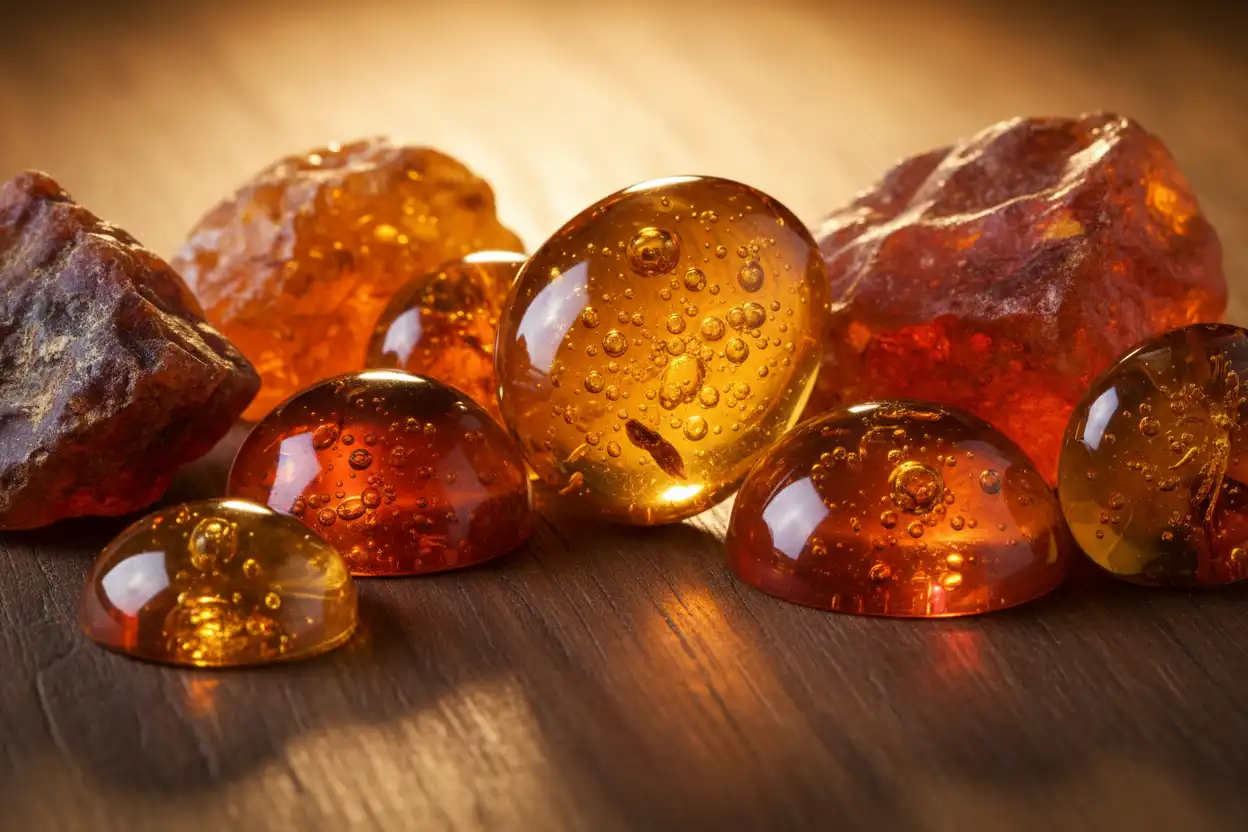
Amber Meaning: 9 Historical & Symbolic Themes Behind Fossil Resin
Amber meaning has developed around sunlight, preservation, warmth, protection, memory, continuity, ancient life, and transformation. Those themes are understandable when the substance itself is considered. Amber began as plant resin, entered sediments, changed over geological time, and sometimes preserved insects, leaves, pollen, or other traces of ecosystems that disappeared millions of years ago. Few gem substances connect the living world and deep geological time so visibly.
The history behind amber meaning is equally important. Amber has been collected, traded, carved, worn, and exchanged for thousands of years. Baltic amber moved across extensive trade networks, while Greek and Roman writers developed stories around its golden appearance, static-electric behavior, origin, and protective reputation. Different communities assigned different uses and beliefs to amber, so no single interpretation should be presented as universal.
Modern amber meaning continues to evolve. People may associate a pendant with family memory, warmth, preservation, personal renewal, or connection with nature. Spiritual interpretations can be meaningful as symbolism, but they should remain separate from claims that amber treats illness or changes the body through an invisible healing force.
9 Amber Meaning Themes Grounded in History, Nature & Symbolism
1. Sunlight and Warmth Shape the Most Familiar Amber Meaning
Golden amber naturally invites comparisons with sunlight. Transparent yellow, honey, orange, and reddish pieces can appear to hold warm light within them, which helps explain why sun symbolism became part of amber meaning in different traditions.
Ancient Greek language also connected amber with the word elektron, a term later associated with electricity because rubbed amber can attract lightweight objects through static charge. Historical explanations of amber’s origin varied, and myth sometimes linked the golden substance with tears, sunlight, or divine events.
Modern interpretations often turn that appearance into themes of warmth, optimism, comfort, or renewed motivation. Someone may wear amber because its color recalls summer light or because the gem is linked with a personally meaningful place.
The stone does not emit emotional warmth in a scientific sense, but visual symbolism can still make sunlight one of the most intuitive aspects of amber meaning.
2. Preservation Gives Amber Meaning a Powerful Connection With Memory
Preservation is one of the most distinctive themes in amber meaning because genuine amber can physically preserve evidence of ancient life. Insects, plant fragments, pollen, fungi, feathers, and other small remains can become trapped in resin before fossilization.
This makes amber an unusually strong symbol for memory. A tiny organism can remain recognizable long after the forest that surrounded it disappeared. The association does not have to be mystical because the fossil record itself supplies the metaphor.
People may therefore connect amber meaning with remembrance, ancestry, family history, or preserving meaningful experiences. An inherited amber necklace can deepen that symbolism because both the fossil resin and the jewelry carry separate layers of time.
The practical amber benefits include this scientific preservation value, particularly when inclusions retain information about ancient ecosystems. Personal meaning can grow naturally from that documented quality.
3. Protection Appears Throughout Amber Lore but Remains Symbolic
Protective beliefs are another long-standing part of amber meaning. Historical cultures used amber in ornaments, amulets, beads, and other personal objects, while later folk traditions attributed protective qualities to it.
Modern crystal practice sometimes expands these traditions into claims that amber shields a person from negative energy, psychic harm, illness, or environmental influences. Those stronger claims have not been demonstrated scientifically.
Protection can still work as a metaphor. Resin originally served biological functions for plants, while hardened amber encloses and preserves some objects trapped within it. Jewelry can also become a reminder to establish boundaries, prepare carefully, or protect something personally important.
Amber meaning is most credible when protective symbolism is described as belief and cultural interpretation rather than as a measurable force surrounding the wearer.
4. Ancient Trade Gives Amber Meaning Themes of Connection and Exchange
Amber traveled remarkable distances in the ancient world. Baltic sources supplied large amounts of fossil resin, and archaeological finds demonstrate that amber reached communities far from northern European coasts through long-distance exchange.
This movement contributes another layer to amber meaning: connection. A small bead could link miners or gatherers, craftspeople, merchants, travelers, and distant owners across regions.
The symbolism can extend naturally to communication and human relationships. Amber represents an object whose appeal crossed languages and borders long before modern transportation.
Historical trade should not be turned into a claim that ancient people everywhere assigned exactly the same spiritual meaning to amber. Its value could be ornamental, economic, social, ritual, or several things at once depending on place and period.
Understanding amber meaning through exchange respects this complexity better than reducing thousands of years of history to one mystical definition.
5. Transformation Is Built Into Amber’s Geological Story
Transformation is another fitting amber meaning because the substance begins as plant resin and changes through burial, chemical alteration, polymerization, and geological time until it becomes fossil resin.
That transition is different from crystal growth. Amber is organic in origin and is not a mineral crystal. Its transformation therefore connects biology and geology in a way that quartz, sapphire, and many other gems do not.
Modern symbolism may use this history to represent gradual personal change. Resin does not become amber instantly, so the metaphor favors patience rather than overnight transformation. Long processes can create something very different from their starting point.
This amber meaning can be personally useful during extended projects, recovery from setbacks, education, or other situations where progress develops gradually. The stone remains a reminder rather than a mechanism causing the change.
6. Amber Meaning Often Includes Continuity Between Past and Present
A piece of amber can be millions of years old while still functioning today as jewelry, a scientific specimen, or a family heirloom. That unusual span makes continuity another natural theme within amber meaning.
An inclusion-bearing piece visibly connects a present-day observer with an ecosystem that existed in deep time. Antique amber jewelry can add another layer by carrying human craftsmanship and ownership history on top of geological history.
For some people, amber therefore represents ancestry, continuity, inherited knowledge, or the idea that the past remains present in subtle ways. An heirloom bead may matter because a relative wore it, not because every piece of fossil resin shares a universal metaphysical property.
This is one area where personal amber meaning can become stronger than generic lists. The history attached to a particular object often matters more than a standardized symbolic description.
7. Amber Meaning Includes Curiosity, Observation & Discovery
Scientific curiosity is an overlooked part of amber meaning. Inclusions have given researchers extraordinary views of ancient insects, plants, behavior, and ecological relationships that might otherwise have disappeared from the fossil record.
A collector examining a genuine inclusion participates in a very different experience from simply admiring color. Questions arise immediately: What organism is preserved? Where did the amber form? How old is the deposit? Is the inclusion natural? What environment once surrounded it?
This curiosity can make amber symbolize observation and learning. The interpretation is especially appropriate for collectors who value paleontology or natural history.
Authenticity matters greatly because modern resin can be used to create convincing imitation inclusions. Learning the clues behind real vs fake amber protects both financial value and the scientific story attached to a specimen.
8. Modern Amber Meaning Often Emphasizes Calmness and Emotional Warmth
Contemporary spiritual literature commonly associates amber meaning with emotional warmth, calmness, confidence, optimism, grounding, and a feeling of safety. Much of that symbolism fits the warm visual character of yellow and orange fossil resin.
A person may use amber during meditation or keep it nearby because its color, texture, history, or family association feels comforting. The subjective experience can be genuine without demonstrating that amber changes brain chemistry or treats a psychological condition.
Claims about amber healing properties become problematic when symbolic calmness is converted into promises involving anxiety disorders, pain, inflammation, teething, thyroid function, or other health problems.
Modern amber meaning remains more defensible when it describes personal association and ritual rather than medical action.
9. Personal History Can Become the Most Important Amber Meaning
The final amber meaning may have little to do with ancient mythology. A pendant bought during travel might represent a particular city. A necklace inherited from a grandparent can symbolize family continuity. Inclusion amber may represent fascination with prehistoric life, while an artisan carving can represent appreciation for skilled handwork.
Personal meaning does not need historical approval. Objects accumulate associations through ownership, gifting, loss, repair, travel, celebration, and memory.
This flexibility also explains why two people can interpret the same amber differently. One sees sunlight, another sees ancient forests, another thinks of family, and another values fossil preservation above symbolism entirely.
Amber meaning works best when documented history, natural science, cultural tradition, and personal interpretation remain distinct enough that none is mistaken for another.
Where the Name Amber Comes From
The English word amber has a complicated linguistic history and should not be confused with ambergris, the waxy substance historically associated with sperm whales and perfumery. The two became linguistically connected even though they have completely different biological origins.
Ancient Greek writers used elektron for amber, and rubbing amber helped inspire terminology that eventually contributed to the modern word electricity because of its ability to develop static charge.
These language connections add depth to amber meaning because they show how one fossil substance influenced both cultural imagination and scientific terminology.
Is Amber Meaning Ancient or Modern?
Both, but the layers should be separated. Ancient societies genuinely used and traded amber, and historical sources preserve beliefs surrounding its origin, symbolism, protection, and value. Modern crystal culture has added further themes such as manifestation, chakra work, energy cleansing, and emotional healing.
The existence of ancient amber traditions does not prove every modern claim descended directly from them. Meanings change as objects move between cultures and periods.
A historically responsible explanation of amber meaning therefore distinguishes archaeological use, recorded folklore, later spiritual traditions, and today’s personal interpretations rather than combining them into one timeless belief system.
Does Amber Color Change Its Meaning?
Modern symbolic lists often assign different meanings to yellow, orange, red, green, blue, or dark amber. These color-based systems can be used personally, but they are not universal historical rules.
Natural amber occurs most commonly in yellow through orange and brown tones, while unusual appearances can arise from structure, fluorescence, oxidation, geological origin, or treatment. Dyed amber also exists.
A buyer should therefore establish whether an unusual color is natural before attaching rarity or historical symbolism to it. Personal amber meaning can be based on color regardless, but gemological identity and treatment should remain separate questions.
Conclusion
Amber meaning has developed from real qualities that already make fossil resin extraordinary. Its golden appearance encourages sunlight symbolism, fossil inclusions connect it with memory, ancient trade suggests human connection, and its transformation from resin into amber naturally represents patience and change.
Protection, warmth, continuity, curiosity, and personal history add further layers. These interpretations become more meaningful when they remain connected with documented history and natural science rather than unsupported medical promises.
FAQs
What Is the Main Amber Meaning?
Amber meaning commonly includes sunlight, warmth, preservation, protection, memory, transformation, continuity, and connection with ancient life.
What Does Amber Symbolize Historically?
Historical symbolism varied between cultures, but amber was widely valued for ornament, trade, amulets, visual beauty, and unusual physical properties.
Why Does Amber Represent Memory?
Genuine amber can preserve insects, plants, pollen, and other ancient biological remains, making preservation and memory natural symbolic themes.
Does Amber Mean Protection?
Protective symbolism appears in historical and modern traditions, but there is no scientific evidence that amber produces a measurable protective energy field.
Why Is Amber Associated With the Sun?
Its yellow, honey, orange, and golden colors resemble warm sunlight, and historical mythology also connected amber with luminous or solar imagery.
Is Amber Meaning Connected to Transformation?
Yes. Fossil resin develops through long geological and chemical processes, making gradual transformation a natural modern metaphor.
Is Amber a Crystal?
No. Amber is fossilized plant resin and is organic in origin rather than a mineral crystal.
Does Amber Color Change Its Spiritual Meaning?
Modern systems sometimes assign different meanings to amber colors, but these are contemporary symbolic interpretations rather than universal historical rules.
Can Amber Meaning Be Personal?
Yes. Family history, travel, collecting, fossil inclusions, craftsmanship, or a significant gift can give one piece a meaning that no generic symbolism can reproduce.
Amber meaning reflects history, culture, spirituality, and personal interpretation; it should not be treated as evidence that amber can replace qualified medical or mental health care.