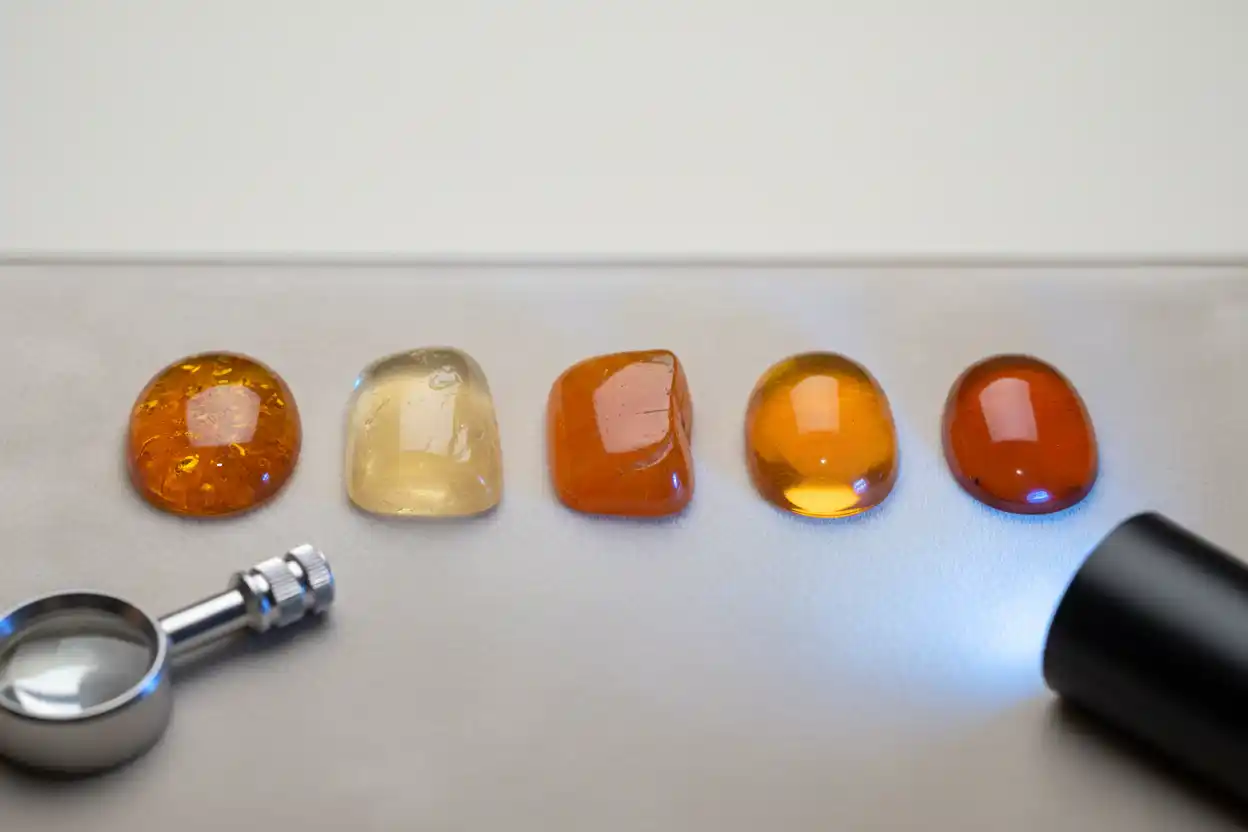
Real vs Fake Amber: Safe Tests, Copal and Imitations
Real amber is fossilized plant resin that hardened and chemically matured over geological time. It is an organic gem material rather than a mineral crystal, and its exact chemistry varies with botanical source, age, burial environment and geographical origin.
Amber imitations include modern plastic, synthetic resin, glass and reconstructed products. A second source of confusion is copal, a younger natural resin that may resemble amber closely and can become harder and more amber-like after heat-and-pressure treatment.
Consequently, the question is not always a simple choice between genuine and fake. A piece may be natural amber, younger copal, pressed amber made from genuine fragments, heat-treated resin, amber filled with polymer, or an unrelated imitation. This page owns the direct identification workflow. The treated-amber guide retains the detailed processes, stability issues and disclosure terminology.
Real Amber vs Copal and Common Imitations
| Feature | Natural amber | Copal | Pressed or reconstructed amber | Plastic or synthetic resin | Glass |
|---|---|---|---|---|---|
| Material | Geologically matured fossil resin | Younger natural resin | Amber fragments consolidated with heat and pressure, sometimes with additives | Manufactured polymer | Manufactured silicate glass |
| Typical hardness | About 2–2.5 Mohs | Often softer or less polymerized | Variable | Variable, often soft | Commonly harder than amber |
| Specific gravity | Commonly near 1.08 | Often similarly low | Variable | Can overlap amber | Usually much higher |
| Refractive index | Commonly near 1.54 | May overlap | May overlap | Variable | Often differs, but some glass can approach amber visually |
| Internal appearance | Flow structures, plant debris, stress features and natural inclusions | Sticky-looking flow, immature resin features and possible surface crazing | Particle boundaries, compressed swirls or granular structure | Molded flow, casting bubbles or artificial inclusions | Round bubbles, homogeneous body and glassy fracture |
| Response to saltwater | Often floats in sufficiently concentrated solution | May also float | May float | Some plastics float | Common glass generally sinks |
| UV fluorescence | Often blue, greenish, yellowish or white, depending on type | May fluoresce similarly | Uneven or granular response may occur | Highly variable | Variable |
| Best confirmation | FTIR or Raman spectroscopy with gemological testing | Spectroscopy and resin characterization | Microscopy and spectroscopy | Microscopy and spectroscopy | Optical properties, density and spectroscopy |
Several columns overlap. That overlap is why the popular saltwater, static and ultraviolet tests can support an assessment but cannot authenticate valuable amber by themselves.
What Is Genuine Amber?
Amber began as sticky resin secreted by ancient trees. After burial, the resin lost volatile components, hardened, cross-linked chemically and underwent long-term molecular changes.
The amber meaning guide owns its formation, history, symbolism and major source regions. The types-of-amber guide compares Baltic, Dominican, Burmese, Mexican and other market categories.
There is no universally accepted age number that separates all amber from copal. Geological age matters, but laboratories focus more reliably on chemical maturity, molecular structure and reference spectra than on an oversimplified age cutoff.
Amber can be transparent, cloudy, opaque or filled with microscopic bubbles. Familiar colors include yellow, honey, orange, cognac and brown, but red, green, cream and blue-appearing varieties also occur.
Amber Is Organic, Not a Mineral Crystal
Amber has no crystalline lattice and does not possess the fixed chemical formula expected from a mineral species.
Its organic composition makes it lightweight, comparatively soft and sensitive to heat, solvents, perfume and abrasion.
A crystal shop may call amber a crystal in the broad metaphysical sense, but fossilized resin is the accurate material description.
That difference also affects testing. Mineral hardness charts and crystal habits provide less useful information than resin structure, density, fluorescence and infrared spectra.
Amber Versus Copal
Copal is natural resin that has not reached the same level of geological and chemical maturity as amber.
It can look nearly identical. Both may be yellow or brown, contain insects or plant matter, feel lightweight and float in concentrated saltwater.
Copal is often more vulnerable to solvents and surface deterioration, but these tendencies vary. Some copal has already hardened substantially, while heat-and-pressure processing can make it resemble amber even more closely.
A seller may use young amber, immature amber or tropical amber as vague alternatives to the word copal. The invoice should state the laboratory-supported material identity rather than relying on romantic trade language.
Advanced treatment can partially polymerize copal and make standard tests inconclusive. FTIR and other spectroscopic techniques are therefore more reliable than one home experiment.
Natural Amber Inclusions
Amber may contain insects, arachnids, feathers, plant fragments, pollen, fungal structures, air bubbles, soil particles and other debris trapped while the resin was sticky.
A genuine biological inclusion does not automatically prove that the surrounding material is natural amber. An insect can be embedded deliberately in modern resin or inserted into a cavity.
Natural inclusions usually interact convincingly with the surrounding flow. Resin may curve around an insect, and fine debris can occur at several depths rather than on one flat plane.
Legs or wings may show natural damage because trapped organisms struggled or decomposed before the resin hardened. However, an intact specimen is not automatically artificial.
The inclusion’s scientific value depends on provenance and expert study. A dramatic insect should never be identified to species from a retail photograph alone.
Suspicious Insect Inclusions
Be cautious when a large, perfectly posed insect sits centrally inside a clear, inexpensive piece.
Modern resin castings may contain common insects arranged with fully spread wings or limbs. A visible insertion channel, flat backing layer or bubble halo can expose the construction.
Some imitations include glitter, modern flowers or colorful objects that would not survive geological burial in their present form.
Even convincing inclusions require examination of the surrounding resin. The correct question is not only whether the insect is real, but whether the host material is mature natural amber.
Pressed and Reconstructed Amber
Small amber fragments can be heated and compressed into larger blocks, beads or decorative objects.
When the material contains only consolidated amber, terms such as pressed amber or reconstructed amber describe it more accurately than solid natural amber.
Microscopy may reveal compressed flow patterns, fragment boundaries, stretched bubbles and granular zones. Ultraviolet examination can sometimes make particle structure easier to see.
Some modern products mix amber powder or fragments with calcite, resin or other fillers. These composites move beyond simple pressed amber and require explicit disclosure.
Pressed material can still contain genuine amber. Its lower rarity, altered structure and possible additives distinguish it from a naturally formed single piece.
Filled Amber
Fractures, cavities or drilled spaces may be filled with epoxy or another polymer.
A filler can improve durability, stabilize an inclusion or make a damaged piece appear cleaner. It can also conceal how much natural amber remains.
Look for differences in luster, bubble shape, fluorescence or refractive behavior along the filled area. A boundary may follow a crack or cavity wall.
Filled amber is not automatically worthless. The treatment should be disclosed, and its price should reflect the altered construction.
Heat-Treated Amber
Heating may clarify cloudy amber, darken its color or create disk-like stress fractures known commercially as sun spangles.
Sun spangles can be visually appealing, but they are commonly treatment-related rather than proof of a naturally trapped prehistoric effect.
Heat and pressure can also produce bright green material from amber or copal. A vivid green body should therefore prompt treatment questions.
The gemstone-treatments guide explains why heat, pressure, filling, coating and reconstruction are separate processes.
Plastic and Synthetic-Resin Imitations
Plastic can imitate amber’s low weight, warm color and translucency easily.
Casting bubbles may be perfectly round or arranged along a mold boundary. Flow patterns can look smooth, repeated or unnaturally symmetrical.
Mold seams are especially useful when present. Inspect bead edges, flat backs and drilled holes for a fine raised line.
Plastic may scratch more readily than amber or produce a different odor when heated, but deliberate burning and hot-needle testing are unsafe and destructive.
Some high-quality resins can imitate amber’s density and fluorescence. A convincing plastic may pass several informal tests.
Glass Imitations
Glass can reproduce amber’s color, transparency and internal bubbles, but it is normally much denser.
A glass bead may feel noticeably heavier than an equal-sized amber bead. However, comparison by hand becomes unreliable when pieces differ in size or contain metal fittings.
Round gas bubbles and curved flow lines can suggest glass. Amber can contain bubbles too, so the complete internal scene must be considered.
Glass usually feels cold at first touch, but room temperature, air conditioning and handling time make this clue weak.
A smooth conchoidal chip looks glass-like, yet amber can also fracture with curved surfaces. Do not break an object to inspect its fracture.
The glass-versus-crystal guide provides the broader distinction between manufactured glass and natural gem materials.
The Saltwater Float Test
Amber’s low density means it commonly floats in a sufficiently concentrated salt solution.
The test requires enough dissolved salt to raise the water’s density above that of amber. Plain tap water is not the same test.
Remove all metal, string, clasps and attached stones first. A mounting can make genuine amber sink or create corrosion.
The method remains only a screening tool. Copal and some plastics also float, while filled, composite or unusually dense material may behave differently.
Saltwater can enter cracks, string holes and porous fittings. Rinse and dry a tested loose piece carefully.
Do not use this test on valuable jewelry, fragile inclusions, unknown adhesives or objects with historical importance.
The Static-Electricity Test
Amber can develop a static charge when rubbed with wool or soft fabric. This historical property contributed to the development of the word electricity.
A charged piece may attract tiny paper fragments, lint or hair.
Plastic can behave similarly, so a positive result does not prove amber. Humidity, surface wax, size and rubbing method also affect the response.
Use the test only as a harmless supporting observation on a stable piece. Do not rub fragile amber aggressively.
Ultraviolet-Light Examination
Many ambers fluoresce blue, blue-white, greenish, yellow or other colors beneath long-wave ultraviolet light.
The precise response varies with source, weathering, oxidation, treatment and bodycolor. Burmese, Baltic, Dominican and other ambers should not be required to fluoresce identically.
Copal and plastic may also fluoresce. Some imitations are designed specifically to copy a familiar blue reaction.
Uneven granular fluorescence can reveal pressed or composite construction. Filling may appear as an area with a different response.
UV remains useful when interpreted comparatively, but it is not a pass-or-fail authenticity test. Wear suitable eye protection and never look directly into the lamp.
Magnification
A 10× loupe provides one of the safest home examinations.
Inspect bubbles, flow lines, particle boundaries, inclusion depth, drill holes and any suspicious surface layer.
Natural amber may show irregular flow, small debris and structures that continue through several depths. Pressed material may show compressed fragments or granular areas.
Plastic can contain round casting bubbles, repeated swirls and mold artifacts. Glass may show bubbles and curved flow.
A clean interior does not prove imitation. Transparent natural amber can be remarkably clear.
Surface and Drill-Hole Clues
Drill holes reveal material that polishing may conceal.
Look for chipping, softened edges, color concentration, resin lining or a different inner body.
Freshly drilled amber commonly produces lightweight shavings rather than hard glass powder, but drilling is a lapidary procedure and should not be attempted for identification.
Surface crazing can occur in aged or poorly stored amber and copal. It does not automatically prove either category.
A thick glossy coating may fill scratches and make a worn piece look newly polished. Examine whether the shine changes at protected recesses.
The Acetone and Solvent Test
Copal and some plastics may soften, become sticky or lose polish when exposed to acetone or alcohol.
Unfortunately, solvents can also damage coatings, fillers, adhesives, stringing materials and some amber surfaces. A negative result does not prove amber because treated copal can become solvent-resistant.
The test therefore risks damage while providing incomplete evidence.
Do not apply solvents to jewelry, carved objects, museum pieces or material containing valuable inclusions.
Why the Hot-Needle Test Should Be Avoided
The traditional hot-needle test relies on odor and melting behavior.
It permanently damages the object, may release irritating or toxic fumes and produces subjective results. Amber, copal and several resins can all smell resinous when heated.
A seller who encourages burning an expensive piece is not offering a professional authentication method.
Microscopy, density, infrared spectroscopy and Raman analysis provide safer information.
Refractive Index and Density
Amber commonly gives a spot refractive-index reading around 1.54 and specific gravity near 1.08.
Copal and some synthetic resins can overlap closely, preventing a definitive separation.
Glass commonly has much greater density, making specific gravity useful when measurements are accurate.
Curved surfaces, inclusions, trapped air and small sample size complicate home measurements.
A gemologist combines these data with fluorescence, microscopy and spectroscopy.
FTIR and Raman Spectroscopy
Fourier-transform infrared spectroscopy examines molecular bonds within the resin.
Reference patterns can separate many natural ambers, copals, treatments and manufactured polymers. Baltic amber may show a characteristic spectral shoulder associated with succinite, although absence of one feature does not resolve every origin question.
Raman spectroscopy provides another molecular fingerprint and can help identify amber, copal, glass, plastic and fillers.
Processed copal can remain challenging because heat and pressure alter its molecular structure. Laboratories may use cautious wording when the starting resin cannot be determined conclusively.
The gemstone-certification guide explains when laboratory testing is proportionate to the purchase.
Color and Locality Claims
Color does not prove locality.
Baltic amber is often yellow, cognac or cream, but similar colors occur elsewhere. Dominican amber is known for blue fluorescence and optical effects, yet not every Dominican piece appears blue.
Burmese amber can be darker and geologically older than many familiar commercial ambers, but visual appearance alone cannot establish Burmese origin.
Green amber may be natural, surface-associated or treatment-produced. Red material may be naturally oxidized, heated or otherwise altered.
The amber buying guide owns locality, quality, inclusion and seller evaluation. The amber price guide retains current market ranges.
Amber Jewelry
An amber necklace minimizes impact but can contact perfume, skin oils and hair products.
Amber earrings are comparatively protected, although posts, glue and settings should still be inspected.
Amber is too soft for an exposed daily ring unless the wearer accepts scratches and surface wear.
Keep amber away from ultrasonic cleaners, steam, alcohol, perfume and household chemicals. The complete physical-care procedure appears in how to clean amber jewelry safely.
Spiritual-practice methods belong in how to cleanse and charge amber and should not involve saltwater, burning or prolonged sun.
Buying Real Amber Online
Request photographs of the exact piece under reflected and transmitted light.
The seller should identify natural amber, copal, pressed amber, filled amber or imitation rather than using genuine resin as a catch-all phrase.
Ask whether color, clarity or shape has been altered by heat, pressure, filling or reconstruction.
An insect inclusion should have magnified photographs and credible provenance. Extraordinary scientific claims deserve independent expert review.
Follow the safeguards in how to buy gemstones online, including a meaningful return period.
A Safe At-Home Screening Sequence
Begin with magnification. Look for mold seams, round casting bubbles, particle boundaries, fillers and suspiciously staged inclusions.
Compare weight with a similarly sized glass object, but treat the result as preliminary.
Use long-wave UV light if available and interpret the reaction as supporting evidence rather than proof.
A saltwater float test may help with a loose, inexpensive, untreated-looking piece, provided it is rinsed and dried immediately.
Review the seller’s disclosure and price. A spectacular inclusion or rare locality offered cheaply deserves skepticism.
Stop before using heat, flame, solvents, scraping or drilling. Seek FTIR or Raman testing when the object is valuable.
Frequently Asked Questions
1. What is real amber?
Real amber is ancient plant resin that underwent long-term geological and chemical maturation.
2. Is copal fake amber?
Copal is genuine natural resin but is less mature than amber. It should be disclosed as copal rather than sold as fully matured amber.
3. Does real amber float in saltwater?
It commonly floats in sufficiently concentrated saltwater, but copal and some plastics may also float. The test is not conclusive.
4. Does real amber always fluoresce blue?
No. Fluorescence varies by source, color, weathering and treatment, while some imitations also fluoresce.
5. Are insects proof that amber is genuine?
No. Modern resin can contain real insects, and inclusions can be inserted into cavities.
6. Is pressed amber real?
It contains genuine amber fragments, but it is reconstructed material rather than one naturally formed solid piece.
7. Is green amber natural?
Some naturally green-appearing amber exists, but bright commercial green amber is frequently produced through heat-and-pressure treatment.
8. Can plastic pass the static test?
Yes. Many plastics develop static electricity, making the test supportive rather than diagnostic.
9. Should I use a hot needle on amber?
No. The test damages the object, releases fumes and cannot provide reliable professional identification.
10. Can acetone distinguish amber from copal?
It may affect some copal, plastics or coatings, but treated copal can resist solvents and valuable amber can be damaged. Avoid the test.
11. What laboratory test is best for amber?
FTIR spectroscopy is one of the most useful tools, often supplemented by Raman spectroscopy, microscopy, fluorescence and density.
12. When should amber be professionally tested?
Testing is appropriate for valuable inclusions, rare locality claims, expensive carvings, suspected composites or disputed amber-versus-copal identity.
Amber authentication becomes more accurate when the categories are kept separate. Natural amber, younger copal, pressed amber, filled amber and plastic imitation may share color, low weight and fluorescence. A trustworthy conclusion combines microscopic structure, physical properties, treatment disclosure and, when value warrants it, molecular spectroscopy.
Amber appears in Crystals That Start With A and Gemstones That Start With A.