Andalusite Meaning: Mineral Identity, History & Symbolism
Andalusite meaning begins with an aluminium silicate mineral, not with a spiritual claim. Andalusite has the ideal composition Al₂SiO₅ and crystallizes in the orthorhombic system. It shares that chemistry with kyanite and sillimanite, but the three are separate mineral species because their atoms are arranged differently. Andalusite is particularly associated with relatively low-pressure metamorphic conditions, making it useful to geologists as an indicator of the physical environment through which aluminium-rich rocks have passed.
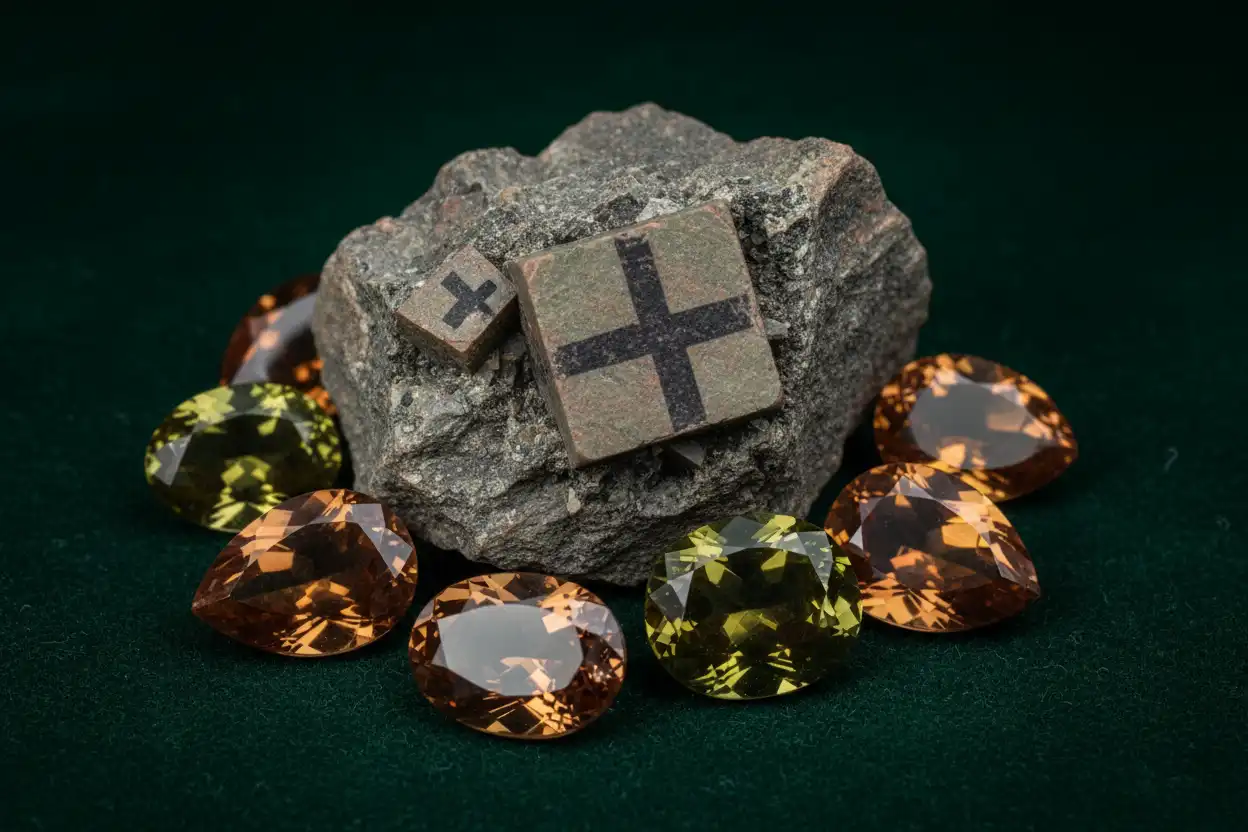
Gem-quality andalusite adds another distinctive characteristic: strong pleochroism. A transparent stone can transmit noticeably different colors along different crystallographic directions, commonly combining greenish, yellowish, orangy, brownish, and reddish tones. This directional color is part of the mineral’s optical behavior, not evidence that several different gemstones have been fused together. GIA examinations of faceted material document strong pleochroism, biaxial optical character, refractive indices in the mid-1.63 to mid-1.65 range, and specific gravity close to 3.1.
Modern symbolism often associates andalusite with perspective, balance, resilience, or seeing an issue from more than one angle. Those interpretations can function as personal metaphors, especially for a mineral whose visible color literally changes with orientation, but they are not scientifically measured effects. The mineral facts, documented history, cultural traditions, and modern symbolism should remain separate.
Readers exploring related minerals can browse the broader Gemstone Guides. This page owns the definition andalusite as a material first; detailed color evaluation, pricing, buying, treatment questions, cutting, and other specialized subjects remain with their dedicated guides.
Andalusite Identity at a Glance
| Property | Andalusite |
|---|---|
| Mineral class | Nesosilicate |
| Ideal formula | Al₂SiO₅ |
| Crystal system | Orthorhombic |
| Structural relationship | Polymorph of kyanite and sillimanite |
| Common colors | Pink, reddish brown, brown, yellow, green, gray, white; violet is uncommon |
| Gem appearance | Commonly greenish to brownish pink with strong directional color |
| Transparency | Transparent to opaque |
| Luster | Vitreous to subvitreous; occasionally greasy |
| Mohs hardness | Approximately 6.5–7.5 |
| Specific gravity | Approximately 3.13–3.21 |
| Optical character | Biaxial |
| Notable optical trait | Often strongly pleochroic |
| Common crystal habit | Prismatic crystals with nearly square-looking cross sections |
| Important variety | Chiastolite, with characteristic dark cruciform inclusion patterns |
| Typical geological role | Metamorphic index mineral, especially in relatively low-pressure settings |
| Identification limit | Color or pleochroism alone cannot establish species, treatment, or provenance |
Andalusite is therefore harder than many collector minerals but should not be described as indestructible. Cleavage, fractures, inclusions, edge geometry, and the orientation of a fashioned stone all affect practical durability. Mineral references place hardness across a fairly broad range, which is another reminder that one numerical property never describes an entire gemstone’s resistance to damage.
Andalusite, Kyanite, and Sillimanite: Same Formula, Different Minerals
One of the most useful facts for understanding andalusite is its relationship with kyanite and sillimanite. All three have the overall composition Al₂SiO₅, but each has a different crystal structure. Because those structures are favored under different combinations of temperature and pressure, geologists use their presence and textural relationships to interpret metamorphic histories.
Andalusite is particularly characteristic of comparatively low-pressure metamorphism. It commonly develops in aluminium-rich sedimentary rocks that have been altered by heat, including contact aureoles surrounding igneous intrusions, although its geological occurrence is more varied than the simplified phrase “contact-metamorphic mineral” suggests. Aluminium-silicate phase relationships are valuable precisely because changes between andalusite, kyanite, and sillimanite can preserve evidence of changing metamorphic conditions.
The full interpretation of pressure-temperature fields, metamorphic reactions, host rocks, veins, igneous occurrences, and deposit history belongs in Andalusite formation and deposit geology. For this meaning reference, the central point is that chemistry alone does not define the mineral; structure and geological context matter.
How Andalusite Forms
Andalusite most famously grows when aluminium-rich rocks undergo metamorphism under conditions where the andalusite structure is stable. Mudrocks and similar sedimentary precursors can provide abundant aluminium, while nearby igneous intrusions can supply the heat needed for recrystallization. New crystals may grow as porphyroblasts within slate, schist, hornfels, and related metamorphic rocks.
Formation is not restricted to one pathway. Geological research also documents andalusite in peraluminous felsic igneous rocks, including granitic and pegmatitic environments, where textural evidence may distinguish crystals formed directly or indirectly from magmatic processes from crystals inherited from surrounding metamorphic rocks. The origin of an individual crystal can consequently require petrographic relationships, inclusions, chemistry, and host-rock evidence rather than a simple rule based on shape.
This matters for specimen interpretation. A prismatic andalusite crystal in mica-rich metamorphic matrix and a transparent gem pebble recovered from secondary sediment may have very different immediate geological settings even though both are the same mineral species. Weathering can liberate durable crystals from their original host, after which they may become concentrated in sediment.
Why Andalusite Shows Different Colors
Andalusite is famous for directional color, but “what causes andalusite color?” has no single answer that applies identically to every specimen. Natural stones can contain iron, titanium, manganese, chromium, vanadium, and other minor components in different combinations, and the optical effect of these elements depends on where they reside within the structure and how they interact electronically.
Research on gem andalusite has linked orangy-brown absorption to iron-titanium intervalence interactions in some stones, while green components can involve iron-related absorption and, in some material, contributions from other transition elements. Vanadium- and chromium-bearing andalusite has also been studied spectroscopically, demonstrating that unusual compositions can produce distinctive absorption and pleochroism.
The important evidence boundary is that a stone’s visible hue does not prove its trace-element chemistry. A green andalusite cannot responsibly be declared “chromium colored” merely from a photograph, and reddish-brown coloration should not automatically be assigned to manganese. Spectroscopy and chemical analysis are required when the specific chromophore matters.
The dedicated Andalusite color meaning guide owns the detailed discussion of natural color variation, lighting, zoning, treatment uncertainty, grading, and human interpretations of color.
Pleochroism Is Central to Andalusite’s Visual Identity
Pleochroism occurs when a doubly refractive mineral absorbs light differently along different crystallographic directions. Andalusite is biaxial and can display strong directional differences, producing combinations such as yellowish green, brownish green, brownish pink, orangy red, or related hues depending on the specimen and viewing direction.
In a faceted stone, those colors do not necessarily appear as three tidy blocks. The cutter’s orientation, facet arrangement, internal reflection, stone thickness, and viewing direction blend the pleochroic components into the face-up appearance. GIA research emphasizes that pleochroism can influence the visible appearance of a finished gem in more complicated ways than the paired windows seen through a dichroscope.
This is one reason two andalusites cut from similar-looking rough can face up very differently. A lapidary may orient one stone to emphasize green while another displays a stronger mixture of brownish pink and green. The underlying optical physics belongs in Andalusite optical properties and color behavior, while the physical orientation choices belong in the separate cutting guide.
Andalusite Diagnostic Traits
A transparent andalusite commonly combines several useful clues: strong pleochroism, refractive indices around the mid-1.63 to mid-1.65 range, specific gravity close to 3.1, biaxial optical character, moderate-to-high hardness, and inclusions or zoning appropriate to natural material. GIA research on Brazilian gems documented green, yellowish green, brownish green, brownish pink, bicolored, and chiastolite-bearing specimens together with characteristic microscopic growth and inclusion features.
No one property is enough in isolation. Tourmaline, certain zoisites, some quartz-related appearances, and other colored stones can create visual confusion for non-specialists. Strong pleochroism narrows the possibilities but still needs to be interpreted with refractive index, optic character, density, microscopy, spectroscopy, and other observations where identification matters.
The Andalusite microscope inclusion notebook owns detailed microscopic observations such as growth structures, fractures, mineral inclusions, fingerprints, zoning, and other internal features. This page only establishes why those observations matter.
Chiastolite Is Andalusite, Not a Separate Mineral
Chiastolite is a variety of andalusite distinguished by an organized pattern of dark inclusions that commonly forms a cross when a suitable prismatic crystal is cut across its length. The pattern can contain graphite or other carbonaceous material together with quartz and related inclusions, depending on the specimen and locality.
Detailed research on chiastolite growth shows that the cross is not painted onto the stone and is not a mystical marking added after crystallization. It records how inclusions became organized as the andalusite porphyroblast grew within its metamorphic environment. Studies of well-developed material document graphite-rich zones and fine quartz inclusions associated with this growth structure.
The cross can vary considerably in width, symmetry, central shape, and completeness. Some sections display a strong four-armed pattern, while others contain rhombic centers, irregular dark sectors, or only partial crosses. The variety name describes the inclusion pattern; it does not define a different chemical species.
An Original Claim-Reconciliation Table for Andalusite
Andalusite attracts several persistent naming and symbolism claims. Separating them by evidence level prevents historical terminology and modern marketing from being confused with mineral science.
| Claim or name | Evidence assessment | Better interpretation |
|---|---|---|
| “Andalusite is an aluminium silicate” | Supported | It is the Al₂SiO₅ mineral andalusite |
| “Andalusite, kyanite, and sillimanite are the same mineral” | Incorrect | They share chemistry but have different structures and are separate mineral species |
| “Chiastolite is a separate gemstone species” | Incorrect | Chiastolite is an inclusion-pattern variety of andalusite |
| “The cross in chiastolite was carved into the stone” | Incorrect for natural chiastolite | The pattern forms from inclusions organized during crystal growth |
| “Every brown-green pleochroic stone is andalusite” | Unsupported | Pleochroism is useful evidence but identification needs additional properties |
| “Green andalusite is always chromium colored” | Unsupported | Color mechanisms vary; chemistry must be demonstrated |
| “Andalusite comes from Andalusia” | Historically misleading | The name arose from an incorrect geographic assumption about early Spanish material |
| “Andalusite is naturally tricolored in three fixed zones” | Misleading | Pleochroic colors depend on crystallographic direction and optical path, not three mandatory color bands |
| “Chiastolite has scientifically proven protective power” | Unsupported | Protection symbolism is cultural or personal, not a measured mineral property |
| “Andalusite heals the body” | Unsupported medical claim | No established gemological or medical evidence demonstrates healing effects |
This table also explains why the proposed “without the myths” approach is useful. Several inaccurate statements begin with a genuine observation—the same chemistry as kyanite, a natural cross in chiastolite, or visibly different colors—and then extend it beyond what the evidence actually establishes.
The Name Andalusite Carries a Geographic Error
Andalusite received its name because early European mineralogists believed the Spanish material being examined came from Andalusia. Later historical investigation indicates that the material was probably associated instead with El Cardoso in the province of Guadalajara. The mineral name remained even after the geographic misunderstanding became apparent.
That history is more instructive than a manufactured ancient gemstone legend. Mineral names often preserve the limitations of historical information, translations, locality assumptions, and early classification. Andalusite literally carries one of those mistakes forward in an internationally accepted name.
The lesson also applies to modern provenance. A seller’s locality statement can be valuable, but geography should be supported by documentation rather than inferred from color or trade habit. The Andalusite provenance and disclosure checklist provides the appropriate framework for examining labels, invoices, collection records, locality claims, treatment disclosure, and documentation.
The Documented Cultural Story of Chiastolite
Chiastolite’s cross-shaped inclusion pattern naturally attracted cultural attention. Older European records referred to cross stones, and specimens from northern Spain became associated with devotional use, pilgrim traditions, protective objects, and souvenirs. The visual association is understandable: a dark cruciform pattern can be immediately recognizable when the crystal is cut in the correct orientation.
This cultural history should be described carefully. A documented tradition involving cross-shaped stones is not evidence that the mineral itself possesses supernatural protective power. It shows that people assigned meaning to a naturally occurring visual pattern.
The distinction matters because later crystal literature can collapse mineral history, religious symbolism, folklore, and contemporary metaphysical claims into one continuous story. They are not the same evidentiary category.
What Andalusite Meaning Can Responsibly Symbolize
Modern andalusite symbolism often centers on perspective, balance, resilience, self-examination, transition, and the ability to see more than one side of a problem. The connection with perspective is particularly intuitive because pleochroic andalusite really does present different colors when viewed along different optical directions.
Someone may therefore choose a stone as a reminder to reconsider an assumption, compare several interpretations before acting, or recognize that one object can present different appearances without changing its underlying identity. That is a meaningful metaphor grounded in an observable feature.
It remains a metaphor.
There is no established scientific evidence that andalusite clears emotional trauma, balances hormones, treats illness, removes toxins, changes blood pressure, guarantees protection, attracts a partner, improves finances, or produces a measurable spiritual field. The broader distinction between mineral facts and belief claims is stated in the Gems Lore disclaimer.
Chiastolite Symbolism Needs the Same Boundary
Because chiastolite naturally displays a cross-like pattern, it has accumulated particularly strong protective and religious associations. A person can wear or keep chiastolite because that symbol is personally significant, culturally familiar, visually interesting, or connected with a particular devotional tradition.
What should not happen is the conversion of symbolism into a physical guarantee. A chiastolite pendant cannot be relied upon to prevent accidents, illness, violence, financial loss, or other real-world hazards. Personal symbolic use should complement—not replace—ordinary safety decisions.
This distinction respects both mineralogy and culture. It allows the stone’s historical associations to be acknowledged without rewriting them as laboratory findings.
Original Andalusite Specimen and Photo Evaluation Checklist
When evaluating an andalusite specimen or online photograph, record what can actually be seen before drawing conclusions about chemistry, treatment, locality, or value.
| Observation | What it can support | What it cannot prove alone |
|---|---|---|
| Green-to-brown color variation as the stone moves | Possible strong pleochroism | Andalusite identity |
| Nearly square prismatic crystal section | Habit compatible with andalusite | Exact mineral species |
| Dark natural cross in a transverse section | Strong support for chiastolite-type inclusion structure | Specific locality |
| Transparent brown-green faceted stone | Appearance compatible with gem andalusite | Treatment status |
| Sharp internal color boundary | Possible zoning | Whether color is natural or treated |
| Mica-rich metamorphic matrix | Plausible geological association | Exact pressure-temperature history |
| Seller label naming a mine or country | Provenance information worth preserving | Independent proof of origin |
| Surface-reaching fracture | Relevant condition observation | Whether resin has been introduced |
| Strong directional colors in video | Useful optical evidence | Trace-element chemistry |
| Raman or other analytical match | Strong species evidence | Geographic provenance or commercial value |
The checklist deliberately distinguishes observation from interpretation. A photograph can show pleochroic-looking color, but it cannot measure refractive index. A cross-shaped inclusion pattern can strongly support chiastolite, but it cannot prove where the stone was mined. A seller description can provide provenance evidence, but it is not equivalent to an independently verified geological origin.
Andalusite Treatments Should Not Be Guessed
Gemological studies have examined attempts to alter andalusite appearance, including heating and fracture filling. Results show why broad claims such as “andalusite is never treated” should be avoided. In studied Brazilian material, heating produced little or only subtle color modification, while resin filling could make fractures substantially less apparent.
That does not mean every andalusite is treated, nor does it justify diagnosing filling from a normal photograph. It simply establishes that treatment is possible and that disclosure matters.
Questions about choosing a seller, requesting treatment information, interpreting reports, and comparing offerings belong to buy andalusite, while commercial value and market methodology belong to the dedicated Andalusite price guide.
Andalusite as a Gem and Collector Mineral
Transparent andalusite can produce distinctive faceted stones because its strong directional colors create an appearance few conventional gems reproduce exactly. A cutter must decide how to orient the rough so the final face-up color balances the different pleochroic components rather than allowing an undesirable direction to dominate.
That orientation decision can sacrifice weight. A theoretically heavier cut may not be the most visually effective cut if it presents muddy or overly dark colors, while a smaller stone may display a much more attractive balance. Those lapidary decisions belong in Andalusite cutting, orientation, and polish.
Opaque chiastolite presents a different objective. Rather than maximizing brilliance, the lapidary often wants a transverse section that preserves the clearest natural cross pattern. Treating transparent gem andalusite and chiastolite as though they should be cut according to the same visual priorities would therefore be a mistake.
Practical Durability and Safe Ownership
Andalusite’s hardness makes it more scratch resistant than softer collector minerals, but hardness is only one aspect of durability. Faceted stones may contain fractures, inclusions, or vulnerable edges, while chiastolite carvings and cabochons can contain inclusion-rich sectors and altered material that behave differently from clean transparent crystals.
A protective jewelry design can reduce exposure to impacts, particularly around corners and thin edges. The mechanical implications of prongs, bezels, exposed girdles, stone orientation, and daily wear belong to Andalusite setting and wear engineering rather than being repeated here.
For loose specimens, prevent unnecessary contact with harder minerals and avoid destructive testing on valuable or well-documented crystals. If a specimen retains its original matrix, old collection labels, or documented locality, preservation of that context may be more important than making the surface look cleaner.
Long-term storage, repairs, label preservation, adhesives, matrix stability, and collection records are addressed in the Andalusite specimen conservation record.
Avoid Creating Dust Unnecessarily
Normal ownership of an intact andalusite gem or specimen is fundamentally different from cutting or grinding mineral material. Lapidary operations can generate fine particulate dust from the stone and any associated matrix or inclusions.
Use ordinary professional lapidary controls when sawing, grinding, or polishing: wet methods where suitable, effective local dust control, clean work practices, and appropriate respiratory protection for the process. Do not intentionally inhale mineral dust simply because the starting specimen is natural.
This guidance is proportionate rather than alarmist. A polished andalusite on a shelf does not present the same exposure pathway as mechanically reducing rough material into airborne particles.
Andalusite Identification Has Limits
Pleochroism is often treated as the headline feature of andalusite, but identification should never become “it changes from green to brown, therefore it must be andalusite.” Gemological identification works by convergence: multiple observations agree.
Refractive index, biaxial behavior, birefringence, specific gravity, pleochroism, absorption, inclusions, and spectroscopy can all contribute. Raman spectroscopy can provide especially useful species-level confirmation when the distinction between aluminium-silicate minerals matters.
Even a laboratory identification does not necessarily prove geographic origin. Likewise, a locality report does not automatically determine market value. Each question needs evidence designed to answer that question.
The editorial principle used throughout Gems Lore is described on About Gems Lore: measurable properties, historical documentation, practical observations, and symbolic claims should not be presented as interchangeable forms of evidence.
Why Andalusite Is More Interesting Without Exaggeration
Andalusite needs little embellishment. A single mineral species can preserve metamorphic pressure-temperature information, share chemistry with two structurally different minerals, form transparent pleochroic gems, develop inclusion-rich chiastolite crosses, preserve complex growth histories, and carry a name born from a geographic misunderstanding.
Those characteristics are already unusually rich.
Reducing the mineral to “a manifestation crystal” discards most of what makes it distinctive. At the opposite extreme, dismissing all symbolism ignores the genuine history of humans assigning meaning to unusual natural forms such as the chiastolite cross.
A better interpretation keeps the layers separate: mineral structure belongs to mineralogy, geological setting belongs to petrology, gem appearance belongs to gemology, cross-stone traditions belong to cultural history, and modern metaphysical associations belong to personal belief.
Frequently Asked Questions
What is andalusite?
Andalusite is an aluminium silicate mineral with the formula Al₂SiO₅. It crystallizes in the orthorhombic system and is structurally distinct from the chemically equivalent minerals kyanite and sillimanite.
What is andalusite meaning in mineralogy?
In mineralogical terms, andalusite refers to a specific Al₂SiO₅ mineral structure commonly associated with relatively low-pressure metamorphic environments. “Meaning” in this scientific context concerns its identity, properties, and geological significance rather than spiritual effects.
What colors can andalusite be?
Natural andalusite can be pink, reddish brown, brown, yellow, green, gray, white, and occasionally other subdued tones. Transparent gem material commonly combines greenish and brownish-pink or orangy colors because of strong pleochroism.
Why does andalusite look like several colors at once?
Andalusite is strongly pleochroic. Its crystal structure absorbs polarized light differently along different directions, so a faceted stone can present multiple directional colors simultaneously through its facet pattern.
Is andalusite a color-change gemstone?
Pleochroism should not automatically be described as conventional color change. Much of andalusite’s multicolored appearance results from viewing different crystallographic directions, facet reflections, and optical path lengths. Lighting can affect appearance, but directional pleochroism is central.
Is chiastolite the same as andalusite?
Chiastolite is a variety of andalusite containing organized dark inclusions that commonly form a cross pattern when the crystal is cut perpendicular to its length. It is not a separate mineral species.
What creates the cross inside chiastolite?
The cross is produced by inclusions, commonly involving carbonaceous material and quartz, organized during crystal growth. It is a natural growth feature rather than a carved or painted mark.
Is andalusite the same as kyanite?
No. Andalusite and kyanite have the same overall chemical formula, Al₂SiO₅, but their crystal structures differ. They are separate mineral species favored by different pressure-temperature conditions.
Is andalusite the same as sillimanite?
No. Sillimanite is another Al₂SiO₅ polymorph with its own crystal structure and stability conditions. Shared chemistry does not make the minerals interchangeable.
Where does andalusite form?
Andalusite is strongly associated with metamorphism of aluminium-rich rocks, particularly under comparatively low-pressure conditions. It is common in contact-metamorphic environments but can also occur in other metamorphic and certain felsic igneous settings.
How hard is andalusite?
Its reported Mohs hardness is approximately 6.5–7.5. That gives useful scratch resistance, but fractures, cleavage, inclusions, and impact vulnerability still matter when evaluating durability.
Is andalusite rare?
Andalusite as a rock-forming or industrial mineral is not extraordinarily rare, but transparent gem-quality material combining attractive color, clarity, cut potential, and strong pleochroism is much less common than ordinary metamorphic andalusite.
What does andalusite symbolize?
Modern symbolism commonly connects andalusite with perspective, balance, resilience, self-reflection, or considering multiple viewpoints. These associations are interpretations rather than scientifically measurable properties.
What does chiastolite symbolize?
The natural cross pattern has been associated historically with devotional and protective symbolism. Modern users may continue those associations, but no scientific evidence demonstrates supernatural protection.
Does andalusite have healing properties?
There is no established scientific evidence that andalusite treats disease, changes bodily functions, or provides medical healing. Crystal-healing claims belong to belief traditions rather than evidence-based medicine.
Can andalusite protect someone from harm?
There is no scientific basis for relying on andalusite or chiastolite for physical protection. A stone can hold symbolic protective meaning without replacing ordinary safety measures.
Can andalusite be treated?
Treatment is possible. Gemological research has examined heat and fracture filling in andalusite, so a seller should not make broad treatment claims without appropriate disclosure or evidence.
Can a photo identify andalusite?
A photograph can show color, apparent pleochroism, crystal habit, matrix, inclusions, or a chiastolite pattern, but it cannot normally establish a complete gemological identification by itself. Additional physical or analytical testing may be required.
Should an old andalusite specimen be removed from its matrix?
Not automatically. Matrix, attached minerals, old labels, and collection history can preserve geological and provenance information. Removing a crystal may reduce that context even if the isolated mineral appears cleaner.
What should I do if an andalusite specimen has an uncertain label?
Preserve the original label and photograph it with the specimen rather than discarding it. Compare the locality claim with known mineral associations and documentation, and seek specialist evaluation when the provenance materially affects scientific or collecting significance. For questions requiring more context, contact Gems Lore.
Andalusite meaning is most defensible when the mineral remains at the center of the story. It is an orthorhombic aluminium silicate whose structure distinguishes it from kyanite and sillimanite, whose occurrence records metamorphic conditions, and whose exceptional pleochroism can turn one transparent crystal into a complex mixture of green, brown, yellow, pink, and orange as light travels through different directions.
Its human story adds separate layers. A geographic misunderstanding became permanently embedded in the mineral’s name. Chiastolite’s natural cross attracted cultural and devotional interpretations. Modern users have extended those observations into themes of perspective, balance, resilience, and protection. Those meanings can be personally significant without being recast as measurable powers.
Keeping mineral fact, history, symbolism, and belief distinct is not a reduction of andalusite. It reveals how much the material already contains without requiring myths to stand in for evidence. Gems Lore handles personal information submitted through its site under the Privacy Policy.