11 Andalusite Benefits: Pleochroic Color, Jewelry Use & Geological Value
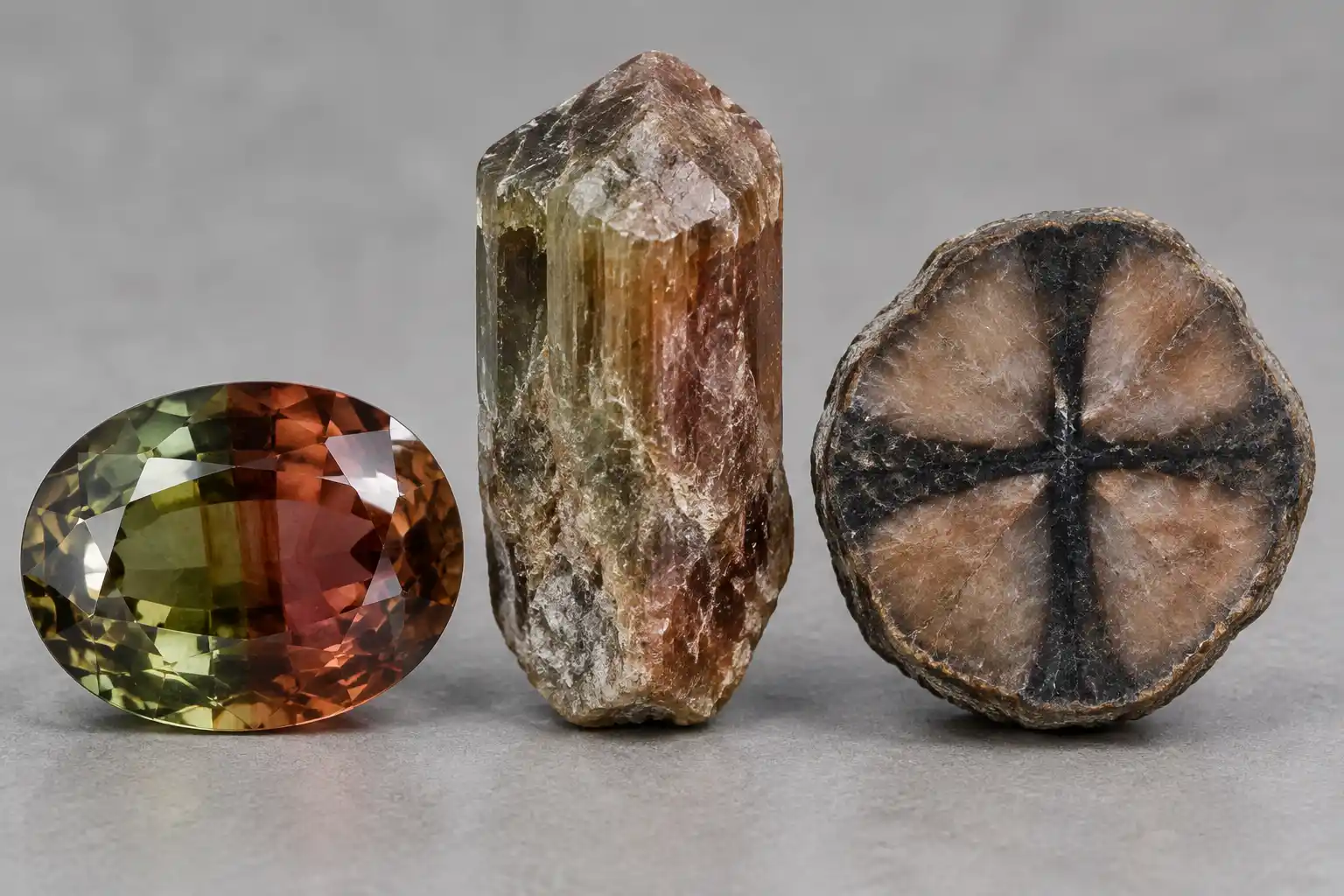
Andalusite benefits begin with exceptional pleochroism. A well-cut transparent andalusite can show green, yellow-green, brown, orange, reddish, or pinkish colors from different crystallographic directions, sometimes allowing several hues to appear across one faceted gem at the same time. That natural multicolor effect gives andalusite an identity very different from stones whose appearance depends mainly on one body color.
Andalusite is an aluminum silicate with the formula Al₂SiO₅ and belongs to the orthorhombic crystal system. It shares the same chemical formula with kyanite and sillimanite, but each has a different crystal structure and forms under different pressure-temperature conditions. This relationship makes andalusite valuable not only as a gemstone but also as an important mineral for understanding metamorphic geology.
The most useful andalusite benefits therefore span gemology, jewelry, lapidary cutting, collecting, mineral identification, geological interpretation, and personal symbolism. Transparent gem-quality crystals are much less common than ordinary opaque andalusite, while chiastolite provides a distinctive opaque variety whose dark inclusions can form a visible cross pattern.
11 Andalusite Benefits at a Glance
- Strong pleochroism can display several natural colors within one faceted gemstone.
- Careful cutting can create striking green, brown, red, and golden color combinations.
- Mohs hardness around 7 to 7.5 provides useful scratch resistance for jewelry.
- Transparent gem-quality andalusite remains uncommon enough to interest collectors.
- Chiastolite offers a distinctive cross-patterned variety for cabochons and collector pieces.
- Andalusite teaches how crystal orientation affects the color of a faceted gem.
- Its relationship with kyanite and sillimanite provides important lessons in metamorphic geology.
- Natural crystal forms add specimen value beyond finished jewelry.
- Relative obscurity can offer individuality to buyers who want an uncommon gemstone.
- Color, cut, transparency, pleochroism, and size provide clear quality factors for informed buying.
- Modern symbolism can add personal meaning without replacing the gem’s verified physical qualities.
Strong Pleochroism Leads the Most Distinctive Andalusite Benefits
Pleochroism is the ability of an anisotropic crystal to show different colors when viewed along different crystallographic directions. Andalusite is especially notable because the effect can be strong enough to reveal greenish, reddish, brownish, or yellowish colors within the same faceted stone.
This differs from color change caused by switching light sources. Alexandrite changes appearance largely because different illumination contains different spectral proportions. Andalusite’s pleochroism arises because light traveling through different crystal directions experiences different selective absorption.
A cutter can orient the rough so multiple pleochroic colors remain visible through the crown. As the stone moves, facet reflections may emphasize different combinations.
Among andalusite benefits, this effect is particularly valuable because it produces a multicolor appearance without dye, coating, or assembling several gemstones together.
Andalusite Benefits Skilled Cutting More Than Many Single-Color Gems
Pleochroism makes cutting one of the most important parts of andalusite quality. Orientation determines which colors dominate face-up and whether the finished stone looks lively, muddy, dark, or beautifully multicolored.
Long shapes such as ovals, marquise cuts, and elongated rectangles can display contrasting color zones effectively. Some stones show a greener center with brown or reddish ends, while other cuts blend several hues into a mosaic of colored reflections.
A poor orientation can sacrifice the most attractive pleochroic direction. An overly deep cut can create unnecessary darkness, while shallow proportions may produce windowing and reduced brilliance.
This relationship between orientation and appearance makes cutting skill one of the strongest andalusite benefits for students of gemology. The cutter is not simply choosing shape. The cutter is deciding how the crystal’s directional colors will appear to the viewer.
Mohs Hardness Gives Andalusite Useful Jewelry Durability
Andalusite generally falls around Mohs 6.5 to 7.5, with many gemological references placing it near 7.5. This gives polished gems useful resistance to routine scratching and allows properly set stones to work in several jewelry types.
The mineral is still brittle and has cleavage, so hardness should not be mistaken for immunity to breakage. Strong blows against an edge or corner can chip a faceted stone. Rings deserve more protection than earrings or pendants because hands encounter desks, doors, tools, and other hard surfaces frequently.
A protective setting can make an andalusite ring more practical, while pendants and earrings allow the gem’s multicolor appearance to remain visible with less mechanical stress.
These andalusite benefits provide a useful compromise between visual delicacy and reasonable wearability.
Transparent Gem Andalusite Is Much Rarer Than the Mineral Itself
Andalusite is not an exceptionally rare mineral in metamorphic rocks, but transparent crystals clean enough for attractive faceting are much less common. Many natural crystals are opaque, heavily included, fractured, or better suited to mineral specimens than gemstones.
That distinction gives gem-quality andalusite collecting interest. A clear stone with attractive pleochroic colors, good brightness, and useful size represents only a small fraction of ordinary andalusite found geologically.
Rarity alone does not determine value. Brown-dominant stones may receive less demand than lively pieces showing strong green, red, or golden combinations. Cutting, transparency, size, and overall brightness matter greatly.
When evaluating andalusite price, the scarcity of transparent rough should therefore be considered together with actual visual quality rather than treated as an automatic premium.
Chiastolite Creates a Completely Different Andalusite Collecting Experience
Chiastolite is an opaque to translucent variety of andalusite famous for dark carbonaceous inclusions arranged in a cross-like pattern when the crystal is cut across its length.
The pattern forms during crystal growth as surrounding impurities become concentrated along particular growth boundaries. It is not painted onto the stone and does not require a separate inserted component.
Lapidaries usually cut chiastolite into flat sections or cabochons that make the cross visible. This gives the variety a visual identity completely different from transparent faceted andalusite.
Historically, the cross pattern encouraged religious and protective symbolism in some regions, adding another dimension to collecting. Among andalusite benefits, chiastolite demonstrates how inclusions can increase rather than reduce visual interest when they form a distinctive natural pattern.
Andalusite Helps Explain Pleochroism Better Than Many Textbook Examples
Because andalusite can show such pronounced directional color, it provides an unusually clear demonstration of pleochroism. A loose faceted stone viewed under stable lighting can reveal significant changes simply through rotation.
This makes andalusite valuable educationally. Students can distinguish pleochroism from color zoning, iridescence, fluorescence, and the light-source-dependent color change seen in alexandrite.
The gem is biaxial because it crystallizes in the orthorhombic system, allowing three principal optical directions. Strongly colored specimens can therefore be trichroic.
These scientific andalusite benefits help explain why orientation matters during cutting and why a stone may photograph differently depending on angle even when lighting remains unchanged.
Andalusite, Kyanite & Sillimanite Share Chemistry but Not Structure
One of the most important geological andalusite benefits comes from its relationship with kyanite and sillimanite. All three have the chemical formula Al₂SiO₅, yet they crystallize differently because their structures are stable under different pressure and temperature conditions.
Mineralogists call such minerals polymorphs. Their presence in metamorphic rocks can provide clues about the conditions under which those rocks formed or changed.
Andalusite tends to be associated with relatively lower-pressure metamorphic conditions than kyanite, while sillimanite becomes important at higher temperatures. The exact interpretation depends on the complete rock assemblage rather than one crystal alone.
For gemstone collectors, this relationship turns andalusite into more than an attractive colored stone. It becomes part of a fundamental geological story about how pressure and temperature reorganize identical chemical ingredients into different crystal structures.
Natural Andalusite Crystals Have Value Beyond Faceting
Not every attractive andalusite should be cut. Natural crystals can show prismatic habits, nearly square cross sections, host-rock relationships, twinning, inclusions, and metamorphic context that disappear after faceting.
A well-formed crystal attached to matrix can therefore appeal to a mineral collector even if it lacks the transparency required for jewelry. Locality and associated minerals may add further interest.
Chiastolite specimens reveal another dimension because cutting across the crystal exposes the internal cross pattern, while an uncut specimen preserves the external crystal form.
These collecting andalusite benefits show why gem quality and specimen quality are separate ideas. A poor faceting candidate can still be an excellent geological specimen.
Andalusite Offers an Uncommon Alternative to Familiar Multicolor Gems
Tourmaline, sapphire, and several other gemstones can display several colors, but andalusite offers a distinct visual effect because multiple pleochroic colors may appear simultaneously through different facets.
The resulting combination of green, reddish brown, yellow, and gold can feel earthy compared with the stronger saturation of many tourmalines. Buyers who prefer natural, understated color may find this especially appealing.
Andalusite also remains less familiar to the general jewelry market than sapphire, emerald, or amethyst. That relative obscurity can be an advantage for someone who wants an unusual stone without choosing solely for brand recognition.
The best andalusite quality grading depends heavily on color appeal, transparency, cutting, visible inclusions, size, and how effectively the pleochroism has been presented.
Identification Teaches Useful Lessons About Similar-Looking Gems
Andalusite can be confused visually with tourmaline because both can show brown, green, reddish, or yellowish tones and strong pleochroism. Hardness and general appearance alone may not separate them confidently.
Gemological testing can use refractive index, optic character, specific gravity, microscopy, and other observations. Andalusite is biaxial, while tourmaline is uniaxial, giving trained gemologists a useful distinction.
Synthetic or assembled lookalikes can also imitate a multicolor appearance without being andalusite. A gem showing green and brown simultaneously should therefore not be identified by appearance alone when significant value is involved.
Accurate identification becomes especially important when you buy andalusite because rarity and value depend on receiving the gemstone actually described.
Andalusite Care Is Straightforward With Impact Protection
Warm water, mild soap, and a soft brush or cloth provide a sensible cleaning method for most finished andalusite jewelry. Rinse away soap residue and dry carefully.
Because andalusite is brittle and has cleavage, hard knocks should be avoided. Steam and ultrasonic cleaning offer little advantage over gentle hand cleaning, particularly when a stone contains inclusions, fractures, or uncertain treatment.
Store andalusite separately from harder gemstones such as sapphire and diamond. Rings should be removed before heavy manual work, while earrings and pendants require less impact protection.
These practical andalusite benefits make ownership manageable without pretending the stone is indestructible.
Modern Symbolism Can Add Personal Meaning Without Health Claims
Modern gemstone symbolism sometimes associates andalusite with perspective, balance, self-knowledge, resilience, or seeing several sides of a situation. Strong pleochroism makes perspective an especially intuitive metaphor because the same crystal reveals different colors from different directions.
Chiastolite’s cross pattern has also encouraged spiritual and protective symbolism over time. These interpretations can have cultural or personal value without proving that the stone changes health, mood disorders, circulation, hormones, or another bodily process.
Someone might keep a pleochroic andalusite as a reminder to reconsider a difficult problem from several viewpoints. The gemstone does not make the decision, but its directional color provides a memorable symbol.
The verified andalusite benefits already include optics, durability, geology, collecting, craftsmanship, and rarity, so medical claims are unnecessary.
Conclusion
Andalusite benefits include strong natural pleochroism, multicolor faceting, useful jewelry hardness, uncommon transparent gem quality, distinctive chiastolite, educational optical properties, metamorphic geological importance, collector appeal, identification value, manageable care, and meaningful personal symbolism.
Its greatest visual strength comes from perspective: changing the viewing direction can reveal several colors inside one crystal. That physical property gives both cutters and collectors far more to appreciate than a single face-up photograph can show.
FAQs
What Are the Main Andalusite Benefits?
Andalusite benefits include strong pleochroism, attractive multicolor appearance, useful hardness, jewelry suitability, rare transparent gem quality, chiastolite patterns, collecting value, and geological importance.
What Colors Can Andalusite Show?
Gem andalusite commonly shows combinations of green, yellow-green, brown, orange, reddish, or pinkish hues depending on viewing direction and cutting orientation.
Why Does Andalusite Show Several Colors?
Andalusite is strongly pleochroic, meaning light is absorbed differently along different crystallographic directions.
Is Andalusite Good for Jewelry?
Yes. Its hardness provides useful scratch resistance, although brittleness and cleavage mean strong impact should still be avoided.
What Is Chiastolite?
Chiastolite is an andalusite variety containing dark inclusions that can form a characteristic cross pattern when the crystal is cut in cross section.
Is Transparent Andalusite Rare?
Andalusite itself is not exceptionally rare, but transparent crystals clean enough for attractive faceting are relatively uncommon.
How Is Andalusite Related to Kyanite?
Andalusite, kyanite, and sillimanite share the formula Al₂SiO₅ but have different crystal structures that form under different geological conditions.
What Makes a Good Faceted Andalusite?
Attractive pleochroic colors, good transparency, skillful orientation, brightness, limited distracting inclusions, and effective proportions are important.
Can Andalusite Be Confused With Tourmaline?
Yes. Both can show similar colors and strong pleochroism, so proper gemological testing may be needed for confident identification.
How Should Andalusite Be Cleaned?
Use warm water, mild soap, and gentle hand cleaning. Protect it from hard impacts and store it away from harder gemstones.
Are Andalusite Healing Benefits Scientifically Proven?
No reliable evidence establishes andalusite as a medical treatment. Its verified strengths are optical, mineralogical, geological, decorative, and collectible.
Modern symbolic andalusite benefits are personal beliefs and should not replace qualified medical or mental health care.