Apache Tears Meaning: Obsidian, History & Symbolism
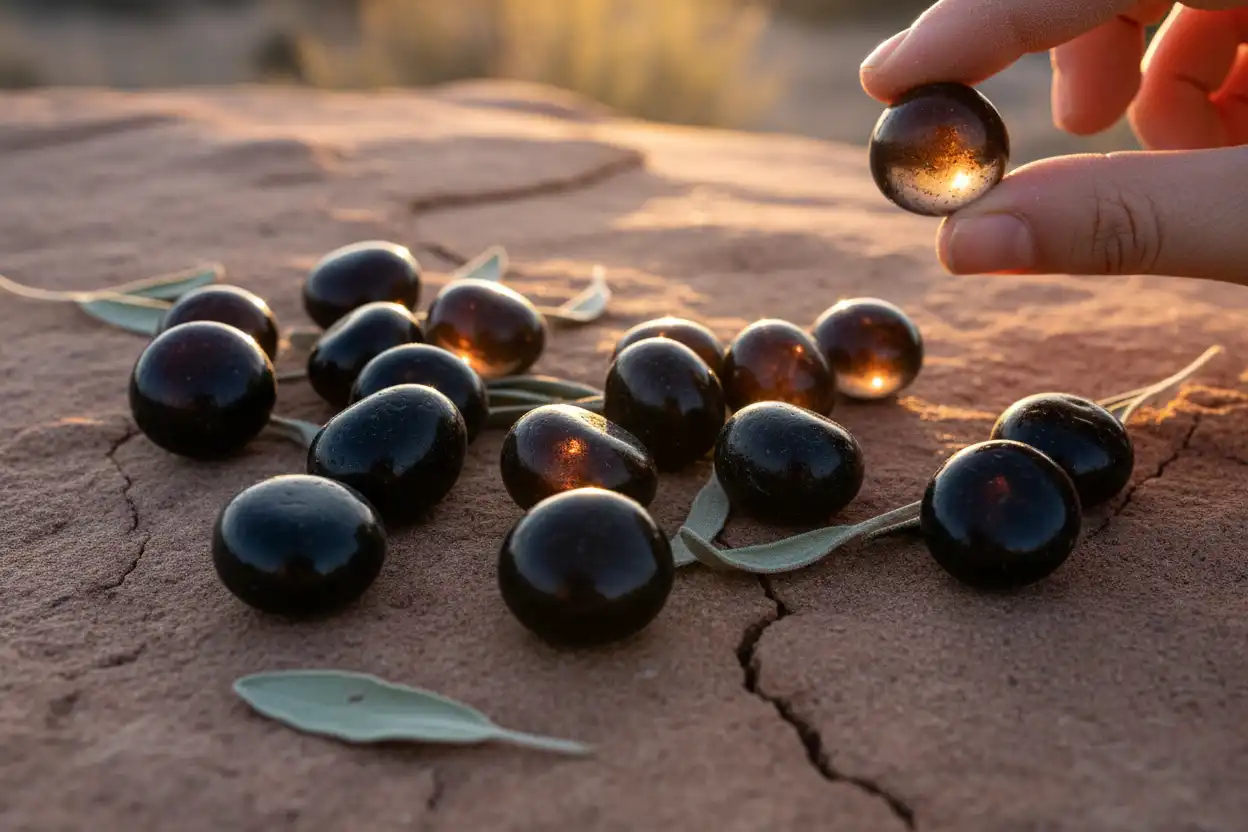
Apache Tears meaning begins with volcanic glass rather than a separate mineral species. Apache Tears are rounded to subrounded nodules of obsidian, usually dark brown to black and commonly associated with hydrated rhyolitic glass called perlite. In geological literature, comparable rounded obsidian bodies may also be called marekanites. Their distinctive shape does not make them a different chemical mineral from other obsidian; it records a particular relationship between relatively fresh volcanic glass and surrounding glass that has undergone greater hydration or alteration.
Obsidian itself is amorphous. Unlike quartz, feldspar, or anatase, it does not possess the repeating atomic lattice required for classification as a mineral species. It forms when silica-rich molten material cools sufficiently rapidly that extensive crystal growth is suppressed, leaving a natural glass. Apache Tears preserve this glassy character as compact nodules whose fresh fractures can be remarkably smooth and sharp.
The human meaning attached to these nodules belongs to a different category. Their name is connected with a widely repeated regional story involving Apache loss, mourning, and the transformation of tears into black stones. The historical details of that story vary substantially between retellings, and published management documentation for the Apache Leap cultural landscape cautions that commonly circulated versions can conflict with Apache oral histories. It is therefore more responsible to describe the account as a regional legend associated with Apache Tears than to present one commercial retelling as verified or universal Apache history.
That separation—geology first, documented cultural context second, modern symbolism last—is the foundation of this Apache Tears meaning guide. Readers exploring comparable evidence-led material references can browse the broader Gemstone Guides.
Apache Tears Identity at a Glance
| Property | Apache Tears |
|---|---|
| Material identity | Natural obsidian nodules |
| Material class | Volcanic glass |
| Mineral species? | No; obsidian is amorphous natural glass |
| Common geological term | Marekanite may be used for comparable rounded obsidian nodules |
| Typical composition | Usually silica-rich volcanic glass of rhyolitic character |
| Crystal system | None; amorphous |
| Typical color | Black, very dark brown, smoky brown |
| Transparency | Apparently opaque in reflected light but commonly translucent at thin edges |
| Luster | Vitreous on fresh fracture surfaces |
| Mohs hardness | Approximately 5–5.5 |
| Specific gravity | Commonly around 2.3–2.5, depending on composition |
| Cleavage | None |
| Fracture | Strongly conchoidal |
| Tenacity | Brittle |
| Typical occurrence | Residual obsidian nodules within or weathered from perlitic volcanic glass |
| Important safety trait | Fresh broken edges can be extremely sharp |
| Identification limit | Shape and black color alone cannot prove Apache Tears, locality, or geological origin |
The most important entry in this table is “mineral species: no.” Calling Apache Tears a crystal is common in retail and metaphysical language, but it is mineralogically inaccurate if “crystal” is being used to imply a crystalline structure. An obsidian nodule may contain tiny crystallites or inclusions, yet the dominant material remains glass.
That distinction does not reduce its geological interest. Natural glass can preserve volcanic flow structures, bubbles, microlites, hydration boundaries, chemical variation, and cooling history that make it useful well beyond ornamental collecting.
Apache Tears Are Obsidian, but Not Every Obsidian Is an Apache Tear
Obsidian is a broad geological name for dense natural volcanic glass, most commonly associated with silica-rich lava. It can occur as extensive glassy flow material, dome material, blocks, bands, nodules, or other forms depending on the eruption and subsequent alteration history.
Apache Tears occupy a much narrower physical category. They are typically discrete rounded, ellipsoidal, subrounded, or irregular nodules rather than large continuous masses. Many occur within pale perlite or weather free from perlitic host material, creating a visual contrast between dark compact glass and lighter hydrated volcanic material.
This relationship is central to the name’s geological use. A polished black obsidian cabochon does not become an Apache Tear simply because it is oval. Likewise, a naturally rounded black stone collected from an unrelated sedimentary environment should not be assigned the name without evidence that it is an obsidian nodule of the appropriate geological type.
The dedicated Apache Tears formation and deposit geology guide owns the detailed volcanic settings, perlite relationships, hydration processes, host deposits, and locality interpretation. Here, those subjects are introduced only far enough to define the material correctly.
How Apache Tears Form
The geological formation of Apache Tears is closely connected with rhyolitic volcanic glass and hydration. Silica-rich magma can become extremely viscous, and when that melt cools rapidly enough, atoms do not organize completely into normal mineral crystals. The result is obsidian or related volcanic glass.
After emplacement, water can diffuse into volcanic glass. Hydration changes the physical structure and appearance of the material and can produce perlite, recognized for characteristic curved or onion-skin fracture patterns. In some perlitic masses, portions of less hydrated, relatively fresh obsidian remain as compact nodules. These residual glassy bodies are the structures commonly identified as marekanites or Apache Tears.
That relationship explains why pale perlite may cling to the outside of an Apache Tear while a fresh broken interior remains dark and strongly vitreous. The boundary represents geological alteration, not a shell manufactured around an unrelated black stone.
It also explains why Apache Tears occur beyond one famous cultural locality. Similar residual obsidian nodules can develop wherever appropriate volcanic glass and hydration processes occur. Their popular name became strongly associated with the American Southwest, but their geological formation mechanism is not restricted to one mountain or one historical narrative.
Why Apache Tears Look Black but Glow Brown in Thin Sections
Many Apache Tears appear completely black when held normally in reflected light. Hold a thin edge against a strong light source, however, and some specimens reveal brown, smoky brown, gray-brown, or occasionally warmer translucent tones.
This does not mean the stone has changed color. A thick path through dark glass absorbs and scatters enough visible light to make the nodule appear opaque, while a much shorter path through a thin edge allows more light to pass through. The effect is similar to other deeply colored transparent or translucent materials whose apparent darkness increases with thickness.
Iron-bearing components, microscopic inclusions, bubbles, tiny crystallites, oxidation state, and glass chemistry can all influence obsidian coloration. It would therefore be inaccurate to assign every Apache Tear’s black or brown appearance to one universal chromophore without specimen-specific analytical evidence.
Detailed refractive behavior, transmitted-light appearance, inclusions, flow structures, and the reasons some obsidians display unusual optical phenomena belong in Apache Tears optical properties and color behavior.
Apache Tears Have No Crystal Structure
One of the most persistent terminology problems deserves a direct answer: Apache Tears do not have a normal crystal system because obsidian is glass.
In crystalline materials, atoms repeat in an ordered three-dimensional pattern. That periodic structure produces crystallographic symmetry, cleavage directions, and many of the optical properties used to classify minerals. Obsidian cooled without developing that type of extensive ordered framework.
Its lack of crystallographic cleavage is particularly visible when the material breaks. Instead of splitting repeatedly along flat atomic planes, obsidian commonly develops curved conchoidal fractures. Those fractures can terminate in extraordinarily thin edges.
This physical behavior is one reason obsidian was such an effective material for cutting tools. It is also why a damaged Apache Tear should be handled differently from a rounded intact nodule: the seemingly smooth black stone can produce a razor-like edge after fracture.
Conchoidal Fracture Is a Strong Diagnostic Clue
Fresh Apache Tears often show the classic shell-like fracture associated with glass. Concentric curved markings, smooth glossy fracture surfaces, and sharp edges can all support an obsidian interpretation.
Conchoidal fracture is not unique to obsidian, however. Other amorphous substances and some crystalline materials can break similarly, including manufactured glass and quartz under appropriate circumstances. The trait is therefore useful evidence rather than proof by itself.
A suspected Apache Tear becomes more convincing when several observations agree: natural rounded nodule form, dark translucent volcanic glass, conchoidal fracture, appropriate density, expected refractive behavior, and association with perlite or a documented volcanic-glass locality.
Microscopic evidence may add flow bands, bubbles, crystallites, hydration structures, or surface weathering. Those observations are developed in the Apache Tears microscope inclusion notebook rather than being repeated in full here.
An Original Apache Tears Specimen and Photo Evaluation Checklist
The following checklist separates what a collector can observe directly from what requires geological, laboratory, or documentary evidence.
| Observation | What it can reasonably support | What it cannot prove alone |
|---|---|---|
| Rounded or subrounded black nodule | Appearance compatible with Apache Tears | Obsidian identity |
| Glossy curved fresh fracture | Strong compatibility with volcanic glass | Exact geological source |
| Smoky-brown translucency at thin edge | Compatible with dark obsidian | Apache Tears trade identity |
| Pale perlite attached to exterior | Strong geological context for a marekanite-type nodule | Specific locality |
| Pitted or weathered outer surface | Natural weathering may be present | Age of specimen |
| No visible crystal faces | Compatible with amorphous glass | Complete absence of microscopic crystallites |
| Seller says “Arizona Apache Tear” | Provenance claim worth preserving | Arizona origin |
| Seller says “from Apache Leap” | Specific locality claim | Historical or geological proof |
| Perfect spherical shape | May indicate tumbling or fashioning | Natural nodule form |
| Uniform pitch-black manufactured-looking glass | Requires closer examination | Natural volcanic origin |
| Raman or compositional testing consistent with volcanic glass | Strong material evidence | Geographic provenance |
| Original locality label plus perlite matrix | Stronger contextual provenance | The historical legend attached to that exact specimen |
The central rule is to describe the evidence at the level it actually supports. “Rounded dark volcanic-glass nodule with attached perlite” is a material observation. “Authentic Apache Tear collected at a historically significant Apache site” combines geological, geographic, and cultural claims that require far more documentation.
For seller statements, mine or collecting locality, original labels, old collection records, and chain-of-custody questions, use the Apache Tears provenance and disclosure checklist.
Apache Tears, Marekanite, and Obsidian: Which Name Is Correct?
All three terms can be correct in the right context, but they do not perform exactly the same job.
| Term or claim | Evidence assessment | Better interpretation |
|---|---|---|
| Obsidian | Correct broad material identity | Natural volcanic glass |
| Apache Tear | Popular geological, lapidary, and collector name | Rounded dark obsidian nodule, especially in southwestern U.S. usage |
| Marekanite | Geological term applied to rounded obsidian nodules | Useful for comparable nodular obsidian beyond the cultural trade name |
| “Apache Tears crystal” | Common retail wording but structurally inaccurate | Natural glass rather than a crystalline mineral species |
| “Black gemstone” | Broad commercial description | Does not explain the material’s volcanic-glass identity |
| “Apache Tears are black quartz” | Incorrect | Quartz is crystalline SiO₂; obsidian is natural volcanic glass |
| “Apache Tears are tektites” | Incorrect | Tektites are impact-generated natural glasses |
| “Every rounded obsidian is from Apache Leap” | Unsupported | Similar nodules occur in multiple volcanic regions |
| “Apache Tears prove the historical legend” | Unsupported | The stones are geological objects; the story is a separate cultural narrative |
| “The legend has one verified historical version” | Too strong | Published retellings differ and may conflict with Apache oral histories |
| “Apache Tears heal grief scientifically” | Unsupported | Grief symbolism is cultural or personal, not a demonstrated medical property |
The use of “marekanite” can be particularly helpful when a geological discussion needs to describe nodular obsidian without automatically importing the Apache Tears cultural story.
Apache Tears Are Not Tektites
Dark natural glasses are frequently grouped together by appearance, but their origins can differ radically. Apache Tears are volcanic. Tektites form through high-energy meteorite-impact processes that melt terrestrial material and eject natural glass.
Both can be dark, glassy, rounded, and conchoidally fractured. Appearance alone can therefore mislead inexperienced collectors.
Geological context matters. A nodule weathering from perlite in a rhyolitic volcanic deposit supports an obsidian origin. A proven tektite field requires a completely different geological history and geographic context.
Calling Apache Tears “meteorite glass” or “space glass” because they look like certain tektites is therefore inaccurate unless an entirely different material is actually being discussed.
Apache Tears Are Not Black Crystals
The word crystal is often used casually for any attractive natural stone, particularly within metaphysical retail. Scientifically, however, the distinction matters.
Apache Tears are glass. Their atomic structure lacks the long-range repeating order of a true mineral crystal. That means descriptions such as “hexagonal Apache Tears,” “crystal lattice of Apache Tears,” or “crystal faces of Apache Tears” should immediately raise questions unless the writer is discussing microscopic inclusions rather than the obsidian itself.
This distinction makes Apache Tears an especially useful neighbor to Anorthite meaning. Anorthite is a true triclinic feldspar crystal with an ordered atomic framework, whereas Apache Tears represent a silica-rich melt frozen into an amorphous state before extensive crystallization occurred.
Both are geological materials, but their internal structures are fundamentally different.
The Apache Tears Name Carries Cultural Weight
The popular story attached to Apache Tears describes Apache people facing violent conflict, deaths at a cliff, and grieving women whose tears became black stones. Versions differ on the identities of combatants, the number of people involved, the sequence of events, and even whether particular elements belong to historical memory, regional folklore, or later retelling.
That variation should not be flattened into a definitive paragraph beginning “According to Apache legend” unless a specific Apache source and community are being represented accurately.
Public documentation connected with the Apache Leap landscape explicitly notes that commonly reported versions of the story can conflict with Apache oral-history accounts. That warning is significant. It means a responsible gemstone reference should acknowledge the regional legend without claiming authority to define Apache cultural memory.
Apache Tears therefore require a stronger symbolism boundary than a mineral whose metaphysical associations began purely in modern retail culture.
A Responsible Way to Describe the Apache Tears Legend
The safest historical wording is that Apache Tears acquired their popular name through a regional legend linking black obsidian nodules with Apache mourning and loss around the Apache Leap landscape in Arizona.
Beyond that basic statement, details should be treated cautiously.
One should not claim that every Apache nation or community tells the story identically. The Apache peoples are not a single undifferentiated cultural group, and externally circulated tourist or commercial versions should not automatically be treated as Indigenous oral tradition.
The stones can be discussed without turning a story of violence and mourning into a sales device. Phrases suggesting that purchasing an Apache Tear gives someone ownership of Apache grief, protection derived from Apache deaths, or a spiritually guaranteed connection with Apache culture are particularly inappropriate.
Cultural respect begins by recognizing the limits of what the material itself can establish.
What Apache Tears Symbolize Today
Modern symbolism commonly connects Apache Tears with grief, remembrance, resilience, emotional release, protection, grounding, acceptance, and moving through loss. The association with grief is easy to trace to the popular naming legend rather than to any measurable property of volcanic glass.
Someone may choose to keep an Apache Tear as a remembrance object after bereavement or during a difficult transition. A rounded black stone can provide a tactile focus for reflection, journaling, prayer, meditation, or memorial practice.
The significance comes from the person’s relationship with the object and the cultural narrative surrounding it.
There is no established scientific evidence that Apache Tears remove grief from the body, shorten bereavement, cure depression, absorb trauma, prevent nightmares, protect someone from violence, or transmit a measurable emotional energy. Mental-health symptoms that interfere with daily functioning require appropriate human and professional support rather than reliance on a gemstone.
The broader evidence boundary for such claims is stated in the Gems Lore disclaimer.
Grief Symbolism Should Not Become a Medical Claim
Apache Tears are often marketed with unusually strong claims about grief because the popular legend itself centers on mourning. This creates a risk of moving from metaphor into unsupported psychology.
“Some people use Apache Tears as a symbol while processing grief” is a description of human behavior.
“Apache Tears release grief stored in the body” is a physiological claim.
The first can be true simply because people choose that symbolic practice. The second would require evidence for a physical mechanism and measurable therapeutic effect.
A stone may help someone remember an intention: call a relative, attend counseling, write down a memory, or sit quietly with an emotion. Those actions can be meaningful without attributing them to energy emitted by volcanic glass.
Apache Tears and Protection Claims
Black stones are frequently associated with protection in modern crystal traditions, and Apache Tears are no exception. Their dark color, volcanic origin, and emotionally charged name make them particularly easy to incorporate into protective symbolism.
There is no mineralogical evidence that carrying obsidian prevents accidents, physical attacks, financial loss, environmental hazards, or supernatural harm.
Someone can still wear an Apache Tear as a personal reminder to maintain boundaries, make cautious decisions, or remember a meaningful story. In that case, any practical benefit comes through human behavior rather than a demonstrated protective field surrounding the stone.
This distinction is especially important because symbolic protection should never replace real-world safety measures.
Why Apache Tears Are Rounded
The rounded form is one of the material’s most recognizable characteristics, but it does not mean each nodule was mechanically polished by a river.
Many Apache Tears originate as discrete glassy cores or nodules within hydrated volcanic glass. Their shapes can be rounded, subrounded, ellipsoidal, irregular, or somewhat angular depending on how the residual glass developed, fractured, weathered, and was liberated from its host.
Subsequent erosion can smooth surfaces further, and lapidary tumbling can make commercial examples much more uniformly polished.
A perfectly glossy sphere should therefore not be assumed to represent the stone’s original geological morphology. It may be fashioned from genuine material.
That distinction belongs partly to provenance and partly to lapidary history rather than to mineral identity.
Natural Surface Versus Tumbled Apache Tear
Untumbled Apache Tears can carry matte, pitted, weathered, dusty, or perlite-coated outer surfaces. Freshly broken areas may contrast dramatically by showing bright vitreous luster.
Tumbling removes much of that weathered exterior and creates a more uniform glossy finish. It can reveal brown translucency at thin areas and make the material attractive for ornamental use.
Neither condition changes obsidian into another material, but it changes the evidence available to a collector. An intact nodule with attached perlite may preserve more geological context than a completely polished piece whose original host relationship is no longer visible.
For detailed questions about sawing, tumbling, polishing, preserving natural surfaces, and managing sharp fracture edges, use Apache Tears cutting, orientation, and polish.
Diagnostic Limits: Black Glass Is Not Enough
Manufactured glass can resemble obsidian closely. So can slag, some black chalcedony, certain opaque gems, and other dark natural materials when photographed under poor lighting.
A useful identification process therefore avoids one-step conclusions.
Conchoidal fracture and vitreous luster support glass. Natural flow structures, bubbles, crystallites, or hydration relationships may support volcanic origin. Refractive index and density can further distinguish obsidian from several substitutes. Microscopic examination can expose molded surfaces, unnatural bubbles, coatings, or other manufacturing clues in suspicious material.
Even when a specimen is confirmed as natural obsidian, that still does not prove it is a naturally rounded Apache Tear rather than a fashioned piece cut from bulk obsidian.
Material identification and object history remain separate questions.
Provenance Matters More Than the Legend for Locality
Apache Tears are strongly associated commercially with Arizona and the wider American Southwest, but similar nodular obsidian occurs in other volcanic terrains. Geographic origin should therefore not be inferred from the popular name.
A seller claiming “Apache Leap Apache Tear” is making a much more specific statement than a seller describing “natural Apache Tears obsidian.”
The first claim requires locality evidence. That could include credible collection records, an original label, documented source history, or another traceable chain of custody. The second primarily requires that the object itself be consistent with the material class.
Collectors should also consider land status and collecting rules rather than assuming that historically or culturally significant landscapes are unrestricted rockhounding sites. Transaction-focused sourcing and seller disclosure are handled in where to buy Apache Tears.
Safe Ownership: The Main Risk Is the Edge
An intact rounded Apache Tear is generally straightforward to handle. The important physical hazard appears when obsidian fractures.
Conchoidal breakage can create extremely thin edges capable of cutting skin. A chipped carving, split nodule, broken bead, or unfinished piece of rough should therefore be handled by its thicker surfaces rather than by a fresh edge.
This is not a reason for alarm. Ordinary polished obsidian jewelry and intact specimens can be owned normally. It is simply a material-specific safety fact arising from the same fracture behavior that made obsidian useful for cutting tools.
For mounted pieces, exposed corners, abrasion, drilling, and impact become jewelry-engineering questions. Those belong in Apache Tears setting and wear engineering.
Do Not Ingest Apache Tears or Use Them as Medicine
Apache Tears are silica-rich natural glass containing various minor elements and inclusions according to geological source. None of that composition establishes nutritional or therapeutic value.
Do not grind the material into powder for ingestion, place fragments in food, or prepare drinking-water “elixirs” on the assumption that obsidian transfers healing properties into liquid. There is no established medical benefit, and unnecessary ingestion of mineral or glass material creates avoidable risk.
Normal external ownership is a different matter. A polished stone held in the hand is not equivalent to intentionally swallowing particulate matter.
Cutting and Grinding Change the Safety Context
Sawing, drilling, grinding, or polishing obsidian can generate sharp fragments and fine particulate material. Eye protection, appropriate respiratory controls, wet-working methods where suitable, controlled equipment, and careful cleanup are ordinary lapidary precautions.
Broken fragments should not be brushed away carelessly by hand because transparent slivers can be difficult to see.
The issue is mechanical processing, not mystical toxicity. A rounded Apache Tear sitting in a display case does not present the same exposure pathway as grinding a large quantity of volcanic glass.
Apache Tears Can Weather and Hydrate
Volcanic glass is not permanently unchanged. Natural obsidian can absorb water gradually and develop hydrated surface layers. Over geological scales, glass may also alter chemically or begin to devitrify as crystalline phases replace the original amorphous material.
Apache Tears themselves can preserve relatively fresh glass precisely because surrounding material experienced stronger hydration and became perlitic.
That history is another reason a specimen with natural perlite attached can be scientifically informative. Cleaning away every pale coating may remove part of the evidence showing how the nodule relates to its host.
Long-term decisions about preserving matrix, stabilizing damaged specimens, retaining old labels, and documenting repairs belong in the Apache Tears specimen conservation record.
Apache Tears and Color-Based Symbolism
Modern crystal guides may assign additional meanings according to whether an Apache Tear appears black, brown, gray, or unusually translucent. These interpretations usually derive from general color symbolism rather than geological distinctions among separate Apache Tears varieties.
A black-looking nodule and a brown-translucent thin edge may be the same piece viewed under different optical conditions.
It would therefore be misleading to claim that the black part has one measurable spiritual function while the brown transmitted color possesses another.
This fact-versus-interpretation distinction parallels the approach used in Apatite color meaning, where physical causes of color must be separated from the meanings humans attach to particular hues.
Apache Tears Are Not Evidence of Supernatural Transformation
The popular legend describes human tears becoming black stones. As symbolism, that transformation is powerful: grief becomes something durable that can be held, remembered, and passed forward.
Geologically, however, Apache Tears formed through volcanic and post-volcanic processes. Human tears did not mineralize into obsidian nodules.
Both ideas can occupy the same discussion when clearly labeled. One is a geological explanation. The other is a story that gives cultural and emotional meaning to a geological object.
Trouble begins only when metaphor is presented as material science or when geological explanation is used dismissively to claim that cultural stories have no human significance.
A Responsible Evidence Ladder for Apache Tears Claims
Apache Tears are a useful example of why different questions require different evidence.
Level 1 — Visual observation: shape, color, weathered exterior, perlite coating, fracture, translucency, and surface polish.
Level 2 — Basic gemological testing: refractive behavior, specific gravity, hardness context, and isotropic glass response where suitable.
Level 3 — Microscopic examination: bubbles, flow structures, microlites, surface hydration, coatings, polishing, fracture features, and manufacturing clues.
Level 4 — Material analysis: spectroscopy, chemistry, or other methods capable of confirming natural volcanic-glass characteristics.
Level 5 — Geological interpretation: host perlite, volcanic unit, field relationships, hydration textures, and deposit context.
Level 6 — Geographic provenance: original labels, collection records, supplier documentation, field location, and chain of custody.
Level 7 — Cultural or historical interpretation: specific archival records, tribal or community oral-history sources, archaeological documentation, and culturally appropriate scholarship.
A Level 1 observation cannot establish a Level 7 conclusion. A black rounded stone may look like an Apache Tear, but its appearance does not authenticate a specific Apache historical narrative.
This distinction is the central information-gain framework for this page.
Apache Tears Meaning Without Commercializing Grief
The name inevitably carries an emotional story, but the material should not be sold or described as though Apache suffering were a decorative branding device.
Responsible writing avoids statements that promise the buyer access to “ancient Apache powers,” claim that Apache people universally used these stones in a particular ceremony without evidence, or imply that possession of the stone confers Indigenous spiritual authority.
A more respectful approach acknowledges three things simultaneously: the geological object is real, a powerful regional legend is associated with the name, and the historical details commonly circulated outside Apache communities are not sufficiently uniform to be presented as one unquestionable tribal account.
That approach allows the cultural context to remain present without pretending to speak for Apache peoples.
Apache Tears as Personal Memorial Objects
Among modern owners, perhaps the most defensible symbolic use is remembrance. A durable dark nodule can represent someone or something that has been lost, particularly because the popular name already carries themes of mourning.
A person could keep one beside a photograph, carry it during a difficult transition, or use it as a physical reminder to make space for memories rather than avoid them.
Again, the stone does not perform the grieving process. The person does.
That distinction keeps symbolic use compatible with psychological reality and avoids promising that a gemstone can replace human relationships, counseling, community, or professional support.
What Apache Tears Meaning Ultimately Represents
Materially, Apache Tears are natural obsidian nodules: silica-rich volcanic glass commonly preserved as relatively fresh cores within hydrated perlitic material. Their amorphous structure, dark color, brown translucency in thin sections, vitreous luster, conchoidal fracture, and sharp broken edges are consequences of their volcanic-glass identity.
Geologically, they record rapid cooling followed by differential hydration and alteration. The surrounding glass may become perlite while compact portions remain less hydrated, preserving the dark nodules that eventually weather free.
Culturally, their popular name is associated with an Apache mourning legend centered on loss and black stones. The story deserves qualification because retellings vary and external written accounts should not automatically be presented as definitive Apache oral history.
Symbolically, Apache Tears can represent grief, memory, resilience, acceptance, protection, or reflection. Those meanings are human interpretations rather than demonstrated physical properties of obsidian.
The editorial distinction between scientific evidence, cultural documentation, and modern belief is part of the approach described on About Gems Lore. Questions involving a particular specimen or uncertain claim can be submitted through Contact Gems Lore, with personal information handled according to the Privacy Policy.
Frequently Asked Questions
What are Apache Tears?
Apache Tears are naturally occurring rounded or subrounded nodules of dark obsidian, a silica-rich volcanic glass. They are frequently associated with perlite and may also be described geologically as marekanite-type obsidian nodules.
Are Apache Tears a mineral?
No. Obsidian is amorphous volcanic glass rather than a mineral species with an ordered crystal lattice.
Are Apache Tears crystals?
Not in the strict mineralogical sense. The material is natural glass. Tiny crystallites or inclusions can occur within obsidian, but the bulk material does not possess a normal crystal structure.
Are Apache Tears the same as obsidian?
Apache Tears are a particular nodular form of obsidian. Not all obsidian occurs as Apache Tears.
What is marekanite?
Marekanite is a geological term used for rounded obsidian nodules, especially glassy residual bodies occurring within hydrated perlitic material. The term can be useful when discussing such nodules without relying on the culturally specific Apache Tears name.
How do Apache Tears form?
They commonly form as relatively fresh obsidian nodules associated with volcanic glass that has undergone hydration to produce perlite. Differential hydration leaves compact glassy cores within more strongly altered surrounding material.
Why are Apache Tears round?
Their rounded to subrounded shapes arise from their development as discrete glassy nodules, subsequent fracturing, hydration relationships, weathering, and erosion. Some commercial pieces are additionally tumbled.
Why do Apache Tears look black?
Their volcanic glass absorbs enough visible light through thick sections to appear black or extremely dark. Thin edges can transmit smoky-brown or brownish light.
Are Apache Tears transparent?
Most look opaque under ordinary reflected light, but many are translucent when a thin edge is viewed against strong transmitted light.
How hard are Apache Tears?
Obsidian is typically around 5–5.5 on the Mohs scale. It is harder than calcite but softer than quartz.
Do Apache Tears have cleavage?
No normal mineral cleavage is present because obsidian is glass rather than a crystal. It characteristically breaks with conchoidal fracture.
Are broken Apache Tears sharp?
Yes. Fresh obsidian fractures can create exceptionally sharp edges and thin splinters. Broken specimens should be handled carefully.
Are Apache Tears found only in Arizona?
No. The popular name is strongly associated with the American Southwest, but comparable nodular obsidian occurs in multiple volcanic regions. Geographic origin cannot be established from shape or color alone.
Do all Apache Tears come from Apache Leap?
No. Apache Leap is central to the popular cultural story surrounding the name, but Apache Tears-type obsidian nodules occur elsewhere.
Is the Apache Tears legend historically proven?
A regional legend links the stones with Apache mourning and loss, but commonly published versions differ in significant details. Public cultural-landscape documentation also cautions that circulated accounts can conflict with Apache oral histories. One commercial retelling should therefore not be presented as settled historical fact.
What does Apache Tears symbolize?
Modern symbolism commonly associates Apache Tears with grief, remembrance, resilience, acceptance, grounding, and protection. These meanings are cultural or personal interpretations rather than measurable properties of volcanic glass.
Do Apache Tears heal grief?
There is no scientific evidence that obsidian chemically or energetically removes grief. Some people use the stones as personal memorial or reflection objects, but emotional or mental-health care should not be replaced by gemstone claims.
Do Apache Tears have protective powers?
No scientifically demonstrated protective field or supernatural mechanism has been established for obsidian. Protection symbolism can still serve as a personal reminder to make careful decisions or maintain boundaries.
Are Apache Tears safe to handle?
Intact rounded stones can be handled normally. Freshly broken pieces can develop extremely sharp edges, and lapidary processing requires appropriate eye, dust, and fragment controls.
Can I drink water that contains an Apache Tear?
Apache Tears should not be used to prepare ingestible crystal elixirs for medical or spiritual purposes. There is no established health benefit from doing so.
Can Apache Tears be polished?
Yes. Obsidian takes a high polish and is commonly tumbled, carved, or fashioned. Polishing can remove natural weathering and attached geological context, so collectible specimens should be evaluated before alteration.
How can I tell whether an Apache Tear is real?
Look for a combination of natural nodule form, glassy conchoidal fracture, dark color with possible brown translucency at thin edges, appropriate density, and geological context such as perlite. Manufactured glass and fashioned bulk obsidian can resemble genuine natural nodules, so higher-value or important specimens may require closer testing.
Can a photograph prove an Apache Tear’s origin?
No. A photograph can document appearance, but it cannot establish a specific collecting locality or cultural provenance. Use original labels and traceable records when geographic origin matters.
Should attached perlite be removed?
Not automatically. Perlite attached to a nodule can preserve useful evidence about its geological origin and hydration relationship. Collector specimens may be more informative when that context remains intact.
Where should I learn about buying Apache Tears?
Use where to buy Apache Tears for seller disclosure, provenance questions, and transaction-specific evaluation rather than turning this meaning reference into a buying guide.
Apache Tears meaning is strongest when its layers are not collapsed into one another. The material is volcanic glass, not a healing mineral or crystalline species. Its rounded form can preserve a real relationship between obsidian and hydrated perlite. Its popular name carries a regional story of Apache mourning whose historical details require cultural care. Its modern symbolism centers naturally on grief, memory, resilience, and protection, but those themes remain human interpretations.
Nothing is gained by turning geological glass into unsupported medicine or presenting one tourist retelling as definitive Apache history. The material is more meaningful when its volcanic origin, cultural sensitivity, and symbolic use are each allowed to remain distinct.