10 Apache Tears Benefits: Obsidian Geology, Collecting & Practical Value
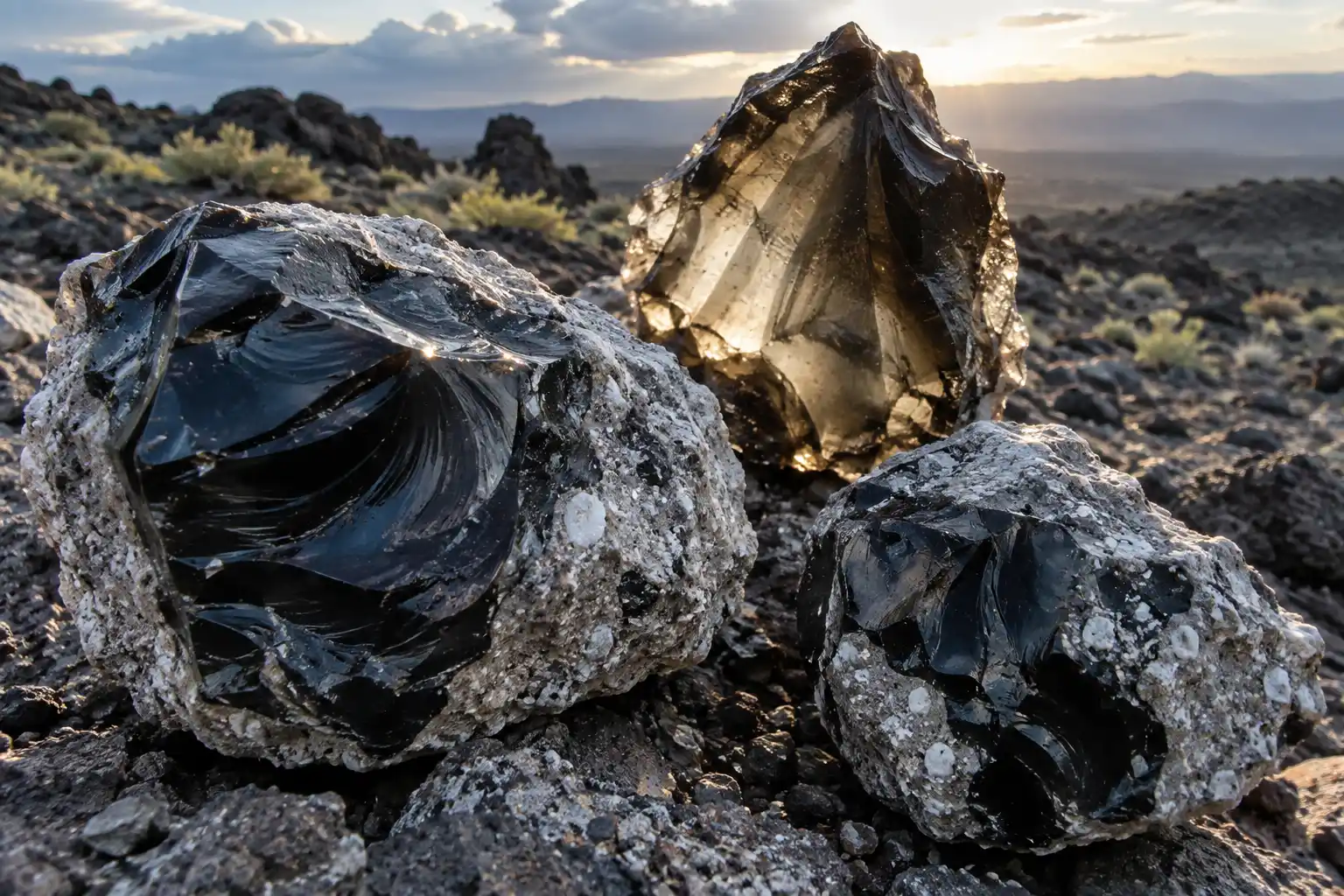
Apache Tears benefits begin with their unusual geological form. Apache Tears are rounded to irregular nodules of obsidian, a natural volcanic glass, commonly found within or associated with hydrated volcanic glass known as perlite. Their dark exterior can appear almost completely black, yet thinner pieces often become smoky brown or translucent when held against strong light. That contrast makes them visually distinctive even before polishing.
Unlike quartz or feldspar, obsidian does not have a long-range ordered crystal structure. It forms when silica-rich lava cools quickly enough that atoms do not organize into ordinary mineral crystals. In deposits containing Apache Tears, portions of volcanic glass remained comparatively fresh while surrounding glass became hydrated and altered toward perlite, leaving dark obsidian cores enclosed within lighter rock.
The strongest Apache Tears benefits are geological, collectible, educational, lapidary, aesthetic, and symbolic. Their rounded form, volcanic origin, translucency, conchoidal fracture, American Southwest locality, and connection with a widely repeated Apache Tears story all contribute to their appeal. Cultural tradition deserves careful treatment, while healing claims should remain separate from verified properties.
10 Apache Tears Benefits at a Glance
- Natural obsidian nodules show an unusual volcanic-glass form.
- Dark stones can reveal surprising brown or smoky translucency when backlit.
- Association with perlite provides a clear lesson in volcanic-glass hydration.
- Rounded natural shapes make many specimens attractive without cutting.
- Conchoidal fracture demonstrates a classic physical property of volcanic glass.
- Southwestern localities give specimens geographic and rockhounding interest.
- Polishing can reveal glossy surfaces while preserving recognizable natural form.
- Apache Tears are accessible educational specimens for comparing glass with crystalline minerals.
- Cultural stories surrounding the name add historical interest when presented respectfully and cautiously.
- Modern symbolism can support remembrance or reflection without turning volcanic glass into a medical treatment.
Natural Obsidian Form Leads the Apache Tears Benefits
The first of the Apache Tears benefits is their unusual appearance as naturally rounded or irregular obsidian nodules. Obsidian more commonly attracts attention as large masses, sharp flakes, or polished black objects, but Apache Tears occur as smaller individual bodies associated with volcanic deposits.
Their form develops within silicic volcanic environments where glassy lava underwent uneven hydration. Water entered much of the surrounding volcanic glass and converted it toward perlite, while less hydrated obsidian remained as dark cores.
This geological relationship gives an Apache Tear more context than a generic black polished stone. The nodule represents a specific history involving rapid lava cooling, volcanic glass, water, hydration, and differential alteration.
Collectors who preserve some attached perlite can see that relationship directly rather than viewing the obsidian as an isolated pebble.
Translucency Gives Apache Tears an Unexpected Visual Effect
One of the most attractive Apache Tears benefits becomes visible only under transmitted light. A nodule that looks opaque black on a table may appear smoky brown, reddish brown, or translucent around thinner edges when held against a strong light source.
This effect occurs because obsidian is volcanic glass rather than an opaque crystalline mineral. Thickness, microscopic inclusions, bubbles, iron-bearing components, and internal structure influence how much light passes through.
The contrast can be dramatic. From the outside, the stone may look dense and nearly featureless. Backlighting can suddenly reveal bands, subtle internal variations, or a warm brown glow.
That hidden translucency gives Apache Tears strong educational and decorative appeal. It also helps explain why identification should involve more than surface color.
Apache Tears Demonstrate How Obsidian and Perlite Are Related
Geological education is one of the most useful Apache Tears benefits. Obsidian and perlite can originate from related volcanic glass, but water content and subsequent hydration alter the structure and appearance.
Silica-rich lava can cool rapidly to produce volcanic glass. Over time, water can enter portions of that glass. Hydrated glass may develop the characteristic concentric fractures and texture associated with perlite, while less altered obsidian survives as darker cores.
Apache Tears can therefore preserve a small-scale record of this process. A specimen with attached gray perlite makes the relationship particularly easy to visualize.
This geology is far more interesting than the oversimplified idea that the nodules are simply droplets of lava frozen while falling through the air. Their occurrence reflects interactions among volcanic glass, cooling, water content, and later hydration.
Natural Shape Makes Apache Tears Easy to Collect
Many mineral specimens require delicate matrix, expensive preparation, or complex display stands. Apache Tears benefits include relatively simple natural forms that can be collected and displayed individually.
Pebble-sized nodules fit easily into specimen boxes, educational collections, and rock displays. Their dark color contrasts strongly with pale perlite where matrix remains attached, while unpolished surfaces retain evidence of natural weathering.
Collectors may seek locality, unusually large size, attached matrix, strong translucency, unusual shape, or historical labels. A plain small nodule and a matrix specimen can therefore appeal for different reasons.
Accurate locality matters. Apache Tears are famously associated with parts of Arizona and the American Southwest, but similar obsidian nodules can occur in other volcanic regions. A seller should not assign an Arizona locality without evidence.
Conchoidal Fracture Shows a Classic Property of Volcanic Glass
Obsidian fractures differently from minerals with strong cleavage. When broken, it commonly forms curved conchoidal surfaces that can become extremely sharp.
This gives Apache Tears benefits for geological education because the fracture illustrates how amorphous glass behaves when it lacks crystallographic cleavage planes. Quartz can also show conchoidal fracture, but obsidian’s glassy texture can produce exceptionally sharp edges.
Freshly broken Apache Tears should therefore be handled carefully. A rounded natural surface may feel safe, yet a new fracture can create knife-like margins.
For the same reason, deliberately breaking specimens merely to test whether they are real is unnecessary. Surface appearance, translucency, density, geological context, and professional identification are better choices than destructive testing.
Polishing Can Reveal a Rich Glassy Surface
Apache Tears can be tumbled or polished to reveal a smooth glassy luster. Polishing removes weathered surface texture and can make brown translucency easier to notice near edges.
Some collectors prefer natural nodules because original surfaces preserve geological character, while others appreciate polished pieces for tactile use or jewelry. Neither approach is inherently superior.
Cutters should remember that obsidian can chip and produces sharp fragments. Eye protection and careful handling are sensible during lapidary work, while wet methods help control fine dust from associated siliceous rock.
These lapidary Apache Tears benefits make the stone suitable for small pendants, polished pocket stones, beads, and simple decorative pieces without requiring faceting.
Southwestern Localities Add Rockhounding Interest
Apache Tears are particularly associated with volcanic areas of the American Southwest, including well-known occurrences in Arizona and New Mexico. The Picketpost Mountain region near Superior, Arizona, is especially familiar to collectors.
Locality adds significance because it connects the specimen with a specific volcanic landscape. Rockhounds may value a modest nodule far more when its exact collecting location is documented.
Responsible collecting still matters. Land ownership, collecting rules, protected areas, Indigenous lands, active mining claims, and local regulations can determine whether removal is permitted.
When deciding where to buy Apache Tears, credible locality information and accurate identification are therefore more valuable than dramatic spiritual claims attached to anonymous black pebbles.
Apache Tears Help Explain the Difference Between Glass and Crystal
Another of the educational Apache Tears benefits is terminology. Obsidian is commonly included in crystal shops, yet scientifically it is an amorphous volcanic glass rather than a crystal.
Crystalline minerals have long-range ordered atomic structures. Obsidian cooled too rapidly for that type of organization to develop throughout the glass.
This does not make obsidian fake or artificial. It is completely natural. The distinction simply describes structure.
Apache Tears are therefore excellent examples for people learning that the commercial word crystal often includes minerals, rocks, glasses, and other natural substances. A naturally occurring gemstone-like object does not need to be crystalline to be geologically authentic.
The Apache Tears Story Requires Respectful Cultural Context
The name Apache Tears is associated with stories of Apache grief following the deaths of warriors in the Southwest. Several versions circulate, particularly around Arizona’s Apache Leap area. Details vary considerably between retellings, including the historical event, participants, and circumstances.
Because versions have changed through repetition, the story should not be presented as a single perfectly documented historical account unless a specific community source confirms it. Popular retellings often describe grieving women whose tears turned into black obsidian stones after warriors died.
This association gives the name emotional weight and has strongly shaped modern Apache Tears meaning around grief, remembrance, resilience, and mourning.
Respect matters. Indigenous cultural stories should not be used merely as decorative marketing or rewritten into claims that every Apache community shares one identical belief about these stones.
Modern Symbolism Often Centers on Grief & Remembrance
Among modern Apache Tears benefits, symbolic use around remembrance is especially common. People may keep a stone during bereavement, carry one as a memorial object, or associate its dark exterior and hidden translucency with grief gradually revealing another layer of experience.
The symbolism can be meaningful without claiming the obsidian removes grief or medically treats depression. Bereavement is not something a stone should be expected to cure.
A memorial object can still serve a real personal role. Holding a stone may remind someone of a person, place, ritual, or promise. The benefit comes from memory and association rather than a demonstrated healing emission.
Descriptions of Apache Tears healing properties should therefore remain within spiritual belief and personal wellness rather than being presented as evidence-based treatment.
Apache Tears Are Relatively Easy to Care For
Obsidian generally ranks around Mohs 5 to 5.5. That makes Apache Tears softer than quartz and vulnerable to scratches from common harder stones.
Store polished pieces away from quartz, topaz, sapphire, diamond, and other hard gems. Natural unpolished nodules tolerate display well but can still chip after hard impacts.
Warm water, mild soap, and gentle wiping are normally sufficient for ordinary cleaning of plain obsidian. Avoid sudden extreme temperature changes, aggressive chemicals, and unnecessary impact.
Fresh fractures are the main immediate physical concern because obsidian edges can become very sharp. Children and pets should not handle broken pieces casually.
These straightforward care requirements support the practical Apache Tears benefits for collectors who want an interesting geological specimen without complicated maintenance.
Conclusion
Apache Tears benefits include natural obsidian form, surprising translucency, volcanic-glass geology, perlite association, collectible shapes, classic conchoidal fracture, lapidary appeal, Southwestern locality interest, educational value, and modern remembrance symbolism.
Their strongest story is already present in the stone itself. Apache Tears preserve evidence of silica-rich volcanic glass and hydration processes while carrying a culturally sensitive name connected with stories of grief and remembrance. Those qualities deserve accurate explanation without adding unsupported medical promises.
FAQs
What Are the Main Apache Tears Benefits?
Apache Tears benefits include geological interest, natural rounded forms, smoky translucency, collectible locality, lapidary use, volcanic-glass education, and personal remembrance symbolism.
Are Apache Tears Really Obsidian?
Yes. Apache Tears are rounded or irregular nodules of obsidian, a natural volcanic glass, commonly associated with perlite.
Are Apache Tears Crystals?
No. Obsidian is amorphous volcanic glass rather than a true crystal with long-range ordered atomic structure.
Why Are Apache Tears Sometimes Translucent?
Thin obsidian allows some light to pass through, so apparently black stones can reveal smoky brown or reddish translucency when strongly backlit.
How Hard Are Apache Tears?
Obsidian generally falls around Mohs 5 to 5.5, making it softer than quartz and susceptible to scratches from harder stones.
Why Are They Called Apache Tears?
The name is associated with stories of Apache grief and mourning in the American Southwest. Several versions circulate, so cultural details should be presented carefully rather than as one universally documented account.
Can Apache Tears Be Polished?
Yes. Polishing can reveal a smooth glassy surface and make translucency easier to appreciate, although natural unpolished nodules also have strong collector appeal.
Where Are Apache Tears Found?
Well-known occurrences exist in the American Southwest, particularly Arizona and New Mexico, with similar obsidian nodules also known from other volcanic regions.
Are Apache Tears Good Memorial Stones?
Some people use them symbolically for grief, remembrance, and resilience. That is a personal practice rather than a medical treatment for bereavement or depression.
Are Apache Tears Healing Benefits Scientifically Proven?
No reliable evidence establishes Apache Tears as a treatment for physical or mental health conditions.
Modern symbolic Apache Tears benefits are personal or spiritual beliefs and should not replace qualified grief, medical, or mental health support.