11 Essential Apache Tears Healing Claims: Positive Traditions, Proven Facts & Safe Use
Apache Tears healing properties are traditionally associated with grief support, emotional release, grounding, resilience, protection symbolism, courage, letting go, self-reflection, patience, comfort during change, and recovering a sense of stability after loss. These meanings come from cultural storytelling and modern crystal practice rather than established medical evidence. Apache Tears do not treat depression, trauma, anxiety, insomnia, pain, neurological conditions, or other physical or mental health concerns through ordinary contact with the body.
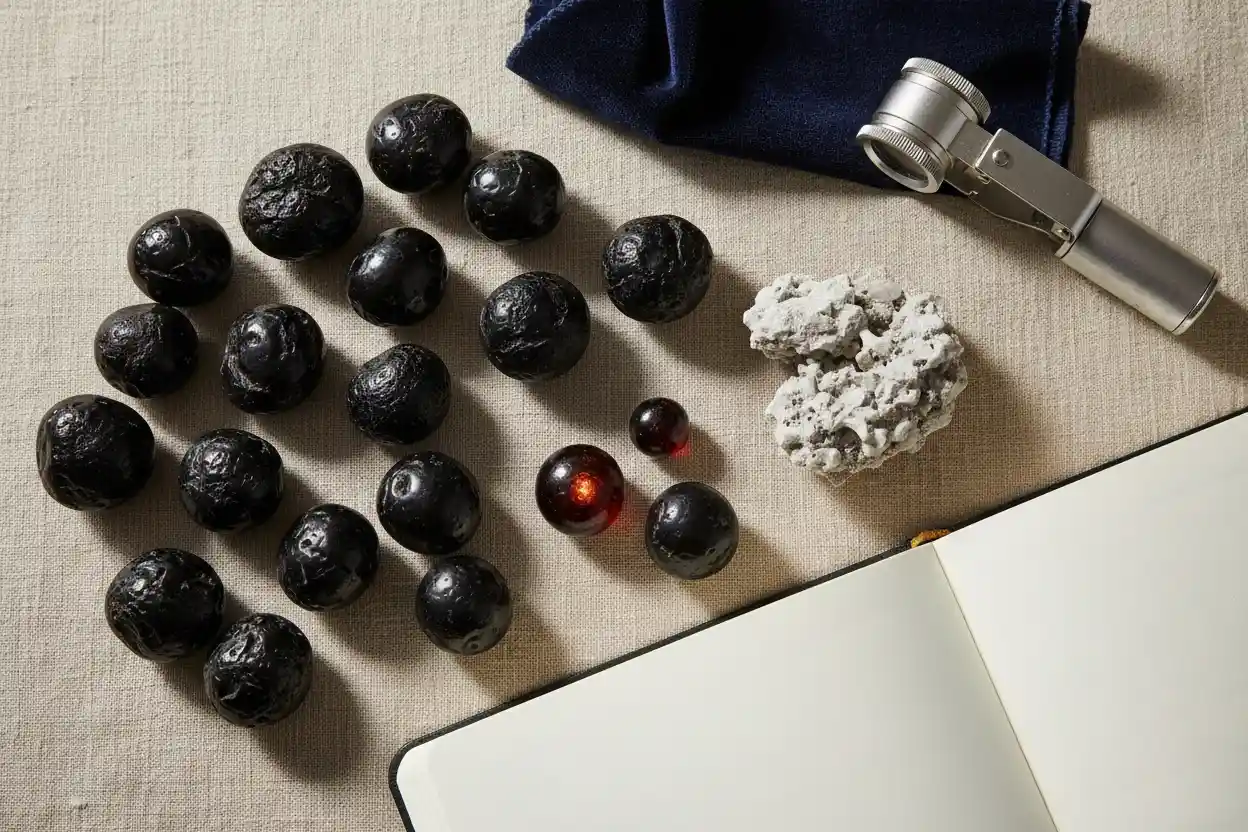
Apache Tears are rounded to irregular nodules of obsidian, a natural volcanic glass formed when silica-rich lava cools rapidly enough that crystals do not have time to develop. They often appear nearly black in normal light but can show brownish translucency along thin edges when held against a strong light source. Their smooth exterior can make them feel different from sharp fractured obsidian, yet they remain volcanic glass and can develop razor-like edges if broken. This physical identity is important because the stone’s actual origin and care requirements are factual, while its grief, protection, and emotional-healing associations remain symbolic.
Apache Tears Grief Traditions Focus on Remembrance, Loss, and Emotional Permission
Grief is the theme most strongly associated with Apache Tears. The name is connected with a widely repeated Indigenous legend involving Apache people and profound loss, and this story has strongly shaped modern metaphysical interpretations of the stone. The cultural narrative should be treated respectfully as tradition rather than reduced to a decorative marketing slogan. Whatever personal meaning someone takes from the story, the stone itself does not alter the biological or psychological processes involved in mourning.
The crystals for grief tradition can still provide a responsible framework when a stone serves as a remembrance object. Someone may hold an Apache Tear while writing about a person who died, keep one near a photograph, or use it during a quiet ritual marking an anniversary or transition. These actions can provide structure to remembrance because they create a deliberate moment to acknowledge grief rather than avoid it.
Grief can also return unpredictably. Feeling intense sadness after a period of relative stability does not mean that progress has disappeared. Apache Tears symbolism works best when it represents permission to experience grief without demanding that the stone remove it. If mourning becomes persistently disabling or is accompanied by severe depression, trauma symptoms, or thoughts of self-harm, appropriate professional support matters far more than crystal practice.
Apache Tears Emotional-Release Claims Should Mean Processing Feelings, Not Purging Energy
Modern crystal descriptions often say Apache Tears help release trapped emotions, remove sorrow, or clear accumulated negativity. These phrases can be interpreted in ways that suggest invisible substances are leaving the body, but there is no established evidence for such a mechanism. Emotional release is more useful when it means identifying and expressing feelings that have been avoided.
A person might use an Apache Tear while journaling about anger, regret, guilt, sadness, or fear and ask what each emotion is responding to. Another might carry the stone during counseling as a familiar tactile object. The process becomes meaningful because feelings are being named and examined, not because the obsidian absorbs them.
The traditional Apache Tears benefits therefore fit best when symbolic comfort is separated from treatment claims. A stone can mark the intention to face a difficult experience gradually, but it cannot guarantee catharsis, erase painful memories, or complete emotional recovery on a predictable schedule.
Apache Tears Grounding Claims Reflect Weight, Texture, and Present-Focused Attention
Apache Tears are frequently described as grounding stones because their dark color, smooth texture, and volcanic origin create a strong association with earth and stability. There is no evidence that they electrically ground the body or alter nervous-system function, but their tactile qualities can make them convenient objects for present-focused routines.
Holding a smooth nodule can become a cue to notice what is physically happening now rather than becoming fully absorbed in imagined future outcomes or repetitive memories. A person might observe the stone’s weight, temperature, surface irregularities, and translucency while taking a short pause before deciding what to do next. This is a behavioral use of attention rather than a transfer of energy from the stone.
Traditional obsidian healing properties are often connected with similar grounding themes because Apache Tears are themselves a form of obsidian. The distinction lies mainly in form, appearance, geological context, and cultural associations rather than a proven difference in therapeutic effect.
Apache Tears Protection Claims Are Symbolic and Cannot Prevent Physical Harm
Protection is another major claim surrounding Apache Tears. Modern metaphysical sources may describe them as shielding against negative energy, absorbing harmful intentions, or preventing emotional attack. These ideas belong to spiritual tradition and should not be interpreted as literal physical protection.
An Apache Tear cannot prevent assault, accidents, theft, illness, or hazardous environmental exposure. It cannot make a dangerous relationship safe or substitute for practical security measures. The stone can instead symbolize the decision to recognize risk earlier, maintain a boundary, leave an unsafe environment, or seek support.
This distinction is especially important when protection language becomes mixed with fear. A person should not be encouraged to believe that losing a stone removes their safety or that encountering difficulty means the stone failed. Real safety depends on circumstances, planning, appropriate equipment, professional help, and other concrete protections.
The traditional black obsidian healing properties share much of this protective symbolism, but the same evidence limits apply. Obsidian is volcanic glass, not a physical or psychological shield.
Apache Tears Resilience and Courage Symbolism Can Support Small, Practical Actions
Apache Tears are often linked with resilience because they combine themes of grief, endurance, and volcanic transformation. In responsible use, resilience should not mean suppressing pain or proving that someone can cope alone. It means continuing to respond to life while acknowledging what has happened.
A stone can represent taking the next manageable action after a setback. That might involve returning to a routine, attending an appointment, asking for help, completing necessary paperwork after a loss, or reconnecting with someone supportive. The crystals for courage tradition becomes more useful when courage is defined as reasonable action in the presence of discomfort rather than fearlessness.
Resilience also includes changing plans. Someone who experiences a major loss may not return to exactly the same life as before. Apache Tears symbolism can represent adapting while continuing to honor what was lost. This is more realistic than treating healing as a return to a previous emotional state.
Apache Tears Letting-Go Claims Should Not Pressure People to Forget or Forgive
Apache Tears are frequently recommended for letting go, especially after grief, breakups, disappointment, or painful memories. The phrase can be misunderstood. Letting go does not require forgetting, approving of what happened, reconciling with someone unsafe, or removing every emotional response connected with the past.
The crystals for letting go approach is healthier when the goal is more specific. A person may want to stop checking an old message thread, release an unrealistic expectation, reduce contact with someone harmful, or stop reorganizing life around an event that cannot be changed. An Apache Tear can symbolize that particular decision.
Some experiences remain meaningful even after their most intense emotional impact decreases. The stone can therefore represent carrying a memory differently rather than erasing it. This interpretation fits grief especially well because remembrance and forward movement are not opposites.
Apache Tears Self-Reflection Claims Should Encourage Questions Rather Than Harsh Self-Judgment
Obsidian traditions often emphasize truth, shadow work, or revealing hidden parts of the self. Apache Tears inherit some of this symbolism but are usually described more gently because of their strong association with grief and comfort. A useful self-reflection practice asks specific questions rather than assuming the stone exposes secret truths.
Someone might ask what they are avoiding, which part of a situation remains unresolved, what boundary was missing, or what support they need now. These questions can lead to insight because the person examines their own experience. The stone does not retrieve hidden information from the unconscious or guarantee that the first interpretation is correct.
Self-reflection should also avoid becoming self-punishment. After loss or conflict, people may exaggerate their responsibility for events they could not fully control. Apache Tears symbolism is more constructive when reflection includes context, uncertainty, and compassion rather than relentless blame.
Apache Tears Are Obsidian Nodules Formed From Rapidly Cooled Volcanic Lava
The real geology of Apache Tears is central to understanding them. Obsidian forms when silica-rich volcanic lava cools rapidly enough to produce glass instead of a fully crystalline rock. Apache Tears occur as rounded or irregular nodules of this volcanic glass, often embedded within lighter volcanic rock such as perlite.
Their dark appearance can be deceptive because thin edges may transmit brownish or smoky light. This translucency is one of the easiest visual features distinguishing many Apache Tears from completely opaque black stones, although appearance alone is not sufficient for rigorous identification. Their surfaces may be naturally rounded or smoothed by weathering, while broken interiors can show the conchoidal fracture typical of glass.
Because they are volcanic glass rather than crystals in the strict mineralogical sense, Apache Tears do not possess a regular crystal lattice. The word “crystal” may still appear in wellness retail language, but geologically they belong to the obsidian family.
Apache Tears Hardness and Glassy Fracture Create Specific Handling Risks
Obsidian is generally around 5 to 5.5 on the Mohs scale, making Apache Tears softer than quartz but harder than many soft decorative stones. Hardness does not make them safe to break intentionally. Like other glass, obsidian can fracture into extremely sharp edges capable of cutting skin.
Rounded intact nodules are usually comfortable to handle, but cracked specimens should be examined carefully. Children should not be given small stones that could become choking hazards, and broken pieces should be stored or disposed of in a way that prevents accidental cuts.
For cleaning, mild soap, lukewarm water, and a soft cloth are generally sufficient. There is no need to use abrasive powders, harsh chemicals, or repeated impact-based rituals. Apache Tears are relatively straightforward collector stones when kept intact and treated like natural glass.
Apache Tears Cultural Meaning Deserves Respectful Context
The name Apache Tears is tied to a story about Apache people and loss that has circulated widely in the American Southwest and commercial gemstone culture. Versions of the story differ, and it is important not to treat a simplified retail legend as a complete account of Apache history or culture.
The traditional Apache Tears meaning can be discussed respectfully by distinguishing cultural narrative from verified geological fact and by avoiding claims that one commercial interpretation represents every Apache community. The stone’s geological origin can be explained confidently, while the human story should be presented with care.
This distinction improves the gemstone’s story rather than weakening it. Apache Tears already possess a striking volcanic origin and a powerful association with remembrance. Respectful context prevents symbolism from becoming cultural oversimplification.
Apache Tears Healing Claims Do Not Treat Trauma, Depression, or Physical Illness
Some wellness descriptions claim Apache Tears relieve depression, heal trauma, improve circulation, reduce pain, strengthen the immune system, or detoxify the body. These claims are not established medical effects of obsidian. Holding or wearing volcanic glass does not deliver a clinically active treatment.
The emotional claims require particular care because grief and trauma can be severe. A personally meaningful stone may support a private ritual or serve as a tactile object during reflection, but it does not replace therapy, medication, crisis intervention, bereavement support, or other appropriate care.
The same applies to sleep, headaches, or physical pain. A stone may remain comforting while someone follows a treatment plan, but it should not become the reason treatment is delayed or stopped.
Conclusion
Apache Tears healing properties are best understood as traditional themes of grief support, emotional release, grounding, resilience, protection symbolism, courage, letting go, self-reflection, patience, comfort during change, and renewed stability. The stones are natural obsidian nodules formed from rapidly cooled volcanic lava, often appearing black until thin edges reveal brownish translucency. They can carry meaningful personal and cultural symbolism, but they do not treat grief, trauma, depression, pain, or other health conditions and cannot provide physical protection.
FAQs
What are the main traditional Apache Tears healing properties?
Apache Tears are commonly associated with grief support, grounding, emotional release, resilience, protection symbolism, courage, letting go, patience, and self-reflection.
Are Apache Tears a type of obsidian?
Yes. Apache Tears are rounded or irregular nodules of natural obsidian, which is volcanic glass.
Why do Apache Tears look black but appear brown in light?
Thin areas can transmit brownish or smoky light even when the stone appears nearly black under ordinary viewing conditions.
Can Apache Tears help grief?
They can serve as personal remembrance objects or reflection cues, but they do not treat grief or shorten the grieving process.
Can Apache Tears protect someone from danger?
No. Protection claims are symbolic and cannot replace real safety measures.
Are Apache Tears scientifically proven to heal?
No. There is no established evidence that Apache Tears treat physical or mental health conditions.
How hard are Apache Tears?
Like other obsidian, they are generally around 5 to 5.5 on the Mohs scale.
Can broken Apache Tears be sharp?
Yes. Obsidian can develop extremely sharp conchoidal fracture edges when broken.
Is Apache Tears symbolism connected with an Apache legend?
Yes. The commercial name is connected with a widely repeated story involving Apache people and loss, which should be presented respectfully as cultural tradition rather than simplified historical fact.
Can Apache Tears help with letting go?
They can symbolize a personal decision to release an expectation, habit, or attachment, but the stone does not cause emotional change by itself.
Can Apache Tears replace grief counseling or trauma care?
No. Significant grief, trauma, depression, or other persistent distress may require appropriate professional support.
Apache Tears healing meanings are traditional or personal practices, not established treatments for grief, trauma, depression, or physical illness.