Brazilianite Meaning: Mineral Facts, History & Symbolism
Brazilianite meaning is often described today through ideas such as optimism, clarity, creativity, confidence, motivation, or purposeful change, but those associations belong to modern symbolism rather than to the mineral’s measurable physical properties. Brazilianite is a genuine mineral species: a sodium aluminum phosphate hydroxide with the ideal formula NaAl₃(PO₄)₂(OH)₄. It is best known for transparent yellow to yellow-green crystals from phosphate-rich pegmatites, particularly classic occurrences in Minas Gerais, Brazil. Mineralogical references place it in the monoclinic crystal system, with Mohs hardness around 5.5, good cleavage, brittle tenacity, and specific gravity close to 3.0.
That mineral identity is important because Brazilianite can resemble several other transparent yellow-green gems, while the modern metaphysical language attached to it developed much later than its documented mineralogical recognition. A responsible Brazilianite meaning reference therefore needs to answer three separate questions: what the stone actually is, what its documented history supports, and what people now choose to symbolize with it.
For other mineral-first references where measurable facts are separated from later interpretations, browse the Gemstone Guides.
What Is Brazilianite?
Brazilianite is a phosphate mineral whose ideal composition combines sodium, aluminum, phosphate groups, and hydroxyl. It is neither quartz nor beryl, despite sometimes overlapping visually with yellow-green varieties of those materials. It is also not simply a commercial color name. Brazilianite is a recognized mineral species with its own crystal structure and diagnostic physical properties.
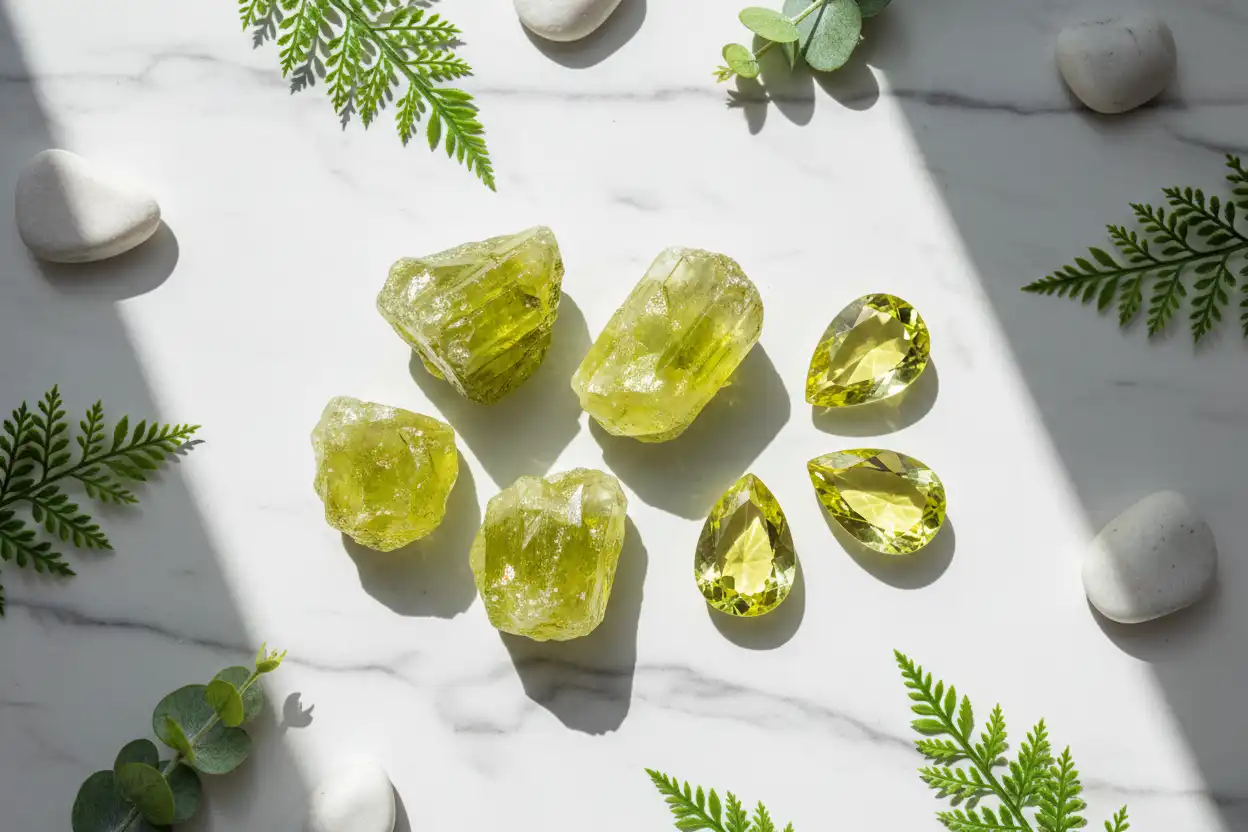
Well-formed crystals are commonly transparent and can develop short prismatic, elongated, or spearhead-like forms. Their color ranges from pale yellow through chartreuse and yellow-green, while colorless material can also occur. Mindat records vitreous to sub-vitreous or locally greasy luster, good cleavage on {010}, conchoidal fracture, and a white streak.
| Property | Brazilianite characteristics |
|---|---|
| Mineral species | Brazilianite |
| Ideal formula | NaAl₃(PO₄)₂(OH)₄ |
| Mineral class | Phosphate |
| Crystal system | Monoclinic |
| Typical color | Pale yellow, chartreuse, yellow-green, occasionally colorless |
| Transparency | Usually transparent in gem-quality material |
| Mohs hardness | About 5.5 |
| Specific gravity | About 2.98–3.01 |
| Cleavage | Good on {010} |
| Fracture | Conchoidal |
| Tenacity | Brittle |
| Luster | Vitreous to sub-vitreous, sometimes slightly greasy |
| Optical character | Biaxial positive |
| Refractive indices | Approximately 1.602–1.623 |
| Birefringence | Roughly 0.019–0.021 |
| Typical occurrence | Phosphate-rich pegmatitic environments |
| Separate mineral species? | Yes |
A GIA-recorded Brazilianite gemstone showed refractive indices around 1.605 and 1.621, specific gravity of 3.01, yellow to yellowish-green pleochroic appearance, vitreous luster, and partially healed fractures containing fluid inclusions. Those observations illustrate why a Brazilianite identification should rely on a combination of physical and optical evidence rather than color alone.
Why Brazilianite Is Unusual Among Gem Minerals
Many familiar transparent gems are silicates, oxides, or carbonates. Brazilianite belongs instead to the phosphate mineral group, making it comparatively unusual among minerals routinely cut as transparent gemstones.
Its chemistry also places it within pegmatitic mineral systems where phosphorus, sodium, aluminum, and volatile components have become concentrated during late stages of granitic evolution. These chemically complex environments can produce suites of unusual phosphate minerals alongside feldspar, quartz, mica, apatite, beryllonite, and members of the amblygonite-montebrasite series.
Brazilianite is therefore interesting not just because of its yellow-green color but because it records a specialized geochemical environment.
How Brazilianite Forms
Brazilianite is particularly associated with phosphate-rich zones of granitic pegmatites. Pegmatites are extremely coarse-grained igneous bodies that commonly represent late-stage crystallization products of granitic magmas. Their residual fluids can become enriched in elements that were poorly accommodated by earlier-forming minerals, allowing uncommon phosphates and other rare minerals to crystallize.
Brazilianite may form during late pegmatitic processes and can also participate in alteration or replacement relationships involving earlier phosphate minerals. Research on Brazilian occurrences has discussed links among amblygonite-montebrasite-group phosphates, sodium-rich alteration, apatite, and Brazilianite, although the exact sequence can vary among deposits and should not be imposed universally on every specimen.
Classic Brazilianite localities in Minas Gerais show associations with minerals such as albite, muscovite, quartz, microcline, beryllonite, eosphorite, fluorapatite, and amblygonite-montebrasite-series material. Those associations provide geological context, but the presence of one companion mineral does not prove Brazilianite identity or locality by itself.
The deposit-level relationships among phosphate mineralization, pegmatite evolution, host minerals, replacement textures, and fluid chemistry are explored separately in Brazilianite formation and deposit geology.
What Causes Brazilianite’s Yellow-Green Color?
Brazilianite color is more complicated than the simple statement that “iron makes it yellow-green.” Research on material from Minas Gerais indicates that the yellow component can be linked to an absorption feature associated with localized oxygen-hole centers in the crystal structure. Experimental and spectroscopic work has shown that irradiation-related defects can strengthen yellow coloration, while the origin of the greenish component is less straightforward.
This is an important correction to simplistic color explanations. Trace iron may be present in Brazilianite, and chemical substitutions are possible, but observing a yellow-green crystal does not allow a viewer to identify the precise color center or trace-element mechanism by eye.
Color can also vary within a single crystal. Pale zones, richer chartreuse areas, yellow-green sections, and uneven intensity can reflect growth conditions, structural defects, later alteration, or the interaction of several optical factors.
The more detailed relationship among absorption, refractive behavior, birefringence, color zoning, and transmitted light belongs in Brazilianite optical properties and color behavior.
Brazilianite Can Lose Color Under Strong Heat
The color of Brazilianite is not necessarily immutable. Experimental observations have reported progressive color loss under elevated heating, reinforcing the conclusion that defect-related mechanisms participate in at least part of its coloration.
That does not make heating a recommended identification test. Deliberately heating a gemstone or collector crystal can permanently change its appearance, damage inclusions or fractures, reduce value, and destroy provenance-sensitive material.
Color stability should therefore be treated as a scientific observation, not as a home experiment.
What Does Natural Brazilianite Look Like?
Gem-quality Brazilianite commonly attracts attention because its color can resemble fresh citrus, chartreuse, yellow-green beryl, or pale chrysoberyl. Rough crystals may be short and blocky or more elongated, with strong vitreous luster and distinct terminations.
Natural crystals are not required to be perfectly clean. Cleavage traces, healed fractures, fluid inclusions, internal veils, edge chips, contact marks, and growth irregularities can occur. The GIA specimen record, for example, documents partially healed fractures containing fluid inclusions in a transparent faceted Brazilianite.
A collector specimen can also differ strongly from faceting rough. A sharp crystal attached naturally to albite and muscovite may be more valuable as a mineral specimen than it would be after removal and cutting, even if transparent material exists inside it.
Original Brazilianite Specimen and Photo Checklist
Use this checklist as a structured first-pass examination. It helps determine whether the available evidence is consistent with Brazilianite, but it does not replace qualified gemological testing.
Examine the overall color
Look for pale yellow, lemon-yellow, chartreuse, yellow-green, or related natural tones. Very intense neon green is not a requirement and may actually be less representative of typical material.
Look for a plausible crystal habit
Well-formed Brazilianite commonly develops short prismatic to elongated forms and can show wedge-like or spearhead-style geometry. A perfectly hexagonal quartz-like point is not characteristic simply because its color looks similar.
Observe luster
Fresh crystal faces and well-polished gems should appear predominantly vitreous. Dull weathering, contact areas, or minor greasy-looking surfaces can occur.
Check for cleavage
Good cleavage is an important property. Natural crystals may show flat cleavage-related breaks or internal planar features, although cleavage should not be deliberately produced for testing.
Inspect existing chips and fractures
Conchoidal fracture can occur where cleavage does not dominate. Natural edge damage, contact marks, and healed internal fractures are compatible with a brittle phosphate mineral.
Compare color through different thicknesses
A crystal can appear stronger in color through thicker sections and considerably paler through thin areas. Do not judge color only from one photograph.
Examine inclusions under magnification
Fluid inclusions, healed fractures, mineral inclusions, growth features, and cleavage-related structures can provide useful evidence. Exact interpretation belongs in the Brazilianite microscope inclusion notebook.
Check matrix associations carefully
Albite, muscovite, quartz, feldspar, and other pegmatite minerals are plausible companions. A specimen glued artificially onto feldspar does not gain authentic provenance simply because the association looks geologically reasonable.
Do not identify from color alone
A yellow-green transparent object could be Brazilianite, apatite, chrysoberyl, beryl, tourmaline, topaz, glass, synthetic material, or another gem.
Do not use hardness as the only test
A hardness near 5.5 can narrow possibilities but is not unique enough to establish Brazilianite.
Compare density where practical
A carefully measured specific gravity close to 3.0 can strengthen an identification when the specimen is loose and free of attached matrix.
Consider refractive testing
A properly polished facet can provide refractive-index evidence that is substantially more useful than an internet color comparison.
Preserve collector labels
An old locality label, collection number, dealer documentation, or acquisition record may contain provenance information that cannot be recovered from the mineral itself.
Be suspicious of impossible certainty from photographs
A photograph can support “consistent with Brazilianite,” but exact identification usually requires physical or instrumental evidence.
Treat metaphysical wording as separate information
Descriptions such as manifestation stone, confidence crystal, solar plexus activator, or high-vibration Brazilianite are not diagnostic evidence.
A Source-Comparison Guide to Brazilianite Claims
Brazilianite is a useful example of how a real mineral can accumulate simplified or unsupported descriptions as information is repeated online.
| Claim | Evidence status | Better interpretation |
|---|---|---|
| Brazilianite is a sodium aluminum phosphate hydroxide | Supported | Its ideal formula is NaAl₃(PO₄)₂(OH)₄ |
| Brazilianite is a variety of quartz | Incorrect | It is a distinct phosphate mineral species |
| Brazilianite crystallizes in the monoclinic system | Supported | This is a defining crystallographic property |
| Brazilianite is always bright lime green | Incorrect | Natural material ranges through pale yellow, chartreuse and yellow-green, with colorless material also known |
| All Brazilianite color comes from iron | Too simplistic | Defect-related oxygen-hole centers are implicated in the yellow component; the full greenish coloration is more complex |
| Brazilianite has Mohs hardness 7 | Incorrect | Its hardness is approximately 5.5 |
| Brazilianite has no cleavage | Incorrect | Good cleavage is documented |
| Every Brazilianite crystal comes from Brazil | Incorrect | Brazil is the classic and type-source country, but occurrences are known elsewhere |
| A Brazilian locality can be proven by color | Unsupported | Provenance requires documentation or stronger locality evidence |
| Brazilianite was widely used in ancient crystal healing | Unsupported | Its documented mineralogical recognition is comparatively recent |
| Brazilianite naturally increases confidence | Modern symbolism | It may serve as a personal reminder, not a measured mineral effect |
| Brazilianite improves intelligence or memory | Unsupported medical/cognitive claim | No gemological property establishes this |
| Brazilianite manifests wealth | Metaphysical belief | Not a mineralogical property |
| Brazilianite activates chakras | Spiritual interpretation | Not measurable through gemological testing |
The table shows why Brazilianite meaning needs evidence categories rather than a mixture of facts and beliefs presented at equal certainty.
Brazilianite Versus Amblygonite-Montebrasite
Brazilianite occurs in geological environments where amblygonite-montebrasite-group minerals may also occur, and alteration relationships among these phosphates have been studied. Visually, pale yellow or yellow-green material can occasionally create confusion, especially in rough or massive pieces.
The distinction cannot be reduced to color. Brazilianite has its own sodium-aluminum phosphate hydroxide composition and monoclinic structure, while members of the amblygonite-montebrasite series are lithium aluminum phosphates containing varying proportions of fluorine and hydroxyl.
Specific gravity, optical properties, cleavage, spectroscopy, and chemical analysis can separate them far more reliably than hue.
Brazilianite Versus Yellow-Green Beryl
A clean faceted Brazilianite can resemble yellow-green beryl because both may display transparent pale yellow-green color and vitreous luster. Their physical properties differ substantially.
Beryl is harder, typically around Mohs 7.5–8, and has a different refractive-index range, crystal system, density, chemistry, and cleavage behavior. Brazilianite is softer at about 5.5 and has good cleavage.
That difference has practical consequences: Brazilianite requires more caution in jewelry even when it looks superficially like a harder traditional gemstone.
Brazilianite Versus Apatite
Apatite can also occur in transparent yellow-green material and shares membership in the phosphate mineral class, making it a particularly reasonable visual comparison.
Apatite is usually slightly softer, around Mohs 5, and has different optical properties, density, chemistry, and crystal symmetry. Color remains insufficient for identification.
This is a good example of why mineral class alone is not diagnostic. Two phosphates can look similar while being structurally and chemically distinct.
Brazilianite Versus Topaz
Yellow topaz can overlap with Brazilianite in broad color and transparency, but topaz is considerably harder and belongs to an entirely different silicate mineral system.
A scratch-resistance difference exists, but destructive testing is unnecessary. Refractive index, density, cleavage character, crystal habit, and qualified gemological examination provide more useful evidence.
Brazilianite Versus Other Neighboring Gem Materials
Brazilianite provides an instructive contrast with several other Gems Lore references. Boulder opal is hydrated amorphous silica naturally retained with host rock rather than a crystalline phosphate. Botswana agate is microcrystalline silica characterized by banding, while Brazilianite is a transparent monoclinic phosphate crystal.
Brookite is titanium dioxide with entirely different density, optical properties, and crystallography, while bronzite belongs to the pyroxene mineral group and is commonly valued for a metallic-looking schiller effect rather than transparent yellow-green color.
These contrasts reinforce a central gemological rule: apparent color or metaphysical category should never replace mineral identity.
Laboratory Identification
A qualified gemologist can build a Brazilianite identification from several independent properties rather than from one visually attractive feature.
Useful evidence can include:
refractive-index measurements;
birefringence;
optic character;
specific gravity;
microscopic inclusions;
cleavage;
absorption behavior;
spectroscopy;
and, where necessary, chemical or structural analysis.
Mindat records Brazilianite as biaxial positive with refractive indices approximately 1.602, 1.609, and 1.621–1.623 and birefringence around 0.020. A documented GIA specimen produced closely compatible gemological values.
Raman spectroscopy can also provide a mineral-specific structural fingerprint because phosphate-group vibrations and Brazilianite’s crystal framework produce characteristic spectral features. Research on Brazilianite has used Raman methods specifically to connect spectral bands with its molecular structure.
What Laboratory Testing Cannot Automatically Prove
Confirming that a stone is Brazilianite does not automatically prove where it was mined.
Material identification and provenance are separate questions. A laboratory can determine that a specimen has Brazilianite’s chemistry and structure without being able to prove that it came from one specific pegmatite in Minas Gerais.
Likewise, identifying a fluid inclusion or associated mineral does not automatically establish a mine. Similar mineral assemblages can occur in more than one pegmatitic environment.
For locality-sensitive collector material, use the Brazilianite provenance disclosure checklist to distinguish confirmed documentation from visual inference.
The Documented History of Brazilianite
The modern mineral name Brazilianite was established after scientific study of material from the Córrego Frio pegmatite in Minas Gerais. Frederick Harvey Pough and Edward Porter Henderson named the mineral for Brazil, the country containing its type locality. Mindat records the Córrego Frio mine at Linópolis, Divino das Laranjeiras, Minas Gerais, as the type locality.
The Geological Survey of Brazil likewise identifies the Córrego Frio pegmatite as the discovery locality of Brazilianite and places it within the Conselheiro Pena pegmatite district of eastern Minas Gerais.
This is genuine documented history. It is very different from claims that Brazilianite was a famous ritual stone in remote antiquity or that ancient civilizations consistently used it for modern chakra concepts.
Because the mineral’s documented recognition is comparatively recent, claims of ancient traditions specifically naming and using Brazilianite require unusually strong evidence.
Was Brazilianite Known in Ancient Crystal Traditions?
There is no good basis for casually assigning Brazilianite the same kind of ancient lore often associated with gemstones documented in historical jewelry, religious objects, trade records, or lapidary texts.
A yellow-green ancient gem could have been beryl, glass, chrysoberyl, apatite, quartz, another phosphate, or a material described using a historical name that does not correspond cleanly with modern mineralogy.
To claim that an ancient object was specifically Brazilianite would require actual mineral identification of the object or credible historical evidence connecting the material with the species now called Brazilianite.
Without that evidence, modern Brazilianite symbolism should be described as modern.
Brazilianite Meaning in Modern Symbolism
Modern Brazilianite meaning commonly emphasizes optimism, motivation, purpose, confidence, creativity, decisiveness, and following through on intentions.
The yellow-green appearance helps explain many of these associations. Yellow is often used symbolically for energy, illumination, confidence, or focus, while green can represent growth, possibility, renewal, or development. A transparent crystal combining the two colors can therefore become an intuitive object for goal-oriented symbolism.
Someone might keep Brazilianite near a notebook while defining priorities, use it as a reminder to convert vague intentions into specific actions, or associate it with examining whether enthusiasm is being supported by practical follow-through.
The stone functions as the chosen symbol. The action remains human.
Brazilianite and Confidence
Confidence is a common symbolic theme, but it should not be treated as a neurological effect of phosphate mineralogy.
A person preparing for a presentation might keep a Brazilianite specimen nearby as a reminder to review the material thoroughly, speak clearly, and focus on controllable aspects of the situation. If that ritual helps organize attention, the benefit comes from preparation and the meaning assigned to the object.
There is no evidence that NaAl₃(PO₄)₂(OH)₄ directly changes confidence hormones, neurotransmitters, or cognitive performance through ordinary contact.
Brazilianite and Creativity
The vivid yellow-green color and relative rarity of Brazilianite make creativity another understandable symbolic association.
Someone might use the mineral as a visual cue to explore alternatives, draft several ideas before selecting one, or return to an unfinished creative project. These are behaviors that can influence creative work.
The mineral does not need to emit creativity energy for the symbolism to function.
Brazilianite and Manifestation
Brazilianite is sometimes placed within modern manifestation practices, particularly those involving goals, opportunity, motivation, or abundance.
Manifestation language can mean different things. If it describes clarifying a goal, writing down actions, monitoring progress, and intentionally directing effort, a Brazilianite specimen can act as a symbolic reminder within that routine.
If manifestation is presented as a claim that the mineral itself causes money, opportunities, relationships, or external events to appear through an invisible force, that claim is not supported by mineralogical evidence.
Chakra Associations
Contemporary metaphysical sources may connect Brazilianite with the solar plexus chakra, heart chakra, or occasionally multiple energy centers because of its yellow-green color.
These associations belong to spiritual interpretation. Gemological testing can establish refractive index, specific gravity, birefringence, crystal structure, and chemical composition; it cannot measure whether a chakra is open, balanced, activated, or blocked.
A person may still include Brazilianite in a private meditation practice while keeping the claim within the spiritual framework in which it originated.
Does Brazilianite Have Healing Properties?
Brazilianite should not be presented as a medical treatment.
Claims that it cures depression, improves concentration disorders, changes metabolism, balances hormones, treats digestive conditions, removes toxins, improves fertility, or heals the nervous system are not established by Brazilianite’s chemistry or optical properties.
The mineral has real measurable characteristics. Those characteristics describe a sodium aluminum phosphate hydroxide crystal. They do not demonstrate therapeutic action in the human body merely because the stone is touched, worn, or placed nearby.
Personal meditation or symbolic practice can coexist with appropriate healthcare, but it should not replace diagnosis, medication, therapy, or other necessary treatment.
Phosphate Chemistry Does Not Create a Biological Benefit
Because Brazilianite is a phosphate mineral, it can be tempting to infer health effects from the fact that phosphate is biologically important. That reasoning is not valid.
Phosphate groups within Brazilianite are chemically bound inside the crystal structure. Holding the mineral does not provide the body with a controlled nutritional phosphate dose, nor does its aluminum or sodium content translate automatically into a physiological effect.
Mineral chemistry explains what the stone is. It is not a list of ingredients being therapeutically delivered through the skin.
Cutting Brazilianite
Transparent Brazilianite can produce attractive faceted gems, but its hardness and cleavage make cutting more demanding than its glassy appearance may suggest.
The cutter must account for:
crystal orientation;
cleavage direction;
internal fractures;
color zoning;
final face-up color;
retention of weight;
and polishing response.
A transparent crystal with strong specimen form may also be worth more intact than as cutting rough. Removing a sharp crystal from an attractive natural matrix can destroy specimen value even if the resulting gemstone is beautiful.
Detailed lapidary considerations are covered in Brazilianite cutting, orientation and polish.
Brazilianite in Jewelry
Brazilianite can be worn in jewelry, but it is not an ideal choice for every setting. Mohs hardness around 5.5 means it scratches more readily than quartz, topaz, sapphire, or beryl, while good cleavage and brittle tenacity add impact vulnerability.
Earrings and pendants usually expose a stone to fewer hard knocks than rings or bracelets. A ring can still be made successfully, but protective design becomes more important.
Sharp corners, thin girdles, cleavage-oriented stress, and exposed edges should be minimized where possible.
Those structural decisions are addressed in the Brazilianite setting and wear engineering guide.
Safe Ownership and Handling
An intact Brazilianite crystal or faceted gem does not need to be treated as hazardous merely because its formula contains aluminum, sodium, or phosphate.
Normal handling of a stable solid specimen is fundamentally different from grinding mineral material into dust or ingesting it.
The more practical risks are mechanical. Brazilianite is brittle and has good cleavage, so crystals can chip or split if struck. Broken edges can become sharp.
Lapidary work creates mineral dust and should use appropriate workshop controls, including wet methods where suitable, local extraction, eye protection, and respiratory protection appropriate to the process.
Brazilianite should not be powdered for ingestion or placed in drinking water as a crystal elixir. Symbolic use does not require consuming mineral material.
Conserving a Collector-Quality Brazilianite Specimen
Important Brazilianite specimens can combine gem transparency with exceptional crystal form and natural pegmatite matrix. Such pieces may carry more scientific and collector information than a loose faceted stone.
Before cleaning or altering an important specimen, record:
overall photographs;
close images of terminations;
cleavage cracks;
matrix contacts;
associated minerals;
dimensions;
weight;
labels;
acquisition records;
repairs;
and existing damage.
Avoid aggressive mechanical cleaning around fragile terminations or cleavage planes.
The Brazilianite specimen conservation record provides a structured way to track condition without assuming that intervention is always necessary.
A Practical Evidence Ladder for Brazilianite Claims
Different Brazilianite claims require different kinds of evidence.
Direct observation can document color, crystal form, transparency, matrix, luster, fractures, dimensions, and visible condition.
Basic gemological testing can evaluate refractive indices, birefringence, specific gravity, optic character, hardness behavior, and cleavage.
Microscopy can reveal healed fractures, fluid inclusions, cleavage traces, mineral inclusions, coatings, repairs, and polishing features.
Spectroscopy can strengthen mineral identification and investigate optical absorption responsible for color.
X-ray diffraction can establish crystal structure when mineralogical certainty is required.
Chemical analysis can confirm sodium, aluminum, phosphorus, and minor constituents or test specific compositional claims.
Geological context can show whether a specimen is compatible with a phosphate-rich pegmatite environment.
Provenance documentation is needed to support a mine, district, collection, or country claim beyond simple visual resemblance.
Historical documentation supports the modern naming history of Brazilianite but does not automatically validate claims of ancient spiritual use.
Symbolic interpretation includes confidence, optimism, manifestation, creativity, purpose, and chakra associations. These are human meanings and are not converted into intrinsic mineral properties through additional laboratory testing.
What Brazilianite Meaning Can Reliably Include
Brazilianite meaning becomes clearest when the geological material, documented history, and modern symbolism remain distinct.
Materially, Brazilianite is NaAl₃(PO₄)₂(OH)₄, a monoclinic sodium aluminum phosphate hydroxide found especially in phosphate-rich pegmatitic environments. It is typically transparent and yellow to yellow-green, with hardness around 5.5, good cleavage, brittle behavior, specific gravity close to 3.0, and optical properties that allow it to be distinguished from look-alike gems.
Its color is more scientifically interesting than the common claim that a single trace element simply makes the mineral green. Spectroscopic work indicates an important role for defect-related centers in the yellow component, while aspects of the greenish coloration remain more complex.
Historically, Brazilianite’s strongest documented story begins with mineralogical study of material from Minas Gerais and its naming for Brazil. Claims that it carried the same confidence, manifestation, chakra, or abundance meanings in antiquity should not be repeated without specific evidence.
Symbolically, modern users can reasonably choose Brazilianite to represent purposeful action, optimism, creativity, confidence, or converting intentions into practical steps. Those meanings can support a personal reflective practice without claiming that the mineral treats disease, changes cognition, controls external events, or emits a scientifically established manifestation energy.
Gems Lore explains its material-first approach on the About page. Health, spiritual, and informational limitations are set out in the Disclaimer, while factual corrections or supporting mineralogical evidence can be submitted through Contact.
Brazilianite does not need exaggerated claims to be remarkable. It is an uncommon transparent phosphate gem whose yellow-green color, pegmatitic origin, distinctive chemistry, cleavage, optical behavior, fluid inclusions, and classic Brazilian crystal specimens provide a substantial scientific story of their own. Brazilianite meaning is most useful when that real mineral identity comes first and its modern symbolism remains the human interpretation placed upon it.