Boulder Opal Meaning: Material Facts, History & Symbolism
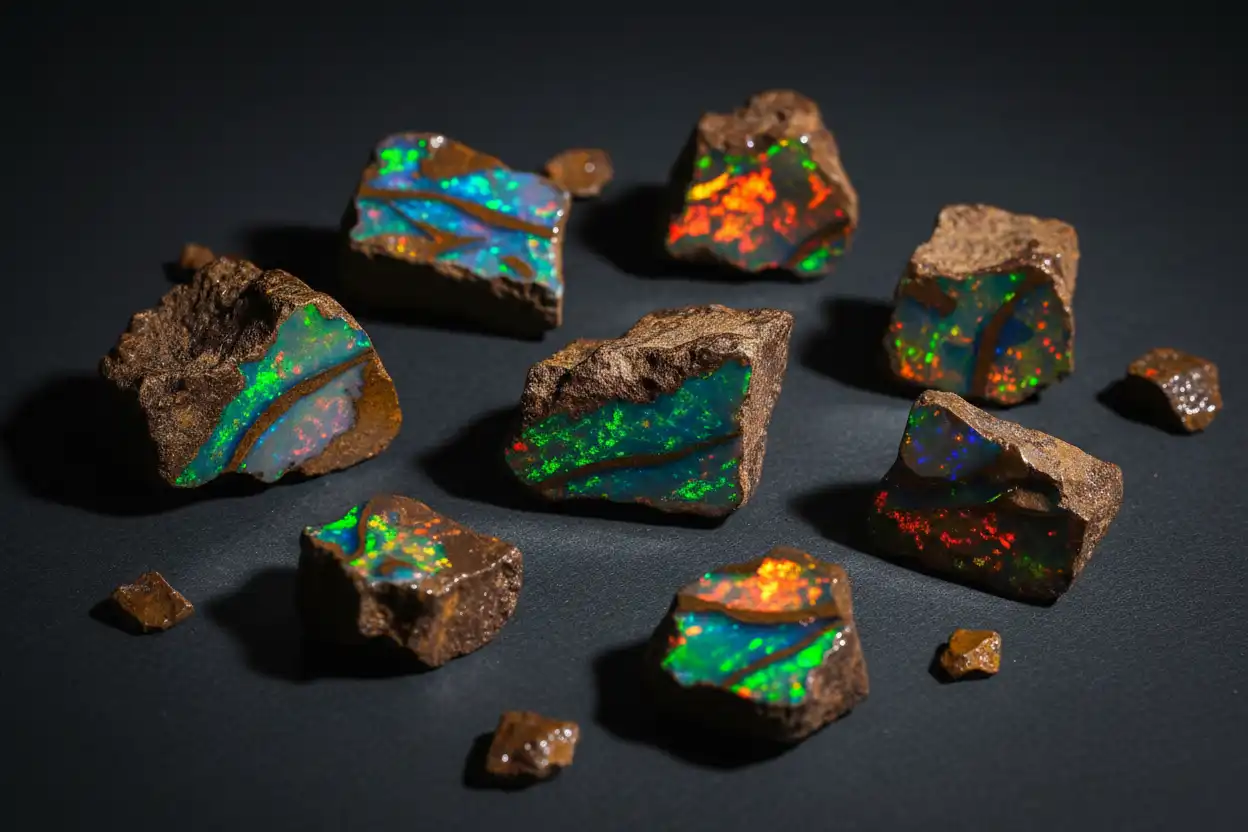
Boulder opal meaning is often described through modern ideas of resilience, individuality, grounding, creativity, and finding beauty within difficult circumstances. Those interpretations are symbolic. Materially, boulder opal is a natural opal-and-host-rock composite in which seams or patches of opal remain attached to the rock in which they formed, most famously the iron-rich host material of western Queensland, Australia.
The retained matrix is not merely packaging around the gem. It is part of boulder opal’s geological identity and often part of the finished stone. GIA defines boulder opal as opal with play-of-color occurring within host rock, with thin opal layers intentionally cut so the supporting matrix remains attached. Queensland’s mining authority similarly describes boulder opal forming where silica occupies cracks and voids in ironstone.
This structure explains why boulder opal can look radically different from a conventional solid opal cabochon. The precious layer may be only a thin vein crossing brown ironstone, a network of narrow seams, a patch covering part of the face, or an irregular naturally shaped area that a cutter preserves instead of forcing into a calibrated oval.
For broader mineral and gem references organized around material identity first, browse the Gemstone Guides.
What Is Boulder Opal?
Boulder opal is a natural combination of opal and its host rock. In the Australian material for which the name is best known, the host is commonly iron-rich rock broadly referred to in the gem trade as ironstone. Precious opal occupies fractures, seams, cavities, voids, or other spaces within that host.
Opal itself is hydrated amorphous silica rather than a conventionally crystalline mineral. It is therefore commonly classified as a mineraloid. Its composition is often represented approximately as SiO₂·nH₂O because variable amounts of water are incorporated within the silica material.
Precious opal is distinguished from common opal by play-of-color. In suitable precious opal, orderly arrangements of submicroscopic silica spheres interact with visible light to produce shifting spectral colors. GIA describes this phenomenon as diffraction associated with organized silica spheres and identifies play-of-color as the defining visual feature of precious opal.
| Property | Boulder opal characteristics |
|---|---|
| Material type | Natural opal retained on or within host rock |
| Gem component | Hydrated amorphous silica |
| Classification of opal | Mineraloid |
| Typical Australian host | Iron-rich rock commonly called ironstone |
| Defining premium feature | Play-of-color when precious opal is present |
| Common opal possible? | Yes; not every opal seam necessarily displays play-of-color |
| Typical structure | Thin seams, patches, veins or networks within matrix |
| Mohs hardness of opal | Approximately 5–6.5 |
| Cleavage | None in opal |
| Fracture | Commonly conchoidal to uneven |
| Transparency | Transparent through translucent to opaque depending on the opal |
| Typical cutting style | Freeform cabochons and polished faces retaining host rock |
| Separate mineral species? | No; “boulder opal” describes a natural opal-host-rock occurrence and gem type |
The host rock makes generalized measurements difficult. A finished boulder opal contains materials with different hardness, porosity, density, polish response, and fracture behavior, so a single number cannot describe every part of the object equally well.
Why the Matrix Is Left Attached
Removing the host rock from many boulder opals would destroy or seriously weaken the precious opal. The color-bearing seam can be extremely thin, irregular, or discontinuous, with ironstone providing the natural backing that supports it.
This is not the same construction as an opal doublet. In a doublet, a thin opal layer is deliberately attached to a separate backing during manufacture. In boulder opal, the opal and matrix occur together naturally in the geological specimen.
That distinction is one of the first things worth establishing when examining an unfamiliar stone. A natural ironstone boundary is evidence of geological association; an adhesive interface suggests an assembled gem.
How Boulder Opal Forms
Boulder opal is strongly associated with western Queensland’s opal fields. Queensland’s mining department identifies Winton and Quilpie among important boulder-opal regions and describes the material as forming when silica fills cracks and voids in ironstone.
The basic process requires mobile silica to enter available spaces in the host rock. Silica-bearing fluids move through fractures, pores, cavities, and other structural openings. Under suitable conditions, hydrated silica accumulates and eventually solidifies as opal.
The result does not have to be a neat, isolated cavity filled entirely with gem material. Narrow fractures can become opal seams only fractions of the width of the surrounding rock. Networks of intersecting cracks can create intricate patterns. Irregular cavities can produce wider patches.
Western Queensland also produces distinctive opal-bearing ironstone concretions. At Yowah, for example, government geological descriptions document siliceous ironstone nodules known as Yowah nuts, some containing precious opal internally.
That does not mean every Yowah nut should simply be called ordinary boulder opal or that every boulder opal forms identically. It demonstrates how closely precious opal can be integrated with iron-rich host material in Queensland’s western opal fields.
The full discussion of host formations, fracture systems, weathering, silica movement, concretions, and regional differences belongs in boulder opal formation and deposit geology.
What Creates Play-of-Color?
Precious opal does not display rainbow color because it contains microscopic pigments corresponding to every visible hue. Its play-of-color is a structural optical phenomenon.
Where silica spheres are organized with appropriate size and spacing, incoming visible light interacts with that structure and different wavelengths emerge strongly at different viewing geometries. As the stone, observer, or light source moves, the dominant colors can shift.
GIA identifies brightness, color range, pattern, and the way play-of-color appears from different directions as important aspects of opal appearance.
This is why the same boulder opal may look predominantly blue-green from one direction, reveal orange from another, and show a small red flash only within a particular angular range.
The detailed optics are covered separately in boulder opal optical properties and color behavior.
The Ironstone Can Improve Visual Contrast
A dark brown iron-rich matrix can provide strong contrast behind a comparatively thin opal seam. Bright blue, green, orange, or red play-of-color can appear especially vivid against the darker host.
This does not mean the ironstone is generating the spectral colors. It acts primarily as host and visual background while the organized silica structure within precious opal produces play-of-color.
Some finished stones use the relationship dramatically: a narrow luminous opal river crosses a broad brown matrix, or several color seams branch through the rock. Others contain a larger face of precious opal with only a narrow ironstone margin visible.
Neither structure is inherently more “authentic.” They represent different ways opal occupied the host.
Boulder Opal, Matrix Opal, and Yowah Nuts
Terminology can become confusing because opal naturally associated with host rock occurs in several forms.
Boulder opal
In the usual gem-trade sense, precious opal occurs in a host rock and the matrix is deliberately retained in the cut gem.
Matrix opal
This term is commonly used when precious opal is distributed through pores, grains, or a broader network inside the host rather than forming one comparatively discrete seam. Trade usage is not always perfectly consistent.
Yowah nut
A Yowah nut is a characteristic siliceous ironstone concretion from the Yowah field. Government descriptions record concentric ironstone structures that can contain precious-opal kernels or seams.
A Yowah nut can yield spectacular opal-bearing material, but the geological name describes the concretion type and locality rather than every possible boulder-opal structure.
A Claim-versus-Evidence Guide to Boulder Opal
Boulder opal meaning attracts statements ranging from basic gemology to folklore and modern metaphysical interpretations. Separating them prevents a real optical property from being used as evidence for an unrelated claim.
| Claim | Evidence status | More accurate interpretation |
|---|---|---|
| Boulder opal contains natural host rock | Supported | Retained matrix is characteristic of the gem type |
| Queensland is a major source | Supported | Western Queensland is particularly associated with boulder opal |
| Silica can fill fractures and voids in ironstone | Supported | This is a documented formation setting |
| All boulder opal consists of one thick opal layer | Incorrect | Opal may occur as very thin seams, networks, patches or cavity fillings |
| Brown backing means the stone is an opal doublet | Incorrect | Natural ironstone is integral to genuine boulder opal |
| Every opal-and-rock composite is boulder opal | Too broad | Geological context and trade terminology matter |
| Rainbow color comes from pigments inside the opal | Incorrect for play-of-color | Ordered silica structures produce the optical phenomenon |
| Stronger color proves a particular mine | Unsupported | Appearance cannot establish locality by itself |
| More visible ironstone means lower quality | Unsupported as a universal rule | Design, play-of-color, pattern and intended aesthetic all matter |
| Boulder opal represents resilience | Modern symbolism | Reasonable as metaphor because opal remains integrated with its host |
| Boulder opal absorbs negative energy | Metaphysical claim | No standard gemological measurement establishes this |
| Boulder opal improves creativity biologically | Unsupported | Creativity is a symbolic association, not demonstrated mineral efficacy |
| Boulder opal medically heals emotions | Unsupported medical claim | Gemological identity does not establish therapeutic action |
| Opal is inherently unlucky | Folklore | A cultural belief, not a physical property |
This framework preserves the interesting cultural layer without using mineral science to authenticate supernatural claims.
An Original Boulder Opal Specimen and Photo Checklist
Photographs can reveal much about boulder opal, but they cannot resolve every question. Use the following checklist as a first-pass observation framework.
Identify the opal-matrix boundary
Look for an irregular geological transition between opal and host rock. Natural seams often follow fractures or uneven surfaces rather than maintaining a perfectly uniform thickness.
Examine whether the matrix continues naturally
On an unmounted stone, compare the face, edges, and back. Natural ironstone should form a coherent part of the specimen rather than appearing as an unrelated backing plate.
Look for an adhesive line
A straight or unusually uniform interface containing glue can indicate an assembled opal rather than natural boulder structure.
Rotate the stone through several angles
Observe where play-of-color appears, disappears, or changes hue. One photograph can capture an unusually favorable position and overstate normal face-up performance.
Compare diffuse and directional light
Directional illumination can intensify flashes. Diffuse light gives a better sense of everyday appearance.
Check the percentage of the face occupied by precious opal
Some stones are predominantly opal with narrow matrix margins; others are mainly ironstone crossed by small opal seams. Record the structure rather than assuming one ratio is universally superior.
Observe dead areas and common opal
Not every silica-rich area will display play-of-color. Potch or common opal can occur beside precious material.
Examine cracks through the opal
Distinguish natural matrix boundaries from actual fractures cutting through precious opal. A crack affecting the opal layer has different durability implications from an ordinary ironstone contact.
Check surface polish
Opal and ironstone respond differently during polishing. Slight topographic differences may be natural, but deep undercutting, pits, or poorly supported seams can affect durability.
Look for suspiciously perfect backing
A uniformly flat, contrasting black or dark layer attached beneath a thin opal slice can be consistent with a doublet rather than natural boulder opal.
Inspect the matrix texture
Natural ironstone should show mineral texture, irregularity, fractures, or weathering rather than behaving like homogeneous plastic.
Use magnification where necessary
A loupe or microscope can help inspect glue, polishing boundaries, fractures, potch, ironstone contacts, inclusions, and surface-reaching cavities.
Do not infer Queensland locality from brown matrix alone
Many rocks are iron-rich. Provenance requires documentation in addition to visual compatibility.
Preserve labels and acquisition history
An old mine label can be more important to provenance than any individual color pattern.
Avoid destructive tests
Do not deliberately chip or grind a potentially valuable boulder opal to “prove” the backing is natural.
The boulder opal microscope inclusion notebook develops those magnified observations without turning this meaning reference into a microscopy manual.
Boulder Opal Versus an Opal Doublet
This distinction deserves special attention because the two can look similar face-up.
A boulder opal retains its naturally associated host rock. A doublet is assembled after mining by attaching opal to a separate backing, commonly to strengthen a thin layer or create darker contrast.
Viewed from the side, a doublet may show a comparatively regular junction between the opal layer and backing. Natural boulder opal usually has a more irregular boundary dictated by the original fracture or cavity.
However, cutting can obscure the distinction. A well-made assembled stone may require expert examination, while a heavily polished natural boulder opal can have surprisingly clean-looking boundaries.
A seller’s disclosure should therefore be considered together with physical evidence.
Boulder Opal Versus Solid Black Opal
Boulder opal can produce brilliant color against dark matrix and may therefore resemble black opal face-up. Their structures are different.
Black opal is valued for precious opal with a naturally dark body tone, whereas boulder opal achieves much of its dark visual background from attached host rock beneath or around comparatively thin opal.
The distinction is structural rather than a judgment about which is better. Fine examples of either type can show exceptional play-of-color.
Readers comparing material identity with another dark opal type can use the separate black opal meaning reference rather than treating all dark-background opal as one category.
How Hard Is Boulder Opal?
The opal portion is commonly around Mohs 5–6.5, making it softer than quartz. GIA gives this range for opal generally.
The matrix may behave differently, which makes “the hardness of boulder opal” an incomplete statement when applied to the entire composite object. Ironstone can contain several minerals and textures, while weathering may create softer areas or pits.
Hardness also measures resistance to scratching rather than resistance to fracture. An opal seam can still crack after impact even when its surface has not been badly scratched.
Is Boulder Opal Fragile?
It deserves sensible care but should not be described as automatically unstable.
The matrix can provide useful natural support for a thin precious-opal seam, one reason retaining it is practical. GIA notes that matrix in boulder opal can reinforce the gem.
Durability still depends on the individual stone. Important variables include:
opal seam thickness;
existing cracks;
whether the seam reaches an exposed edge;
ironstone stability;
amount of undercutting;
cabochon thickness;
setting protection;
and impact exposure.
A thin intact seam well supported by ironstone can perform differently from a thicker opal layer crossed by an open fracture.
Detailed setting decisions belong in boulder opal setting and wear engineering.
Cutting Boulder Opal Follows the Color
Standardized calibrated shapes can waste the best part of boulder-opal rough. Because precious opal follows natural seams and fractures, cutters commonly use freeform shapes that preserve color and maintain enough matrix to support the opal.
A promising surface may reveal only a narrow seam before cutting. Grinding too deeply can remove the strongest color completely. Conversely, carefully following the layer can expose a much broader patch than was initially visible.
This makes orientation a three-dimensional problem. The cutter is simultaneously considering:
direction and depth of the opal seam;
brightness;
pattern;
color range;
weak fractures;
matrix thickness;
final face orientation;
and the amount of material needed for structural support.
Those decisions are addressed in detail in boulder opal cutting, orientation and polish.
Why Boulder Opal Shapes Are Often Irregular
An asymmetrical outline is not automatically poor cutting. In boulder opal, an irregular shape can preserve a natural seam that would be destroyed by forcing the material into an oval or circle.
GIA specifically notes that fine opals may be cut in irregular shapes to preserve desirable play-of-color.
A successful freeform should still look intentional. Attractive outline, balanced visual weight, sound edges, secure setting potential, and effective presentation of play-of-color matter even when the gem is not calibrated.
Documented History of Queensland Boulder Opal
Western Queensland has a strong documented relationship with boulder opal mining, including fields around Winton, Quilpie, Yowah, and other parts of the western opal region. Queensland’s current mining information describes Winton as particularly famous for boulder opal and Quilpie as an important high-quality producing region.
This documented regional history is more useful than vague statements that boulder opal has been regarded identically by all cultures for thousands of years.
Opal itself has a much older human history, but the specifically Queensland matrix material recognized today as boulder opal belongs to a particular geological and mining context. Historical claims should distinguish general opal lore from the documented story of Australian boulder opal.
Is Opal Unlucky?
The idea that opal brings bad luck is folklore, not a gemological property.
Like many gemstones, opal accumulated contradictory cultural associations across different periods and places. It has been admired as fortunate, beautiful, mysterious, precious, unlucky, protective, or dangerous depending on the storyteller and cultural context.
None of those beliefs changes the stone’s silica structure or determines what will happen to its owner.
A person may enjoy the folklore as cultural history without treating it as evidence that wearing boulder opal changes probability.
Boulder Opal Meaning in Modern Symbolism
Modern boulder opal meaning commonly centers on resilience, individuality, creativity, grounding, adaptation, and remaining connected to one’s foundations while allowing something new to emerge.
The symbolism is unusually easy to understand from the material itself. Precious opal does not sit independently above the host; it follows cracks and spaces inside a darker rock. The finished gem often preserves both components visibly.
That structure invites a metaphor of beauty forming within constraints rather than outside them.
Someone might use a boulder opal as a reminder that difficult circumstances do not prevent meaningful development, or that change can occur without rejecting everything that came before.
That is symbolism. The stone does not need to emit a resilience field for the metaphor to be useful.
Resilience as a Material-Inspired Metaphor
The word resilience should not be interpreted literally as a claim that boulder opal is exceptionally tough. Opal remains a material that benefits from careful handling.
Symbolically, however, the relationship between the delicate precious seam and its ironstone support can represent resilience effectively. A narrow vein can persist inside a much larger host and become the feature that gives the entire cut stone its visual identity.
A person might associate that structure with preserving a valued quality through an uncomfortable situation, maintaining perspective during change, or recognizing that visible imperfections can be part of an object’s character rather than defects to erase.
Grounding Symbolism
The brown ironstone matrix makes grounding another common modern association.
In crystal practice, grounding is often described as an energetic process. There is no standard gemological measurement demonstrating that boulder opal transfers unwanted energy into the Earth.
The same word can be used more practically. Holding a textured object and deliberately noticing its weight, temperature, color boundaries, irregular outline, and changing flashes can be part of a sensory attention exercise.
The physical observation is real. The interpretation remains personal.
Creativity and Play-of-Color
Boulder opal’s appearance changes with movement. A quiet blue area can suddenly reveal green, orange, or red when the viewing geometry shifts.
That visual variability naturally supports modern symbolism involving creativity and perspective. Someone may use the stone as a reminder that a problem can look different from another angle.
The optical cause, however, remains light interacting with precious-opal structure. It is not evidence that the gem chemically increases creativity or produces artistic ability.
Does Boulder Opal Have Healing Properties?
Boulder opal should not be presented as a medical treatment.
Claims that it heals emotional trauma, improves eyesight, balances hormones, treats depression, relieves chronic pain, strengthens immunity, improves fertility, or changes neurological function are not established by identifying the stone as hydrated silica.
A person can find a gemstone personally comforting or include it in meditation, journaling, or a reflective ritual. That experience does not demonstrate a specific therapeutic action of opal.
Health symptoms should be addressed through appropriate professional care rather than replaced with gemstone claims.
Chakra Associations
Modern metaphysical systems assign boulder opal to several chakras depending on body color and play-of-color. Multicolored examples are sometimes described as affecting multiple energy centers.
These are spiritual interpretations rather than mineralogical classifications.
A spectroscope can investigate optical absorption, and microscopy can reveal physical structures. Neither determines whether a chakra is blocked, activated, opened, aligned, or healed.
Someone may still use boulder opal in a personal chakra practice while recognizing that the association belongs to belief.
Provenance: Can You Recognize Queensland Boulder Opal by Sight?
Appearance can suggest compatibility with Queensland material, especially when precious opal remains attached to characteristic brown iron-rich matrix. It cannot prove a specific mine, field, or district.
Western Queensland contains multiple opal-producing areas, and cut gems often lose much of the geological information that would otherwise aid provenance.
Useful evidence can include:
original mine or parcel labels;
supplier documentation;
cutter records;
photographs of rough before cutting;
collection history;
acquisition records;
and a traceable chain connecting the object with its claimed source.
Use the boulder opal provenance disclosure checklist when locality materially affects how a specimen is represented.
Boulder Opal Price Is a Different Question
Meaning and material identity establish what boulder opal is; they do not establish a universal financial value.
Brightness, color range, pattern, face coverage, seam condition, amount and visual placement of matrix, size, cut, origin documentation, and commercial context can all affect value. GIA identifies play-of-color as the most important general quality factor for opal and notes that boulder opal can display intense color.
A dedicated boulder opal price guide handles valuation methodology rather than repeating price ranges here.
Buying Boulder Opal Requires Different Evidence
A buyer evaluating an actual stone needs more than a meaning reference. Seller disclosure, natural versus assembled construction, representative videos, treatment information, dimensions, cracks, return terms, documentation, and comparable value all matter.
That decision belongs in the dedicated buy boulder opal guide.
The central point here is narrower: a compelling symbolic story should never substitute for examining what the physical object actually is.
Cleaning Requires Attention to Both Materials
Because boulder opal combines opal with host rock, cleaning decisions must respect the entire object rather than only the colorful seam.
Unknown treatments, fractures, porous matrix, adhesives in mounted jewelry, and differing surface responses can all affect the safest method. Opal should also be protected from extreme heat and excessively harsh conditions.
For practical maintenance, use the dedicated guide on how to clean boulder opal jewelry instead of experimenting with acids, abrasive compounds, aggressive ultrasonics, or household chemicals.
Safe Ownership
Normal handling of an intact boulder opal specimen or finished gem does not require unusual concern. The material is not inherently hazardous simply because the host rock contains iron-bearing minerals or because the opal contains water within its structure.
Different considerations apply during sawing, grinding, drilling, and polishing. The matrix and opal are silica-rich geological materials, and lapidary processing can generate fine mineral dust. Suitable wet methods, local extraction, eye protection, and appropriate respiratory controls should be used rather than uncontrolled dry grinding.
Do not grind boulder opal into powder for ingestion or use pieces to prepare drinking-water crystal elixirs. Symbolic use does not require consuming geological material.
Conserving an Important Specimen
Collector-grade rough can preserve geological information that disappears after cutting. Natural fracture networks, matrix contacts, potch, ironstone textures, original mine labels, and rough orientation may all contribute to its scientific or provenance value.
Before modifying an important specimen, record photographs of every face, dimensions, weight, labels, existing fractures, opal seams, matrix condition, and any prior repairs.
A structured documentation framework is available in the boulder opal specimen conservation record.
An Evidence Ladder for Boulder Opal Claims
A reliable interpretation of boulder opal meaning begins by matching each claim with evidence capable of addressing it.
Direct observation can document ironstone matrix, opal seams, play-of-color, fractures, pattern, dimensions, polish, and visible construction.
Basic gemological examination can assess whether optical behavior, hardness, specific gravity where meaningful, and surface characteristics are consistent with opal.
Magnification can help distinguish natural matrix boundaries from adhesive joins, reveal fractures and potch, and document polishing features.
Spectroscopic or advanced gemological analysis can provide stronger material identification and investigate treatments when ordinary observation is insufficient.
Geological evidence can determine whether the host-rock relationship and mineral textures are compatible with known boulder-opal formation.
Provenance documentation is required for mine, field, cutter, or geographic claims that appearance alone cannot prove.
Historical documentation establishes genuine mining history and recorded opal lore rather than invented ancient traditions.
Symbolic interpretation covers resilience, creativity, grounding, individuality, transition, luck, and chakra associations. These meanings can be culturally or personally significant, but additional laboratory testing cannot transform them into intrinsic physical powers.
What Boulder Opal Meaning Can Reliably Include
Boulder opal meaning becomes clearer when the material, history, and symbolism remain distinct.
Materially, boulder opal is natural opal retained within or on its host rock, especially the iron-rich material characteristic of western Queensland. Thin precious-opal seams can occupy cracks and cavities in that host, and retaining the matrix allows cutters to preserve color that might otherwise be too thin or irregular to fashion as a conventional solid opal. Queensland’s mining authority directly describes this crack-and-void relationship in western boulder-opal fields.
Gemologically, play-of-color is produced by the internal organization of precious opal rather than by mystical energy or rainbow pigments. The ironstone can support the opal physically and provide attractive contrast, but the two remain materially distinct parts of one naturally integrated gem.
Historically, Queensland boulder opal has a real mining and lapidary story that does not need an invented ancient biography. Modern symbolic associations with resilience, grounding, creativity, individuality, and adapting within constraints are best presented as interpretations inspired by the stone’s unusual structure.
Gems Lore explains its material-first approach on the About page. Health, spiritual, and informational limitations are set out in the Disclaimer, factual corrections or supporting evidence can be submitted through Contact, and site data practices are described in the Privacy Policy.
Boulder opal needs little embellishment to be remarkable. Precious color can occupy a seam only a fraction of the surrounding rock’s thickness, follow an irregular fracture through dark ironstone, and reveal a completely different appearance as viewing angle changes. Its geological relationship with the host is precisely what makes the gem distinctive. Boulder opal meaning is therefore most useful when that real material story comes first and symbolism remains the human layer inspired by it.