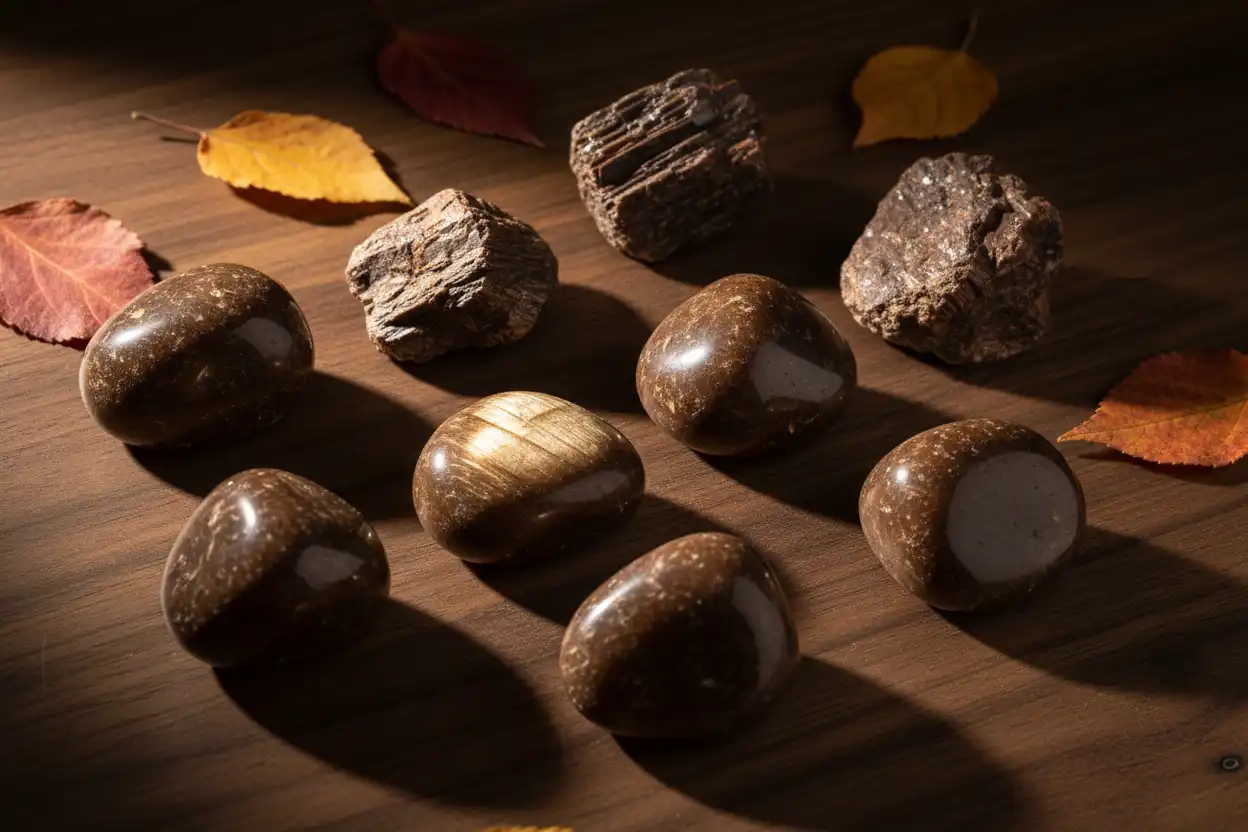
Bronzite Meaning: Mineral Facts, History & Symbolism
Bronzite meaning is commonly associated with steadiness, confidence, composure, boundaries, resilience, and approaching difficult situations with practical judgment. Those ideas belong to modern symbolism. Mineralogically, bronzite is not recognized as a separate mineral species in the same way as quartz, calcite, or garnet. It is a traditional varietal name for iron-bearing enstatite, an orthopyroxene in the magnesium-iron silicate system.
The bronze appearance that gives bronzite its name is equally important to understand correctly. The stone is not metallic bronze, and its sheen is not evidence of copper or gold. Its characteristic bronzy reflection, or schiller, is associated with fine oriented alteration products and iron-rich microscopic features along structurally controlled planes within the pyroxene. Modern mineral references classify bronzite as an iron-bearing variety of enstatite and explicitly connect its name with the bronze-like submetallic reflection seen on characteristic surfaces.
For other material-first references that separate mineral identity from later symbolism, browse the Gemstone Guides.
What Is Bronzite?
Bronzite belongs to the orthopyroxene branch of the pyroxene mineral group. Its composition can be represented broadly as (Mg,Fe²⁺)₂Si₂O₆, equivalently written in simplified pyroxene notation as (Mg,Fe)SiO₃. Magnesium-rich material belongs toward the enstatite end of the enstatite-ferrosilite series, while increasing ferrous iron progressively changes composition, density, optical properties, and color.
The name bronzite has historically been applied to iron-bearing enstatite that develops a conspicuous bronze-like schiller. Current mineralogical references therefore treat it as a variety of enstatite rather than an independent species. The iron-dominant end member of the same compositional system is ferrosilite.
| Property | Typical bronzite characteristics |
|---|---|
| Material identity | Iron-bearing variety of enstatite |
| Mineral group | Pyroxene, specifically orthopyroxene |
| Broad formula | (Mg,Fe²⁺)₂Si₂O₆ |
| Crystal system | Orthorhombic |
| Typical color | Brown, greenish-brown, olive-brown to bronze-brown |
| Characteristic effect | Bronze-like schiller or submetallic sheen |
| Mohs hardness | About 5.5 |
| Specific gravity | Commonly around 3.2–3.5 depending on iron content |
| Cleavage | Distinct to good pyroxene cleavage |
| Fracture | Uneven to locally conchoidal |
| Luster | Vitreous on ordinary surfaces; bronzy to submetallic on schiller-rich planes |
| Transparency | Transparent in some enstatite material, but ornamental bronzite is commonly translucent to opaque |
| Separate mineral species? | No; varietal/descriptive name for iron-bearing enstatite |
Gemological references similarly describe bronzite as an iron-bearing enstatite variety with approximately Mohs 5.5 hardness, substantial density, orthorhombic structure, brown to greenish-brown color, and a bronze-like submetallic luster.
Why the Name Bronzite Requires Some Precision
Bronzite is a useful name in lapidary, collector, and field contexts because it describes a recognizable material and appearance. It becomes less precise when someone treats it as though “bronzite” represented one fixed chemical composition separated sharply from enstatite.
Enstatite and ferrosilite form a compositional series in which magnesium and ferrous iron substitute for one another. Historical mineral terminology divided intermediate compositions into names such as bronzite and hypersthene, but modern mineralogical classification relies more heavily on actual composition rather than maintaining every older intermediate name as a distinct mineral species.
That means two stones legitimately sold or collected as bronzite may not contain exactly the same iron percentage. Their color, density, schiller strength, inclusions, alteration, and host-rock relationship can differ while both remain iron-bearing orthopyroxene material fitting the traditional bronzite description.
Bronzite, Enstatite, and Hypersthene
These three names are often presented as though they describe completely separate minerals arranged in a simple sequence. The relationship is more nuanced.
Enstatite
Enstatite is the recognized magnesium-rich orthopyroxene mineral species and provides the mineralogical framework within which bronzite is currently treated.
Bronzite
Bronzite is a traditional name for iron-bearing enstatite showing characteristic brown-to-greenish color and bronze schiller. It remains useful descriptively and commercially even though it is not a separate species.
Hypersthene
Hypersthene is another historical name formerly used for iron-bearing orthopyroxene of intermediate composition. Modern mineral classification treats the name as obsolete in formal species nomenclature, with compositions instead assigned within the enstatite-ferrosilite series. Mindat likewise describes hypersthene as an obsolete intermediate term when explaining bronzite.
The practical lesson is that mineral names evolve as analytical methods improve. A historic label reading “bronzite” can still communicate meaningful information even when modern classification would describe the specimen more precisely as ferroan enstatite.
A Source-Reconciliation Table for Bronzite Claims
Bronzite is especially prone to copied descriptions that mix current mineral nomenclature, older terminology, optical observations, and metaphysical claims.
| Claim | Evidence status | More accurate interpretation |
|---|---|---|
| Bronzite is a separate mineral species | Not current mineralogical usage | It is treated as an iron-bearing variety of enstatite |
| Bronzite belongs to the pyroxene group | Supported | It is an orthopyroxene material |
| Bronzite contains magnesium, iron, silicon and oxygen | Supported | Its composition lies within the Mg-Fe orthopyroxene system |
| Bronzite contains actual metallic bronze | Incorrect | The name refers to appearance, not bronze alloy composition |
| The bronze sheen is ordinary metallic glitter | Misleading | It is directional schiller associated with oriented microscopic features |
| Every brown enstatite is automatically bronzite | Too broad | The varietal name is most useful where iron-bearing composition and bronzy appearance are appropriate |
| Hypersthene is a fully separate modern mineral species | Outdated | The name is obsolete in current formal mineral classification |
| Bronzite always has one fixed iron percentage | Incorrect | Composition varies within the enstatite-ferrosilite system |
| Stronger sheen proves a specific locality | Unsupported | Schiller intensity cannot establish provenance |
| Bronze color proves the stone is untreated | Unsupported | Material identity and treatment status are separate questions |
| Bronzite scientifically creates grounding energy | Unsupported | Grounding is a modern symbolic interpretation |
| Bronzite protects against negative energy | Metaphysical belief | No standard mineralogical test establishes such protection |
| Bronzite increases confidence biologically | Unsupported | Confidence symbolism does not demonstrate physiological action |
| Bronzite heals emotional or medical conditions | Unsupported medical claim | Mineral identity does not establish therapeutic efficacy |
This framework is useful because bronzite meaning can remain culturally interesting without turning historical terminology or optical effects into evidence for unrelated claims.
What Creates the Bronze Schiller?
The visual feature most responsible for bronzite’s popularity is its bronze-like reflection. Unlike random sparkle from isolated glittering particles, bronzite schiller is strongly directional. A polished surface may appear ordinary brown from one angle and suddenly develop broad bronze flashes when the specimen or light source moves.
Older descriptions explain this through a process often called schillerization, in which iron-bearing orthopyroxene develops extremely fine iron oxide or hydroxide films along cleavage-related structures during alteration. Modern specimen descriptions also document microscopic iron-oxide inclusions contributing to the metallic-looking reflection.
The exact microscopic arrangement can differ among specimens, so it is safer to describe the effect as reflection from oriented iron-rich alteration features or inclusions rather than insisting that every bronzite stone contains exactly the same reflective phase.
Schiller Is Not the Same as Aventurescence
Bronzite’s broad sheen can be confused with the sparkling appearance of aventurine or sunstone, but the optical effects look different.
Aventurescence generally appears as numerous individual flashes from reflective platelets dispersed through a material. Bronzite more often develops broad sheet-like or streak-like bronze reflections controlled by crystal orientation, cleavage, and grain direction.
A tumbled bronzite stone may therefore show several broad bright zones rather than hundreds of isolated glitter points. In a multi-grained specimen, different grains can flash at different angles because each has its own crystallographic orientation.
The detailed relationship among grain orientation, reflection, polish, color, and viewing geometry is covered in bronzite optical properties and color behavior.
Why Bronzite Is Brown or Greenish-Brown
The underlying color of bronzite reflects its iron-bearing orthopyroxene composition. Ferrous iron substituting for magnesium affects optical absorption and shifts enstatite toward greenish, yellow-brown, brown, or related colors.
Gemological data for enstatite varieties record brown and greenish colors associated especially with Fe²⁺, while bronzite itself is commonly described as greenish-brown with bronze-like luster.
The final visual appearance also depends on alteration and schiller. A dark chocolate-brown specimen with strong bronze reflection can look warmer and more metallic than another specimen with similar bulk chemistry but weaker reflective microstructures.
Color therefore provides useful context but cannot determine exact composition from a photograph.
How Bronzite Forms
Bronzite inherits the geological environments of iron-bearing orthopyroxene. Orthopyroxenes are important rock-forming minerals in magnesium- and iron-rich igneous systems and can occur in mafic and ultramafic rocks such as norite, gabbro, pyroxenite, and peridotite. They can also occur in metamorphic rocks where temperature, pressure, and bulk composition favor pyroxene stability.
In slowly cooled igneous rocks, orthopyroxene crystals can grow as individual grains interlocked with feldspar, olivine, clinopyroxene, or other mafic minerals. Later alteration may affect grain margins or cleavage-related structures and contribute to the reflective features associated with bronzite.
Because bronzite is a descriptive variety rather than one deposit-specific mineral, there is no single universal bronzite geological setting. A polished stone from one source may come from an orthopyroxene-rich intrusive rock, while another collector specimen may have a different geological history.
The broader geological relationships among host rocks, orthopyroxene crystallization, alteration, and associated minerals are explored in bronzite formation and deposit geology.
What Natural Bronzite Looks Like
Commercial bronzite is commonly sold as polished slabs, cabochons, beads, carvings, spheres, palm stones, and tumbled material because polishing reveals its directional bronze sheen effectively.
Rough material can appear much less spectacular. It may look like a dense brown or greenish-brown rock with only scattered reflective cleavage faces. Cutting across favorable grain orientations exposes larger reflective areas, while polishing reduces surface roughness and allows the schiller to become visually stronger.
Common observations include:
chocolate-brown to olive-brown body color;
broad bronze or golden-brown reflection;
several grains flashing at different orientations;
pale or dark associated minerals;
cleavage-related flat surfaces;
minor fibrous alteration along grain edges;
natural fractures;
variable grain size;
and areas with little or no visible schiller.
Not every square millimeter needs to shine. In natural multi-grained material, uneven reflection is expected.
Original Bronzite Specimen and Photo Checklist
A photograph cannot confirm every mineralogical detail, but a structured visual examination can determine whether a stone is broadly consistent with bronzite and identify cases that deserve stronger testing.
Start with the body color
Look for brown, olive-brown, greenish-brown, bronze-brown, or related subdued colors rather than assuming bronzite must resemble polished metal everywhere.
Move one directional light
Bronzite’s sheen should change as the light or specimen moves. Broad reflection that appears only at favorable angles is more consistent with schiller than uniformly painted metallic color.
Look for oriented reflective zones
Observe whether the bronze effect follows grains, cleavage surfaces, bands, or broad planar areas rather than appearing as completely random glitter.
Compare adjacent grains
In coarse material, neighboring grains may flash independently. This is useful evidence that the appearance is structurally controlled.
Examine rough edges
A polished face can be misleading by itself. Unpolished areas may reveal brown orthopyroxene grains, cleavage, matrix, weathering, and natural fracture.
Check for actual metallic flakes
Large loose glitter-like particles are not required for bronzite. Obvious metallic foil or uniformly distributed artificial sparkle deserves closer examination.
Use magnification
Look for fine reflective inclusions, cleavage features, fractures, alteration, polish scratches, coatings, resin, and relationships among differently oriented grains.
Inspect polish continuity
The bronze effect should arise from within or immediately beneath the mineral surface rather than from a removable metallic coating.
Compare different light sizes
A small directional lamp often reveals schiller better than flat room lighting. A genuine specimen can look much less reflective under diffuse illumination.
Do not expect gem transparency
Transparent enstatite exists, but much bronzite used ornamentally is translucent to opaque and valued for schiller rather than transparency.
Note associated rock material
Feldspar, olivine, other pyroxenes, serpentine-related alteration, and dark mafic minerals can occur depending on geological setting.
Avoid destructive scratch testing
Mohs hardness can provide supporting evidence, but deliberate scratching can damage a polished or collectible object.
Do not assign a mine from visual appearance
Brown color and strong schiller can occur in bronzite from multiple geological regions.
Preserve original labels
A documented locality label can carry more provenance information than color, sheen, or grain size.
Separate metaphysical terms from mineral evidence
Words such as grounding, protective, masculine, stabilizing, or confidence stone do not authenticate bronzite.
For a closer examination of reflective lamellae, inclusions, cleavage, alteration textures, coatings, and diagnostic limitations, use the bronzite microscope inclusion notebook.
Diagnostic Traits That Matter More Than Bronze Color
Color is helpful but insufficient. Several brown ornamental materials can develop metallic-looking reflections, while dyed, coated, or composite products can imitate bronze tones.
A stronger bronzite identification combines:
pyroxene-like hardness;
appropriate specific gravity;
characteristic cleavage;
brown to greenish-brown body color;
directional bronze schiller;
orthopyroxene optical properties where measurable;
compatible microscopy;
and geological context where available.
A specimen does not need every test when the identification stakes are low, but valuable or unusual material deserves evidence proportional to the claim being made.
Hardness and Cleavage
Bronzite is commonly around Mohs 5.5. It is therefore softer than quartz and chalcedony but harder than calcite and fluorite.
Its pyroxene cleavage is more diagnostically interesting than hardness alone. Pyroxenes characteristically show two major cleavage directions intersecting close to a right angle. In a polished multi-grained bronzite piece, those relationships may be difficult to see because each grain can be oriented differently.
Cleavage also matters for durability. A stone can resist ordinary light scratching reasonably well yet still chip or separate along structural weaknesses after impact.
Specific Gravity and Iron Content
Increasing iron substitution generally raises density relative to magnesium-rich enstatite. Gemological references commonly place bronzite around the low-to-mid 3s in specific gravity, although exact values vary with composition and with included or associated phases.
A density measurement can therefore strengthen an identification, particularly for a loose homogeneous sample, but an ornamental rock containing feldspar, serpentine, multiple pyroxenes, or other minerals may not produce a value corresponding neatly to pure bronzite.
That limitation should be recorded rather than ignored.
Bronzite Is Not Metallic Ore
The bronze sheen can make polished bronzite look metallic, but the host mineral is a silicate, not a native metal or sulfide ore.
This distinguishes it sharply from brookite meaning, which concerns titanium dioxide, and from metallic copper-iron sulfides such as bornite. A surface appearance described casually as “metallic” does not establish similar chemistry.
Bronzite’s sheen is primarily an optical and microstructural feature superimposed on an orthopyroxene host.
Bronzite Versus Brazilianite
The neighboring Brazilianite meaning reference describes a transparent yellow-green sodium aluminum phosphate hydroxide mineral. Brazilianite is a defined mineral species with good transparency in gem material, whereas bronzite is an iron-bearing enstatite variety commonly valued as an opaque-to-translucent ornamental stone.
The comparison illustrates why similar earthy or greenish tones provide almost no classification value without mineralogical context.
Treatments, Coatings, and Imitations
Most ordinary bronzite is purchased for its natural brown coloration and schiller, but polished ornamental material can still be waxed, oiled, resin-stabilized, coated, dyed, or assembled depending on the product.
A surface coating may increase gloss or produce an unnaturally uniform metallic appearance. Resin can fill fractures and improve polish on weak material. Neither modification necessarily changes the underlying mineral identity, but disclosure matters when treatment influences appearance, durability, or value.
There is little reason to assume every polished bronzite stone is treated. The appropriate approach is evidence-based: examine the surface, fractures, polish, color concentrations, and seller disclosure rather than treating modification as either impossible or universal.
Documented History of the Bronzite Name
Bronzite’s documented naming story is rooted in mineral appearance. The name refers to the bronze-like submetallic luster shown particularly on characteristic surfaces of iron-bearing enstatite. Modern mineral databases continue to preserve the term as a variety name even though the material is classified mineralogically under enstatite.
Historically, bronzite also functioned as a practical geological field description for orthopyroxene with noticeable bronze schiller and intermediate iron content. That usage explains why older rock descriptions and specimen labels may use bronzite more prominently than a modern compositional classification would.
This documented mineralogical history should not be confused with modern claims that bronzite was universally known in antiquity as a crystal for protection, confidence, manifestation, or energetic grounding. Such claims require specific cultural and archaeological evidence.
Was Bronzite an Ancient Protective Stone?
Broad historical claims about “bronze-colored stones” or ancient use of brown minerals do not prove that a specific object was bronzite in the modern mineralogical sense.
Before attributing a historical tradition to bronzite, three questions need answers:
Was the archaeological material actually identified as iron-bearing enstatite?
Is there evidence that the culture distinguished it from visually similar rocks?
Does a documented source support the claimed symbolic use?
Without those steps, statements about ancient bronzite protection rituals should be treated cautiously.
Modern symbolism does not need an invented ancient origin to be meaningful.
Bronzite Meaning in Modern Symbolism
Modern bronzite meaning commonly focuses on steadiness, self-possession, confidence, boundaries, resilience, and remaining practical when circumstances become difficult.
The appearance makes those interpretations understandable. Bronzite is visually earthy and subdued until light catches an oriented surface, producing a sudden bronze reflection. That contrast can become a metaphor for maintaining internal capability without needing constant outward display.
Someone might keep a polished stone near a workspace as a reminder to distinguish what can be controlled from what cannot, carry one before a difficult conversation as a cue to respond deliberately, or use its shifting schiller during reflection on a complicated decision.
Those practices describe human behavior and intention. They do not require a hidden mineral energy mechanism.
Grounding as Symbolism
Grounding is one of the most repeated bronzite associations, but the term can mean several different things.
In electrical engineering, grounding has a precise physical definition. In psychological self-regulation, grounding can refer to focusing attention on immediate sensory information. In metaphysical practice, grounding is commonly described as the movement or stabilization of subtle energy.
A bronzite stone can participate practically in a sensory exercise because it has weight, temperature, texture, pattern, and directional reflection. Someone can notice those physical properties while deliberately returning attention to the present moment.
That does not establish that bronzite drains negative energy into the Earth or alters a measurable human energy field.
Confidence and Boundaries
Bronzite is also frequently associated with confidence and personal boundaries. Used symbolically, these themes can be translated into concrete behaviors.
A bronzite stone might represent:
giving a clear answer instead of an ambiguous one;
declining an obligation that cannot realistically be met;
preparing before a difficult discussion;
separating evidence from assumption;
or pausing before responding emotionally.
The stone does not create those abilities biologically. It can serve as an intentionally chosen reminder of them.
Protection Symbolism
The bronze, shield-like appearance of polished bronzite makes protection another intuitive association. Many modern crystal descriptions describe it as a protective stone against negativity or unwanted energy.
There is no gemological measurement demonstrating that iron-bearing enstatite creates an invisible protective barrier, prevents accidents, changes another person’s intentions, or blocks supernatural influences.
Protection can still function as metaphor. A person might use the stone to represent practical boundaries, situational awareness, or thoughtful risk reduction.
Chakra Associations
Contemporary metaphysical systems often associate bronzite with the root or sacral chakra, sometimes extending the symbolism to other energy centers because of its earthy brown and bronze coloration.
These associations belong to spiritual practice. Mineralogical methods can measure crystal structure, chemistry, refractive properties, density, and inclusions; they cannot determine whether a chakra is blocked, balanced, opened, or activated.
People who value chakra symbolism can still use bronzite within that framework while keeping the claim separate from geology or medicine.
Does Bronzite Have Healing Properties?
Bronzite should not be presented as a treatment for anxiety, depression, digestion, hormonal conditions, pain, inflammation, circulation, fatigue, or other health problems.
Its scientifically measurable properties include magnesium-iron silicate composition, orthorhombic crystal structure, hardness, cleavage, density, optical behavior, inclusions, and alteration. None demonstrates therapeutic action in the human body through ordinary contact.
A personally meaningful object can be incorporated into meditation, journaling, breathing exercises, or other reflective practices without replacing appropriate medical or mental-health care.
Iron and Magnesium Do Not Become Nutritional Benefits
Bronzite contains iron and magnesium as structural components of a silicate crystal. That fact does not mean wearing the mineral supplements either element.
The atoms are bound within the crystal lattice rather than being delivered through skin contact in a controlled nutritional form. Mineral chemistry therefore explains composition, color, and physical properties—not dietary or medical effects.
This distinction prevents a genuine chemical fact from being stretched into an unsupported biological claim.
Cutting Bronzite for the Best Schiller
Cutting orientation can transform the appearance of bronzite. A surface cut across unfavorable grain orientations may remain relatively dull, while another plane can reveal broad bronze reflections.
In coarse multi-grained material, the cutter often works with several crystal orientations simultaneously. The resulting cabochon or slab may show patches that flash sequentially as the piece moves rather than one uniform reflective sheet.
Fractures, cleavage, alteration, matrix minerals, and grain size also influence polish quality.
The practical relationship among saw orientation, schiller direction, grain boundaries, fracture management, and polishing is covered in bronzite cutting, orientation and polish.
Bronzite in Jewelry
Bronzite is widely used for beads, pendants, cabochons, bracelets, rings, carvings, and decorative objects. Its moderate hardness makes it usable, but it is not as scratch-resistant as quartz-family gems.
Cleavage, grain boundaries, and fractures can further affect durability. A dense fine-grained cabochon can perform differently from a coarse piece containing weak alteration or several mineral phases.
Pendants and earrings generally face less impact than rings and bracelets. Protective bezels, adequate thickness, rounded edges, and sensible placement can improve wear performance.
Detailed mechanical considerations belong in the bronzite setting and wear engineering guide.
Provenance Cannot Be Proven From Schiller
Bronzite occurs in multiple countries and geological environments. Strong bronze reflection, dark brown color, or a particular grain size cannot establish a specific mine or country.
Reliable provenance may include:
original mine or locality labels;
supplier documentation;
collection history;
field records;
parcel information;
photographs from acquisition;
or a traceable chain of custody.
A locality can be plausible without being proven.
The bronzite provenance disclosure checklist provides a structured way to separate documented origin from visually inferred origin.
Buying Bronzite Without Buying the Story
When evaluating an actual specimen, material description is more useful than metaphysical language. Representative photographs should show the stone under more than one lighting angle because directional schiller can look dramatically stronger in carefully staged images.
Useful seller information includes dimensions, weight, natural versus treated condition where known, matrix, fractures, whether the item is solid bronzite-bearing material or a composite product, and what evidence supports a locality claim.
Statements such as “high vibration,” “guaranteed protection,” or “healing grade” do not establish authenticity.
Seller selection, disclosure quality, and purchasing considerations are addressed in where to buy bronzite.
Safe Ownership and Handling
Normal handling of an intact polished bronzite stone does not require treating it as hazardous simply because it contains iron or magnesium. Those elements are incorporated into a stable silicate mineral structure.
The exposure context changes during lapidary work. Sawing, grinding, drilling, or polishing produces fine mineral dust, and the exact rock may contain bronzite alongside quartz, feldspar, alteration minerals, or other phases. Dust generation should therefore be controlled with appropriate wet methods where suitable, local extraction, eye protection, and respiratory protection appropriate to the process.
Do not deliberately inhale mineral dust, grind bronzite for consumption, or place it into drinking water to prepare crystal elixirs.
Collector specimens also deserve protection from unnecessary impact because cleavage, grain boundaries, and alteration can create weak areas.
Conserving an Important Bronzite Specimen
A mineral specimen preserving natural grain relationships, host rock, cleavage surfaces, alteration textures, or an old locality label can contain more geological information than a polished object.
Before cutting or aggressively cleaning an important specimen, document:
all visible faces;
dimensions and weight;
labels;
associated minerals;
existing fractures;
schiller orientation;
altered edges;
prior repairs;
and acquisition information.
Changes can then be distinguished from features that were already present.
The bronzite specimen conservation record provides a structured framework for that documentation.
A Practical Evidence Ladder for Bronzite Claims
Bronzite claims become easier to evaluate when each question is matched with evidence capable of answering it.
Direct observation can document brown or greenish-brown color, schiller, grain size, matrix, fractures, polish, and visible alteration.
Basic mineral testing can assess hardness, density, cleavage, and other properties expected for orthopyroxene.
Polarized-light or gemological examination can evaluate optical properties when suitable material and instrumentation are available.
Microscopy can reveal oriented reflective features, cleavage, inclusions, alteration, coatings, resin, and relationships among grains.
Spectroscopic methods can support enstatite identification and investigate mineral phases where visual examination is inadequate.
Chemical analysis can determine magnesium-to-iron relationships and establish where a specimen lies within the orthopyroxene compositional system.
X-ray diffraction can identify crystal structure when formal mineralogical characterization is required.
Geological context can determine whether the specimen’s host-rock relationship is consistent with an orthopyroxene-bearing igneous or metamorphic environment.
Provenance documentation is needed for mine, country, collector, or ownership claims.
Historical documentation supports the development and use of the bronzite name but should not be replaced with invented ancient metaphysical stories.
Modern symbolism includes grounding, protection, confidence, resilience, and boundaries. Those meanings belong to human interpretation and are not converted into physical mineral properties by additional laboratory testing.
What Bronzite Meaning Can Reliably Include
Bronzite meaning becomes clearer when mineral identity, documented history, and symbolism remain separate.
Materially, bronzite is best understood as iron-bearing enstatite rather than as a separate mineral species. It belongs to the orthopyroxene group, has a broad magnesium-iron silicate composition, commonly measures around Mohs 5.5, and develops the brown-to-greenish color and characteristic bronze schiller responsible for its traditional name. Modern mineralogical references explicitly retain bronzite as a variety of enstatite rather than an independent species.
Its visual identity is also more interesting than a simple “brown stone” description suggests. Fine iron-rich alteration features and inclusions aligned with structural planes can produce broad directional reflections that appear or disappear as a polished surface moves under light. The effect is mineralogical, not evidence of a supernatural energy field.
Historically, bronzite has a legitimate place in mineral and geological terminology, including older field descriptions of iron-bearing orthopyroxene. Modern symbolism involving steadiness, confidence, boundaries, resilience, and practical grounding can then be discussed as the human layer inspired by its dense earthy appearance and restrained bronze reflection.
Gems Lore explains its material-first approach on the About page. Health, spiritual, and informational limitations are set out in the Disclaimer, factual corrections or supporting evidence can be submitted through Contact, and site data practices are described in the Privacy Policy.
Bronzite needs no exaggerated mythology to be distinctive. Its place within the enstatite-ferrosilite system, evolving mineral nomenclature, iron-bearing chemistry, pyroxene cleavage, mafic and ultramafic geological setting, directional schiller, and usefulness as an ornamental stone provide a substantial material story. Bronzite meaning is strongest when that story comes first and symbolism remains what it is: a modern human interpretation inspired by a naturally bronzy orthopyroxene.