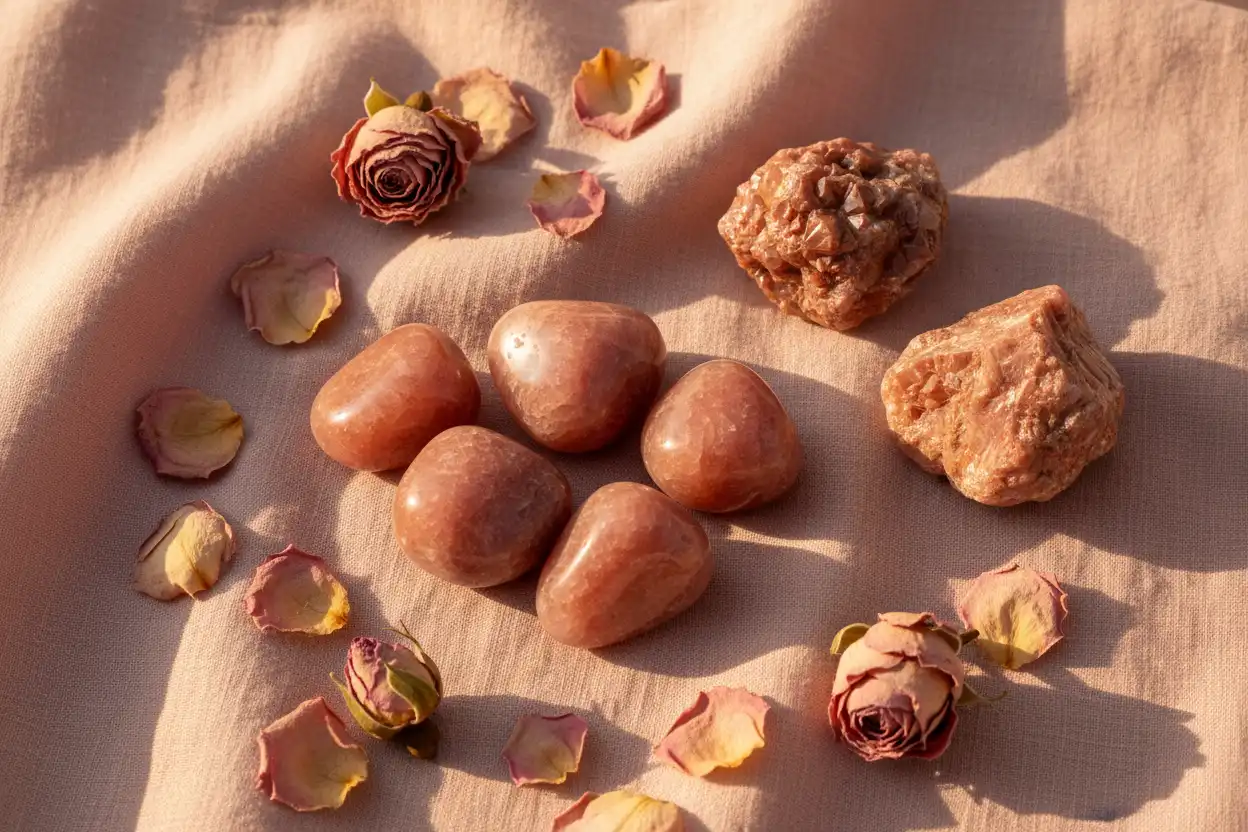
Bustamite Meaning: Mineral Facts, History & Symbolism
Bustamite meaning is commonly associated in modern crystal practice with adaptability, composure, compassion, emotional balance, and accepting change, but those associations belong to symbolism rather than mineral science. Materially, bustamite is a calcium-manganese silicate with the simplified formula CaMn²⁺Si₂O₆. It crystallizes in the triclinic system, belongs to the wollastonite-group pyroxenoids, and commonly appears pale to medium pink, pinkish orange, brownish red, or yellowish pink in thinner transmitted sections. Its hardness is approximately 5.5–6.5, its specific gravity commonly falls around 3.32–3.43, and it has pronounced cleavage that can make even attractive material brittle in use.
Those facts matter because bustamite is easily oversimplified as merely a “pink manganese stone.” Its identity depends on structure as well as composition, and its history is unusually complicated: material originally described under the bustamite name was later shown to be a mixture of other manganese silicates, after which the name was reused for the distinct mineral now recognized as bustamite. Even the historical namesake has been disputed in later mineralogical discussion.
For other material-first mineral references, browse the Gemstone Guides.
What Is Bustamite?
Bustamite is a recognized mineral species in the calcium-manganese silicate system. Its formula is commonly simplified as CaMn²⁺Si₂O₆, although the full structural description used in modern mineral classification reflects its three-periodic silicate-chain architecture within the wollastonite group.
That structural point is important. Bustamite is not simply a manganese-rich version of ordinary pyroxene, even though its simplified formula resembles the pyroxene formula of johannsenite. Its silicate chains and triclinic structure place it among pyroxenoids rather than conventional pyroxenes.
| Property | Bustamite characteristics |
|---|---|
| Mineral species | Bustamite |
| Simplified formula | CaMn²⁺Si₂O₆ |
| Mineral class | Inosilicate |
| Structural group | Wollastonite-group pyroxenoid |
| Crystal system | Triclinic |
| Typical color | Pale to medium pink, pinkish orange, brownish red |
| Color in thin transmitted sections | Colorless to yellowish pink |
| Mohs hardness | Approximately 5.5–6.5 |
| Specific gravity | Approximately 3.32–3.43 |
| Cleavage | Perfect in one major direction, good in others |
| Fracture | Uneven to splintery |
| Tenacity | Brittle |
| Luster | Subvitreous, resinous or waxy depending on surface |
| Transparency | Transparent to translucent |
| Optical character | Biaxial negative |
| Common geological setting | Metamorphosed manganese-rich rocks and metasomatic assemblages |
These properties are consistent with modern mineralogical descriptions of bustamite and help distinguish it from visually similar pink manganese silicates.
Bustamite Is a Pyroxenoid, Not an Ordinary Pyroxene
The word pyroxenoid can sound like an informal approximation, but it describes a genuine structural distinction.
Pyroxenes are built from repeating single chains of silica tetrahedra with a characteristic periodicity. Pyroxenoids also contain single silicate chains, but the chain repeats over a different number of tetrahedra. Bustamite belongs to a three-periodic chain group, whereas common pyroxenes have a two-periodic chain.
That difference changes crystal symmetry and physical behavior.
This is especially useful when comparing bustamite with johannsenite. Both can be represented with closely related Ca-Mn-Si-O chemistry, yet johannsenite belongs to the pyroxene group and is monoclinic, while bustamite is triclinic and structurally belongs with pyroxenoids.
Chemistry alone therefore does not establish the mineral name.
Bustamite and Johannsenite Have a Structural Relationship
Johannsenite and bustamite are closely related calcium-manganese silicates and can be discussed as polymorphically related phases at appropriate compositions. Johannsenite is the lower-temperature pyroxene structure, while bustamite represents the higher-temperature pyroxenoid structure in the CaMnSi₂O₆ system.
This relationship helps explain why manganese-rich metamorphic deposits can contain several superficially similar pink, red, or brown silicates that are difficult to distinguish visually.
Rhodonite, pyroxmangite, johannsenite, and bustamite can all overlap in general color. Their crystal structures, optical properties, chemistry, and geological stability fields are different.
A pink specimen should therefore never be identified as bustamite solely because it contains manganese or resembles a known photograph.
How Bustamite Forms
Bustamite typically develops in rocks that began with significant manganese-bearing material and later experienced metamorphism, metasomatism, or both. Manganese-rich sedimentary or ore-forming systems can be recrystallized under elevated temperature and pressure, producing assemblages that include bustamite together with other manganese silicates, carbonates, garnets, pyroxenes, and related minerals.
Skarn-like and metasomatic environments are particularly important because hot fluids can redistribute calcium, manganese, silica, iron, and other constituents while the rock is recrystallizing.
At well-known manganese deposits, bustamite may occur with rhodonite, tephroite, calcite, johannsenite, wollastonite, garnet-group minerals, and other calcium-manganese silicates. The exact assemblage reflects temperature, fluid chemistry, bulk composition, silica activity, and the geological history of the deposit.
The detailed mineral reactions and host-rock relationships are covered in bustamite formation and deposit geology.
Why Bustamite Is Pink
Manganese is central to bustamite’s identity and also contributes strongly to its characteristic pink-to-reddish coloration. Mn²⁺ incorporated into the crystal structure can absorb particular wavelengths of visible light, leaving the material with pale rose, salmon, pinkish orange, or brownish-red appearance.
The exact shade can vary with:
manganese concentration;
iron substitution;
microscopic inclusions;
crystal thickness;
structural defects;
oxidation;
weathering;
and illumination.
This is why one specimen may appear soft pink while another looks distinctly orange-brown.
The statement “manganese makes bustamite pink” is therefore broadly useful, but it should not be treated as a complete optical explanation for every specimen.
The relationship among absorption, pleochroism, refractive indices, color zoning, and viewing direction is examined in bustamite optical properties and color behavior.
Bustamite Can Look Different in Transmitted Light
A thick bustamite specimen may look medium pink or brownish red in reflected light yet become much paler through a thin transparent edge.
Mineralogical data describe colorless to yellowish-pink appearances in transmitted light and visible pleochroism in suitable material, with orange and rose directions reported.
This matters for both identification and photography.
A bright backlit image may make a specimen look more transparent, orange, or yellow than it appears under ordinary room lighting. Conversely, a thick massive specimen may look duller and darker even when it is chemically the same mineral.
Product photographs should therefore be interpreted with lighting geometry in mind.
Some Pink Bustamite Can Be Light-Sensitive
One unusual collector consideration is that pink bustamite has been documented as capable of fading under prolonged light exposure. Mineral references specifically note that pink coloration can fade with light, while some weathered material can develop darker surfaces associated with manganese oxidation.
This does not mean every bustamite specimen will rapidly lose color in ordinary display conditions.
It does mean that unusually vivid or historically important pink material should not be stored indefinitely in intense direct sunlight or under unnecessarily strong display lighting.
Color stability is a conservation issue, not evidence that the mineral is spiritually “releasing energy.”
Bustamite’s Cleavage Is an Important Diagnostic Clue
Bustamite has strong directional cleavage. One cleavage direction is described as perfect, with additional good and poorer directions.
That creates a very different breaking behavior from materials such as quartz, which lack comparable perfect cleavage.
A natural broken surface may therefore show relatively flat cleavage-controlled planes, while other areas can appear uneven or splintery.
This property also affects lapidary work and specimen handling. A stone can be reasonably hard on the Mohs scale while still splitting under an impact directed along a vulnerable cleavage plane.
Hardness and toughness should never be treated as interchangeable.
An Original Bustamite Specimen and Photo Checklist
The following checklist provides a practical evidence framework for assessing a purported bustamite specimen or online listing without pretending that a photograph can provide a complete laboratory identification.
Start with the color range
Look for pale pink, rose, salmon, pinkish orange, reddish brown, or yellowish-pink tones. Bustamite is frequently paler and somewhat more orange than classic deep-pink rhodonite, although this is only a clue.
Examine the crystal or aggregate habit
Bustamite may occur as prismatic, tabular, fibrous, cleavable massive, or compact material. Do not require sharp isolated crystals.
Look for directional cleavage
Broad, repeated planar breaks are important. Strong cleavage can also make some massive material appear fibrous or splintery.
Compare weathered and fresh areas
Weathered surfaces may look darker or browner than freshly exposed material. Natural oxidation can alter the surface without changing the underlying mineral species.
Use neutral lighting
Pink manganese minerals can shift substantially under warm or cool illumination. Compare photographs made under neutral light whenever possible.
Inspect thin edges
Translucent areas may become pale yellowish pink or nearly colorless through sufficiently thin sections.
Look for geological associations
Calcite, rhodonite, tephroite, johannsenite, wollastonite, garnet, and other manganese-rich minerals may occur with bustamite depending on locality.
Association supports a geological interpretation but does not independently establish identity.
Check whether the specimen appears naturally attached
A crystal or cleavable mass on matrix should show plausible growth or replacement contacts rather than an obvious adhesive interface.
Examine cleavage under magnification
A loupe can reveal stepped planes, intersecting cleavages, fractures, weathering, inclusions, and repairs.
Do not identify it from manganese-pink color alone
Rhodonite, pyroxmangite, johannsenite, pink calcite, some garnets, synthetic materials, and several other minerals can overlap visually.
Do not rely on a single hardness observation
Bustamite’s hardness overlaps many other silicates and deliberate scratch testing damages collectible material.
Consider measured density if the specimen is loose
A specific gravity in the low-to-mid 3s is compatible with bustamite, but matrix-rich pieces cannot be interpreted as pure mineral samples.
Preserve locality labels
For unusual manganese minerals, provenance often provides essential context for deciding which species are geologically plausible.
Look for signs of light fading
If an older label or protected surface preserves stronger pink color than the exposed face, light-sensitive fading may deserve consideration.
Keep symbolic descriptions separate
Terms such as transformation stone, compassion mineral, emotional healer, or heart-energy crystal contribute nothing to identification.
Magnified cleavage, alteration features, intergrowths, inclusions, and the limits of visual identification are treated more fully in the bustamite microscope inclusion notebook.
A Source-Reconciliation Table for Bustamite Claims
Bustamite has an unusually complicated naming history, making it a good mineral for demonstrating why repeated online statements should be checked against mineralogical classification.
| Claim | Evidence status | More accurate interpretation |
|---|---|---|
| Bustamite is a valid mineral species | Supported | Modern bustamite is a recognized triclinic calcium-manganese silicate |
| Bustamite is simply pink wollastonite | Incorrect | It belongs to the wollastonite structural group but is a distinct species |
| Bustamite is an ordinary pyroxene | Incorrect | It is a pyroxenoid with a different silicate-chain repeat |
| Bustamite and johannsenite have identical structures | Incorrect | Their chemistry can be closely related, but their structures differ |
| Bustamite is commonly pale pink to brownish red | Supported | This is a characteristic color range |
| Every pink manganese silicate is bustamite | Incorrect | Rhodonite, pyroxmangite, johannsenite and others can look similar |
| The original material first called bustamite was the modern species | Incorrect | The original material later proved to be a mixture |
| The bustamite name has always referred unambiguously to one material | Incorrect | The name was reused after the original material was discredited |
| The historical namesake is completely settled | Disputed | Later mineralogical discussions disagree over which Bustamante was intended |
| Pink bustamite can fade under strong light | Supported for documented material | Important specimens deserve conservative light exposure |
| Weathering can darken manganese-rich surfaces | Reasonable and documented in collector material | Surface oxidation should not be confused with intrinsic dark body color |
| Bustamite scientifically creates compassion | Unsupported | Compassion is a modern symbolic association |
| Bustamite removes emotional trauma | Unsupported medical claim | Mineral properties do not establish psychological treatment |
| Bustamite balances the heart chakra | Spiritual interpretation | Not a measurable mineral property |
This history is a useful reminder that mineral nomenclature can change when improved structural or chemical evidence shows that an older name was applied incorrectly.
The Original Bustamite Was Not Modern Bustamite
The earliest material described under the name bustamite came from Mexico. Later examination showed that this original material was not the distinct species now recognized under the name; it was a mixture involving rhodonite and johannsenite.
The bustamite name was subsequently reused for chemically related but structurally distinct material from Franklin, New Jersey, which became the basis of modern bustamite.
This creates an unusual historical situation.
A nineteenth-century reference to “bustamite” may not necessarily describe modern bustamite as currently defined. Historical mineral labels and old literature therefore need to be interpreted in the context of changing mineral classification.
Even the Namesake Has Been Disputed
Secondary references have disagreed about which member of the Bustamante family the original name was intended to honor.
Current summaries have associated it with Miguel Bustamante y Septiem, while later historical examination of the original mineralogical literature has argued that José María Bustamante, connected with the Mexican mining school and the specimens used in the original work, is the better interpretation.
The most responsible conclusion is therefore not to state the disputed attribution as absolute fact.
For a reader interested in mineral history, the important point is that the name comes from the Mexican mineralogical context surrounding the original specimens, but the precise historical attribution has been debated.
Bustamite Versus Rhodonite
Rhodonite is probably the most obvious visual comparison because both minerals can be pink and manganese-rich.
They are not the same mineral.
Rhodonite belongs to a different pyroxenoid structural group and has a different ideal composition and silicate-chain periodicity. Bustamite contains substantially more calcium in its ideal formulation.
Color can sometimes help: bustamite is often paler and may show an orange tint, while rhodonite can be stronger rose-red or pink. This is not reliable enough for definitive identification.
Optical properties, crystal structure, chemical composition, cleavage, geological setting, and instrumental analysis provide stronger evidence.
Bustamite Versus Johannsenite
Johannsenite creates an even more technical identification challenge because its simplified formula can also be written CaMnSi₂O₆.
The difference lies in structure.
Johannsenite is a monoclinic pyroxene, while bustamite is a triclinic pyroxenoid. Their polymorphic relationship means that two materials with very similar bulk chemistry can nevertheless represent distinct minerals.
This is precisely why elemental analysis alone may not always answer the full identification question.
A technique that can distinguish structure, such as X-ray diffraction or Raman spectroscopy, can be especially valuable.
Bustamite Versus Pyroxmangite
Pyroxmangite is another manganese-rich pyroxenoid that can resemble rhodonite and bustamite in hand specimen.
Its chemistry and chain structure differ, and field appearance alone may be insufficient for certainty.
Reports from manganese-bearing localities demonstrate that light-pink bustamite and darker related manganese silicates can occur close together and sometimes require X-ray or optical work for confident distinction.
The practical lesson is straightforward: a beautiful pink manganese mineral can be identified tentatively from context, but a high-confidence species determination may require analytical evidence.
Laboratory Identification
Several techniques can distinguish bustamite from visually similar manganese minerals.
X-ray diffraction is particularly useful because it directly characterizes crystal structure and can separate bustamite from structurally different minerals with similar chemistry.
Raman spectroscopy can provide a mineral-specific vibrational fingerprint related to the silicate-chain structure.
Chemical analysis can establish calcium, manganese, silicon, iron, magnesium, zinc, and other constituents, helping determine whether composition is compatible with bustamite.
Polarized-light microscopy can evaluate optic sign, refractive indices, pleochroism, cleavage, and extinction behavior in suitable material.
Gemological refractive-index measurements can help with transparent or polished specimens.
Bustamite is biaxial negative, with reported refractive indices broadly spanning the mid-1.6 to low-1.7 range and birefringence around 0.015.
No single test should be interpreted outside its limits.
Chemistry Alone May Not Be Enough
Bustamite and johannsenite demonstrate why an elemental result can be incomplete.
If an analytical instrument reports calcium, manganese, silicon, and oxygen in proportions near CaMnSi₂O₆, both minerals may still need consideration.
The remaining question is structural.
This makes bustamite an excellent example of a general mineralogical rule:
A mineral is defined by both composition and crystal structure.
Two samples can contain nearly the same elements in nearly the same proportions while representing different mineral species because their atoms are arranged differently.
Bustamite and Light Exposure
Because some pink bustamite is light-sensitive, specimen display should emphasize preservation rather than maximum illumination.
A collector does not need to keep every specimen permanently in darkness, but valuable material can benefit from avoiding prolonged intense sunlight and unnecessarily strong display lamps.
Baseline photographs taken under consistent lighting are useful because they make later color changes easier to recognize.
The bustamite specimen conservation record provides a structured approach to documenting color, fractures, matrix, repairs, labels, and other condition details.
Provenance Matters More Than Color
Bustamite occurs in several manganese-rich mineral districts, and locality can strongly influence collector interest because individual deposits produce distinctive associations, crystal forms, or historically important material.
Color alone cannot establish origin.
A pale pink specimen from one manganese deposit may closely resemble material from another. Strong provenance instead relies on evidence such as:
an original mine label;
collection cards;
field records;
mineral dealer documentation;
old photographs;
acquisition history;
specimen numbers;
or a traceable chain of custody.
The bustamite provenance disclosure checklist provides a structured way to assess such claims.
Cutting Bustamite
Transparent or attractive translucent bustamite can be fashioned into cabochons, carvings, and occasionally faceted stones, but the material presents genuine lapidary challenges.
Its pronounced cleavage and brittleness require careful orientation. A cutter who ignores cleavage may create edge chipping, polishing difficulties, or a stone that later splits under setting pressure.
Color is another consideration. A thick piece may become darker or more brownish, while thinner material can show a lighter pink or yellowish tone.
The technical balance among cleavage orientation, color, fractures, weight retention, and final polish is developed in bustamite cutting, orientation and polish.
Bustamite in Jewelry
Bustamite can be used ornamentally, but it is not a carefree everyday jewelry stone.
Its Mohs hardness is moderate, so it resists scratching better than calcite or fluorite but less effectively than quartz, topaz, corundum, or many standard jewelry gems. More importantly, strong cleavage and brittle behavior create impact vulnerability.
A pendant or earring generally presents a lower mechanical risk than an exposed ring or bracelet.
Protective setting geometry, sufficient stone thickness, pressure distribution, and cleavage orientation all matter. Those considerations are covered in bustamite setting and wear engineering.
Bustamite Versus Nearby Gems and Minerals
Bustamite sits within a useful group of neighboring Gems Lore references that demonstrate how similar colors can conceal very different mineral identities.
Brucite meaning concerns soft magnesium hydroxide with perfect basal cleavage, while bustamite is a substantially harder calcium-manganese silicate.
Brookite meaning concerns dense titanium dioxide crystals, commonly brown to nearly black rather than manganese-pink.
Bytownite meaning describes a calcium-rich plagioclase feldspar whose twinning, structure, hardness, and igneous origin are entirely different.
The following cacoxenite meaning reference moves into an iron-aluminum phosphate mineral with radically different chemistry and crystal habit.
These comparisons make the same point repeatedly useful in mineral identification: color families are visual categories, not species definitions.
Documented History Versus Modern Spiritual Lore
Bustamite has a legitimate mineralogical history involving changing species definitions, manganese-mineral research, structural analysis, and historically important mining districts.
That documented record is more complicated and more interesting than a generic claim that it was an “ancient compassion stone.”
Because the original material associated with the name did not even correspond to modern bustamite, projecting today’s metaphysical descriptions backward into early history becomes especially problematic.
Any claim that a particular historic culture used bustamite specifically for emotional healing, chakras, manifestation, protection, or spiritual transformation would require identification of the actual mineral and evidence for the cultural interpretation.
Without that evidence, such statements should be treated as modern lore.
Bustamite Meaning in Modern Symbolism
Modern bustamite meaning commonly emphasizes compassion, emotional steadiness, acceptance, adaptability, and approaching change without unnecessary resistance.
Its color provides an obvious symbolic starting point. Pink minerals are commonly associated in contemporary crystal culture with affection, empathy, and emotional themes, while bustamite’s complex history of structural identity and reclassification can lend itself metaphorically to ideas about seeing something more accurately as evidence improves.
Someone might use a bustamite specimen during reflection as a reminder to revise an old assumption when new information appears.
That is a particularly fitting metaphor for this mineral.
Its own scientific history changed when the first material associated with the name was shown not to be what mineralogists had originally believed.
Adaptability as a Mineral-Inspired Metaphor
Bustamite’s relationship with johannsenite provides another natural symbolic theme.
Similar chemistry can exist in different crystal structures depending on geological conditions. The basic ingredients may remain closely related while their organization changes.
A person might use that idea metaphorically when asking whether a difficult situation requires completely new resources or simply a different structure.
This does not mean the mineral physically causes psychological adaptability.
The mineral provides the analogy; human reflection provides the interpretation.
Compassion and Pink-Color Symbolism
Pink materials are frequently used symbolically to represent compassion, gentleness, affection, reconciliation, or emotional openness.
Bustamite fits easily into that modern visual language because many specimens naturally display pale rose or salmon coloration.
There is no gemological test demonstrating that pink manganese silicate causes compassion or changes emotional behavior through direct contact.
Someone can still choose the mineral as a reminder to listen before responding, separate intent from impact, or approach a difficult conversation more thoughtfully.
Those are practical behaviors rather than mineral emissions.
Chakra Associations
Contemporary metaphysical descriptions sometimes associate bustamite with the heart chakra because of its pink coloration.
This is a spiritual interpretation.
Mineralogical testing can establish chemistry, crystal structure, cleavage, density, refractive behavior, and optical properties. None measures whether a chakra is blocked, open, aligned, activated, or healed.
A person can incorporate bustamite into a symbolic spiritual practice while keeping the claim separate from mineral science.
Does Bustamite Have Healing Properties?
Bustamite should not be presented as a medical or psychological treatment.
Claims that it treats anxiety, depression, trauma, circulation problems, inflammation, heart disease, hormonal imbalance, neurological conditions, or other illnesses are not established by its calcium-manganese silicate composition.
Its measurable properties describe a mineral.
They do not demonstrate therapeutic action through ordinary skin contact.
A person may use a specimen during journaling, meditation, breathing exercises, or another personally meaningful practice without using it as a substitute for medical or mental-health care.
Manganese Does Not Become a Therapeutic Benefit Through Touch
Manganese is biologically relevant in appropriate nutritional contexts, but that fact should not be converted into a health claim about bustamite.
Manganese in bustamite is structurally incorporated into a silicate crystal. Ordinary handling does not deliver a controlled dietary manganese dose through the skin.
Likewise, the calcium in bustamite does not make it a calcium supplement.
Mineral chemistry explains color, structure, density, geological behavior, and related properties. It is not a list of nutrients being therapeutically transferred to the owner.
Safe Ownership and Handling
Normal handling of a stable bustamite specimen does not require extraordinary precautions. The important practical concerns are mechanical fragility, conservation, and dust generation during processing.
Strong cleavage means crystals and polished stones should be protected from impacts. Pale pink material that is known or suspected to be light-sensitive should also be protected from unnecessary prolonged intense illumination.
Different considerations apply when bustamite-bearing rock is cut, drilled, ground, or polished. Lapidary processing generates fine mineral dust, and the matrix may include several other manganese, calcium, or silica-bearing minerals.
Use appropriate wet methods where suitable, local extraction, eye protection, and respiratory controls rather than uncontrolled dry grinding.
Do not grind bustamite for consumption or use mineral material to prepare drinking-water crystal elixirs.
A Practical Evidence Ladder for Bustamite Claims
Bustamite claims become easier to evaluate when the question is matched with evidence capable of answering it.
Direct observation can document pink-to-brown color, cleavage, habit, transparency, matrix, fractures, weathering, dimensions, and visible condition.
Basic mineral testing can assess hardness, density, fracture, and other physical properties compatible with bustamite.
Microscopy can reveal cleavage relationships, intergrowths, alteration, repairs, inclusions, and associated mineral phases.
Optical mineralogy can evaluate biaxial character, refractive indices, pleochroism, and extinction in suitable material.
Raman spectroscopy can distinguish structural vibrational features from those of related manganese silicates.
X-ray diffraction can determine whether the crystal structure is bustamite rather than johannsenite, rhodonite, pyroxmangite, or another phase.
Chemical analysis can establish calcium-manganese-silicon proportions and identify iron, magnesium, zinc, or other substitutions.
Geological context can determine whether the associated assemblage is compatible with metamorphosed manganese-rich rocks or metasomatic mineralization.
Provenance documentation supports mine, district, collector, and historical-label claims.
Historical analysis is especially important because the original bustamite name was applied to material later found to be a mixture, and even the intended namesake has been disputed.
Modern symbolism includes compassion, adaptability, emotional balance, acceptance, and chakra themes. These remain human interpretations rather than intrinsic mineral properties.
What Bustamite Meaning Can Reliably Include
Bustamite meaning is most accurate when mineral identity, documented history, and symbolism remain distinct.
Materially, bustamite is a triclinic calcium-manganese silicate pyroxenoid with a simplified formula of CaMn²⁺Si₂O₆. Its pale pink to brownish-red color, strong cleavage, moderate hardness, relatively high density, manganese-rich chemistry, and occurrence in metamorphosed or metasomatized manganese deposits provide a substantial mineralogical identity.
Its history adds genuine complexity. The earliest material carrying the bustamite name was later recognized as a mixture rather than the modern species, and the name was subsequently reused for structurally distinct material now accepted as bustamite. The historical attribution behind the name has also been debated, making the mineral a useful example of how scientific nomenclature can change as evidence improves.
Symbolically, bustamite can reasonably represent adaptability, compassion, revising old assumptions, or remaining open to better information. Those interpretations become especially fitting when inspired by the mineral’s own complicated history, but they do not establish that the stone medically alters emotions, activates chakras, or emits a scientifically demonstrated healing field.
Gems Lore explains its material-first approach on the About page. Health, spiritual, and informational limitations are set out in the Disclaimer, while factual corrections or supporting mineralogical evidence can be submitted through Contact.
Bustamite does not need exaggerated mythology to be unusual. It combines manganese-rich color, complex silicate-chain structure, a polymorphic relationship with johannsenite, demanding identification against similar pink minerals, light-sensitive collector material, and one of the more complicated naming histories among ornamental manganese silicates. Bustamite meaning becomes most useful when those verifiable facts come first and the symbolic layer remains clearly human.