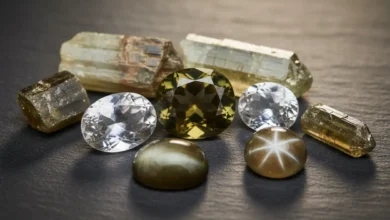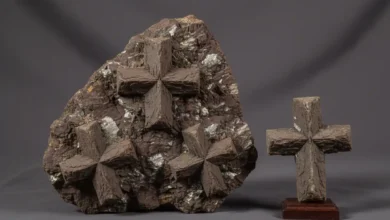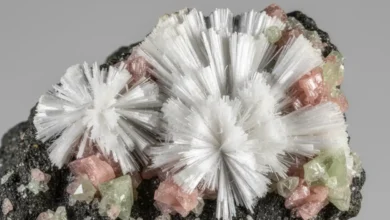

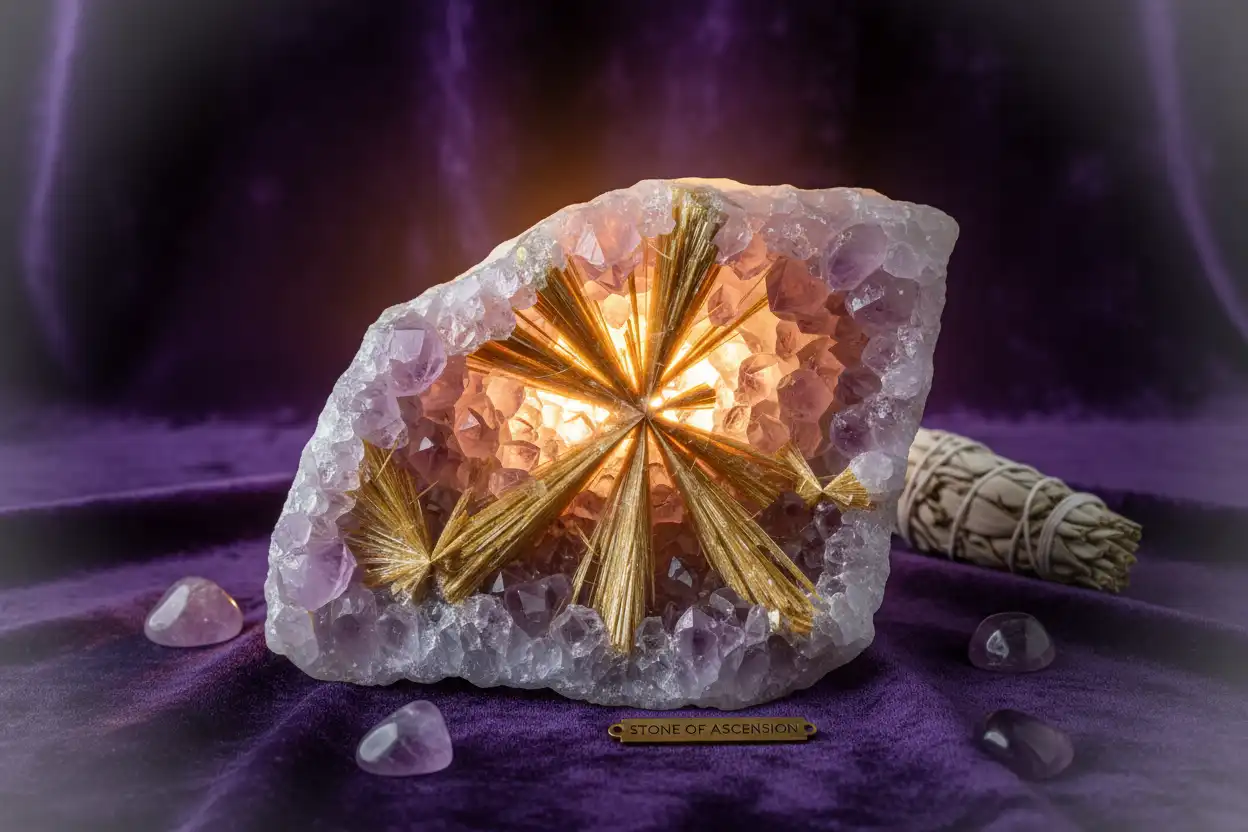

Cacoxenite is a hydrated iron-aluminum phosphate mineral that usually forms tiny golden-yellow, orange-brown, or reddish needle-like crystals. Its most distinctive habit consists of silky radial sprays and spherical starbursts coating iron-rich matrix or growing with other secondary phosphate minerals.
Cacoxenite at a Glance
| Property | Details |
|---|---|
| Mineral group or material type | Hydrated iron-aluminum phosphate mineral |
| Composition | Fe³⁺₂₄Al(PO₄)₁₇O₆(OH)₁₂·17H₂O |
| Colors | Yellow, golden yellow, brownish yellow, orange, reddish orange, brown, and rarely greenish |
| Crystal system | Hexagonal |
| Habit | Acicular needles, fibrous bundles, radial sprays, spherical aggregates, crusts, coatings, and intergranular cement |
| Luster | Silky; occasionally greasy on dense aggregates |
| Transparency | Semitransparent; individual fine needles may transmit light |
| Mohs hardness | About 3–4 |
| Cleavage | None observed |
| Tenacity | Brittle |
| Common use | Mineral specimens, micromounts, quartz-associated specimens, educational collections, and rare polished inclusion material |
| Main care concern | Fragile needles, soft aggregates, delicate matrix, chemical cleaners, and frequent misidentification as Goethite or Rutile |
What Is Cacoxenite?
Cacoxenite consists of ferric iron, aluminum, phosphate, hydroxyl groups, oxygen, and structural water. Although its chemical formula appears complex, the mineral’s visual identity is usually straightforward: extremely fine yellow-to-brown needles gather into radiating tufts, stars, spheres, or fibrous crusts.
Most crystals remain microscopic or only a few millimeters long. Therefore, Cacoxenite functions primarily as a specimen mineral rather than a conventional gemstone for faceting.
The mineral’s golden sprays have also entered the commercial crystal market through quartz and Amethyst products. However, many specimens sold under the Cacoxenite name have never received laboratory confirmation, making identification one of the most important parts of this guide.
Origin of the Name
Cacoxenite takes its name from Greek roots meaning “bad guest.” Early mineralogists used the phrase because phosphate-bearing material in iron ore could reduce the quality of iron produced during smelting.
The name reflects an industrial concern rather than the mineral’s appearance or modern spiritual symbolism. In a collector specimen, the same phosphorus that troubled ironworkers helps create a complex and visually distinctive phosphate mineral.
Cacoxenite was described during the nineteenth century from the Hrbek Mine in the present-day Czech Republic. That locality remains important for historical and reference material.
How Cacoxenite Forms
Cacoxenite develops mainly as a secondary mineral in oxidized, iron-rich environments. Water and oxygen alter earlier iron and phosphate minerals, releasing elements that later recombine in fractures, cavities, coatings, and porous rock.
Oxidized phosphatic magnetite deposits provide a classic setting. The mineral may also occur in limonite-rich zones, phosphate-bearing pegmatites, novaculite, iron-rich sediments, soils, and altered phosphate assemblages.
Late-stage growth commonly produces tiny radial sprays on pre-existing minerals. As a result, Cacoxenite may coat Goethite, Quartz, Wavellite, Strengite, Dufrénite, Beraunite, Variscite, Magnetite, or other phosphate and iron minerals.
The crystal habit reflects open growth space. Needles develop outward from a central point, while crowded growth can form dense spheres, crusts, or cement between grains.
Crystal Form and Texture
Individual Cacoxenite crystals are typically acicular, meaning they resemble needles. Groups may form stars, fans, radiating spheres, compact felted coatings, or randomly arranged fibrous bundles.
Some crystals appear crudely hexagonal under magnification. Nevertheless, their small size often prevents collectors from recognizing clear external faces without a microscope.
The silky luster comes from light reflecting across many parallel fibers. A dense aggregate can look golden and velvety, whereas widely spaced needles create a delicate flower-like appearance.
Because the crystals are soft and brittle, touching a spray can flatten or remove it. Even a cotton swab may cause permanent damage to fine specimen material.
Color
Most Cacoxenite ranges from straw yellow to deep golden brown. Reddish orange, brownish yellow, ocher, and rare greenish tones also occur.
Iron contributes strongly to the color, while crystal thickness, hydration, associated minerals, staining, and lighting affect the exact appearance. Thin needles may look brighter and more translucent than dense brown aggregates.
Golden coloration does not prove Cacoxenite. Goethite, Rutile, Lepidocrocite, iron staining, and several phosphate minerals can produce similar colors and radiating textures.
Backlighting may intensify orange or yellow tones. Consequently, a seller should provide images under both reflected and transmitted light rather than relying on one dramatic illuminated view.
Cacoxenite and Quartz
Cacoxenite can occur with Quartz and may coat crystal surfaces, fill cavities, or appear near quartz-hosted phosphate assemblages. Genuine associations have been documented from several localities.
However, “associated with Quartz” does not automatically mean “included inside transparent Quartz.” A surface-grown spray and a sealed internal inclusion represent different geological relationships.
Some polished Quartz pieces contain golden or brown needles labeled Cacoxenite. Without Raman spectroscopy, X-ray diffraction, or another reliable analytical method, the identification remains uncertain.
The problem becomes more significant when the commercial name adds a rarity premium. Buyers should distinguish visually attractive included Quartz from scientifically confirmed Cacoxenite-bearing material.
Is Cacoxenite Found in Amethyst?
Commercial sellers frequently describe golden sprays in Brazilian Amethyst as Cacoxenite. Nevertheless, mineral inclusion specialists have repeatedly found that many such sprays are Goethite, iron oxides, or related iron-rich material instead.
True Cacoxenite can occur in association with Quartz, so an absolute statement that the two minerals can never occur together would be too broad. Even so, a golden spray inside Amethyst should not receive the Cacoxenite label based on appearance alone.
Goethite commonly forms radiating yellow, brown, red, or black inclusions in Quartz and Amethyst. Its appearance overlaps closely with material sold as “Cacoxenite Amethyst.”
A credible seller should state whether the inclusion received analytical confirmation. Phrases such as “believed to be,” “traditionally sold as,” or “unverified golden iron-mineral inclusions” provide more accuracy when testing is absent.
Cacoxenite and Super Seven
Cacoxenite is often listed as one of the minerals supposedly present in Super Seven or Melody Stone. The standard commercial list usually includes Amethyst, clear Quartz, Smoky Quartz, Rutile, Goethite, Lepidocrocite, and Cacoxenite.
The Super Seven guide retains the broader trade-material query. From a mineralogical perspective, each claimed component requires independent confirmation, and one polished stone rarely proves the presence of seven separate phases by visual inspection.
Golden needles may be Goethite rather than Cacoxenite, while red flakes labeled Lepidocrocite may represent Hematite or another iron oxide. Additionally, clear, smoky, and purple zones can all belong to the same Quartz crystal rather than three separate mineral species.
Therefore, Super Seven should be evaluated as a commercial name for included Quartz unless analytical results establish the individual minerals.
Important Localities
The Hrbek Mine near Svatá Dobrotivá in the Czech Republic is the type locality. Historic material from this district holds particular interest for phosphate-mineral collectors.
Minas del Horcajo in Castilla-La Mancha, Spain, has produced recognizable Cacoxenite specimens. Blaton in Belgium also represents an important European phosphate locality with Cacoxenite and related secondary minerals.
Brazilian occurrences include phosphate-rich pegmatites such as the Sapucaia Mine in Minas Gerais. Although Brazil supplies large quantities of included Quartz to the commercial market, a Brazilian origin does not confirm that any golden inclusion is Cacoxenite.
Documented American occurrences appear in Arkansas, Tennessee, Alabama, Pennsylvania, New Hampshire, Florida, and other phosphate- or iron-rich settings. Many of the finest pieces remain micromount material rather than large display crystals.
British and Welsh phosphate localities have also produced the mineral with Wavellite, Variscite, Quartz, and iron oxides. The associated Wavellite guide covers the better-known radiating aluminum phosphate separately.
Is Cacoxenite a Gemstone?
Cacoxenite is not a practical faceting gemstone. Its crystals are generally too small, fibrous, soft, and brittle to cut as individual transparent stones.
Quartz containing genuine or suspected Cacoxenite may be shaped into cabochons, beads, pendants, or freeforms. In those products, Quartz supplies the main hardness and structural durability, while the Cacoxenite functions as an inclusion.
The distinction should appear clearly in product descriptions. “Quartz with Cacoxenite inclusions” does not mean the polished object consists primarily of Cacoxenite.
Most scientifically valuable material remains unpolished. Microscopic radial sprays on natural matrix preserve the crystal habit, mineral association, and locality information that cutting could destroy.
Jewelry Suitability
Pure Cacoxenite crystals are unsuitable for exposed jewelry because they scratch and crush easily. A natural spray mounted without protection could lose needles through ordinary contact.
Quartz-hosted material offers better durability, provided the host remains intact and the inclusion identification is accurate. Pendants and earrings create less impact risk than rings or bracelets.
Open cavities require special caution. A Quartz cabochon with an exposed pocket of golden fibers can trap residue and suffer damage during cleaning.
Jewelry labels should identify the host mineral and disclose whether the Cacoxenite identification is confirmed. Otherwise, the buyer may incorrectly assume that a common Quartz piece carries the rarity of a verified phosphate specimen.
How Cacoxenite Is Sold
Collectors encounter Cacoxenite as micromounts, thumbnail specimens, fibrous coatings, radial sprays on matrix, Quartz-associated specimens, old locality pieces, and analytical reference samples.
Commercial crystal shops also sell polished included Quartz, Amethyst points, cabochons, beads, pendants, spheres, and palm stones under the Cacoxenite or Super Seven name. Those objects occupy a different market from documented mineral specimens.
Micromount dealers usually provide more precise locality and association information. Meanwhile, decorative sellers tend to emphasize color, polish, size, and spiritual descriptions.
Cacoxenite is generally priced per specimen rather than by carat. When the mineral appears inside Quartz, the finished object may instead be priced by piece, jewelry design, or total Quartz weight.
Cacoxenite Price and Value
Small study specimens and micromounts often retail for approximately $10–$50. Better thumbnails with distinct radial sprays, strong color, and a documented locality commonly appear around $30–$150.
Larger or especially aesthetic specimens may sell for $150–$500 or more. Historic labels, unusual crystal size, rare associations, or classic localities can raise the value further.
Polished Quartz and Amethyst marketed as Cacoxenite commonly range from about $10 for small pieces to several hundred dollars for large freeforms or jewelry. However, those prices often reflect the host Quartz, cutting, size, and commercial story rather than verified Cacoxenite content.
A high asking price does not confirm the inclusion. When the mineral identity drives the premium, analytical documentation should carry more weight than a metaphysical product certificate.
Value Factors
Specimen collectors evaluate several features:
- Confirmed identity: Analytical evidence becomes especially important when the specimen resembles Goethite or another iron phosphate.
- Crystal habit: Clear radial sprays, spheres, fans, and intact needles show the species more effectively than featureless coatings.
- Color: Golden-yellow and orange sprays often provide stronger visual contrast against dark matrix.
- Condition: Crushed fibers, rubbed surfaces, detached clusters, and heavy dust reduce display quality.
- Matrix relationship: A well-positioned spray on contrasting Quartz, Goethite, or phosphate matrix can improve aesthetics.
- Locality: Type-locality, historic European, classic American, and documented Brazilian material appeal to different specialist interests.
- Provenance: Old labels and collection records increase confidence when locality material is no longer readily available.
- Scale: Large crystals are unusual, but magnified beauty can matter more than overall specimen dimensions.
Polished inclusion material follows different criteria. Quartz clarity, inclusion arrangement, color contrast, cut quality, and honest identification determine practical appeal.
Treatments and Misleading Presentation
Cacoxenite itself has no established routine gem treatment. Natural specimens may receive trimming, cleaning, mounting, stabilization, or repair.
Quartz marketed as Cacoxenite may receive polishing, resin filling, dye, coating, heat treatment, or surface enhancement. Those processes do not necessarily create the internal golden sprays, but they may alter the host’s appearance or conceal fractures.
Warm lighting can make ordinary iron staining look intensely golden. Similarly, wet photographs deepen colors and temporarily hide surface damage.
Some sellers digitally increase yellow and purple saturation. Therefore, neutral-light photographs, close-ups, side views, and a clear treatment disclosure provide more useful information than highly styled promotional images.
Cacoxenite Lookalikes
Several minerals overlap with Cacoxenite:
- Goethite: Commonly forms brown, yellow, red, or black radiating needles and represents the most important confusion in included Quartz.
- Rutile: Produces golden, coppery, red, or black needles, although crystal form and chemistry differ.
- Lepidocrocite: May form reddish plates or fibers but is frequently misidentified in commercial included Quartz.
- Strengite: A hydrated iron phosphate that may occur beside Cacoxenite in phosphate deposits.
- Wavellite: Forms radial phosphate aggregates, usually with thicker fibers and different color and chemistry.
- Limonite: A field term for mixtures of hydrated iron oxides that can create yellow-brown coatings and staining.
- Beraunite and Dufrénite: Iron phosphates that share alteration environments and may occur in the same specimen.
The crystal identification guide provides a general framework. Nevertheless, microscopic iron and phosphate minerals often require laboratory instruments rather than home observation.
How to Identify Cacoxenite
Start with crystal habit, color, luster, geological setting, and associated minerals. Golden acicular sprays in a phosphate-rich iron deposit fit Cacoxenite more convincingly than similar needles inside an untested commercial Amethyst.
Hardness of approximately 3–4 offers limited help because the crystals are too delicate for responsible scratch testing. Specific gravity also becomes difficult to measure when microscopic fibers remain attached to matrix.
Optical examination can reveal strong birefringence and uniaxial-positive behavior, yet individual needles may be too small for routine gemological instruments.
Raman spectroscopy and X-ray diffraction provide stronger identification. Scanning-electron microscopy with elemental analysis can detect iron, aluminum, and phosphorus, although chemistry alone may not distinguish every related phosphate without structural data.
A polished Quartz piece presents additional challenges because the inclusion cannot be separated easily. In that case, a specialist laboratory must analyze the internal spray through the host or test an exposed representative area.
Buying Guidance
First, determine whether the product is a documented mineral specimen or commercial included Quartz. Those categories should not be compared by size or price alone.
For natural specimens, request the complete locality, dimensions, magnification level, associated minerals, repair disclosure, and photographs of the exact piece. A micromount image may show crystals far larger than they appear without magnification.
For Quartz or Amethyst, ask how the inclusion was identified. A seller who relies only on appearance should not describe the species as laboratory-confirmed.
The practical fake-crystal guide can help identify dyed hosts, coatings, glued composites, and misleading presentation. However, a natural Quartz host can still contain a misidentified natural inclusion.
Compare the price with ordinary included Quartz as well as verified mineral specimens. Paying a substantial premium makes sense only when documentation, aesthetics, craftsmanship, or provenance supports it.
Hardness and Durability
Cacoxenite’s hardness of 3–4 makes exposed crystals easy to scratch. Fibrous bundles are even more vulnerable because each needle can bend, crush, or detach independently.
A specimen should be handled by its strongest matrix area rather than by the golden coating. Support the piece over a padded surface in case a loose fragment falls.
Quartz-hosted inclusions gain protection when completely enclosed. However, surface-reaching fractures and open pockets can expose the soft mineral to water, dirt, and physical contact.
Vibration creates unnecessary risk. Consequently, avoid ultrasonic cleaning, rotary brushes, compressed workshop air, and repeated movement in loose display boxes.
Water Safety and Cleaning
Cacoxenite contains structural water and occurs with minerals that may respond differently to soaking. A brief controlled rinse may not destroy every stable specimen, but water cleaning should not serve as the default.
Begin with a hand air blower and visual inspection. If dust remains, use an exceptionally soft artist’s brush only when the fibers are firmly attached and the matrix contains no hazardous or crumbly material.
Do not soak a micromount, repaired specimen, old label, or porous phosphate matrix. Detergents may leave residue between needles, while acids can attack associated phosphates and iron minerals.
Quartz jewelry with sealed inclusions can usually be wiped with a damp cloth. Still, open cavities, resin fills, adhesives, and uncertain treatments require more cautious care.
After any approved rinse, allow the specimen to drain and dry naturally. Heat, hair dryers, steam, and pressurized air may detach fibers or stress the host.
Storage and Display
Store Cacoxenite in a rigid covered box with enough clearance around every spray. Cotton fibers and loose tissue can catch delicate needles, so fitted foam or mineral putty should support only the matrix.
A dust-resistant cabinet reduces cleaning frequency. Furthermore, stable shelving protects the specimen from vibration, accidental contact, pets, and falling objects.
Moderate indirect lighting reveals the silky luster without heating adhesives or matrix. Direct sunlight is unnecessary and may fade labels, coatings, or associated minerals.
Preserve every locality label and collection number. For small phosphate specimens, provenance may hold as much long-term importance as visual size.
Cacoxenite Meaning and Symbolism
Modern spiritual communities often associate Cacoxenite with perspective, personal growth, collective reflection, and recognizing a constructive direction during change. Its radiating crystal habit may inspire personal symbolism related to ideas spreading outward from one central insight.
Commercial literature also calls it a stone of ascension or heightened awareness. These phrases belong to contemporary spiritual traditions rather than mineralogical research.
Scientific study describes Cacoxenite’s phosphate chemistry, crystal structure, formation, and optical properties. It does not establish that the mineral changes health, consciousness, energy fields, or external events.
People may still use a specimen as a contemplative object or personal reminder. Such use does not require presenting subjective experience as a universal physical effect.
Frequently Asked Questions
Is Cacoxenite rare?
The mineral occurs at numerous phosphate and iron-rich localities, but large, well-formed, undamaged sprays remain uncommon. Much collectible material requires magnification.
Is Cacoxenite always found in Amethyst?
No. Cacoxenite primarily occurs in oxidized phosphate-rich environments. Many golden sprays sold inside Amethyst are more likely Goethite or another iron mineral unless testing confirms Cacoxenite.
Is Cacoxenite one of the Super Seven minerals?
Commercial descriptions commonly include it in the list. However, the mineral identities within an individual Super Seven stone require analysis rather than visual assumption.
Can Cacoxenite be faceted?
Individual crystals are normally too small, soft, and fibrous for faceting. Quartz containing suspected or confirmed Cacoxenite may be polished as the host material.
What color is real Cacoxenite?
Typical colors include yellow, golden yellow, brownish yellow, orange, reddish orange, and brown. Rare material may appear greenish.
How can I distinguish Cacoxenite from Goethite?
Habit and geological context provide clues, but the two can look extremely similar in Quartz. Raman spectroscopy, X-ray diffraction, or other laboratory analysis offers the most reliable distinction.
Can Cacoxenite go in water?
Prolonged soaking is not recommended. Fragile fibers, repairs, porous matrix, and associated phosphate or iron minerals make dry or minimally damp cleaning safer.
Is Cacoxenite toxic?
An intact specimen is not normally treated as a highly toxic display mineral. Nevertheless, mineral dust should not be inhaled or ingested, and the specimen may contain associated minerals with separate safety concerns.
Explore more entries in the crystals that start with C directory or continue through the Gemstone Guides collection.
Disclaimer: Spiritual meanings are cultural or personal interpretations rather than scientifically proven effects. Do not ingest Cacoxenite, place it in drinking water, or inhale dust from cutting, grinding, brushing, or breaking mineral specimens.