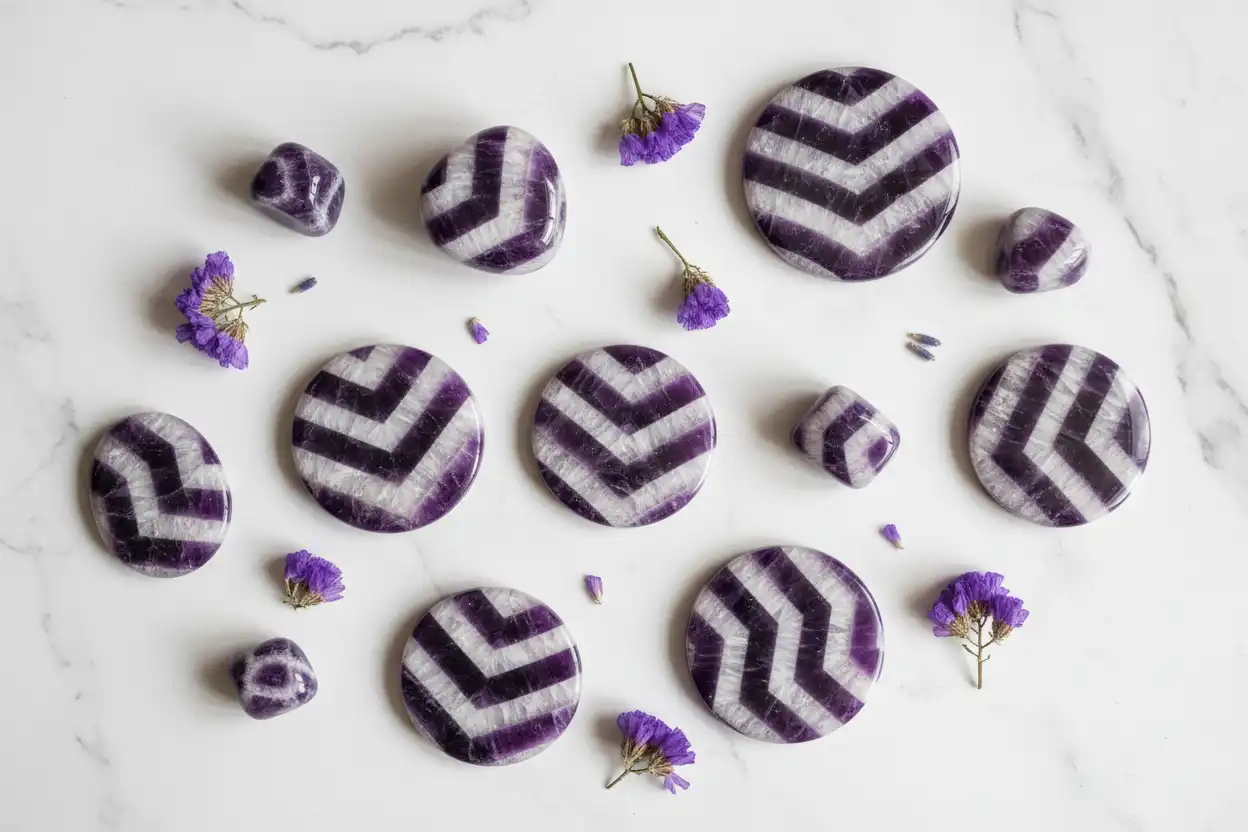
Chevron Amethyst Meaning: Facts, History & Symbolism
Chevron amethyst meaning is commonly associated in modern crystal traditions with reflection, focus, balance, personal growth, perspective, and moving through change with greater awareness. Those themes are symbolic interpretations inspired largely by the stone’s alternating purple and white pattern. Materially, chevron amethyst is quartz, SiO₂, showing recognizable zones of purple amethyst and paler, colorless, or milky quartz arranged in V-shaped, zigzag, triangular, or repeated angular patterns.
The chevrons do not make the material a separate mineral species. The purple portions are amethyst, while the white or nearly colorless areas remain quartz with different color, transparency, inclusion content, or growth characteristics. The entire specimen generally belongs to the quartz family and retains the characteristic hardness, density, refractive behavior, lack of prominent cleavage, and conchoidal fracture associated with quartz.
This distinction is the foundation for understanding chevron amethyst meaning. The geological pattern is real. The quartz properties are measurable. Amethyst has a documented human history. Modern ideas about intuition, spiritual protection, chakra activation, dream enhancement, or emotional healing belong to separate belief systems and should not be presented as properties established by mineral science.
For more material-first references to minerals and ornamental stones, browse the Gemstone Guides.
What Is Chevron Amethyst?
Chevron amethyst is patterned amethyst-bearing quartz characterized by alternating purple and pale quartz zones that commonly create angular, V-shaped, or zigzag markings.
Its essential chemistry is:
SiO₂
The name describes appearance rather than a distinct mineral species.
| Property | Typical chevron amethyst characteristics |
|---|---|
| Material identity | Patterned amethyst-bearing quartz |
| Chemical formula | SiO₂ |
| Mineral family | Quartz |
| Crystal system | Trigonal |
| Characteristic pattern | Purple and white/colorless V-shaped or zigzag growth zones |
| Purple component | Amethyst |
| Pale component | Colorless, cloudy, or milky quartz |
| Typical colors | Lavender, violet, purple, white, colorless, grayish white |
| Transparency | Translucent to transparent locally; commonly mixed with cloudy zones |
| Mohs hardness | 7 |
| Specific gravity | About 2.65 |
| Refractive indices | Approximately 1.544 and 1.553 |
| Birefringence | Approximately 0.009 |
| Cleavage | No prominent easy cleavage |
| Fracture | Conchoidal to uneven |
| Luster | Vitreous |
| Common fashioned forms | Cabochons, beads, polished points, carvings, spheres and slabs |
| Separate mineral species? | No |
| Common trade synonym | Dream amethyst |
The important phrase is “patterned amethyst-bearing quartz.” It explains the physical material much more accurately than descriptions suggesting that chevron amethyst is a newly discovered mineral with chemistry different from ordinary amethyst.
Why Does Chevron Amethyst Have White and Purple Bands?
The pattern reflects differences that developed as quartz crystallized.
Amethyst color forms where quartz contains appropriate iron-related defects and color centers. Irradiation acting on iron-bearing quartz is central to the development of violet coloration, although the detailed structural chemistry of individual color centers can be more complex than simplified descriptions imply.
Not every region of a growing quartz body develops identical color.
Changes in:
trace-element distribution;
defect concentration;
growth conditions;
crystal orientation;
inclusion abundance;
fluid chemistry;
and subsequent irradiation
can produce zones with different color intensity.
Some regions remain pale or colorless.
Others become lavender or strongly violet.
When repeated growth geometry intersects a cut surface, those zones can appear as chevrons.
The White Areas Are Usually Quartz Too
A common misunderstanding is that the white stripes are a second unrelated mineral cementing amethyst together.
In typical chevron amethyst, the pale zones are quartz-rich material as well.
They may appear white because of:
microscopic fluid inclusions;
tiny fractures;
scattering centers;
growth irregularities;
fine inclusions;
or simply an absence of strong purple color.
A polished slab can therefore contain visually dramatic purple and white contrast while remaining overwhelmingly SiO₂.
This makes chevron amethyst a useful example of how one mineral can display very different appearances within a single specimen.
Chevron Pattern Versus Ordinary Amethyst Zoning
Ordinary amethyst can show color zoning without producing a strong chevron pattern.
A faceted amethyst may contain:
angular violet sectors;
alternating pale and dark zones;
color concentrated near crystal tips;
irregular patches;
or nearly uniform purple.
Chevron amethyst describes material where the zoning produces conspicuous repeated angular bands, particularly after cutting.
The difference is therefore partly one of visible pattern.
There is no universal laboratory threshold stating that a quartz becomes chevron amethyst once a band reaches a certain angle or width.
The trade name is descriptive.
Chevron Amethyst and Crystal Growth
Quartz crystals do not necessarily grow at exactly the same rate on every crystallographic face.
As growth conditions change, different zones can record variations in chemistry, defects, inclusions, and color.
When later material grows over earlier quartz, the geometry of those earlier surfaces can remain recorded internally.
Cutting across that structure exposes repeated angular boundaries.
This is why a polished slice can resemble nested Vs or mountain peaks even though the original rough material may not display such obvious surface stripes.
The complete discussion of growth environments, hydrothermal fluids, zoning, cavities, veins, and repeated crystallization belongs on chevron amethyst formation and deposit geology.
Why Some Chevron Amethyst Looks Like Layered Arrows
The apparent arrows or Vs are intersections between three-dimensional growth zones and a two-dimensional polished surface.
Imagine a sequence of crystal surfaces growing outward.
If each later growth stage differs slightly in color or cloudiness, the internal stone develops nested geometric zones.
Cutting through those zones at a favorable angle can expose them as repeated chevrons.
Change the cutting orientation and the pattern can change substantially.
The same rough piece might produce:
sharp Vs;
broad triangles;
parallel-looking bands;
irregular zigzags;
or much weaker patterning
depending on where and how it is sliced.
This makes orientation especially important for lapidary work.
Is Chevron Amethyst the Same as Dream Amethyst?
“Dream amethyst” is widely used as a commercial synonym for chevron-patterned amethyst.
It is a trade name rather than a separate mineral species.
A seller may use:
chevron amethyst;
dream amethyst;
banded amethyst;
patterned amethyst;
or another decorative descriptor.
Those names can overlap without carrying perfectly standardized definitions.
The strongest description states what the specimen actually shows.
For example:
Natural quartz containing alternating violet amethyst and milky-white quartz growth zones arranged in repeated chevrons.
That description communicates far more mineralogical information than “high-grade dream stone.”
Is Chevron Amethyst the Same as Cape Amethyst?
Not necessarily.
Cape amethyst is another historical or trade term used for amethyst mixed or banded with milky quartz, often producing purple-and-white material.
The terminology can overlap with chevron amethyst, but the names should not automatically be treated as exact synonyms in every market.
“Chevron” specifically emphasizes the V-shaped or angular pattern.
“Cape amethyst” has been used more broadly for amethyst associated with pale quartz.
Where a specimen clearly displays repeated angular bands, chevron amethyst is the more descriptive term.
Original Chevron Amethyst Specimen and Photo Checklist
Use this checklist when examining a rough specimen, polished stone, carving, bead strand, sphere, or online listing.
Confirm quartz-like physical character
The material should have a vitreous polish, quartz-family hardness, no obvious easy cleavage, and an overall appearance consistent with crystalline silica.
Examine whether the pattern enters the stone
Natural chevrons should continue through the body rather than existing only as painted surface stripes.
A cut edge or back surface can be particularly informative.
Look for irregular band width
Natural growth zones do not have to repeat with mechanical precision.
Bands may widen, narrow, terminate, split, or become less distinct.
Follow one chevron through the specimen
A genuine internal growth zone should have plausible continuity in three dimensions.
Compare purple saturation between bands
Different growth zones may vary from nearly colorless to pale lavender and deeper violet.
Uniform computer-like repetition is not required.
Examine the white portions
Cloudy white zones can contain microscopic inclusions, fractures, or scattering features.
They should not automatically be assumed to be calcite or feldspar.
Use transmitted light
Backlighting can reveal how deeply the violet zoning extends and whether white regions are translucent.
Inspect for fractures
Natural quartz commonly contains healed or open fractures that can interrupt the chevron pattern.
Look for dye concentration
Artificial color may collect in fractures, pits, or porous surface-reaching areas.
Natural amethyst color should not normally appear merely as purple liquid concentrated inside cracks.
Examine polished points critically
Many commercial “chevron amethyst points” are carved from massive patterned material rather than naturally terminated crystals.
A carved point is not fake simply because the termination is manufactured.
Look at the base and back
Photographs showing only the most attractive patterned face can conceal repairs, weak patterning, coatings, or lower-quality material.
Use magnification
A loupe can reveal growth zoning, fractures, fluid inclusions, polish features, surface coatings, and treatment clues. More detailed observations belong in the chevron amethyst microscope inclusion notebook.
Avoid destructive scratch testing
Quartz hardness is useful diagnostically, but scratching a finished object is unnecessary when non-destructive evidence is available.
Separate locality from pattern
A strong chevron pattern cannot prove a specific mine or country by itself.
Exclude metaphysical labels from identification
Descriptions such as dream crystal, third-eye stone, spiritual amplifier, aura cleanser, or intuition stone do not establish mineral identity.
Claim Versus Evidence: Chevron Amethyst
| Claim | Evidence status | More accurate interpretation |
|---|---|---|
| Chevron amethyst is quartz | Supported | It is patterned amethyst-bearing SiO₂ |
| The purple zones are amethyst | Supported | They represent violet quartz |
| The white zones are always a completely different mineral | Usually incorrect | They are commonly pale or milky quartz |
| Chevron amethyst is a separate mineral species | Incorrect | Chevron describes pattern |
| Dream amethyst is a separate species | Incorrect | It is primarily a trade name |
| Every purple-and-white quartz is automatically chevron amethyst | Too broad | Chevron terminology is most descriptive where angular repeated zoning is visible |
| Chevron patterns reflect crystal-growth zoning | Supported | Repeated growth and color differences create the pattern |
| White bands were painted onto natural amethyst | Not characteristic of genuine material | Surface-applied color would be a treatment or imitation issue |
| Every polished point is a natural crystal termination | Incorrect | Many points are carved from massive material |
| Chevron amethyst is harder than ordinary amethyst | Incorrect | Both are quartz, around Mohs 7 |
| Stronger purple automatically means higher mineralogical quality | Too simple | Pattern, condition, color, translucency, treatment and workmanship also matter |
| Chevron amethyst scientifically improves intuition | Unsupported | Intuition is a modern symbolic association |
| It cures anxiety or sleep disorders | Unsupported medical claim | Quartz identity does not establish therapeutic effects |
| Its white bands purify the purple bands energetically | Metaphysical interpretation | The color contrast has no established cleansing mechanism |
| Chevron amethyst guarantees vivid or prophetic dreams | Unsupported | Dream symbolism is not a measured mineral property |
The pattern is sufficiently distinctive without adding unsupported scientific claims to it.
Chevron Amethyst Versus Ordinary Amethyst
Both materials are amethyst-bearing quartz.
Ordinary amethyst may be:
evenly purple;
strongly zoned;
pale at the base;
darker near terminations;
or irregularly colored.
Chevron amethyst places particular emphasis on repeated purple-and-white angular zoning.
Their core physical properties remain essentially the same.
A chevron specimen does not gain extra hardness, density, refractive index, or durability merely because its pattern is more complex.
The distinction is visual and textural.
Chevron Amethyst Versus Banded Agate
Both can show repeated patterns, but their textures differ.
Agate is microcrystalline chalcedony with characteristic fine banding.
Chevron amethyst is macrocrystalline quartz material whose color and cloudy growth zones create angular patterns.
A polished agate usually has extremely fine, dense texture without the larger quartz growth relationships typical of chevron amethyst.
The two materials can both contain SiO₂ while recording silica crystallization at different textural scales.
Chemistry alone does not tell the entire story.
Chevron Amethyst Versus Fluorite
Purple fluorite can visually overlap with amethyst, particularly after polishing.
Physical properties separate them readily.
Quartz has Mohs hardness 7 and no prominent easy cleavage.
Fluorite has Mohs hardness 4 and perfect octahedral cleavage.
Their crystal systems and refractive properties also differ.
A purple-and-white fluorite object should therefore not be classified as chevron amethyst merely because angular color zones are present.
The diagnostic framework must begin with mineral identity.
Chevron Amethyst Versus Charoite
The neighboring charoite meaning reference provides a useful comparison because both materials can display dramatic purple-and-white patterns.
Charoite is a complex silicate commonly occurring in fibrous, swirling ornamental rock. Its purple structures often resemble feathers, flames, waves, or flowing ribbons.
Chevron amethyst is quartz.
Its pattern tends to follow more angular growth zoning.
The difference is especially obvious under moving light: charoite can show broad silky directional reflection from fibrous bundles, whereas chevron amethyst behaves optically like quartz with color zoning.
Similar color does not imply similar mineralogy.
Chevron Amethyst Versus Chiastolite
The mapped chiastolite meaning reference concerns a variety of andalusite known for distinctive dark cross-like inclusion patterns.
Both materials can produce recognizable geometric markings after cutting.
Their patterns form for very different reasons.
Chevron amethyst records repeated quartz growth and color zoning.
Chiastolite’s characteristic cross involves inclusion distribution during crystal growth.
One produces Vs and angular bands.
The other is famous for cross-shaped internal sectors.
Pattern recognition should therefore lead to a mineralogical question, not substitute for one.
Why Chevron Amethyst Can Look Different After Cutting
A rough specimen contains a three-dimensional pattern.
A polished surface reveals only one intersection through that structure.
Cut orientation can determine:
how sharp the chevrons appear;
how frequently they repeat;
whether bands look symmetrical;
how much purple is visible;
whether white zones dominate;
and whether the final piece displays a strong central pattern.
This means two cabochons cut from adjacent portions of the same rough can look surprisingly different.
One may contain dramatic nested Vs.
The next may show mostly irregular stripes.
The lapidary has not changed the underlying mineral identity.
The orientation changed the visible cross-section.
Cutting and Polishing Chevron Amethyst
Quartz’s Mohs hardness of 7 makes chevron amethyst suitable for conventional lapidary work.
The main challenge is visual orientation rather than extreme fragility.
Before cutting, a lapidary can inspect the rough from several directions and consider:
strongest chevron face;
depth of purple zones;
fractures;
cloudy areas;
potential cabochon size;
carving orientation;
and how much pattern will survive polishing.
Spheres create a particularly interesting effect because the changing surface orientation reveals different sections through the same growth zones.
The detailed relationship among sawing direction, pattern placement, fracture avoidance, and polish belongs in chevron amethyst cutting, orientation and polish.
Chevron Amethyst in Jewelry
Chevron amethyst inherits quartz’s generally useful jewelry durability.
With Mohs hardness 7 and no strong cleavage, it can be used in:
pendants;
earrings;
bracelets;
beads;
brooches;
and rings.
The individual piece still matters.
Surface-reaching fractures can create local weaknesses.
Sharp carved points can chip more easily than rounded cabochons.
A thin section cut across a fracture may be less durable than a thicker compact piece.
Protective mounting becomes particularly relevant for rings and bracelets because they encounter harder surfaces more frequently.
The detailed engineering considerations belong in chevron amethyst setting and wear engineering.
Heat Treatment and Amethyst Color
Amethyst color can respond strongly to heat.
Depending on the material and conditions, heating can:
lighten violet color;
remove purple;
create yellow or brownish colors;
or produce other altered appearances.
The result depends on the original quartz and its defect chemistry.
Heating does not convert quartz into a completely different mineral species.
It changes color-related defects within the silica structure.
Chevron patterning may remain visible after color modification because the structural or inclusion differences between zones can persist even when the purple color changes.
Treatment history therefore matters separately from mineral identity.
Irradiation and Color
Natural radiation is involved in the development of amethyst’s color centers.
Artificial irradiation can also modify color in appropriate quartz.
That does not mean every violet specimen is artificially irradiated.
Natural geological environments provide radiation over long periods from surrounding minerals containing radioactive elements at low concentrations.
The important distinction is not “radiation equals artificial.”
It is whether the present appearance resulted from natural geological processes or later human treatment.
Determining that history can require specialized testing and may remain difficult for some material.
Can Chevron Amethyst Be Dyed?
Quartz itself is relatively resistant to simple dye penetration when compact, but fractures, porous areas, coatings, or associated material can accept artificial color.
Low-quality pale quartz can therefore be enhanced in ways that make a patterned object appear more vividly purple.
Useful clues include:
purple concentrated inside fractures;
color gathered around drill holes;
superficial purple coatings;
highly unnatural saturation;
or color that does not follow internal growth structure.
None alone proves treatment.
Natural amethyst can also be intensely violet.
The strongest conclusion comes from combining microscopy, optical observations, spectroscopy where appropriate, and seller disclosure.
Synthetic Amethyst Exists
Laboratory-grown amethyst can be produced through hydrothermal crystal growth.
Synthetic quartz is genuine crystalline SiO₂ but has laboratory rather than geological origin.
Distinguishing natural from synthetic amethyst can require careful microscopy and advanced testing because both materials share the same fundamental quartz chemistry and many physical properties.
For ordinary chevron amethyst carvings, treatment, misleading pattern descriptions, dyed substitutes, and reconstructed commercial material may be more common practical concerns than sophisticated synthetic chevron material.
Still, “quartz” and “natural geological quartz” are not automatically identical claims.
Origin must be supported separately.
Laboratory Identification
Most typical chevron amethyst is recognizable as quartz, but laboratory testing becomes useful when material is unusually valuable, treated, synthetic-suspect, or visually atypical.
Useful methods include:
Refractive-index testing. Values should fall within the quartz range.
Specific gravity. Clean material should approximate ordinary quartz.
Polarized-light testing. Quartz’s anisotropic optical behavior can support identification.
Microscopy. Growth zoning, fractures, fluid inclusions, color boundaries, and treatment clues can be examined directly.
Raman spectroscopy. This can confirm quartz structure and identify some associated phases.
Infrared spectroscopy. Advanced testing can provide useful information about quartz defects and natural-versus-synthetic characteristics in specialized contexts.
The analytical method should answer the actual uncertainty.
Confirming that the material is quartz does not automatically establish natural origin, treatment history, locality, or trade variety.
Where to Buy Chevron Amethyst
Purchase-specific questions such as seller evaluation, treatment disclosure, photographs, pattern quality, dimensions, return policies, and price belong in where to buy chevron amethyst.
For the meaning reference, the buying boundary is straightforward.
Terms such as:
high-vibration chevron amethyst;
psychic-grade dream amethyst;
healer-selected quartz;
crown-chakra quality;
spiritual awakening stone;
or manifestation-grade amethyst
are not gemological grades.
A buyer should first evaluate mineral identity, whether the pattern is natural, treatment disclosures, workmanship, fractures, and the accuracy of photography.
Pattern Quality Is Not One Universal Standard
A person buying a polished piece may prefer sharp, symmetrical Vs.
A collector may prefer unusual natural zoning, complex fractures, or a specimen that clearly preserves growth history.
A carver may value a large block with continuous pattern.
A jewelry buyer may prioritize durability and attractive face-up contrast.
There is therefore no single scientific scale for “best chevron amethyst.”
Commercial quality is purpose-dependent.
The strongest material is the piece whose physical properties and appearance suit the intended use and whose description accurately represents what it is.
Provenance and Locality
Chevron-patterned amethyst occurs in more than one geological region.
Pattern alone should therefore never be treated as proof that a specimen came from a particular country, district, mine, or deposit.
Useful provenance can include:
original mine labels;
supplier documentation;
parcel records;
collection cards;
acquisition history;
specimen numbers;
field photographs;
or a traceable chain of custody.
The chevron amethyst provenance disclosure checklist provides a structured way to distinguish documented locality from an appearance-based assumption.
The more strongly provenance affects price, the stronger the supporting evidence should be.
Conserving Chevron Amethyst Specimens
Quartz is relatively durable, but important specimens and lapidary objects can still lose information through careless restoration.
A rough piece may preserve:
natural crystal surfaces;
contacts with matrix;
weathering;
growth boundaries;
old fractures;
mineral inclusions;
and provenance labels.
A historic or particularly fine polished object can preserve older workmanship and surface character.
Before repolishing, aggressively cleaning, or cutting a significant specimen, document its condition.
The chevron amethyst specimen conservation record provides a structured framework for recording pattern, dimensions, fractures, repairs, labels, photographs, and subsequent changes.
Cleaning Chevron Amethyst
Solid untreated quartz is relatively straightforward to clean conservatively, but the complete object determines what is safe.
Potential complications include:
fracture filling;
dye;
adhesives;
mixed mineral matrix;
metal jewelry settings;
old repairs;
coatings;
and delicate carvings.
Mild cleaning is preferable to assuming that hardness 7 makes every treatment harmless.
Heat deserves particular caution because amethyst color itself can change under sufficiently strong thermal exposure.
Avoid high-temperature methods intended merely to “energize” or cosmetically alter a valued specimen.
Safe Ownership
Normal handling of intact chevron amethyst is generally straightforward.
The more important safety distinction appears during lapidary processing.
Chevron amethyst is quartz, and cutting, drilling, grinding, sanding, or crushing quartz can generate respirable crystalline-silica dust.
Appropriate lapidary practice should therefore use suitable wet methods, effective local extraction, eye protection, and appropriate respiratory controls rather than uncontrolled dry grinding.
Do not deliberately pulverize chevron amethyst for inhalation or ingestion.
The fact that quartz is common does not make fine respirable silica dust harmless.
An intact polished stone and airborne cutting dust are different exposure situations.
Chevron Amethyst’s Documented History
Amethyst itself has a long documented history as an ornamental and gem material.
Purple quartz has been carved, set into jewelry, collected, traded, and assigned cultural meanings in numerous societies.
The history of specifically named chevron amethyst requires more caution.
A historic reference to amethyst does not automatically demonstrate that the object had alternating V-shaped purple-and-white bands.
Likewise, older references to banded quartz or pale-and-purple amethyst do not necessarily use modern commercial terminology.
The strongest historical approach is therefore:
recognize the well-established history of amethyst;
identify chevron-patterned material only where the physical pattern is documented;
avoid retroactively assigning modern “dream amethyst” terminology;
separate modern metaphysical meanings from historically demonstrated beliefs.
That avoids creating an ancient tradition simply because ordinary amethyst has one.
Ancient Amethyst Symbolism Is Not Automatically Chevron Symbolism
Historical cultures used and interpreted amethyst in different ways.
Some meanings associated with purple quartz became widely repeated through later literature.
Those traditions can be historically interesting without proving that chevron amethyst had a separate symbolic identity.
A patterned modern carving should therefore not automatically inherit every claim ever made about amethyst.
The material connection is real.
The symbolic continuity may not be.
Specific historical claims need specific evidence.
Chevron Amethyst Meaning in Modern Symbolism
Modern chevron amethyst meaning commonly emphasizes clarity, reflection, intuition, balance, personal growth, and seeing patterns within complicated situations.
The physical pattern provides an obvious source for these interpretations.
Purple and white zones alternate while remaining part of one quartz body.
A person can interpret that structure as a reminder that apparently opposing experiences can belong to one larger process.
Likewise, repeated Vs can symbolize progression, direction, or recognizing recurring patterns.
These are human interpretations.
The quartz does not need to transmit a measurable spiritual frequency for the symbolism to be meaningful.
Pattern Recognition as a Practical Symbol
Chevron amethyst offers a particularly natural metaphor for pattern recognition.
A single purple band may not reveal much.
Repeated bands make the structure easier to see.
Applied to everyday reasoning, someone might ask:
Is this event isolated or recurring?
Which parts of the situation repeat?
Where does the pattern change?
Am I reacting to one incident while ignoring the larger sequence?
Which evidence would confirm or challenge the pattern I think I see?
This turns chevron amethyst meaning into a practical reflective framework.
The stone does not perform the analysis.
It provides a visual cue for doing it deliberately.
Balance Without Assuming Equal Halves
Chevron amethyst is frequently associated with balance because purple and white areas coexist.
Natural specimens demonstrate something more interesting than perfect symmetry.
The zones are rarely equal.
One band may dominate.
Another may fade.
A fracture can interrupt the sequence.
Color intensity can vary dramatically.
A more realistic symbolic interpretation is therefore not “balance means equal amounts.”
It is:
Balance can mean different parts functioning within one structure even when they are unequal.
That is a more useful metaphor for real decisions, priorities, work, relationships, and personal routines.
Personal Growth and Repeated Layers
Repeated quartz growth zones can also inspire symbolism around gradual development.
The final patterned stone records several stages rather than one instantaneous event.
A person might use that structure as a reminder that progress often develops through accumulation:
one skill;
one correction;
one attempt;
one boundary;
one completed task;
one revised assumption.
No individual layer needs to represent a dramatic transformation.
The visible pattern exists because multiple stages remain together.
That symbolism is grounded in the appearance of the stone without converting geological growth into a supernatural mechanism.
Chevron Amethyst and Intuition
Intuition is another common theme.
A responsible interpretation distinguishes intuitive impressions from evidence.
Someone may use the stone during reflection and ask:
What is my first impression, and what evidence would support or contradict it?
That preserves intuition as part of human cognition without claiming that quartz creates extrasensory perception.
Statements that chevron amethyst scientifically produces clairvoyance, telepathy, prophetic insight, or psychic accuracy are not established by its mineral properties.
Those remain metaphysical beliefs.
Chevron Amethyst and Dreams
The trade name dream amethyst naturally encourages associations with dreams and sleep.
Some users choose the stone as part of a bedtime ritual, meditation practice, or dream journal.
A familiar visual object can function as a cue to remember an intention such as recording dreams after waking or reducing stimulating activity before sleep.
That practical use should not be confused with claims that the stone:
guarantees vivid dreams;
produces prophetic dreams;
prevents nightmares;
medically treats insomnia;
or alters sleep architecture through emitted crystal energy.
Those effects are not established by quartz mineralogy.
Chevron Amethyst and the Third Eye Chakra
Modern crystal systems frequently associate purple stones with the third eye or crown chakra.
Chevron amethyst is therefore often assigned to one or both.
Some interpretations use the white bands symbolically to represent higher awareness or purification.
These are spiritual frameworks.
Gemological instruments can measure:
refractive index;
birefringence;
quartz structure;
color zoning;
inclusions;
absorption;
and physical properties.
They cannot determine whether a chakra is blocked, open, activated, balanced, aligned, cleansed, or healed.
A person can include the stone in private chakra practice while keeping that interpretation separate from mineral science.
Does Chevron Amethyst Have Healing Properties?
Chevron amethyst should not be presented as a medical treatment.
Claims that it treats anxiety, headaches, insomnia, neurological illness, addiction, hormone disorders, pain, inflammation, immune conditions, or other diseases are not established by its identity as patterned quartz.
Its measurable characteristics describe:
SiO₂ chemistry;
quartz structure;
violet color zoning;
inclusions;
hardness;
optical properties;
and geological formation.
Those facts do not demonstrate therapeutic action through ordinary physical contact.
A meaningful object can still have a place in meditation, reflection, or personal routine without replacing appropriate medical or mental-health care.
Iron in Amethyst Is Not a Medical Ingredient
Iron-related defects are central to the formation of amethyst color.
That should not be converted into a nutritional claim.
The trace iron associated with quartz coloration is chemically and structurally embedded within the mineral system.
It is not equivalent to a measured iron supplement.
Biological effects depend on chemical form, concentration, dose, solubility, exposure route, and metabolism.
The same rule applies to silicon and oxygen.
A mineral formula explains what the stone is.
It does not describe what the body should consume.
An Evidence Ladder for Chevron Amethyst Claims
Different claims require different levels of evidence.
Direct observation can document purple-and-white chevrons, translucency, fractures, polish, carved versus natural surfaces, and general condition.
Basic gemological testing can establish whether hardness, density, refractive behavior, and fracture are compatible with quartz.
Microscopy can reveal growth zoning, fluid inclusions, fractures, color distribution, coatings, dye concentrations, and evidence of treatment.
Polarized-light testing can support quartz identification and reveal optical orientation.
Raman spectroscopy can confirm quartz and identify associated mineral phases.
Advanced spectroscopy can investigate color centers and natural-versus-synthetic characteristics in specialized cases.
Geological context can establish whether the pattern is consistent with repeated quartz crystallization in a plausible mineralizing environment.
Provenance documentation supports mine, district, supplier, and collector claims.
Historical evidence supports the broader history of amethyst but should not be stretched into undocumented ancient chevron-amethyst traditions.
Modern symbolism includes reflection, balance, intuition, pattern recognition, dreams, chakra work, and personal growth. These are interpretations rather than intrinsic physical effects.
What Chevron Amethyst Meaning Can Reliably Include
Chevron amethyst meaning becomes clearest when mineral identity, growth pattern, documented history, and modern symbolism remain separate.
Materially, chevron amethyst is patterned amethyst-bearing quartz, SiO₂. Its characteristic appearance comes from alternating violet and pale quartz growth zones that produce repeated V-shaped, triangular, or zigzag markings when the material is viewed or cut in favorable orientations. The white portions are commonly quartz too, so the contrast does not require two unrelated minerals.
Its basic physical properties remain those of quartz: Mohs hardness 7, specific gravity near 2.65, refractive indices around 1.544 and 1.553, modest birefringence, vitreous luster, no prominent easy cleavage, and conchoidal-to-uneven fracture. Chevron patterning does not make the material harder, denser, or chemically separate from ordinary amethyst.
Geologically, the pattern records changing quartz growth conditions. Variations in color-producing defects, inclusion content, transparency, and successive growth zones can become preserved inside the stone and later appear as dramatic angular bands after cutting.
Historically, amethyst itself has a substantial documented human story, but the specific modern identity of chevron amethyst or dream amethyst should not be projected backward without evidence that a historical object actually showed this pattern and was interpreted separately from ordinary purple quartz.
Symbolically, modern users may interpret chevron amethyst meaning through ideas such as reflection, recognizing patterns, maintaining perspective, balancing different priorities, or understanding gradual growth. Those interpretations can be personally useful without claiming that the stone medically heals the body, guarantees dreams, creates psychic perception, activates chakras scientifically, or transmits therapeutic mineral energy.
Gems Lore explains its material-first approach on the About page. Health, metaphysical, identification, and informational limitations are set out in the Disclaimer, factual corrections or supporting mineralogical evidence can be submitted through Contact, and site data practices are described in the Privacy Policy.
Chevron amethyst does not need exaggerated mythology to be distinctive. Ordinary quartz can preserve successive changes in color and crystal growth as repeating violet and white geometry, turning geological zoning into a visible record of development. Chevron amethyst meaning is strongest when that real growth story comes first and the symbolic layer remains the human interpretation inspired by the pattern.