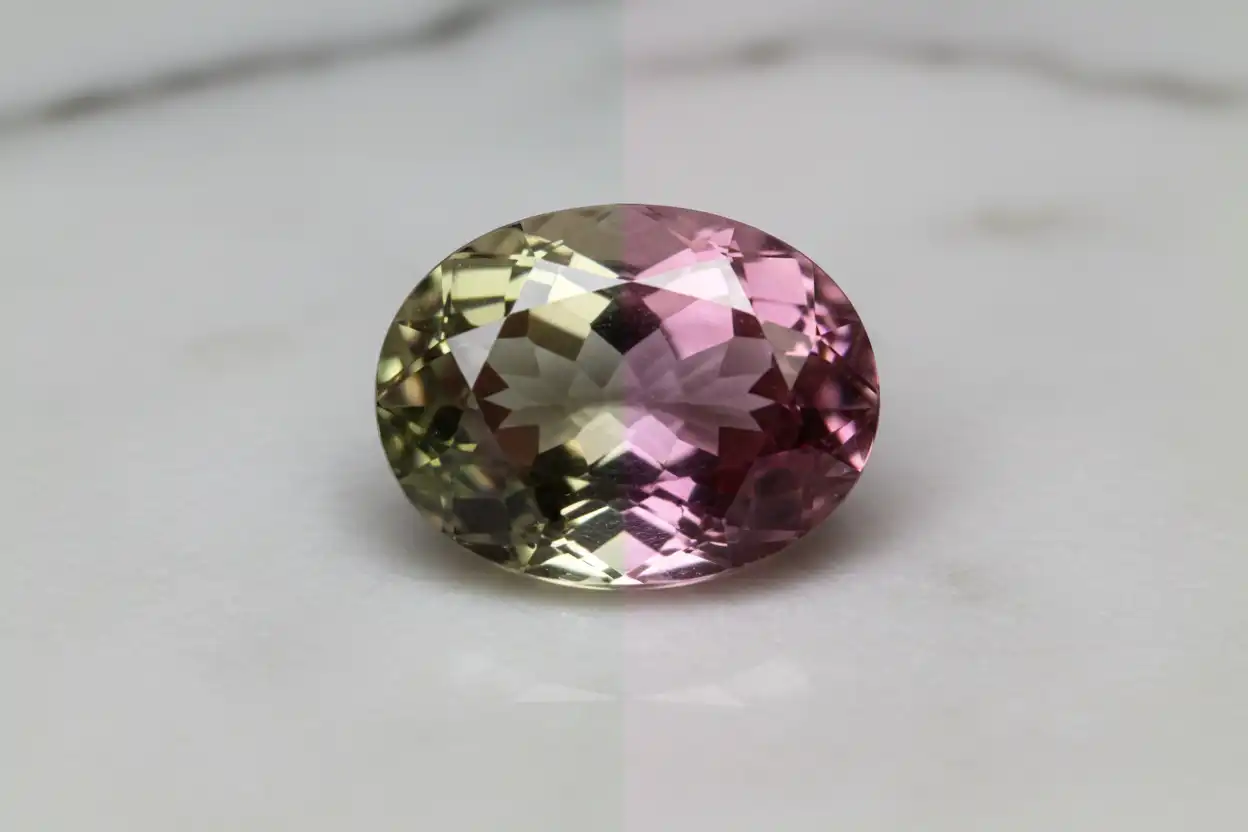
Diaspore Meaning: Mineral Facts, Color Change & Symbolism
Diaspore meaning is easiest to understand when the mineral’s unusual optical behavior is separated from the mythology that has accumulated around gem-quality color-change material. Diaspore is an aluminum oxide hydroxide mineral with the idealized formula AlO(OH). It crystallizes in the orthorhombic system, commonly occurs in aluminum-rich geological environments, and may appear colorless, white, gray, yellowish, brown, greenish, pinkish, or other subdued shades. Fine transparent crystals can be faceted, while exceptional gem material is particularly known for pleochroism and a lighting-dependent color shift that may move between greenish or yellowish tones and warmer pink, brownish, champagne, or raspberry-like colors.
That natural color behavior gives diaspore meaning a visual foundation that is already more distinctive than generic crystal symbolism. A stone can genuinely look different under different illumination because the spectrum of the light source interacts with the mineral’s selective absorption and directional optical properties. That does not mean the gemstone changes emotional energy, adapts itself to the wearer’s mood, or physically transforms from one mineral into another. The observable phenomenon belongs to optics; meanings such as adaptability, perspective, balance, transformation, clarity, or resilience are later human interpretations.
Within Gems Lore’s Gemstone Guides collection, this page owns that foundational distinction. Questions about market selection, valuation, detailed microscopy, advanced optical measurements, cutting, setting engineering, specimen conservation, and provenance remain separate so the central diaspore meaning stays focused on material identity, formation, color, diagnostic characteristics, documented history, symbolism, and safe ownership.
Diaspore at a Glance
| Property | Practical reference |
|---|---|
| Material identity | Aluminum oxide hydroxide mineral |
| Idealized formula | AlO(OH) |
| Crystal system | Orthorhombic |
| Typical colors | Colorless, white, gray, yellow, brown, greenish, pinkish |
| Transparency | Transparent to translucent; opaque massive material also occurs |
| Luster | Vitreous, with pearly appearance possible on cleavage surfaces |
| Mohs hardness | Approximately 6.5–7 |
| Specific gravity | Roughly 3.3–3.5 |
| Cleavage | Distinct to perfect in important directions, making cutting and impact resistance more complicated than hardness alone suggests |
| Optical character | Biaxial with comparatively strong birefringence |
| Pleochroism | Can be strong in transparent colored material |
| Famous gem behavior | Lighting-dependent color change in some gem-quality stones |
| Major geological occurrence | Aluminum-rich metamorphic, hydrothermal, and bauxite-related environments |
| Common commercial names | Diaspore plus trade names used for certain Turkish gem material |
| Main naming caution | Commercial names do not create separate mineral species |
| Symbolic associations | Adaptability, perspective, balance, transformation, clarity |
| Evidence boundary | Symbolism is personal or cultural interpretation, not a scientifically demonstrated healing mechanism |
The combination of hardness and cleavage deserves special attention. Diaspore can resist ordinary surface scratching reasonably well, yet a stone with strong cleavage can still split or chip from an unfavorable impact. This is one reason hardness alone should never be used to decide whether a gem is indestructible or suitable for every style of jewelry.
What Diaspore Actually Is
Diaspore is a mineral species composed principally of aluminum, oxygen, and hydroxyl within an orthorhombic crystal structure. It belongs to a group of aluminum-rich minerals that can occur during the geological alteration, metamorphism, or concentration of aluminous material.
Its formula may look simple, but natural specimens can contain trace elements, inclusions, structural defects, strain, and growth variations that influence color and optical behavior. Gem-quality diaspore therefore should not be imagined as chemically perfect AlO(OH) with no variation whatsoever.
Diaspore is also distinct from corundum, despite both being aluminum-rich. Corundum is Al₂O₃ and has a different crystal structure and physical behavior. Diaspore includes hydroxyl in its structure and responds differently to heat, cleavage, and other conditions.
This material-first definition is central to diaspore meaning because commercial narratives can become confusing when a color-changing gemstone is discussed primarily through brand names rather than mineral identity.
Diaspore, Zultanite, and Csarite
Gem-quality color-change diaspore from Turkey has been marketed under commercial names including Zultanite and Csarite. Those names may be useful within particular retail histories or branding systems, but they do not represent separate mineral species.
The underlying gemstone remains diaspore when its chemistry and structure meet the mineral definition.
This distinction matters because sellers sometimes present a commercial name as though it guarantees superior composition, origin, rarity, or optical performance. A branded or trade-named stone may indeed come with specific marketing or sourcing claims, but those claims should be evaluated separately from basic mineral identification.
Likewise, an authentic transparent color-change diaspore does not become fake simply because it is sold under the mineral name rather than a commercial label.
A useful hierarchy is:
Diaspore describes the mineral species.
Color-change diaspore describes an observable gemological behavior.
Zultanite or Csarite may function as commercial or trade terminology in particular market contexts.
A specific mine or geographic origin is a provenance claim requiring its own evidence.
Keeping these layers separate prevents a name from doing more evidentiary work than it should.
How Diaspore Forms
Diaspore commonly forms in aluminum-rich geological environments. It is associated particularly with bauxite and other strongly aluminous rocks, where chemical weathering, fluid alteration, metamorphism, or later recrystallization can concentrate aluminum-bearing phases.
Bauxite is not one mineral but a rock or ore composed of several aluminum-rich minerals and associated components. Diaspore can occur alongside other aluminum hydroxide or oxide minerals, iron-bearing phases, clay minerals, and related alteration products depending on the deposit.
In metamorphosed or hydrothermally altered aluminum-rich rocks, changing temperature, pressure, fluid chemistry, and water activity can promote formation or recrystallization of diaspore. Certain geological settings allow larger, more transparent crystals to develop, while ordinary ore-related material may be massive, granular, compact, or unsuitable for gem cutting.
The more detailed geological relationships belong in diaspore formation and deposit geology. For diaspore meaning, the important point is that gem transparency represents an unusually favorable expression of a mineral that also occurs in far less visually dramatic forms.
Why Gem-Quality Diaspore Can Change Color
The famous color shift is one of the most important factual parts of diaspore meaning. Some transparent diaspore absorbs different parts of visible light strongly enough that its apparent color changes when the spectral composition of the illumination changes.
Daylight-rich illumination may make a suitable stone appear greenish, olive, yellow-green, or somewhat straw-colored. Warmer illumination can push the appearance toward champagne, peach, pinkish brown, reddish brown, or raspberry-like tones.
The exact result varies from stone to stone.
Several variables contribute, including trace-element chemistry, crystal orientation, pleochroism, stone thickness, saturation, cut, and the spectrum of the light source. A gemstone may show a dramatic change between two carefully selected lamps yet appear subtler in ordinary mixed lighting.
That does not make the change artificial. It demonstrates why standardized observation matters.
The detailed optical mechanisms belong in diaspore optical properties and color behavior, where pleochroism, birefringence, lighting spectra, orientation, and apparent color can be treated without turning this article into a laboratory optics manual.
Color Change and Pleochroism Are Not the Same Thing
These two effects are often merged in commercial descriptions, but they answer different questions.
Color change refers to a gemstone appearing different under different illumination sources.
Pleochroism refers to different colors or color strengths observed along different crystallographic directions in an anisotropic material.
Diaspore can exhibit both.
A cutter may orient rough so that the finished gem presents attractive combinations of directional color and lighting response. Turning the stone while keeping the lamp constant can therefore alter the observed color because of pleochroism, while changing the lamp without changing the stone’s orientation can alter it through color-change behavior.
A seller who photographs one orientation under daylight and another orientation under warm light can unintentionally—or deliberately—combine both effects and make the transformation look stronger than a simple lighting comparison would show.
This is why a careful evaluation protocol is valuable.
An Original Diaspore Color-Change Photo Checklist
A useful diaspore photo set should begin with one fixed stone position. Place the gem on a neutral gray or white surface and mark its orientation so it is not rotated between photographs.
Photograph it first under diffuse daylight-balanced illumination. Avoid increasing saturation or selectively shifting green tones during editing. The image should show the actual face-up body color rather than a dramatic interpretation.
Without moving the gemstone, replace the light with a warm incandescent-style source. Keep camera position, exposure logic, background, and viewing angle as consistent as practical.
Then photograph the stone at several orientations under one fixed light source. This second set helps reveal pleochroism independently from the lamp-induced color shift.
Add one image against a dark neutral background and one against a pale neutral background. Background color can change perceived saturation, particularly in relatively light stones.
Record whether the color transformation remains visible to the unaided eye or is strongest only through the camera. Cameras, automatic white balance, image-processing software, and screens can exaggerate or suppress subtle color shifts.
Finally, describe what happened rather than assigning a dramatic grade without a defined method. “Olive-green in daylight-balanced light and pinkish champagne under warm illumination” is more useful than “extreme five-color transformation.”
This checklist produces original information gain because it distinguishes three variables that commercial photography often mixes together: lamp spectrum, viewing orientation, and image processing.
Why Some Diaspore Looks Green, Yellow, Pink, or Brown
Not every diaspore displays a dramatic color change. Many specimens are colorless, pale, brownish, yellowish, grayish, or only mildly green.
Natural color depends on trace-element chemistry, structural defects, inclusions, oxidation state, orientation, and light interaction. Some stones simply lack the combination necessary for a strong commercial color-change effect.
That means “diaspore” and “color-change diaspore” should not be treated as exact synonyms.
A pale brown crystal can be genuine diaspore. A nearly colorless transparent crystal can be genuine diaspore. A strongly color-changing green-to-pink gemstone can also be genuine diaspore.
Material identity is established by mineralogical properties rather than by whether the specimen performs the most famous visual effect associated with the gem market.
Strong Pleochroism Can Complicate Color Description
Because diaspore is anisotropic, color can depend strongly on crystallographic direction. One orientation may show more greenish or yellowish character while another presents warmer or browner tones.
In rough crystals, this directional behavior may be especially obvious when the specimen is rotated in front of a light source.
Faceting introduces another layer because multiple facets send light through the stone along different paths. The face-up appearance is therefore an integrated optical result rather than one simple crystal-axis color.
This is why a single photograph cannot completely describe a good color-change diaspore.
For readers comparing listings, video under controlled lighting can be much more informative than one highly saturated product image.
Diagnostic Traits That Matter
Diaspore identification should combine several independent properties rather than rely on color change alone. Its orthorhombic crystal structure, refractive behavior, birefringence, density, hardness, cleavage, pleochroism, inclusions, and spectroscopy can collectively support identification.
A color-changing gemstone is not automatically diaspore.
Other gem materials can show lighting-dependent color differences, pleochroism, or both. Likewise, ordinary pale green stones can resemble diaspore without sharing its composition.
Hardness around 6.5–7 can help narrow possibilities, but deliberate scratch testing is inappropriate for fine faceted material.
Density may be useful on loose stones when measured accurately. Optical testing can be especially valuable because diaspore occupies characteristic refractive ranges and behaves as a doubly refractive gem.
For high-value stones, professional testing is preferable to improvised home identification.
What Magnification Can Reveal
Diaspore may contain crystals, needles, fluid-related inclusions, fractures, cleavage-related features, growth structures, clouds, or other internal characteristics depending on origin and specimen.
Magnification can also reveal abrasion, chips, polish marks, repaired damage, surface-reaching fractures, residue, or structural features that influence durability.
The dedicated diaspore microscope and inclusion notebook handles those observations in detail.
A microscope cannot automatically establish every disputed commercial claim. An internal crystal that appears consistent with a known inclusion species may still require analytical confirmation. Likewise, seeing natural-looking inclusions does not prove a precise mine locality.
Species identification, treatment assessment, and geographic provenance remain separate conclusions.
A Source-Comparison Table for Common Diaspore Claims
| Common claim | What can reasonably be retained | What needs correction or stronger evidence |
|---|---|---|
| “Diaspore is AlO(OH).” | This is the idealized mineral formula | Natural specimens can contain trace elements and inclusions |
| “Every diaspore changes color dramatically.” | Some gem-quality material shows strong color change | Many specimens show weak change or none that is visually dramatic |
| “Zultanite is a different mineral from diaspore.” | Zultanite has been used commercially for gem material | It does not represent a separate mineral species |
| “Csarite is a different species.” | Csarite is used as commercial terminology | The underlying gemstone is still diaspore when properly identified |
| “Color change proves Turkish origin.” | Famous gem-quality material is associated with Turkey | Optical behavior alone cannot prove geographic origin |
| “Green-to-pink change happens because the stone senses light energy.” | Light source changes perceived color | The phenomenon is explained through selective absorption and optics |
| “Pleochroism and color change are the same.” | Both can alter observed color | Pleochroism depends on viewing direction; color change depends on illumination spectrum |
| “Diaspore is as durable as diamond because hardness is near 7.” | Diaspore has useful surface hardness | Strong cleavage creates different impact risks |
| “Diaspore contains healing aluminum.” | Aluminum is essential to its chemistry | Mineral composition does not establish a therapeutic effect |
| “Diaspore physically improves adaptability.” | Adaptability is a coherent modern symbolic theme | No established evidence shows the mineral changes personality or cognition |
| “A trade name guarantees premium quality.” | Branding may represent a selected commercial product | Quality still needs to be evaluated stone by stone |
| “A vivid photograph proves exceptional color change.” | Photography can document change | White balance, lighting, orientation, and editing can distort the effect |
This table highlights the main evidence boundary in diaspore meaning: the gemstone really can change appearance dramatically, but a real optical phenomenon should not be used to validate unrelated claims about origin, healing, emotion, or spiritual transformation.
Diaspore Versus Diopside
Diopside provides a useful comparison because green gem material from both minerals can appear attractive and transparent while being chemically unrelated.
Diopside is a calcium-magnesium pyroxene with a monoclinic crystal structure. Diaspore is an aluminum oxide hydroxide with an orthorhombic structure.
Their refractive properties, cleavage, density, geological environments, and color mechanisms differ.
The comparison becomes particularly useful when a buyer encounters a green faceted stone without a report. Color alone cannot determine whether the material is diaspore, diopside, garnet, tourmaline, glass, or another gem.
Correct identification comes before symbolic interpretation.
Diaspore Versus Diamond
Diamond sits at a very different end of gem durability and crystal chemistry. Diamond is crystalline carbon with Mohs hardness 10, while diaspore is AlO(OH) with substantially lower hardness and much more important cleavage considerations.
Both may display striking optical effects after faceting, but the causes differ.
Diamond’s visual character depends strongly on high refractive index and dispersion. Diaspore is especially notable for pleochroism and lighting-dependent color change in suitable material.
A bright faceted appearance therefore does not imply similar structure or durability.
This distinction matters particularly in jewelry, where consumers sometimes infer toughness from brilliance.
Cutting Diaspore Requires Respect for Cleavage
Diaspore’s cleavage creates a significant challenge for cutters. Rough orientation must account not only for color and yield but also for directions along which the material may split.
Strong pleochroism and color-change behavior add another layer because the cutter may need to orient the stone so desirable colors appear face-up rather than along a less visible direction.
Those competing objectives can make high-quality cutting difficult: preserve carat weight, avoid problematic cleavage, maximize visual size, position color well, and polish a stone capable of showing its distinctive optical behavior.
The specialist diaspore cutting, orientation, and polish page owns the technical process. For diaspore meaning, the important point is that the gemstone’s final appearance reflects both natural optical properties and deliberate human orientation.
Jewelry Suitability
Diaspore can be used successfully in jewelry, but it should not be treated as though hardness alone makes it suitable for every design.
Pendants and earrings usually face less impact than rings. A ring can expose the stone to accidental strikes against counters, doors, tools, or hard surfaces, while cleavage can make an unfortunate impact more consequential.
Setting design matters accordingly.
The diaspore setting and wear engineering guide addresses protection, prong placement, edge exposure, stone height, and other mechanical considerations without turning the meaning page into a construction manual.
The symbolism of adaptability does not make the physical stone more adaptable to impact.
Safe Ownership
Ordinary handling of an intact diaspore specimen or finished gemstone does not require unusual alarmist precautions. The primary everyday concerns are mechanical damage, jewelry condition, and avoiding inappropriate cleaning or heating.
Heat deserves particular caution because diaspore contains hydroxyl structurally and has historically been associated with decrepitation behavior when strongly heated. Heating should therefore not be used casually as a home identification test.
Cutting, grinding, drilling, or sanding creates a different exposure environment because mineral dust can be generated. Appropriate wet lapidary methods, ventilation, extraction, eye protection, and respiratory controls are preferable to uncontrolled dry grinding.
Direct-contact drinking-water elixirs are unnecessary. A natural specimen can contain inclusions, associated minerals, polishing compounds, residues, adhesives, or treatments that are not represented by the simplified AlO(OH) formula.
The site’s Disclaimer provides the broader boundary between general mineral information and individualized medical, toxicological, or occupational-safety guidance.
Aluminum Chemistry Is Not Medicine
Diaspore contains aluminum as a major structural component, but elemental presence does not imply medical usefulness or predictable biological exposure.
Aluminum locked within a mineral lattice is chemically different from soluble compounds, pharmaceuticals, industrial materials, or dietary exposures involving other forms.
The same reasoning applies to oxygen and hydrogen in the hydroxyl component. Familiar elements do not convert a stone into a therapeutic substance.
Diaspore meaning can therefore discuss clarity, balance, or transformation as symbolic themes without using chemistry to imply treatment for neurological, emotional, hormonal, skeletal, or other medical conditions.
Documented History Behind the Name
The name diaspore derives from a Greek root associated with scattering or dispersion. The historical naming is connected with the mineral’s tendency to break apart or decrepitate under strong heating.
That origin is geological and descriptive rather than metaphysical.
The mineral became important scientifically because of its relationship to aluminum-rich rocks and ores, while transparent gem-quality material later introduced a very different commercial identity centered on optical beauty.
This two-part history matters. Diaspore existed as a mineralogical subject before it became widely recognized by jewelry consumers as a color-changing gemstone.
Modern trade names, luxury positioning, and metaphysical symbolism therefore belong to later commercial and cultural layers rather than to the definition of the mineral itself.
Turkish Gem Diaspore and Provenance
Fine transparent color-change diaspore is strongly associated with deposits in southwestern Turkey, which has made Turkish origin commercially significant.
That association does not mean every color-changing stone can be assigned to Turkey visually.
Provenance requires documentation.
A gemstone may show colors strongly associated with well-known Turkish material while lacking any surviving evidence of mine or district origin. Once rough has been faceted, matrix and geological context disappear, making documentary chain of custody even more important.
The diaspore provenance disclosure checklist provides a stronger framework for separating documented locality from seller inference.
Color change can support recognition of a gem type. It is not a passport.
Buying and Price Are Separate From Meaning
Because high-quality color-change diaspore can be scarce and heavily marketed, buying questions can quickly dominate an educational page. They deserve their own treatment.
The buy diaspore guide focuses on seller disclosure, reports, photography, trade names, return conditions, and purchase comparison.
Likewise, diaspore price owns the valuation factors that determine why one stone costs substantially more than another.
Those factors can include size, strength and attractiveness of color change, face-up color, transparency, cut, inclusions, origin documentation, commercial branding, and retail channel.
None of those price variables makes one stone spiritually stronger.
Market value and symbolic meaning should remain independent.
Conservation of Natural Diaspore Specimens
Transparent crystals can be tempting candidates for cleaning, polishing, or faceting, yet an intact natural specimen may preserve information that cutting would remove permanently.
Crystal faces, growth features, matrix contacts, associated minerals, fractures, labels, and provenance can all contribute to collector or scientific significance.
A damaged crystal does not always need to be repaired, and a dull natural surface does not necessarily need to be polished.
The diaspore specimen conservation record is useful when an important specimen has repairs, detached fragments, historical labels, changing fractures, or cleaning history worth tracking.
Preservation should protect evidence, not merely maximize shine.
Diaspore Meaning in Modern Symbolism
Modern diaspore meaning commonly includes adaptability, perspective, transition, clarity, balance, resilience, and the ability to see one situation differently under changing conditions.
The color-change phenomenon makes these associations especially intuitive.
A gemstone that appears greenish in one light and warmer pinkish or champagne in another can become a powerful metaphor for context. The underlying object remains the same even when its appearance shifts substantially.
That can symbolize the idea that a problem may look different when circumstances change, that several interpretations can coexist, or that adapting perspective does not require abandoning identity.
Those themes work precisely because the mineral has a real optical behavior that inspires metaphor.
They should not be converted into claims that diaspore scientifically increases adaptability, alters personality, improves decision-making, or changes emotional regulation through contact with the skin.
Perspective May Be the Most Natural Symbol
Among the symbolic interpretations attached to diaspore, perspective is unusually well matched to the material.
Turn a pleochroic crystal and its color changes because the viewing direction changes. Change the illumination and the stone may appear different again.
The mineral does not need to change composition for the observer’s experience to change.
A person can use that fact as a deliberate reflective prompt: “What changes if I examine this problem from another direction?” or “Am I reacting to the situation itself, or to the conditions under which I am viewing it?”
That is a meaningful use of diaspore meaning without pretending the gemstone supplies an answer.
Adaptability Without Magical Transformation
Transformation is another recurring theme because the color shift can appear dramatic.
Scientifically, however, the stone is not transforming into a different substance. The crystal remains diaspore while illumination and optical interaction change the color perceived by the observer.
That creates a more precise metaphor for adaptability.
Adaptation does not always require becoming something entirely different. Sometimes the same underlying structure can respond differently to a changed environment.
This interpretation is more closely connected to what the gemstone actually does than claims that it physically removes negative energy or rewrites emotional patterns.
Balance and Two-Sided Interpretations
A color-change gem naturally invites paired symbolism: cool and warm, daylight and evening, logic and emotion, stability and change, observation and interpretation.
Those pairs can become useful themes in personal reflection.
Someone might use diaspore as a reminder to consider both immediate and long-term consequences before making a decision. Another person might associate the dual color appearance with balancing work and personal priorities.
No standardized spiritual system is required for those meanings.
Diaspore meaning can remain personal without being presented as a universal property shared identically by every wearer.
Chakra and Energy Claims
Modern crystal traditions may assign color-change diaspore to different chakras depending on which color is emphasized. Greenish appearances can invite heart-related symbolism, while warmer pink, gold, or champagne tones may be mapped differently by various practitioners.
These classifications are not mineralogical standards.
The same stone does not change its anatomy because one author associates it with the heart chakra and another with a different spiritual center.
No validated medical or gemological test demonstrates that diaspore opens, balances, activates, or cleanses chakras.
The physical color shift is real. Chakra interpretation is a belief-based layer added afterward.
Claims the Stone Does Not Need
Diaspore meaning does not become more valuable by claiming the gemstone treats depression, repairs memory, balances hormones, cures stress disorders, detoxifies the body, improves fertility, reverses aging, or protects against electromagnetic radiation.
None of those medical-style claims follows from the mineral’s composition or color-change behavior.
It also does not need an invented ancient civilization narrative.
Diaspore’s documented mineralogical identity, unusual pleochroism, color-change behavior, geological setting, and modern commercial history already provide enough substance for a distinctive reference page.
The strongest symbolism grows from those facts rather than replacing them.
How to Evaluate a Diaspore Claim
A useful way to assess diaspore meaning is to ask what kind of evidence each claim would require.
“AlO(OH)” is a mineralogical statement.
“Strongly pleochroic” is an optical statement.
“Changes from olive green to warm pinkish tones under different illumination” is an observable gemological statement.
“From a specific Turkish deposit” is a provenance statement.
“Symbolizes adaptability” is a cultural or personal interpretation.
“Treats anxiety” is a medical-style claim requiring medical evidence.
The evidence framework described on Gems Lore’s About page is especially useful for a gemstone whose genuine optical behavior can make unrelated metaphysical explanations sound more scientific than they are.
Real color change deserves accurate gemology rather than exaggerated claims.
Frequently Asked Questions About Diaspore Meaning
What is diaspore?
Diaspore is an aluminum oxide hydroxide mineral with the idealized formula AlO(OH). It crystallizes in the orthorhombic system and can occur in transparent gem-quality crystals as well as massive or non-gem material.
What does diaspore meaning symbolize?
Modern diaspore meaning commonly includes adaptability, perspective, transformation, balance, clarity, and resilience. These are symbolic interpretations inspired partly by the gemstone’s color-changing appearance.
Does diaspore really change color?
Some gem-quality diaspore shows genuine lighting-dependent color change. Its appearance may shift from greenish or yellowish tones in daylight-like illumination toward champagne, pinkish, brownish, or raspberry-like colors under warmer light.
Is diaspore the same as Zultanite?
Zultanite has been used as a commercial name for gem-quality color-change diaspore. It does not represent a separate mineral species.
Is Csarite the same mineral as diaspore?
Csarite is commercial terminology associated with certain gem-quality material. Properly identified stones remain the mineral diaspore.
Does every diaspore change color?
No. Diaspore occurs in many forms and colors, and not every specimen shows a dramatic lighting-dependent change.
Is pleochroism the same as color change?
No. Pleochroism involves color differences seen along different crystallographic viewing directions. Color change involves different appearance under different light sources. Diaspore can show both.
What color is natural diaspore?
Natural diaspore can be colorless, white, gray, yellowish, brownish, greenish, pinkish, or related subdued shades depending on composition and optical conditions.
How hard is diaspore?
Diaspore is approximately 6.5–7 on the Mohs scale, giving it useful scratch resistance. Strong cleavage still makes impact protection important.
Is diaspore durable enough for jewelry?
Yes, transparent material can be used in jewelry, but cleavage and impact vulnerability mean setting and wear conditions should be considered carefully.
Does color change prove Turkish origin?
No. Strong color change may be characteristic of well-known Turkish gem material, but optical appearance alone does not prove geographic provenance.
How can I photograph diaspore color change accurately?
Keep the gemstone and camera position fixed, use neutral backgrounds, photograph under clearly different light sources, avoid aggressive white-balance correction, and distinguish lighting-induced change from rotation-induced pleochroism.
Does diaspore have scientifically proven healing properties?
No established scientific evidence shows that diaspore treats medical or psychological conditions, changes hormones, improves cognition, or produces therapeutic effects through ordinary handling.
Can diaspore go in water?
Brief contact with clean water may not automatically damage every intact diaspore, but prolonged soaking is unnecessary. Jewelry settings, treatments, fractures, residues, and associated minerals can create additional care considerations.
Why is diaspore difficult to cut?
Its cleavage, directional optical properties, and need to balance color, yield, and durability make orientation more demanding than simply shaping a transparent piece of rough.
Diaspore Meaning Is Really About Context
The most distinctive diaspore meaning emerges from something the gemstone physically demonstrates: context changes appearance. The mineral can remain structurally the same while daylight, warm illumination, crystal orientation, and viewing conditions alter what the observer sees.
That makes diaspore unusually suitable as a symbol of perspective and adaptability without requiring any supernatural mechanism. Its color change is not evidence that the gemstone senses emotion; it is evidence that light and matter interact in complex ways. Its pleochroism is not proof of multiple personalities inside the crystal; it demonstrates that an anisotropic structure can present different optical responses along different directions.
The same discipline should be applied to its commercial story. Diaspore is the mineral. Zultanite and Csarite are commercial naming layers. Turkish origin is a provenance question. Color-change quality is an optical question. Price is a market question. Symbolism is a human question.
Keeping those layers distinct produces a more useful interpretation than blending them into one marketing narrative.
If a particular specimen presents an unusual issue—such as a claimed trade name with uncertain mineral identity, a dramatic photographic color shift that cannot be reproduced, or contradictory locality documentation—the relevant photographs, reports, and labels can be submitted through Contact so the specific evidence can be evaluated rather than generalized from branding or appearance.