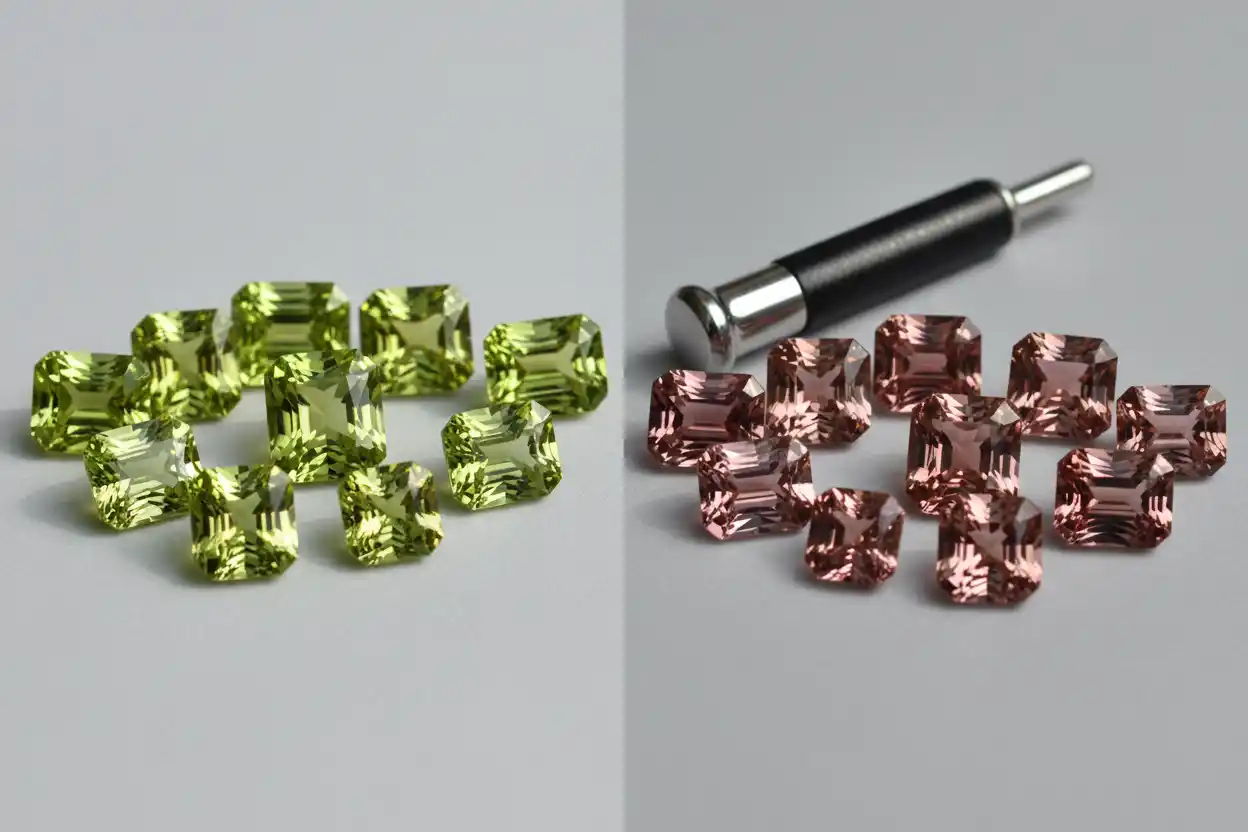
Buy Diaspore: Buyer Essentials, Provenance, Treatments & Returns
To buy diaspore responsibly, begin with identity, color-change performance, pleochroism, cut orientation, durability, provenance, treatment disclosure, documentation, and return rights rather than relying on the trade name printed in the listing. Diaspore is the mineral α-AlO(OH), an aluminum oxyhydroxide that crystallizes in the orthorhombic system. Gem-quality material can show strong pleochroism and, in notable examples, a distinct color change between daylight-equivalent and incandescent illumination. GIA research on color-change diaspore links the phenomenon to trace-element chromophores and describes the material as valued for rarity, pronounced pleochroism, and color change.
The best-known commercial color-change material has strong associations with Turkey, but buyers should not turn that history into a simplistic identity test. GIA has studied Turkish color-change diaspore extensively and has also analyzed diaspore from Myanmar in scientific color-origin research. Trade names such as Zultanite and Csarite refer to color-change diaspore in the marketplace rather than defining a separate mineral species; GIA itself notes that such trade names are used for color-change diaspore.
Buy Diaspore At a Glance
| Buying Factor | What to Check | Why It Matters |
|---|---|---|
| Identity | Genuine diaspore rather than glass or another color-change material | Look-alikes can imitate the color-change effect |
| Color Change | Daylight-equivalent color versus incandescent/warm-light color | Strength and attractiveness of the change are major value factors |
| Pleochroism | Different colors seen along different crystal directions | Diaspore can display strong trichroism |
| Cut Orientation | Whether the cutter captured the most attractive color behavior | Orientation strongly affects color and color change |
| Color Quality | Hue, saturation, brightness, brown component | Attractive balanced color is more desirable than dull or muddy appearance |
| Clarity | Inclusions, fissures, transparency | Clean transparent gems are desirable, but durability must also be considered |
| Carat Weight | Weight together with dimensions | Size matters, but cutting and cleavage can make yield difficult |
| Cleavage | Perfect cleavage direction and existing fractures | Diaspore is brittle and vulnerable to splitting from impact |
| Treatment | Seller disclosure and laboratory findings | Treatment status should be established rather than assumed |
| Trade Name | Diaspore versus Zultanite/Csarite marketing | Trade names do not create a different mineral species |
| Provenance | Turkish or other locality claim and supporting evidence | Seller origin claims should be separated from laboratory-supported facts |
| Return Terms | Inspection period under multiple lighting environments | Color-change appearance is difficult to judge from still photography alone |
Diaspore Is Its Own Mineral Species
Diaspore is an aluminum oxyhydroxide mineral rather than a variety of chrysoberyl, corundum, garnet, or another better-known color-change gemstone. GIA identifies its composition as α-AlO(OH) and records it as orthorhombic, with strong pleochroism and high birefringence.
This distinction matters because sellers sometimes lean heavily on comparisons with alexandrite. Color-change diaspore can indeed shift between greenish or yellowish tones in cooler light and pinkish, brownish, or reddish tones in warmer light, but it does so through a different mineral structure and optical system. The Gems Lore guide on how to buy alexandrite is useful for comparison because both gems can show dramatic changes under different illumination, yet they should never be treated as interchangeable species.
Buyers should also distinguish diaspore from andalusite, another strongly pleochroic gem whose apparent color can vary with viewing direction. Gems Lore’s buy andalusite guide and andalusite price guide provide useful context for understanding why crystal orientation and directional color matter in gem cutting.
Color Change Is a Major Quality Factor
GIA has documented Turkish diaspore changing from brownish green or yellowish green under daylight-equivalent or fluorescent illumination to brownish pink or pinkish brown under incandescent light. The magnitude and attractiveness of this change can strongly influence desirability.
Do not judge color change from two seller photographs alone. Camera white balance, exposure, background, bulb spectrum, and image processing can exaggerate the difference between frames. Request continuous video showing the same stone moving between clearly identified light sources whenever the purchase is significant.
A strong change should remain visually convincing in real-world conditions rather than appearing only under laboratory-like extremes. One buyer may prefer a dramatic green-to-pink shift, while another may value brighter overall color even if the change is somewhat less pronounced.
Pleochroism and Color Change Are Different Phenomena
Diaspore can display strong trichroism, meaning it shows different bodycolors when viewed along different crystallographic directions. GIA documented yellowish green, purple, and brown directional colors in a color-change cat’s-eye diaspore. Color change, by contrast, refers to the gemstone showing a different dominant appearance when the spectral composition of the illumination changes.
Both effects can operate at the same time. This makes diaspore unusually sensitive to cutting orientation because the cutter must decide which directional colors will dominate face-up and how those choices interact with daylight and incandescent light.
A listing that says “three colors” should therefore clarify whether the seller means pleochroism, color change, viewing-angle shifts, or all of these together.
Cut Orientation Can Make or Break an Excellent Piece of Rough
Diaspore’s strong pleochroism means that orientation influences which colors emerge through the finished stone. GIA’s color-origin research specifically controlled crystal orientation because the optical response changes strongly with direction. A cutter who ignores orientation may produce a larger stone whose face-up colors are duller or browner than a smaller stone cut more thoughtfully.
This is one reason carat weight should not dominate a diaspore buying decision. Preserving every possible gram of rough can sacrifice the color-change presentation or leave an unattractive directional color facing the viewer.
Look for balanced brightness, a deliberate facet pattern, limited windowing, attractive color in both cool and warm light, and a shape that does not appear distorted merely to retain weight.
Diaspore Can Be Large, but Fine Faceted Material Is Still Specialized
Historical GIA reports documented Turkish color-change diaspore in faceted sizes ranging from a few carats to stones exceeding twenty carats, and later GIA laboratory notes described a 60.71-carat chatoyant cabochon. Large size therefore should not automatically be interpreted as impossible or fraudulent.
However, fine transparent faceting rough with strong color change, attractive orientation, limited fracturing, and good cutting remains a specialized product. Perfect cleavage and brittleness complicate both cutting and setting, so finished yield can matter as much as rough crystal size.
A huge stone with weak color change or compromised cut can be less desirable than a smaller gem displaying a stronger and more balanced optical effect.
Diaspore Is Harder Than Its Toughness Suggests
GIA records diaspore at approximately 6½ to 7 on the Mohs hardness scale, but hardness alone does not describe its durability. The same GIA material records perfect cleavage in one direction, and modern laboratory reporting describes diaspore as very brittle with perfect cleavage.
This distinction between hardness and toughness is essential. A gemstone can resist moderate scratching while still splitting along a cleavage plane if struck or pressured in an unfavorable direction. Diaspore therefore requires more thoughtful handling than a buyer might assume from the Mohs number alone.
Protective settings are especially sensible for rings. Pendants and earrings generally experience fewer sharp blows, while exposed corners or thin girdles can increase risk in everyday hand jewelry.
Cleavage Should Influence Both Cut and Setting Choice
Perfect cleavage creates risk during faceting, polishing, mounting, repair, and daily wear. Pressure from a prong being tightened incorrectly can potentially damage a vulnerable stone, and a hard blow in the wrong direction may cause a split rather than a simple surface scratch.
When buying a mounted diaspore, examine the girdle near prongs for small chips or fractures. Request magnified images when the stone is expensive, and ask whether the setting work was performed by a jeweler experienced with cleavage-sensitive gems.
A durable-looking heavy bezel can be protective after proper setting, but the installation process itself requires skill. More metal is not automatically safer if the stone was subjected to excessive pressure.
Clarity Should Be Judged Alongside Structural Integrity
Transparent diaspore can be impressively clean, and older GIA reports describe faceted Turkish stones showing attractive transparency. A clean-looking stone can command stronger demand, particularly when color change and cutting are also fine.
Not every internal feature is merely cosmetic, however. Fissures that follow cleavage or reach the surface may affect durability. GIA’s cat’s-eye diaspore study documented fissures associated with repeated cleavage while noting that no clarity enhancement was detected in that particular stone.
The absence of enhancement in one examined specimen should not be generalized into a claim that all diaspore is untreated. Buyers should ask about treatment explicitly and allow laboratory analysis to address detectable enhancement when the financial stakes justify it.
Cat’s-Eye Diaspore Is a Genuine but Specialized Phenomenon
GIA documented a 60.71-carat color-change cat’s-eye diaspore whose chatoyancy was caused by aligned needles, tubes, reflective films, and fissures associated with repeated cleavage. This shows that diaspore can combine color change with chatoyancy, creating an unusual collector gem.
A cat’s-eye premium should depend on the eye itself. A sharp, centered, mobile band that contrasts strongly against the body can be more desirable than a diffuse or incomplete line. The cabochon should also retain attractive color-change behavior if that is part of the seller’s value claim.
Do not assume that every silky or included diaspore can produce a fine eye. Correct inclusion orientation and cutting are essential.
Trade Names Such as Zultanite and Csarite Need Context
GIA notes that color-change diaspore is sometimes known in the trade as Zultanite or Csarite. These names can identify commercial branding or a particular market presentation, but the underlying gemological identity remains diaspore.
A branded name should not be treated automatically as a laboratory species, quality grade, or proof of mine origin. The invoice should still identify the material clearly enough for the buyer to understand what is being sold.
This is particularly important when one seller offers “diaspore” and another offers “Zultanite” at dramatically different prices. Determine whether the price difference comes from provenance, cut quality, color change, branding, documentation, or simple marketing rather than assuming the names describe different minerals.
Be Alert to Glass and Other Imitations
GIA publications have documented man-made glass presented as Zultanite-like color-change material. In one case, samples reportedly purchased as Turkish Zultanite showed color-change behavior but analytical testing established that they were man-made glass rather than natural diaspore.
This is a strong reminder that color change alone does not prove identity. Glass can be colored and formulated to behave differently under different light sources, while other natural or synthetic materials may also show apparent color shifts.
Avoid destructive home tests. A reputable colored-stone laboratory can identify material through refractive, spectroscopic, microscopic, and other analytical properties without intentionally damaging the gem.
Laboratory Identification Is Valuable for Significant Purchases
GIA’s Colored Stone Identification Report is available for polished loose or mounted material and can identify the gemstone, determine natural or synthetic status where applicable, describe detectable treatments, and record measurements, weight where possible, shape, cutting style, color, and a photograph.
Diaspore is not currently listed among the limited gemstone species eligible for GIA’s standard Colored Stone Identification & Origin Report. That means a normal identification report should not be represented as though it automatically proves Turkish geographic origin.
For a high-value diaspore sold with a strong locality premium, provenance may therefore rely on supplier documentation, mine-to-market records, specialist expertise, or other evidence rather than the standard GIA origin service.
Seller Origin Claim and Documented Provenance Are Different
Turkey has enormous importance in the modern color-change diaspore market, and GIA has documented Turkish material since the 1990s. Scientific research also examined Turkish material alongside Myanmar diaspore, showing that diaspore itself should not be treated as a one-country mineral.
A seller may have credible information that a stone came from a particular Turkish mining district, but buyers should ask how that information was established. An invoice, chain-of-custody record, mine documentation, and laboratory identity report each support different conclusions.
Origin can add collector appeal, but a famous locality should not compensate for weak color change, poor cutting, serious cleavage damage, or questionable identity.
Treatment Claims Should Be Precise
Diaspore does not have the same widely discussed routine treatment profile as gemstones such as sapphire or aquamarine, but that is not a reason to assume every stone is untreated. GIA colored-stone reports are specifically designed to list detectable treatments when applicable.
If the seller charges a substantial premium for “untreated,” ask whether that statement is based on laboratory testing, supplier disclosure, or assumption. A natural stone can still have undergone treatment, so “natural” and “untreated” should not be used interchangeably.
Likewise, absence of evidence for enhancement in one published specimen does not prove that treatment never occurs in the broader market.
Lighting Conditions Should Be Part of Your Return Inspection
Color-change gems are especially difficult to buy online because the defining quality depends on illumination. A seller can choose an LED spectrum that maximizes green and a warm lamp that maximizes pink, making the shift appear more dramatic than it does under the buyer’s normal home or office lighting.
A useful return period allows you to inspect the stone under daylight, daylight-equivalent lighting, warm incandescent-style light, and mixed indoor environments. Compare the color shift continuously rather than switching between separately edited seller photographs.
Return rights therefore have unusually high practical value when you buy diaspore. The stone may be genuine and accurately described yet still fail to show the particular color behavior you personally find attractive.
Do Not Confuse Color Change With Camera White Balance
Automatic phone cameras can modify white balance aggressively when moving between cool and warm light. That processing can make the gemstone appear to change more strongly than the human eye actually sees.
Ask for unedited video with the light sources shown where possible. A neutral white or gray reference object in the frame can also make it easier to judge whether the camera is changing its own color rendering.
The same caution applies when comparing diaspore with alexandrite. Gems Lore’s alexandrite price guide explains why the strength and quality of a color change should be judged as a real optical phenomenon rather than a marketing label.
Cutting Quality Deserves a Premium When It Preserves the Optical Effect
Diaspore is challenging to cut because the cutter must consider trichroism, color change, birefringence, cleavage, brittleness, shape of the rough, and weight retention simultaneously. Historical Gem-A reporting described faceted diaspore as difficult to cut, consistent with its perfect cleavage.
A well-cut gem should therefore be evaluated for more than symmetry. Determine whether the stone looks lively, whether the desired daylight and warm-light colors dominate face-up, whether windowing distracts from the center, and whether the facet design exposes vulnerable cleavage-related edges.
Custom cutting can add legitimate craftsmanship value, particularly when a cutter has sacrificed weight to improve orientation and color behavior.
Compare Diaspore With Diaspore Before Comparing Price
Color-change alexandrite, some garnets, sapphire, spinel, and other gems can show superficially similar illumination-dependent effects, but they belong to different mineral species and markets. GIA’s research notes that color-change phenomena occur across several gem families, including diaspore.
The Gems Lore buy alexandrite guide is therefore helpful as a buying-method comparison, while alexandrite price provides context for why an exceptional color-change effect can influence value differently in another mineral.
Within diaspore itself, compare stones of similar size, color-change strength, clarity, cutting, provenance, treatment disclosure, and condition before deciding whether one seller’s price is genuinely lower or higher.
Common Red Flags When You Buy Diaspore
Several signals deserve additional verification:
Zultanite or Csarite described as a mineral species separate from diaspore.
Turkish origin treated as proven solely because the stone changes color.
Dramatic before-and-after images with no continuous video.
No return period for a high-priced online color-change stone.
“AAA” or “investment grade” terminology without defined criteria.
Very large, flawless, strongly color-changing material offered at an implausibly low price without laboratory identification.
Visible chips or fissures near corners and prongs not mentioned in the listing.
“Untreated” represented as fact without explaining the basis.
A laboratory identification report misrepresented as a geographic-origin report.
Guaranteed appreciation claims based on rarity or a trade name.
Evidence should become stronger as the claim becomes more valuable.
How to Compare Diaspore Listings Fairly
A useful comparison should include:
Confirmed identity as diaspore.
Daylight-equivalent color.
Warm/incandescent color.
Strength and completeness of color change.
Pleochroism and face-up orientation.
Carat weight and millimeter dimensions.
Transparency and clarity.
Windowing, extinction, symmetry, and polish.
Cleavage-related fractures or chips.
Cat’s-eye effect if present.
Treatment disclosure.
Seller-stated origin and supporting provenance.
Laboratory identification.
Return and independent inspection terms.
Once those variables align reasonably well, the price difference becomes much easier to interpret.
Conclusion
To buy diaspore confidently, focus on the genuine optical and structural characteristics of the stone rather than the prestige of a trade name. Diaspore is an orthorhombic aluminum oxyhydroxide capable of strong trichroism and striking color change, with Turkish material playing an important role in the modern gem market. The gem is also brittle and has perfect cleavage, so durability and setting quality deserve far more attention than a simple Mohs-hardness number suggests.
A strong purchase combines convincing identity, attractive color under multiple light sources, thoughtful orientation, good transparency, careful cutting, sound condition, honest treatment disclosure, credible provenance, and meaningful return rights. Zultanite and Csarite are trade terms rather than separate mineral species, while a GIA identification report can verify material and detectable treatments but does not currently provide standard geographic-origin reporting for diaspore.
Frequently Asked Questions
What should I check first when I buy diaspore?
Confirm the material is actually diaspore, then evaluate its color change under clearly different light sources, pleochroism, cut orientation, clarity, fractures, carat weight, dimensions, treatment disclosure, provenance, and return terms. Identity should come before paying a premium for a trade name.
What colors can color-change diaspore show?
GIA has documented Turkish and other color-change diaspore showing yellowish green or brownish green under daylight-equivalent or fluorescent light and pinkish brown or related warm tones under incandescent illumination. Exact appearance depends on composition, orientation, lighting, and the individual stone.
Is Zultanite a different mineral from diaspore?
No. GIA uses Zultanite as a commercial name associated with color-change diaspore rather than as a separate mineral species. Csarite is another trade name used in the market.
Does every diaspore come from Turkey?
No. Turkey is extremely important to the modern color-change diaspore market, but GIA scientific research has examined diaspore samples from both Turkey and Myanmar. A seller’s specific Turkish-origin claim should be treated as provenance rather than assumed from mineral identity alone.
Is diaspore durable enough for a ring?
Diaspore has a Mohs hardness around 6½ to 7, but it is very brittle and has perfect cleavage in one direction. It can be used in rings with protective design and careful wear, but pendants and earrings generally expose it to fewer hard knocks.
Can diaspore show a cat’s-eye effect?
Yes. GIA has documented color-change cat’s-eye diaspore, including a 60.71-carat cabochon whose chatoyancy arose from aligned internal features. Cat’s-eye material belongs to a specialized collector category and should be judged by the sharpness, centering, and movement of the eye.
Can glass imitate color-change diaspore?
Yes. GIA has documented man-made glass sold or submitted as Zultanite-like color-change material. Color change alone is therefore not proof of identity.
Can GIA identify diaspore?
Yes. GIA’s Colored Stone Identification Report is available for polished loose or mounted material and can identify the gemstone and list detectable treatments.
Can a GIA report confirm Turkish origin for diaspore?
Not through GIA’s current standard Colored Stone Identification & Origin Report, because diaspore is not among the listed gemstones eligible for that geographic-origin service. Provenance claims should therefore be evaluated according to the documentation actually available.
Does untreated diaspore always cost more?
Not automatically. Treatment status can affect collector preference, but color-change quality, cutting, size, transparency, condition, provenance, and demand also matter. An untreated claim should be supported rather than assumed.
Is diaspore the same as alexandrite?
No. Both can show color change, but alexandrite is chromium-bearing chrysoberyl while diaspore is aluminum oxyhydroxide. Their structures, physical properties, durability, rarity, and markets are different.
Is diaspore a guaranteed investment?
No. Gem-quality color-change diaspore can be rare and collectible, but future value depends on demand, quality, provenance, condition, market liquidity, and transaction costs. Trade names and rarity claims cannot guarantee appreciation.