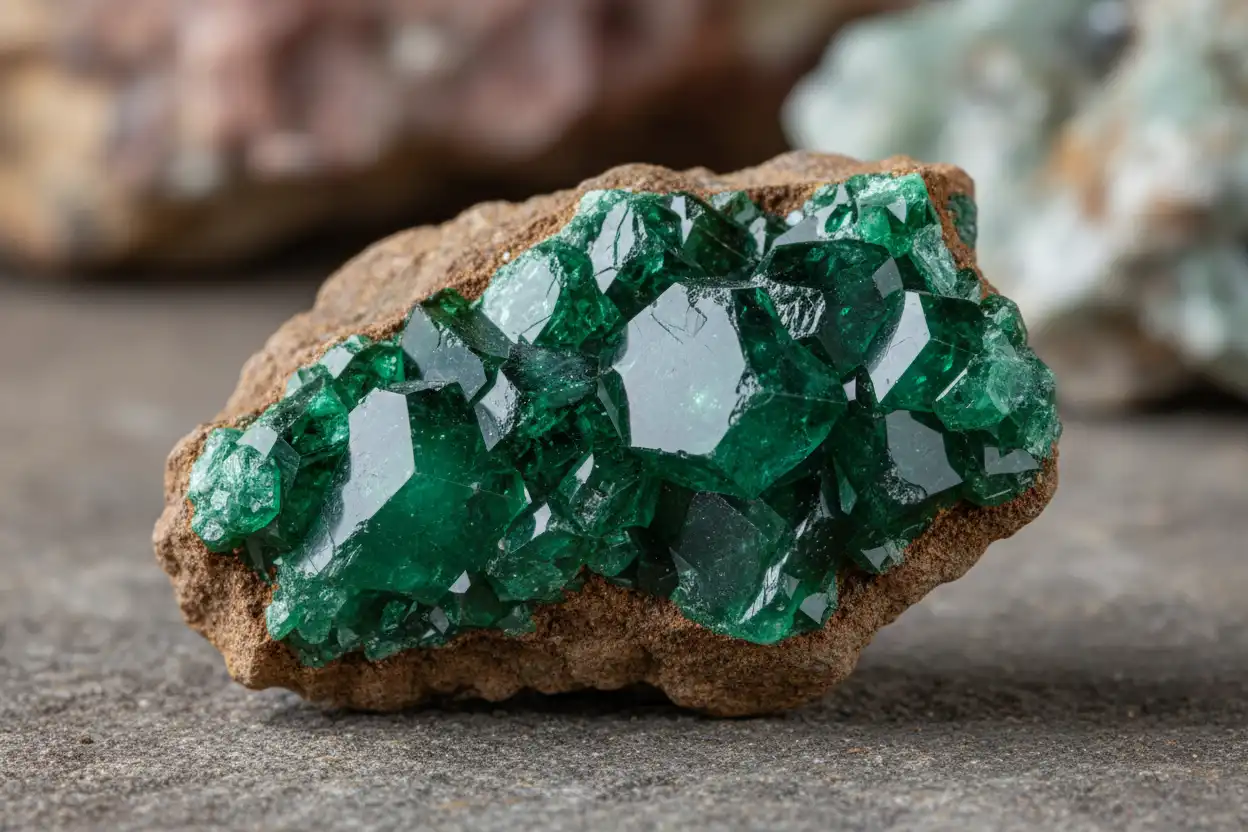
Dioptase Meaning: Mineral Facts, History & Symbolism
Dioptase meaning begins with a mineral whose color can make identification surprisingly difficult. Fine dioptase develops an intense emerald-green to blue-green appearance that can immediately invite comparisons with emerald, chrome diopside, malachite-associated copper minerals, or other saturated green stones. Mineralogically, however, dioptase is a distinct hydrated copper cyclosilicate with the commonly expressed formula Cu₆Si₆O₁₈·6H₂O. It crystallizes in the trigonal system, typically forms short prismatic or rhombohedral-looking crystals, has a vitreous luster, and combines striking transparency in good material with approximately Mohs hardness 5 and pronounced cleavage. Those characteristics make it highly desirable as a mineral specimen while limiting the kinds of jewelry use that are mechanically sensible.
The vivid color is not merely decorative. Copper in the crystal structure is central to dioptase’s selective absorption of visible light and therefore to the intense green that defines many fine specimens. That genuine optical behavior should remain separate from modern symbolic interpretations that associate dioptase meaning with emotional renewal, compassion, clarity, forgiveness, transformation, or heart-centered reflection. Such meanings can be culturally or personally useful, but they are not experimentally demonstrated effects of copper, silica, structural water, crystal symmetry, or green color.
Within Gems Lore’s Gemstone Guides collection, this page owns that foundational distinction. It defines dioptase as a material first, then examines its formation, color, diagnostic characteristics, documented history, modern symbolism, and safe ownership without reproducing the separate cluster pages devoted to buying, microscopy, detailed optics, cutting, jewelry engineering, conservation, or provenance.
Dioptase at a Glance
| Property | Practical reference |
|---|---|
| Material identity | Hydrated copper cyclosilicate |
| Common formula | Cu₆Si₆O₁₈·6H₂O |
| Crystal system | Trigonal |
| Typical color | Emerald green, deep green, blue-green |
| Transparency | Transparent to translucent |
| Luster | Vitreous |
| Mohs hardness | About 5 |
| Specific gravity | Roughly 3.3 |
| Cleavage | Pronounced and important to durability |
| Tenacity | Brittle |
| Typical habit | Short prismatic crystals, commonly terminated by rhombohedral faces |
| Geological setting | Secondary mineral in oxidized copper deposits |
| Common associations | Calcite and other secondary copper minerals depending on locality |
| Main color cause | Copper within the crystal structure |
| Main look-alike concern | Emerald, green diopside, glass, and other saturated green minerals |
| Typical best use | Mineral specimen; carefully protected ornamental use in selected material |
| Symbolic associations | Renewal, compassion, perspective, emotional clarity, transformation |
| Evidence boundary | Symbolism is interpretive rather than a scientifically established healing property |
The combination of moderate hardness, brittleness, and cleavage is especially important. Dioptase can look like a robust transparent gemstone, yet its mechanical behavior is much less forgiving than its brilliant crystal surfaces suggest. That contrast explains why spectacular natural clusters are commonly preserved as specimens rather than converted automatically into faceted jewelry.
What Dioptase Actually Is
Dioptase is a copper-bearing cyclosilicate mineral. In a cyclosilicate structure, silicate tetrahedra are linked into rings rather than forming the chains found in pyroxenes or the continuous framework found in quartz. Copper and water-related structural components occupy their own positions within this organized crystal architecture.
The chemical formula is useful because it immediately separates dioptase from several green minerals that resemble it visually. Emerald is a variety of beryl, chrome diopside is a pyroxene, malachite is a copper carbonate hydroxide, and chrysocolla is a copper-bearing material with a substantially different and often more complex structural description.
That means an intensely green crystal should not be identified from color alone.
Dioptase meaning is strongest when the species is established through structure and physical characteristics before symbolism or commercial naming enters the discussion.
Why Dioptase Is a Cyclosilicate
The term cyclosilicate refers to the way silicate tetrahedra are connected into ring structures. Dioptase contains six-membered silicate rings, a structural arrangement that helps define the mineral as distinct from other copper silicates.
This structural classification is not merely academic. Mineral structure influences symmetry, cleavage, optical behavior, hardness, and how the crystal grows externally.
Two minerals can contain copper and silica while behaving very differently because their atoms are arranged differently.
This principle also prevents chemistry from becoming an ingredient-list shortcut. Saying that a stone contains copper and silicon does not make it dioptase. The elements must occur in the correct crystal structure.
How Dioptase Forms
Dioptase is most characteristic of oxidized zones in copper deposits. Primary copper-bearing minerals exposed to oxygen-rich water and near-surface alteration can break down, releasing copper into circulating fluids. Under suitable chemical conditions, that copper can combine with silica-bearing solutions and crystallize as secondary minerals including dioptase.
Open fractures, cavities, and voids provide especially favorable spaces because crystals can grow without being completely constrained by surrounding rock. That is one reason collector specimens often show vivid green crystals coating pale matrix or projecting into cavities.
The surrounding assemblage matters. Calcite, quartz, malachite, chrysocolla, plancheite, shattuckite, cerussite, wulfenite, and other secondary minerals may occur in copper-rich oxidized environments, although no single association appears with every dioptase specimen.
A more detailed treatment of fluid chemistry, oxidation zones, host rocks, and deposit architecture belongs in dioptase formation and deposit geology. For dioptase meaning, the central point is that the green crystals record a specific secondary copper-mineral process rather than a mysterious transformation caused by the later symbolism attached to the stone.
Why Dioptase Is Such an Intense Green
Copper is fundamental to dioptase coloration. Copper ions within the crystal structure interact with visible light by absorbing selected wavelengths while allowing others to reach the observer, producing the strong green to blue-green appearance associated with the species.
Color intensity depends on more than the mere presence of copper.
Crystal thickness matters because light travels through more colored material in thicker sections. A thin crystal edge may appear brighter and more transparent than the darker central part of the same crystal. Internal fractures, inclusions, surface coatings, and illumination also influence apparent saturation.
Photography can exaggerate the effect substantially. Increased saturation can transform realistic green into neon emerald, while cool white balance can push natural green toward an unnatural blue-green. Backlighting can make crystal edges look far more transparent than they appear under ordinary reflected light.
The specialist guide to dioptase optical properties and color behavior covers these effects in greater detail. On this page, the important distinction is that the color has a physical cause; the meanings assigned to green come afterward.
Dioptase Is Not Emerald
The visual comparison is understandable. Fine dioptase crystals can display a saturated green that looks remarkably emerald-like in photographs or small specimens.
Mineralogically, the two are unrelated.
Emerald is chromium- and/or vanadium-colored beryl, a beryllium aluminum silicate. Dioptase is a hydrated copper cyclosilicate. Their crystal systems, hardness, cleavage, density, refractive properties, formation environments, and durability differ substantially.
Emerald is considerably harder and has a much more established jewelry role. Dioptase’s pronounced cleavage and lower hardness make it far more vulnerable to damage during cutting, setting, and ordinary wear.
Color similarity therefore provides no basis for calling dioptase “copper emerald” as though it were chemically related to emerald.
Such phrases can be useful informal visual descriptions only when they are not mistaken for mineral identification.
The Problem With “Emerald Copper”
Commercial or collector descriptions occasionally use informal phrases that combine dioptase with emerald terminology because the color resemblance is compelling.
Those phrases should not be treated as formal mineral names.
A trade description can communicate visual character, but it does not change crystal chemistry. Dioptase remains dioptase regardless of whether a seller emphasizes emerald-like color, copper origin, or unusual brilliance.
This distinction matters because an informal name can gradually acquire claims it never justified. A buyer may begin with “emerald-colored copper mineral” and end up assuming a relationship to emerald composition, hardness, or durability.
The safest description is the simplest one: vivid green dioptase.
Diagnostic Traits That Matter
A strong dioptase identification combines several compatible properties. Saturated green color, trigonal crystal morphology, vitreous luster, approximately Mohs hardness 5, specific gravity in the low 3s, marked cleavage, refractive behavior, copper-related spectroscopy, and suitable mineral associations can collectively support the identification.
Natural crystal habit can be particularly informative.
Well-developed dioptase often forms short prisms with characteristic terminations. Crystals may appear almost blocky when the prism is short, while longer examples can display more obvious elongation.
Cleavage deserves caution because intentionally breaking a specimen to examine it would destroy valuable evidence. Existing chips or naturally broken surfaces can provide information without creating new damage.
When transparent material has been faceted, most external crystal-form evidence disappears. Standard gemological or analytical testing becomes correspondingly more important.
What Magnification Can Reveal
Dioptase crystals can contain fractures, growth features, mineral inclusions, internal veils, cleavage-related structures, surface deposits, and relationships with neighboring matrix minerals.
Magnification can also reveal whether a vivid green crystal is naturally attached to matrix, glued into position, repaired after breakage, coated by another mineral, or mechanically damaged.
The dedicated dioptase microscope and inclusion notebook is the appropriate place for detailed inclusion interpretation.
A microscope has limits, however. A white grain attached to dioptase may resemble calcite, but appearance alone may not establish the species conclusively. Likewise, a crystal that looks typical of material from a famous locality does not become proven locality material under magnification.
Observation should precede identification.
An Original Dioptase Specimen and Photo Checklist
Begin with the entire specimen rather than the brightest individual crystal. Record overall dimensions, matrix type, crystal distribution, cavity structure, and whether several generations of minerals appear to be present.
Photograph the specimen first under neutral diffuse light. This documents body color, matrix relationships, broken crystals, repairs, surface condition, and the overall visual balance without relying on dramatic transmitted light.
Next, photograph selected crystal edges with restrained backlighting. Note which parts genuinely transmit light and which only appear brighter because the surface is reflective. Do not increase saturation to force a stronger emerald-green impression.
Rotate the specimen and inspect crystal attachment points. Genuine matrix relationships should make geological sense: crystal bases enter or grow from the substrate rather than sitting unnaturally above adhesive seams. A repaired specimen can still be collectible, but repair should be documented rather than hidden.
Use magnification on existing broken surfaces and cleavage features. Record whether fractures follow repeated directions, whether internal cracks reach the surface, and whether apparently separate crystals are actually one damaged larger crystal.
Inspect pale matrix minerals separately. Describe them as “white carbonate-like matrix,” “clear rhombohedral crystal,” or another observational phrase until identification is adequately supported.
Check for surface coatings. Secondary copper minerals can alter or cover parts of dioptase, and cleaning may expose brighter crystal surfaces underneath. Do not assume every blue-green film is contamination.
Finally, record confidence in separate categories:
Species: Is the green mineral convincingly dioptase?
Condition: Are crystals intact, chipped, repaired, or stabilized?
Matrix: Which associated minerals are actually identified?
Locality: Is geographic origin documented?
Treatment: Has the specimen been cleaned, coated, repaired, or otherwise modified?
This framework avoids the common mistake of allowing one recognizable green crystal to validate every other claim made about the specimen.
A Claim-Reconciliation Table
| Common claim | What can reasonably be retained | What requires correction or stronger evidence |
|---|---|---|
| “Dioptase is a copper silicate.” | Correct broad mineral classification | Exact species still depends on structure and diagnostic evidence |
| “Dioptase is emerald.” | Fine crystals can resemble emerald in color | Emerald is beryl; dioptase is a copper cyclosilicate |
| “Every deep-green copper mineral is dioptase.” | Dioptase can be intensely green | Several unrelated copper minerals can also be green |
| “The greener the crystal, the more chromium it contains.” | Strong green is characteristic | Dioptase color is fundamentally copper-related rather than an emerald-style chromium requirement |
| “Transparent dioptase is ideal for rings.” | Transparent material can be faceted | Cleavage and moderate hardness make exposed daily wear risky |
| “A perfect crystal on matrix is always unrepaired.” | Natural matrix specimens can be exceptionally aesthetic | High-quality specimens can still contain repairs or reconstructed attachments |
| “Tsumeb-looking dioptase must be from Tsumeb.” | Some localities produce recognizable habits and associations | Appearance alone cannot establish geographic provenance |
| “Copper in dioptase heals the body.” | Copper is essential to the mineral structure | The crystal is not a therapeutic copper supplement |
| “Green dioptase heals the heart.” | Green encourages modern heart-related symbolism | No established evidence shows cardiovascular or psychological treatment |
| “Dioptase is an ancient universal healing stone.” | Copper minerals have long histories of human use | Specific dioptase traditions require identification and documentary evidence |
| “Its crystal water hydrates the body.” | Water is structurally associated with the mineral | Wearing the crystal does not provide biological hydration |
| “The brighter the crystal, the stronger its energy.” | Brightness depends on optics, transparency, polish, and lighting | No validated energetic scale follows from luster |
The useful pattern is consistent: an observable property can inspire a symbolic story without proving the story scientifically. Dioptase really is copper-rich, really can be vividly green, and really can be transparent. None of those facts demonstrates medical healing or spiritual potency.
Dioptase Versus Diopside
Diopside is one of the most practical neighboring comparisons because chrome diopside can display an equally compelling saturated green.
The chemistry immediately separates them.
Diopside is a calcium-magnesium pyroxene with the idealized formula CaMgSi₂O₆. Dioptase is a hydrated copper cyclosilicate. Diopside also has different cleavage, crystal habit, optical behavior, and geological occurrence.
Chrome diopside is generally better suited to conventional faceting and jewelry than dioptase, though it still requires realistic durability expectations of its own.
The visual overlap demonstrates why “emerald green” is a color description rather than a species test.
Dioptase Versus Dolomite
Dolomite may seem like an unusual comparison, but pale carbonate minerals can occur as matrix or associated material around vivid secondary copper minerals, making matrix identification relevant to collector specimens.
Dolomite itself is a calcium-magnesium carbonate with entirely different chemistry and physical properties from dioptase.
A white or pale crystal beneath a green dioptase cluster should therefore not automatically be called dolomite, calcite, or quartz solely from color. Crystal form, cleavage, reaction behavior, and analytical evidence may be needed when accurate matrix identification matters.
This is particularly important in provenance research because associated minerals can contribute useful context only when they are identified correctly.
Why Matrix Matters
A loose dioptase crystal provides information about the mineral itself, but a matrix specimen can preserve far more geological context.
Matrix can show how crystals occupied a cavity, which minerals formed before or after them, whether several growth generations occurred, how fractures controlled fluid movement, and whether later alteration modified the specimen.
That context can also be commercially important. Fine dioptase positioned naturally on contrasting pale matrix can be more aesthetically desirable than loose fragments of comparable crystal quality.
Removing matrix merely to expose more green surface can therefore destroy information and sometimes reduce collector appeal.
The most visually dramatic specimen is not always the one that has been cleaned most aggressively.
Documented History of Dioptase
Dioptase entered formal mineralogical study after specimens from Central Asia attracted attention because their intense green color led to confusion with emerald. The mineral was subsequently recognized as chemically and structurally distinct and received the name dioptase from Greek roots associated with seeing through or seeing across, reflecting observations connected with its transparency and internal cleavage.
That history is particularly appropriate for the material because visual resemblance played such a strong role in its identification story.
A green crystal looked like emerald.
Closer examination showed that it was not emerald.
The mineral’s documented history therefore reinforces the central principle of dioptase meaning: appearance begins the investigation, but evidence determines identity.
Later discoveries from important copper deposits expanded collector interest, with some localities becoming famous for exceptional crystal color, transparency, matrix contrast, and crystal size.
Famous Locality Does Not Mean Automatic Provenance
Certain dioptase deposits have become iconic among mineral collectors, and photographs of material from those locations can be visually distinctive.
That familiarity creates a provenance problem.
A crystal cluster may strongly resemble specimens from a famous mine without carrying a surviving label or trustworthy acquisition history. Similar habits and mineral associations can occur elsewhere, and dealer descriptions may be inherited through several ownership transfers.
The dioptase provenance disclosure checklist provides the stronger evidence hierarchy: original labels, collection cards, mine or district documentation, dated acquisition records, credible dealer histories, and coherent chain of custody should support a locality premium.
Color can suggest a comparison. It cannot supply a mine name.
Dioptase Meaning in Modern Symbolism
Modern dioptase meaning commonly emphasizes compassion, emotional renewal, forgiveness, perspective, transformation, openness, and releasing patterns that no longer serve a person.
Its vivid green color is a major reason.
Green is culturally associated with vegetation, growth, spring, renewal, and—in contemporary chakra-based traditions—the heart. A transparent green crystal therefore lends itself naturally to symbolism involving emotional clarity or relational openness.
These interpretations can be meaningful without becoming medical claims.
A person might keep dioptase near a journal when thinking through resentment or an unresolved relationship, using the stone as a visual cue to ask whether a situation can be interpreted differently. Another might associate the intensity of the green with deliberate renewal after a difficult transition.
The reflection occurs because the person chooses the symbol.
The crystal does not need to alter brain chemistry or emotional physiology.
The Heart Symbolism Boundary
Heart-centered language appears frequently in dioptase meaning. It can refer to compassion, forgiveness, emotional openness, grief, relational honesty, or modern heart-chakra practice.
Those ideas belong to symbolism.
They should not be converted into claims that dioptase treats arrhythmia, blood pressure, coronary disease, circulation problems, panic disorders, clinical depression, trauma, or any other medical condition.
Color has cultural meaning, but it is not cardiology.
The distinction allows readers to use a green crystal as an intentional emotional symbol without mistaking it for treatment.
Transformation Without Magical Causation
Dioptase is often described as a transformation stone.
There is a genuine geological transformation story behind the specimen: copper-bearing minerals alter in oxidized environments, fluids redistribute elements, and new secondary minerals can crystallize in fractures and cavities.
That process can inspire metaphor.
A person may associate dioptase with changing perspective, releasing an outdated habit, rebuilding trust, or accepting that a difficult experience has changed their priorities.
Those are meaningful interpretations precisely because transformation is being used symbolically.
The geology does not demonstrate that the crystal causes psychological transformation.
Forgiveness as a Reflective Practice
Forgiveness is another recurring part of modern dioptase meaning, especially in crystal-healing literature.
There is no scientific evidence that holding the mineral automatically causes forgiveness or resolves conflict.
A stone can nevertheless become a prompt for a structured question:
What am I still carrying from this event?
What would forgiveness mean here—reconciliation, reduced resentment, clearer boundaries, or simply no longer organizing my life around the injury?
Does forgiveness require renewed contact, or can it exist alongside distance?
Those are human decisions.
Dioptase may serve as a memorable object around which the reflection is organized, but it does not determine the answer.
Chakra Associations
Modern crystal systems frequently associate green dioptase with the heart chakra because of its color.
Some traditions describe it as opening, clearing, activating, or balancing that energetic center.
These are belief-based interpretations rather than experimentally established anatomical processes.
No validated medical or gemological instrument demonstrates that dioptase physically changes a chakra, and there is no standardized mineralogical chakra classification that laboratories use when identifying the stone.
A person can still incorporate dioptase into meditation or ritual if that framework is personally meaningful.
The important boundary is that a spiritual system should be presented as a spiritual system.
Copper Chemistry Is Not Copper Therapy
Dioptase contains copper as an essential structural component. Copper is also biologically important in appropriate chemical forms and controlled amounts.
Those two facts should not be merged.
Copper locked inside a mineral crystal is not equivalent to a dietary copper compound or a prescribed medical treatment. Biological effects depend on chemical form, solubility, concentration, dose, exposure route, and metabolism.
Touching intact dioptase does not provide a controlled nutritional copper dose.
Likewise, deliberately ingesting powdered mineral is not a responsible way to obtain copper.
Mineral chemistry explains the green crystal. It does not turn the specimen into medicine.
Structural Water Is Not Hydration
The traditional dioptase formula includes water associated with its structure.
That fact sometimes encourages wellness claims involving hydration, emotional flow, or water balance.
The inference is unsupported.
Water incorporated into a mineral structure is not equivalent to drinking water, and wearing a crystal does not transfer useful hydration into the body.
The same rule applies broadly across hydrous minerals: structural chemistry should not be transformed into health claims merely because familiar biological substances appear in a formula.
Safe Ownership
An intact dioptase specimen can generally be displayed and handled carefully using ordinary mineral-collection hygiene. The greatest everyday concern is typically mechanical damage rather than an unusual exposure from brief contact with a sound crystal.
Dioptase’s approximately Mohs 5 hardness means harder materials can scratch it relatively easily. Its cleavage and brittleness create additional vulnerability, particularly in sharp crystals or transparent material with internal fractures.
Dust-generating work is different from ordinary handling. Cutting, grinding, drilling, or sanding can create fine particles containing copper-bearing mineral matter and silica-related components. Appropriate wet methods, local extraction, ventilation, eye protection, and respiratory controls are more suitable than casual dry processing.
Direct-contact drinking-water elixirs are unnecessary, and ingestion should be avoided. The site’s Disclaimer provides the wider boundary between general mineral handling information and individualized toxicological, medical, or occupational-safety advice.
Why Fine Dioptase Is Usually Better as a Specimen
Transparent dioptase can tempt gem cutters because its saturated color is extraordinary. The difficulty is that the same crystal may be substantially more valuable or scientifically informative in natural form.
Cutting removes crystal faces, matrix contacts, associated minerals, surface growth features, and locality context permanently.
Cleavage also makes lapidary work challenging.
A small faceted dioptase can be beautiful, but sacrificing an intact well-formed crystal merely because it is transparent may produce a less significant object than the original specimen.
The detailed technical tradeoffs belong in dioptase cutting, orientation, and polish. For dioptase meaning, the preservation principle is more important: transparency does not automatically make faceting the best use.
Jewelry Use Requires Protection
Dioptase jewelry exists, but the material is unsuitable for careless wear.
Its moderate hardness means abrasion can affect polish, while cleavage and brittleness make exposed edges vulnerable to impact. Rings present the greatest routine challenge because hands frequently encounter hard surfaces.
Pendants, earrings, brooches, or highly protected collector jewelry can reduce some mechanical exposure, though the individual stone’s fractures and setting still matter.
The engineering questions are handled separately in dioptase setting and wear engineering.
A stone associated symbolically with resilience or emotional strength does not become mechanically tougher because of that interpretation.
Conservation Should Preserve the Geological Evidence
Natural dioptase specimens can be visually spectacular and physically delicate.
Thin crystal edges can chip.
Matrix can fracture.
Old repairs may weaken.
Dust can collect in cavities.
Water or aggressive cleaning may affect associated minerals even when the dioptase itself appears unchanged.
A conservation decision should therefore consider the entire specimen rather than the green crystals alone.
The dioptase specimen conservation record provides a structure for recording detached crystals, repairs, matrix fractures, cleaning history, label information, storage changes, and other condition details.
A specimen’s history can become part of its value.
Buying Requires More Than Finding the Brightest Green
A buyer choosing dioptase should evaluate species identity, crystal condition, repairs, matrix relationships, locality evidence, treatment or cleaning history, and whether photography represents the true color realistically.
High saturation alone is insufficient.
A perfect-looking cluster may contain reattached crystals. A famous locality claim may lack a surviving label. A heavily backlit image may exaggerate transparency. An unusually inexpensive “faceting crystal” may contain cleavage fractures that make cutting impractical.
Those seller-selection questions belong in where to buy dioptase rather than being repeated throughout this meaning reference.
The central principle remains: buy the material and evidence first, then the story.
Evidence Should Scale With the Claim
The research approach described on Gems Lore’s About page is particularly useful for dioptase because its appearance invites strong conclusions quickly.
“Vivid green transparent crystal” is an observation.
“Consistent with dioptase” is an identification judgment.
“Dioptase on calcite” requires the matrix mineral to be identified as well.
“From a famous named mine” is a provenance claim.
“Untreated and unrepaired” is a condition and disclosure claim.
“Heals emotional trauma” is a therapeutic claim requiring an entirely different kind of evidence.
One statement cannot validate the next simply because they occur in the same product description.
Frequently Asked Questions About Dioptase Meaning
What is dioptase?
Dioptase is a hydrated copper cyclosilicate mineral commonly represented by the formula Cu₆Si₆O₁₈·6H₂O. It crystallizes in the trigonal system and is especially known for intense green crystals.
What does dioptase meaning symbolize?
Modern dioptase meaning commonly includes compassion, forgiveness, renewal, emotional clarity, transformation, openness, and perspective. These are symbolic interpretations rather than scientifically demonstrated effects.
Why is dioptase green?
Copper within the crystal structure is responsible for the strong green to blue-green coloration characteristic of dioptase.
Is dioptase the same as emerald?
No. Emerald is green beryl, while dioptase is a copper cyclosilicate. Their chemistry, crystal structure, hardness, cleavage, formation, and durability differ substantially.
Is dioptase rare?
Fine transparent, well-formed, strongly colored crystals can be comparatively uncommon and highly collectible, although rarity varies greatly by specimen quality and locality.
How hard is dioptase?
Dioptase is approximately Mohs 5. It is considerably softer than quartz, topaz, sapphire, or diamond.
Does dioptase have cleavage?
Yes. Cleavage is an important part of its physical behavior and contributes to its vulnerability during cutting, setting, and impact.
Can dioptase be faceted?
Transparent material can be faceted, but cleavage, brittleness, limited rough, and potential specimen value make cutting challenging.
Is dioptase suitable for a ring?
It can be set in jewelry, but an exposed everyday ring presents substantial risk because of moderate hardness, cleavage, and brittleness. More protected, lower-impact uses are generally easier on the stone.
Is dioptase a copper mineral?
Yes. Copper is an essential component of dioptase’s crystal chemistry and is central to its characteristic green color.
Does the copper in dioptase have healing benefits?
No established evidence shows that touching or wearing dioptase provides a therapeutic copper dose or treats medical conditions.
Does dioptase heal the heart?
Heart-related interpretations belong to modern symbolism and chakra traditions. There is no established evidence that dioptase treats cardiovascular disease or other medical conditions.
Can dioptase go in drinking water?
Direct-contact crystal elixirs are unnecessary. Natural specimens may include copper-bearing phases, matrix minerals, cleaning residues, repairs, or other materials that should not be intentionally ingested.
How can I identify genuine dioptase?
Identification can combine crystal morphology, hardness, density, cleavage, optical properties, spectroscopy, chemistry, inclusions, and geological context. Color alone is insufficient for a valuable specimen.
Can a dioptase locality be identified from a photograph?
A photograph may suggest similarities with material from a known deposit, but reliable locality attribution requires provenance evidence rather than appearance alone.
Dioptase Meaning Begins With Seeing More Carefully
The strongest dioptase meaning grows directly from the mineral’s own identification history. Its green can be so convincing that appearance encourages the wrong conclusion: emerald. Closer examination reveals a completely different material—a hydrated copper cyclosilicate with its own trigonal structure, cleavage, optical behavior, deposit environment, and collector significance.
That makes dioptase unusually appropriate as a symbol of perspective. The first impression may be compelling without being complete. Looking more carefully can reveal a different explanation without making the original observation meaningless. The crystal really is intensely green; it simply is not emerald.
The same discipline improves its modern symbolism. Green can represent renewal without proving biological healing. Transparency can represent clarity without altering cognition. Copper can explain color without becoming medicine. A mineral formed through secondary alteration can inspire ideas of transformation without claiming to cause psychological transformation.
A dioptase specimen therefore carries several legitimate layers at once: copper mineral, geological record, collector object, optical study, and personally meaningful symbol. Keeping those layers distinct allows each one to remain useful.
When an unusual specimen raises a material question—such as an apparently reconstructed cluster, conflicting matrix identification, uncertain locality label, or a green crystal that does not behave like expected dioptase—photographs and supporting documentation can be submitted through Contact. Any personal information supplied with that evidence is handled under the site’s Privacy Policy, keeping specimen evaluation tied to the specific claim rather than to unnecessary personal details.