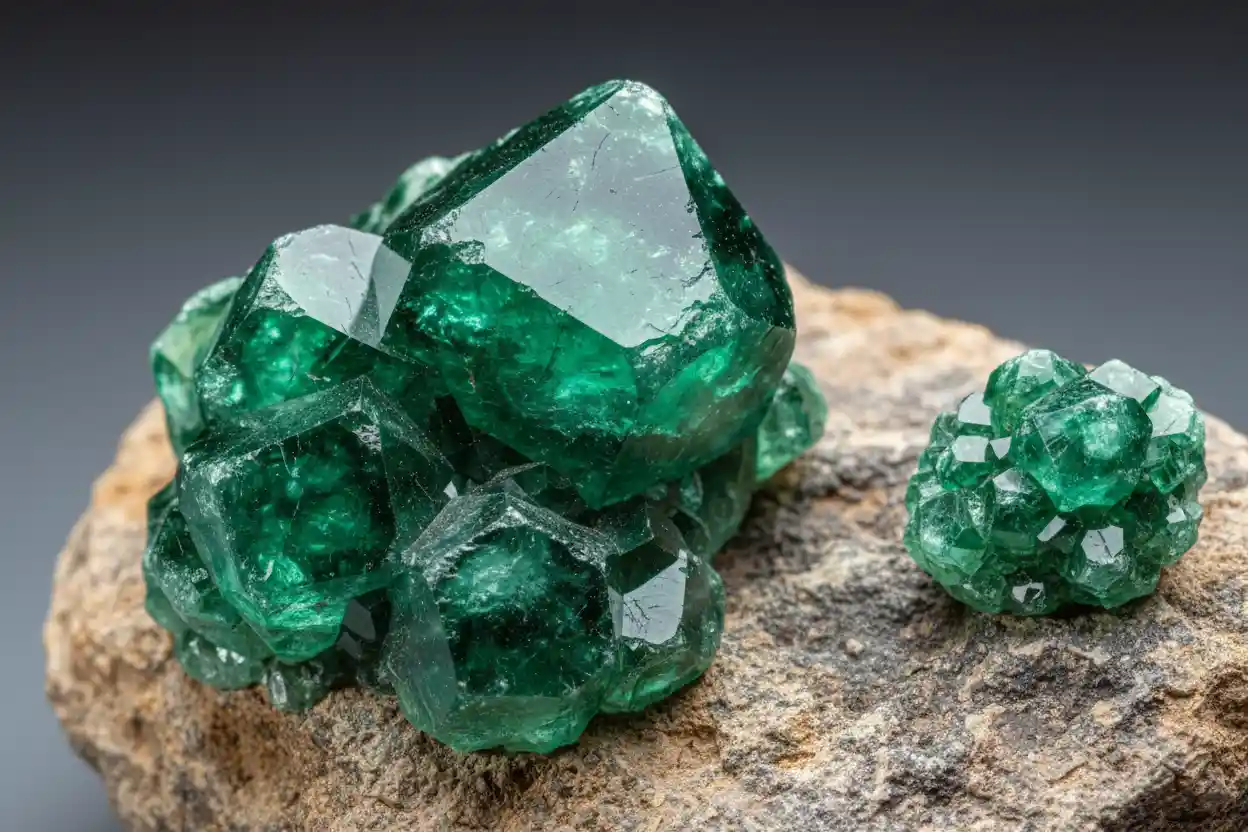
12 Dioptase Healing Properties: Traditional Claims, Evidence & Safe Limits
Dioptase healing properties are commonly described in crystal practice through themes of emotional release, compassion, forgiveness, confidence, grief reflection, relationship awareness, mental clarity, calm, motivation, present-moment attention, spiritual insight, and personal renewal. Its intense green color has made it especially popular in heart-centered spiritual practices, but color symbolism should not be mistaken for a therapeutic mechanism. Dioptase has not been demonstrated to treat depression, anxiety, trauma, cardiovascular disease, high blood pressure, pain, inflammation, infection, hormonal conditions, or any other medical disorder, and its copper content does not create a health benefit when the stone is worn or handled. Scientifically, dioptase is a distinct hydrated copper silicate mineral with the formula CuSiO₃·H₂O, a trigonal crystal structure, Mohs hardness of about 5, brittle tenacity, and perfect cleavage. Those characteristics are measurable; its healing reputation belongs to spiritual and personal practice.
12 Dioptase Healing Properties Commonly Claimed in Crystal Practice
- Emotional release and letting go
- Compassion toward oneself and others
- Forgiveness after conflict
- Support during grief reflection
- Confidence and emotional courage
- Healthier relationship boundaries
- Mental clarity during difficult decisions
- Calm during emotionally intense moments
- Motivation for personal change
- Present-moment awareness
- Heart-centered spiritual reflection
- Renewal after a difficult life transition
These twelve themes are distinct enough to support different rituals, but they remain claims rather than demonstrated biological effects. Many of the dioptase benefits described in modern crystal culture become more practical when translated into deliberate behaviors such as journaling, preparing for a conversation, setting a boundary, breathing slowly, or identifying the next action under personal control.
What Dioptase Really Is: Formula, Crystal Structure, Color, Hardness, and Cleavage
Dioptase is a copper silicate mineral with the ideal chemical formula CuSiO₃·H₂O. Because water is an essential part of that formula, dioptase is a hydrated mineral rather than an anhydrous silicate. It belongs to the cyclosilicate class and crystallizes in the trigonal system, commonly producing short to elongated rhombohedral or prismatic crystals with sharply defined faces. The mineral’s saturated emerald-green to blue-green color is one of its most recognizable features and comes from copper in its crystal chemistry.
Fresh crystal faces can show vitreous to sub-adamantine luster, giving good specimens a brilliance that historically caused confusion with emerald. Transparency varies from transparent to translucent. Dioptase has a Mohs hardness of approximately 5, which is considerably softer than quartz and emerald. This means it can be scratched by many common gemstones and should not be treated as though its bright color indicates similar durability to beryl.
Its physical weakness becomes even more important because dioptase is brittle and has perfect cleavage. A sharp impact can separate a crystal along preferred structural planes even when the surface appears flawless. Fracture outside those cleavage directions can be uneven to conchoidal. These characteristics explain why attractive crystals are commonly kept as mineral specimens rather than used in exposed everyday rings.
The mineral can superficially resemble emerald, especially in small intensely green crystals, but their properties are substantially different. Emerald is green beryl, much harder at about 7.5 to 8 and chemically unrelated to dioptase. Malachite, chrysocolla, green fluorite, and other copper-bearing or green minerals may also appear alongside dioptase or be confused with it in rough specimens. Identification should therefore rely on crystallography, hardness, cleavage, optical properties, chemistry, and geological context rather than color alone.
Dioptase Discovery, Name History, Type Locality, and Important Deposits
Dioptase entered European mineralogical literature in the late eighteenth century after green crystals from what is now Kazakhstan were initially mistaken for emerald. The French mineralogist René Just Haüy named the mineral dioptase in 1797. The name was derived from Greek roots referring to seeing through, an allusion to internal cleavage planes that could be observed through transparent crystals.
Its type locality is the Altyn-Tyube dioptase deposit in the Karaganda Region of Kazakhstan. The locality remains historically important because it supplied the specimens that led to the recognition of dioptase as a distinct mineral rather than an unusual form of emerald.
Dioptase typically forms as a secondary mineral in the oxidized zones of copper deposits, where copper-bearing fluids interact with silica under suitable near-surface conditions. Rather than growing from deep magmatic melt, many specimens develop during chemical alteration of copper deposits. This setting explains why dioptase may occur alongside minerals such as calcite, malachite, chrysocolla, cerussite, mimetite, wulfenite, and other secondary species depending on the deposit.
Namibia is especially famous for spectacular dioptase from the Tsumeb mine, where lustrous crystals on contrasting matrix became classics of mineral collecting. The Democratic Republic of the Congo has also produced notable material, while Kazakhstan remains central to the mineral’s discovery history. Locality can affect crystal habit, associated minerals, size, transparency, and collector value, but it does not change the lack of evidence for crystal-healing effects.
Emotional Release, Compassion, Forgiveness, and Grief Reflection Claims
1. Emotional Release as a Structured Letting-Go Practice
Dioptase is often described as a stone for releasing emotional burdens. The mineral does not extract memories, trauma, or emotional pain from the nervous system. A more realistic ritual is to use it while writing down what happened, what cannot be changed, what remains unresolved, and what specific action would reduce the problem now. The symbolic act of setting the stone down after journaling can mark the end of the exercise without assigning the emotional change to copper silicate.
2. Compassion Through Deliberate Perspective-Taking
Its intense green color has encouraged associations with compassion and heart-centered awareness. Holding a crystal cannot biologically increase empathy, but it can serve as a cue to ask what another person may have experienced, what information may be missing, and how to respond without abandoning personal boundaries. The potentially useful process is perspective-taking rather than mineral energy.
3. Forgiveness After Conflict
Dioptase is sometimes described as helping people forgive. Forgiveness is complicated and should never be treated as an obligation, especially when harm is ongoing. A crystal cannot repair trust or make another person accountable. Someone who chooses to use dioptase symbolically might instead distinguish forgiveness from reconciliation, identify what boundary remains necessary, and decide whether releasing repeated mental rehearsal would serve them. The stone is a reminder, not the agent of forgiveness.
4. Grief Reflection Without Promising Grief Relief
Another common healing claim links dioptase with grief. Grief cannot be removed by a mineral, and persistent or overwhelming grief may require appropriate professional support. As a personal ritual object, dioptase can accompany remembrance, letter-writing, prayer, or quiet reflection. The act may help someone create a contained time for acknowledging a loss. That is very different from claiming the crystal treats grief as a clinical condition.
Confidence, Boundaries, Mental Clarity, and Calm Claims
5. Confidence and Emotional Courage
Dioptase is sometimes associated with courage in emotionally difficult situations. There is no established mechanism by which its copper or crystal structure increases confidence. Before an uncomfortable conversation, a person could use the stone as a cue to state what they know, what they need to say, and what outcome they can realistically control. Preparation provides the functional advantage.
6. Relationship Boundaries and Self-Respect
Heart-centered crystal language can sometimes overemphasize openness while ignoring boundaries. A more useful interpretation of dioptase is to associate it with deciding where compassion ends and self-protection begins. Write down the behavior you will accept, the behavior you will not accept, and the response you will use if a boundary is crossed. The mineral does not enforce that boundary. Clear behavior does.
7. Mental Clarity During Difficult Decisions
Some practitioners say dioptase clears confusion. It has not been shown to affect cognition or executive function. A decision ritual can nevertheless be practical: list the available options, evidence for and against each, consequences that matter most, and the information still missing. Looking at the stone can simply remind you to perform the process rather than continue cycling through the same thoughts.
8. Calm During Emotional Intensity
Holding a small object can provide a neutral sensory focus during an emotionally charged moment. If someone uses dioptase while slowing their breathing and deliberately noticing physical sensations, the routine may support a pause before reacting. The stone does not directly lower stress hormones or treat anxiety. The change comes from breathing, attention, and delayed response.
Motivation, Mindfulness, Spiritual Reflection, and Renewal Claims
9. Motivation for Personal Change
Dioptase is sometimes described as helping people transform old patterns. Transformation becomes more useful when defined as behavior rather than metaphysical energy. Choose one action connected to the desired change and associate the stone with performing it consistently, whether that means making an appointment, beginning a project, limiting an unhelpful habit, or completing a daily practice. The stone does not supply motivation; it can act as a visible commitment cue.
10. Present-Moment Awareness
The mineral’s vivid color, sharp crystal faces, and transparency make it visually absorbing. A person can use those features for focused attention by observing the crystal for a minute while noticing breathing, posture, sound, and surroundings. Dioptase does not create mindfulness through an invisible field. Attention is being trained by repeatedly returning to a chosen object.
11. Heart-Centered Spiritual Reflection
In spiritual practice, dioptase is often associated with love, compassion, emotional truth, and the heart chakra. Someone may hold it during prayer or meditation while reflecting on relationships, gratitude, grief, forgiveness, or values. These experiences can be personally meaningful, but they do not demonstrate that dioptase physically opens an energy center or changes the cardiovascular system.
12. Renewal After a Difficult Transition
The bright green color of dioptase is often interpreted as a symbol of growth and renewal. That symbolism can be used after a move, breakup, job change, bereavement, or other transition by identifying what has ended, what remains important, and what the next stage requires. The stone doesn’t produce renewal. The routine helps turn an abstract wish for a new beginning into concrete decisions.
Dioptase Chakra Associations and Spiritual Symbolism
Dioptase is most commonly associated with the heart chakra in contemporary crystal systems because of its vivid green color and emotional symbolism. Some practitioners extend the association toward the throat or higher spiritual centers when using the mineral for communication or insight, but heart-chakra themes dominate most modern interpretations. Chakras are a spiritual framework rather than anatomical structures, so these associations should not be presented as measurable organs or physiological pathways.
A person using dioptase in a heart-centered meditation might focus on compassion, grief, gratitude, boundaries, or reconciliation. The dioptase meaning attached to these practices can function as symbolism without implying that a hydrated copper silicate crystal changes heart function, circulation, hormones, or neural activity.
Dioptase Physical Care: Perfect Cleavage, Water Exposure, Chemicals, Heat, and Dust Safety
Dioptase requires considerably more care than quartz-based gemstones. At Mohs 5, it can be scratched by quartz, topaz, corundum, and many other stones commonly stored in mineral or jewelry collections. Its perfect cleavage and brittle tenacity also mean a sharp impact may split a crystal even if scratching is avoided. Specimens should be stored individually in a padded box or display position where other minerals cannot strike the crystal faces.
Brief contact with plain water is unlikely to dissolve intact dioptase immediately, but prolonged soaking is a poor choice for valuable specimens. Dioptase is a hydrated mineral, commonly occurs on matrix with other minerals, and often forms delicate exposed crystals with perfect cleavage. Water may also affect associated minerals, adhesives, labels, coatings, or repaired areas. Routine cleaning is better handled with a soft dry brush or gentle air movement. If water is necessary for a simple, sturdy specimen, use a small amount briefly and dry it thoroughly.
Acids and aggressive household cleaners should be avoided because copper silicate minerals and associated matrix minerals can react or suffer surface alteration. Steam cleaning is unsuitable because heat and rapid temperature changes can stress brittle crystals and repaired specimens. Ultrasonic cleaners are also inappropriate for dioptase because vibration can exploit perfect cleavage, existing fractures, matrix contacts, or crystal attachments.
Dioptase contains copper, so it should never be ground into powder for ingestion, placed in the mouth, or used to prepare drinking water or “crystal elixirs.” Cutting, drilling, or grinding also creates mineral dust. Lapidary work, where attempted, should use wet methods, extraction, eye protection, and appropriate respiratory precautions rather than dry dust-generating techniques.
Ritual Cleansing Dioptase Without Risking Delicate Crystals
Ritual cleansing does not require physical washing. For a fragile mineral such as dioptase, dry spiritual practices are especially sensible because they avoid unnecessary contact with water, salt, heat, smoke residue, or chemicals.
Sound, quiet reflection, intention-setting, placing the specimen on a clean dry surface, or simply acknowledging the end of one ritual before beginning another are low-risk choices. A person might sit near the crystal, reflect on the intention associated with it, and decide whether that intention still serves them. Nothing needs to be physically extracted from the mineral for the ritual to have symbolic value.
Saltwater soaking, burying specimens in damp soil, repeated washing, steam, direct flame, abrasive powders, and chemical sprays are poor choices for dioptase. A specimen-quality crystal is best protected by minimal handling.
Conclusion
Dioptase combines extraordinary green color with a mineral structure that deserves more attention than its wellness mythology. It is a hydrated copper silicate with trigonal crystallography, Mohs 5 hardness, perfect cleavage, and a history beginning with crystals from Kazakhstan that were once mistaken for emerald. Its twelve healing themes can be used as prompts for reflection, boundaries, compassion, planning, and personal change, but they should remain clearly separated from medical or biological claims.
Frequently Asked Questions About Dioptase Healing Properties
What are the main dioptase healing properties people claim?
Common claims include emotional release, compassion, forgiveness, grief support, confidence, healthier boundaries, mental clarity, calm, motivation, mindfulness, spiritual awareness, and renewal. These are crystal-healing beliefs rather than verified therapeutic effects.
What is dioptase made of?
Dioptase is a hydrated copper silicate with the ideal chemical formula CuSiO₃·H₂O. It contains copper, silicon, oxygen, hydrogen, and structurally essential water.
What color is dioptase?
Dioptase is best known for intense emerald-green to blue-green colors. Transparent crystals can show striking brilliance and were historically confused with emerald.
How hard is dioptase?
Dioptase is about 5 on the Mohs hardness scale. It is considerably softer than quartz and emerald and also has perfect cleavage, making it relatively fragile despite its bright luster.
Is dioptase scientifically proven to heal emotional trauma or grief?
No. Dioptase has not been demonstrated to treat trauma, grief, depression, anxiety, or another mental health condition through a mineral-specific mechanism. It can be used symbolically during journaling, remembrance, meditation, or other reflective practices.
Which chakra is dioptase associated with?
Modern crystal practice most commonly associates dioptase with the heart chakra because of its green color and themes of compassion and emotional reflection. Chakra systems are spiritual frameworks rather than anatomical ones.
Can dioptase go in water?
Brief contact with plain water may not immediately damage a sturdy isolated crystal, but soaking is not recommended. Dioptase is hydrated, brittle, perfectly cleavable, and commonly attached to matrix containing other minerals. Dry cleaning methods are safer for valuable specimens.
Is dioptase safe to use in crystal water?
Direct immersion for drinking is not recommended. Dioptase is a copper-bearing mineral, and unknown matrix minerals, contamination, treatments, or surface residues create additional uncertainty. Keep the crystal outside the drinking container if it is used symbolically near water.
How should dioptase be physically cleaned?
A soft dry brush is the safest default for collectible specimens. Avoid steam, ultrasonic cleaners, acids, aggressive chemicals, abrasive scrubbing, and unnecessary soaking because crystals can fracture along perfect cleavage.
What should I look for when buying dioptase?
Strong natural color, intact crystal faces, limited damage, attractive matrix, credible locality information, and disclosure of repairs are important considerations. The workbook-verified where to buy dioptase topic focuses specifically on sourcing and common buying risks.