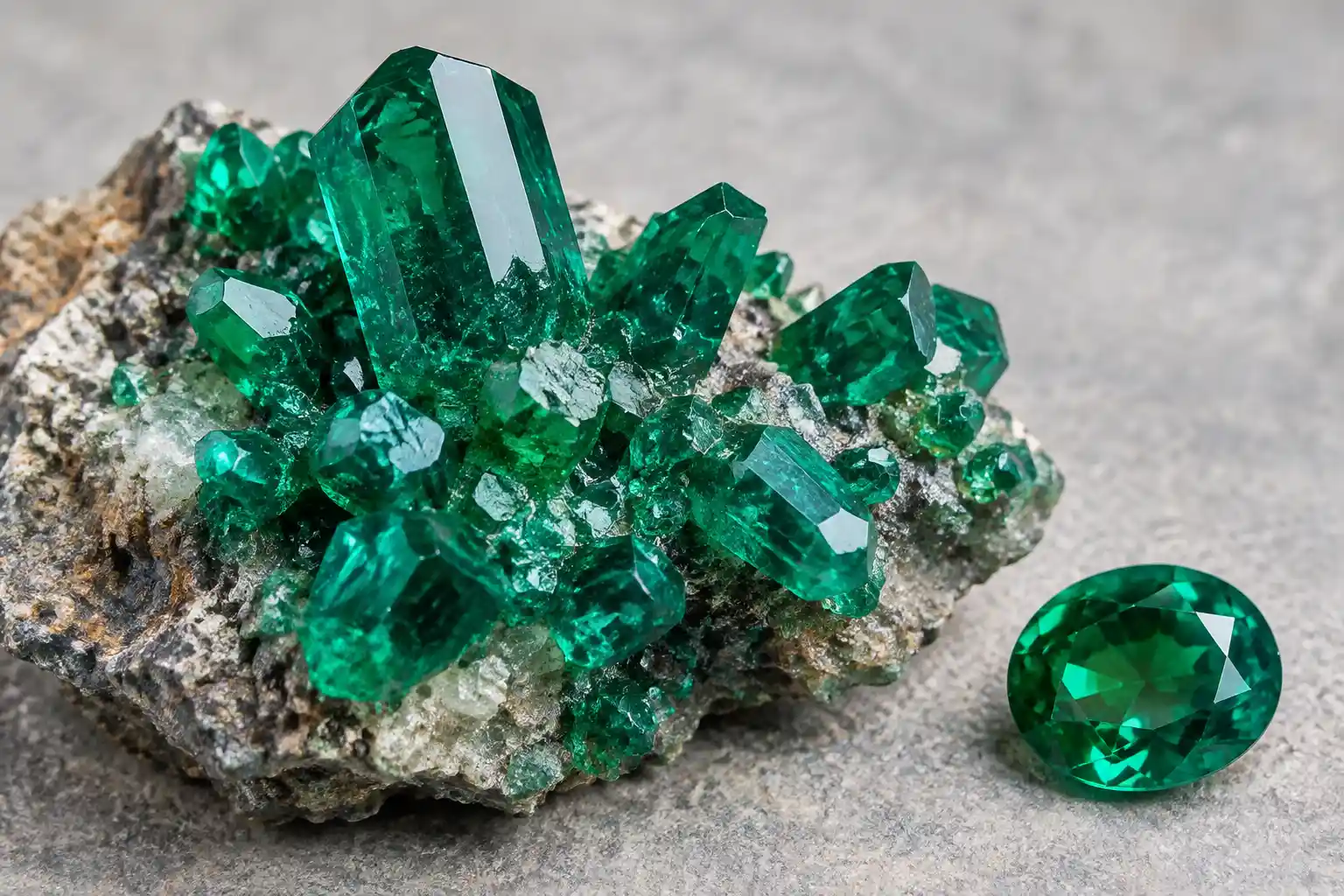
Dioptase Benefits: 11 Real Uses, Helpful Symbolism & Verified Facts, Safe Limits
Dioptase benefits begin with an extraordinary emerald-green to blue-green color, bright vitreous to sub-adamantine luster, well-formed crystals, copper-rich chemistry, and strong value as a collector mineral. Dioptase is a hydrated copper silicate, commonly written as CuSiO₃·H₂O, with a trigonal crystal structure and a Mohs hardness of about 5. It usually forms as a secondary mineral in oxidized copper deposits, where circulating fluids and changing near-surface conditions redistribute copper and silica into new mineral combinations.
Its color can be intense enough to invite comparison with emerald, yet dioptase is physically very different. The mineral is softer, brittle, and has perfect cleavage, making large transparent crystals far better suited to careful collecting than to exposed everyday jewelry. Small transparent pieces can be faceted, but cutters must balance color, clarity, cleavage, and weight retention while accepting that many attractive crystals are more valuable intact on matrix than reduced to gemstones.
These physical and geological qualities create genuine dioptase benefits in mineral collecting, gemological education, copper-deposit study, photography, faceting, identification, and personal symbolism. Modern spiritual traditions sometimes associate dioptase with compassion, emotional release, forgiveness, heart-centered awareness, or renewal. Those themes may be personally meaningful, but dioptase does not treat heart disease, trauma, depression, anxiety, blood disorders, or other medical conditions through ordinary wearing or handling.
11 Dioptase Benefits at a Glance
- Intense emerald-green to blue-green color gives dioptase exceptional visual impact.
- Bright vitreous to sub-adamantine luster makes well-formed crystals highly attractive for display.
- Oxidized copper-deposit formation provides valuable geological insight.
- Trigonal crystal forms make dioptase useful for mineralogical and crystallographic study.
- Classic localities provide strong collecting and provenance interest.
- Small transparent crystals can produce unusual faceted collector gems.
- Perfect cleavage offers an important lesson in the difference between hardness and toughness.
- Copper-rich chemistry helps students compare dioptase with other secondary copper minerals.
- Identification skills help separate dioptase from emerald, green glass, malachite, and other green substances.
- Natural crystal clusters can be excellent subjects for mineral photography and display.
- Modern symbolism can represent compassion, perspective, or renewal when kept separate from medical claims.
Vivid Copper-Green Color Is the Most Obvious Dioptase Benefit
Color is responsible for much of dioptase’s immediate appeal. Fine crystals can show intense emerald green, bluish green, or slightly darker green tones that remain vivid even in relatively small specimens. Copper is fundamental to this coloration, connecting the appearance directly with the mineral’s chemistry and with the oxidized copper environments in which dioptase typically forms. Unlike a pale green ornamental stone whose appeal depends heavily on size, a small dioptase crystal can create strong visual impact because saturation and luster concentrate within a compact crystal.
This color is one reason dioptase has historically been mistaken for or compared with emerald. The resemblance is superficial rather than mineralogical. Emerald is beryl colored mainly by chromium and/or vanadium, while dioptase is a hydrated copper silicate with different hardness, cleavage, density, crystal structure, and optical properties. That contrast makes dioptase benefits especially useful for anyone learning why color alone cannot identify a gemstone. Two green crystals may appear similar from a distance while behaving very differently under gemological examination.
Crystal Form and Luster Make Dioptase an Exceptional Display Mineral
Many of the strongest dioptase benefits belong to mineral collecting rather than jewelry. Dioptase commonly forms attractive modified rhombohedral or prismatic crystals whose glassy to nearly adamantine surfaces can appear exceptionally bright against pale calcite, dark host rock, or other contrasting matrix. Even relatively small crystals can become visually dramatic when they form dense clusters or line cavities.
Collectors often value intact crystal form more highly than cutting potential because faceting destroys the natural geometry and geological relationships that make the specimen interesting. A crystal perched on contrasting matrix can preserve information about formation sequence, associated minerals, cavity growth, and locality that disappears once the crystal is removed and polished. Surface condition also matters greatly. Sharp terminations, strong luster, minimal contact damage, attractive positioning, and well-preserved matrix can make a specimen much more desirable than another piece with deeper color but damaged crystals.
For anyone building a mineral collection, these dioptase benefits demonstrate why specimen quality cannot be evaluated using the same criteria applied to faceted jewelry.
Oxidized Copper Geology Gives Dioptase Scientific Value
Dioptase generally develops as a secondary mineral in oxidized zones of copper deposits, which gives it substantial geological importance. Near Earth’s surface, oxygenated water and changing chemical conditions can alter earlier copper-bearing minerals and redistribute their components through fractures, cavities, and porous rock. Under suitable conditions, copper and silica combine to form dioptase crystals rather than remaining in the original primary minerals.
This environment may also produce malachite, azurite, chrysocolla, calcite, cerussite, wulfenite, and numerous other secondary species depending on the chemistry of the deposit. A dioptase specimen can therefore represent one stage within a complex sequence of alteration rather than an isolated crystal-growth event. Associations on matrix are especially informative because one mineral may coat, replace, intersect, or grow over another.
These geological dioptase benefits transform an attractive green crystal into evidence of fluid movement, oxidation, chemical redistribution, and changing mineral stability. For students, the vivid color makes an otherwise technical topic much easier to visualize.
Famous Localities Add Provenance and Collecting Depth
The type locality for dioptase is the Altyn-Tyube deposit in present-day Kazakhstan, and the mineral’s formal name dates to the late eighteenth century. Later localities became equally important to collectors, with Tsumeb in Namibia particularly renowned for exceptional mineral specimens. Dioptase has also been documented in other copper districts across Africa, North America, and additional regions.
Locality creates several dioptase benefits because specimens from different deposits can vary in crystal size, habit, matrix, associated minerals, color, and overall appearance. A Tsumeb specimen may appeal because of its historic mine provenance and associated mineralogy, while an Altyn-Tyube example carries importance as material from the classic type area.
Reliable provenance therefore matters. A vivid green cluster sold without locality information can still be beautiful, but documented mine or district information adds geological context and collecting value. A person deciding where to buy dioptase should look for accurate locality descriptions, realistic photographs, crystal condition, repair disclosure, dimensions, and evidence supporting unusually important provenance rather than relying on generic rarity language.
Small Transparent Crystals Can Produce Unusual Faceted Gems
Faceting represents one of the more specialized dioptase benefits. Transparent crystals can yield bright green gemstones with strong luster and attractive saturation, but suitable rough is limited because many crystals are small, fractured, included, cleaved, or more valuable as intact mineral specimens.
A cutter faces several challenges. The Mohs hardness of about 5 is moderate, while perfect cleavage and brittle tenacity increase the risk of damage during sawing, preforming, faceting, setting, and later wear. Rough orientation also matters because the cutter wants to preserve green color and transparency while avoiding structural weakness. These constraints mean a fine faceted dioptase is often best understood as a collector gem rather than a stone selected for unrestricted daily jewelry.
The rarity of large transparent faceted examples adds interest, but size alone should not determine quality. Color, transparency, brilliance, cutting precision, structural stability, and absence of distracting fractures all matter. A small but vivid and well-proportioned stone may be far more appealing than a larger gem whose durability or optical performance is compromised.
Perfect Cleavage Makes Dioptase an Excellent Durability Lesson
Hardness is frequently misunderstood in gemstone discussions, and dioptase provides a particularly useful correction. A Mohs hardness around 5 means it is softer than quartz, topaz, sapphire, and many everyday jewelry stones. More importantly, dioptase has perfect cleavage and brittle behavior, which means a strong blow can separate the crystal along preferred structural planes.
These facts make durability one of the educational dioptase benefits. A gemstone’s ability to survive use depends on hardness, toughness, stability, inclusions, cleavage, cutting style, and setting design rather than a single number. A harder gem may still fracture under the wrong impact, while a softer but tougher stone may survive certain blows more successfully.
Dioptase earrings, pendants, or protected collector jewelry can be possible, but exposed everyday rings are substantially more vulnerable. Even loose specimens should be handled over a padded surface because dropping a crystal onto a hard floor can cause permanent cleavage damage. The best ownership strategy is therefore to respect what the mineral actually is rather than expecting emerald-like wear from an emerald-colored crystal.
Copper Chemistry Makes Dioptase Valuable for Mineral Education
Dioptase benefits students because its vivid green appearance offers a direct entry into copper mineral chemistry. Copper contributes striking blue and green colors to numerous minerals, but the exact shade and physical properties depend on the chemical structure surrounding the copper ions. Dioptase, malachite, azurite, chrysocolla, turquoise, and other copper-bearing substances can therefore look very different even though copper plays an important role in their appearance.
Comparing these minerals demonstrates why elemental composition alone does not determine every property. Crystal structure, oxidation state, associated anions, hydration, trace components, and growth environment all influence color, hardness, luster, cleavage, and density.
This also creates an important safety boundary. Copper inside a mineral structure does not make dioptase a nutritional copper source, and wearing the crystal does not deliver medically useful copper through the skin. Finished specimens can be handled normally, but mineral powders, cutting dust, or homemade crystal elixirs should not be treated casually simply because the mineral is natural.
Identification Separates Dioptase from Emerald and Other Green Stones
A small transparent dioptase crystal can resemble emerald strongly enough to demonstrate why systematic identification matters. Emerald is significantly harder and belongs to the beryl family, while dioptase has lower hardness, a different refractive index range, different density, perfect cleavage, and distinctive crystallographic features.
Green glass can also imitate vivid color, while other copper minerals may overlap in hue without sharing transparency or crystal habit. Visual appearance therefore provides an initial clue rather than a final answer. Professional testing may consider refractive behavior, specific gravity, crystal morphology, inclusions, spectroscopy, and other characteristics according to whether the specimen is loose, faceted, or still attached to matrix.
These identification-related dioptase benefits strengthen general gemstone literacy. Once a collector learns why emerald green does not mean emerald, it becomes easier to question similar assumptions involving red, blue, purple, or colorless stones elsewhere in the market.
Mineral Photography Benefits from Dioptase’s Color and Crystal Contrast
Mineral photography is another practical area where dioptase benefits become obvious. Saturated green crystals can contrast dramatically with white calcite, gray rock, dark cavities, or metallic associated minerals, creating photographs with strong depth and color even when the specimen itself is small.
Photographing dioptase accurately still requires restraint. Strong lighting, oversaturation, aggressive contrast, and altered white balance can push natural emerald green into unrealistic neon color. Depth of field is another challenge because crystals projecting from matrix occupy several focal planes simultaneously.
Accurate photography is especially important in online sales. A seller can make a specimen appear darker, greener, or larger than it actually is through lighting, cropping, and color adjustments. Collectors benefit when images show several views, include scale information, preserve realistic color, and reveal contact damage or repair rather than hiding it.
Modern Symbolism Often Focuses on Compassion and Emotional Perspective
Contemporary crystal culture commonly connects dioptase benefits with compassion, forgiveness, emotional release, heart-centered awareness, renewal, and letting go of painful experiences. The vivid green color helps explain these associations because many modern systems connect green gemstones with emotional or heart-related symbolism.
A responsible interpretation keeps those ideas metaphorical. Someone may use a dioptase specimen during journaling because it represents approaching a difficult relationship with greater compassion, or keep one near a workspace as a reminder not to let resentment control a decision. The mineral does not produce forgiveness automatically, and emotional change still requires reflection, boundaries, communication, support, and sometimes professional care.
Beliefs surrounding dioptase healing properties may extend these themes into physical heart health, trauma treatment, anxiety relief, blood pressure, or energetic cleansing. Such interpretations belong to spiritual practice rather than established medicine.
Safe Handling Preserves Both Specimens and Owners
Dioptase requires gentle physical care because of its softness, brittleness, and perfect cleavage. Valuable crystals should be handled over a padded surface, kept away from harder minerals, and protected from unnecessary impact. Lukewarm water and very gentle cleaning may be appropriate for stable pieces, but aggressive brushing, ultrasonic cleaning, steam, acids, harsh chemicals, and sudden temperature changes are poor default choices for fragile specimens.
Matrix pieces require additional caution because associated minerals may react differently from dioptase. A cleaning method that leaves one component unharmed can damage another, so important collector pieces are often safest when cleaned minimally.
Cutting or grinding also creates a different safety situation from ordinary display. Dioptase contains copper and silica, so mineral dust should not be inhaled or ingested. Wet methods, ventilation, eye protection, and appropriate workshop precautions are necessary when machining rough. Likewise, dioptase should not be dissolved, powdered for ingestion, or placed into drinking water as a homemade mineral remedy.
Conclusion
Dioptase benefits include exceptional green color, bright luster, attractive crystal form, copper-deposit geology, important locality history, specialized faceting, mineral education, identification practice, photography, collecting, and meaningful modern symbolism. Its visual resemblance to emerald may attract initial attention, but its true value lies in being a very different mineral with its own chemistry, structure, cleavage, and geological story.
The strongest dioptase benefits come from appreciating intact crystals, understanding their copper-rich formation, recognizing the difference between hardness and durability, and handling fragile specimens responsibly. Modern themes involving compassion, forgiveness, or renewal can add personal significance when they remain symbolic rather than medical.
FAQs
What are the main dioptase benefits?
The most verifiable dioptase benefits include mineral collecting, copper-deposit geology, vivid green color, crystallographic study, gemstone identification, specialized faceting, mineral photography, and educational value.
What is dioptase made of?
Dioptase is a hydrated copper silicate commonly written as CuSiO₃·H₂O. Copper is responsible for much of its characteristic emerald-green to blue-green color.
How hard is dioptase?
Dioptase has a Mohs hardness of about 5, making it substantially softer than quartz, sapphire, and diamond.
Is dioptase suitable for jewelry?
It can be faceted and used carefully in protected jewelry, but perfect cleavage and brittle behavior make it poorly suited to exposed everyday wear compared with tougher gemstones.
Is dioptase an emerald?
No. Dioptase and emerald can share vivid green color, but dioptase is a hydrated copper silicate while emerald is a chromium- or vanadium-colored variety of beryl.
Where is dioptase found?
Important occurrences include the type locality at Altyn-Tyube in Kazakhstan and famous deposits such as Tsumeb in Namibia, along with other copper districts around the world.
Why is dioptase valuable to collectors?
Strong color, sharp crystals, luster, locality, matrix associations, condition, crystal size, and specimen aesthetics can all make dioptase highly attractive to mineral collectors.
What does dioptase symbolize?
Modern symbolism commonly connects dioptase with compassion, forgiveness, renewal, emotional perspective, and heart-centered reflection.
Is dioptase safe to put in water for drinking?
Dioptase should not be used to prepare homemade drinking elixirs or ingested. It is a copper-bearing mineral, and mineral powders or dissolved components should not be treated as wellness products.
Does dioptase have healing benefits?
There is no established clinical evidence that dioptase treats heart disease, trauma, anxiety, depression, blood disorders, pain, or other medical conditions.
How should dioptase be stored?
Keep specimens protected from impacts, harder minerals, harsh chemicals, and unnecessary handling. Fragile crystal clusters are safest in stable display positions where they cannot fall or be rubbed against other specimens.
Dioptase benefits described as healing, emotional, heart-related, chakra, protective, or energetic effects remain spiritual and personal beliefs and should not replace qualified medical or mental-health care.