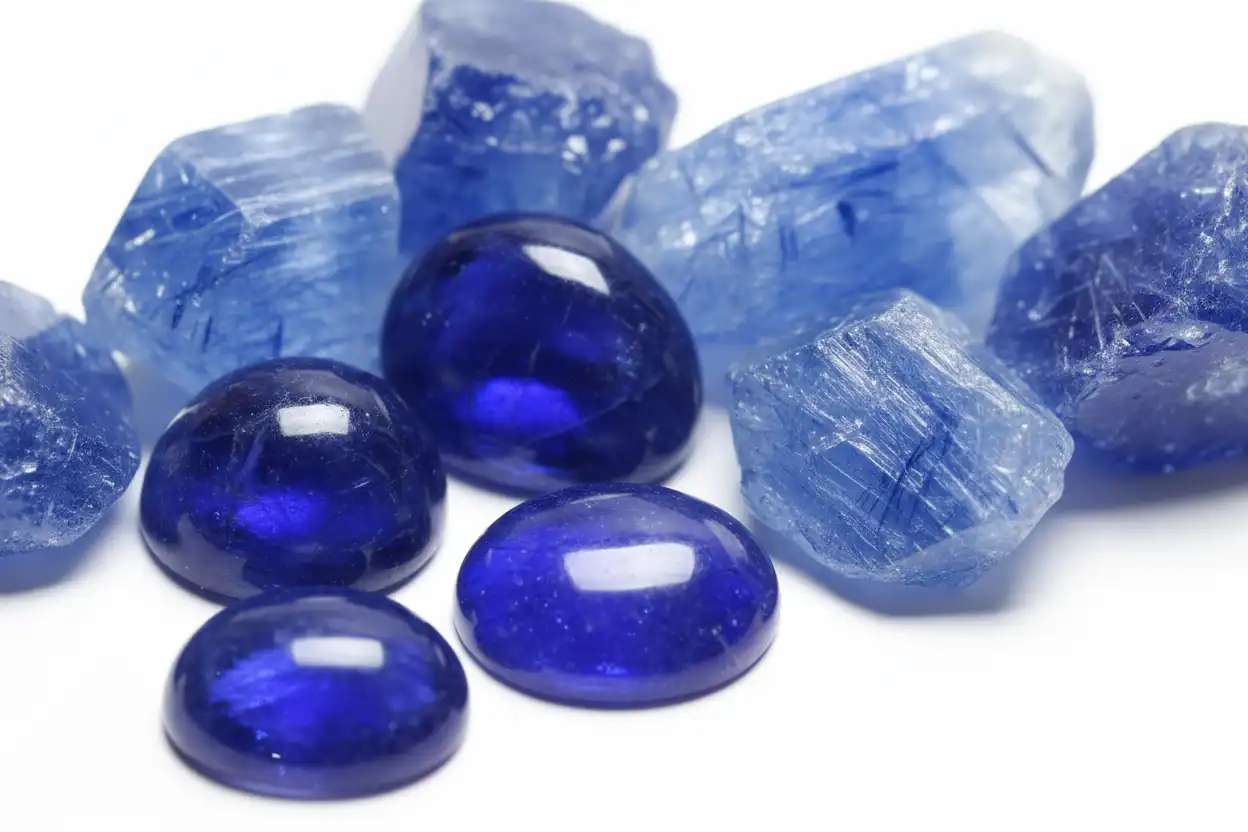
Dumortierite Meaning: Mineral Facts, History & Symbolism
Dumortierite meaning begins with a mineral that is frequently encountered not as a single transparent crystal but as blue, violet-blue, brown, or fibrous material dispersed through another mineral—especially quartz. Dumortierite is an aluminum borosilicate mineral commonly represented by the idealized formula Al₇BO₃(SiO₄)₃O₃. It crystallizes in the orthorhombic system and commonly occurs as fibrous, columnar, prismatic, radiating, or massive aggregates rather than the large transparent crystals expected from conventional jewelry gemstones. Its hardness can be relatively high, yet the practical behavior of dumortierite-bearing material depends strongly on texture, fractures, inclusions, grain boundaries, and the host in which the mineral occurs.
The blue color responsible for much of modern dumortierite meaning is likewise more complicated than a single pigment-like ingredient. Natural dumortierite may appear denim blue, royal blue, violet-blue, gray-blue, pinkish, reddish brown, brown, greenish, or nearly colorless depending on composition, trace elements, oxidation state, defects, grain size, associated minerals, and light interaction. Some commercial “dumortierite” is actually quartz containing abundant dumortierite inclusions, so a polished blue stone can be a multi-phase material rather than one chemically uniform dumortierite crystal.
Modern symbolism often associates dumortierite meaning with discipline, mental organization, patience, communication, persistence, self-control, learning, and maintaining perspective during complex tasks. Those themes are understandable because blue stones are widely linked with thought and communication in modern crystal traditions, while the mineral’s fibrous intergrowths can inspire metaphors involving organization and many components working together. They remain symbolic interpretations, not experimentally demonstrated neurological, psychological, or medical effects.
Within Gems Lore’s Gemstone Guides collection, this reference therefore separates three questions that commercial descriptions often merge: what dumortierite is, what material actually creates a blue polished specimen, and what later cultural or personal meanings people choose to attach to it.
Dumortierite at a Glance
| Property | Practical reference |
|---|---|
| Material identity | Aluminum borosilicate mineral |
| Idealized formula | Al₇BO₃(SiO₄)₃O₃ |
| Crystal system | Orthorhombic |
| Common colors | Blue, violet-blue, gray-blue, brown, reddish, pinkish, greenish, nearly colorless |
| Typical habit | Fibrous, columnar, prismatic, radiating, granular, massive aggregates |
| Transparency | Transparent in uncommon crystals to translucent or opaque in aggregates |
| Luster | Vitreous to silky depending on texture |
| Mohs hardness | Commonly around 7, with reported variation depending on material and direction |
| Specific gravity | Roughly in the low-to-mid 3s |
| Cleavage | Can be present but aggregate behavior often dominates polished material |
| Common ornamental form | Dumortierite-bearing quartz |
| Major geological setting | Aluminum-rich metamorphic rocks; also certain pegmatitic and hydrothermal contexts |
| Main identification caution | Blue dumortierite-bearing quartz is not the same thing as one pure dumortierite crystal |
| Common look-alikes | Sodalite, lapis lazuli, blue quartz, kyanite, lazulite, dyed materials |
| Symbolic associations | Discipline, organization, learning, communication, patience, persistence |
| Evidence boundary | Symbolism is interpretive rather than a scientifically demonstrated therapeutic effect |
The most important line in the table is common ornamental form: dumortierite-bearing quartz. Many polished pieces marketed under the mineral name are attractive precisely because fine dumortierite needles, fibers, or aggregates color a quartz-rich host. That does not make the stone falsely labeled in every commercial context, but mineralogical precision requires distinguishing the blue inclusion from the complete rock or gem material.
What Dumortierite Actually Is
Dumortierite is a boron-bearing aluminum silicate mineral with a structurally complex orthorhombic framework. Natural crystals can incorporate substitutions involving iron, titanium, magnesium, and other elements, while inclusions and associated minerals create additional variation beyond the simplified formula.
This compositional complexity matters because dumortierite is sometimes described as though every blue sample has one perfectly identical chemistry.
Natural minerals rarely behave that neatly.
One specimen may contain relatively discrete dumortierite crystals. Another may consist of tiny fibers intergrown with quartz. A third may be a fine-grained rock in which several mineral phases are difficult to separate visually.
Dumortierite meaning should therefore begin at the correct scale. The mineral species has one structural identity, while a commercial polished stone may represent an aggregate containing that species.
Dumortierite Versus Dumortierite Quartz
“Dumortierite quartz” or “dumortierite in quartz” generally describes quartz containing dumortierite inclusions or aggregates. The quartz can be colorless, white, translucent, or cloudy, while the included dumortierite creates blue, violet, or mottled zones.
That distinction is more than terminology.
Quartz has its own hardness, fracture, refractive behavior, and crystal structure. Dumortierite contributes color and inclusions but may occupy only part of the total volume.
A blue cabochon can therefore be predominantly quartz while looking visually dominated by dumortierite.
This is similar to other inclusion-rich gem materials where a host and an included mineral create one commercial appearance. The name used at retail may emphasize the visually important inclusion, but technical description should identify both when known.
A useful dumortierite meaning reference should never imply that every polished blue specimen is one solid crystal of Al₇BO₃(SiO₄)₃O₃.
How Dumortierite Forms
Dumortierite commonly develops in aluminum-rich rocks subjected to metamorphism and boron-bearing fluid activity. High-aluminum sedimentary or metamorphic precursors can provide abundant aluminum, while boron introduced or redistributed through geological fluids helps create the conditions necessary for dumortierite crystallization.
Temperature and pressure influence which aluminum-rich minerals are stable. Depending on composition and metamorphic conditions, dumortierite can occur with quartz, feldspar, mica, and other aluminous or boron-bearing minerals.
Some occurrences are associated with pegmatitic or hydrothermal activity, where chemically evolved fluids concentrate elements such as boron and interact with surrounding rocks.
The full geological relationships belong in dumortierite formation and deposit geology. For dumortierite meaning, the important point is that the mineral commonly records an aluminum-rich environment modified by heat, pressure, and boron-bearing geological processes.
Why Boron Matters
Boron is a key component of dumortierite’s structure and an important element in several gem and mineral families.
It behaves differently from major rock-forming elements such as silicon or aluminum because it can become concentrated in certain fluids and evolved magmas. Boron-bearing minerals can therefore provide evidence about fluid movement, metamorphism, and geochemical specialization.
This geological importance should not be transformed into a nutritional claim.
The boron bound inside dumortierite is part of a stable mineral structure. Wearing a dumortierite-bearing stone does not provide a controlled dietary boron dose, and the mineral should not be powdered or ingested for wellness purposes.
Composition tells geologists what participated in mineral formation.
It does not tell the human body what to absorb from a specimen.
Why Dumortierite Is Blue
Blue is the color most strongly associated with dumortierite, yet its origin can involve a combination of transition-element substitutions, charge-transfer effects, structural defects, and compositional variation rather than one universally simple cause.
Iron and titanium are important components in discussions of color in many dumortierite specimens, but the exact mechanism and dominant contributors can vary with material.
That makes statements such as “all blue dumortierite is blue because of one element” too rigid.
Grain size also changes perceived color. Fine fibers dispersed through pale quartz can create a soft denim-blue appearance, while denser aggregates appear deeper indigo or blue-violet.
Thickness matters as well.
A thin edge may transmit much more light than a thick cabochon, causing the same material to appear substantially lighter.
The dedicated dumortierite optical properties and color behavior page owns the deeper optical discussion.
Why Some Dumortierite Is Violet, Brown, or Pinkish
Dumortierite is not restricted to blue.
Compositional substitutions, iron and titanium states, manganese-related chemistry in some material, inclusions, oxidation, structural defects, and associated mineral phases can shift appearance toward violet, reddish brown, pinkish, gray, or other tones.
This variability matters when evaluating unusual specimens.
A brown dumortierite should not be rejected merely because it lacks the familiar blue associated with commercial cabochons. Likewise, a strongly pink or purple material should not automatically receive a rare variety label without analysis.
Color can guide investigation but should not replace mineral identification.
The same mineral structure can support more visual diversity than marketing categories imply.
Fibrous Texture Is a Major Visual Clue
Dumortierite commonly develops fibrous or columnar habits. In polished quartz-rich material, these fibers can appear as clouds, streaks, dense patches, branching bundles, or directional blue zones.
The texture can be more diagnostic than color alone.
Sodalite and lapis lazuli tend to produce different granular or massive patterns. Kyanite more commonly forms bladed crystals. Dyed quartz may show color concentrated in fractures rather than naturally intergrown blue fibers.
No one texture is definitive, but fibrous-to-columnar dumortierite within quartz creates a recognizable microstructural pattern when examined carefully.
That makes magnification particularly useful.
What Magnification Can Reveal
Under magnification, a visually uniform blue cabochon may resolve into colorless quartz containing countless blue needles, fibers, sprays, or compact aggregates.
That observation can immediately change how the object should be described.
The dumortierite microscope and inclusion notebook is the appropriate place for detailed grain-scale documentation, inclusion morphology, surface features, and host-inclusion relationships.
Magnification can also reveal fractures, polish lines, cavities, dye concentrations, matrix minerals, grain boundaries, and zones where dumortierite is much denser.
What a microscope usually cannot do by appearance alone is confirm the chemistry of every blue fiber.
Analytical methods may still be necessary when distinguishing fine dumortierite from other blue inclusions.
An Original Host-versus-Inclusion Observation Protocol
A useful specimen assessment starts by asking a different question from the usual “Is this dumortierite?”
Ask instead:
What proportion of the object appears to be the blue mineral, and what material surrounds it?
Photograph the specimen under neutral diffuse light. Record whether the blue is uniform or patchy. A perfectly even commercial blue should not automatically be assumed natural.
Inspect thin edges with transmitted light. In dumortierite-bearing quartz, pale or colorless host areas may become more obvious when light passes through them.
Use magnification on boundaries between blue and clear zones. Look for fibers, needles, radiating clusters, granular aggregates, or clouds embedded within a separate host.
Examine fractures. If blue becomes strongly concentrated only along cracks while unfractured areas remain pale, dyeing becomes more plausible. Naturally intergrown dumortierite should show mineral textures rather than simply liquid penetration pathways.
Inspect a chipped edge if one already exists. Determine whether blue fibers continue below the polished surface.
Compare hardness behavior only through existing wear rather than destructive scratch tests. Quartz-rich areas and dumortierite-rich areas may not wear identically.
Finally, record the identification at the appropriate level:
Commercial description: Dumortierite or dumortierite quartz.
Observed structure: Blue fibrous inclusions in a pale host.
Host identification: Quartz if adequately supported.
Blue-mineral identification: Dumortierite if supported by compatible optical or analytical evidence.
Treatment status: Natural color, treated, or uncertain.
This host-first protocol is more informative than treating every blue polished stone as chemically homogeneous.
A Source-Comparison Table for Common Dumortierite Claims
| Common claim | What can reasonably be retained | What needs correction or stronger evidence |
|---|---|---|
| “Dumortierite is a blue mineral.” | Blue is its best-known color | Natural dumortierite also occurs in other colors |
| “Every blue dumortierite stone is pure dumortierite.” | Dumortierite may dominate appearance | Many ornamental pieces are quartz containing dumortierite |
| “Dumortierite quartz is a separate mineral species.” | It is a useful commercial description | It is an inclusion-bearing material, not a new species |
| “Blue color proves dumortierite.” | Blue is compatible with the species | Sodalite, kyanite, lazulite, dyed quartz, and other materials can overlap visually |
| “All blue color comes from one element.” | Trace-element chemistry is important | Color mechanisms can involve several compositional and structural factors |
| “Dumortierite is always fibrous.” | Fibrous and columnar habits are common | Other habits and compact aggregates also occur |
| “Its boron improves the body.” | Boron is structurally present | Wearing the mineral does not provide a therapeutic boron dose |
| “Blue dumortierite improves communication scientifically.” | Communication is a common symbolic association | No established neurological mechanism follows from blue color |
| “Dumortierite makes students learn faster.” | Learning and discipline are common modern themes | No established evidence shows mineral contact increases academic performance |
| “A dark-blue stone is more powerful.” | Deeper saturation may increase visual appeal | Color intensity does not demonstrate stronger metaphysical effects |
| “Dumortierite has one exact hardness in every polished stone.” | The mineral is relatively hard | Aggregate and host behavior can vary |
| “A locality can be identified by shade.” | Some deposits produce characteristic textures | Color is not a geographic fingerprint |
This table highlights the main error surrounding dumortierite meaning: observations about blue color and fibrous texture are often extended into claims about purity, healing, learning, or provenance that require completely different evidence.
Dumortierite Versus Druzy Quartz
Druzy Quartz illustrates the difference between an inclusion-controlled material and a surface-growth texture.
Druzy quartz consists of numerous small quartz crystals covering a cavity or surface.
Dumortierite quartz generally consists of quartz containing dumortierite fibers, needles, or aggregates within the host.
One displays crystals outward from a surface.
The other commonly displays a blue mineral inside another material.
Both may be called quartz-based ornamental stones, but their textures preserve very different geological processes.
Dumortierite Versus Dravite
Dravite is a magnesium-rich tourmaline species. It commonly forms brown prismatic crystals and contains boron as part of its tourmaline structure.
Dumortierite also contains boron, but shared boron does not make the minerals closely equivalent.
They differ in structure, composition, symmetry, crystal habit, optical behavior, and common geological occurrence.
This comparison is particularly useful because elemental overlap can create false assumptions. Boron identifies neither mineral by itself.
A dumortierite-bearing quartz cabochon and a brown dravite prism preserve completely different mineralogical stories.
Dumortierite Versus Elbaite
Elbaite is another tourmaline-supergroup mineral and can produce blue, green, pink, red, colorless, and multicolored gem crystals.
Blue elbaite can therefore overlap visually with fine blue mineral material, particularly after cutting.
The distinction is structural and chemical.
Elbaite belongs to the complex tourmaline family, whereas dumortierite belongs to its own aluminum borosilicate structural type.
Their crystal habits differ dramatically in natural specimens, with elbaite commonly forming strongly striated tourmaline prisms and dumortierite commonly occurring as fibrous, columnar, or compact aggregates.
After polishing, testing becomes more important than color.
Dumortierite Versus Eclogite
Eclogite is not one mineral but a high-pressure metamorphic rock typically dominated by garnet and omphacitic clinopyroxene.
Dumortierite is a defined mineral species.
The comparison matters because both can occur in metamorphic discussions while representing very different classification levels.
A dumortierite crystal records the stability of one boron-bearing aluminum silicate.
An eclogite records an entire high-pressure mineral assemblage and the metamorphic conditions that produced it.
One mineral can be part of a rock.
A rock cannot be reduced to one formula.
This distinction is fundamental whenever polished geological materials are given simple commercial names.
Dumortierite Versus Common Blue Ornamental Stones
A blue polished dumortierite-bearing stone can be confused with sodalite, lapis lazuli, blue quartz, dyed quartz, kyanite-rich material, lazulite-bearing rock, or other blue ornamental materials.
Color alone performs poorly because all can occupy overlapping blue ranges.
Texture provides additional clues.
Lapis lazuli can contain calcite and pyrite.
Sodalite commonly appears granular and may include white veining.
Kyanite tends toward bladed crystal textures.
Dumortierite-bearing quartz commonly reveals blue fibrous or cloud-like material distributed through a quartz-rich host.
These are comparison clues, not absolute rules.
A valuable or unusual object deserves identification based on several properties rather than whichever blue stone it most resembles in one photograph.
Documented History of the Name Dumortierite
Dumortierite was named in honor of French paleontologist Eugène Dumortier. Its recognition as a distinct mineral belongs to the development of systematic mineralogy rather than to an ancient gemstone category.
That history matters because modern crystal descriptions sometimes attach long spiritual lineages to the species without demonstrating that historical objects were actually identified as dumortierite.
Humans have used blue minerals and blue stones for ornament, pigment, symbolism, trade, and ritual across many cultures, but “blue stone” is far too broad to establish dumortierite.
Lapis lazuli, azurite, turquoise, blue glass, sodalite, sapphire, kyanite, and numerous other materials can occupy historical blue-stone categories.
Responsible dumortierite meaning therefore distinguishes broad blue symbolism from documented identification of this particular mineral.
Why Ancient Blue-Stone Lore Cannot Automatically Be Assigned to Dumortierite
Older texts often classify stones according to appearance, locality, use, or cultural vocabulary rather than modern chemistry and crystallography.
A historical account of a “blue stone for wisdom” cannot simply be rewritten as dumortierite lore.
The object might have been a completely different material.
The problem becomes greater when polished blue stones lack obvious crystal habit. Without compositional testing, historical artifacts can be difficult to identify accurately even when they survive physically.
Modern dumortierite meaning does not lose credibility by acknowledging this limitation.
It becomes easier to distinguish documented mineral history from contemporary symbolism.
Why Discipline Became a Modern Dumortierite Theme
Discipline is one of the most common modern themes associated with dumortierite.
The connection is symbolic rather than chemical.
Its relatively restrained blue color, frequently ordered fibrous texture, and reputation in contemporary crystal practice have made it a popular metaphor for organization, self-control, persistence, and completing difficult work.
A person might keep a dumortierite-bearing stone beside a work area as a reminder to finish one task before opening another.
Someone studying might associate it with following a planned schedule rather than waiting for motivation.
The stone does not create discipline.
It can function as a physical cue for a behavioral rule the person has already chosen.
Learning Without the “Study Crystal” Myth
Dumortierite is frequently marketed as a stone for students, memory, learning, concentration, or intellectual performance.
There is no established scientific evidence that carrying the mineral increases memory formation, raises intelligence, accelerates learning, changes neurotransmitter activity, or improves examination performance.
That does not make the study symbolism useless.
A stone can become part of a consistent study ritual: place it beside the notebook, silence notifications, define one objective, work through a timed session, and record what remains unclear.
The effective components are the behaviors.
Dumortierite meaning can support the ritual as symbolism without claiming that aluminum borosilicate improves cognition.
Communication as a Blue-Stone Association
Blue gemstones and minerals are widely assigned communication themes in contemporary crystal traditions.
Dumortierite therefore often appears in descriptions involving speaking clearly, listening, expressing ideas, or maintaining composure during difficult conversations.
The color association is culturally understandable.
A practical symbolic use might involve asking three questions before responding:
What do I actually know?
What am I assuming?
What needs to be communicated clearly?
The specimen can remind someone to follow the sequence.
There is no established evidence that the mineral physically changes vocal function, language processing, speech disorders, or social cognition.
Patience and the Fibrous Aggregate
Dumortierite’s common fibrous and aggregate textures offer a more material-specific symbolism than generic blue-stone lore.
A polished piece may contain countless fine blue fibers distributed through quartz. No single fiber creates the whole pattern.
The visual result emerges from accumulation.
That makes patience and sustained effort particularly coherent themes within dumortierite meaning. Large outcomes can be built from many small contributions that are individually easy to overlook.
The mineral does not cause patience.
Its texture provides a useful analogy for it.
Organization Without Rigidity
The ordered appearance of fine fibers can inspire themes of organization, but natural dumortierite aggregates are rarely perfectly uniform.
Fibers intersect.
Color density changes.
Quartz interrupts blue zones.
Fractures cross the material.
Other minerals can appear between aggregates.
That makes the stone a more interesting symbol for organization than a perfectly regular manufactured pattern would be.
Effective organization does not require eliminating variation. It requires creating enough structure that complex components remain workable.
This interpretation grows from the actual material and avoids claiming that the crystal automatically organizes thought.
Throat and Third-Eye Chakra Associations
Modern crystal systems often associate blue dumortierite with the throat chakra because of communication symbolism and sometimes with the third-eye chakra because of learning, insight, or mental-focus themes.
These classifications vary between practitioners.
They are not mineralogical properties.
No established scientific test demonstrates that dumortierite opens, balances, activates, or clears a chakra, and no gemological laboratory uses chakra response to identify the mineral.
A person can use dumortierite in meditation or spiritual practice if that framework is meaningful to them, but the chakra association should remain clearly separated from physical claims about the stone.
Aluminum and Boron Are Not Medical Ingredients Here
Dumortierite contains aluminum and boron within a stable mineral structure.
Both elements have broader chemical and biological contexts, but those contexts cannot be transferred automatically to a mineral specimen.
Skin contact does not convert dumortierite into a controlled source of boron.
The aluminum in the crystal does not produce a therapeutic effect simply because it is present.
Likewise, silicon and oxygen in the structure do not create a detoxification mechanism.
Biological effects depend on chemical species, concentration, dose, exposure route, metabolism, and many other variables.
Mineral composition explains identification and formation.
It does not prescribe treatment.
Safe Ownership
An intact dumortierite or dumortierite-bearing quartz specimen can generally be handled normally with ordinary mineral-collection hygiene.
Physical behavior depends on the object.
Compact dumortierite-bearing quartz can be relatively durable because of the quartz host, while fractured fibrous aggregates or mixed rocks can contain local weak points. Hardness alone cannot describe every grain boundary, inclusion, crack, or associated mineral.
Dust-generating processing deserves greater care. Cutting, grinding, drilling, and sanding dumortierite-quartz material can generate silica-bearing mineral dust. Wet methods, suitable local extraction, eye protection, and respiratory controls are preferable to uncontrolled dry processing.
Direct-contact drinking-water elixirs are unnecessary. Natural specimens can contain several minerals, polishing compounds, dyes, coatings, adhesives, or contaminants not captured by the ideal dumortierite formula.
The site’s Disclaimer provides the broader boundary between general mineral information and individualized medical, toxicological, or occupational-safety advice.
Cutting Depends on Whether the Material Is Crystal or Aggregate
A cutter approaching a transparent dumortierite crystal faces different problems from one working with dumortierite-bearing quartz.
Single-crystal material requires attention to crystal orientation, fractures, inclusions, color direction, and polish.
Aggregate material requires attention to grain boundaries, quartz distribution, pattern orientation, local hardness differences, pits, cracks, and whether the blue fibers will remain visible after shaping.
The dumortierite cutting, orientation, and polish guide owns those technical choices.
For dumortierite meaning, the key insight is that lapidary treatment can change what part of the material dominates visually. A rough piece that appears mostly gray quartz may reveal an intense blue fiber network after one well-chosen cut.
Jewelry Suitability Depends on the Whole Piece
Dumortierite-bearing quartz is commonly fashioned into cabochons, beads, pendants, bracelets, and carvings because compact quartz-rich material can take a useful polish.
That does not mean every blue specimen behaves identically.
Fractures can weaken drill holes.
Fibrous or granular zones may undercut.
Matrix minerals can be softer than quartz.
A polished cabochon may contain hidden cracks along inclusion-rich zones.
The specialist dumortierite setting and wear engineering page addresses those mechanical questions.
A symbolic association with discipline does not make a fractured bead more resistant to impact.
Provenance Requires More Than a Shade of Blue
Dumortierite occurs in multiple geological regions, and similar denim-blue or violet-blue material can come from different deposits.
Color therefore cannot prove locality.
Polishing removes additional evidence by eliminating matrix, crystal habit, weathered surfaces, and host-rock relationships.
The dumortierite provenance disclosure checklist provides the stronger framework: original labels, mine information, supplier documentation, collection records, acquisition history, and consistent geological context should support locality claims when origin matters.
A beautiful blue pattern may be characteristic.
Documentation makes it provenance.
Conservation Should Preserve the Host Relationship
A natural dumortierite specimen can be important precisely because it shows how blue mineral aggregates occur within quartz, matrix, or another host.
Heavy polishing may improve decorative appearance while destroying that relationship.
Natural crystal terminations, fibrous bundles, alteration zones, associated minerals, and old labels can all have collector or scientific value.
The dumortierite specimen conservation record provides a way to record repairs, polishing history, detached fragments, fractures, labels, matrix loss, and other changes when preservation matters.
A specimen does not need to become a cabochon to become valuable.
Sometimes the unpolished boundary between blue dumortierite and pale host is the most informative part of the object.
A Better Way to Evaluate Dumortierite Claims
The evidence-first framework described on Gems Lore’s About page is especially useful for dumortierite because several different claims can hide behind one blue polished surface.
“Blue ornamental stone” is an observation.
“Quartz containing blue fibrous inclusions” is a structural description.
“Blue inclusions are dumortierite” is a mineral identification.
“From a named locality” is a provenance claim.
“Associated with discipline” is symbolism.
“Improves memory” is a psychological or medical-style claim requiring entirely different evidence.
One blue color cannot establish all of these simultaneously.
That separation is the foundation of responsible dumortierite meaning.
Frequently Asked Questions About Dumortierite Meaning
What is dumortierite?
Dumortierite is an aluminum borosilicate mineral commonly represented by the idealized formula Al₇BO₃(SiO₄)₃O₃. It typically occurs in fibrous, columnar, prismatic, or aggregate forms.
What does dumortierite meaning symbolize?
Modern dumortierite meaning commonly includes discipline, organization, patience, communication, learning, persistence, focus, and self-control. These are symbolic interpretations rather than scientifically demonstrated effects.
Is dumortierite always blue?
No. Blue is its best-known color, but dumortierite can also appear violet, brown, reddish, pinkish, gray, greenish, or nearly colorless depending on composition and material.
Is dumortierite quartz the same as pure dumortierite?
No. Dumortierite quartz generally refers to quartz containing dumortierite inclusions or aggregates. The complete polished stone can therefore contain substantial quartz.
What causes dumortierite’s blue color?
Its blue coloration is related to compositional and structural effects involving transition elements and charge-transfer mechanisms. Exact color causes can vary between specimens and should not always be reduced to one element.
Is dumortierite a tourmaline?
No. Dumortierite and tourmaline can both contain boron, but they belong to different mineral structures and species groups.
Is dumortierite the same as sodalite?
No. Sodalite is a sodium-rich feldspathoid mineral with different chemistry and structure. The two can overlap in blue color but differ in texture and physical properties.
Is dumortierite the same as lapis lazuli?
No. Lapis lazuli is a rock dominated by lazurite and commonly containing other minerals such as calcite and pyrite. Dumortierite is a defined mineral species and is often found included in quartz.
How hard is dumortierite?
Dumortierite is relatively hard, commonly around Mohs 7, although reported values and practical behavior can vary with direction, aggregate texture, host material, and associated minerals.
Is dumortierite good for jewelry?
Compact dumortierite-bearing quartz can be suitable for many ornamental uses. Individual pieces should still be checked for fractures, weak grain boundaries, drilling damage, and softer associated minerals.
Does dumortierite improve memory?
There is no established scientific evidence that carrying or wearing dumortierite improves memory, intelligence, academic performance, or neurological function.
Does dumortierite help with communication?
Communication is a modern symbolic association, especially because of the stone’s blue color. The mineral has not been shown scientifically to change speech or language function.
Does dumortierite have healing properties?
There is no established scientific evidence that dumortierite treats medical or psychological conditions through ordinary handling or wear.
Is dumortierite a throat chakra stone?
Many modern crystal systems associate blue dumortierite with the throat chakra and sometimes the third-eye chakra. These are spiritual interpretations rather than mineralogical classifications.
How can I tell if a polished blue stone contains dumortierite?
Look for natural fibrous, needle-like, cloud-like, or aggregate blue material distributed through a separate host such as quartz. Magnification, optical testing, spectroscopy, and compositional analysis can provide stronger identification when certainty matters.
Dumortierite Meaning Begins With Asking What the Blue Actually Is
The strongest dumortierite meaning comes from refusing to let one attractive blue surface answer every question at once. A polished cabochon may be sold simply as dumortierite, yet magnification can reveal a more interesting structure: blue fibrous mineral aggregates distributed through colorless or milky quartz, with each component contributing something different to the finished object.
That host-and-inclusion relationship provides a more specific symbolism than a generic “blue crystal” description. The blue pattern can represent organization without perfect uniformity, persistence through repeated small components, and the idea that a larger structure can contain many individual strands without losing coherence.
Those metaphors remain human interpretations.
The mineral itself records aluminum-rich geology, boron-bearing processes, crystallization, intergrowth, and compositional variation. Its blue color can be investigated through optics and chemistry. Its fibrous texture can be photographed and studied. Its locality can be documented. None of those physical facts demonstrates improved memory, automatic discipline, chakra activation, or medical healing.
Dumortierite meaning becomes more useful when each layer is kept in its proper place: mineral identity for science, provenance for documentation, historical claims for records, and symbolism for personal interpretation.
When a specimen raises a genuine material question—such as whether a blue polished stone is dumortierite-bearing quartz rather than another blue material, whether coloration follows natural fibers or possible dye penetration, or whether a locality attribution survives beyond a seller description—photographs, measurements, and supporting records can be submitted through Contact so the claim can be evaluated from the specimen rather than from color alone.