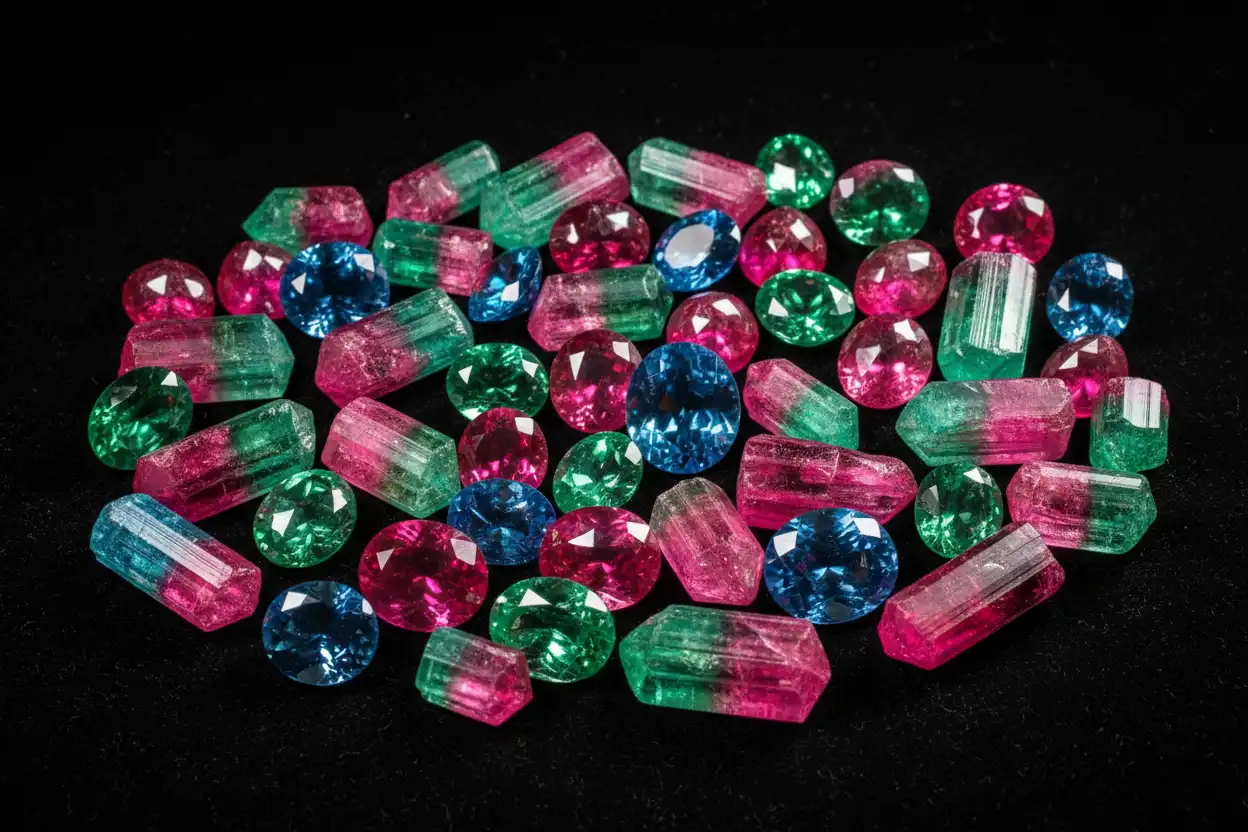
Elbaite Meaning: Mineral Facts, History & Symbolism
Elbaite meaning begins with one of the most chemically and visually diverse members of the tourmaline supergroup. Elbaite is a sodium-, lithium-, and aluminum-rich borosilicate tourmaline, commonly represented by the idealized formula Na(Li₁.₅Al₁.₅)Al₆(Si₆O₁₈)(BO₃)₃(OH)₃OH. It crystallizes in the trigonal system and can occur as colorless, pink, red, green, blue, yellow, violet, brown, or distinctly multicolored crystals. Some of the most recognizable tourmaline color varieties—including many rubellite, indicolite, verdelite, achroite, and watermelon tourmalines—are elbaite-rich material, although commercial variety names do not replace mineral identification.
That diversity is central to elbaite meaning because the stone can look radically different from one specimen to another while remaining within the same mineral species. A pale colorless prism, vivid pink crystal, blue-green copper-bearing gem, and green-rimmed watermelon slice may all be elbaite. The colors arise from trace elements, charge-transfer processes, structural defects, growth zoning, oxidation states, and in some cases later treatment. A dramatic color pattern is therefore an optical and chemical record before it becomes a symbolic story about emotional balance, transformation, creativity, communication, or integrating different parts of oneself.
Modern symbolism frequently connects elbaite meaning with emotional range, adaptability, openness, creativity, individuality, communication, love, and personal integration. Different colors may acquire additional associations, but none of those interpretations constitutes proof that elbaite alters hormones, treats anxiety, heals the heart, increases confidence, or transfers lithium through skin contact. Within Gems Lore’s Gemstone Guides collection, the useful approach is to establish the tourmaline species first, then examine color, formation, history, symbolism, and ordinary ownership without converting beautiful mineral chemistry into medical or metaphysical certainty.
Elbaite at a Glance
| Property | Practical reference |
|---|---|
| Material identity | Lithium-rich member of the tourmaline supergroup |
| Idealized formula | Na(Li₁.₅Al₁.₅)Al₆(Si₆O₁₈)(BO₃)₃(OH)₃OH |
| Mineral class | Complex borosilicate |
| Crystal system | Trigonal |
| Common colors | Colorless, pink, red, green, blue, yellow, violet, brown, multicolored |
| Transparency | Transparent to translucent; some material can be opaque |
| Luster | Vitreous |
| Mohs hardness | Approximately 7–7.5 |
| Cleavage | Poor to indistinct |
| Typical habit | Elongated prismatic crystals with strong longitudinal striations |
| Pleochroism | Common and often strong in colored transparent material |
| Famous zoning | Watermelon-style pink centers and green outer zones, plus many other combinations |
| Geological setting | Lithium- and boron-rich granitic pegmatites and related fluid systems |
| Common commercial variety names | Rubellite, indicolite, verdelite, achroite, watermelon tourmaline |
| Main identification caution | Color variety names do not prove elbaite composition |
| Symbolic associations | Integration, adaptability, creativity, emotional range, communication |
| Evidence boundary | Symbolism is interpretive rather than scientifically demonstrated therapy |
The range of colors makes elbaite meaning unusually prone to overclassification. A seller may treat every pink tourmaline as rubellite, every blue stone as indicolite, or every pink-and-green crystal as superior watermelon tourmaline. These labels can be useful descriptively, but species identification, color variety, treatment status, quality, and provenance remain separate questions.
What Elbaite Actually Is
Elbaite belongs to the tourmaline supergroup, one of mineralogy’s most compositionally complex families. Tourmaline structure contains several crystallographic sites capable of accommodating different elements, so species distinctions depend on which elements dominate particular positions rather than on color alone.
Elbaite is especially associated with lithium-rich, aluminum-rich compositions and sodium occupying an important structural site. Natural crystals commonly depart from the idealized formula through substitutions involving manganese, iron, magnesium, calcium, fluorine, vacancies, and other components.
Those substitutions are not impurities in the everyday sense of dirt accidentally trapped in an otherwise perfect material. They are part of how natural tourmaline chemistry works.
This complexity explains why elbaite can generate such a wide visual spectrum. Slight changes in composition or oxidation state can change optical absorption dramatically without changing the broad tourmaline framework.
Elbaite meaning should therefore begin with structural identity rather than with the color variety printed on a jewelry tag.
Elbaite Is Tourmaline, but Tourmaline Is Not One Mineral
“Tourmaline” is often used as though it were a single mineral species. In strict mineralogical usage, it refers to a supergroup containing multiple species.
Elbaite is one of them.
Dravite is magnesium-rich. Schorl is iron-rich. Uvite and several other members occupy different compositional positions. Natural tourmaline crystals can also show substantial zoning, so the composition may change from core to rim or along the length of one specimen.
This means a crystal can look like familiar elbaite while requiring analytical confirmation before an exact species assignment is secure.
Crystal habit can establish that a specimen is consistent with tourmaline.
Color can suggest particular compositions.
Chemistry establishes the species.
That distinction is particularly important for valuable or scientifically unusual material.
Why Lithium Matters to Elbaite
Lithium is an important component in ideal elbaite chemistry and is one reason the mineral is strongly associated with chemically evolved granitic pegmatites.
Lithium behaves incompatibly during much of ordinary magma crystallization, meaning it tends to remain concentrated in residual melts and fluids rather than being incorporated readily into many early-forming common minerals. As granitic magma evolves, elements such as lithium, boron, cesium, tantalum, beryllium, and others can become enriched in the remaining melt or associated fluids.
These chemically specialized environments can produce extraordinary tourmaline crystals.
Lithium’s geological significance should not be confused with pharmaceutical lithium.
Lithium atoms incorporated within a stable tourmaline structure do not turn a crystal into psychiatric medication. Wearing elbaite does not deliver a controlled pharmaceutical dose, and the presence of lithium cannot be used as evidence that the stone stabilizes mood.
Chemistry identifies the mineral.
Dosage and medicine are entirely different subjects.
How Elbaite Forms
Elbaite is especially characteristic of evolved granitic pegmatites rich in boron and lithium. Pegmatites are very coarse-grained igneous bodies that can crystallize from late-stage granitic melts and associated fluids enriched in volatile and incompatible elements.
These environments can provide several conditions favorable to remarkable elbaite crystals: abundant boron for tourmaline formation, lithium for elbaite-rich compositions, open pockets where crystals can grow freely, and chemically changing fluids capable of producing dramatic color zoning.
A single pegmatite can experience several stages of crystallization. Early tourmaline growth may differ compositionally from later zones, while fractures can admit new fluids and trigger additional mineralization.
That history can become visible inside one crystal.
The more detailed relationship among pegmatite evolution, fluid chemistry, pocket formation, replacement, and regional geology belongs in elbaite formation and deposit geology. For elbaite meaning, the essential point is that multicolor crystals often record changing geological conditions during growth rather than random decoration.
Why Elbaite Comes in So Many Colors
Elbaite color depends on how specific elements and structural states absorb visible light.
Manganese is especially important in many pink and red elbaites. Iron can contribute blue, green, yellow, or brown components depending on oxidation state and structural environment. Copper produces the famous intense blue-to-green colors associated with certain Paraíba-type tourmalines. Titanium, manganese, iron interactions, defects, radiation-related color centers, and other factors can further modify appearance.
No one element maps perfectly to one retail color.
A pink stone cannot be assigned a precise manganese concentration from appearance.
A blue stone is not automatically copper-bearing.
A bright green stone is not automatically chrome-bearing.
Color is a clue to investigate, not a complete chemical analysis.
The specialist elbaite optical properties and color behavior reference addresses these mechanisms without reducing them to one-element explanations.
Color Zoning Is a Growth Record
Elbaite is famous for spectacular zoning.
Some crystals change from colorless to pink along their length. Others contain a pink center surrounded by green, producing the familiar watermelon appearance in cross section. Crystals can also show blue-green, yellow-green, red-green, or several successive zones.
These patterns develop because the chemistry of the crystallizing environment changes through time.
As the crystal grows, newly added material records the composition and conditions of the fluid or melt available at that moment. Changes in manganese, iron, lithium, copper, oxidation state, or other variables can alter color in later growth zones.
A multicolored crystal is therefore a chronological structure.
The center generally formed before the rim.
That makes zoning one of the most scientifically interesting parts of elbaite meaning because the color pattern can be read as a sequence rather than merely admired as a palette.
What Is Watermelon Tourmaline?
Watermelon tourmaline is a descriptive commercial term for tourmaline showing a pink or reddish interior and a green outer zone, especially when a cross-sectional slice resembles watermelon flesh and rind.
Much classic watermelon material is elbaite.
The term is not a separate mineral species.
It does not guarantee geographic origin, treatment status, transparency, value, or a perfectly symmetrical pink-and-green pattern.
Some specimens have pale intermediate zones. Others show only partial green rims. Still others display complex multiple generations of color beyond the simple two-color commercial ideal.
The useful scientific observation is that the crystal grew through changing chemical conditions.
The fruit comparison comes afterward.
Rubellite Is a Color Variety, Not Another Species
Rubellite is a traditional gem trade term generally used for strongly pink, red, purplish-red, or related tourmaline of sufficient saturation to be considered more than ordinary pale pink material.
Many rubellites are elbaite.
However, the boundary between “pink tourmaline” and “rubellite” is not defined by one universal mineralogical measurement accepted across every seller.
Commercial terminology varies.
A laboratory can identify elbaite and describe color, but a seller may apply the rubellite label according to market convention.
That means a red stone should not be assigned higher scientific status merely because it receives a more prestigious variety name.
Elbaite meaning remains rooted in the mineral species.
Indicolite, Verdelite, and Achroite
Indicolite is commonly used for blue tourmaline, verdelite for green material, and achroite for colorless or nearly colorless tourmaline.
Elbaite can occur in all of these appearances.
Like rubellite, these are variety or trade descriptors rather than separate species.
The terms become especially complicated because tourmaline chemistry can cross species boundaries while retaining similar colors. A green tourmaline is not automatically elbaite simply because it is called verdelite.
A blue tourmaline may require chemical confirmation before a precise species label is justified.
This is why commercial names should be treated as the beginning of description rather than the end of identification.
Copper-Bearing Blue-Green Elbaite
Some of the most valuable and visually intense elbaite contains copper that contributes electric blue, turquoise, blue-green, or vivid green coloration.
These stones are associated commercially with Paraíba-type tourmaline terminology, although geographic and compositional naming conventions require care.
Copper-bearing color is analytically significant.
A vivid blue photograph does not prove copper.
Likewise, a copper-bearing tourmaline does not automatically prove one geographic origin because copper-bearing material has been found in more than one region.
This distinction is important enough that high-value origin and composition claims should be supported by appropriate gemological evidence rather than inferred from saturation alone.
Pleochroism Changes the Face-Up Color
Elbaite is anisotropic and can show strong pleochroism, meaning color or color intensity changes with viewing direction.
A green crystal may look much darker along one direction than another.
A blue elbaite can show different blue or green components depending on orientation.
A red stone may shift in saturation.
Cutters must account for these directional effects when positioning the table of a faceted gem.
The same property matters when photographing rough crystals. Rotating one specimen can produce a visibly different color without changing the light source.
That is an optical effect of crystal orientation.
It should not be interpreted as the stone changing according to a person’s emotions or energetic state.
Why Some Elbaite Is Almost Colorless
Achroite-like elbaite demonstrates that strong color is not required for species identity.
When color-causing trace elements and defects are present at sufficiently low levels or in forms that do not strongly absorb visible wavelengths, elbaite can appear nearly colorless.
Such material can be scientifically interesting precisely because commercial tourmaline imagery is dominated by saturated color.
A colorless crystal may still show strong tourmaline morphology, longitudinal striations, trigonal cross-sectional character, inclusions, and high transparency.
This reminds us that mineral identity is not a beauty category.
Elbaite remains elbaite whether vivid pink or almost invisible in color.
Diagnostic Traits That Matter
Elbaite identification should combine properties rather than rely on color.
Tourmaline’s trigonal symmetry, elongated prismatic habit, strong longitudinal striations, hardness around 7–7.5, poor cleavage, characteristic refractive behavior, birefringence, pleochroism, density, electrical properties under suitable conditions, inclusions, and chemical composition can all contribute.
In rough crystals, morphology is especially useful.
Natural tourmaline commonly forms three-, six-, or rounded-triangular cross-sectional outlines. Prism surfaces frequently carry strong striations parallel to crystal length.
Faceting removes much of that external evidence.
For a loose polished gem, refractive and spectroscopic testing becomes more important. Distinguishing exact tourmaline species can require chemical analysis when composition falls near species boundaries.
Identification should move from group to species, not from color to certainty.
What Magnification Can Reveal
Elbaite can contain liquid-rich inclusions, needles, mineral crystals, growth tubes, fractures, healed fissures, color zoning, internal strain, and other features.
Some inclusion patterns can be visually characteristic of tourmaline, while others may contribute evidence about geological environment or treatment history.
The elbaite microscope and inclusion notebook owns the detailed examination of those features.
Magnification can also clarify zoning boundaries. A color transition may follow growth structure cleanly, occur along fractures, or be associated with included material.
That distinction matters when evaluating whether color is intrinsic to crystal growth.
A microscope cannot automatically identify every inclusion or establish locality from appearance alone. Describing an inclusion accurately is stronger than assigning it a mineral species without supporting analysis.
An Original Elbaite Color-Zoning Evidence Protocol
A useful elbaite assessment should document color as a three-dimensional growth feature rather than as one attractive photograph.
Start with the complete crystal under diffuse neutral light. Record the colors visible along its length and across its width. Note whether zoning is longitudinal, concentric, sector-based, patchy, or fracture-controlled.
Photograph both sides. A strongly colored surface may hide a nearly colorless interior, while one side of a crystal can show a different apparent sequence from the other because of thickness and pleochroism.
If a natural cross section or pre-existing cut surface is available, photograph it perpendicular to crystal length. This can reveal whether green forms a genuine outer rim around a pink center or whether the apparent watermelon pattern exists only from one viewing direction.
Rotate the crystal under the same light source. Record directional changes caused by pleochroism separately from fixed growth zoning.
Then change the illumination while holding the crystal orientation constant. This helps separate light-source effects from crystallographic effects.
Inspect color boundaries under magnification. A natural growth zone should normally relate coherently to crystal structure. Color concentrated only in fractures raises different questions.
Record any treatment disclosure separately. A naturally grown crystal can still have had its color modified later.
Finally, classify the evidence into five layers:
Species: Is the material confirmed as elbaite?
Growth zoning: Does color follow genuine crystal growth?
Color mechanism: Is the contributing chemistry established or inferred?
Treatment: Is color natural, modified, or uncertain?
Origin: Is geographic provenance independently supported?
This protocol prevents one multicolored photograph from being used to prove composition, treatment status, and locality simultaneously.
A Claim-Reconciliation Table for Elbaite
| Common claim | What can reasonably be retained | What needs correction or stronger evidence |
|---|---|---|
| “Elbaite is lithium tourmaline.” | Lithium-rich chemistry is central to the species | Exact composition is more complex than one-element naming |
| “Every pink tourmaline is elbaite.” | Many pink tourmalines are elbaite | Species identification still depends on composition |
| “Rubellite is a different mineral.” | Rubellite is a recognized gem variety term | It is not a separate mineral species |
| “Watermelon tourmaline is always pink inside and green outside.” | That is the classic pattern | Natural zoning can be incomplete or more complex |
| “Every vivid blue tourmaline contains copper.” | Copper can produce exceptional blue-green material | Color alone does not establish copper |
| “Paraíba color proves Paraíba origin.” | Certain vivid colors are strongly associated commercially with copper-bearing material | Geographic origin requires separate evidence |
| “A multicolor crystal contains several tourmaline species.” | Composition can vary through one crystal | Color zoning does not automatically mean each zone is a different species |
| “Lithium in elbaite stabilizes mood.” | Lithium is part of ideal elbaite chemistry | Wearing the mineral does not provide pharmaceutical lithium |
| “Pink elbaite heals the heart.” | Pink supports modern love-related symbolism | No established cardiovascular or psychological treatment follows |
| “Blue elbaite improves communication.” | Blue stones commonly receive communication symbolism | No established neurological mechanism is demonstrated |
| “Tourmaline electricity proves healing energy.” | Tourmaline has real pyroelectric and piezoelectric behavior | Those effects do not validate metaphysical healing claims |
| “More colors mean more spiritual powers.” | Multicolor zoning creates rich symbolism | Crystal color count does not establish measurable therapeutic effects |
The table shows why elbaite meaning requires unusually careful boundaries. This mineral genuinely has remarkable chemistry, electrical behavior, pleochroism, and color zoning. Those scientific properties are interesting enough without being used as proof for unrelated healing claims.
Elbaite Versus Enstatite
Enstatite is a magnesium silicate orthopyroxene and provides a useful contrast with elbaite because both can appear green, brown, yellowish, or occasionally gem-quality.
Their mineral structures are unrelated.
Enstatite is a chain silicate with a much simpler idealized composition. Elbaite is a complex borosilicate tourmaline capable of extensive substitution and dramatic color zoning.
Natural crystal habits differ as well. Elbaite commonly shows strongly striated prismatic crystals with trigonal character, while enstatite belongs to the orthorhombic pyroxene system.
Color overlap should therefore never override structure.
Elbaite Versus Eclogite
Eclogite is a metamorphic rock rather than one mineral species.
A polished eclogite can display vivid red-and-green contrast, superficially recalling multicolor tourmaline combinations. The colors, however, come from different minerals—typically red garnet and green omphacitic clinopyroxene—rather than from compositional zoning inside one elbaite crystal.
That distinction is fundamental.
Elbaite can record chemical changes during the growth of one crystal.
Eclogite records the coexistence of several minerals during high-pressure metamorphism.
A similar color palette can therefore preserve entirely different geological information.
Elbaite Versus Epidote
Epidote can produce pistachio-green, yellow-green, dark green, and brown crystals that overlap visually with some green tourmaline.
Epidote belongs to a different silicate structure, has monoclinic symmetry, and commonly forms in metamorphic and hydrothermal environments unlike the specialized lithium-rich pegmatites strongly associated with elbaite.
Crystal habit helps in rough specimens.
Tourmaline’s longitudinally striated prisms and trigonal cross sections often differ noticeably from epidote’s typical habits.
After cutting, optical and compositional testing provide stronger separation than green color.
Elbaite Versus Dumortierite
Dumortierite is an aluminum borosilicate, so it shares boron and aluminum with elbaite while remaining a completely different mineral.
This is a useful chemical lesson.
Shared elements do not create the same structure.
Dumortierite commonly forms fibrous, columnar, or aggregate material and is widely recognized through blue dumortierite-bearing quartz. Elbaite more commonly forms distinct prismatic tourmaline crystals capable of exceptional transparency and color zoning.
Both can be blue.
Both contain boron.
Neither fact makes them interchangeable.
Cutting Elbaite Requires Choosing Which Color Wins
Multicolored elbaite creates difficult lapidary choices because cutting orientation determines which colors remain visible face-up.
A rough crystal may contain valuable pink in one region, green in another, and a nearly colorless section between them. Maximizing carat weight can preserve more material while placing the least attractive direction toward the observer.
Strong pleochroism adds another variable.
Dark material may need orientation that reduces optical path length through the most strongly absorbing direction. Pale stones may require greater depth to retain saturation.
The detailed tradeoffs belong in elbaite cutting, orientation, and polish. For elbaite meaning, the important point is that the colors visible in a finished gem reflect both natural zoning and human orientation.
Jewelry Suitability Is Good but Not Unlimited
Elbaite’s hardness of approximately 7–7.5 makes it suitable for many jewelry applications, but hardness does not eliminate every risk.
Tourmaline can contain fractures, liquid inclusions, growth tubes, thin color-zone boundaries, and internal stress. Long crystal sections can chip at exposed edges, while faceted gems can be vulnerable to sharp impact.
Setting pressure deserves care, especially around heavily included stones.
The elbaite setting and wear engineering reference addresses prong placement, edge exposure, protective settings, fracture visibility, and mechanical wear without turning this meaning page into a jewelry construction manual.
A symbolic association with adaptability does not make an included tourmaline mechanically indestructible.
Natural Specimens Can Preserve More Than a Faceted Gem
A well-formed elbaite crystal can preserve longitudinal striations, terminations, zoning, pocket contacts, attached matrix, associated minerals, etched surfaces, healed growth interruptions, and historic labels.
Cutting removes most of that information permanently.
The commercial temptation can be especially strong when a natural crystal contains transparent gem-quality zones. Yet a complete multicolor crystal from a documented locality may have collector or scientific significance greater than the potential polished yield.
The elbaite specimen conservation record provides a structure for documenting chips, repairs, detached fragments, polishing, cleaning, old labels, matrix changes, and other condition information.
Transparency does not automatically mean a crystal should be faceted.
Provenance Is Separate From Color
Some localities are famous for distinctive elbaite colors, habits, pocket assemblages, or crystal sizes. That familiarity can encourage origin guesses from appearance.
A pink-and-green crystal does not carry a geographic label inside its colors.
Similar zoning can occur in different pegmatite districts. Faceting removes matrix and crystal-surface evidence, while rough material can change hands many times before reaching a collector.
The elbaite provenance disclosure checklist provides the stronger hierarchy: original mine labels, collection cards, acquisition records, supplier documentation, associated minerals, and a coherent chain of custody should support locality claims.
Color can be characteristic.
Provenance requires documentation.
Documented History of the Elbaite Name
Elbaite takes its name from the island of Elba in Italy, a classic locality associated with important tourmaline specimens. The naming reflects mineralogical study of tourmaline compositions rather than ancient metaphysical classification.
Tourmaline itself has a much broader historical story. Colored tourmalines entered European trade under names derived from South Asian gem commerce, and before modern mineralogical testing, differently colored stones could be grouped according to appearance rather than exact composition.
The later identification of elbaite as a specific lithium-rich tourmaline species belongs to systematic mineralogy.
That historical sequence matters because ancient references to red, green, or multicolored stones cannot automatically be reassigned to elbaite.
A historical pink gem may have been tourmaline, spinel, sapphire, garnet, glass, or another material unless the object survives and can be identified.
Multicolor Tourmaline Does Not Prove Ancient “Rainbow Healing”
Elbaite’s dramatic zoning makes it tempting to attach universal ancient symbolism to every color combination.
Documentation should come first.
Human cultures have long assigned meaning to color, gemstones, amulets, and visually unusual natural materials. That broad truth does not establish a specific ancient tradition for watermelon elbaite, copper-bearing blue elbaite, or each modern trade variety.
Modern elbaite meaning can be described honestly as modern when evidence does not support an older lineage.
This does not diminish the stone.
Its geological history is already extraordinary: one crystal can preserve several stages of chemical evolution in visible color.
Elbaite Meaning and the Symbolism of Integration
Integration is one of the most material-specific themes that can be drawn from elbaite.
A multicolored crystal may contain pink, green, colorless, or blue zones without losing structural continuity. The appearance changes from one growth region to another, yet the specimen remains one crystal.
That makes elbaite a useful metaphor for holding several roles, emotions, or priorities without demanding that they become identical.
A person can use the stone as a reminder that consistency does not require uniformity.
The metaphor is strengthened by the actual growth zoning.
It does not require a claim that the mineral physically integrates the personality or heals psychological fragmentation.
Adaptability and Changing Growth Conditions
Elbaite crystals can record changing chemical environments during growth. A crystal that begins nearly colorless may later become pink or green as the available chemistry changes.
The crystal does not deliberately adapt.
Its structure incorporates what is thermodynamically and chemically available under changing conditions.
As symbolism, however, this provides a useful model for adaptability.
Changing circumstances do not always require abandoning the entire underlying structure. Sometimes new conditions become incorporated into continued growth.
This is a more precise elbaite meaning than simply calling the stone “transformational.”
Pink Elbaite and Love Symbolism
Pink and red elbaite are frequently associated with affection, compassion, emotional openness, self-respect, and romantic love.
These meanings arise largely from established cultural associations with pink and red.
They do not demonstrate that rubellite or pink elbaite alters cardiac function, treats grief, changes attachment patterns, or causes another person to feel affection.
A person may still use a pink crystal intentionally as a reminder to communicate with kindness or maintain self-respect within relationships.
The useful result comes from the chosen behavior.
The mineral provides the symbol.
Green Elbaite and Growth
Green elbaite is commonly associated with growth, renewal, nature, prosperity, or emotional balance.
Again, the connection is visually intuitive.
Green evokes vegetation and living systems in many modern symbolic traditions.
A practical interpretation might use green tourmaline as a cue to ask where steady improvement matters more than dramatic change.
That symbolic growth should not be converted into claims about cellular regeneration, fertility, metabolism, or accelerated biological healing.
Color is not medicine.
Blue Elbaite and Communication
Blue elbaite and indicolite are frequently associated with communication, calm expression, insight, or truthfulness.
These themes fit broader modern symbolism attached to blue gemstones.
There is no established evidence that wearing blue elbaite changes language processing, treats speech disorders, improves neurological communication, or automatically makes someone more truthful.
A useful symbolic practice could be simpler: before an important conversation, identify what is known, what remains uncertain, and what needs to be said clearly.
The stone can mark the intention.
The communication skill remains human.
Colorless Elbaite and Clarity
Colorless elbaite receives less commercial attention but provides an interesting symbolic counterpoint.
Without strong body color, the observer notices transparency, internal inclusions, crystal shape, and light behavior more directly.
That can inspire themes of clarity, simplicity, or reducing distractions.
There is no need to claim that achroite physically clears thoughts.
A colorless specimen can simply serve as a reminder to distinguish essential information from decorative noise.
This interpretation grows naturally from appearance without pretending the mineral alters cognition.
Watermelon Elbaite and Opposites
Watermelon tourmaline often receives symbolism involving balance between emotion and growth, inner and outer identity, heart and grounding, or different parts of the self.
The pink center and green rim make duality visually obvious.
The geological reality is equally useful: those colors record different growth conditions within one continuous crystal.
A person can interpret that as a reminder that internal and external states need not match perfectly in order to belong to one coherent life.
No chakra mechanism is required for the metaphor to work.
Chakra Associations
Modern crystal systems commonly assign pink and green elbaite to heart-centered symbolism, blue elbaite to the throat, and various multicolor specimens to several chakras at once.
These associations vary substantially among practitioners.
They are not mineralogical classifications.
A laboratory does not determine an elbaite species by chakra response, and there is no validated scientific instrument showing that different growth zones activate different anatomical energy centers.
People can incorporate elbaite into meditation or spiritual practice if those traditions are meaningful to them.
The claim should remain clearly identified as spiritual interpretation.
Tourmaline Electricity Is Real but Limited in What It Proves
Tourmaline can exhibit pyroelectric and piezoelectric behavior.
Temperature changes can produce electrical polarization, and mechanical stress can generate electrical responses. These properties are genuine and historically important in the scientific study of tourmaline.
They do not demonstrate metaphysical healing.
The measurable effect occurs under specific physical conditions and can be studied with instruments.
That does not establish that an elbaite pendant emits therapeutic energy, neutralizes negative emotions, blocks harmful electromagnetic fields, or magnifies intentions.
Real physics should not be used as a bridge to unrelated conclusions.
Lithium in Elbaite Is Not Mood Medication
Because elbaite contains lithium, some metaphysical descriptions imply that the stone naturally calms mood or produces effects analogous to lithium-based medication.
That inference is especially important to correct.
Pharmaceutical lithium uses specific soluble compounds administered at controlled doses and monitored because biological concentration matters.
Lithium locked inside tourmaline’s crystal structure is chemically and physically different.
Touching or wearing elbaite does not provide a controlled medical dose.
Elbaite meaning can include symbolic calmness without borrowing medical authority from the word lithium.
Safe Ownership
An intact elbaite crystal or finished gemstone can generally be handled normally using ordinary mineral-collection hygiene.
Tourmaline’s hardness provides good resistance to routine scratching, but individual crystals can still chip or break, particularly where fractures, thin edges, inclusions, or internal stress are present.
Dust-generating lapidary work is a different exposure environment. Cutting, drilling, grinding, and sanding should use appropriate wet processing, local extraction, eye protection, and respiratory controls rather than uncontrolled dry dust.
Direct-contact drinking-water elixirs are unnecessary. Natural specimens can contain matrix minerals, inclusions, polishing compounds, adhesives, surface coatings, or treatment residues that are not represented by the simplified elbaite formula.
The site’s Disclaimer provides the broader boundary between general mineral information and individualized medical, toxicological, or occupational-safety guidance.
How to Evaluate Elbaite Claims Without Flattening the Mineral
Elbaite deserves precise language because several different kinds of evidence can be present in one specimen.
“Pink-and-green striated prismatic crystal” is an observation.
“Tourmaline” is a mineral-group identification.
“Elbaite” is a species-level conclusion based on composition.
“Watermelon zoning” is a descriptive growth pattern.
“Copper-bearing” is a chemical claim.
“From a specific pegmatite district” is a provenance claim.
“Symbolizes integration” is interpretation.
“Treats anxiety” is a medical-style claim requiring medical evidence.
The evidence-first framework described on Gems Lore’s About page helps keep these categories separate. A beautiful multicolored crystal can support several observations at once, but one photograph cannot establish species, locality, treatment status, and therapeutic effect simultaneously.
Frequently Asked Questions About Elbaite Meaning
What is elbaite?
Elbaite is a lithium-rich member of the tourmaline supergroup. It is a complex borosilicate mineral famous for transparent crystals that can be colorless, pink, red, green, blue, yellow, violet, or multicolored.
What does elbaite meaning symbolize?
Modern elbaite meaning commonly includes integration, adaptability, creativity, emotional openness, communication, individuality, and accepting different aspects of oneself. These are symbolic interpretations rather than scientifically demonstrated effects.
Is elbaite the same as tourmaline?
Elbaite is one species within the tourmaline supergroup. Tourmaline includes several other species with different dominant compositions.
Is every pink tourmaline elbaite?
Many pink tourmalines are elbaite, but color alone does not prove the exact tourmaline species. Composition is the stronger basis for classification.
Is rubellite a form of elbaite?
Many rubellite gemstones are red or strongly pink elbaite. Rubellite is a gem variety term rather than a separate mineral species.
What is watermelon elbaite?
Watermelon tourmaline commonly describes elbaite with a pink or reddish center surrounded by a green outer zone. It is a color-zoning pattern rather than a separate mineral species.
What causes elbaite’s colors?
Manganese, iron, copper, titanium-related interactions, oxidation states, defects, radiation-related color centers, crystal thickness, and other structural or chemical factors can influence color.
Does elbaite show pleochroism?
Yes. Colored elbaite can display strong directional differences in hue or saturation because tourmaline absorbs light differently along different crystallographic directions.
Why does elbaite form in pegmatites?
Chemically evolved granitic pegmatites can concentrate boron, lithium, and other elements necessary for elbaite formation while also providing open pockets where large crystals can grow.
Is Paraíba tourmaline elbaite?
Much copper-bearing Paraíba-type tourmaline is elbaite, although exact classification and geographic terminology should be supported by appropriate gemological evidence.
How hard is elbaite?
Elbaite is approximately 7–7.5 on the Mohs scale, giving it useful scratch resistance for jewelry. Fractures and inclusions can still affect durability.
Does elbaite contain lithium?
Yes. Lithium is important in ideal elbaite chemistry. That does not mean wearing the mineral provides a pharmaceutical lithium dose.
Does elbaite have healing properties?
There is no established scientific evidence that elbaite treats medical or psychological conditions, alters hormones, provides lithium therapy, or causes healing through ordinary contact.
Is elbaite safe to wear?
Suitable elbaite is widely used in jewelry. Individual stones should still be protected from severe impact, extreme conditions, and inappropriate treatment depending on inclusions and construction.
How can I confirm a tourmaline is elbaite?
Tourmaline-group identity can often be supported through morphology and gemological testing, while exact elbaite classification may require compositional analysis when species certainty matters.
Elbaite Meaning Is a Record of Change Within One Crystal
The most distinctive elbaite meaning does not come from assigning a different supernatural property to every color. It comes from understanding how one crystal can preserve several stages of geological change without losing its underlying structural continuity.
A pink center and green rim can record different chemical conditions during growth. A nearly colorless section can precede a deeply saturated zone. Pleochroism can make one crystal appear different merely because the observer changes direction. A cutter can reveal one color while hiding another. The specimen’s appearance is therefore shaped by composition, time, orientation, and human presentation.
That makes integration and adaptability unusually coherent symbolic themes. Elbaite demonstrates that variation can exist within continuity. Different growth stages do not need to erase one another to become part of the same crystal.
The scientific boundaries remain equally important. Lithium is mineral chemistry, not medication. Copper can explain blue-green color without proving geographic origin. Pink can symbolize affection without healing the heart. Pyroelectricity is genuine physics without validating invisible therapeutic fields.
Elbaite is already remarkable as a mineral: complex, zoned, chemically variable, strongly pleochroic, and capable of producing some of the broadest color diversity found within a single gemstone species.
When an unusual tourmaline presents a genuine classification problem—such as a disputed elbaite assignment, uncertain copper-bearing claim, color zoning that may have been modified, or provenance that no longer matches surviving documentation—clear photographs, measurements, reports, and labels can be submitted through Contact so the material can be evaluated from its actual evidence rather than from its most marketable color name.