Ethiopian Opal Meaning: Properties, Uses & Symbolism
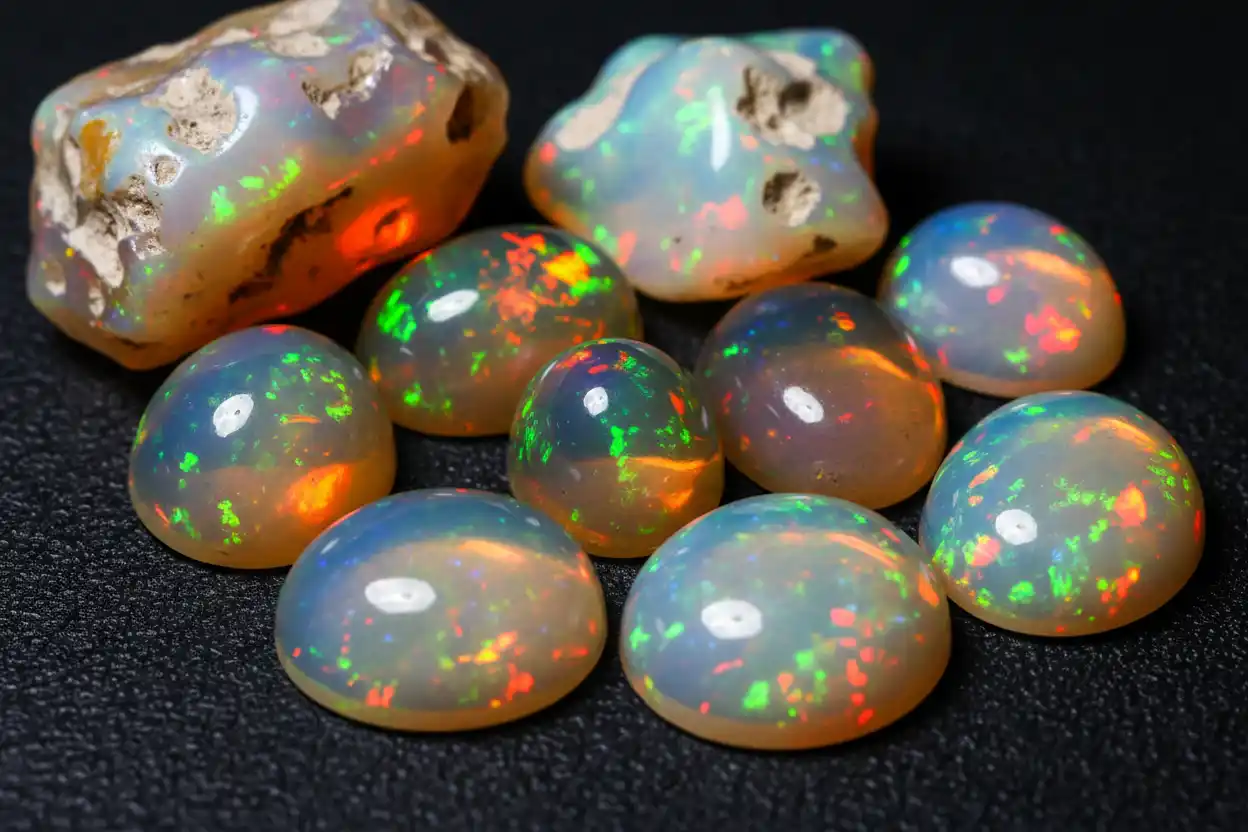
Ethiopian opal meaning begins with material identity. Ethiopian opal is not a separate mineral species from opal simply because it comes from Ethiopia; it is a geographic description for natural opal recovered from Ethiopian deposits, including important volcanic-hosted occurrences. Opal itself is a hydrated, non-crystalline form of silica commonly written approximately as SiO₂·nH₂O. Unlike quartz, it lacks a conventional long-range crystal lattice, so mineralogically it is generally described as a mineraloid rather than a crystalline mineral. Ethiopian material can occur as precious opal with play-of-color, common opal without play-of-color, transparent or translucent crystal-like material, pale body-color opal, darker material, and specimens associated with volcanic host rock.
That foundation matters because Ethiopian opal meaning is often reduced to color symbolism or generalized claims about creativity, emotion, luck, or transformation. Those interpretations can be discussed as modern cultural or personal symbolism, but they do not explain the physical material. The measurable story involves silica, water, internal structure, volcanic geology, optical interference, porosity, inclusions, and variable stability. Readers who want other material-first references can explore the broader Gemstone Guides while keeping geographic origin, mineral identity, treatment status, and symbolic interpretation separate.
Ethiopian Opal Meaning at a Glance
| Feature | Grounded reference |
|---|---|
| Material | Natural opal from Ethiopian deposits |
| Mineralogical type | Hydrated amorphous silica mineraloid |
| General composition | SiO₂·nH₂O |
| Crystal system | None in the conventional crystalline sense |
| Common appearance | White, cream, yellowish, transparent, translucent, orange, brown, gray, or darker body colors |
| Play-of-color | May show red, orange, yellow, green, blue, violet, or combinations |
| Mohs hardness | Commonly around 5.5–6.5 |
| Cleavage | None; fracture is typically conchoidal to uneven |
| Important behavior | Many Ethiopian opals are hydrophane and can absorb liquids |
| Geological context | Important deposits occur in volcanic sequences |
| Identification limit | Hydrophane behavior alone does not prove Ethiopian origin |
| Symbolic interpretation | Modern reflective associations, not measurable mineral properties |
| Ownership concern | Protect from avoidable impact, contamination, extreme conditions, and dust-producing processing |
The phrase Ethiopian opal meaning therefore covers more than a colorful gemstone. It refers to a material whose appearance can change dramatically with lighting, viewing angle, internal ordering, body transparency, absorbed liquids, and treatment. Those variables are why a photograph can be useful for documentation but insufficient for establishing every important claim about a stone.
What Ethiopian Opal Actually Is
A specimen called Ethiopian opal should satisfy two separate ideas: it must be opal, and its geographic provenance must credibly connect it to Ethiopia. The first question is mineralogical or gemological. The second is a provenance question. One does not automatically answer the other.
Precious opal displays play-of-color because its internal silica structures can interact with visible light. In suitable material, relatively ordered microscopic silica particles and the spaces between them create optical conditions that separate light into spectral colors. The visible result can appear as pinfire, broad flashes, patches, rolling color, mosaics, or other patterns depending on structure, cut, lighting, and viewing direction. Common opal lacks this distinct play-of-color even though it remains opal.
Ethiopian opal meaning is also complicated by the wide variation within Ethiopian material itself. Pale translucent hydrophane opal from one deposit should not be treated as physically identical to every Ethiopian specimen from another locality. Body color, porosity, transparency, inclusions, host rock, stability, and optical character can vary. Geographic shorthand is useful, but it should not erase the natural diversity within the material.
Questions about seller selection and transaction evidence belong separately in buying Ethiopian opal, while this page remains focused on foundational Ethiopian opal meaning rather than becoming a purchasing guide.
How Ethiopian Opal Forms
Ethiopian opal is strongly associated with volcanic geological environments. Silica-bearing fluids can move through porous volcanic rocks, fractures, cavities, and altered layers. As chemical and physical conditions change, silica-rich material can accumulate and eventually form opal within available spaces. Repeated fluid movement, host-rock alteration, weathering, and local geochemistry can influence the texture and quality of the resulting material.
Some well-known Ethiopian opal deposits occur within layered volcanic sequences where opal-bearing horizons developed between or within altered volcanic rocks. The precise geological history matters because it influences matrix, inclusions, porosity, and specimen morphology. An opal still attached to host rock can preserve useful geological context, whereas a polished cabochon may retain little visible evidence of its original setting.
This geological framework also explains why Ethiopian opal meaning should not be based only on a gem’s finished appearance. A polished stone may look similar to opal from another part of the world even though its geological history differs. The detailed deposit science, host-rock relationships, and formation mechanisms are better treated in Ethiopian opal formation and deposit geology rather than duplicated in a foundational meaning reference.
Why Ethiopian Opal Shows Play-of-Color
Play-of-color is structural rather than mystical. When microscopic silica particles are arranged with sufficient regularity, visible light interacting with that internal structure can be diffracted and interfered with in ways that separate wavelengths. Different viewing angles change the optical path, so red, green, blue, orange, and other spectral colors may appear, disappear, or move across the stone.
The size and arrangement of the internal structure influence which colors are visible. Red play-of-color generally requires structural spacing capable of interacting with longer visible wavelengths, while smaller-scale ordering can favor shorter wavelengths such as blue and green. A single Ethiopian opal may display several colors because its internal organization is not perfectly uniform throughout the stone.
Body color is a separate concept. An opal can have a pale, yellowish, transparent, gray, orange, brown, or dark background while also displaying play-of-color. The background modifies visual contrast but does not itself create the spectral phenomenon. More detailed treatment of transparency, body color, optical behavior, and directional effects belongs in Ethiopian opal optical properties and color behavior.
Hydrophane Behavior Is Important—but Easy to Misinterpret
Many Ethiopian opals encountered in the gem trade are hydrophane, meaning their porous structure can absorb water or other liquids. When water enters those pores, transparency, apparent body color, and play-of-color can temporarily change. A previously milky-looking stone may become much more transparent when wet, and its spectral display may weaken, shift, or become harder to see until the material dries.
This behavior is useful evidence, but it creates two common mistakes in discussions of Ethiopian opal meaning. First, hydrophane behavior does not by itself prove that an opal came from Ethiopia. Porosity is a material characteristic, not a geographic passport. Second, soaking a stone should not be treated as a routine way to “activate,” improve, or permanently enhance its color. Absorbed liquids can temporarily modify appearance and may introduce contaminants into porous material.
Oils, dyes, fragrances, cosmetics, household liquids, and dirty water can be especially problematic because hydrophane opal may absorb substances other than pure water. Once foreign material enters pore spaces, changes may not reverse as cleanly as ordinary wetting. This is a physical property of porous opal, not evidence that the stone is absorbing emotional or spiritual “energy.”
Diagnostic Traits: What Supports an Identification
Ethiopian opal meaning is more useful when readers understand what can and cannot be inferred from observable traits. Opal commonly has relatively low refractive properties compared with many crystalline gemstones, modest specific gravity, hardness below quartz, no cleavage, and conchoidal to irregular fracture. Precious material may show recognizable play-of-color, while common material may not.
Microscopy can reveal internal features such as color concentrations, fractures, cavities, included mineral grains, host-rock remnants, growth-related structures, and possible evidence of treatment. It can also help document surface-reaching features that may absorb dyes, oils, smoke-related residues, or other substances. Yet microscopic appearance alone does not necessarily establish geographic origin.
A more systematic magnification workflow belongs in the Ethiopian opal microscope inclusion notebook. Where origin or treatment has significant financial consequences, a qualified gemological laboratory may be needed. This reference does not claim that photographs can establish mine origin, treatment status, or laboratory-grade identification.
Original Ethiopian Opal Photo and Claim Checklist
A useful Ethiopian opal record should separate what the owner can observe from what still requires evidence. The table below is designed to prevent common jumps from appearance to unsupported claims.
| Label or observation | What can reasonably be recorded | What should not be assumed |
|---|---|---|
| “Ethiopian opal” | Seller documentation, invoices, labels, visual characteristics | Geographic origin is proven by appearance alone |
| “Welo opal” | Exact trade wording used by seller | Precise mine or deposit is established |
| “Wollo opal” | Regional attribution stated in documentation | Every Ethiopian hydrophane opal is from the same locality |
| “Hydrophane” | Reversible absorption-related behavior documented carefully | Hydrophane behavior proves Ethiopia |
| “Natural black Ethiopian opal” | Dark body appearance under defined lighting | Dark color is natural and untreated |
| “Smoked opal” | Treatment disclosure if provided | All dark Ethiopian opal has been smoke treated |
| “Dyed opal” | Unusual color concentrations or seller disclosure | Color treatment is proven from a photograph alone |
| “Crystal opal” | High transparency or translucency with play-of-color | Material is crystalline in the mineralogical sense |
| “Fire opal” | Orange, yellow, or reddish body color if present | Geographic origin or play-of-color is proven by the term |
| “Untreated” | Seller or laboratory statement | Absence of visible treatment proves untreated status |
| “Stable opal” | Current condition, crack history, storage observations | Future freedom from crazing or damage is guaranteed |
| “Investment grade” | Weight, appearance, documentation, report details | Future appreciation or resale liquidity is guaranteed |
| “Healing opal” | Cultural or seller claim can be documented | A medical effect has been demonstrated |
| “Water activated” | Appearance changed after liquid absorption | Water creates or restores metaphysical power |
This checklist highlights a central principle of Ethiopian opal meaning: a descriptive term can be useful without being conclusive. “Hydrophane,” “crystal opal,” “Welo,” “black,” and “untreated” answer different questions and require different levels of evidence.
Welo, Wollo, Crystal Opal, and Fire Opal: Names Need Context
“Welo” is widely encountered in the international gem trade, while “Wollo” is also used for the Ethiopian region associated with major opal production. The different spellings can create the impression that they describe different gem species or separate material categories. They do not. A seller’s use of either spelling should be treated as a geographic or trade attribution whose precision depends on the documentation supporting it.
“Crystal opal” creates another misunderstanding. In gem terminology it generally refers to opal with substantial transparency or translucency, often with visible play-of-color. It does not mean the material has suddenly become a crystalline mineral. Opal remains non-crystalline at the mineralogical scale relevant to its classification.
“Fire opal” usually describes opal with yellow, orange, or reddish body color, although usage varies across markets. The term does not inherently mean Ethiopian origin and does not guarantee play-of-color. Likewise, “black opal” refers primarily to dark body tone, not automatically to one country, one deposit, or one treatment status.
For stones where locality claims matter, preserve invoices, dealer notes, old labels, laboratory reports, and collection records. The Ethiopian opal provenance disclosure checklist provides a more detailed framework for keeping documented origin separate from assumption.
Ethiopian Opal in Modern Gem History
Ethiopia has become an important source in the modern opal trade through discoveries from more than one geological area. Material from Shewa attracted early attention, and later production from the Wollo region substantially expanded the availability and international visibility of Ethiopian precious opal. Those deposits also brought hydrophane behavior into much wider discussion among dealers, cutters, collectors, and jewelry buyers.
This history matters because Ethiopian opal meaning sometimes gets flattened into the idea that all Ethiopian opal is one uniform commercial product. It is not. Different deposits and individual specimens can show different body colors, transparency, porosity, matrix relationships, durability behavior, and play-of-color.
The history also demonstrates why provenance matters. A geographic label is more meaningful when supported by traceable documentation than when inferred from appearance. An attractive hydrophane opal may be consistent with material commonly sold as Ethiopian, but visual compatibility is not equivalent to authenticated origin.
Ethiopian Opal Meaning in Modern Symbolism
Modern symbolic interpretations often associate Ethiopian opal meaning with creativity, emotional expression, imagination, adaptability, hope, or the idea of seeing more than one possibility in a changing situation. The shifting play-of-color makes those metaphors easy to understand: a stone that reveals different colors as it moves naturally lends itself to symbolic themes of perspective and change.
That symbolism can be used responsibly. Someone might keep an opal near a journal as a reminder to reconsider a problem from several angles, or use its changing appearance as a metaphor for separating immediate impressions from a more complete view. In that context, Ethiopian opal meaning functions as a personal reflective framework.
What it should not become is a scientific claim. There is no established gemological evidence that Ethiopian opal predicts the future, attracts a specific relationship, cures emotional distress, regulates hormones, improves neurological function, treats anxiety or depression, or changes physical health. The site’s Disclaimer explains the broader boundary between educational mineral information and health, financial, or other professional advice.
Water Content Does Not Make Ethiopian Opal Medicinal
Because opal contains structural and molecular water, some symbolic descriptions imply that it can “hydrate,” “detoxify,” or regulate fluids in the human body. That conclusion does not follow from mineral chemistry. Water contained within a silica structure does not function like drinking water, and wearing an opal does not transfer meaningful hydration to the body.
The same rule applies to silica. Silicon and oxygen are fundamental parts of the material, but touching Ethiopian opal does not provide nutritional silica or a medically useful dose of any constituent element. Mineral composition is not a prescription.
Ethiopian opal meaning can therefore remain visually and culturally rich without turning chemistry into medicine. There is also no reason to ingest opal, place fragments in drinking water, or prepare crystal elixirs. Reflective symbolism does not require consuming the material.
Safe Ownership of Ethiopian Opal
Normal handling of an intact Ethiopian opal is different from cutting, grinding, sanding, or drilling it. Finished stones and stable specimens can generally be handled as decorative mineral materials, but mechanical processing creates fine silica-bearing dust. Dry dust generation should be avoided, and lapidary work requires appropriate dust-control practices and professional safety measures.
Opal’s moderate hardness also does not make it impact-proof. It lacks cleavage, but it can still fracture or chip, and some specimens may develop cracks from pre-existing stress, dehydration-related changes, mechanical shock, or unfavorable handling. Setting design therefore matters for jewelry exposed to repeated impact. Those mechanical considerations belong in Ethiopian opal setting and wear engineering.
Hydrophane material adds a different ownership issue because liquids can enter the stone. Routine soaking, exposure to oils, colored liquids, fragrances, and chemical mixtures should not be treated as experiments or spiritual practices. Long-term storage, display conditions, documentation, and specimen preservation are covered separately in Ethiopian opal specimen conservation and record keeping.
Cutting also presents specialized decisions involving orientation, play-of-color, porosity, inclusions, shape retention, and fracture risk. Those questions are addressed in Ethiopian opal cutting, orientation and polish rather than expanded into an incomplete lapidary manual here.
Meaning Does Not Determine Price
Bright red play-of-color, attractive patterns, transparency, size, condition, treatment status, body color, and provenance can all influence how Ethiopian opal is evaluated commercially, but symbolic significance does not establish market value. A stone described as spiritually “powerful” is not therefore more valuable in a gemological sense.
Pricing also varies too much for a foundational Ethiopian opal meaning page to provide a responsible shortcut. Quality differences within the material are substantial, and the market may distinguish stones by color pattern, brightness, treatment, stability, size, cutting quality, and documentation. Those commercial questions belong in the dedicated Ethiopian opal price investigation rather than being compressed into a symbolic reference.
This separation helps buyers avoid a common mistake: confusing an emotionally compelling description with evidence of material quality.
Comparing Ethiopian Opal With Other Mineral References
Ethiopian opal meaning becomes clearer when compared with minerals that may be equally striking but structurally very different. Euclase meaning concerns a crystalline beryllium aluminum hydroxide silicate with defined crystallography and prominent cleavage. Its physical behavior and geological identity are fundamentally different from amorphous hydrated silica.
Erythrite meaning concerns a soft hydrated cobalt arsenate mineral whose vivid pink-to-red color arises from a completely different chemical system. Erythrite and Ethiopian opal can both be visually dramatic, but their chemistry, hardness, formation, durability, and handling considerations have little in common.
These contrasts are useful because symbolic markets often group visually attractive minerals together under similar themes such as creativity, transformation, protection, or emotional balance. Shared symbolism does not make their mineralogical identities interchangeable.
What Ethiopian Opal Meaning Can—and Cannot—Tell You
A grounded Ethiopian opal meaning reference can explain that the material is opal from Ethiopian deposits, why precious examples show play-of-color, how volcanic settings contribute to formation, why hydrophane behavior matters, how trade terminology can create confusion, and where symbolism should be separated from measurable properties.
It cannot authenticate geographic origin from a photograph. It cannot prove that a dark stone is naturally colored, establish treatment status from a seller’s silence, guarantee long-term stability, determine exact market value, or predict how an individual will emotionally respond to wearing the stone. Those questions require provenance, gemological testing, commercial evidence, or personal experience depending on the claim.
Gems Lore’s broader approach to distinguishing measurable gemological information from interpretation is described on About Gems Lore. Readers who encounter a disputed identification, unusual locality claim, treatment question, or factual issue can provide the relevant documentation through Contact Gems Lore.
FAQ
What is the basic Ethiopian opal meaning?
The basic Ethiopian opal meaning is material-first: it is natural opal originating from Ethiopia, often associated with volcanic deposits and, in many commercially important examples, hydrophane behavior. Modern symbolism may connect it with creativity, perspective, or adaptability, but those associations are not measurable mineral properties.
Is Ethiopian opal a separate mineral species?
No. Ethiopian opal is a geographic description, not a separate mineral species. It is opal whose provenance is attributed to Ethiopia. Individual Ethiopian opals can differ substantially in body color, transparency, porosity, inclusions, and play-of-color.
Why does Ethiopian opal change appearance when wet?
Many Ethiopian opals are hydrophane and can absorb water into microscopic pore spaces. That can temporarily change transparency, body appearance, and play-of-color. The effect is physical and should not be interpreted as spiritual activation.
Does hydrophane behavior prove an opal is Ethiopian?
No. Hydrophane behavior can support a material description but does not independently establish geographic origin. Provenance requires documentation or appropriate expert evaluation.
Are Welo opal and Wollo opal different gemstones?
The terms commonly refer to opal associated with the Wollo region of Ethiopia, with “Welo” widely used as a trade spelling. They do not represent separate mineral species. A precise locality claim still depends on documentation.
Is Ethiopian opal naturally black?
Some Ethiopian opal can have darker natural body colors, but dark appearance alone cannot establish whether a specific stone is naturally colored or modified. Treatment disclosure and, where necessary, laboratory examination are important for consequential claims.
Is Ethiopian opal safe to wear?
A properly finished stone can be worn, but opal is not exceptionally hard and can chip or fracture under impact. Hydrophane material also deserves protection from unnecessary contact with oils, dyes, fragrances, and other liquids that may enter its pores.
Does Ethiopian opal have healing properties?
No scientifically established property of Ethiopian opal demonstrates that it treats physical or mental-health conditions. It can be used as a symbolic object or personal reminder, but that use should remain separate from medical claims.
Understanding Ethiopian Opal Without the Myths
The strongest Ethiopian opal meaning begins with a material that is already extraordinary without supernatural additions. It is hydrated amorphous silica formed in distinctive geological environments, capable in precious examples of producing spectral color through microscopic internal order. Many Ethiopian stones add hydrophane behavior to that story, allowing liquids to alter their appearance temporarily and creating identification, treatment, and ownership questions that deserve careful interpretation.
Its human meaning can coexist with those facts. Shifting color can become a personal metaphor for perspective, creativity, or adaptability without being presented as a physical force. Geographic labels can preserve important provenance without being inferred casually from appearance. Commercial descriptions can be evaluated without confusing symbolism with quality or price. When mineral identity, documented history, and reflective interpretation remain clearly separated, Ethiopian opal meaning stays connected to the real material—and the real material is compelling enough on its own.