Ethiopian Opal Healing Properties: 11 Real Claims, Gentle Traditions & Safe Limits
Ethiopian opal healing properties are commonly described through themes of creativity, emotional expression, confidence, adaptability, self-reflection, joy, relationship awareness, motivation, intuition, spiritual contemplation, and renewal. Its dramatic play-of-color makes it especially easy to associate with imagination and change, but Ethiopian opal has not been demonstrated to regulate emotions, stimulate creativity neurologically, balance hormones, improve eyesight, enhance fertility, treat depression or anxiety, relieve pain, or heal disease. Most commercially important Ethiopian precious opal is also hydrophane, meaning its porous structure can absorb water, temporarily changing its transparency and appearance and sometimes creating durability concerns. Scientifically, opal is hydrated amorphous silica, conventionally represented as SiO₂·nH₂O. It does not possess a true crystal system because its silica structure lacks the long-range crystalline order of minerals such as quartz.
11 Ethiopian Opal Healing Claims Shaped by Color, Change, and Reflection
- Creativity and imaginative thinking
- Emotional expression
- Confidence and self-expression
- Adaptability during change
- Self-reflection and greater awareness
- Joy and appreciation of positive experiences
- Relationship awareness and communication
- Motivation to begin something new
- Intuition and reflective decision-making
- Spiritual contemplation
- Renewal after major transitions
These eleven themes are genuine parts of contemporary opal symbolism, but that does not make them scientifically verified healing properties. The Ethiopian opal benefits people describe can often be reframed into practical behaviors such as brainstorming, journaling, preparing for a conversation, reviewing a decision, or creating a deliberate transition ritual.
Ethiopian Opal Mineral Facts: Hydrated Silica, Play-of-Color, Hardness, and Hydrophane Behavior
Opal is a hydrated form of amorphous silica commonly written as SiO₂·nH₂O, with variable water content rather than one fixed stoichiometric amount. Because it lacks the repeating long-range atomic arrangement that defines a crystalline mineral, opal is generally described as a mineraloid. It therefore has no conventional crystal system and does not form true crystals comparable with quartz, beryl, or tourmaline.
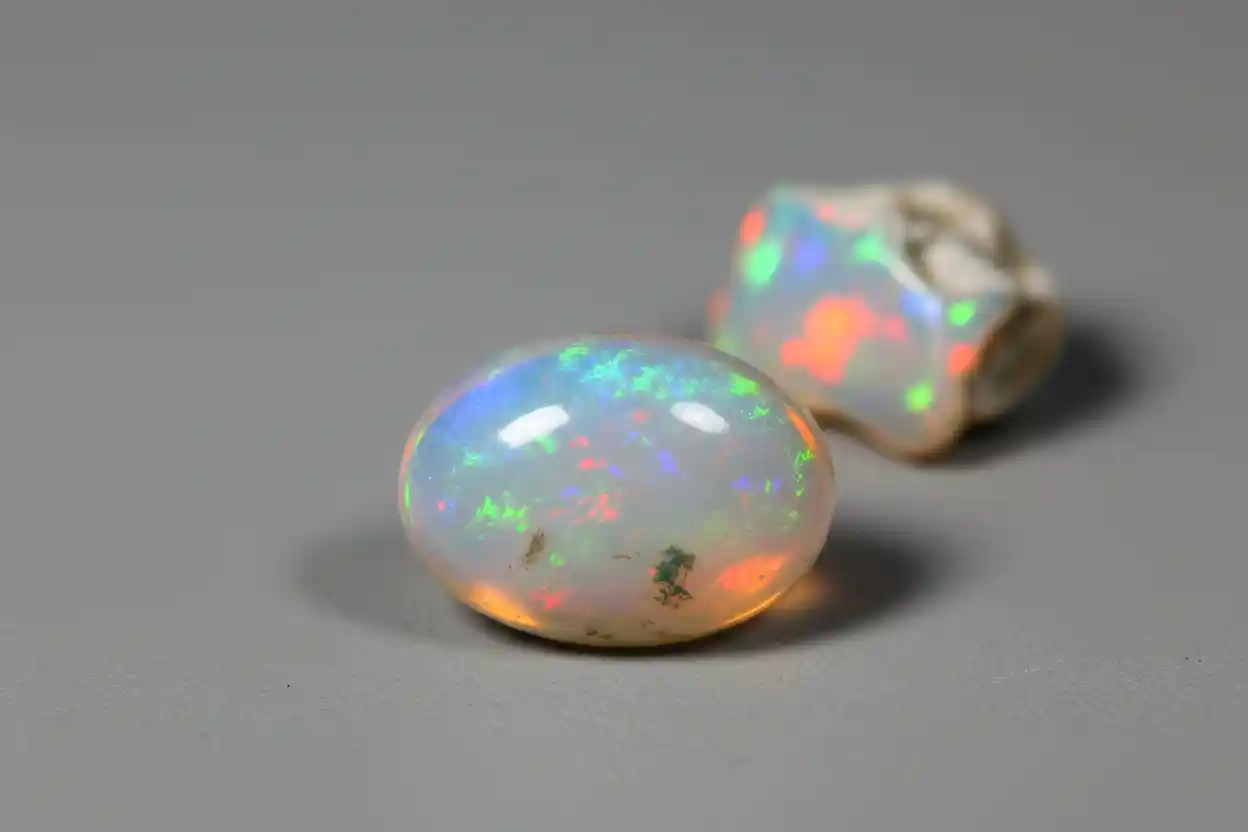
Precious opal displays play-of-color when its internal arrangement of silica spheres and void spaces interacts with light so that different wavelengths are diffracted at different viewing angles. The resulting flashes can appear red, orange, yellow, green, blue, violet, or combinations of several colors. Common opal lacks significant play-of-color even though it has the same general silica-water composition.
Ethiopian opal can have white, cream, yellow, orange, reddish brown, brown, black, gray, or nearly colorless bodycolor. Transparency ranges from transparent to opaque. Some material displays broad flashes, pinfire, rolling flash, honeycomb-like patterning, or other play-of-color arrangements prized in the gem trade.
Opal usually falls around Mohs 5.5 to 6.5. That makes it significantly softer than quartz, topaz, sapphire, ruby, and diamond, all of which can scratch it. It has no true cleavage, but it is brittle and commonly breaks with conchoidal to uneven fracture. Thin edges, exposed cabochons, and stones with internal cracks require particular care.
The defining practical feature of much Ethiopian opal, especially material from Wollo, is hydrophane behavior. Hydrophane opal is porous enough to absorb water readily. As water enters the pore structure, a stone may become more transparent, lose or change its apparent play-of-color, darken, or otherwise change appearance. These effects may reverse as it dries, but water absorption and drying can also contribute to cracking in susceptible stones. This is why water advice for Ethiopian opal must be very different from advice for quartz or agate.
Ethiopian Opal Discovery, Wollo and Shewa Sources, and Its Modern Gem History
Ethiopia has become one of the world’s major opal-producing countries, but the commercially important Ethiopian opal trade is modern rather than ancient. Notable precious opal was reported from Ethiopia’s Shewa region during the final years of the twentieth century. A much larger discovery in Wollo, also commonly written Welo in the gem trade, later transformed global opal supply because the deposits produced substantial quantities of bright precious opal with vivid play-of-color.
Wollo material became particularly significant because much of it is hydrophane. This property differs from many familiar Australian precious opals and affects identification, treatment detection, cutting, cleaning, and jewelry care. Hydrophane structure can also make Ethiopian opal receptive to dyes, smoke treatment, impregnation, and other modifications, so unusual bodycolors deserve careful evaluation.
Ethiopian opal forms in volcanic geological settings. Silica-bearing fluids move through volcanic rocks and deposit opaline silica in cavities, fractures, and other spaces. Layers and nodules can develop under changing conditions, and the resulting structure may produce common or precious opal depending on how the silica is organized.
There is no formal type locality for “Ethiopian opal” because the term describes opal from a geographic source rather than a separate mineral species. Likewise, modern Ethiopian precious opal should not automatically inherit every legend associated with opal from ancient Greece, Rome, India, or other historical settings. The Ethiopian opal meaning used today developed around a modern gem source even though opal as a wider gemstone family has a much older cultural history.
Creativity, Emotional Expression, and Confidence Claims
1. Creativity as a Deliberate Brainstorming Cue
Ethiopian opal’s shifting colors make creativity one of its most intuitive contemporary associations. The gemstone has not been shown to increase creative cognition through its silica structure or play-of-color. A practical ritual is to place the stone beside a notebook and use it as the signal for ten minutes of unrestricted idea generation before evaluating anything. The potentially useful effect comes from giving creative work protected time rather than from the opal changing brain activity.
2. Emotional Expression Through Structured Journaling
Some practitioners describe Ethiopian opal as helping emotions come to the surface. The stone cannot extract suppressed feelings or regulate emotional chemistry. It can instead be paired with a journal prompt such as, “What am I feeling that I have not said clearly?” Writing the answer can make an unclear emotional state easier to examine. The stone provides symbolism; language and reflection provide the actual process.
3. Confidence and Self-Expression
Colorful opal is often linked with individuality and confidence. Wearing it cannot biologically increase self-esteem or eliminate social anxiety. Someone can use the gemstone as a reminder before a presentation, meeting, or conversation to identify the message they want to communicate, rehearse the opening sentence, and decide what outcome is under their control. Preparation makes self-expression more reliable than relying on a crystal effect.
Adaptability, Self-Reflection, and Joy Claims
4. Adaptability During Change
Because opal’s appearance shifts dramatically with angle and light, it readily becomes a metaphor for adapting to changing circumstances. The gemstone cannot make someone psychologically flexible by itself. During a transition, use it as a prompt to separate what has changed permanently from what can still be adjusted. Identifying one workable response turns adaptability into behavior rather than metaphysics.
5. Self-Reflection and Greater Awareness
Ethiopian opal is sometimes described as revealing hidden aspects of the self. There is no evidence that it uncovers unconscious information through a mineral mechanism. A reflective practice can still use the stone as an object associated with honest self-review. Ask what pattern has repeated recently, what part you contributed, and what response you want to change next time. The insight arises from examination, not from the opal transmitting information.
6. Joy and Appreciation of Positive Experiences
The flashes of color in precious opal can be visually engaging, and many users associate the stone with joy. Looking at an attractive gemstone may genuinely be pleasurable, but that is different from claiming it medically improves mood. A simple practice is to connect the stone with noticing one enjoyable or meaningful experience each day. The ritual trains attention toward experiences the person actually had instead of attributing happiness to the stone.
Relationships, Motivation, and Intuition Claims
7. Relationship Awareness and Communication
Opal has long accumulated symbolism involving love, desire, loyalty, and emotion. Ethiopian opal is therefore often incorporated into modern relationship rituals. A gemstone cannot repair trust, create attraction, or control another person’s feelings. Used more realistically, it can cue a conversation check: What happened? What do I need? What assumption have I not confirmed? What boundary or request needs to be stated clearly?
8. Motivation to Begin Something New
Ethiopian opal is sometimes presented as a stone for fresh starts. It does not generate physical energy or motivation. A useful ritual is to associate the gemstone with starting rather than finishing. When the stone is placed in a work area, spend five minutes on the next action before deciding whether to continue. Small initiation rituals can reduce the resistance that often keeps a larger project untouched.
9. Intuition and Reflective Decision-Making
Some crystal traditions say opal strengthens intuition. This does not mean the stone provides hidden information, predicts outcomes, or improves extrasensory perception. A safer interpretation is to use it while distinguishing immediate feelings from available evidence. Write down the instinctive response, then list facts that support or contradict it. Intuition becomes one input into a decision rather than a supernatural certainty attributed to the gemstone.
Spiritual Contemplation and Renewal Claims
10. Spiritual Contemplation
The shifting play-of-color of Ethiopian opal can serve as a compelling meditation object. Some practitioners interpret the changing flashes as symbols of inner complexity, possibility, or spiritual insight. A person can observe the stone while meditating, praying, or contemplating values without assuming that it alters consciousness through a scientifically measurable energy.
11. Renewal After Major Transitions
Modern crystal culture frequently associates Ethiopian opal with transformation and renewal. After a move, breakup, career change, loss, or other transition, the gemstone can symbolize the point at which a new routine begins. A useful exercise is to identify what has ended, what should be retained, and what action will define the next stage. The stone marks the transition; it does not cause recovery or transformation.
Ethiopian Opal Chakra Associations: Sacral Creativity, Heart Themes, and Crown Symbolism
Contemporary crystal systems often associate Ethiopian opal with several chakras because the stone can display many colors. Orange and fiery specimens are frequently connected with the sacral chakra and themes of creativity, emotional expression, and pleasure. Green flashes may be linked symbolically with the heart chakra, while violet, white, or multicolor opals are sometimes associated with the crown chakra and spiritual contemplation.
Chakras are a spiritual framework rather than anatomical structures. Ethiopian opal has not been demonstrated to affect reproductive organs, the cardiovascular system, the brain, or any other body region because of a chakra association. The color-based framework can still function as a way of organizing meditation themes as long as symbolism is not presented as physiology.
Ethiopian Opal Physical Care: Hydrophane Water Absorption, Scratching, Heat, Steam, and Ultrasonics
Ethiopian opal requires unusually specific care because many stones are hydrophane. Unlike a relatively nonporous gemstone, hydrophane opal can absorb water into its internal pore structure. Immersion may temporarily change transparency, bodycolor, weight, and play-of-color. A wet stone can look dramatically different and may need days to return fully to its original appearance as moisture leaves.
For this reason, Ethiopian opal should not be routinely soaked in water. Accidental brief contact is not automatically disastrous, but repeated or prolonged immersion creates unnecessary instability. Some hydrophane opals tolerate wetting and drying without visible damage, while others can develop cracks depending on porosity, inclusions, existing flaws, and drying conditions. Predicting the response of an individual stone is difficult.
At approximately Mohs 5.5 to 6.5, opal is also vulnerable to scratching. Quartz dust, quartz gemstones, topaz, sapphire, ruby, and diamond are all harder. Store Ethiopian opal separately from harder jewelry, preferably in a soft pouch or compartment. Rings face significantly more risk than pendants and earrings because hands strike hard surfaces during ordinary activities.
Warm soapy water can be used carefully for brief physical cleaning when needed, but soaking should be avoided. Apply mild soapy water with a soft cloth, remove residue gently, and allow the stone to dry naturally. Do not accelerate drying with a hair dryer, heater, radiator, direct flame, or strong sunlight because rapid changes in temperature and moisture can increase stress.
Steam cleaners are inappropriate for Ethiopian opal. Ultrasonic cleaning should also be avoided because vibration and liquid immersion create unnecessary risk for a porous, brittle gemstone. Strong acids, alkalis, bleach, solvents, oils, perfumes, and household chemicals should be kept away from hydrophane opal because porous material may absorb liquids or contaminants.
The same porosity that allows water absorption can also make Ethiopian opal susceptible to dyeing, smoke treatment, impregnation, or accidental absorption of oils and colored liquids. Buyers should therefore consider treatment disclosure when choosing a stone. The workbook-verified buy Ethiopian opal topic addresses quality and purchasing checks, while Ethiopian opal price depends on factors including play-of-color, bodycolor, pattern, transparency, stability, treatments, and overall quality.
Ritual Cleansing Ethiopian Opal Without Soaking a Hydrophane Gem
Ritual cleansing should be especially gentle with Ethiopian opal. Water immersion may be popular in generalized crystal advice, but hydrophane opal is exactly the kind of gemstone for which repeated soaking is unnecessary and potentially troublesome. Spiritual cleansing does not require physically saturating the gem.
Sound, dry placement, intentional breathing, prayer, quiet reflection, or placing the opal on a clean dry cloth are safer choices. A person can also use a short transition ritual in which they acknowledge the previous intention associated with the stone and decide what it will represent next.
Avoid saltwater, bowls of water, wet soil, steam, heat, direct flame, chemical sprays, oils, perfume, and other liquids. Dry symbolic methods protect the porous structure while serving the same ritual purpose.
Conclusion
Ethiopian opal is a case where accurate gemstone care matters as much as separating belief from evidence. Its play-of-color, hydrated amorphous silica structure, relatively low hardness, and hydrophane behavior are real and fascinating. Its eleven healing claims belong to symbolism and personal practice. Using the stone as a prompt for creativity, reflection, communication, adaptability, and new routines preserves that meaning without assigning medical powers to a porous silica gem.
Frequently Asked Questions About Ethiopian Opal Healing Properties
What are the main Ethiopian opal healing properties people claim?
Popular claims include creativity, emotional expression, confidence, adaptability, self-reflection, joy, relationship awareness, motivation, intuition, spiritual contemplation, and renewal. These are symbolic or wellness beliefs rather than proven therapeutic effects.
What is Ethiopian opal made of?
Ethiopian opal is hydrated amorphous silica, commonly represented as SiO₂·nH₂O. Its water content varies, and unlike quartz it lacks a regular long-range crystal structure.
Is Ethiopian opal a crystal?
Not in the strict crystallographic sense. Opal is generally classified as a mineraloid because its silica lacks the long-range ordered crystal lattice found in minerals such as quartz.
How hard is Ethiopian opal?
Opal is approximately 5.5 to 6.5 on the Mohs scale. It can be scratched by quartz and many common gemstones, and its brittle nature also makes it vulnerable to chips and cracks.
What does hydrophane mean in Ethiopian opal?
Hydrophane means the opal is porous enough to absorb water readily. Much Wollo opal is hydrophane. Absorption can temporarily alter transparency, play-of-color, appearance, and weight, and repeated wetting may create durability concerns in susceptible stones.
Is Ethiopian opal scientifically proven to improve creativity or intuition?
No. There is no evidence that Ethiopian opal neurologically increases creativity, reveals hidden information, or provides supernatural intuition. It can be used as a visual prompt for brainstorming, reflection, or deliberate decision-making.
Which chakras are associated with Ethiopian opal?
Modern crystal systems may connect it with the sacral, heart, or crown chakra depending on bodycolor and play-of-color. Chakra associations are spiritual concepts rather than verified anatomical relationships.
Can Ethiopian opal go in water?
Hydrophane Ethiopian opal can absorb water, so routine soaking is not recommended. Accidental brief wetting may be reversible, but immersion can change the stone’s appearance and may increase cracking risk in susceptible material.
Can Ethiopian opal be cleaned ultrasonically or with steam?
No. Ultrasonic and steam cleaning should be avoided. A soft cloth and brief, gentle cleaning with mild soapy water are safer, followed by natural drying away from heat.
Why does Ethiopian opal sometimes change appearance after getting wet?
Water can enter the pore structure of hydrophane opal and temporarily alter its optical behavior. The stone may become clearer, cloudier, darker, or show less obvious play-of-color until the absorbed moisture gradually leaves.
Crystal healing claims are traditional or personal beliefs and should not replace qualified medical or mental health care.