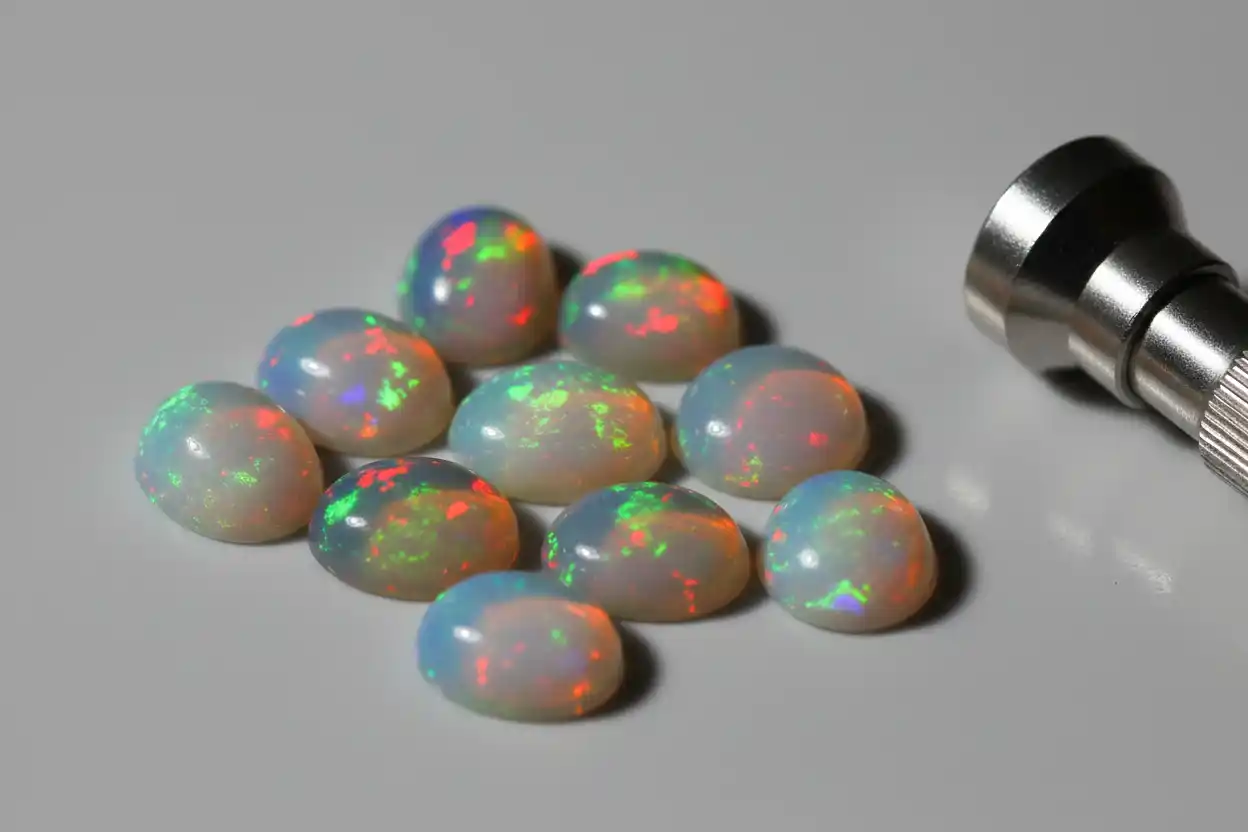
Buy Ethiopian Opal: Buying Criteria, Treatments, Grading & Cost
To buy Ethiopian opal intelligently, evaluate the individual stone by play-of-color, bodycolor, pattern, transparency, stability, hydrophane behavior, treatment disclosure, cut, condition, provenance, and documentation rather than relying on carat weight or a retailer’s grade. Ethiopia became an important source of precious opal after major production developed near Wegel Tena in Wollo Province, where opal can occur with white, colorless, yellow, orange, brown, reddish-brown, and darker bodycolors. Much Ethiopian material is hydrophane, meaning its porous structure can absorb water and other liquids, sometimes changing transparency, appearance, or weight temporarily.
Hydrophane behavior is not itself proof of poor quality, instability, treatment, or authenticity; it is a physical property that varies considerably from specimen to specimen. It does, however, affect how Ethiopian opal should be handled and evaluated because porous material can absorb water, oils, dyes, and other substances more readily than non-hydrophane opal. GIA has documented both attractive natural-color hydrophane opal and hydrophane material modified by dye, oil, resin, and related treatments, so buyers should separate porosity from treatment status rather than assuming one automatically proves the other.
Buy Ethiopian Opal At a Glance
| Buying Factor | What to Examine | Why It Matters |
|---|---|---|
| Identity | Natural Ethiopian opal versus synthetic opal, imitation, doublet, or triplet | Similar appearance does not establish the same material or value |
| Hydrophane Character | Water absorption and related temporary appearance changes | Common in Wollo material and important for care, treatment detection, and durability |
| Play-of-Color | Brightness, color range, coverage, movement, and viewing angles | The principal visual quality factor in precious opal |
| Bodycolor | White, crystal, yellow, orange, brown, dark, or other natural appearance | Bodycolor changes contrast and may influence treatment scrutiny |
| Pattern | Broad flashes, rolling color, pinfire, digit-like structures, or other arrangements | Attractive distinctive patterns can increase collector appeal |
| Transparency | Transparent through opaque appearance appropriate to the opal type | Clarity expectations differ by opal type |
| Stability | Crazing, cracks, prior water-related changes, structural weakness | Instability can reduce durability and value |
| Treatment | Dye, smoke, oil, resin, impregnation, coating, or other enhancement | Porous Ethiopian opal can accept treatments readily |
| Cut | Dome, thickness, polish, orientation, symmetry, and color presentation | Good cutting maximizes play-of-color and protects the stone |
| Carat Weight | Weight together with millimeter dimensions | Size matters, but quality and stability remain more important |
| Origin | Ethiopian/Wollo provenance versus general seller assertion | Geographic origin can be reported for opal when determinable |
| Documentation | Laboratory identification, treatment findings, and return terms | Reduces uncertainty on expensive purchases |
Understand What Ethiopian Opal Actually Is
Opal is hydrated silica rather than a conventionally crystalline mineral such as quartz, garnet, or beryl. Its famous play-of-color results from diffraction of light through ordered microscopic silica structures, creating spectral flashes that shift as the gem, viewer, or light source moves. GIA identifies color, pattern, and clarity as the principal aspects of opal quality and treats play-of-color as the most important visual factor in precious opal.
Ethiopian opal is therefore not one single standardized appearance. Wollo material can be white, colorless or “crystal,” yellow, orange, brown, reddish-brown, or darker, and the amount and type of play-of-color vary widely. GIA’s field research also notes that Ethiopian deposits can produce material ranging from common opal to precious opal within the same mining environment, which means the country name alone does not establish gem quality.
A buyer should judge the actual polished gem rather than the national origin label. The same principle applies when comparing Ethiopian opal with the already drafted Gems Lore guides to buy black opal and buy boulder opal: source and type matter, but the individual gem’s visual quality, treatment, structure, and condition ultimately determine whether the purchase makes sense.
Hydrophane Behavior Is One of the Most Important Ethiopian Opal Buying Issues
Most Wollo opal is hydrophane, meaning it has enough connected porosity to absorb water readily. GIA notes that immersion can change the transparency, play-of-color, and weight of hydrophane opal, sometimes dramatically, until the absorbed liquid evaporates again. Degree of porosity varies among stones, so one Ethiopian opal may react quickly while another changes much more slowly or only slightly.
This property creates practical buying implications. A seller should not intentionally wet a stone simply to make it look clearer, darker, or otherwise more attractive without disclosing that its appearance has been altered temporarily. A recently soaked hydrophane opal can look different from the same gem after it returns to equilibrium, making photographs taken immediately after immersion potentially misleading.
Hydrophane behavior can also create care concerns. GIA warns that immersion can sometimes enlarge internal cracks or contribute to cracking in porous opal, although the response is not identical in every specimen. Natural hydrophane opal can be stable in ordinary jewelry use, but routinely soaking it to “improve” appearance is not a sensible ownership practice.
Play-of-Color Should Carry More Weight Than Carat Size
The most compelling Ethiopian opals display vivid play-of-color across a meaningful percentage of the face, remain lively as the stone moves, and show enough color range or pattern interest to create a strong visual impression. GIA evaluates opal by examining the proportion and intensity of play-of-color, dominant hues, color range, pattern, transparency, clarity, and cut.
Brightness deserves particular attention. A smaller Ethiopian opal with strong red, orange, green, blue, and violet flashes across much of its face can be more desirable than a substantially heavier stone with weak or isolated color. Large inactive areas, sometimes called dead spots when no play-of-color is visible, generally reduce visual appeal when they interrupt an otherwise precious-opal surface.
Rotate the stone slowly under neutral lighting rather than judging one still image. Ethiopian opal can display rolling color, broad flashes, fine pinfire, structured digit-like patterns, and other effects, so movement reveals far more than one photograph.
Red Play-of-Color Can Be Desirable, but It Is Not the Only Measure of Quality
GIA’s current phenomenal-gem guidance notes that red play-of-color is comparatively uncommon and can be especially valuable when it occurs vividly alongside other spectral hues. A full-spectrum display with strong, clearly defined patterning can therefore attract substantial interest.
A buyer should not turn this into the simplistic rule that every red-flashing Ethiopian opal must outrank every blue-green stone. A tiny weak red patch does not necessarily make a gem better than a stone covered in exceptionally bright green, blue, and orange. Brightness, coverage, pattern, transparency, stability, and the quality of the entire face remain important.
The correct evaluation asks whether the play-of-color is attractive as a whole rather than whether a particular hue appears somewhere in the gem.
Pattern Can Add Collector Interest
Wollo opal is known for visually distinctive patterns, including so-called digit patterns in which play-of-color areas interpenetrate common-opal areas in finger-like structures. GIA research on Ethiopian opal has documented these formations and linked them with natural post-growth structural processes rather than treating them as evidence of synthetic origin.
Pattern terminology in opal is often descriptive rather than standardized. Sellers may use names such as honeycomb, broad flash, rolling flash, pinfire, floral, chaff, straw, or other commercial descriptions. Those terms can help communicate appearance but should not be treated as universal laboratory grades.
Pay for the visual result. An unusual pattern can command a premium when it is bright, attractive, balanced, and difficult to replace, but the name attached to the pattern does not create value by itself.
Transparency Needs to Be Evaluated by Opal Type
GIA emphasizes that preferred clarity and transparency differ among opal types. Crystal opal is valued for transparency or semitransparency, whereas darker or opaque backgrounds can be desirable in black opal because they increase contrast with play-of-color.
Ethiopian opal can occur in transparent, translucent, or more opaque material, so buyers should avoid applying one universal “clearer is always better” rule. A transparent crystal opal with vivid internal play-of-color can be highly attractive, while a translucent white Wollo opal can also command strong demand when the spectral display is bright and broad.
Cloudiness deserves separate scrutiny. A naturally translucent stone can be beautiful, while a milky or hazy appearance caused by instability, absorbed liquid, or treatment can affect value differently. Context matters.
Bodycolor Should Be Evaluated for Both Beauty and Treatment Risk
Ethiopian opal occurs naturally in several bodycolors, including white, yellow, orange, brown, reddish-brown, and dark material. GIA’s field research confirms this broad natural range.
Hydrophane porosity means unusual or strongly saturated bodycolors deserve treatment scrutiny. GIA has documented purple, pink, and blue dyed hydrophane opal and explains that porous opal can absorb organic dyes. The presence of hydrophane behavior does not prove dyeing, but it makes artificial coloration physically plausible.
Buyers should therefore be cautious when a vividly colored Ethiopian opal looks dramatically different from commonly documented natural material and carries no credible treatment disclosure. Laboratory examination becomes increasingly valuable as the color becomes more unusual and the price rises.
Dyeing Can Transform Ordinary Hydrophane Opal
GIA studies show that white hydrophane opal can be dyed to produce colors that appear commercially attractive while still retaining play-of-color. In documented treated samples, laboratory testing established that the artificial color came from organic dye rather than from natural bodycolor.
Dyed Ethiopian opal can still be attractive jewelry material if sold honestly. Treatment does not make the underlying opal “fake,” but it moves the stone into a different comparison category from natural-color precious opal.
A seller should disclose both the natural material identity and the modification. “Natural Ethiopian opal” can be incomplete if the bodycolor was subsequently dyed.
Oil and Resin Impregnation Also Matter
GIA has documented oil and Opticon-type resin treatment in Ethiopian hydrophane opal. Such materials can enter the porous structure and alter apparent transparency, durability, or clarity, and advanced spectroscopy may be required to detect them because treatment can be subtle under ordinary visual inspection.
Impregnation should be distinguished from simple temporary water absorption. Water eventually evaporates, whereas oil or polymer may remain and change the long-term appearance or maintenance requirements.
Ask the seller whether any impregnation, resin treatment, oiling, coating, dye, or other enhancement is known. For higher-value stones, a laboratory report is a stronger basis than a verbal statement.
Do Not Assume Ethiopian Opal Is Unstable
Ethiopian opal has sometimes acquired a broad reputation for instability because some material is hydrophane and some early Ethiopian deposits showed sensitivity to moisture, heat, or light. That reputation is too general. GIA research on Wollo material documented hydrophane behavior while also finding important material capable of withstanding normal handling, and stability varies among stones.
The correct buying question is not “Are Ethiopian opals unstable?” but “Is this specific stone free from crazing, major fractures, active cracking, or evidence of problematic moisture sensitivity?” Inspect every piece individually.
Existing crazing should receive serious attention because GIA notes that cracked opal has reduced durability and commercial value.
Inspect for Crazing and Structural Cracks
Crazing appears as a network of fine cracks and can result when opal loses moisture or experiences unfavorable environmental conditions. GIA notes that opal with established crazing has low durability in jewelry and commands lower value than sound material.
Use magnification to inspect the entire surface, especially near the girdle and any thin edges. Distinguish actual cracks from natural pattern boundaries or internal inclusions.
A seller should disclose existing fractures rather than relying on bright play-of-color to distract from them. Return rights are particularly valuable if the stone cannot be inspected in person before purchase.
Cut Quality Should Maximize Color Without Making the Stone Fragile
Opals are commonly cut as cabochons because domed surfaces can show play-of-color effectively from several viewing angles. GIA notes that a very flat cabochon can become vulnerable during setting, while an excessively high dome may be difficult to mount.
Ethiopian crystal opal may also be faceted when transparency and rough shape support it, but the same principles of stability, color orientation, polish, and face-up appearance still apply.
Good cutting should preserve enough thickness for structural security, orient the strongest color toward the viewer, minimize distracting dead areas, and produce clean polish without unnecessary weight.
Carat Weight Is Secondary to Face-Up Quality
Opal has relatively low density compared with many popular gemstones, which allows fairly large pieces to remain comfortable in jewelry. GIA notes that opal occurs across a wide range of carat weights and dimensions.
A large Ethiopian opal is not automatically superior. Weight can include areas with limited color or extra thickness that contributes little to the face-up display.
Compare dimensions alongside carat weight. A lighter stone with broad coverage of vivid play-of-color may offer more visual impact than a heavier stone whose additional mass sits below the visible surface.
Origin Can Be Independently Reported for Opal
Current GIA colored-stone services include natural opal among the materials eligible for a Colored Stone Identification & Origin Report, with geographic origin added when determinable.
That makes it possible to distinguish independent origin evidence from a seller’s Ethiopian or Wollo provenance claim in significant transactions. A laboratory origin opinion does not automatically identify a specific individual mine or guarantee market value, but it can strengthen confidence that the broader geographic representation is supportable.
Origin still should not replace quality. GIA’s opal buyer guidance explicitly emphasizes that opal value depends on quality rather than locality alone.
GIA Does Not Give Opal a Universal Quality Grade
GIA evaluates opal but does not issue an overall opal quality grade. A GIA Colored Stone Identification Report can describe characteristics, identify natural versus laboratory-grown material, and list detectable treatments, but it does not assign an AAA, AAAA, or equivalent retail quality level.
Seller grades such as AAA, AAAA, top fire, premium honeycomb, or museum grade are therefore internal commercial descriptions unless a retailer defines a specific system.
Translate the grade into observable qualities: brightness, color range, pattern, transparency, stability, treatment, dimensions, and cut.
Natural, Synthetic, and Imitation Opal Are Different Categories
Natural Ethiopian opal formed geologically. Synthetic opal is laboratory-grown material engineered to reproduce opal’s structure and optical behavior, while imitation opal is another material made or selected to resemble opal.
GIA recognizes synthetic counterparts and imitations in the opal market and can distinguish material type through laboratory analysis.
A synthetic opal can be attractive and durable enough for many jewelry uses, but it should not be priced or represented as mined Ethiopian opal.
Compare Ethiopian Opal With Ethiopian Opal
Comparing Ethiopian opal directly with black opal or boulder opal on a simple price-per-carat basis can be misleading because the materials differ in bodycolor, host-rock relationship, porosity, treatment profile, market history, and typical construction. The Gems Lore black opal price guide and boulder opal price guide explain the quality systems appropriate to those categories.
Within Ethiopian material, compare natural-color hydrophane with similar natural-color hydrophane, dyed material with appropriately disclosed treated material, and crystal opal with crystal opal of similar quality. That produces a much more defensible buying decision than assuming every opal with similar rainbow color belongs to the same value tier.
Common Red Flags When You Buy Ethiopian Opal
Several warning signs deserve additional scrutiny:
Very unusual saturated bodycolor with no treatment disclosure.
A stone photographed wet without that condition being stated.
“Non-hydrophane” or “100% stable” guarantees unsupported by evidence.
A seller claiming that all Ethiopian opal is unstable or all Ethiopian opal is hydrophane in exactly the same way.
AAA or AAAA presented as an independent laboratory grade.
An expensive opal with no meaningful return period.
Visible craze lines or cracks dismissed as harmless “natural character.”
A seller using “natural” while refusing to answer whether the stone was dyed, oiled, impregnated, or coated.
Doublets or triplets represented as solid opal.
Geographic origin used as a substitute for play-of-color quality.
A strong seller should be willing to provide side and back images, discuss hydrophane behavior honestly, disclose treatments, and allow independent inspection when the value justifies it.
Care Requirements Should Influence the Purchase
Opal has a Mohs hardness around 5 to 6.5 and toughness ranging from very poor to fair, so it can scratch or break more readily than sapphire, ruby, or diamond. GIA recommends warm soapy water as the safest general cleaning method and warns that high heat or sudden temperature change can fracture opal.
Hydrophane Ethiopian opal deserves additional caution around immersion because absorbed liquid can change appearance and may create cracking risk in susceptible stones. GIA specifically advises against routinely immersing hydrophane opal.
A protective ring setting can reduce impacts, while earrings and pendants usually experience fewer knocks. Jewelry design should match the individual stone’s stability rather than treating every opal identically.
Conclusion
To buy Ethiopian opal well, judge the individual gem rather than the country name or a seller-defined grade. Ethiopian opal can offer exceptional play-of-color, distinctive patterns, substantial sizes, and an enormous variety of bodycolors, but much Wollo material is hydrophane and therefore requires informed handling and careful treatment disclosure.
The strongest purchase combines vivid play-of-color, attractive pattern, suitable transparency, sound structural condition, skilled cutting, honest disclosure of hydrophane behavior and treatment, and documentation appropriate to the price. GIA can identify natural versus laboratory-grown opal, report detectable treatments, and currently provides geographic-origin reporting for natural opal when determinable.
Hydrophane should not be treated as a defect by default, and Ethiopian origin should not be treated as a guarantee of quality. Buyers who distinguish material properties, treatment, stability, origin evidence, and visible beauty can evaluate Ethiopian opal much more confidently.
Frequently Asked Questions
What is Ethiopian opal?
Ethiopian opal is natural opal mined from deposits in Ethiopia, with major modern production coming from the Wollo region near Wegel Tena. Material can occur in white, crystal, yellow, orange, brown, reddish-brown, dark, and other appearances, with or without strong play-of-color.
Is most Ethiopian opal hydrophane?
Much Ethiopian opal, particularly material from Wollo, is hydrophane and can absorb water readily. The degree of porosity varies from stone to stone, so not every Ethiopian opal reacts identically.
Does hydrophane mean the opal is fake?
No. Hydrophane is a natural porosity characteristic found in many genuine Ethiopian opals. It describes how readily the material absorbs liquid rather than whether it formed naturally or was treated.
Can Ethiopian opal be dyed?
Yes. GIA has documented dyed hydrophane opal in colors including purple, pink, and blue, and porous opal can accept coloring agents readily.
Can Ethiopian opal be resin or oil treated?
Yes. GIA has documented oil and resin-type impregnation in Ethiopian hydrophane opal. Treatment should be disclosed because it changes the appropriate market comparison and may affect care.
Should Ethiopian opal be soaked in water?
Routine soaking is not recommended for hydrophane opal. GIA notes that absorbed water can change appearance and that immersion can create cracking risk in some porous specimens.
What makes Ethiopian opal valuable?
Brightness and quality of play-of-color, color range, pattern, coverage, transparency, bodycolor, stability, cut, size, treatment status, and condition all contribute. GIA considers play-of-color the most important quality factor in precious opal generally.
Does GIA grade Ethiopian opal AAA?
No. GIA evaluates opal but does not issue an overall opal quality grade. AAA and similar grades are seller-defined.
Can GIA confirm Ethiopian origin?
Natural opal is currently eligible for GIA’s Colored Stone Identification & Origin Report, which can include geographic origin when determinable.
Is Ethiopian opal less durable than all Australian opal?
That statement is too broad. Ethiopian material varies in porosity and stability, and GIA research documents both hydrophane behavior and substantial variation among deposits and individual specimens. Inspect the individual stone for crazing, fractures, and stability rather than judging durability only by country.
Is Ethiopian opal suitable for rings?
Yes, but opal is softer and less tough than many popular ring stones. GIA recommends protective settings for opal rings and careful wear to reduce scratching and breakage.