Fire Opal Meaning: Properties, Uses & Symbolism
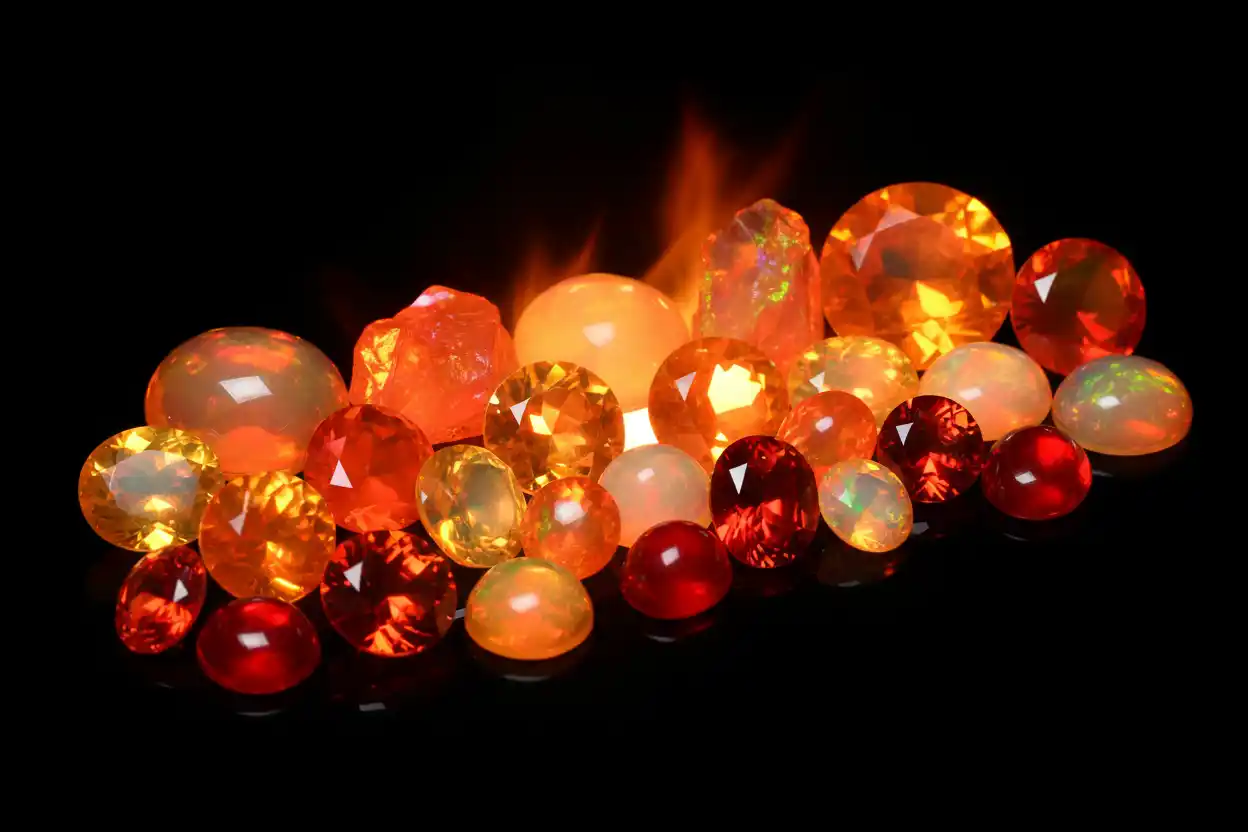
Fire opal meaning begins with a variety of opal recognized primarily for warm yellow, orange, orange-red, or reddish body color. Fire opal is not a separate mineral species, and the word “fire” does not necessarily mean that the stone displays precious opal’s moving spectral play-of-color. Some fire opals do show play-of-color, but many attractive specimens are valued almost entirely for transparent to translucent orange or red body color. Mineralogically, the material is opal: hydrated, non-crystalline silica commonly represented approximately as SiO₂·nH₂O and generally classified as a mineraloid rather than a conventionally crystalline mineral.
That distinction is fundamental to fire opal meaning because several unrelated ideas are easily compressed into the word “fire.” Warm body color, spectral play-of-color, transparency, geographic origin, treatment status, and symbolic associations are separate characteristics. An orange opal can be genuine fire opal without showing rainbow flashes, while an opal showing brilliant spectral color is not automatically fire opal if its body color does not fit the conventional use of the term. Readers exploring other material-led references can use the broader Gemstone Guides while keeping trade terminology and mineral identity distinct.
Fire opal meaning also benefits from separating measurable facts from personal interpretation. Composition, water content, refractive behavior, hardness, fracture, inclusions, body color, and play-of-color can be examined gemologically. Geological context can be studied through host rocks and deposit relationships. Historical and trade usage can be documented. Modern associations with motivation, creativity, confidence, passion, optimism, or personal renewal are symbolic readings rather than scientifically demonstrated effects of opal.
Fire Opal Meaning at a Glance
| Feature | Grounded reference |
|---|---|
| Material identity | Warm-colored variety of natural opal |
| General composition | Hydrated amorphous silica, approximately SiO₂·nH₂O |
| Crystal system | None in the conventional crystalline sense |
| Typical body colors | Yellow, honey, orange, orange-red, reddish orange, and related warm tones |
| Transparency | Commonly transparent to translucent; opaque examples also occur |
| Play-of-color | May be present or absent |
| Mohs hardness | Commonly about 5.5–6.5 |
| Cleavage | None |
| Fracture | Commonly conchoidal to uneven |
| Major color influence | Iron-related trace chemistry and structural effects contribute to warm coloration |
| Geological occurrence | Silica deposition in cavities, fractures, and volcanic or hydrothermal settings |
| Important trade distinction | “Fire opal” describes body-color character, not automatically precious play-of-color |
| Symbolic meaning | Modern cultural or personal interpretation |
| Identification limitation | Orange color alone cannot establish natural opal, treatment, or origin |
| Ownership emphasis | Protect from impact, contamination, extreme conditions, and uncontrolled silica dust during processing |
The table captures the central boundary in fire opal meaning: “fire” can describe the visual warmth of the body color even when no moving spectral flashes appear. That makes fire opal fundamentally different from terms that are defined chiefly by an optical phenomenon.
What Fire Opal Actually Is
Opal consists primarily of hydrated silica with variable water content and microscopic structural organization. It lacks the long-range ordered crystal lattice found in quartz, topaz, corundum, or feldspar, so gemological descriptions typically treat it as a mineraloid. Fire opal belongs within that broader opal family but is distinguished in commerce and gemology by its characteristic yellow-through-red body coloration.
The material can range from nearly transparent to noticeably translucent. Some transparent orange fire opal is faceted because clarity and body color can produce an appearance more similar to transparent colored gemstones than to traditional domed precious opal. Other fire opal is cut as cabochons, particularly when inclusions, internal structure, or play-of-color favor a curved polished surface. Rough specimens may preserve host-rock relationships, cavities, fractures, or natural surfaces that polished gems no longer show.
This variation means fire opal meaning should never imply one standardized appearance. A pale honey-colored transparent stone and an intense orange-red translucent cabochon may both be legitimate fire opal. One may show spectral flashes while the other does not. One may be faceted and another left in matrix. The shared commercial identity comes primarily from opal material combined with a warm body-color range.
How Fire Opal Forms
Fire opal forms when silica-bearing fluids enter suitable geological spaces and eventually deposit hydrated silica. Cavities, fractures, vesicles, and porous zones in volcanic rocks can provide the open spaces needed for opal development. As silica-bearing fluids circulate, evaporate, react with host rock, or otherwise change chemical conditions, opal can accumulate progressively rather than crystallizing as a conventional mineral crystal.
Volcanic settings are particularly important in the history and geology of many well-known fire opal deposits. Silica released through alteration of volcanic materials can be transported by groundwater or hydrothermal fluids and redeposited in open spaces. Iron present in the geological system can contribute to the yellow, orange, and reddish body colors that distinguish many fire opals. The precise sequence differs among deposits, so a simple statement such as “all fire opal forms the same way” would erase meaningful geological variation.
Host-rock relationships can provide useful clues about formation, but they are not automatic proof of locality. A polished loose stone has usually lost most of the geological evidence that once surrounded it, while even a matrix specimen can be mislabeled or moved between collections. A fuller discussion of volcanic hosts, silica movement, deposit environments, and mineral associations belongs in fire opal formation and deposit geology, keeping this page focused on foundational fire opal meaning.
What Causes Fire Opal’s Yellow, Orange, and Red Colors?
Warm body color is central to fire opal meaning. Iron-related trace chemistry is an important contributor to the yellow, orange, and reddish appearance seen in many natural fire opals. The precise visible result depends on concentration, chemical state, microscopic structure, transparency, stone thickness, inclusions, and the way light passes through or reflects from the material.
A thick orange stone can look substantially deeper in color than a thin slice of comparable material. A transparent gem can also appear brighter because light travels through more of the colored body and returns from polished facets. Conversely, cloudy inclusions or internal scattering can soften or mute apparent saturation. A stone photographed against a black background may look more intense than the same gem viewed over a pale surface.
This is why body color should be documented under reasonably neutral lighting rather than judged from one saturated seller image. Camera white balance, exposure, background, and image processing can shift yellow toward orange, deepen red, or increase apparent transparency. The detailed relationship between optical behavior, body color, transparency, and play-of-color is covered separately in fire opal optical properties and color behavior.
Fire Opal Does Not Need Play-of-Color
One of the most persistent misunderstandings in fire opal meaning is the assumption that every authentic fire opal must show moving rainbow colors. It does not. The term is widely used for warm-bodied opal regardless of whether precious play-of-color is visible.
Precious opal produces spectral play-of-color when sufficiently ordered microscopic silica structures interact with visible light. Those structures can diffract and interfere with light so that different wavelengths become visible as the stone moves. Fire opal can contain that ordered structure and therefore show play-of-color, but many examples do not.
An orange transparent opal without spectral flashes can consequently be a valid fire opal. If play-of-color is present, it becomes an additional quality and descriptive feature rather than the basic requirement for the name.
This distinction also prevents a common labeling error in the opposite direction. A white, gray, or dark precious opal displaying brilliant rainbow color is not automatically fire opal simply because its spectral flashes look “fiery.” Body color and optical play answer different questions.
Diagnostic Traits That Support Identification
Reliable fire opal identification requires more than orange color. Glass, quartz-family materials, synthetic products, resinous imitations, treated stones, and several natural gems can overlap visually with transparent yellow or orange opal. A gemologist therefore considers a group of properties rather than relying on appearance alone.
Opal’s relatively modest hardness, characteristic refractive behavior, specific gravity range, absence of cleavage, fracture characteristics, transparency, internal features, and optical reaction can collectively narrow the possibilities. Play-of-color can strongly support an opal identification when natural internal structure is evident, but fire opal without play-of-color demands greater attention to other properties.
Magnification can reveal internal clouds, fractures, cavities, flow-like structures, surface-reaching features, polish characteristics, and possible signs of treatment or assembly. Yet inclusions should not be turned into automatic locality indicators. Similar internal features can occur in material from more than one deposit, and photographic comparison alone cannot establish origin reliably.
A structured examination framework for internal and surface features is provided in the fire opal microscope inclusion notebook. Where a consequential stone cannot be resolved through routine testing, specialist gemological examination is more appropriate than forcing certainty from visual evidence.
An Original Fire Opal Name and Claim Audit
Fire opal meaning becomes much clearer when commonly encountered names are separated according to what they actually claim. The following table identifies useful terminology alongside assumptions that should not be made without stronger evidence.
| Name or claim | What the term can reasonably indicate | What it does not prove |
|---|---|---|
| Fire opal | Opal with yellow-to-red warm body color | Play-of-color |
| Precious fire opal | Fire opal that also displays play-of-color | Specific geographic origin |
| Common fire opal | Warm-colored opal without notable play-of-color | Low quality in every commercial context |
| Crystal fire opal | Transparent or highly translucent fire opal in common gem-trade usage | A crystalline mineral structure |
| Mexican fire opal | Claimed or documented Mexican origin | Origin from orange color alone |
| Cherry fire opal | Descriptive reddish color terminology | Separate mineral species |
| Red fire opal | Strong red or reddish body color | A universal standardized quality grade |
| Orange opal | Describes color broadly | That the material qualifies as fire opal without confirming opal identity |
| Jelly opal | Informal description emphasizing translucent or gelatinous-looking appearance | One defined mineral variety |
| Untreated fire opal | Claim that no relevant enhancement was applied | Verification merely because treatment is not visible |
| Natural fire opal | Natural-origin claim | Geographic locality or absence of treatment |
| AAA fire opal | Seller-specific commercial grade | Internationally standardized quality |
| Investment-grade fire opal | Marketing or valuation claim | Guaranteed future appreciation |
| Healing fire opal | Symbolic or commercial wording | Medical efficacy |
| Passion stone | Personal or metaphysical association | A measurable emotional effect |
“Crystal fire opal” deserves particular care. In gem commerce, “crystal” can describe transparent opal, but mineralogically opal remains non-crystalline. The term therefore communicates appearance rather than conventional crystallography.
“Mexican fire opal” also requires evidence beyond hue. Mexico is historically important for warm-colored opal and remains closely associated with the fire opal trade, but not every orange opal can be assigned there visually. Where origin materially affects collecting or commercial decisions, supporting paperwork should be preserved.
Provenance Is Stronger Than a Color-Based Origin Guess
A seller may describe a stone as Mexican, Ethiopian, Brazilian, Australian, or from another source, but body color alone rarely authenticates the claim. Orange and reddish opals can occur in more than one geological environment, while polished stones often lack the host-rock context that might otherwise offer useful clues.
Good provenance begins with documentation: original labels, invoices, dealer records, collection numbers, mine information, older photographs, laboratory reports where relevant, and a traceable chain of ownership. Each item answers a different question. An invoice demonstrates what a seller represented; it does not necessarily prove the representation independently.
The fire opal provenance disclosure checklist provides a separate framework for recording those claims without allowing an attractive locality name to replace evidence.
The Documented History of Fire Opal
Warm-colored opal has an especially strong historical association with Mexico, where volcanic environments have produced celebrated transparent yellow, orange, and reddish material. The country’s fire opal became notable not only because of its intense body color but also because transparent material could be faceted in a way uncommon for many traditional opals.
The term “fire opal” is essentially descriptive. “Opal” identifies the material family, while “fire” evokes the warm colors of flame, embers, or heated metal. It does not mean the stone produces heat or contains literal fire.
Historical interpretation should stop there unless additional cultural documentation exists for a specific tradition. It is easy to move from the descriptive word “fire” to claims that the gemstone was historically believed everywhere to increase body heat, sexual energy, metabolism, courage, or physical vitality. Such broad statements require evidence and should not be presented simply because modern symbolism makes them sound intuitive.
Fire Opal Meaning in Modern Symbolism
Modern symbolic readings commonly associate fire opal meaning with creativity, motivation, confidence, enthusiasm, passion, optimism, and deliberate action. Its yellow-to-red palette makes these themes understandable as visual metaphors. Orange and red objects are widely capable of suggesting warmth, movement, alertness, or intensity in human perception and culture.
A grounded symbolic practice can use those associations without turning them into physical claims. Someone might keep a fire opal near a notebook as a cue to begin a creative task rather than continuing to postpone it. Another person might associate its transparent orange appearance with the question, “What am I actually willing to act on rather than merely think about?”
In those examples, fire opal meaning functions through attention and personal association. The stone does not need to radiate a scientifically demonstrated force. There is no established gemological evidence that fire opal automatically creates confidence, increases libido, attracts a partner, guarantees professional success, changes another person’s emotions, or produces a predetermined future outcome.
The broader boundary between mineral education, personal symbolism, and medical or other professional claims is explained in the site’s Disclaimer.
Warm Color Does Not Make Fire Opal a Medicine
The language surrounding fire opal sometimes moves from visual warmth into medical claims about circulation, metabolism, hormonal function, fertility, inflammation, energy levels, or emotional disorders. Fire opal meaning does not support those conclusions.
Silicon, oxygen, water, iron, and other trace constituents are part of the physical material. Their presence does not mean that wearing or touching the stone transfers a useful nutritional dose into the body. Iron responsible for or associated with orange-red coloration is not equivalent to an iron supplement, and silica in opal is not a medical treatment.
Fire opal should therefore not be presented as a therapy for anxiety, depression, cardiovascular conditions, hormonal disorders, neurological problems, reproductive conditions, or any other health issue. Personal enjoyment or reflective symbolism can coexist with evidence-based healthcare without replacing it.
There is likewise no reason to ingest fire opal, powder it for consumption, or use it in drinking-water elixirs.
Safe Ownership of Fire Opal
Normal handling of an intact polished fire opal or stable specimen is fundamentally different from grinding, sanding, drilling, cutting, or crushing it. Finished stones can be handled as gemstones, while lapidary processing produces fine silica-bearing material that should not be inhaled. Dust-generating work requires appropriate professional controls, including suitable wet methods, ventilation, eye protection, and respiratory precautions.
Mechanical durability presents a different issue. Opal is not extremely hard, and although it has no cleavage, it can chip or fracture. Existing internal cracks, thin edges, high domes, exposed girdles, and hard impacts can all increase damage risk. Transparent faceted fire opal can look like a conventional crystalline gem but should not be assumed to tolerate the same treatment as sapphire or topaz.
Jewelry design therefore needs to consider the actual stone rather than the beauty of its color alone. Protective settings, reduced edge exposure, and realistic expectations for wear are discussed more fully in fire opal setting and wear engineering.
Cutting Fire Opal Requires More Than Maximizing Weight
Fire opal rough can present cutters with competing goals. Retaining maximum carat weight may preserve a deep belly that contributes little to face-up appearance. Cutting away too much can reduce color saturation or expose fractures. Transparent material may benefit from faceting, while translucent or play-of-color material may perform better as a cabochon.
Orientation also matters when play-of-color is present. A cutter must determine where the strongest color sits within the rough and how it will face the viewer after shaping. Even when the gem relies mainly on orange body color, inclusions and transparency influence the best orientation.
These decisions are sufficiently specialized that they belong in the dedicated fire opal cutting, orientation and polish guide rather than being compressed into a few generic instructions here.
Cleaning and Everyday Use Need Material-Specific Care
Fire opal’s appearance can tempt owners to treat it like harder transparent gems, particularly when it is faceted. That is not a safe assumption. Opal’s water-bearing structure, moderate hardness, and potential internal fractures justify conservative handling.
Owners should avoid aggressive mechanical cleaning methods simply because a setting contains precious metal. Harsh procedures that are acceptable for some jewelry materials may be unsuitable for opal or for an assembled piece containing other sensitive components. Practical maintenance belongs in how to clean fire opal jewelry so this meaning page does not duplicate a dedicated care guide.
A collector specimen has different priorities again. Matrix, natural surfaces, old labels, and repaired areas may carry information that routine jewelry-care advice does not address.
Preserving Fire Opal Specimens and Their Records
A rough or matrix fire opal can preserve geological evidence that disappears after cutting. Host rock, cavity surfaces, natural fracture relationships, weathering, and attached mineral material may all contribute to understanding how the opal formed.
The documentation can be equally important. An old collection label carrying a locality name should be photographed and retained even if later examination raises questions about its accuracy. Historical labels document the specimen’s collection history even when they are not perfect mineralogical proof.
Longer-term methods for documenting condition, storing specimens, retaining labels, and deciding when intervention is justified belong in fire opal specimen conservation and record keeping.
Fire Opal Meaning Does Not Determine Price
Symbolism and commercial value answer different questions. A fire opal described as a stone of creativity or passion does not become more valuable simply because the symbolic description is appealing. Market evaluation may consider body-color intensity, transparency, play-of-color, size, cut, condition, treatment, provenance, rarity within a particular quality band, and the sales context.
A smaller vivid red-orange transparent stone can therefore be valued differently from a much larger pale yellow specimen, while play-of-color can introduce another layer of comparison. No single body-color adjective determines price.
Those commercial variables belong in the separate fire opal price analysis rather than being folded into foundational fire opal meaning. Buyers who are deciding where and how to purchase material can use buying fire opal for the transaction-focused questions that this page intentionally does not duplicate.
What Fire Opal Meaning Can Reliably Tell You
A grounded fire opal meaning reference can explain that fire opal is warm-colored opal rather than a separate mineral species, distinguish body color from play-of-color, describe its hydrated silica identity, outline how silica-rich geological systems form the material, identify the broad physical traits useful in examination, and separate documented naming history from modern symbolism.
It cannot authenticate Mexican or another geographic origin from orange color alone. It cannot prove that a stone is untreated because treatment is not obvious in a photograph. It cannot establish value from the word “fire,” guarantee durability from transparency, or determine every unusual opal from one visual clue.
Gems Lore’s broader material-first approach is described on About Gems Lore. Readers with documented corrections, unusual historical labels, treatment evidence, or specimen-identification information can submit the relevant context through Contact Gems Lore; information supplied through the site is handled under the Privacy Policy.
FAQ
What is the basic fire opal meaning?
The basic fire opal meaning is gemological: fire opal is opal with a yellow, orange, orange-red, or reddish body color. Modern symbolic traditions often associate it with creativity, confidence, motivation, or passion, but those themes are personal interpretations rather than measurable mineral effects.
Does fire opal have to show rainbow colors?
No. Fire opal can be valuable for warm body color alone. Some specimens also display precious play-of-color, but rainbow flashes are not required for the conventional fire opal name.
What makes fire opal orange?
Iron-related trace chemistry and the way those components interact with the opal’s structure contribute significantly to yellow, orange, and reddish coloration. Stone thickness, transparency, inclusions, and lighting can change how saturated the color appears.
Is fire opal a crystal?
Not in the conventional mineralogical sense. Opal is non-crystalline hydrated silica and is generally classified as a mineraloid. “Crystal fire opal” is a gem-trade description commonly referring to transparent or highly translucent material, not a statement that the stone has a conventional crystal lattice.
Is all fire opal from Mexico?
No. Mexico is historically and commercially important for fire opal, but warm-colored opal occurs elsewhere. A geographic origin should be supported by provenance rather than inferred solely from orange or red color.
Is red fire opal rarer than orange fire opal?
Strong reddish material can be highly desirable, but color alone does not establish rarity or value. Transparency, saturation, size, treatment, condition, play-of-color, provenance, and market context also matter.
Can fire opal be faceted?
Yes. Transparent material can be faceted, particularly when body color and clarity are the main visual attractions. Other material may perform better as cabochons depending on inclusions, fractures, transparency, and play-of-color.
Can a photograph confirm natural fire opal?
A photograph can show color, transparency, cut, inclusions, and visible optical effects, but it cannot independently establish all aspects of identity, treatment, or geographic origin. Consequential or disputed stones may require professional gemological examination.
Does fire opal have scientifically proven healing properties?
No. There is no established scientific evidence that fire opal treats physical or mental-health conditions. It may be used as a personal symbol or reflective prompt, but those associations should not be represented as medical effects.
Is fire opal literally hot or connected with physical heat?
No. “Fire” describes the warm visual character of the stone and, in some examples, dramatic optical color. Fire opal does not produce unusual heat or scientifically increase metabolism, circulation, or body temperature.
Reading Fire Opal Beyond the Word “Fire”
The most useful fire opal meaning comes from separating several visually compelling ideas that are often confused. Fire opal is first hydrated non-crystalline silica with a warm body color. That body color is not the same phenomenon as precious opal play-of-color, although both can occur in one stone. Transparency does not make opal crystalline, orange color does not establish Mexican origin, and a seller’s quality adjective does not replace gemological evidence.
Its geological story is already substantial. Silica-bearing fluids occupy cavities and fractures, hydrated opal develops within those spaces, iron-related chemistry contributes warm coloration, and individual stones preserve different combinations of transparency, inclusions, body color, and sometimes spectral play.
Modern symbolism can then be added without rewriting that material story. Fire opal meaning may serve as a personal metaphor for creativity, deliberate action, confidence, or renewed attention because its color evokes warmth and movement. Those associations belong to human interpretation. Keeping them distinct from mineral facts allows both the symbolism and the gemstone to be understood more clearly.