Fire Opal Price: Value, Cost & What Affects Price
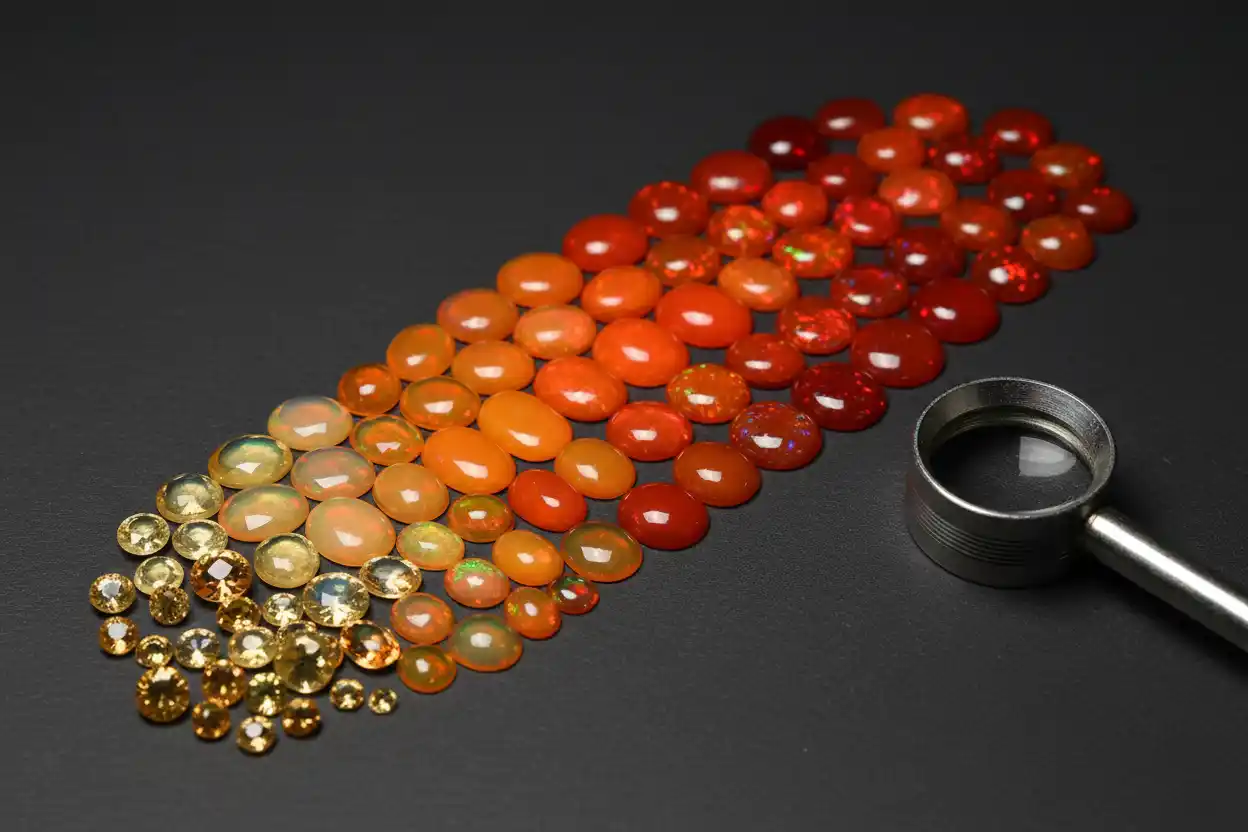
Fire opal price can vary dramatically even between stones that have the same weight and are described with the same broad trade name. A pale yellow transparent fire opal with visible inclusions, an intensely saturated orange-red faceted stone, and an orange opal with strong play-of-color are not economically equivalent simply because each weighs one carat. Body color, transparency, play-of-color when present, cut quality, condition, treatment status, origin documentation, size, and the type of retail market all influence what buyers are actually being asked to pay.
Current public listings illustrate that spread. One natural Mexican fire opal retail listing for a 1.26-carat pair was offered at $29.94, or about $23.76 per carat, while a 0.71-carat faceted Mexican fire opal on a marketplace was listed at $44, or about $61.97 per carat. A more strongly marketed 3.399-carat vivid “Fanta color” Mexican fire opal was offered at $890, or roughly $262 per carat. These are asking prices rather than a universal market scale, but they demonstrate why one generic fire opal price per carat cannot describe the category accurately.
Readers researching the material itself rather than its market value should start with fire opal meaning. This page focuses specifically on how fire opal price can be compared and documented. Seller-selection and transaction questions belong on buying fire opal rather than being duplicated here.
Fire Opal Price at a Glance
| Value factor | Why it matters |
|---|---|
| Body color | Strong, attractive yellow-orange through red saturation can command a premium |
| Transparency | Fine transparent faceting material may occupy a different market from cloudy or opaque material |
| Play-of-color | Bright spectral flashes can add an additional value factor when present |
| Color evenness | Attractive distribution can improve appearance, although zoning can sometimes be desirable |
| Cut | Symmetry, polish, proportions, face-up brightness, and weight retention affect marketability |
| Condition | Cracks, crazing, chips, pits, abrasion, and instability can reduce value |
| Treatment | Impregnation, coating, dye, smoke-related modification, or other treatment changes comparison |
| Natural versus laboratory-grown | Must be established before meaningful like-for-like pricing |
| Weight | Larger fine stones may be harder to replace, but value does not increase linearly |
| Origin | A documented locality can matter commercially, but color alone does not prove origin |
| Documentation | Credible reports and provenance can reduce uncertainty for higher-value stones |
| Retail channel | Dealer, auction, marketplace, wholesale, and finished-jewelry prices are not equivalent |
| Rough versus cut | Rough carries yield and stability uncertainty that finished stones do not |
| Asking versus sold price | A listed price records seller intent, not necessarily realized market value |
GIA describes fire opal as transparent to translucent opal with usually yellow, orange, or red body color, and notes that it may or may not display play-of-color. For opal generally, color, pattern, clarity or transparency, and cut are central quality considerations.
What Is Being Priced?
The first step in understanding fire opal price is identifying the commercial object. Rough, loose faceted gems, cabochons, cantera or matrix opal, matched pairs, beads, collector specimens, and completed jewelry should not be placed in the same price-per-carat table without qualification.
A transparent Mexican fire opal suitable for faceting can be evaluated primarily through body color, transparency, cut, condition, and size. A precious fire opal that also displays spectral play-of-color adds another quality dimension. Cantera fire opal retains opal within its host matrix and may be valued for the visual relationship between the opal and the surrounding rock rather than simply for transparent opal weight.
This distinction is particularly important because jewelry prices include costs that belong to metal, manufacturing, design, accompanying gems, brand positioning, warranty, and retail service. Dividing a completed ring price by the stated opal weight does not generate a legitimate loose-stone fire opal price.
A Transparent Fire Opal Price Method
A useful valuation framework can be written as:
Comparable fire opal price = material type + body-color quality + transparency + play-of-color + cut + condition + size + treatment adjustment + origin evidence + retail context
This is a methodology, not a fixed numerical formula. There is no scientifically established coefficient saying that red adds a specific percentage, a certain clarity grade doubles value, or Mexican origin automatically multiplies price. Opals are too individually variable for that level of invented precision.
The sequence matters. Confirm or reasonably establish the material class first. Then record body color and transparency under neutral conditions. Note play-of-color separately rather than using the word “fire” ambiguously. Inspect condition and cutting. Record treatment claims and provenance evidence. Only after those factors are defined should comparable listings or documented transactions be selected.
A Current Anonymized Fire Opal Price Sample
The following small sample illustrates public asking prices found during market research. Seller names are omitted because the purpose is comparison methodology rather than endorsement. All prices are in U.S. dollars, and shipping, tax, coupons, negotiation, and future listing changes are excluded.
| Source type | Material as listed | Weight | Asking price | Approx. price/ct | Important limitation |
|---|---|---|---|---|---|
| Retail catalog | Natural medium-orange Mexican fire opal pair, transparent, untreated | 1.26 ct total | $29.94 | $23.76 | Two-stone calibrated pair rather than one large gem |
| Marketplace | Natural Mexican fire opal, orange, faceted, seller-described untreated | 0.71 ct | $44 | $61.97 | Seller origin and treatment attribution; marketplace asking price |
| Marketplace | Natural Mexican fire opal, vivid orange, faceted, seller-described untreated | 3.399 ct | $890 | $261.84 | Premium commercial descriptors; asking price, not sold price |
| Marketplace | Ethiopian “fire opal” cabochon, seller-described untreated | 2.60 ct | $60 | $23.08 | Uses “fire opal” differently from classic Mexican warm-body fire opal |
The first three examples alone span roughly $24 to $262 per carat despite all being presented as fire opal. The fourth example demonstrates a terminology problem: online marketplaces sometimes apply “fire opal” to Ethiopian play-of-color opal that would not necessarily fit the narrower warm-body-color definition used in established gemological references.
That difference is exactly why price scraping without material classification creates misleading averages. A spreadsheet that mixes Mexican transparent orange opal, Ethiopian precious opal, matrix cantera material, rough, and finished jewelry may calculate a numerical mean, but the result has little gemological usefulness.
What the Current Sample Does—and Does Not—Prove
The sample demonstrates market dispersion. It does not establish that $24 per carat is a minimum, that $262 per carat is a ceiling, or that every fine stone falls between those figures. Exceptional fire opal can sit outside a small public sample, while lower-quality rough, treated material, distressed listings, parcels, or wholesale transactions can fall below it.
The table also records asking prices. A seller can list a gem for $900 without demonstrating that another buyer will pay $900. Completed transactions are stronger evidence of realized price, but even those need context because auction fees, buyer premiums, shipping, taxes, negotiation, and bundled purchases can affect the economic result.
A responsible fire opal price article therefore treats live listings as comparable observations rather than authoritative appraisal values.
Body Color Is a Major Fire Opal Price Driver
Unlike precious opal categories where spectral play-of-color may dominate the evaluation, many fire opals derive most of their visual appeal from body color. Transparent yellow, orange, orange-red, and red material can therefore trade according to saturation, brightness, hue, evenness, and how effectively the cut returns that color.
A pale yellow stone with weak saturation normally belongs in a different comparison set from an intense orange-red gem with lively transparency. Rich reddish orange may command substantial premiums when the color remains attractive rather than becoming overly dark or brown. However, there is no universal rule that “red equals X dollars per carat.”
Photographic color requires caution. A stone photographed under warm illumination or heavily saturated editing can look more intense than it appears in neutral daylight. For expensive material, a short neutral-light video and explicit disclosure of image conditions can be more useful than one dramatic promotional photograph.
The optical and color mechanisms themselves belong in fire opal optical properties and color behavior, while this page concentrates on how those observations affect market comparison.
Transparency Changes the Market Context
Fine transparent fire opal can be faceted, which distinguishes it from many familiar opals that are primarily cut as cabochons. Transparency lets a skilled cutter create internal brightness and color return through facet geometry, making some fire opals function visually more like transparent colored gemstones.
Cloudiness, large inclusions, surface-reaching fractures, or excessive internal haze can lower value when transparency is the desired quality. Yet an included stone can still have strong decorative appeal if the color is attractive and the inclusions do not threaten durability.
Clarity should therefore be evaluated according to the type of fire opal rather than copied from diamond-style grading language. GIA notes that transparency expectations differ among opal types and that inclusions, fractures, pits, matrix, and crazing can all affect quality.
Detailed internal observations can be documented using the fire opal microscope inclusion notebook, particularly when fractures, surface-reaching features, or possible treatment evidence materially affect value.
Play-of-Color Can Add a Separate Premium
Fire opal does not need play-of-color to qualify as fire opal, but when a stone combines attractive orange-to-red body color with strong spectral flashes, another value dimension enters the comparison.
The important factors are not simply whether play-of-color exists. Brightness, color range, coverage, pattern, viewing-angle persistence, and interaction with the underlying body color all matter. GIA identifies play-of-color, intensity, and pattern among important opal quality factors.
A small patch of weak green seen only at one angle should not be compared with broad, bright multicolor coverage. Likewise, a seller’s use of “rainbow fire” or “full spectrum” should be checked against actual movement of the stone rather than accepted as a standardized grade.
Cut Can Add Value—or Hide Weight
Faceted fire opal requires a balance between weight retention and optical performance. A deeply cut stone may retain more carats while facing up small for its weight. A well-proportioned stone may sacrifice rough weight to improve brightness, outline, and apparent color.
Symmetry, meet-point accuracy, polish, windowing, extinction, girdle condition, and face-up dimensions all matter for transparent faceted material. Cabochons require a different evaluation focused on dome, outline, polish, thickness, color orientation, and any play-of-color.
Weight therefore cannot be separated from shape and dimensions. A 5-carat stone that carries much of its weight in an unnecessarily deep pavilion may be less commercially attractive than a lighter gem with better face-up presentation.
The specialist mechanics of maximizing color while limiting damage belong in fire opal cutting, orientation and polish rather than being duplicated as a cutting manual here.
Size Can Raise Total Price Without Creating a Simple Multiplier
Larger transparent fire opals with strong color and good condition can become progressively harder to replace. That scarcity can increase both total value and, in some cases, price per carat. But there is no automatic rule that a 10-carat stone should cost ten times a 1-carat stone.
Larger stones may also contain more visible inclusions, fractures, cloudy zones, or color variation. Some retain extra depth solely to preserve carat weight. A large stone of moderate quality can therefore cost less per carat than a much smaller specimen with exceptional color and transparency.
This is visible even in current marketplace material. A premium 3.399-carat Mexican fire opal was offered at roughly $262 per carat, far above the per-carat level of the smaller examples in the sample. The difference cannot be assigned to weight alone because the listing also emphasizes vivid saturation and cutting quality.
Condition Can Override Attractive Color
Opal is relatively soft compared with sapphire or topaz, and GIA places opal around 5 to 6.5 on the Mohs scale. More importantly for value, its toughness can range from very poor to fair, and heat, abrupt temperature changes, or moisture-related instability can contribute to cracking or crazing in vulnerable material.
Crazing is especially serious. A vivid orange fire opal with a network of cracks should not be compared directly with an intact stone simply because both share attractive color. Surface chips, abrasions, fractures, pits, poorly repaired areas, and unstable cracks can all reduce practical and resale value.
For jewelry, setting design adds another durability variable. The separate fire opal setting and wear engineering guide covers protection, edge exposure, and mounting stresses without converting this valuation page into a wear manual.
Collectors evaluating long-term condition can use fire opal specimen conservation and record keeping for documentation practices that help distinguish existing defects from later change.
Treatment Must Be Separated From Natural Color
Opal can undergo several treatments. GIA notes impregnation with oil, wax, or plastic as well as surface modifications among recognized opal treatments.
For fire opal price comparisons, treatment disclosure matters because two stones with similar face-up color may not belong in the same value category if one relies on modification. The market significance varies with the specific treatment, transparency of disclosure, permanence, detectability, and buyer expectations.
A listing saying “untreated” records a seller claim unless the evidence supporting it is stated. A reputable laboratory report can reduce uncertainty for higher-value stones, but the report must be read for what it actually concludes.
GIA does not issue an opal quality grade. It evaluates opal and can report characteristics, natural versus laboratory-grown status, and detectable treatments. Therefore, phrases such as “GIA AAA fire opal” should not be interpreted as an official GIA quality grade unless the documentation says something materially different.
Natural, Synthetic, Assembled, and Imitation Material Need Separate Comparables
Before a fire opal price per carat means anything, the buyer needs confidence about what kind of material is being compared. Natural opal, laboratory-grown opal, glass imitations, resinous imitations, doublets, triplets, and other assembled products occupy different commercial categories.
GIA notes that synthetic counterparts and imitations exist for opal, and assembled opals can incorporate thin opal layers with backing or caps.
A visually attractive assembled stone may be perfectly legitimate when disclosed, but it should not be priced against a comparable-looking solid natural fire opal as though their material status were identical.
Origin Claims Can Influence Fire Opal Price—but Need Evidence
Mexico is historically and commercially associated with transparent orange and red fire opal, and current listings frequently use “Mexican fire opal” as a value-bearing description. However, geographic origin is a separate claim from body color.
GIA specifically notes that opal value depends on quality rather than locality alone. A documented Mexican origin can still matter to collectors or buyers seeking a particular provenance, but an attractive orange stone is not automatically Mexican simply because its appearance resembles familiar material.
Seller declarations, mine-to-market records, older collection labels, invoices, and laboratory reports provide different levels of evidence. The dedicated fire opal provenance disclosure checklist helps separate documented origin from a locality assumption.
A particular mine or region should command a premium only when the market values that attribution and the evidence supporting it is strong enough to justify the distinction.
Retail Context Explains Some Large Price Gaps
Fire opal prices can differ because sellers are providing different products and services, not merely because one price is “right” and another is “wrong.”
A high-volume online retailer may price calibrated commercial stones aggressively. A specialist dealer may spend more time selecting rare saturation, commissioning cutting, obtaining reports, photographing movement accurately, carrying inventory, and offering longer inspection periods. Auction marketplaces can show another price structure entirely, especially where sellers accept offers.
Wholesale parcel prices are not equivalent to single-stone retail prices. Neither is a private distress sale equivalent to an established dealer’s asking price.
This is why the approximately $24-, $62-, and $262-per-carat examples in the current sample should be treated as different market observations rather than steps on a universal fire opal grading ladder.
Rough Fire Opal Requires a Yield-Based Valuation
Rough material carries uncertainties that polished stones have already resolved. A piece may appear strongly orange externally but contain internal fractures, weak color zones, unwanted matrix, or shapes that force significant weight loss during cutting.
A useful rough valuation asks how much attractive, stable finished material can realistically be recovered. Total rough carat weight is secondary to expected usable yield.
For example, a 20-carat rough piece does not represent twenty finished carats. If cutting reveals that only five carats can be recovered as commercially attractive gems, the economics are completely different from a clean 20-carat preform approaching final shape.
This makes direct per-carat comparisons between rough and polished fire opal especially misleading.
Matrix and Cantera Fire Opal Need Their Own Comparables
Cantera fire opal is commonly sold with opal retained in volcanic host rock. The attraction can come from the contrast between the opal and matrix, the shape of an opal pocket, transparency, play-of-color, body color, or the sculptural appearance of the entire cabochon.
A public marketplace example describes a roughly 5.3-carat Mexican cantera opal retained in rhyolite matrix. That type of piece should not be compared per carat with a transparent 5.3-carat faceted fire opal because much of the weight and aesthetic belong to the host rock.
Cantera material needs comparables with similar proportions of visible opal, matrix attractiveness, polish, condition, locality evidence, and optical quality.
A Laboratory Report Adds Information, Not Automatic Value
A laboratory report can make a higher-value fire opal easier to evaluate by addressing natural versus laboratory-grown status, detectable treatment, and other reportable characteristics. In some circumstances, origin analysis may also be relevant where the laboratory offers it and evidence is sufficient.
Current marketplace examples include large fire opals marketed with GIA documentation, illustrating how laboratory evidence can become part of the sales presentation. But the existence of a report does not make promotional phrases such as “investment-grade,” “top tier,” or “monumental rarity” laboratory conclusions.
The buyer should read the report itself rather than inherit the seller’s interpretation of it.
A report can reduce uncertainty. It cannot guarantee resale value.
Seller Grades Are Not Universal Fire Opal Grades
Terms such as AAA, AAAA, top quality, museum grade, collector grade, vivid, Fanta, investment grade, and premium appear frequently in gemstone commerce. They may communicate how a particular seller organizes inventory, but they are not universal fire opal grading standards.
GIA explicitly states that it evaluates opal but does not grade it.
This creates a simple price-comparison rule: translate marketing language back into observable variables. Instead of accepting “AAA,” record the actual hue, saturation, transparency, inclusions, cutting, play-of-color, condition, treatment disclosure, size, and provenance.
Those observations can be compared. The letter grade usually cannot.
Example: Comparing Three Fire Opals Properly
Consider three hypothetical one-carat stones.
Stone A is pale yellow-orange, transparent, lightly included, competently faceted, and has no play-of-color. Stone B is strongly saturated red-orange, highly transparent, well cut, and clean face-up. Stone C is rich orange with moderate transparency and vivid green-red play-of-color covering much of the stone.
Giving all three the same fire opal price simply because each weighs one carat would ignore their most important differences.
Stone A should be compared with commercial transparent body-color fire opal. Stone B needs comparables with similarly strong saturation and transparency. Stone C belongs with precious fire opal displaying both warm body color and substantial play-of-color.
None should be compared only through carat weight.
Jewelry Price Is Not Loose Fire Opal Price
A fire opal ring can include gold, platinum, diamonds, craftsmanship, design work, brand markup, certification, packaging, warranty, and retail service. Those components may represent most of the final ticket price.
If a ring containing a one-carat fire opal sells for $2,000, the conclusion is not that fire opal costs $2,000 per carat. The loose stone might account for a small or substantial portion depending on the piece.
This is another reason to keep loose-gem valuation separate from how to clean fire opal jewelry and other ownership topics. Price analysis should isolate the object being valued.
Fire Opal Price Is Not an Investment Promise
A high retail fire opal price does not guarantee a high resale price. The dealer who sold the stone may have included inventory costs, selection labor, photography, reports, rent, marketing, warranties, and profit margin. A private seller attempting immediate resale may not recover those components.
Gemstone markets are also fragmented. There is no centralized exchange publishing one transparent fire opal price. Demand varies according to buyer taste, locality, stone quality, jewelry trends, economic conditions, and the sales venue.
For that reason, phrases such as “guaranteed appreciation” or “safe gemstone investment” should be treated cautiously. The site’s Disclaimer explains the boundary between educational valuation information and personalized financial advice.
A Better Fire Opal Comparison Worksheet
For a real stone, record these fields before searching for comparables:
| Field | Example of a useful record |
|---|---|
| Material | Natural fire opal, subject to available evidence |
| Form | Faceted loose stone |
| Weight | Exact carat weight |
| Dimensions | Length × width × depth |
| Body color | Yellow-orange, orange, red-orange, etc. |
| Saturation | Weak, moderate, strong—described under neutral lighting |
| Transparency | Transparent, semi-transparent, translucent |
| Play-of-color | None, weak, moderate, strong; note coverage and colors |
| Clarity | Eye-visible inclusions, fractures, cloudiness, pits |
| Cut | Shape, symmetry, windowing, polish, depth |
| Condition | Chips, scratches, crazing, repairs |
| Treatment | Unknown, seller-disclosed, or lab-documented |
| Origin | Unstated, seller-attributed, documented, or laboratory-supported |
| Report | Laboratory and exact findings |
| Sales channel | Retail dealer, marketplace, auction, private sale |
| Price type | Asking, discounted asking, auction result, completed sale |
This creates a repeatable methodology instead of a vague question such as “How much is orange fire opal worth?”
Corrections and Limitations
The market examples in this article are snapshots of public listings, not permanent benchmarks. Listings can be removed, prices can change, coupons can appear, descriptions can be revised, and stones can sell or remain unsold.
Seller-stated origin and treatment are not represented here as independent laboratory findings unless the cited material specifically includes stronger documentation. One marketplace audit explicitly notes that origin and treatment declarations can remain seller opinions unless supported by an approved laboratory report, which is an important limitation when using online listings as research evidence.
The comparison table is intentionally small because invented comprehensiveness would be worse than a transparent limited sample. It demonstrates methodology and price dispersion rather than claiming to map the entire international fire opal market.
Gems Lore explains its broader evidence approach on About Gems Lore. Readers who identify a changed listing, calculation error, or materially inaccurate market comparison can provide documentation through Contact Gems Lore. Information submitted through the site is handled according to the Privacy Policy.
FAQ
What is the average fire opal price per carat?
There is no reliable single average that applies to all fire opal. In a small documented sample used here, public asking prices for relevant loose stones ranged from roughly $24 to $262 per carat, but the stones differed materially in size, color, transparency, seller positioning, and quality. A meaningful comparison requires stones with similar characteristics.
Why is some fire opal so cheap?
Lower fire opal price can reflect pale color, weak saturation, small size, inclusions, fractures, poor cutting, commercial-grade production, treatment, uncertain origin, or aggressive seller pricing. Low price alone does not prove that a stone is fake.
What makes fire opal expensive?
Strong orange-to-red saturation, high transparency, attractive cutting, clean condition, larger usable size, exceptional play-of-color when present, credible treatment disclosure, and strong provenance can all support higher fire opal price.
Is red fire opal more valuable than orange fire opal?
Fine red-orange or reddish material can command premiums, but hue alone does not determine value. Saturation, transparency, clarity, cut, size, condition, treatment, and demand must still be considered.
Does play-of-color make fire opal more expensive?
Strong play-of-color can add significant value when it is bright, attractive, broad in coverage, and paired with a desirable body color. Fire opal does not require play-of-color, so body-color-only material and precious fire opal should be compared separately.
Is Mexican fire opal always more valuable?
No. Mexican origin can be commercially desirable and historically significant, but GIA notes that opal value is fundamentally based on quality rather than locality alone. A weak Mexican stone does not automatically outrank a finer stone from another source.
How much is a one-carat fire opal worth?
Weight alone is insufficient. Current public examples show sub-one- to approximately one-carat Mexican fire opal at very different per-carat asking prices. A one-carat estimate requires body color, transparency, play-of-color, clarity, cut, treatment status, condition, and origin evidence.
Does a GIA report increase fire opal price?
A reputable report can reduce uncertainty about identity, natural versus laboratory-grown status, and detectable treatments. GIA evaluates opal but does not issue a quality grade. A report can support confidence but does not automatically create a fixed price premium.
Are AAA fire opals more valuable?
“AAA” is not a universal scientific grade for opal. Different sellers can use it differently. Compare the underlying color, transparency, play-of-color, condition, cut, treatment, size, and documentation instead.
Is fire opal a good investment?
No fire opal price trend guarantees future profit. Gemstone resale can be illiquid, retail markups may not be recovered, and buyer demand changes. Fire opal should not be purchased on the basis of guaranteed appreciation claims.
The Most Defensible Fire Opal Price Comes From Comparable Stones
A useful fire opal price is not a number attached to the words “one carat,” “Mexican,” “AAA,” or “investment grade.” It is a comparison built from material type, warm body color, saturation, transparency, play-of-color, cutting, condition, treatment, size, provenance evidence, and the market channel in which the stone is being offered.
The current listing sample makes that principle visible. Fire opals presented in today’s online market can occupy radically different per-carat price levels even before jewelry markup or truly exceptional collector stones are considered.
That variation is not a problem to be eliminated with an oversimplified price chart. It is the defining feature of the market. The more precisely a fire opal is described, the narrower and more useful its comparable set becomes—and the more defensible its price estimate can be.