Buy Fire Opal: Buyer Essentials, Authenticity, Origin & Price
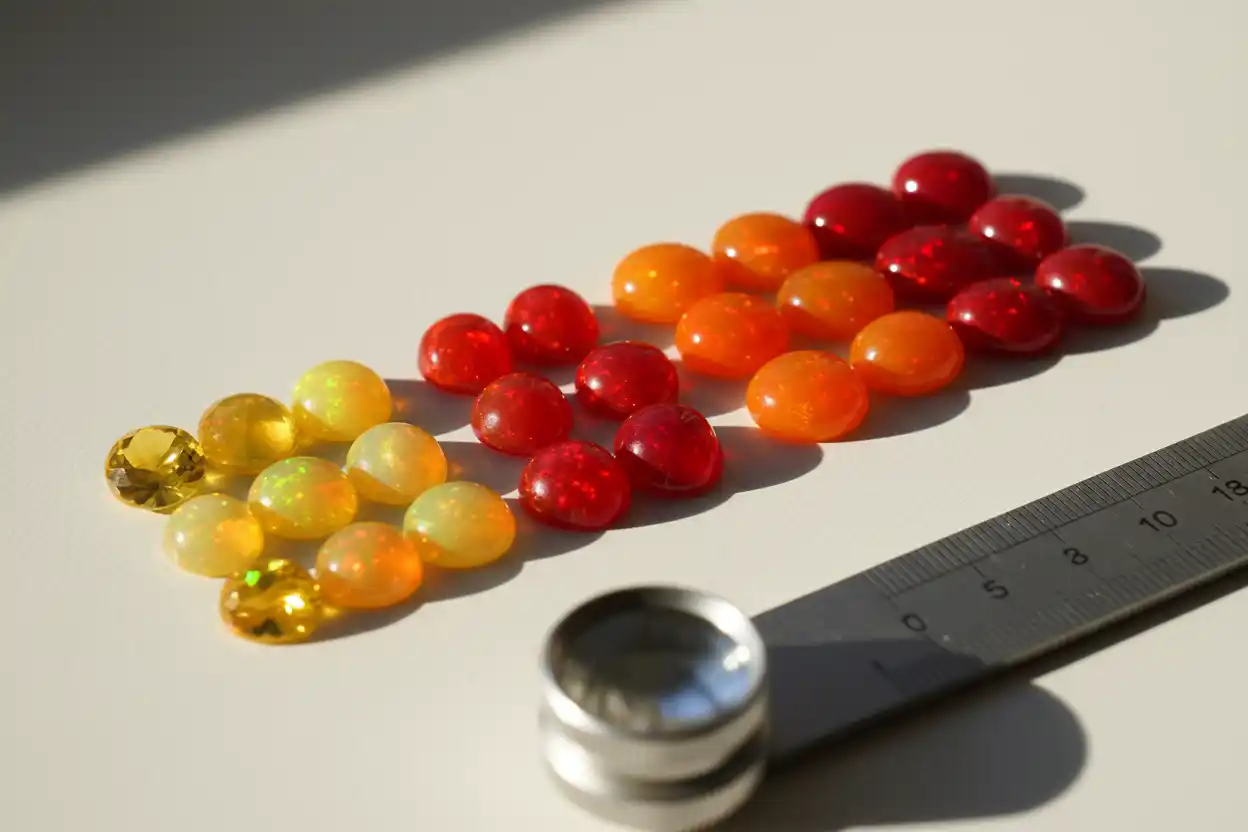
To buy fire opal well, begin by understanding that fire opal is defined primarily by its warm bodycolor rather than by the presence of rainbow play-of-color. GIA describes fire opal as transparent to translucent opal with a bodycolor usually ranging through yellow, orange, and red; some examples show play-of-color, while others do not. Mexican material is historically important enough that “Mexican opal” and “Mexican fire opal” are common trade descriptions, but fire opal as a gem type should not be reduced to a country name alone.
That distinction changes how buyers should evaluate quality. In a fire opal without play-of-color, the beauty of the warm bodycolor, transparency, saturation, brightness, cut, clarity, and condition can carry most of the value. In a fire opal that also displays play-of-color, both the warm bodycolor and the spectral phenomenon need to be considered. GIA’s broader opal framework still applies: color, pattern, clarity, transparency, and cut determine how compelling the finished stone appears.
Buy Fire Opal At a Glance
| Buying Factor | What to Examine | Why It Matters |
|---|---|---|
| Identity | Natural fire opal versus synthetic opal, imitation, coated material, or another orange gem | Warm color alone does not prove opal identity |
| Bodycolor | Yellow, orange, reddish orange, or red hue, saturation, and evenness | Bodycolor is central to fire opal’s appeal |
| Transparency | Transparent to translucent appearance | Fine faceted fire opal often relies heavily on transparency and brightness |
| Play-of-Color | Presence, brightness, pattern, and coverage when present | Adds another value layer but is not required for fire-opal identity |
| Clarity | Clouds, inclusions, pits, fractures, crazing | Clean transparent material is particularly important for faceted stones |
| Cut | Faceting, cabochon dome, proportions, symmetry, polish | Cutting determines brightness and how color is presented |
| Size | Carat weight plus millimeter dimensions | Larger fine material can be desirable, but size alone is not quality |
| Treatment | Coating, impregnation, dye, smoke, oil, wax, resin, or other modification | Fire opal has documented treated and coated examples |
| Natural/Synthetic Status | Mined versus laboratory-grown opal | Synthetic fire opal can resemble natural material |
| Origin | Mexico, Ethiopia, or other locality and supporting evidence | Origin can be reported for opal when determinable |
| Stability | Crazing, fractures, dryness sensitivity | Opal requires careful durability assessment |
| Condition | Scratches, chips, abrasion, worn facets | Important in both cabochons and faceted stones |
| Documentation | Laboratory identity, treatment findings, and origin opinion | Useful when price or origin claims are significant |
Fire Opal Does Not Need Play-of-Color to Be Fire Opal
One of the most persistent buyer misunderstandings is that every valuable opal must show rainbow flashes. Fire opal is an important exception because its identity in the trade is tied to transparent or translucent yellow, orange, or red bodycolor. GIA explicitly notes that fire opal may or may not display play-of-color.
A clean, vividly orange transparent fire opal can therefore be a legitimate fine gemstone even if it shows no rainbow phenomenon. Conversely, a fire opal that combines rich warm bodycolor with strong play-of-color can occupy another highly desirable category.
Buyers should ask whether the seller is pricing the stone primarily for bodycolor, transparency, play-of-color, rarity, cutting, or provenance rather than assuming every premium rests on the same quality factor.
Mexico Is the Classic Commercial Source
Mexico is internationally associated with fire opal, and GIA identifies Querétaro as an important producer of yellow, orange, reddish-orange, and red material, some of which also displays play-of-color. GIA industry reporting likewise describes Mexican fire opal as ranging from colorless to dark red and notes that sufficiently transparent material can be faceted.
This source history explains the common phrase Mexican fire opal, but the geographic name should not replace individual quality assessment. A pale, included, poorly cut Mexican stone does not become fine solely because of its source.
Fire-colored opal can also occur outside Mexico. Ethiopian deposits, for example, can produce orange and other warm-colored material, so visual appearance alone does not prove Mexican origin.
Geographic Origin Can Be Independently Reported for Natural Opal
Current GIA services include natural opal among the stones eligible for a Colored Stone Identification & Origin Report. When sufficient gemological evidence exists, the report can add geographic origin to the identification conclusion.
This matters when a seller charges a premium for Mexican origin. A laboratory origin opinion provides different evidence from a supplier statement, mine story, or trade name.
Origin still should not be treated as a universal quality grade. GIA’s general opal buyer guidance states that opal value depends on quality rather than locality alone.
Bodycolor Is Usually the First Fire-Opal Quality Factor
Fire opal can range from yellow through orange to reddish orange and red, and saturation can vary from very pale to intense. Strong, attractive color can create substantial demand even in stones without play-of-color.
Evaluate hue, tone, saturation, and evenness under neutral lighting. A vivid orange can be compelling when the stone remains bright and transparent, while an extremely dark reddish-brown stone may lose brilliance even though it appears strongly colored.
Photography deserves scrutiny because warm lamps can intensify orange and red dramatically. Request daylight-equivalent images or neutral video if the asking price depends heavily on color.
Transparency Has Greater Importance in Faceted Fire Opal
Fire opal is often transparent enough to facet, which distinguishes much of the commercial material from opaque cabochon opal. GIA’s market reporting on Mexican fire opal specifically notes that clean material can be faceted and can range widely in bodycolor.
Faceting places greater emphasis on internal transparency and light return. Cloudiness, surface-reaching fractures, internal fissures, or poor polish can reduce brilliance more noticeably than they might in an opaque cabochon.
A cabochon fire opal can still be excellent, especially when play-of-color benefits from a domed surface. Cutting style should serve the optical properties of the individual rough rather than follow one universal rule.
Play-of-Color Adds a Second Dimension of Value
When fire opal displays play-of-color, evaluate the spectral effect independently from the orange, yellow, or red bodycolor. GIA identifies play-of-color brightness, range, pattern, and coverage as important aspects of opal quality.
A stone can have extraordinary orange bodycolor but weak rainbow flashes, or modest bodycolor with exceptionally vivid play-of-color. The buyer needs to decide which combination creates the stronger visual result.
A fire opal displaying vivid spectral color across much of its face should not be compared directly with a transparent non-phenomenal orange fire opal solely by carat weight because the two stones appeal to partially different buyer priorities.
Fire Opal Should Not Be Confused With Black Opal
Black opal is defined by a dark background that intensifies contrast with play-of-color, whereas fire opal is associated with yellow-to-red bodycolor and may have no play-of-color at all. GIA lists them as separate major opal categories.
The Gems Lore guides to buy black opal and black opal price explain the black-opal framework, where dark body tone and spectral coverage dominate evaluation.
A buyer who wants a transparent fiery-orange stone should judge fire opal according to its own quality system rather than assuming the darkest opal category is automatically more prestigious.
Fire Opal and Ethiopian Opal Can Overlap
Ethiopian deposits can produce yellow, orange, and reddish material in addition to white, crystal, and darker opal. GIA’s Wollo research specifically records some fire-opal material from the Wegel Tena deposit.
This means “fire opal” and “Ethiopian opal” are not mutually exclusive concepts: one describes an appearance/type, while the other describes geographic origin. A gem may be both Ethiopian and fire opal.
The Gems Lore buy Ethiopian opal and Ethiopian opal price guides are therefore useful when a warm-colored opal is represented as Ethiopian, especially because Wollo material is commonly hydrophane and can require additional treatment scrutiny.
Hydrophane Fire-Colored Opal Requires Extra Treatment Scrutiny
Some Ethiopian fire-colored opal can be hydrophane, meaning it readily absorbs liquids. GIA specifically cautions that orange hydrophane opal can potentially be artificially colored because porous stones absorb dye, even though orange can also occur naturally.
A vivid orange bodycolor should therefore be judged together with origin and porosity. Mexican fire opal and Ethiopian hydrophane orange opal can behave differently, and the same care or treatment assumptions should not automatically be applied to both.
Laboratory analysis is particularly useful when the color is unusual, the price is high, or the seller makes strong untreated claims.
Coated Fire Opal Exists
GIA has documented coated natural fire opal in the marketplace. In one examined orange cabochon, gemological investigation identified a surface coating that altered the stone’s appearance, demonstrating that fire-opal color should not automatically be assumed to exist entirely within untreated material.
A coated fire opal can remain an attractive product when disclosed clearly. The concern is durability and representation: surface films may wear differently from the underlying opal and should not be hidden from the buyer.
Inspect facet junctions, scratches, drill holes, and worn edges under magnification because coating irregularities can sometimes become more visible in these areas.
Other Opal Treatments Should Also Be Considered
GIA recognizes impregnation with oil, wax, or plastic as well as surface modification among opal treatments. Additional research on hydrophane opal documents dye and resin treatments, showing how porous material can be modified beyond ordinary polishing.
Treatment should be evaluated according to the individual fire opal’s source and structure rather than through a blanket statement that all fire opal is untreated or all orange opal is treated.
A professional seller should state what is known and should not use the word natural as a substitute for treatment disclosure.
Synthetic Fire Opal Exists
GIA’s research on the modern fire-opal market notes natural, synthetic, and treated material circulating commercially, including synthetic products marketed under proprietary names.
Synthetic opal is not the same as an imitation. A synthetic product is manufactured to reproduce opal-like material and optical behavior, while an imitation may be glass or another substance selected simply because it resembles opal.
Laboratory testing can distinguish these categories when visual inspection is insufficient. For an expensive stone, independent identification is far more reliable than a seller’s phrase such as “lab tested” without a verifiable report.
Clarity Has a Different Meaning in Transparent Fire Opal
GIA defines opal clarity broadly through transparency and the quantity or effect of inclusions. Experts expect different levels of clarity for different types of opal.
Transparent faceted fire opal usually benefits from strong clarity because the buyer wants light to move through the stone cleanly. Internal clouds, fractures, or inclusions can interrupt brilliance and make the color look less luminous.
Minor natural features may be acceptable, especially in rare material, but surface-reaching cracks deserve greater caution because they can affect durability.
Crazing Is a Serious Value and Durability Issue
Opal can craze when internal moisture balance changes under unfavorable conditions, creating a fine network of fractures. GIA notes that crazed opal has reduced durability and commercial value.
Inspect fire opal carefully under magnification, particularly transparent material where fine cracks may be easy to overlook in bright photographs.
A seller should never describe active crazing merely as natural inclusion texture. Crazing is damage or instability rather than an attractive internal feature.
Cut Style Should Match the Material
Transparent fire opal can be faceted, while material with play-of-color may be fashioned as a cabochon to display spectral flashes effectively. GIA notes broadly that fine opals are often cut in ways that preserve and maximize their optical features rather than to standardized shapes alone.
In a faceted fire opal, inspect windowing, symmetry, polish, brilliance, and pavilion depth. In a cabochon, examine dome shape, polish, color orientation, thickness, and whether the play-of-color remains visible from useful angles.
Freeform shapes can be completely appropriate when they preserve valuable rough. Shape should serve beauty and durability rather than exist only to retain extra carat weight.
Carat Weight Should Be Considered With Dimensions and Quality
Opal’s relatively low density means a fire opal can look physically large for its weight compared with denser gemstones. GIA notes that larger opals can remain comfortable to wear because of this lower density.
A large fine fire opal can be desirable, but larger weight has the greatest value when color, transparency, stability, and cut remain strong.
Compare dimensions with carat weight. A deep faceted stone may carry more weight without providing equivalent face-up spread, while a well-proportioned gem can appear larger even at a lower numerical weight.
Mexican Origin Is Valuable Provenance, Not a Substitute for Quality
Mexico’s long association with fire opal creates legitimate market recognition. Querétaro is particularly well known, and GIA identifies the region as an important source of yellow, orange, reddish-orange, and red fire opal.
Fine Mexican provenance can add collector interest, but a dull or damaged Mexican stone remains dull or damaged. Color, transparency, treatment, cut, stability, and condition still determine the physical quality.
For significant transactions, GIA’s current geographic-origin service for natural opal provides a stronger basis for an origin premium than a seller’s unsupported country claim.
GIA Does Not Grade Fire Opal AAA
GIA evaluates opal but does not issue an overall opal quality grade. Its reports can establish material identity, natural versus laboratory-grown status, characteristics, and detectable treatments, while origin reporting is available for natural opal when determinable.
Retail terms such as AAA fire opal, AAAA Mexican opal, top fire, collector grade, or investment grade are therefore seller-defined.
The safest response is to ask what the grade actually measures and then examine those characteristics yourself.
Condition Matters in Pre-Owned Fire Opal
Opal ranges around 5 to 6.5 on the Mohs hardness scale and has very poor to fair toughness, making it more susceptible to scratches and breakage than many common faceted jewelry stones.
Faceted fire opal can show abraded facet edges, chipped girdles, or scratches across broad facets after prolonged wear. Cabochons can become dull through surface abrasion or develop edge chips if mounted carelessly.
Condition should be evaluated separately from natural clarity. A clean stone damaged through wear is not equivalent to an undamaged stone with a harmless natural inclusion.
Jewelry Setting Should Reflect Fire Opal’s Durability
Fire opal can be worn successfully in rings, but a protective design becomes particularly valuable for larger or heavily worn pieces. GIA recommends protective settings for opal rings because the gem is vulnerable to scratches and chips.
Bezel-style or protective halo designs can reduce direct impact, though setting pressure must still be applied carefully. Earrings and pendants normally experience fewer knocks and can be safer choices for especially fine or delicate stones.
A beautiful fire opal in a poor setting can become a costly repair problem, so mounting quality deserves part of the buying budget.
Compare Fire Opal With Fire Opal
A transparent orange Mexican fire opal without play-of-color should be compared with similar transparent warm-body opal, not automatically with black opal, boulder opal, or Ethiopian white precious opal.
Gems Lore’s black opal price guide explains the dark-body play-of-color market, while boulder opal price addresses matrix-backed Australian material. The Ethiopian opal price guide covers hydrophane characteristics and treatment risks that may be relevant when a fire-colored opal is Ethiopian.
The more closely the material categories align, the more meaningful the numerical price comparison becomes.
Common Red Flags When You Buy Fire Opal
Be cautious when:
A seller claims every fire opal must show rainbow play-of-color.
Mexican origin is asserted solely because the stone is orange.
Extremely saturated color appears only in heavily edited photographs.
A seller refuses treatment disclosure.
Coated material is represented as untreated natural color.
Synthetic opal is described simply as natural fire opal.
Crazing or fractures are hidden by favorable lighting.
AAA or AAAA is presented as a universal laboratory grade.
A GIA identification report is described as a price appraisal.
A large transparent stone carries a major rarity premium with no evidence supporting exceptional quality.
The seller provides no inspection or return period for an expensive online purchase.
Strong documentation should increase as the financial claim becomes larger.
Conclusion
To buy fire opal confidently, evaluate bodycolor first while remembering that play-of-color is optional rather than mandatory. Fire opal is typically transparent to translucent with yellow, orange, reddish-orange, or red bodycolor, and Mexican material has an especially important historic and commercial role.
Quality depends on hue, saturation, transparency, cut, clarity, stability, size, treatment, and condition, with play-of-color adding another value layer when present. Buyers should also distinguish Mexican provenance from appearance alone, natural opal from synthetic or imitation material, and untreated color from coated or otherwise enhanced stones. GIA has documented coated fire opal and currently provides identification, treatment testing, and geographic-origin reporting for natural opal when determinable.
A strong fire-opal purchase is therefore not simply the reddest or largest stone available. It is the gem whose color, transparency, cutting, stability, treatment disclosure, provenance, and price make sense together.
Frequently Asked Questions
What is fire opal?
Fire opal is transparent to translucent opal with a bodycolor commonly ranging from yellow through orange to red. It may show play-of-color, but rainbow play-of-color is not required for the material to be called fire opal.
Is all fire opal from Mexico?
No. Mexico is the classic and commercially important source, especially Querétaro, but warm-colored opal can also occur elsewhere, including Ethiopia.
Does fire opal need play-of-color to be valuable?
No. Transparent, richly colored fire opal can be valuable based on bodycolor, transparency, cut, size, and quality even without rainbow flashes. Play-of-color creates an additional optical and value factor when present.
What is the best fire opal color?
There is no single universally best hue, but attractive saturated orange, reddish orange, and red can command strong demand when the stone remains bright and transparent. Individual beauty, treatment status, clarity, and cut remain important.
Can fire opal be faceted?
Yes. GIA notes that sufficiently transparent Mexican fire opal can be faceted. Less transparent material or stones with play-of-color may be better suited to cabochons.
Can fire opal be treated?
Yes. GIA has documented coated fire opal and recognizes additional opal treatments such as impregnation and surface modification. Treatment should be disclosed clearly.
Can fire opal be synthetic?
Yes. Synthetic fire-opal products exist, and GIA has documented natural, synthetic, and treated fire opals in the marketplace.
Does orange color prove Mexican origin?
No. Orange and fire-colored opal can occur outside Mexico. Geographic origin requires stronger evidence than appearance alone.
Can GIA confirm fire opal origin?
Natural opal is currently eligible for GIA’s Colored Stone Identification & Origin Report, with geographic origin included when determinable.
Does GIA grade fire opal AAA?
No. GIA evaluates opal but does not assign an overall opal quality grade. AAA and similar labels are seller-defined.
Is fire opal durable enough for rings?
It can be used in rings, but opal is comparatively soft and has limited toughness. GIA recommends protective settings and careful wear to reduce scratching and chipping.
Is fire opal a guaranteed investment?
No. Fine fire opal can be scarce and collectible, but future value depends on color, transparency, size, treatment, origin, condition, demand, and liquidity. No seller grade or geographic name guarantees appreciation.