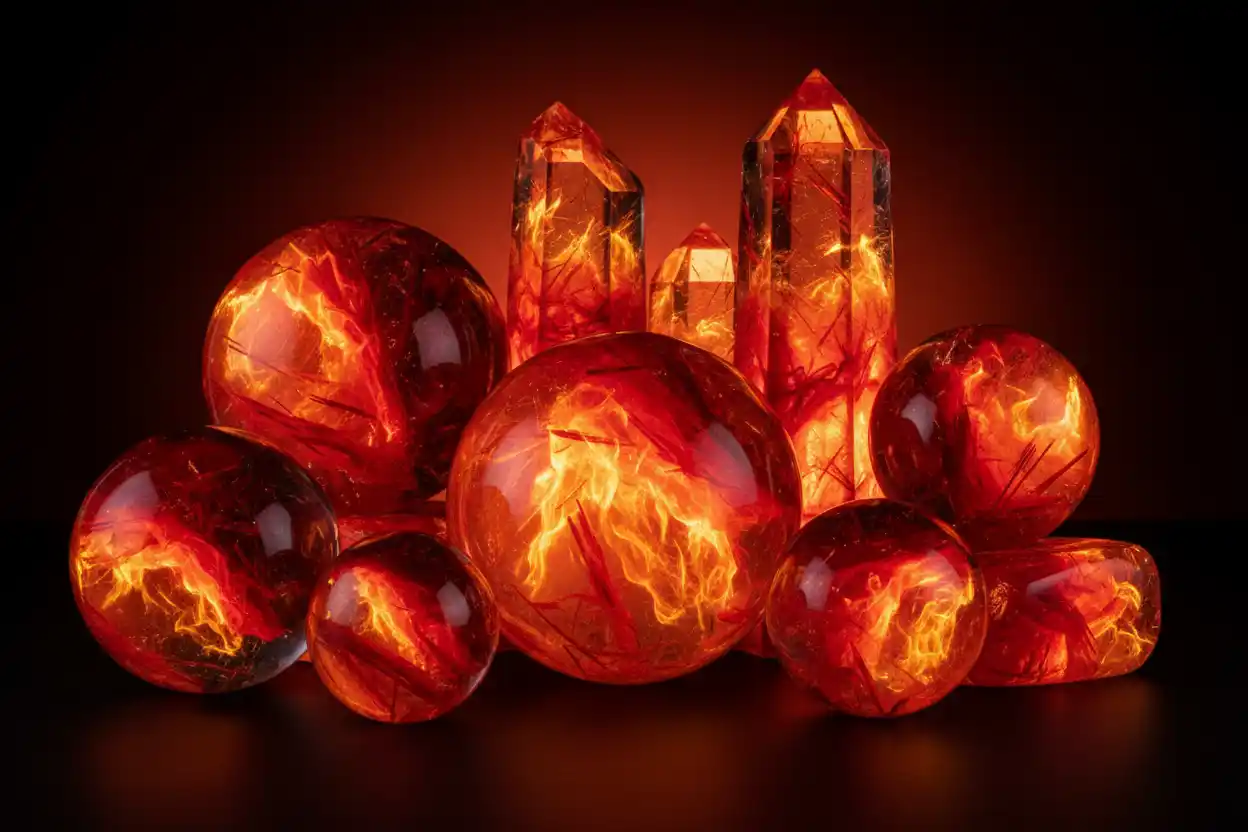
Fire Quartz Meaning: Properties, Uses & Symbolism
Fire quartz meaning starts with quartz containing visually prominent red, orange, rust, brown, or dark iron-rich material—not with a separate mineral species called “fire quartz.” In the gem and crystal trade, fire quartz is most commonly used for quartz whose appearance is shaped by iron oxide or iron oxyhydroxide inclusions, coatings, fracture fillings, or growth-related features. Hematite is particularly important in many specimens, while goethite and other iron-bearing phases may occur in some material. The exact identity of a red platelet, needle, film, cloud, or granular inclusion cannot always be established from appearance alone, so technically specific labels require more evidence than a photograph.
That distinction gives fire quartz meaning a stronger foundation. The host is quartz, a crystalline form of silicon dioxide, SiO₂, with the familiar physical properties of the quartz mineral species. The vivid internal features are additional mineralogical components or alteration products that modify appearance without transforming the host quartz into a new species. A transparent crystal with scattered hematite platelets, a milky quartz cabochon with rusty inclusions, and a reddish quartz specimen with iron-rich fracture staining may all be marketed under similar names even though their internal textures are not identical.
Modern symbolism can be discussed after that physical identity is clear. Fire quartz meaning is often connected with motivation, persistence, confidence, vitality, focus, or deliberate action because its warm red-orange inclusions visually suggest heat and movement. Those associations can function as personal metaphors, but they are not measurable properties of quartz or hematite. Readers who want the same material-first approach across other stones can explore the broader Gemstone Guides without treating commercial crystal names as formal mineral species.
Fire Quartz Meaning at a Glance
| Feature | Grounded reference |
|---|---|
| Material identity | Quartz containing visible iron-rich inclusions, coatings, or associated features |
| Host mineral | Quartz |
| Host composition | SiO₂ |
| Crystal system | Trigonal |
| Typical colors | Colorless, white, smoky, red, rust-orange, reddish brown, yellow-brown, or mixed |
| Main source of “fire” appearance | Commonly hematite and other iron-bearing inclusions or staining |
| Mohs hardness | About 7 for the quartz host |
| Cleavage | None |
| Fracture | Commonly conchoidal |
| Luster | Vitreous on fresh quartz surfaces |
| Transparency | Transparent to translucent; heavily included material may appear opaque |
| Common commercial names | Fire quartz, hematoid quartz, hematite quartz, red healer quartz, and overlapping informal names |
| Species status | “Fire quartz” is not a separate mineral species |
| Identification limit | Inclusion species cannot always be identified visually |
| Symbolism | Modern personal or cultural interpretation rather than a scientifically demonstrated effect |
| Ownership concern | Ordinary intact handling differs from cutting or grinding crystalline silica |
The central fire quartz meaning boundary is therefore simple: quartz identity can be established independently from the identity of every inclusion. A specimen may unquestionably be quartz while the red material inside it remains only provisionally identified as an iron oxide until appropriate analysis is performed.
What Fire Quartz Actually Is
Quartz is one of the most widespread minerals in the Earth’s crust and occurs in igneous, metamorphic, hydrothermal, and sedimentary environments. Its crystal structure is built from interconnected silicon-oxygen tetrahedra, and well-formed crystals commonly develop hexagonal-looking prisms terminated by rhombohedral faces even though quartz belongs to the trigonal crystal system.
Fire quartz meaning describes what happens when this normally colorless or pale host contains visually significant iron-bearing material. The inclusions can appear as red platelets, orange clouds, rusty veils, dark flakes, dots, needles, films, fracture coatings, or irregular aggregates. Some specimens contain inclusions incorporated during crystal growth. Others may show later mineral deposition along fractures or surfaces. A polished stone can combine several textures at once.
This variability is why the name is useful commercially but imprecise scientifically. “Fire quartz” tells a buyer approximately what visual family to expect. It does not tell a mineralogist exactly which iron minerals are present, when they formed relative to the quartz, or whether every red feature has the same composition.
The underlying quartz remains identifiable through its own physical and optical properties. A more detailed examination of internal features belongs in the fire quartz microscope inclusion notebook, where platelets, fractures, clouds, surface-reaching features, and grain relationships can be documented without turning every reddish inclusion into an unsupported species assignment.
How Fire Quartz Forms
Fire quartz formation generally requires two ingredients: silica capable of crystallizing as quartz and an environment containing mobile or available iron. Silica-rich hydrothermal fluids are especially important in many quartz-forming systems. These fluids can travel through fractures, cavities, veins, and altered rock, depositing quartz as temperature, pressure, chemistry, or fluid conditions change.
Iron-bearing material can become associated with that quartz at several stages. Minute crystals or particles may be trapped as quartz grows around them. Iron-bearing minerals can crystallize along growth surfaces between episodes of quartz deposition. Later fluids can introduce iron into cracks or cavities. Weathering and oxidation can modify pre-existing iron-bearing phases, producing reddish or brown secondary material along fractures and exposed surfaces.
Those pathways are not visually identical. A sharply bounded red platelet suspended inside transparent quartz suggests a different relationship from rusty material concentrated only along a surface-reaching fracture. Both may contribute to what the marketplace calls fire quartz, but they preserve different parts of the specimen’s geological history.
Formation details should therefore be inferred from texture and evidence rather than from the trade name alone. Host-rock relationships, hydrothermal conditions, mineral associations, oxidation, and the sequence of quartz and iron-mineral development are treated more fully in fire quartz formation and deposit geology.
What Causes the Red and Orange Colors?
The warm coloration central to fire quartz meaning usually comes from iron-bearing material rather than from the ideal chemistry of pure quartz. Hematite, an iron oxide, is an important cause of red coloration in many natural mineral specimens because finely divided hematite can produce vivid red to reddish-brown appearances. Goethite and related iron oxyhydroxide material can contribute yellow-brown, orange-brown, or darker tones.
Particle size changes appearance. Extremely fine material may create diffuse clouds or an almost uniform reddish tint, while larger crystals can appear as distinct platelets, flakes, or needles. Concentration also matters: sparse inclusions leave much of the quartz transparent, whereas dense networks can make a stone translucent or nearly opaque.
Lighting adds another variable. Reflections from metallic-looking platelets can produce brighter flashes under directional illumination than under diffuse light. An inclusion that looks dark brown from one angle may reflect coppery red or orange from another. Polished surfaces, camera exposure, background color, and image saturation can further increase apparent intensity.
The specialized relationship between quartz optics, inclusion orientation, transparency, and apparent color is covered in fire quartz optical properties and color behavior. For fire quartz meaning, the important point is that the warm visual effect can arise from real mineral inclusions without implying literal heat or an unusual energetic emission.
Diagnostic Traits: Identify the Quartz and the Inclusions Separately
A disciplined fire quartz meaning assessment asks two different questions: “Is the host quartz?” and “What is causing the visible coloration?”
Quartz commonly has a Mohs hardness near 7, vitreous luster, no cleavage, conchoidal fracture, a specific gravity near 2.65, and refractive indices around 1.54–1.55. Those properties help identify the host. Crystal habit, optical behavior, and appropriate gemological testing can strengthen the conclusion.
The inclusions require a separate assessment. Red color can make hematite plausible, but color is not a definitive species test. Brown or yellowish material may suggest goethite or other iron-rich alteration products, yet several minerals can overlap visually. Metallic-looking platelets are not automatically hematite, and transparent reddish needles are not automatically a specific mineral simply because a seller uses a familiar inclusion name.
Where exact identification matters, methods such as Raman spectroscopy, X-ray diffraction, electron microscopy with chemical analysis, or other specialist techniques may be required. Those methods answer questions that a loupe or photograph cannot.
This distinction is especially important for high-value specimens. A dealer can reasonably describe a stone as quartz with red iron-rich inclusions when the evidence supports that broad wording. Claiming a rare inclusion species requires a higher evidence threshold.
Original Fire Quartz Name and Specimen Claim Checklist
Fire quartz meaning is surrounded by overlapping trade names. The following checklist separates terms that can be useful descriptively from labels that should not be treated as proven mineralogical conclusions without supporting evidence.
| Label or claim | What it can reasonably describe | What still needs evidence |
|---|---|---|
| Fire quartz | Quartz with warm red, orange, rust, or iron-rich visual features | Exact inclusion mineral |
| Hematoid quartz | Quartz associated visually or compositionally with hematite-rich material | That every inclusion is hematite |
| Hematite quartz | Quartz containing confirmed or strongly supported hematite | Precise abundance and formation sequence |
| Goethite quartz | Quartz claimed to contain goethite inclusions | Confirmation of goethite rather than another iron-bearing phase |
| Lepidocrocite quartz | Quartz marketed with red or metallic-looking inclusions attributed to lepidocrocite | Analytical confirmation of lepidocrocite |
| Harlequin quartz | Informal trade name for quartz with contrasting red, dark, or sparkling inclusions | A single standardized mineralogical definition |
| Strawberry quartz | Quartz with pink-to-red included appearance in common commerce | That it is synonymous with fire quartz |
| Red healer quartz | Informal metaphysical or retail name | Formal mineral-species or variety status |
| Golden healer quartz | Quartz with yellow-to-golden iron-related surface or internal coloration | That it is the same material as red fire quartz |
| Natural untreated | Seller or laboratory statement about modification | Absence of treatment solely from appearance |
| Inclusion-rich quartz | Visible abundance of internal material | Identity of each included phase |
| Iron-rich quartz | Broad compositional or descriptive statement | Quantitative iron concentration |
| “Rare lepidocrocite” | Seller’s species and rarity claim | Analytical species identification and defensible rarity context |
| “High vibration quartz” | Metaphysical terminology | Measurable mineralogical property |
| “Healing fire quartz” | Symbolic or commercial wording | Medical efficacy |
The “lepidocrocite quartz” issue deserves particular caution. Red, orange, or metallic platelets inside quartz are sometimes assigned to lepidocrocite visually, but platelet shape and color do not uniquely establish that mineral. Hematite and other iron-bearing phases can produce overlapping appearances. A specimen described specifically as lepidocrocite-bearing should ideally have analytical evidence if the species claim materially affects price, rarity, or scientific significance.
“Strawberry quartz” creates a different naming problem. It is an established commercial description for quartz with attractive pink-to-red included coloration, but materials sold under that name can have different inclusion compositions. Some may overlap visually with fire quartz; others should not be treated as synonyms.
Fire Quartz, Hematoid Quartz, and Hematite Quartz
These names frequently overlap because hematite is central to many reddish quartz specimens. “Hematoid quartz” is generally a descriptive trade term for quartz whose appearance is influenced by hematite or hematite-like iron-rich material. “Hematite quartz” more directly asserts that hematite is present.
The distinction may seem minor in ordinary retail use, but it matters when fire quartz meaning becomes technical. “Hematoid” can function as a broad visual or compositional descriptor. “Hematite quartz” can be interpreted as a mineral-inclusion identification. When that exact inclusion identity matters, evidence should rise with the specificity of the wording.
The best label is therefore sometimes deliberately modest: “quartz with red iron-rich inclusions.” That description communicates what is materially relevant without pretending that a photograph has done the work of spectroscopy.
Why “Lepidocrocite Quartz” Should Not Be Assigned From Photos Alone
Lepidocrocite is an iron oxyhydroxide mineral. Its name has become popular in some crystal markets, particularly where red platelets or sparkling internal features occur in transparent quartz. The commercial appeal of the name can create pressure to identify every visually similar inclusion as lepidocrocite.
That is not a defensible identification method.
Fine hematite plates, goethite-related material, mixtures of iron oxides and oxyhydroxides, and other inclusions can overlap visually. Lighting can make thin plates appear metallic, translucent red, black, or copper-colored depending on orientation. Magnification helps document morphology but does not necessarily resolve species.
Fire quartz meaning is better served by acknowledging uncertainty than by converting a seller’s attractive inclusion name into mineralogical fact. Exact identification belongs to analytical mineralogy when it matters.
Documented History Behind Fire Quartz
Quartz has an extensive human history as a tool material, ornament, carving material, gemstone, optical material, and mineral specimen. Clear quartz, smoky quartz, amethyst, citrine, chalcedony, and numerous included varieties have been collected and used across many cultures. That broad quartz history is well established.
“Fire quartz,” however, should not automatically inherit every ancient quartz story. The phrase functions primarily as a modern descriptive trade name for reddish or iron-included quartz. Claims that a specific ancient culture used “fire quartz” under exactly that identity need evidence tied to the actual material rather than a retrospective application of today’s commercial vocabulary.
“Hematoid” and hematite-related wording are rooted in the blood-red appearance traditionally associated with hematite and its red streak. That etymological relationship helps explain the descriptive language surrounding reddish quartz but does not prove that historical users assigned the same symbolic meanings found in modern crystal commerce.
A careful fire quartz meaning history therefore separates the long documented use of quartz from the more recent commercial packaging of particular inclusion-rich varieties.
Fire Quartz Meaning in Modern Symbolism
Modern fire quartz meaning often emphasizes motivation, persistence, focused action, confidence, courage, emotional steadiness, or the ability to combine enthusiasm with practical follow-through. The visual logic is easy to understand: transparent quartz containing red or orange mineral material naturally lends itself to metaphors of internal fire, contained energy, or purposeful movement.
Those metaphors can be used without making scientific claims. Someone might keep fire quartz beside a work plan as a visual reminder to finish one priority before adding another. Another person might use the contrast between transparent host quartz and opaque inclusions as a prompt to separate what is clear in a situation from what still requires investigation.
That type of reflective practice is compatible with a material-first fire quartz meaning because the mechanism is human attention. The stone becomes a chosen cue rather than a physiological device.
There is no established gemological evidence that fire quartz creates courage automatically, removes emotional trauma, changes another person’s feelings, attracts guaranteed prosperity, or protects someone from accidents. The broader distinction between symbolic mineral use and medical, financial, or other professional claims is explained in the site’s Disclaimer.
Iron Inside Fire Quartz Is Not an Iron Supplement
Iron-rich inclusions are central to the appearance of many fire quartz specimens, but mineral chemistry is not medicine. Hematite embedded inside quartz does not function as a dietary source of iron when the stone is worn, held, or placed against the skin.
The same principle applies to silicon and oxygen in the host quartz. The fact that an element occurs in both minerals and biological systems does not establish a route of nutritional delivery or a therapeutic effect.
Fire quartz meaning should therefore never be extended into claims that the stone treats anemia, cardiovascular disease, fatigue, hormonal conditions, neurological problems, anxiety, depression, or another health condition. A mineral specimen is not a substitute for diagnosis, treatment, nutrition, or medication.
Crystal ingestion is also unnecessary. Fire quartz should not be powdered for consumption or placed directly into drinking water as an elixir. Symbolic practice does not require turning a geological material into something ingested.
Safe Ownership: Intact Quartz Versus Quartz Dust
Ordinary handling of an intact fire quartz crystal, cabochon, bead, or polished specimen is different from cutting, grinding, drilling, sanding, carving, or crushing it. The host material is crystalline silica. Processes that generate fine respirable silica dust create an occupational hazard that is not present merely because someone displays or wears a finished stone.
Lapidary work therefore requires proper dust control. Wet cutting and grinding, effective local extraction, suitable respiratory protection, eye protection, and disciplined cleanup are more appropriate than dry grinding that allows fine dust to become airborne.
The iron-bearing inclusions do not remove that quartz-related concern. A mixed mineral specimen should be processed according to the hazards of the complete material rather than assuming that a decorative trade name makes the dust benign.
Cutting decisions also affect appearance. Iron-rich layers or inclusion concentrations can be lost if rough is oriented poorly, while fractures may dictate safer shapes. Those specialized questions belong in fire quartz cutting, orientation and polish.
Fire Quartz in Jewelry
Quartz’s hardness near 7 gives it useful resistance to everyday scratching, but hardness does not make every included specimen equally durable. Dense fractures, surface-reaching inclusions, internal stress, thin edges, and existing chips can make one fire quartz stone substantially more vulnerable than another.
A heavily included cabochon may have beautiful rust-red internal texture while also containing fractures that need protection from impact. Beads can wear against one another. Rings face more knocks than pendants. Large points mounted in jewelry may expose vulnerable tips.
Setting design should therefore respond to the individual stone rather than the generic hardness of quartz. Mechanical protection, edge exposure, attachment methods, and wear scenarios are treated in fire quartz setting and wear engineering.
Preserving Fire Quartz Specimens and Their Evidence
A natural fire quartz specimen can contain more information than a polished surface reveals. Crystal faces, attached matrix, fracture fillings, inclusion concentrations, contact zones, weathering, and original labels may all help interpret how the specimen formed and where it came from.
Cleaning or polishing can improve appearance while destroying some of that evidence. Removing an iron-rich surface coating, for example, may erase a secondary mineral feature that was part of the specimen’s geological history. Grinding a natural crystal into a polished point can eliminate growth surfaces and matrix relationships permanently.
Collectors should photograph important specimens before alteration, retain original labels, and distinguish repairs from natural structures. Long-term condition, storage, documentation, and intervention decisions are addressed separately in fire quartz specimen conservation and record keeping.
Where geographic origin matters, labels and ownership records deserve similar care. The fire quartz provenance disclosure checklist provides a framework for separating documented locality from seller attribution or visual guesswork.
Fire Quartz Compared With Nearby Materials
Comparisons clarify fire quartz meaning best when they focus on material mechanisms rather than symbolic similarities.
Flint meaning concerns a dense microcrystalline silica material commonly associated with chert rather than transparent macrocrystalline quartz containing visible iron-rich inclusions. Both are silica-rich, but their textures, geological occurrence, fracture behavior in use, and typical appearance are very different.
Fire opal meaning concerns hydrated non-crystalline silica whose yellow-to-red body color defines the trade variety. Fire opal can be transparent and orange, but it is not iron-included quartz. Its water-bearing structure, hardness, fracture behavior, and optical characteristics require a different framework.
Flower agate meaning concerns chalcedony material valued for plume-like or floral internal patterns. It belongs within microcrystalline silica rather than macrocrystalline quartz, even though both can be sold as polished decorative stones with visually complex inclusions.
Fire agate meaning is different again. Its spectral “fire” results from thin internal iron-rich layers associated with chalcedony and optical interference. Fire quartz usually derives its warm appearance from visible iron-rich inclusions or staining rather than the same iridescent layered mechanism.
These distinctions demonstrate why shared words such as “fire,” “quartz,” “agate,” or “red” should not be treated as evidence that materials are mineralogically interchangeable.
What Fire Quartz Meaning Can Reliably Tell You
A grounded fire quartz meaning reference can establish that fire quartz is a commercial or descriptive form of quartz containing conspicuous warm-colored iron-rich material. It can explain how quartz forms, why hematite and other iron-bearing phases can create red and orange appearances, which quartz properties help identify the host, why inclusion species need separate evidence, and how modern symbolism developed around the material’s visual character.
It cannot identify every red platelet from a photograph, prove that “lepidocrocite quartz” contains lepidocrocite, authenticate geographic origin from color, establish treatment status from seller silence, or confirm that two similarly colored stones contain the same inclusion minerals.
Gems Lore’s broader material-first approach is described on About Gems Lore. Readers with analytical data, historic labels, documented corrections, or unusual inclusion evidence can provide that context through Contact Gems Lore rather than treating a visually plausible identification as laboratory confirmation.
FAQ
What is the basic fire quartz meaning?
The basic fire quartz meaning is mineralogical and descriptive: fire quartz is quartz containing red, orange, rust, brown, or related iron-rich inclusions or features, commonly involving hematite and sometimes other iron-bearing minerals. Modern symbolism may associate the material with motivation or focused action, but those themes are not measurable properties of quartz.
Is fire quartz a separate mineral?
No. Fire quartz is not a separate mineral species. The host is quartz, while the included or associated iron-rich material creates the warm coloration and visual character behind the trade name.
Is fire quartz the same as hematoid quartz?
The names commonly overlap in the marketplace. Hematoid quartz generally refers to quartz whose appearance is influenced by hematite or hematite-rich material, while fire quartz is a broader descriptive term frequently used for similar red-orange included quartz.
Does every fire quartz contain hematite?
Hematite is common in material sold as fire quartz, but every reddish feature should not automatically be assigned to hematite. Other iron oxides, oxyhydroxides, mixtures, alteration products, or staining may contribute depending on the specimen.
Is lepidocrocite quartz really fire quartz?
Some quartz sold as “lepidocrocite quartz” may also be marketed as fire quartz because the stones share a reddish included appearance. The inclusion species should not be determined from color or platelet shape alone. Analytical confirmation is appropriate when a precise lepidocrocite claim matters.
Is strawberry quartz the same as fire quartz?
Not necessarily. Strawberry quartz is a commercial term for quartz with pink-to-red included coloration, while fire quartz often emphasizes more obvious rust, red, orange, or hematite-rich visual effects. Some specimens may overlap commercially, but the terms are not universal mineralogical synonyms.
Can fire quartz be identified from a photo?
A photograph can strongly support quartz identification when crystal habit and appearance are clear and can document internal red-orange features. It cannot reliably identify every inclusion mineral, establish treatment history, or authenticate locality by itself.
Is fire quartz safe to wear?
Finished fire quartz jewelry can generally be worn with normal gemstone precautions. Individual durability depends on fractures, inclusions, cut, and setting. Processing the material is a separate issue because cutting or grinding quartz can generate hazardous respirable crystalline silica dust.
Does fire quartz provide iron to the body?
No. Iron contained in hematite or other inclusions is locked within mineral material and does not become a nutritional supplement through skin contact. Wearing fire quartz is not a treatment for iron deficiency or another medical condition.
Does fire quartz have scientifically proven healing properties?
No. There is no established scientific evidence that fire quartz treats physical or mental-health conditions. It can function as a personal symbol or reflective object without those associations being presented as medical effects.
Reading the “Fire” Inside Quartz Accurately
The strongest fire quartz meaning comes from resisting the temptation to turn every vivid inclusion into a dramatic claim. The host mineral is quartz. The red, rust, orange, brown, or dark internal features often record real iron-bearing minerals and geological processes. Those inclusions may have been trapped during crystal growth, deposited along changing growth surfaces, introduced through fractures, or modified by later oxidation. Their textures are evidence worth observing rather than decoration that needs a mystical explanation.
The same restraint improves nomenclature. “Fire quartz” is useful as a commercial visual description. “Hematoid quartz” can communicate a hematite-related appearance. More specific names such as “lepidocrocite quartz” require stronger confirmation when species identity matters. A trade name can remain useful without being promoted into a formal mineral species.
Modern symbolism can then occupy its proper place. Fire quartz meaning may represent persistence, disciplined motivation, or the choice to turn intention into action because people find those metaphors useful when looking at warm mineral inclusions held inside clear quartz. That meaning arises from interpretation. The geological material remains compelling on its own—and understanding exactly what is known, what is plausible, and what still requires testing makes the stone more interesting rather than less.