
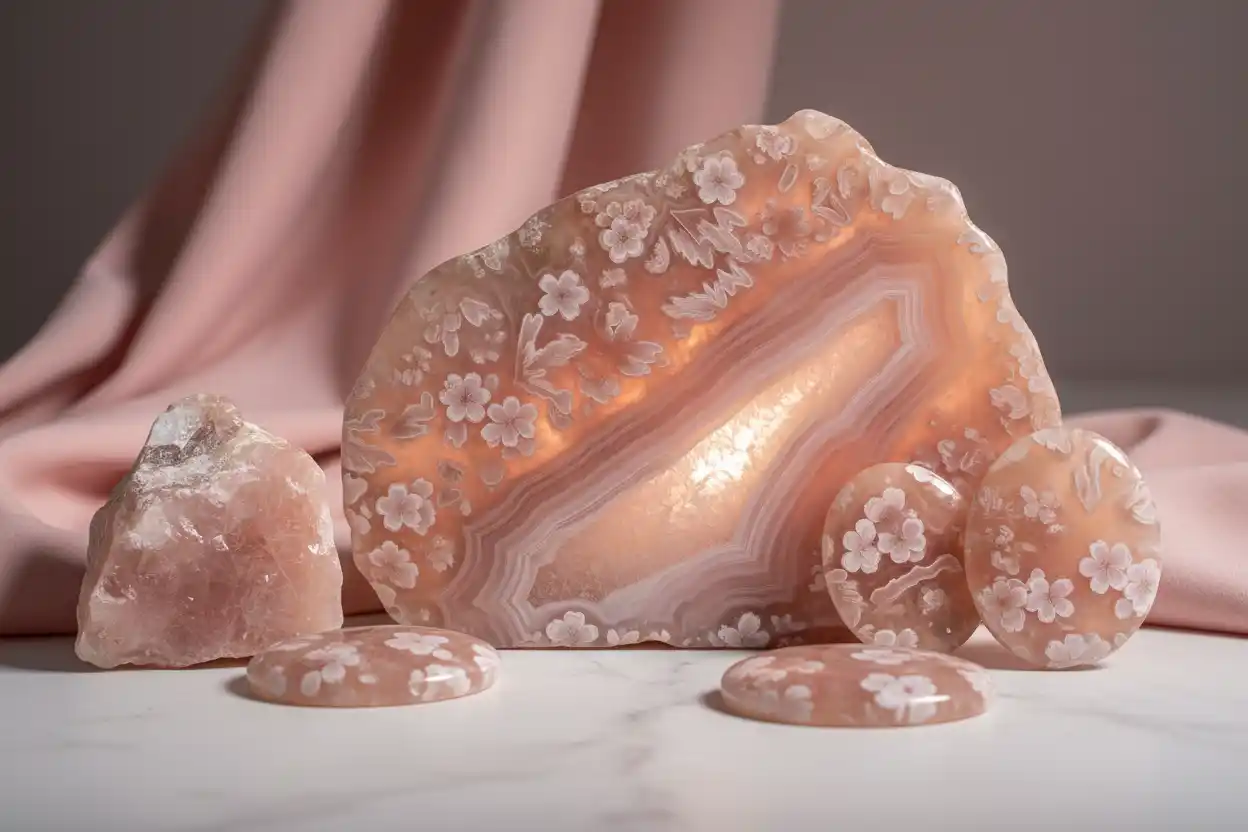

Flower Agate is a modern trade name for translucent Chalcedony containing white, cream, peach or pink plume-like inclusions that resemble blossoms, petals or seed heads. Most commercial material is attributed to Madagascar, but the name describes appearance rather than a separately recognized mineral species.
Flower Agate at a Glance
| Property | Details |
|---|---|
| Mineral group or material type | Plume-bearing Chalcedony or Agate sold under a trade name |
| Principal composition | Silicon dioxide, SiO₂, with inclusion minerals or secondary silica growth |
| Common colors | Colorless, gray, white, cream, peach, pink, tan, brown, greenish gray and pale orange |
| Crystal system | Trigonal at the microscopic Quartz level |
| Habit | Massive nodules, cavity fillings, seams, brecciated masses and occasional druzy pockets |
| Luster | Waxy to vitreous after polishing |
| Transparency | Translucent to opaque, with occasional transparent zones |
| Mohs hardness | Approximately 6.5–7 |
| Cleavage | None |
| Tenacity | Brittle |
| Common use | Cabochons, beads, pendants, bracelets, palm stones, spheres, carvings and polished slabs |
| Main care concern | Unstandardized naming, fractures, pits, dye, resin, artificial flower patterns and confusing inclusions with mineral species |
Flower Agate Is a Trade Variety
The name Flower Agate does not identify one new mineral.
The host is generally Chalcedony, a fine intergrowth of Quartz and moganite. White or colored internal formations create the flower-like appearance.
Some pieces also contain recognizable Agate banding, which supports the commercial use of Agate.
Other specimens show little obvious banding. Mineralogically, they may be described more precisely as plume-bearing Chalcedony.
The trade name remains useful because it identifies a recognizable pattern. Nevertheless, a seller should not assign one universal formula to the entire stone or claim that each “flower” consists of a rare mineral without testing.
The family relationships are explained in Types of Agate.
What Creates the Flower-Like Patterns?
The blossom forms are internal mineral or silica growths rather than fossil flowers.
Several structures can create the effect:
- Plume-shaped Chalcedony
- Radiating silica aggregates
- Spherulitic growth
- Mineral inclusions coated by later Chalcedony
- Branching iron- or manganese-rich material
- Small cavity fillings
- Cloud-like microcrystalline zones
- Druzy crystal pockets viewed through translucent silica
The exact composition may differ between pieces.
A cream blossom could consist largely of fine silica, while a peach or brown center may include iron oxides. Greenish areas may contain clay, chlorite or another inclusion mineral.
Therefore, visual appearance does not justify labeling every flower as Plume Calcite, Zeolite, Hematite or another specific phase.
Raman spectroscopy and microscopic chemical analysis would be required to identify an individual inclusion confidently.
Flower Agate and Plume Agate
Flower Agate fits broadly within the plume-agate tradition.
Plume Agate contains branching, feathered or cloud-like inclusions inside Chalcedony. Patterns can resemble:
- Feathers
- Ferns
- Flames
- Trees
- Underwater plants
- Clouds
- Flowers
Flower Agate is distinguished commercially by rounded, petal-like or blossom-like plumes.
The boundary remains subjective. One seller may call a stone Flower Agate, while another labels the same pattern Plume Agate.
A descriptive phrase such as “Madagascar Chalcedony with cream flower-like plumes” communicates more than insisting on a rigid trade distinction.
How Flower Agate Forms
The material likely forms inside cavities and fractures in volcanic or silica-bearing host rock.
Silica-rich fluid enters the open space and begins depositing Chalcedony along the walls.
During one growth stage, plumes, spherules or inclusion minerals develop. Later silica surrounds and preserves those structures.
Changes in fluid chemistry can produce:
- Clear Chalcedony
- Milky zones
- Peach or pink coloration
- Iron-rich areas
- Agate bands
- Quartz druse
- Open cavities
- Brecciated patterns
The flowers are therefore records of growth sequence rather than objects placed into finished Agate.
One blossom may have formed before the surrounding translucent silica. Another could represent a cavity filled after the main Chalcedony body developed.
The complexity explains why a polished piece can contain flowers at several apparent depths.
The Madagascar Source
Most material sold under the Flower Agate name is attributed to Madagascar.
Madagascar contains extensive volcanic, hydrothermal and silica-rich deposits that produce Chalcedony, Agate, Jasper, Quartz and related ornamental stone.
Commercial rough commonly reaches cutting workshops outside the country. As a result, polished beads or towers may be cut in China, India or another manufacturing center even when the raw stone is Malagasy.
Country of cutting and geological origin are separate facts.
Retail descriptions often provide no mine, district or quarry. “Madagascar” should therefore be treated as a broad trade attribution unless more specific provenance accompanies the rough.
A visually similar plume Chalcedony from another country could still be marketed as Flower Agate. The pattern name does not legally or mineralogically restrict the source.
Common Body Colors
Colorless and Gray
Transparent-to-gray Chalcedony provides a neutral background that makes white plumes appear suspended.
Smoke-like gray areas may come from fine inclusions, darker host material or microscopic voids.
White and Cream
Milky Chalcedony can surround cream flowers and create a soft low-contrast appearance.
Completely opaque white sections show less internal depth but may provide a strong frame for translucent windows.
Pink and Peach
Iron-related coloring commonly produces peach, salmon, apricot and pale-pink areas.
Pink Flower Agate should not automatically be compared with Rose Quartz, which is a different Quartz material with its own color mechanisms.
Brown and Tan
Iron oxides, clay and host-rock fragments create brown or beige zones.
Dark brown webbing may follow fractures or breccia boundaries.
Greenish Material
Green-gray patches appear in some commercial pieces. Their cause may involve chlorite, clay or other inclusions rather than a standard green Flower Agate variety.
Druzy Flower Agate
Some pieces contain open cavities lined with small Quartz crystals.
That sparkling surface belongs to the texture described in Druzy Quartz.
A cutter may shape the surrounding Chalcedony while preserving the natural crystal pocket.
The cavity can add value when:
- The crystals remain intact
- The opening fits the design
- No unstable thin walls surround it
- The interior is clean
- The druzy is natural rather than glued
Open pockets also trap soap, dust and fibers. Jewelry containing them requires more careful cleaning than a closed cabochon.
Flower Agate vs Moss Agate
Moss Agate contains branching or filament-like inclusions resembling moss, plants or landscapes.
The inclusions are commonly green, brown, black or reddish and may involve iron or manganese minerals.
Flower Agate generally has rounder, denser cream-to-pink plumes that resemble petals or blossoms.
The visual boundary can blur. A single stone may contain moss-like filaments and flower-like clusters.
Neither material contains actual preserved plants.
Flower Agate vs Dendritic Agate
Dendritic Agate contains branching mineral growths that resemble trees or frost.
Dendrites usually form thin flat patterns along fractures or bedding surfaces. Manganese and iron oxides are common contributors.
Flower Agate’s plumes tend to be three-dimensional, cloud-like or spherulitic.
A dendrite can look botanical, but it commonly has sharp branching geometry rather than rounded petals.
Flower Agate vs Ocean Jasper
Ocean Jasper is a commercial orbicular silica-rich material from Madagascar.
Its circular eyes and orbs can resemble the centers of Flower Agate blossoms.
However, Ocean Jasper commonly has opaque multicolored orbicular patterns, whereas Flower Agate usually relies on translucent Chalcedony surrounding pale plumes.
Both trade names cover patterned silica material from Madagascar, so sellers sometimes confuse or combine them.
Orbicular Jasper describes the broader circular-pattern category without implying one source.
Flower Agate vs Jasper
Jasper is opaque silica-rich material.
Flower Agate usually contains enough translucent Chalcedony to reveal internal depth.
Some massive pieces have opaque sections that could be described as Jasper-like. The trade name may still remain Flower Agate when visible plumes dominate the design.
The distinction is based on texture and transparency rather than one sharp chemical boundary.
Flower Agate vs Cherry Blossom Agate
Cherry Blossom Agate is generally another name for Flower Agate.
The phrase emphasizes pink or white blossoms resembling cherry flowers.
Neither name defines a separate mineral species.
A seller may reserve Cherry Blossom Agate for pale-pink material and Flower Agate for the broader range, but that distinction is commercial rather than standardized.
Flower Agate vs Sakura Agate
Sakura is the Japanese word for cherry blossom.
Sakura Agate is therefore another trade label applied to flower-patterned Chalcedony.
The term does not prove Japanese origin. Most commercial Sakura Agate is attributed to Madagascar and cut elsewhere.
Names such as Sakura Stone, Cherry Blossom Stone and Blossom Agate should be evaluated through the actual mineral material rather than the cultural imagery used in marketing.
Cutting Flower Agate
The cutter’s main task is to orient the internal pattern.
A rough surface reveals only part of the design. Sawing may expose blossoms that were invisible from the exterior or cut directly through an attractive cluster.
Translucent windows are examined with backlighting before the final orientation is selected.
Common cuts include:
- Oval cabochons
- Freeforms
- Teardrops
- Hearts
- Spheres
- Towers
- Palm stones
- Beads
- Polished slabs
A cabochon dome can magnify flowers beneath the surface. However, excessive height adds weight without improving the pattern.
Flat tablets display broad internal scenes but provide less protection against bending and edge impact.
Fractures, Pits and Vugs
Flower Agate rough frequently contains open cavities and healed fractures.
Small pits can be natural remnants of incomplete silica filling. They do not automatically mean the stone is fake.
However, open fractures reduce durability and collect polishing compound.
Some finished pieces receive clear resin to:
- Fill pits
- Stabilize cracks
- Improve polish
- Strengthen drill holes
- Support thin cavity walls
Resin treatment should be disclosed.
A smooth surface that bridges deep cavities can indicate filler. Under magnification, resin may show bubbles, flow lines or a different luster from Chalcedony.
Flower Agate Price
Small tumbled stones commonly sell for approximately $3–$15.
Commercial cabochons often range from $5 to $40.
Palm stones, towers and small freeforms commonly sell for $15–$75.
Better designer cabochons with balanced blossoms, strong translucency and minimal fractures may range from $40 to $150.
Large spheres, carvings and display pieces often cost $75–$300, depending on weight and workmanship.
Exceptional slabs or custom cuts with unusually distinct three-dimensional flowers may exceed those ranges.
The raw material remains generally accessible. Much of the retail price reflects cutting, polishing, pattern selection and shipping weight rather than mineral rarity alone.
What Determines Value?
Flower Definition
Rounded, recognizable plumes receive more demand than vague cloudy patches.
Contrast
Cream, peach or pink flowers should remain visible against the body.
Depth
Several blossom layers at different depths create a stronger three-dimensional effect.
Transparency
Translucent windows reveal internal structure. Excessive cloudiness can flatten the pattern.
Pattern Placement
A cabochon should frame the strongest flower rather than cut it off at the edge.
Color
Natural peach, pink and cream combinations are popular, but saturation should not depend on heavy photo editing.
Surface Quality
An even polish, limited pits and sound edges improve durability.
Druzy
A clean, intact crystal pocket can add interest when it fits the design.
Treatment
Untreated material receives greater confidence than undisclosed dye or resin.
Provenance
A documented Madagascar source adds context, though most retail pieces lack mine-level records.
Dye and Color Enhancement
Pale Chalcedony can absorb dye through fractures and pores.
Pink, purple, blue and green Flower Agate products may be enhanced, especially when color appears unnaturally uniform.
Signs of dye include:
- Pigment concentrated in cracks
- Dark drill holes
- Color around pits
- Pale uncolored centers
- Color that stops at a polished surface
- Staining of string or adhesive
- Unusually bright color at a low price
The process in How to Spot Dyed Crystals provides practical inspection steps.
Natural pink and peach material does exist. Therefore, bright color is a reason to investigate rather than proof of treatment.
Resin, Coatings and Composite Pieces
Clear resin can improve a fractured surface.
Wax or oil may deepen color temporarily and make dry areas appear more translucent.
Surface coating can add rainbow, metallic or glossy effects unrelated to natural Chalcedony.
Composite products may use:
- Agate slices backed with resin
- Crushed Flower Agate in polymer
- Glued druzy
- Printed flower patterns
- Glass cabochons with internal images
- Doublets with a thin patterned layer
The broader checks in How to Spot Fake Crystals help distinguish natural texture from assembly.
Agate-specific enhancement and imitation issues appear in How to Spot Treated or Synthetic Agate.
How to Identify Flower Agate
First, confirm the host resembles Chalcedony.
It should show:
- Waxy-to-vitreous polish
- Hardness near 7
- No cleavage
- Dense fine-grained texture
- Conchoidal fracture in rough
- Translucent edges or windows
- Internal rather than printed patterns
Next, examine the flowers under magnification.
Natural plumes should have irregular depth, branching and overlap. Perfectly repeated identical blossoms suggest printing, molded resin or manufactured decoration.
Check the reverse and edges. Patterns should continue naturally through the material rather than ending at a backing.
A handheld light helps determine whether the inclusions sit at several depths.
Raman spectroscopy can confirm Quartz or Chalcedony. Identifying the plume composition may require separate analysis at several points.
The workflow in How to Identify Crystals should therefore distinguish the host identification from the inclusion identification.
Hardness and Jewelry Suitability
The Chalcedony host has Quartz-family hardness.
Its position on the Gemstone Hardness Chart supports use in pendants, earrings, bracelets and rings.
Nevertheless, Flower Agate is brittle. Internal cavities and fractures can reduce strength even when the surface remains scratch resistant.
The difference appears in Gemstone Toughness vs Hardness.
A compact cabochon in a bezel can tolerate regular wear.
Pieces with large druzy cavities, thin walls or open fractures are better suited to pendants and display objects.
Bead drill holes should be inspected for white stress lines and resin.
Water and Cleaning
Stable untreated Flower Agate tolerates brief cleaning with lukewarm water and mild soap.
Avoid prolonged soaking when the material contains dye, resin, open cavities or glued metalwork.
The distinctions in Which Crystals Can and Can’t Go in Water apply to the complete finished object.
A soft brush can remove residue from ordinary polished surfaces. Druzy pockets require especially gentle brushing.
Ultrasonic cleaning is unnecessary because vibration can extend fractures or affect filler. The relevant risks appear in Which Gemstones Can Go in an Ultrasonic Cleaner?.
Steam can damage resin, dye and glue.
Store each piece separately from Diamond, Sapphire and Topaz, which can scratch it.
Buying Flower Agate
Request photographs of the actual item rather than one representative stone.
Pattern varies too widely for stock images to be useful.
Ask the seller to show:
- Front
- Back
- Edges
- Drill holes
- Open cavities
- Fractures
- Dry color
- Transmitted-light appearance
- Treatment disclosure
- Source attribution
A video over both white and dark backgrounds helps reveal whether the flowers remain distinct without strong editing.
The online transaction safeguards in How to Buy Gemstones Online are especially useful for towers and spheres, where one attractive side can conceal fractures on the reverse.
Flower Agate Meaning and Symbolism
The flower imagery comes from the pattern rather than from preserved biological material.
Modern sellers commonly connect the stone with growth, beginnings, patience and personal development.
Its geology supports a more precise interpretation. A flower-like plume formed during one stage, and later Chalcedony preserved it inside a larger body.
Someone may use that visible sequence as a personal symbol for progress becoming clearer only after additional stages have developed around it.
No evidence establishes one ancient Flower Agate tradition. The commercial name and widespread symbolism are modern.
Flower Agate has no scientifically demonstrated ability to accelerate personal growth, improve fertility or change emotional health.
The material appears naturally in the F directories because of its trade name, but its most accurate identity remains plume-bearing Chalcedony rather than a botanical fossil or separate crystal species.
Frequently Asked Questions
Is Flower Agate a real mineral?
The material is real Chalcedony or Agate, but Flower Agate is a trade name rather than a separate mineral species.
Are the flowers fossilized plants?
No. The blossom patterns are mineral or silica growths that resemble flowers.
Where does Flower Agate come from?
Most commercial material is attributed to Madagascar, although mine-level documentation is often unavailable.
Is Flower Agate the same as Cherry Blossom Agate?
The names are generally used for the same or closely overlapping commercial material.
Is Sakura Agate from Japan?
Not necessarily. Sakura is a flower-inspired trade term, while most marketed material is attributed to Madagascar.
How is Flower Agate different from Moss Agate?
Moss Agate has finer branching moss-like inclusions. Flower Agate typically contains rounder cream, pink or peach plume formations.
Is Flower Agate naturally pink?
Natural peach and pink tones occur, but dyed material also exists. Fractures, drill holes and treatment disclosure should be checked.
Can Flower Agate go in water?
Stable untreated material tolerates brief washing. Avoid soaking dyed, resin-filled, fractured or druzy pieces.
Is Flower Agate suitable for rings?
Compact cabochons are reasonably durable. Pieces with open cavities or major fractures are safer in pendants.
Is Flower Agate rare?
Attractive well-defined patterns are selective, but commercial rough, beads and polished pieces are widely available.
The most informative purchase is not the stone with the greatest number of pale spots. It is the piece whose natural plumes remain clear, well positioned and structurally sound under ordinary light.
Disclaimer: Flower Agate contains silica. Sawing, drilling or dry grinding can release respirable crystalline-silica dust; use wet lapidary methods, effective extraction and suitable respiratory protection.