
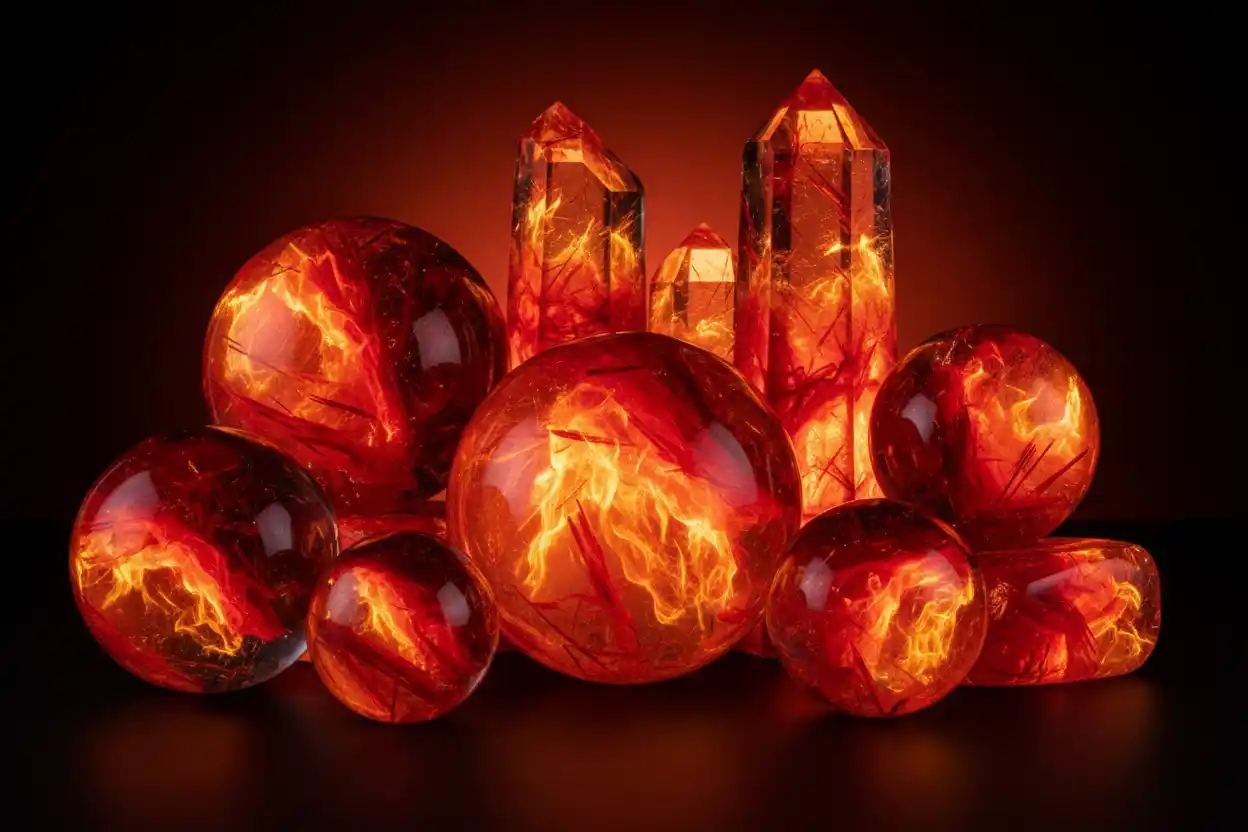

Fire Quartz is an informal trade name for Quartz containing red, orange, gold or brown iron-rich inclusions. Hematite is the most frequently cited inclusion, although Goethite, iron staining and mixed iron oxides can produce similar commercial appearances.
Fire Quartz at a Glance
| Property | Details |
|---|---|
| Mineral group or material type | Iron-included Quartz sold under a trade name |
| Host composition | Silicon dioxide, SiO₂ |
| Common inclusions | Hematite, Goethite and mixed iron oxides or hydroxides |
| Colors | Colorless, white, smoky or pale-yellow Quartz with red, orange, rust, gold, brown, gray or black inclusions |
| Crystal system | Trigonal |
| Habit | Prismatic Quartz crystals, clusters, phantoms, veins, massive material and polished freeforms |
| Luster | Vitreous |
| Transparency | Transparent to opaque depending on inclusion density |
| Mohs hardness | 7 for the Quartz host |
| Cleavage | None |
| Tenacity | Brittle |
| Common use | Mineral specimens, cabochons, beads, spheres, carvings, polished points and occasional faceted gems |
| Main care concern | Unstandardized naming, misidentified inclusions, heating, dye, coating, fractures and synthetic reshaping |
Fire Quartz Is a Trade Name
Fire Quartz is not an approved mineral species.
The name is normally applied to Quartz containing warm-colored iron-rich inclusions that resemble sparks, flames, clouds or embers.
A more descriptive label is often possible:
- Quartz with Hematite inclusions
- Hematoid Quartz
- Ferruginous Quartz
- Quartz with Goethite
- Hematite phantom Quartz
- Iron-stained Quartz
However, commercial use remains inconsistent. Two sellers may use Fire Quartz for materials with different inclusion minerals, patterns and treatments.
Therefore, a precise listing should identify the host, probable inclusion and locality instead of treating Fire Quartz as one chemically uniform variety.
What Does Hematoid Mean?
Hematoid means blood-like or resembling blood.
Hematoid Quartz usually refers to Quartz containing red-to-brown Hematite or related iron-rich material.
Hematite is iron oxide, Fe₂O₃. It can occur as red earthy particles, metallic-gray plates, black crystals or complex rose-like aggregates.
Inside Quartz, Hematite may appear as:
- Red dust
- Orange clouds
- Metallic platelets
- Dark gray blades
- Star-like groups
- Rose-shaped aggregates
- Phantom layers
- Fine sparkling points
A metallic-gray inclusion can still be Hematite even when the surrounding trade material is called red Fire Quartz.
Goethite in Fire Quartz
Goethite is iron oxide hydroxide, FeO(OH).
It commonly forms yellow-brown, orange-brown, reddish or dark needle-like and fibrous structures.
Inside Quartz, Goethite can produce sprays, needles, plumes and golden-to-brown inclusions.
Visual separation from Hematite is not always reliable. Oxidation, dehydration and fine grain size can create intermediate-looking material.
Additionally, Goethite can transform toward Hematite when heated. Consequently, an orange or red inclusion may reflect natural growth, weathering or later heat treatment.
Raman spectroscopy provides a much stronger identification than color.
Ferruginous Quartz
Ferruginous means iron-bearing.
Ferruginous Quartz is therefore a broad descriptive category that can include:
- Hematite-included Quartz
- Goethite-included Quartz
- Limonite-stained Quartz
- Iron-coated Quartz
- Quartz with iron-rich fracture fillings
Not every ferruginous specimen should be marketed as Fire Quartz. The trade name is usually reserved for material with visually attractive red, orange or gold patterns.
Likewise, ferruginous color does not prove that the iron mineral lies inside the Quartz. Some specimens have only an external coating.
How the Inclusions Enter Quartz
Quartz grows from silica-rich hydrothermal fluid inside fractures, cavities and veins.
Iron can enter the system through altered host rock, weathered ore minerals or changing groundwater chemistry.
Several growth sequences are possible.
Iron Minerals Form First
Hematite or Goethite crystallizes on a cavity wall. Later Quartz covers and preserves the iron-rich crystals.
Both Grow Together
Quartz and iron minerals develop during overlapping stages, trapping particles or plates at the advancing growth surface.
Iron Forms Between Quartz Generations
An early Quartz crystal stops growing. Iron-rich material settles on its faces, and later Quartz encloses the coating.
This process can create a red or golden phantom.
Iron Enters Existing Fractures
After Quartz forms, iron-bearing fluid penetrates cracks and deposits oxides along them.
The resulting red vein may look internal even though it developed after the original crystal growth.
Hematite Roses Inside Quartz
Hematite can form rosette-shaped groups of thin plates.
When Quartz encloses one of these aggregates, the result resembles a dark metallic or red flower suspended inside transparent crystal.
The structure provides stronger evidence of a true mineral inclusion than a uniform surface stain.
A complete rose with visible depth can add substantial collector value. Nevertheless, its fragility and orientation influence whether the crystal should remain a specimen or become a polished window.
Cutting through the rosette destroys the feature, so cutters often polish only one face of the host Quartz.
Phantom Fire Quartz
A phantom records an earlier crystal-growth stage.
Iron-rich particles coat the faces of a smaller Quartz crystal. Growth later resumes, enclosing the older outline within a larger crystal.
The result can appear as a red, orange, gold or brown geometric shape.
Phantom Quartz describes the growth structure, while Fire Quartz describes the warm iron-rich appearance.
One specimen can therefore belong to both trade categories.
A random cloud of Hematite is not automatically a phantom. The inclusion should preserve recognizable earlier crystal faces.
Fire Quartz vs Tangerine Quartz
Tangerine Quartz usually has an orange iron-oxide coating on the outside of the crystal.
The color can settle in surface grooves, growth lines and contact areas. It may rub off or change during aggressive cleaning.
Fire Quartz generally emphasizes inclusions inside the crystal.
However, trade usage overlaps. Some sellers call externally coated Tangerine Quartz Fire Quartz, while others reserve Fire Quartz for internal Hematite.
Examine broken areas and crystal faces to determine whether the color sits on the surface or continues through the interior.
Fire Quartz vs Golden Healer Quartz
Golden Healer Quartz commonly refers to Quartz with yellow-to-golden iron-oxide staining or films.
Its appearance is usually softer and more uniform than the red clouds or metallic flakes associated with Fire Quartz.
A specimen can contain both golden coatings and red Hematite inclusions.
Neither term defines a mineral species. Therefore, the best label describes the actual iron-rich feature rather than forcing one commercial category.
Fire Quartz vs Clear Quartz
Clear Quartz is transparent colorless Quartz with limited visible inclusions.
Fire Quartz retains the same host mineral, hardness and crystal system. Iron-rich inclusions create its distinguishing appearance.
A very lightly included crystal may be sold under either name depending on the seller.
The inclusion should be described directly when it contributes to value.
Fire Quartz vs Smoky Quartz
Smoky Quartz obtains its brown-to-gray body color from radiation-related color centers involving aluminum.
The color lies within the Quartz structure rather than coming from visible Hematite particles.
A smoky crystal can also contain red iron inclusions, producing smoky Fire Quartz.
The two features should be recorded separately because one describes body color and the other describes included minerals.
Fire Quartz vs Harlequin Quartz
Harlequin Quartz is another unstandardized trade name.
Some sellers use it for Quartz containing red Hematite and black or metallic inclusions. Others apply the name to material claimed to contain Lepidocrocite, Hematite or several minerals.
Laboratory testing has shown that trade identifications of tiny red inclusions are often inaccurate.
A seller should avoid assigning Lepidocrocite, Cacoxenite or another uncommon mineral without analytical evidence.
“Quartz with red iron-oxide inclusions” is more credible than an unsupported list of several rare minerals.
Fire Quartz vs Strawberry Quartz
Strawberry Quartz is usually translucent-to-transparent Quartz containing fine red inclusions that create a comparatively even pink or strawberry-red appearance.
Fire Quartz commonly has coarser clouds, flakes, veils or patches.
The trade boundary is subjective. Some material could be sold under either name.
True Strawberry Quartz should not be confused with glass containing copper-colored glitter or synthetic material.
Main Commercial Sources
Madagascar
Madagascar supplies much of the polished Fire Quartz found as towers, spheres, palms and freeforms.
Material commonly has milky-to-transparent Quartz with red, orange and gold areas.
The polished form may hide the original crystal habit. Consequently, the locality and treatment history depend heavily on supplier documentation.
Zambia
Zambian material can contain Hematite and Goethite inside clear-to-smoky Quartz.
Natural points and clusters appear in specialist mineral inventories, including examples with fine sprays or red sparkling particles.
Locality should be stated more precisely than the country when mine-level information exists.
Zimbabwe
Zimbabwe, including the Karoi region, produces natural Hematoid Quartz crystals and clusters.
Some pieces have dense red inclusions concentrated near the tips, while others contain scattered orange or metallic particles.
Complete natural crystals may carry more specimen interest than sawn and repolished points.
Brazil
Brazil has produced clear Quartz containing Hematite plates, roses, phantoms and clouds.
Fine included specimens can come from several states and mining districts. A broad Brazilian label therefore provides limited provenance.
Morocco
Moroccan Quartz can contain red, brown and metallic iron-rich inclusions.
However, the country also supplies externally stained Quartz and treated decorative pieces. Each specimen should be evaluated individually.
Is Fire Quartz a Gemstone?
Transparent included Quartz can be fashioned into cabochons, faceted stones and polished windows.
Faceting works best when the inclusions remain visible beneath a broad table. Excessive brilliance can distract from a subtle internal scene, while a poor orientation can hide the best feature.
Cabochons suit dense clouds and plumes. Meanwhile, spheres and freeforms expose patterns from several directions.
Natural points are often polished selectively rather than reshaped completely.
The material’s gem value depends more on inclusion composition and aesthetics than on ordinary Quartz clarity.
Fire Quartz Price
Small tumbled stones commonly sell for approximately $2–$15.
Simple natural points, clusters and small polished pieces often range from $10 to $50.
Better towers, spheres and freeforms commonly sell for $30–$150.
Larger transparent pieces with well-positioned Hematite sprays, phantoms or rose-like inclusions may range from $150 to $500.
Exceptional natural specimens with documented locality, complete crystal form and unusual inclusions can exceed $500.
The market has no standard per-carat scale. Much of the price reflects carving labor, size, clarity and visual composition.
A polished tower should not receive a rarity premium merely because it is large. Buyers must consider whether the shape came from natural crystal form or extensive manufacturing.
Value Factors
Inclusion Identification
A confirmed Hematite rose or Goethite spray carries more confidence than an unsupported rare-mineral label.
Pattern
Distinct clouds, phantoms, veils and suspended plates create more interest than uniform muddy staining.
Contrast
Red or metallic inclusions should remain visible against the host.
Host Clarity
Transparent Quartz gives greater depth, although a milky background can strengthen some red patterns.
Crystal Form
Natural terminations and complete clusters receive collector premiums.
Position
An inclusion near the center or beneath a polished window displays better than one hidden at the base.
Color
Rich natural red, orange and gold generally receive more demand than dull brown staining.
Treatment
Untreated internal inclusions deserve greater confidence than dyed cracks or heat-altered surface coatings.
Locality
Mine or district information can add mineralogical context.
Craftsmanship
Polished objects should have good symmetry without removing the most important natural features.
Heating
Heating can change iron-rich inclusions.
Goethite contains hydroxyl and can dehydrate toward Hematite at elevated temperatures. The color may become stronger red or orange.
Heat can also intensify surface iron staining or alter associated minerals.
A heated specimen may remain natural Quartz, but its inclusion color no longer represents only the original geological condition.
Treatment should be disclosed, especially when unusually vivid red color creates the selling point.
The wider definitions appear in Gemstone Treatments Explained.
Dye, Coating and Manufactured Shapes
Dye can enter fractures and produce red or orange lines that resemble natural iron-rich veins.
Pigment commonly concentrates around pits, drill holes and the bases of polished towers.
Surface coatings may create metallic, rainbow or unnaturally uniform color.
Some towers are cut from massive Quartz and polished into artificial crystal shapes. They are still natural Quartz, but they are not natural points.
Resin can fill fractures or combine Quartz fragments into composite objects.
The warning signs in How to Spot Fake Crystals should be applied separately to the host, inclusion and finished shape.
How to Identify Fire Quartz
First, establish that the host is Quartz.
The material should have vitreous luster, hardness around 7, no cleavage and typical conchoidal fractures or trigonal crystal form.
Next, determine whether the color is internal.
Rotate the specimen and inspect it under magnification. A genuine inclusion should remain suspended at a measurable depth or continue through the host.
Surface staining follows grooves and can obscure natural luster.
Hematite may appear red, black or metallic gray. Therefore, color alone cannot identify it.
A magnet test provides limited evidence because pure Hematite is only weakly magnetic, while Magnetite inclusions can produce a stronger response.
Do not perform streak testing on a polished object.
Raman spectroscopy can identify both the Quartz host and individual accessible inclusions. The general sequence in How to Identify Crystals helps determine when professional analysis is worthwhile.
The checks in Real vs Fake Clear Quartz also help separate natural Quartz from glass, although they do not identify the red mineral.
Hardness and Jewelry Wear
The Quartz host ranks 7 on the Gemstone Hardness Chart.
It therefore resists ordinary scratches better than Feldspar, Opal and Calcite.
Quartz has no cleavage, but it remains brittle. Internal fractures around inclusions can create impact weaknesses.
The distinction is addressed in Gemstone Toughness vs Hardness.
Pendants, beads and earrings are practical for compact material.
Rings can tolerate regular wear when the stone lacks large fractures and receives a protective setting.
Large spheres and towers should stand on stable surfaces. A natural point can chip if it falls against another Quartz specimen.
Water and Cleaning
Quartz itself tolerates brief water cleaning.
However, Fire Quartz may contain surface Goethite, iron-stained fractures, resin, dye or attached matrix. The complete specimen should therefore be evaluated through Which Crystals Can and Can’t Go in Water.
Use lukewarm water, mild soap and a soft brush for stable untreated material.
Avoid acids and rust-removal chemicals. They can dissolve or alter iron-rich features that provide the stone’s identity.
Ultrasonic cleaning is unnecessary, especially when fractures surround the inclusions. The risks are explained in Which Gemstones Can Go in an Ultrasonic Cleaner?.
Dry the specimen thoroughly and store it away from harder gemstones.
Fire Quartz Meaning and Symbolism
Fire Quartz contains visually active iron-rich material inside a transparent or translucent host.
That structure can support a personal interpretation centered on preserving a record of earlier mineral growth rather than hiding every inclusion.
A phantom provides an especially direct example. The red outline marks a stage when growth paused before the crystal continued.
Someone may use that pattern as a reminder that an interruption can remain part of a finished structure without preventing later development.
Modern spiritual communities associate Fire Quartz with motivation, focus and emotional stability. Those interpretations remain personal or cultural.
The mineral has no scientifically demonstrated ability to treat anxiety, improve blood circulation or transfer the physical properties of iron to the body.
Its name appears in Crystals That Start With F, but a responsible label should state whether the color comes from internal Hematite, Goethite, surface staining or treatment.
Frequently Asked Questions
Is Fire Quartz a real mineral?
The Quartz is real, but Fire Quartz is a trade name rather than an approved mineral species.
Is Fire Quartz the same as Hematoid Quartz?
The terms frequently overlap. Hematoid Quartz more specifically suggests red or blood-like Hematite-bearing material.
What causes the red color?
Hematite is the most common identified cause, although Goethite, mixed iron oxides and iron-rich staining can also contribute.
Is every red inclusion Lepidocrocite?
No. Many trade identifications of Lepidocrocite are unsupported. Hematite and Goethite are more common possibilities.
How is Fire Quartz different from Tangerine Quartz?
Fire Quartz generally emphasizes internal inclusions. Tangerine Quartz usually has an external orange iron-oxide coating.
Is Fire Quartz naturally heated?
The mineral can form in warm hydrothermal environments, but commercial heating may separately alter Goethite and intensify red-orange color.
Can Fire Quartz be worn every day?
Compact material can tolerate regular wear, although large internal fractures and exposed crystal points require protection.
Can Fire Quartz go in water?
Stable untreated Quartz can be washed briefly. Avoid soaking pieces with matrix, dye, resin or surface iron coatings.
Is Fire Quartz expensive?
Most material is affordable. Fine natural crystals with well-positioned, analytically identified inclusions can command collector premiums.
How can I tell whether a polished point is natural?
Check whether the crystal faces, termination and growth lines are natural or uniformly machine-ground. A carved point can contain genuine Quartz while having an artificial shape.
Disclaimer: Cutting, grinding or drilling Fire Quartz can release respirable crystalline silica and iron-rich dust. Use wet lapidary methods, effective extraction and suitable respiratory protection.