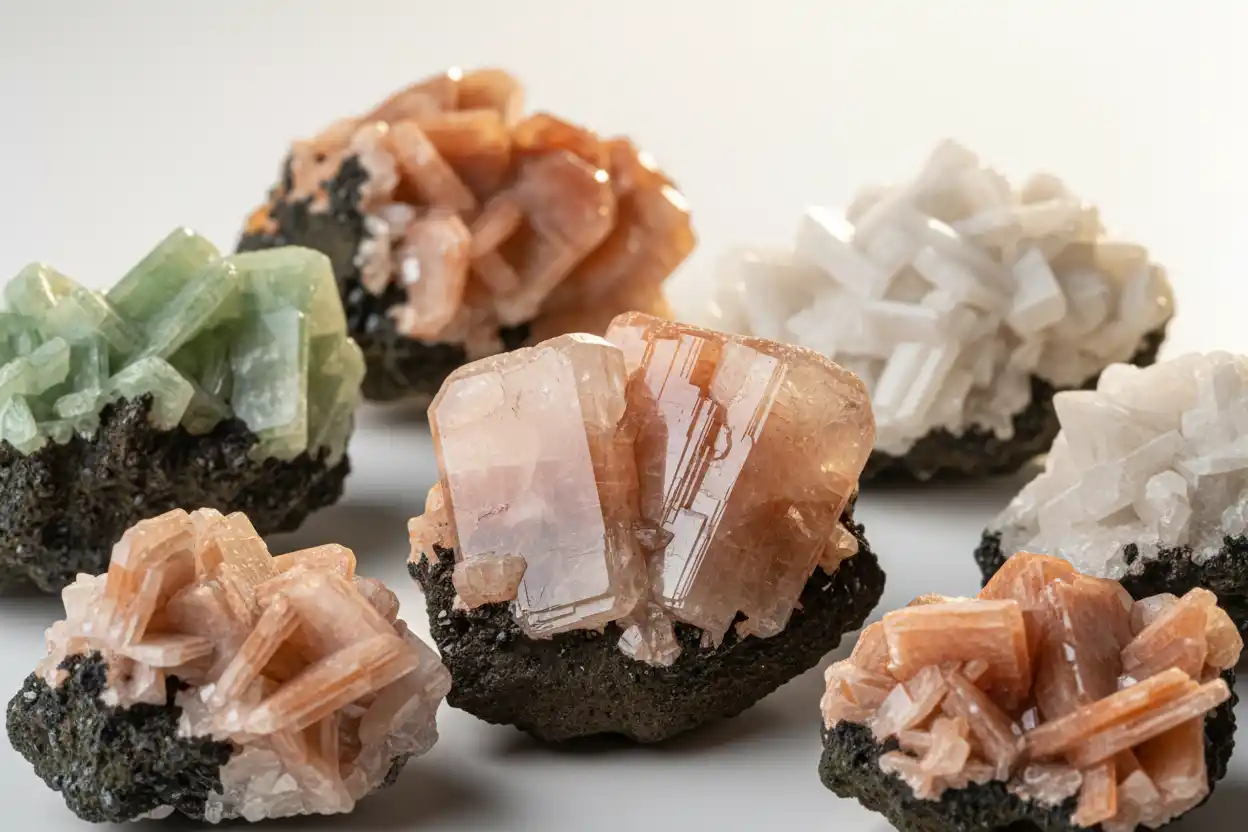
Heulandite Meaning: Properties, Uses & Symbolism
Heulandite meaning begins with a zeolite framework rather than with one fixed chemical formula. In modern mineral nomenclature, heulandite is a subgroup within the zeolite group whose members share the same basic framework topology but differ according to the dominant extra-framework cation. Recognized members include heulandite-Ca, heulandite-Na, heulandite-K, heulandite-Sr, and heulandite-Ba. When the dominant cation has not been established, the broader name heulandite may be used. Mindat summarizes the subgroup with a variable hydrated aluminosilicate composition and lists a representative heulandite-Ca formula as (Ca,Na)₅(Si₂₇Al₉)O₇₂·26H₂O.
This variable chemistry is important because many simplified crystal descriptions present heulandite as though every specimen contains exactly the same proportions of calcium, sodium, potassium, aluminum, silicon, oxygen, and water. Zeolites do not work that way. Their open aluminosilicate frameworks contain channels and cavities occupied by water molecules and exchangeable cations, and natural composition can vary substantially while the essential framework remains related. International mineral nomenclature therefore distinguishes heulandite species by the dominant extra-framework cation and specifically cautions against treating one simplified formula as universally “ideal” for all zeolite specimens.
Heulandite meaning also benefits from distinguishing geology from symbolism. Crystal structure, hydration, cleavage, refractive index, density, Si:Al ratio, cation dominance, formation environment, and mineral associations are measurable. The historical name can be documented. Modern ideas involving calm, openness, reflection, emotional processing, perspective, or personal change belong to contemporary symbolic practice rather than to demonstrated effects of a hydrated zeolite on human physiology.
Readers exploring other mineral-first references can browse the Gemstone Guides. This page defines heulandite itself, explains how it differs from closely related zeolites, examines the physical evidence behind identification, and then discusses modern heulandite meaning within clear evidence boundaries.
Heulandite Meaning at a Glance
| Property or question | Evidence-aware summary |
|---|---|
| Mineral family | Zeolite group |
| Mineral subgroup | Heulandite subgroup |
| Common species | Heulandite-Ca, -Na, -K, -Sr, -Ba |
| Representative heulandite-Ca formula | (Ca,Na)₅(Si₂₇Al₉)O₇₂·26H₂O |
| Crystal system | Monoclinic |
| Typical colors | Colorless, white, pink, red, yellow, brown, green |
| Mohs hardness | Approximately 3.5–4 |
| Specific gravity | Approximately 2.1–2.2 |
| Typical luster | Vitreous; notably pearly on good cleavage surfaces |
| Cleavage | Perfect on {010} |
| Optical character | Biaxial positive for heulandite-Ca |
| RI range for heulandite-Ca | Approximately 1.491–1.512 across principal indices |
| Transparency | Transparent to translucent |
| Typical crystal appearance | Tabular, blocky, coffin-shaped, wedge-like or aggregated |
| Main geological settings | Basalt cavities, low-temperature hydrothermal alteration, zeolitized volcanic rocks and related environments |
| Closely related mineral series | Clinoptilolite |
| Formal heulandite/clinoptilolite boundary | Heulandite has framework Si:Al < 4.0; clinoptilolite ≥ 4.0 |
| Common visual confusion | Stilbite and other pale zeolites |
| Modern symbolism | Reflection, calm, perspective, transition, emotional organization |
| Scientific status of symbolism | Interpretive rather than demonstrated physiological effect |
| Main ownership concern | Soft, brittle and strongly cleavage-prone |
Heulandite-Ca, one of the common members encountered in collections, has hardness approximately 3.5–4, measured density around 2.1–2.2 g/cm³, perfect cleavage on {010}, and biaxial-positive optical behavior with refractive indices spanning roughly 1.491–1.512.
What Is Heulandite?
Heulandite is a hydrated aluminosilicate zeolite characterized by an open framework that can accommodate water molecules and extra-framework cations. That structure is part of what defines zeolite minerals as a group and helps explain their relatively low density, water-bearing nature, ion-exchange behavior, and sensitivity to composition.
The generic word heulandite does not always identify one exact mineral species. Modern nomenclature appends a chemical suffix when the dominant extra-framework cation is known. A calcium-dominant specimen becomes heulandite-Ca, a sodium-dominant specimen heulandite-Na, and so on. Mindat lists calcium, sodium, potassium, strontium, and barium species within the subgroup.
This makes a seller’s simple label “heulandite” reasonable for an attractive collector specimen when chemistry has not been determined, but technically ambitious descriptions should not invent a Ca, Na, K, Sr, or Ba suffix from appearance alone.
Heulandite Identity Table
| Characteristic | Heulandite |
|---|---|
| Mineral class | Hydrated aluminosilicate |
| Group | Zeolite |
| Subgroup | Heulandite |
| Framework type | Shared HEU-type topology with clinoptilolite |
| Crystal system | Monoclinic |
| Common dominant cations | Ca, Na, K, Sr, Ba |
| Typical habit | Tabular, blocky, wedge-like, coffin-shaped crystals; aggregates |
| Typical color | Colorless, white, pink, red, yellow, brown, green |
| Luster | Vitreous to pearly |
| Streak | White |
| Hardness | About 3.5–4 |
| Density | Roughly 2.1–2.2 g/cm³ for common members such as heulandite-Ca |
| Cleavage | Perfect on {010} |
| Fracture | Uneven to subconchoidal |
| Tenacity | Brittle |
| Optical behavior | Biaxial |
| Typical occurrence | Cavities and fractures in altered volcanic rocks; other low-temperature mineral assemblages |
| Key chemical distinction | Si:Al ratio separates heulandite from clinoptilolite |
| Main visual look-alikes | Stilbite, clinoptilolite, other pale tabular zeolites |
| Technical confirmation | XRD, chemistry, Raman/IR where appropriate, optical mineralogy |
The identity table also shows why heulandite is not an ideal everyday gemstone. Its softness, brittle behavior, and perfect cleavage make it much more natural as a mineral specimen than as a conventional ring stone.
Heulandite Is a Subgroup, Not One Fixed Formula
This nomenclature point is one of the most important pieces of heulandite meaning from a mineralogical perspective.
Modern zeolite nomenclature recognizes compositional series in which the dominant extra-framework cation determines the species suffix. Heulandite therefore includes Ca-, Na-, K-, Sr-, and Ba-dominant members. The broad name can remain useful when chemical dominance has not been established.
The framework itself contains aluminum and silicon in tetrahedral positions linked through oxygen. Because substituting Al³⁺ for Si⁴⁺ creates charge imbalance, positively charged ions such as calcium, sodium, potassium, strontium, or barium occupy extra-framework sites to maintain charge balance. Water molecules also occupy the channels.
This is real crystal chemistry.
It is not evidence that heulandite “stores emotional water,” “holds memory in its pores,” or exchanges negative human energy for positive energy.
Heulandite Versus Clinoptilolite
Heulandite and clinoptilolite are exceptionally close relatives and share the same basic framework topology.
International zeolite nomenclature makes a specific exception for this pair: heulandite is defined by framework Si:Al below 4.0, while clinoptilolite has Si:Al of 4.0 or greater. The boundary is deliberately compositional rather than visual, and the series between them is continuous.
That means a pale tabular zeolite cannot always be assigned confidently to heulandite or clinoptilolite through photographs alone.
Historically, thermal stability was sometimes used as an identification clue, but the IMA nomenclature report specifically treats this as a derivative property rather than the formal basis for separating the two series.
For a technically significant specimen, chemical composition and structural analysis are stronger than a simple heating test.
Why the Heulandite–Clinoptilolite Boundary Matters
The difference may appear academic, but it prevents a recurring mineral-identification error.
If two specimens share the same framework, similar pale colors, similar crystal habits, low density, and related geological environments, visual inspection may produce false certainty. The Si:Al distinction provides a reproducible chemical criterion even though nature produces a continuous compositional transition rather than an obvious visual dividing line.
This is a useful broader lesson in mineral identification: taxonomy is sometimes determined by chemistry that cannot be seen.
A photograph can suggest heulandite.
It cannot measure the framework Si:Al ratio.
Why Does Heulandite Contain Water?
The water in heulandite occupies spaces within the zeolite structure. It is part of the hydrated mineral system rather than simply moisture coating the crystal surface.
Zeolites can lose and regain portions of their water under changing temperature and humidity conditions without automatically becoming entirely unrelated materials. International nomenclature specifically states that dehydration, partial hydration, or over-hydration alone is not sufficient grounds for recognizing new zeolite species.
This structural water should not be interpreted as a medicinal water reservoir.
A crystal containing H₂O in its formula does not hydrate the body by skin contact, supply “charged water,” or justify making mineral elixirs.
How Heulandite Forms
Heulandite commonly forms during low-temperature alteration of volcanic rocks, especially where water reacts with basaltic glass and primary volcanic minerals. Zeolites can line cavities, fractures, joints, and interstitial spaces after the original lava has cooled.
USGS research on basaltic pillow lavas documented heulandite together with stilbite, chabazite, apophyllite, calcite, and other secondary minerals. The study concluded that alteration of initially abundant basaltic glass was important in zeolite formation and considered low-temperature hydrothermal fluids or long interaction with meteoric water among plausible processes.
This explains the familiar collector specimens in which pale heulandite crystals emerge from dark volcanic matrix.
The full reaction sequence, zeolite-zone relationships, water-rock chemistry, host-rock alteration, and deposit comparisons belong in Heulandite Formation and Deposit Geology.
Why Basalt Cavities Produce So Many Zeolites
Fresh volcanic rocks contain unstable glass and minerals that can react with circulating water after eruption. As basalt alters, elements including calcium, sodium, potassium, aluminum, and silica become redistributed.
Open vesicles and fractures provide space into which those dissolved components can move and crystallize.
Small differences between nearby cavities can create different mineral assemblages even within one lava sequence. USGS documented adjacent basalt cavities containing different combinations of stilbite, heulandite, chabazite, analcime, apophyllite, calcite, and other secondary minerals, emphasizing the sensitivity of zeolite formation to local water-rock chemistry.
A specimen containing several zeolites therefore records sequential mineral growth rather than a random pile of crystals.
Heulandite Does Not Have One Universal Formation Temperature
Zeolite minerals occur across a range of low-temperature geological conditions. Some heulandite develops through hydrothermal alteration, some during burial or low-grade metamorphic processes, and some through long interaction between groundwater and reactive volcanic material.
The presence of heulandite alone does not provide one exact formation temperature for every deposit.
Temperature interpretations require the complete assemblage, chemistry, textural relationships, and geological setting.
That distinction prevents the simplistic statement that “all heulandite forms at X degrees.”
Why Is Heulandite Pink, Peach, White, or Green?
Heulandite-Ca is documented in white, colorless, red, yellow, brown, and green material, while collector specimens commonly occur in white, cream, peach, salmon, or pink shades.
The safest mineralogical interpretation is that pure or compositionally simple framework material tends toward colorless or white, while trace constituents, microscopic inclusions, coatings, associated iron-bearing material, defects, and other impurities can modify appearance.
A pink specimen should not automatically be described as “manganese-colored heulandite” or “iron-colored heulandite” without analysis.
Color cause belongs to the specimen.
The more specialized relationship between absorption, inclusions, surface coatings, luster, pleochroism, and color should remain with Heulandite Optical Properties and Color Behavior.
Why Can Heulandite Look Pearly?
Heulandite has vitreous luster on many crystal surfaces but can appear distinctly pearly on cleavage surfaces.
Mindat records perfect cleavage on {010} and specifically notes pearly luster on that cleavage.
This can be an important field clue. A cleaved face may look smoother, brighter, or more pearl-like than other natural crystal faces.
The same property also creates fragility.
A beautiful pearly surface can represent a cleavage plane along which the specimen may split relatively easily.
The Classic “Coffin-Shaped” Heulandite Habit
Collectors often describe heulandite crystals as coffin shaped because many blocky monoclinic crystals develop a recognizable outline with sloping termination faces.
The description is useful as a visual clue rather than as a formal diagnostic test. Experienced mineral collectors frequently distinguish blockier, coffin-like heulandite from the sheaf-like, bow-tie, or more elongated aggregates typical of stilbite. Mindat discussions of difficult specimens repeatedly emphasize this morphological distinction.
However, both minerals can vary in habit and can occur together.
A photograph may support a likely identification.
It should not be treated as equivalent to X-ray diffraction or chemical analysis.
Heulandite Versus Stilbite
Heulandite and stilbite are among the most commonly confused zeolites in collector material because they can share white, peach, pink, cream, or colorless appearances and may grow together in the same basalt cavities.
Both are relatively soft, low-density, monoclinic zeolites with vitreous-to-pearly luster. Stilbite-Ca has hardness around 3.5–4 and SG near 2.19, which overlaps strongly with heulandite.
Morphology often provides the quickest visual clue. Stilbite commonly forms elongated tabular crystals, sheaf-like aggregates, bow ties, or bundled forms. Heulandite more commonly develops blockier or coffin-shaped crystals with especially prominent pearly cleavage.
The important word is commonly.
Neither habit is a guarantee.
Diagnostic Characteristics of Heulandite
For a hand specimen, a reasonable diagnostic package includes low hardness around 3.5–4, low density near 2.1–2.2, perfect cleavage, vitreous-to-pearly luster, monoclinic crystal form, white streak, and a crystal habit compatible with heulandite.
For transparent crystals, optical data can provide additional support. Heulandite-Ca is biaxial positive, with refractive indices broadly around 1.491–1.512 and birefringence around 0.007–0.009.
Those properties can separate heulandite from many unrelated minerals.
They may still be insufficient for differentiating members of the heulandite subgroup or separating chemically borderline heulandite from clinoptilolite.
That is where chemistry and diffraction become important.
Why Hardness Testing Is Usually a Poor Collector Strategy
A hardness of 3.5–4 means heulandite can be scratched by harder common materials.
That does not make scratching a collectible specimen good practice.
Crystal faces and edges are often part of the specimen’s value. Perfect cleavage makes mechanical damage still easier. Testing an inconspicuous fragment may be reasonable in field mineralogy, but scraping a fine crystal cluster merely to confirm softness sacrifices the very surface being studied.
Non-destructive observation should come first.
Inclusions and Intergrowths
Heulandite may contain fluid inclusions, mineral inclusions, growth zoning, tiny internal fractures, clay or iron-rich particles, and intergrowths related to the surrounding zeolite assemblage.
GIA has even used Raman spectroscopy to identify near-colorless heulandite crystals enclosed within Ethiopian opal, demonstrating that heulandite can itself occur as an inclusion mineral inside another gem material.
This is a useful reminder that apparent “inclusions in heulandite” and “heulandite as an inclusion” are different relationships.
The detailed microscopic work belongs in the Heulandite Microscope Inclusion Notebook.
Original Information Gain: Heulandite Name and Claim Audit
| Name or claim | Evidence-aware interpretation | What should not automatically be assumed | Stronger evidence when needed |
|---|---|---|---|
| Heulandite | Subgroup/general name when cation dominance is unknown | One fixed formula | Chemical analysis |
| Heulandite-Ca | Calcium-dominant species | Every peach specimen is Ca-dominant | Chemistry |
| Heulandite-Na | Sodium-dominant species | White color proves Na dominance | Chemistry |
| Heulandite-K | Potassium-dominant species | Locality alone proves species | Chemistry |
| Heulandite-Sr | Strontium-dominant species | Trace Sr is enough for suffix | Quantitative composition |
| Heulandite-Ba | Barium-dominant species | Heavy appearance proves Ba | Chemistry |
| Clinoptilolite | Same framework topology but higher Si:Al | Visual synonym for heulandite | Si:Al analysis |
| “Pink heulandite” | Color description | One universal chromophore | Spectroscopy/chemistry |
| “Coffin zeolite” | Collector morphology description | Formal species name | Mineral identification |
| “Peach zeolite” | Appearance/retail terminology | Automatically heulandite | Identification |
| Stilbite sold as heulandite | Common visual confusion | Same mineral | Habit plus analytical evidence |
| “Water crystal” | Heulandite is structurally hydrated | Drinking or hydration benefit | No such inference |
| “Detox zeolite” | Wellness marketing language | Heulandite removes toxins from the human body | Clinical evidence would be required |
| “Emotional-cleansing stone” | Modern symbolism | Physiological cleansing | Remains metaphor |
| “High-vibration heulandite” | Spiritual language | Standardized measurable physical property | No accepted gemological scale |
The strongest information gain here is nomenclature. A seller can be correct in calling a specimen heulandite while still lacking enough evidence to call it specifically heulandite-Ca.
Original Specimen and Photo Checklist
| Observation | Photograph can often support | Photograph cannot reliably prove |
|---|---|---|
| Coffin-like crystal outline | Heulandite-compatible habit | Chemical species |
| Peach or pink color | Hue and distribution | Exact coloring agent |
| Pearly face | Possible cleavage surface | Full orientation without crystallography |
| Blocky monoclinic habit | Identification clue | Heulandite versus clinoptilolite conclusively |
| Stilbite association | Geological association | Which mineral grew first without textures |
| Basalt matrix | Volcanic host appearance | Exact locality |
| Apophyllite association | Common cavity assemblage | Formation temperature |
| Surface coating | Visible secondary material | Coating composition |
| Clear internal cavity | Internal structure | Fluid composition |
| Seller “heulandite-Ca” label | Claim being made | Cation dominance |
| “Detox crystal” claim | Marketing wording | Medical efficacy |
| “Healing energy” | Nothing objectively measurable | Physiological effect |
A strong photo record should show the specimen from several angles rather than only from the most attractive face. Include a scale, matrix, associated minerals, broken or cleaved regions already present, and close-ups of representative crystals.
For pale specimens, use neutral white balance. Warm lighting can turn nearly colorless heulandite artificially peach, while aggressive saturation can create exaggerated pink material that does not resemble the stone in ordinary light.
Original Evidence Hierarchy for Heulandite Identification
| Evidence level | What it supports |
|---|---|
| Peach/white zeolite appearance | Heulandite is one possibility |
| Coffin-shaped morphology | Stronger visual support |
| Pearly perfect cleavage | Stronger heulandite-compatible evidence |
| Hardness around 3.5–4 | Consistent with heulandite |
| Low density near 2.1–2.2 | Consistent with common heulandite |
| Optical properties | Further species-level screening |
| X-ray diffraction | Strong framework/mineral identification |
| Quantitative chemistry | Determines cation dominance and Si:Al relationship |
| XRD plus chemistry | Strong basis for heulandite species assignment |
| Provenance plus analytical data | Strongest collector documentation |
This hierarchy is particularly useful for heulandite because several zeolites overlap in color, hardness, density, and geological occurrence.
Documented History of the Heulandite Name
Heulandite was distinguished as a separate mineral in the early nineteenth century by mineralogist Henry James Brooke and named in honor of John Henry Heuland, a prominent mineral collector and dealer. Mindat records that history for both the subgroup and heulandite-Ca.
This naming history is materially different from modern metaphysical stories.
The name honors a person.
It does not mean “heart stone,” “healing water,” “angel crystal,” or “emotional release” in an ancient language.
Any modern symbolic interpretation should therefore be described as modern rather than projected backward into the mineral’s name.
Zeolite History Is Broader Than Heulandite History
Zeolite minerals were recognized as a broader class before heulandite itself was distinguished clearly from minerals such as stilbite.
Older mineralogical terminology sometimes grouped visually similar zeolites together, and historical descriptions do not always map neatly onto modern species concepts. Mindat’s stilbite history notes that some early material called stilbite would now be interpreted as heulandite.
This is another reason old names should be read in historical context.
Modern analytical mineralogy is more chemically precise than early hand-specimen classification.
Modern Heulandite Meaning
Modern heulandite meaning commonly centers on emotional reflection, calm, perspective, transition, memory, acceptance, communication, and the ability to reorganize one’s thoughts after change.
Several of these themes can be understood metaphorically from the mineral itself. Heulandite is an open-framework mineral containing water and exchangeable cations. It commonly forms during alteration, when older volcanic material interacts with circulating fluids and reorganizes into new minerals.
That geological transformation can provide a powerful metaphor.
It does not establish a biological mechanism for changing emotions.
Heulandite and Perspective
Transparent or pale heulandite crystals can suggest clarity, but the stronger metaphor comes from mineral identification itself.
A specimen that looks like “pink zeolite” may require morphology, cleavage, chemistry, and XRD before its identity becomes clear.
That process encourages a useful reflective question: What information am I missing before deciding what something means?
The crystal does not provide intuition or supernatural certainty.
It can serve as a reminder to investigate before concluding.
Heulandite and Change
Heulandite often forms because an earlier volcanic material has been altered by water and low-temperature geological processes.
As symbolism, this can represent gradual change rather than sudden transformation.
A practical interpretation might focus on one small routine that can be changed consistently instead of expecting an immediate emotional breakthrough.
The geological process provides the metaphor.
The mineral does not force personal transformation.
Heulandite and Emotional Organization
Some modern descriptions connect heulandite with releasing emotions, processing old experiences, or clearing emotional burdens.
A safer interpretation is organizational rather than therapeutic. Someone could use a specimen during journaling to separate an experience into what happened, how it felt, what remains unresolved, and what action is possible now.
That process may make difficult thoughts easier to examine.
Heulandite has not been demonstrated to treat trauma, anxiety, depression, grief disorders, or other mental-health conditions.
Heulandite and Calm
Pale zeolites can have a visually quiet aesthetic, especially when transparent or softly colored.
A specimen may therefore function well as a calming visual object in meditation or a low-stimulation workspace.
That subjective response is different from proving that heulandite changes cortisol, heart rate, neurotransmitters, sleep architecture, or neurological activity through mineral contact.
A person can appreciate calm symbolism without turning it into physiology.
Heulandite and “Energy Clearing”
Energy clearing is common language in contemporary crystal culture.
If the phrase means creating a ritual transition—cleaning a workspace, setting an intention, ending one activity before starting another—it can be understood symbolically.
If it is used to claim that heulandite removes measurable toxins, pathogens, electromagnetic radiation, negative ions, illness, or physical contaminants from a person’s body or room, the claim requires scientific evidence that mineral symbolism does not provide.
The broader boundary around wellness claims is stated in the Gems Lore Disclaimer.
Heulandite and “Detox” Claims
Zeolites are studied and used in many industrial contexts because their structures can interact with ions and molecules. That genuine materials science is sometimes misused to promote collector crystals as human detoxification devices.
A mineral’s ion-exchange behavior in a defined chemical system does not demonstrate that holding a heulandite specimen removes heavy metals, medications, metabolic waste, environmental pollutants, or other substances from the human body.
Clinical claims require clinical evidence.
The word zeolite alone is not proof of a health mechanism.
Heulandite Is Not a Nutritional Mineral Supplement
Heulandite contains aluminum, silicon, oxygen, water, and variable calcium, sodium, potassium, strontium, or barium depending on species and composition.
Those elements are part of a crystal structure.
They should not be interpreted as dietary delivery merely because some of the same element names appear in nutrition.
Wearing heulandite does not function as calcium or potassium supplementation.
Do Not Ingest Heulandite or Make Mineral Elixirs
Natural heulandite specimens should not be powdered, swallowed, added to supplements, or deliberately placed into drinking water for metaphysical purposes.
A collector specimen may contain other zeolites, calcite, apophyllite, clay minerals, iron compounds, basalt fragments, surface contamination, cleaning residues, adhesives, or unknown associated phases.
Even when a chemically characterized zeolite has an industrial application, that does not make an unregulated mineral specimen food- or medicine-grade.
Symbolic use does not require ingestion.
Safe Ownership: Heulandite Is Soft and Cleaves Easily
Heulandite’s hardness of roughly 3.5–4 makes it vulnerable to scratching from ordinary household dust and many harder minerals. Its perfect cleavage adds a greater structural concern because an impact in an unfavorable direction can split a crystal.
Fine clusters should therefore be handled by the matrix rather than by individual crystals wherever possible.
Loose specimens should not be stored where quartz, garnet, beryl, corundum, or other harder materials can rub against them.
Its softness and cleavage are physical properties, not signs of “gentle energy.”
Water and Cleaning Require Restraint
Although heulandite is a hydrated mineral, that does not mean repeated soaking is automatically appropriate for every specimen.
Matrix minerals, coatings, iron oxides, clay, associated zeolites, adhesives, repaired areas, and delicate crystal contacts can all affect cleaning choices. Strong temperature changes can also influence hydrated zeolite structures.
This meaning page intentionally does not prescribe aggressive soaking, ultrasonic cleaning, acids, steam, or heat.
Conservative dry handling and specimen-specific assessment are safer than generic “water-safe crystal” labels.
Cutting and Polishing
Transparent heulandite can theoretically be cut, but its softness and perfect cleavage make it challenging and uncommon as a conventional faceted gemstone.
Cutting can also destroy natural crystal morphology that gives the specimen much of its collector appeal.
Where lapidary work is justified, orientation has to account for cleavage, fractures, thin crystal sections, polish quality, and the possibility of breaking along {010}.
The specialized workmanship belongs in Heulandite Cutting, Orientation and Polish.
Jewelry Wear
Heulandite is not an ideal exposed everyday ring stone.
Mohs 3.5–4 hardness means scratches can accumulate quickly, while perfect cleavage and brittle tenacity increase impact risk. Protected pendants, collector jewelry, or occasional-use pieces are more realistic than highly exposed settings.
The actual suitability of one piece depends on thickness, cleavage orientation, fractures, matrix, setting pressure, and how the jewelry will be worn.
Those mechanical questions belong in Heulandite Setting and Wear Engineering.
Specimen Conservation
Heulandite specimens can preserve natural crystal faces, cleavage, delicate zeolite associations, basalt cavity relationships, growth sequence, coatings, matrix, and locality history.
Aggressive cleaning or removing associated minerals can erase that evidence.
Photograph the specimen before modification and preserve labels, locality information, dimensions, crystal associations, visible repairs, collection numbers, and analytical records.
The Heulandite Specimen Conservation Record provides the mapped framework for documenting those details.
Heulandite Versus Hiddenite
Hiddenite Meaning concerns green spodumene rather than a zeolite.
Hiddenite is considerably harder, belongs to the monoclinic spodumene species, has strong cleavage of its own, and typically shows transparent green coloration associated with chromium-related chemistry. Heulandite is much softer, less dense, structurally hydrated, and commonly occurs as pale cavity crystals.
Their shared suffix does not indicate mineralogical relationship.
“Heulandite” and “hiddenite” are unrelated names.
Heulandite Versus Hessonite Garnet
Hessonite Garnet Meaning concerns orange-to-brownish grossular garnet.
Hessonite is far denser, significantly harder, isotropic, and generally occurs as a much more durable gem material. Warm peach heulandite and light cinnamon hessonite can overlap superficially in photographs, but their refractive index, density, hardness, cleavage, and crystal structure differ sharply.
Color is therefore a weak comparison tool.
Heulandite Versus Hollandite Quartz
Hollandite Quartz Meaning concerns quartz containing inclusions identified or marketed as hollandite-related material.
Quartz has Mohs hardness 7 and no zeolite-like perfect cleavage, while heulandite is approximately 3.5–4 and strongly cleavage-prone.
Both can be prized for interesting internal or associated mineral structures.
The host mineral still determines the physical behavior.
Heulandite Versus Herkimer Diamond
Herkimer Diamond Meaning concerns double-terminated quartz associated with the classic New York locality tradition.
Herkimer quartz is harder, denser, uniaxial, and lacks heulandite’s zeolitic hydration structure. A clear heulandite crystal and clear Herkimer quartz can both be visually attractive, but quartz will behave very differently in scratch resistance, cleavage, optical testing, and long-term wear.
Transparency does not make them related.
A Better Way to Read a Heulandite Specimen
A useful heulandite meaning can be built directly from observable evidence.
Start with the shape. Is the crystal blocky or coffin-like, or does it form sheaf-like bundles more suggestive of stilbite? Look for pearly cleavage surfaces, but do not deliberately break the crystal to create one.
Then examine the matrix and associated minerals. Basalt, stilbite, apophyllite, calcite, chabazite, and other zeolites can support a low-temperature volcanic-cavity context without proving one exact species.
Finally, separate what is known from what remains uncertain. “Pink heulandite from India” may be a seller label. “Heulandite-Ca” is a chemistry claim. “Formed at exactly this temperature” is a geological interpretation.
Each statement requires a different level of evidence.
Evidence and Technical Limits
This article does not claim first-hand mine visits, private chemical analyses, X-ray diffraction of reader specimens, or specialist authentication of every zeolite sold as heulandite. The broader evidence-first approach used by Gems Lore is described on About Gems Lore.
Difficult specimens may require X-ray diffraction, quantitative chemistry, Raman or infrared spectroscopy, optical mineralogy, or specialist zeolite review. In particular, visually separating heulandite from clinoptilolite cannot establish the formal Si:Al boundary, and deciding whether a specimen is specifically heulandite-Ca, -Na, -K, -Sr, or -Ba requires compositional evidence.
Readers with documented corrections, analytical results, locality records, or stronger mineralogical sources can submit them through Contact Gems Lore. Information submitted through site channels is handled according to the Privacy Policy.
Frequently Asked Questions About Heulandite Meaning
What is heulandite meaning?
Heulandite meaning combines the mineral’s identity as a hydrated zeolite with modern symbolic themes such as reflection, calm, perspective, emotional organization, and gradual change. Those symbolic meanings are interpretations rather than demonstrated medical effects.
What is heulandite?
Heulandite is a subgroup of hydrated aluminosilicate zeolites with recognized Ca-, Na-, K-, Sr-, and Ba-dominant species.
What is the formula of heulandite?
There is no single universal formula for every heulandite species. A representative formula for heulandite-Ca is (Ca,Na)₅(Si₂₇Al₉)O₇₂·26H₂O, while the broader subgroup has variable cation and water contents.
Is heulandite a zeolite?
Yes. Heulandite belongs to the zeolite group.
How hard is heulandite?
Heulandite-Ca is approximately Mohs 3.5–4.
What is heulandite’s specific gravity?
Common heulandite-Ca is approximately 2.1–2.2 g/cm³.
Does heulandite have cleavage?
Yes. Heulandite-Ca has perfect cleavage on {010}, often producing a distinctly pearly surface.
What colors can heulandite be?
Documented colors include colorless, white, red, yellow, brown, and green, with pink and peach material also common in collections.
What causes pink heulandite?
Color cause can vary between specimens and may involve impurities, inclusions, coatings, trace constituents, or defects. Pink color alone does not identify one specific chromophore.
What is the difference between heulandite and clinoptilolite?
They share the same basic framework topology. Formal nomenclature distinguishes heulandite by framework Si:Al below 4.0 and clinoptilolite at 4.0 or above.
Can heulandite and clinoptilolite be separated by appearance?
Not reliably in every case. Chemistry and structural analysis may be necessary because the compositional transition is continuous.
What is the difference between heulandite and stilbite?
Both are pale zeolites with overlapping hardness and density. Heulandite is often blockier or coffin-shaped with prominent pearly cleavage, while stilbite frequently forms elongated, bundled, sheaf-like, or bow-tie crystals.
Where does heulandite form?
It commonly forms during low-temperature alteration of volcanic rocks, including cavities and fractures in basalt where water-rock interaction produces zeolite assemblages.
Who was heulandite named after?
The mineral was named in honor of mineral collector and dealer John Henry Heuland after it was distinguished as a separate mineral in the early nineteenth century.
Does heulandite contain water?
Yes. Water molecules occupy spaces within its zeolite framework. This structural hydration does not mean the specimen provides drinking-water or hydration benefits.
Does heulandite have healing properties?
There is no established scientific evidence that holding or wearing heulandite treats disease or creates specific physiological healing effects.
Can heulandite detox the body?
There is no established clinical evidence that an intact heulandite crystal removes toxins from the human body through skin contact or proximity.
Does heulandite help anxiety or emotional healing?
A person may use a specimen as a symbolic object during meditation or journaling, but heulandite has not been established as a treatment for anxiety, depression, trauma, or other mental-health conditions.
Is heulandite safe to wear?
It can be used in protected jewelry, but its low hardness, brittle nature, and perfect cleavage make it unsuitable for heavily exposed everyday wear.
Can heulandite go in drinking water?
Collector specimens should not be deliberately used to prepare mineral drinking-water elixirs. Natural specimens can contain associated minerals, contaminants, coatings, or residues not represented by a simplified chemical formula.
Can I identify heulandite from a photo?
A photograph can support observations about crystal habit, color, cleavage, and associated minerals, but it cannot reliably determine the Si:Al ratio, dominant extra-framework cation, or every difficult heulandite-versus-clinoptilolite distinction.
Final Perspective
Heulandite meaning becomes far more interesting when the mineral is allowed to remain chemically variable rather than being reduced to a single formula and a peach-colored photograph. Heulandite is a subgroup of hydrated aluminosilicate zeolites whose recognized members differ according to dominant calcium, sodium, potassium, strontium, or barium. Common material is soft, low-density, brittle, monoclinic, and strongly cleavage-prone, with vitreous crystal faces and especially pearly cleavage surfaces.
Its closest nomenclatural relationship also provides valuable information gain. Heulandite and clinoptilolite share a framework topology and form a continuous compositional relationship, yet formal classification separates them at a framework Si:Al ratio of 4.0. That boundary cannot be established through color, crystal photographs, or metaphysical descriptions.
Its geology is equally concrete. Heulandite commonly develops during low-temperature alteration of volcanic material, often sharing basalt cavities with stilbite, chabazite, apophyllite, calcite, and other secondary minerals. The resulting specimens preserve evidence of water-rock interaction, chemical redistribution, cavity growth, and changing local conditions.
Modern associations with calm, emotional organization, perspective, transition, and reflection can still form a responsible heulandite meaning when they remain clearly symbolic. The material-first approach is straightforward: recognize heulandite as a zeolite subgroup, avoid inventing a chemical suffix without analysis, distinguish it from clinoptilolite by composition rather than appearance, treat pink or peach color as specimen-specific, respect softness and perfect cleavage, preserve natural cavity associations, avoid ingestion and unsupported detox claims, and keep personal spiritual meaning separate from what the mineral’s structure actually demonstrates.