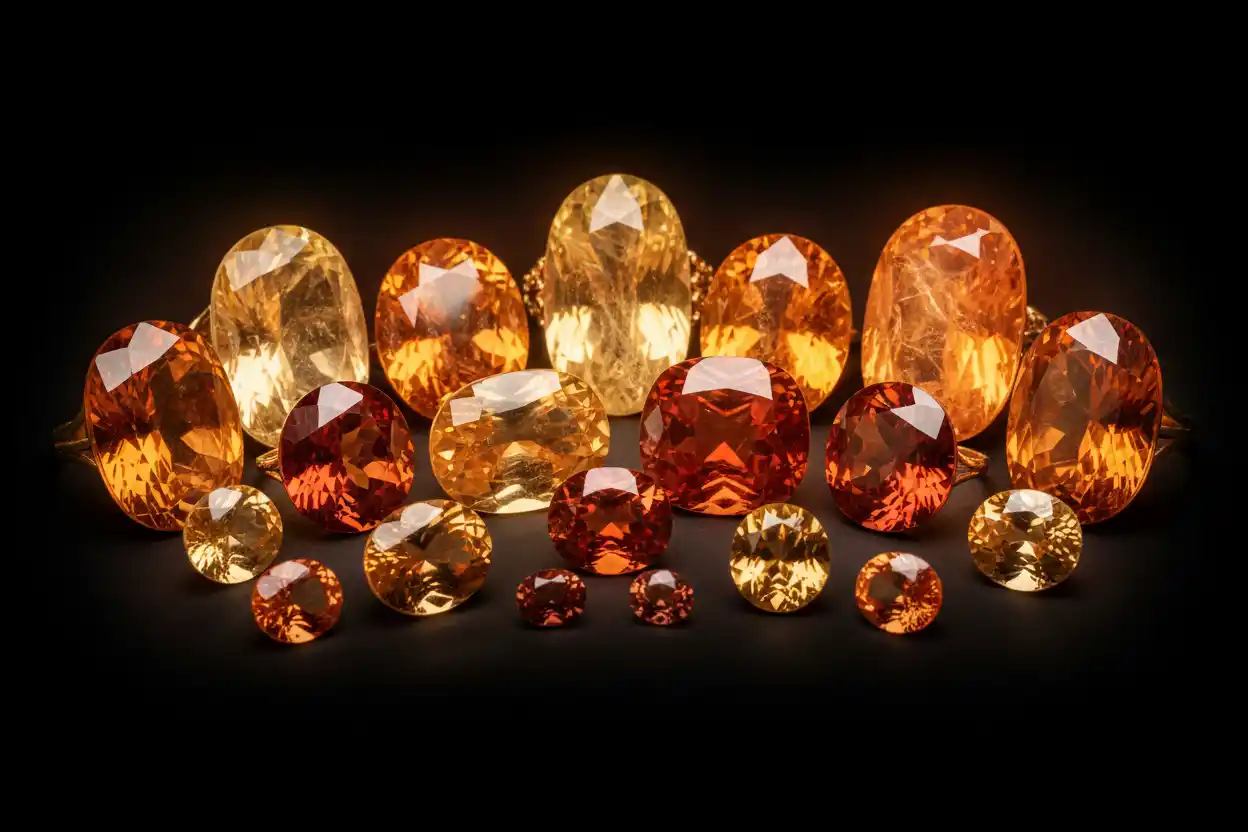
Hessonite Garnet Meaning: Properties, Uses & Symbolism
Hessonite garnet meaning begins with grossular. Hessonite is the traditional orange, brownish-orange, cinnamon, yellow-brown, or orangy-red gem variety of grossular garnet, whose ideal composition is Ca₃Al₂(SiO₄)₃. It belongs to the garnet group, crystallizes in the isometric system, and shares grossular’s approximate Mohs hardness of 6.5–7. Mindat describes hessonite as gemmy, more or less orange grossular and gives a measured specific-gravity range of roughly 3.62–3.67.
Fine hessonite is also known for an internal appearance that gemologists often describe as roiled, turbulent, oily, treacle-like, or “heat-wave.” GIA identifies this disturbed-looking interior as a common feature of hessonite and notes that orange garnets such as hessonite frequently contain eye-visible inclusions. A documented GIA hessonite from Sri Lanka, for example, had RI 1.742, SG 3.65, abundant mineral inclusions, pronounced growth zoning, and a strong roiled appearance.
Neither the cinnamon color nor the roiled appearance should be turned into an absolute identification rule. Grossular occurs in many colors, other garnets can overlap hessonite visually, individual hessonites vary in internal texture, and a convincing identification is strongest when color, refractive index, spectrum, density, inclusions, and garnet-family context agree. GIA’s work on gem-quality grossular emphasizes that defining hessonite by color alone has historically been inconsistent because published descriptions span yellow, orange, brown, reddish-orange, and related hues.
The responsible framework for hessonite garnet meaning is therefore mineral first, history second, symbolism third. Readers exploring other material-first references can browse the Gemstone Guides. This page defines hessonite as grossular, explains its characteristic color and internal appearance, outlines formation and identification, and then separates modern meanings such as confidence, steadiness, ambition, creativity, and grounded action from unsupported medical or supernatural claims.
Hessonite Garnet Meaning at a Glance
| Property or question | Evidence-aware summary |
|---|---|
| Mineral species | Grossular |
| Gem variety | Hessonite |
| Ideal formula | Ca₃Al₂(SiO₄)₃ |
| Mineral group | Garnet |
| Crystal system | Isometric / cubic |
| Typical color | Yellow-orange, cinnamon, brownish orange, orangy red, reddish brown |
| Important color contributor | Iron, especially Fe³⁺, is associated with hessonite’s warm coloration; detailed mechanisms can be more complex |
| Mohs hardness | Approximately 6.5–7 |
| Specific gravity | Commonly about 3.62–3.67 for hessonite references |
| Typical RI | Often around the low-to-mid 1.74 range, varying with composition |
| Optical character | Isotropic, though anomalous double refraction can occur in garnets |
| Cleavage | No prominent true cleavage |
| Tenacity | Brittle |
| Characteristic internal appearance | Frequently roiled, turbulent, oily, treacle-like, or “heat-wave” |
| Common inclusions | Mineral crystals, fluid-related features, zoning, granular or roiled internal textures |
| Formal status | Hessonite is a grossular variety, not a separate garnet species |
| Historic synonym | Cinnamon stone |
| Main identification caution | Color or roiling alone does not prove hessonite |
| Typical geology | Calcium-rich metamorphic and metasomatic settings, including skarn and calc-silicate environments |
| Modern symbolism | Confidence, steadiness, purposeful action, creativity, resilience |
| Scientific status of symbolism | Interpretive rather than demonstrated physiological effect |
| Main ownership principle | Sound stones work well in many jewelry uses, but fractures, inclusions and impacts still matter |
The wider grossular species includes green tsavorite, colorless grossular, yellow material, pink and red stones, and orange hessonite. Hessonite is therefore one branch of a compositionally broader mineral species rather than a separate “cinnamon garnet mineral.”
What Is Hessonite Garnet?
Hessonite is orange-to-brownish grossular garnet. The host mineral’s ideal composition contains calcium, aluminum, silicon, and oxygen, arranged in the garnet structure. Natural grossular can accept substitutions involving iron and other elements, which influence color, density, refractive index, spectroscopy, and composition.
Mindat describes hessonite as a gemmy orange grossular whose warm coloration is related to a small iron component, particularly ferric iron. The simple statement “iron makes hessonite orange” is useful at introductory level, but real gem coloration should not be reduced to one universal impurity concentration. GIA has discussed typical orange grossular absorption as involving broad iron-related mechanisms, while unusual grossular compositions can produce substantially different colors.
This is why hessonite should be identified as grossular first and interpreted as a color variety second.
Hessonite Identity Table
| Characteristic | Hessonite garnet |
|---|---|
| Species | Grossular |
| Ideal grossular formula | Ca₃Al₂(SiO₄)₃ |
| Variety status | Orange-to-brownish grossular gem variety |
| Crystal system | Isometric |
| Common crystal forms | Dodecahedral and trapezohedral garnet forms; massive or granular material also occurs |
| Typical gem color | Cinnamon, honey-orange, yellow-orange, brownish orange, orangy red |
| Luster | Vitreous |
| Transparency | Transparent to translucent |
| Hardness | Approximately 6.5–7 |
| Typical hessonite SG | About 3.62–3.67 |
| Typical RI region | Commonly around 1.73–1.76 depending on composition |
| Pleochroism | None in ideal isotropic behavior |
| Cleavage | None prominent |
| Fracture | Uneven to subconchoidal |
| Typical internal feature | Strong roiled or heat-wave appearance in many stones |
| Main related variety | Tsavorite is green grossular, not hessonite |
| Main look-alikes | Spessartine, orange pyrope-spessartine mixtures, zircon, orange sapphire, glass and other orange gems |
| Main laboratory principle | Use combined optical, physical and spectroscopic evidence |
One GIA reference specimen of Sri Lankan hessonite measured RI 1.742 and SG 3.65 and was isotropic, demonstrating the practical gemological profile of a well-characterized stone. Those values are examples rather than fixed constants for every hessonite.
Why Is Hessonite Called Cinnamon Stone?
Cinnamon stone is a historical synonym for hessonite and grossular-related orange material. Mindat records “Cinnamon Stone” as a synonym of hessonite and traces early grossular terminology through the German Kanelstein, literally cinnamon stone.
The association is visual. Warm orange, orange-brown and reddish-brown stones can resemble cinnamon in color.
The historical phrase should not be turned into a chemical category. Hessonite does not contain culinary cinnamon, cinnamon oil, or botanical compounds that cause its color.
Similarly, a cinnamon-colored garnet is not automatically hessonite. Species identification still matters.
Where Does the Name Hessonite Come From?
The name hessonite derives from a Greek word meaning “inferior” or “lesser.” Historical gemologists used the term because hessonite was considered lower in hardness and density than some other gemstones with which it was compared. Mindat records this etymology directly.
The historical wording should not be interpreted as a modern statement that hessonite is a poor-quality gem.
Hessonite can be attractive, transparent, sizeable, historically significant, and highly collectible. “Inferior” explains the origin of the name; it does not define contemporary quality.
Hessonite Is Grossular, but Not All Grossular Is Hessonite
Grossular occurs in a broad range of colors, including colorless, white, yellow, orange, brown, red, pink, and green.
Hessonite occupies the yellow-orange through brownish-orange and reddish-orange part of that range. Tsavorite occupies the transparent green gem-variety territory. Other grossulars may simply be called grossular without a special variety name.
This makes “grossular” the species-level identity and “hessonite” a narrower appearance-based gem-variety designation.
The distinction is useful when a specimen lies near a color boundary. A pale yellow grossular does not need to be forced into the hessonite category if the terminology would create more certainty than the evidence supports.
What Causes Hessonite’s Orange and Cinnamon Color?
Iron plays an important role in ordinary hessonite coloration.
Mindat associates orange hessonite with small amounts of Fe³⁺. GIA’s examination of grossular spectra has also described the usual orange hessonite appearance as resulting from broad iron-related absorption rather than one narrow spectral line. In one discussion, Fe²⁺–Ti⁴⁺ intervalence charge transfer was proposed as an important contributor to the broad orange absorption typical of many hessonites.
These descriptions should not be treated as contradictory simply because one emphasizes ferric iron and another discusses intervalence transfer. Gem color can involve multiple ions, structural positions, oxidation states, and interacting absorption mechanisms.
The practical conclusion is narrower: hessonite’s warm color is produced by trace-element chemistry within grossular, not by pigment injected into the stone.
The detailed spectroscopy, absorption features, apparent color, zoning, and unusual grossular color mechanisms belong in the Hessonite Garnet Optical Properties and Color Behavior reference.
What Is the Hessonite “Heat-Wave” Effect?
The roiled internal appearance is one of hessonite’s most recognizable gemological characteristics.
Under magnification—or sometimes even to the unaided eye—parts of the stone can look as though viewed through shimmering heated air, stirred honey, oil, treacle, or moving water. GIA calls this a turbulent or roiled effect and shows it as a characteristic inclusion-related appearance in hessonite.
A GIA-documented Sri Lankan stone showed strong roiling associated with prominent growth zoning, along with mineral inclusions. Other explanations of the phenomenon emphasize microscopic compositional irregularities, granular structure, and changes in how light travels through the material.
The safest interpretation is that “roiling” describes the observable optical appearance. Its microscopic structural origin may vary between specimens and should not be oversimplified into one universal inclusion.
Does Every Hessonite Have a Roiled Interior?
No.
Roiling is common enough to be a powerful supporting clue, but it is not mandatory in every specimen. Mindat specifically notes that some hessonites from particular deposits can lack the strongly developed classic effect.
Likewise, another transparent gem displaying internal distortion is not automatically hessonite.
A strong identification combines the characteristic internal appearance with grossular-compatible refractive index, density, spectrum, optical behavior, and other observations.
The detailed inclusion work belongs in the Hessonite Garnet Microscope Inclusion Notebook.
Growth Zoning and the Roiled Effect
Growth zoning records changes during crystal development.
Even within one nominal grossular crystal, small variations in composition can develop as the surrounding metamorphic or hydrothermal environment changes. These zones can affect how light passes through the stone.
GIA’s documented hessonite specimen showed pronounced growth zoning producing a strong roiled effect.
This is important because the roiling is not a magical mist trapped inside the stone. It is an optical consequence of real internal structure.
A gemstone can look “alive” under magnification while remaining entirely explicable through mineral growth and optics.
Common Hessonite Inclusions
Hessonite commonly contains mineral crystals, fluid-related inclusions, growth zoning, granular textures, fractures, and roiled regions.
GIA notes that orange garnets such as hessonite often contain eye-visible inclusions, unlike many red garnets whose commercial appeal tends toward greater apparent clarity.
This makes hessonite an interesting exception to the idea that every visible inclusion automatically destroys gem quality.
Some internal texture is part of the visual identity collectors associate with the variety.
However, a large dark crystal beneath the table, an open surface-reaching fracture, or severe loss of transparency can still affect desirability and durability.
How Hessonite Garnet Forms
Grossular forms especially well where calcium-rich rocks interact with silica- and aluminum-bearing geological systems. Contact metamorphism of impure limestone can generate calc-silicate minerals and skarns containing grossular, while regional metamorphism and metasomatism can create additional grossular-bearing environments.
Mindat describes gem-quality hessonite as occurring in geological settings including high-grade metamorphic suites and contact zones, while grossular more broadly occurs in skarns, calc-silicate rocks, rodingites, and related environments.
The chemical logic is straightforward: calcium is available from carbonate-rich or altered mafic rocks, while aluminum and silica arrive from the host system or reacting fluids and minerals. Under appropriate pressure, temperature, and fluid conditions, grossular becomes stable.
Individual hessonite deposits can have different formation histories, so a Sri Lankan gem, an Italian crystal, and material from another metamorphic belt should not be assigned one identical geological pathway.
The detailed reaction mineralogy, skarn environments, metamorphic grade, host rocks, fluid history, and deposit comparisons belong in Hessonite Garnet Formation and Deposit Geology.
Hessonite in Skarn and Calc-Silicate Rocks
Skarn is a particularly important context for calcium garnets.
When carbonate rocks such as limestone or dolostone react with silica-, iron-, aluminum-, or magnesium-bearing fluids and adjacent igneous rocks, new calc-silicate minerals can form. Garnets, pyroxenes, wollastonite, epidote-group minerals, calcite, and other phases may develop depending on chemistry.
Grossular-rich garnet is favored where calcium and aluminum are available and iron is relatively limited compared with andradite-rich compositions.
Natural compositions can also lie between grossular and andradite rather than forming perfect end members. Mindat emphasizes that grossular-andradite solid solutions and compositional zoning are common enough that some specimens are mislabeled when assigned purely by appearance.
That is another reason hessonite identification should begin with actual garnet composition.
Hessonite and Secondary Deposits
Gem-quality hessonite can weather out of its original host rock and become concentrated in sedimentary or alluvial deposits.
Once freed from primary metamorphic rock, relatively durable garnet can survive transport better than softer surrounding minerals. Rounded crystals and water-worn rough can therefore occur away from the original source.
A gem recovered from secondary gravel no longer carries the complete matrix association visible in primary rock.
That loss of context makes locality documentation and inclusion study more important when geological provenance matters.
Diagnostic Characteristics of Hessonite
Hessonite identification normally works through a combined evidence package rather than one dramatic test.
The stone should first fall within grossular-compatible properties. Hessonite commonly gives RI values in the low-to-mid 1.74 region, has relatively high density around the mid-3.6 range, is isotropic as a garnet, and frequently displays orange-brown color plus characteristic roiling.
GIA historically emphasized using multiple properties—particularly color, refractive index, and absorption spectrum—when distinguishing garnet species because different garnets can overlap visually.
This remains the better principle today.
An orange stone that simply “looks like hessonite” deserves a provisional rather than final identification.
Hessonite Versus Spessartine
Spessartine is a manganese-aluminum garnet whose ideal formula differs fundamentally from calcium-aluminum grossular.
Both can be orange.
Spessartine frequently reaches bright mandarin orange, reddish orange, or orange-red colors, while hessonite commonly has warmer cinnamon, honey, brown-orange, or orangy-red tones. Those tendencies are useful visually but overlap too much for confident identification.
Spessartine also tends to have higher refractive index and greater density than grossular.
A strong roiled interior supports hessonite, but measurement is preferable to color guessing.
Hessonite Versus Grossular-Andradite Intermediate Garnet
Grossular and andradite form a continuous compositional relationship.
Natural garnets near the boundary can therefore share some grossular characteristics while containing substantial iron in the andradite component. Mindat warns that such crystals are commonly mislabeled and may be better described as grossular-andradite series material when precise chemistry has not been established.
For transparent gem material, refractive index and spectroscopy can reveal composition shifts.
A cinnamon color alone cannot determine exactly where a garnet falls in that series.
Hessonite Versus Heliodor
Heliodor Meaning concerns yellow beryl rather than garnet.
Heliodor generally has lower density than hessonite, is uniaxial rather than isotropic, has somewhat greater hardness, and commonly occurs in yellow to greenish-yellow rather than the classic roiled cinnamon-orange hessonite palette.
A warm golden heliodor can still overlap visually with a light hessonite in photographs.
Refractive index and optical character separate them much more reliably than color.
Hessonite Versus Herkimer Diamond
Herkimer Diamond Meaning concerns clear double-terminated quartz from the well-known New York locality tradition.
Quartz is substantially less dense and lower in RI than hessonite, and clear Herkimer material lacks the typical cinnamon grossular body color.
Both can show attractive internal inclusions, but the host species and geological settings are unrelated.
The comparison demonstrates why generic words such as “crystal” or “gem” are never enough for identification.
Hessonite Versus Heulandite
Heulandite Meaning concerns a zeolite-group mineral.
Heulandite is much softer, cleavage-prone, commonly tabular, and often white, colorless, pink, peach, or reddish. Hessonite is a garnet, significantly harder, denser, and normally displays the compact mechanical behavior associated with garnet rather than zeolite cleavage.
Warm peach color in an online photograph can make unrelated minerals appear deceptively similar.
Physical properties resolve the confusion.
Hessonite Versus Hiddenite
Hiddenite Meaning concerns green spodumene rather than garnet.
Hiddenite is typically green through chromium-related coloration, strongly pleochroic, monoclinic, and cleavage-prone. Hessonite is isotropic grossular and normally orange to brownish orange.
They are not serious color look-alikes, but the comparison illustrates how varietal names can obscure the underlying species if the mineral name is omitted.
“Hiddenite” means spodumene.
“Hessonite” means grossular.
Original Information Gain: Hessonite Name and Claim Audit
| Name or claim | Evidence-aware interpretation | What should not automatically be assumed | Stronger evidence when needed |
|---|---|---|---|
| Hessonite | Orange-to-brownish gem variety of grossular | Separate garnet species | Grossular identification |
| Hessonite garnet | Correct common wording | Different chemistry from grossular | Same species relationship |
| Cinnamon stone | Historical synonym for hessonite | Every cinnamon-colored gem is hessonite | Gemological testing |
| Grossularite | Older grossular terminology | Separate modern species | Current nomenclature |
| Orange grossular | Material-first description | Automatically within every trade definition of hessonite | Color plus gem context |
| “Ceylon hessonite” | Possible provenance description for Sri Lankan material | Sri Lankan origin from appearance | Documentation/lab evidence |
| “Gomed” or “Gomedh” | Cultural/astrological trade terminology frequently applied to hessonite | Separate mineral species | Confirm grossular |
| “Natural hessonite” | May establish mined origin | Automatically untreated or locality-proven | Treatment/provenance evidence |
| “Heat-wave hessonite” | Common roiled interior is useful evidence | Roiling alone proves identity | RI, SG, spectrum |
| “Flawless hessonite” | Clarity description | Absence of roiling means fake | Some genuine stones can lack strong roiling |
| “Honey garnet” | Appearance/marketing wording | Formal mineral variety | Gem identification |
| “Rahu stone” | Astrological or cultural symbolism | Astronomical body physically affects the stone | Remains belief-based terminology |
| “Prosperity stone” | Modern symbolism | Guaranteed financial outcomes | No established mechanism |
| “Digestive healing stone” | Wellness claim | Treatment of digestive disease | Clinical evidence would be required |
| “Detox garnet” | Unsupported health terminology | Removal of toxins | Clinical evidence would be required |
The most important identification lesson is that hessonite is a variety name nested inside grossular, while cinnamon stone and many cultural names are additional historical or commercial layers.
Original Specimen and Photo Checklist
Hessonite is especially suitable for controlled photo documentation because the roiled interior, color, zoning, and inclusions can change dramatically with lighting.
| Observation | Photograph can often support | Photograph cannot reliably prove |
|---|---|---|
| Cinnamon-orange color | Hue, tone and saturation | Grossular species |
| Brownish modifier | Visible warmth/darkness | Exact iron mechanism |
| Roiled interior | Turbulent optical texture | Hessonite identity by itself |
| Growth zoning | Internal bands or regions | Exact chemistry of each zone |
| Mineral inclusions | Shape and distribution | Inclusion species without analysis |
| Transparency | Visual clarity | RI or SG |
| Natural garnet crystal form | Dodecahedral/trapezohedral morphology | Variety classification |
| Water-worn rough | Rounded surface | Source deposit |
| “Sri Lankan” label | Claimed provenance | Geographic origin |
| “Untreated” label | Seller disclosure | Laboratory confirmation |
| “Healing vibration” | Nothing objectively measurable | Physiological effect |
A useful specimen photo set should include neutral diffuse white light, transmitted light, and oblique side lighting. The transmitted-light view often reveals roiling and zoning far better than a conventional face-up jewelry photograph.
Avoid excessive sharpening. Digital clarity filters can artificially exaggerate hessonite’s internal turbulence and make ordinary zoning look more dramatic than it really is.
Original Evidence Hierarchy for a Hessonite Identification
| Evidence level | What it can establish |
|---|---|
| Orange/cinnamon appearance | Hessonite is one possibility |
| Garnet-like crystal form | Garnet becomes plausible |
| Roiled “heat-wave” interior | Strong supporting clue |
| SG around mid-3.6 | Grossular becomes more plausible |
| RI around low-to-mid 1.74 | Strong grossular/hessonite support |
| Isotropic behavior | Supports garnet |
| Absorption spectrum | Helps distinguish garnet composition |
| Raman/chemical analysis | Species/composition can be established more directly |
| Provenance documentation | Adds locality evidence |
| Several independent properties agreeing | Best basis for confident identification |
This hierarchy prevents one inclusion or one seller name from carrying more evidentiary weight than it deserves.
Documented History Versus Later Symbolism
Hessonite’s documented history includes the cinnamon-stone name, the “inferior” etymology, and its longstanding recognition as a warm-colored grossular garnet.
That is different from proving that today’s detailed metaphysical system was attached to the material throughout antiquity.
Modern crystal and astrological traditions often connect hessonite with ambition, confidence, obstacles, worldly success, protection, or particular astrological interpretations. Those traditions can be described as beliefs.
They should not be rewritten as mineralogical facts or projected into every historical period without primary evidence.
Hessonite and Astrological Traditions
Hessonite has a particularly strong presence in South Asian astrological gemstone traditions, where it may be known through names such as gomed or gomedh and associated with Rahu.
This is a cultural and religious framework rather than a gemological property.
The garnet does not physically contain Rahu, alter planetary motion, or provide a scientifically measured connection between astronomical bodies and human events.
Someone can value the cultural practice without describing its mechanism as established physics.
Modern Hessonite Garnet Meaning
Modern hessonite garnet meaning commonly centers on confidence, ambition, grounded action, resilience, creativity, discipline, discernment, and the ability to move through uncertainty.
Its dense warm color naturally contributes to these interpretations. Cinnamon-orange can evoke warmth, activity, autumnal maturity, fire, or determination, while garnet’s broader cultural reputation encourages associations with commitment and persistence.
A symbolic meaning becomes most useful when translated into something the person can actually do.
Hessonite and Confidence
Hessonite is frequently presented as a confidence stone.
A grounded interpretation might use the gem as a reminder to prepare for a difficult conversation, make a decision based on available evidence, or take one step that has been repeatedly postponed.
The gemstone does not alter self-esteem biologically.
Confidence develops through preparation, experience, feedback, skills, and action.
Hessonite and Ambition
Warm orange stones are often connected symbolically with motivation and ambition.
Hessonite can therefore represent a goal that requires sustained work rather than an imagined shortcut to success.
A useful practice could pair the stone with a written target, measurable milestone, and deadline.
The mineral cannot guarantee promotions, clients, business growth, examination results, or financial success.
Hessonite and Creativity
Hessonite’s roiled interior makes creativity an especially fitting metaphor because the stone can look visually complex rather than perfectly uniform.
A person may interpret that texture as a reminder that useful ideas can emerge from complexity, revision, and imperfect first attempts.
The actual mineral does not stimulate creative brain function through iron or calcium transfer.
Its usefulness is symbolic and aesthetic.
Hessonite and Discernment
One of the strongest responsible themes for hessonite is discernment.
Its appearance itself teaches a useful lesson: what looks like a flaw can sometimes be characteristic evidence. The roiled interior may reduce apparent clarity while simultaneously helping an experienced observer recognize the variety.
That makes hessonite a good metaphor for looking beyond superficial first impressions.
The crystal does not grant clairvoyance or guarantee that a person’s judgment becomes correct.
Hessonite and Protection
Protection appears frequently in modern garnet symbolism and in astrological descriptions of hessonite.
A grounded interpretation can turn the idea into preparedness: verify information, establish a boundary, secure an account, inspect equipment, or avoid an unsafe situation.
No gemstone can guarantee protection from accidents, crime, financial loss, illness, another person’s behavior, or supernatural harm.
Hessonite Healing Claims
There is no established scientific evidence that hessonite treats digestive disorders, anxiety, depression, hormonal conditions, neurological disease, infertility, immune dysfunction, cardiovascular conditions, pain, infections, or other medical problems.
Grossular contains calcium, aluminum, silicon, and oxygen, with iron contributing to hessonite’s coloration. Those elements inside a garnet crystal lattice are not automatically nutrients or medicine.
Wearing hessonite does not function as calcium or iron supplementation.
The site’s broader separation between gemstone symbolism and health claims is stated in the Gems Lore Disclaimer.
Hessonite and “Detox” Claims
The word detox is particularly misleading when attached to minerals.
Hessonite does not extract metabolic waste, heavy metals, pathogens, or environmental toxins from the human body simply through contact.
Clinical detoxification is a medical or physiological subject with specific mechanisms.
A gemstone may instead be used symbolically to represent giving up an unwanted habit or simplifying a routine.
That is a behavioral metaphor, not mineral detoxification.
Jewelry Wear
Hessonite’s grossular hardness of approximately 6.5–7 gives it useful scratch resistance for jewelry, although it is not as hard as beryl, corundum, or diamond.
GIA describes garnets generally as having fair-to-good toughness and being suitable for jewelry when protected from hard blows. Warm soapy water is the consistently safe cleaning approach, while steam cleaning is not recommended.
Individual hessonites with strong fractures, highly included regions, or surface-reaching cavities need more caution than clean stones.
The detailed relationship between setting pressure, impacts, exposed edges, and long-term wear belongs in Hessonite Garnet Setting and Wear Engineering.
Cutting and Orientation
Hessonite can be faceted, cabochon cut, carved, or polished depending on transparency and inclusion character.
Because garnet is isotropic, cutters do not orient hessonite around strong pleochroism in the way they would orient many anisotropic gems. They still need to consider color zoning, roiled areas, fractures, inclusions, rough shape, weight retention, and the desired face-up appearance.
A cutter may deliberately retain some characteristic internal texture rather than chase flawless transparency.
The specialized workmanship belongs in Hessonite Garnet Cutting, Orientation and Polish.
Treatment Considerations
Garnets are not among the gemstones most strongly associated with routine color treatment, but treatment should never be declared impossible.
GIA notes that garnets can rarely be fracture filled. GIA has also documented polymer filling in grossular/hessonite material containing extensive cavities and fractures, with tested samples retaining normal hessonite RI, SG, roiling, and inclusions alongside the filler.
That example demonstrates a key distinction: treatment can modify a natural hessonite without changing its underlying grossular identity.
A seller’s “natural hessonite” statement should therefore be read carefully if treatment disclosure matters.
Safe Ownership: Intact Stone Versus Processing
Ordinary handling of an intact hessonite gemstone or mineral specimen is different from sawing, grinding, sanding, drilling, crushing, or heating it.
Lapidary processing creates mineral dust and can expose particles from both garnet and associated minerals. Appropriate wet methods where suitable, local dust control, eye protection, equipment safeguards, and properly selected respiratory protection should be used in professional workshop contexts.
There is no reason to grind hessonite into powder for ritual use.
Do Not Ingest Hessonite
Hessonite should not be powdered, swallowed, added to supplements, or deliberately soaked to create gemstone drinking-water preparations.
Natural stones can contain inclusions, matrix residues, polishing compounds, fracture fillers, adhesives, surface contamination, or associated minerals beyond the ideal grossular formula.
Mineral composition is not dosage guidance.
Symbolic gemstone use does not require ingestion.
Specimen Conservation
Natural hessonite crystals can preserve crystal form, matrix association, growth zoning, inclusions, metamorphic relationships, locality information, and historic collection provenance.
A sharply formed cinnamon-colored grossular crystal on matrix may have more collector and geological value intact than it would after faceting.
Photograph and record the original specimen before cleaning or modification. Preserve locality labels, collection numbers, dimensions, weight where useful, crystal form, visible damage, matrix, associated minerals, previous ownership information, and analytical documentation.
The Hessonite Garnet Specimen Conservation Record provides the dedicated framework for that documentation.
Evidence and Technical Limits
This article does not claim first-hand mine visits, private gemstone purchases, unpublished spectroscopy, direct examination of reader specimens, or laboratory authentication of every hessonite locality. The wider evidence approach used by Gems Lore is described on About Gems Lore.
Exact garnet composition, grossular-andradite boundaries, unusual color mechanisms, difficult inclusion identity, filler detection, or geographic origin may require refractometry, spectroscopy, Raman analysis, microscopy, chemical analysis, or specialist gemological review.
A strong roiled appearance can support a hessonite identification.
It cannot replace the rest of the evidence.
Readers with documented corrections, analytical data, locality records, or stronger mineralogical evidence can submit them through Contact Gems Lore. Information submitted through site channels is handled according to the Privacy Policy.
Frequently Asked Questions About Hessonite Garnet Meaning
What is hessonite garnet meaning?
Hessonite garnet meaning combines its identity as cinnamon-to-orange grossular with modern symbolic themes such as confidence, grounded action, ambition, discernment, creativity, and resilience. Those themes are interpretations rather than scientifically demonstrated physiological effects.
What is hessonite?
Hessonite is an orange, yellow-brown, brownish-orange, or orangy-red gem variety of grossular garnet, Ca₃Al₂(SiO₄)₃.
Is hessonite a separate garnet species?
No. Its mineral species is grossular. Hessonite is a gem-variety name within grossular.
Why is hessonite called cinnamon stone?
The historical name refers to the warm cinnamon-like appearance of many hessonite garnets. Mindat records cinnamon stone as a synonym of hessonite.
Why does hessonite have a roiled appearance?
Growth zoning, compositional variation, microscopic structural irregularities, inclusions, and light scattering can contribute to the characteristic turbulent or heat-wave appearance. GIA documents pronounced roiling as a well-known hessonite feature.
Does every hessonite look roiled?
No. The feature is common and diagnostically useful but not mandatory in every stone.
What color is hessonite?
Typical colors range through yellow-orange, cinnamon, brownish orange, orangy red, and reddish-brown shades.
What causes hessonite’s color?
Iron-related absorption plays an important role. Fe³⁺ is associated with hessonite coloration, while more detailed spectroscopic explanations can include interacting iron and titanium charge-transfer mechanisms in some material.
How hard is hessonite?
As grossular garnet, hessonite is approximately Mohs 6.5–7.
What is hessonite’s specific gravity?
Mindat gives approximately 3.62–3.67 for hessonite.
What is hessonite’s refractive index?
Individual stones vary, but hessonite generally occupies the low-to-mid 1.74 region. A documented GIA Sri Lankan hessonite measured RI 1.742.
Is hessonite singly refractive?
Grossular is cubic and fundamentally isotropic. Natural strain or compositional irregularity can occasionally produce anomalous behavior, so complete gemological interpretation is preferable to relying on one polariscope observation.
Is hessonite the same as spessartine?
No. Both can be orange garnets, but hessonite is calcium-aluminum grossular while spessartine is manganese-aluminum garnet.
Is hessonite the same as grossular?
Hessonite is a variety of grossular. All hessonite is grossular, but not all grossular is hessonite.
Where does hessonite form?
Hessonite forms in calcium-rich metamorphic and metasomatic environments, including calc-silicate rocks, skarns, contact zones, and related grossular-bearing geological systems.
Can hessonite be treated?
Treatment is not as routine as in many gem species, but fracture filling is possible. GIA has documented polymer-filled hessonite/grossular material.
Does hessonite have healing properties?
There is no established scientific evidence that hessonite treats disease or produces specific physiological healing effects.
Does hessonite improve confidence?
A person may use hessonite as a symbolic reminder to prepare, act, or follow through on a decision. That is different from demonstrating that the mineral biologically increases confidence.
Does hessonite attract money or success?
There is no scientific evidence that hessonite changes financial probabilities, business results, employment outcomes, or investment returns.
Is hessonite safe to wear?
Generally, yes. Grossular has useful hardness and fair-to-good toughness for jewelry, but fractures, inclusions, cut shape, and setting design affect individual durability.
Can hessonite go in drinking water?
Hessonite should not be powdered, ingested, or deliberately used to prepare gemstone drinking-water elixirs. Natural specimens and treated stones may contain material beyond ideal grossular chemistry.
Final Perspective
Hessonite garnet meaning becomes more useful when the cinnamon color is placed inside the correct mineral identity. Hessonite is orange-to-brownish grossular garnet, Ca₃Al₂(SiO₄)₃, with grossular’s isometric structure, hardness around 6.5–7, and the comparatively high density expected from a calcium garnet. The name does not define a separate species; it identifies a warm-colored gem variety within a much broader grossular family.
Its most recognizable internal characteristic is equally grounded in real gemology. Many hessonites display a roiled, turbulent, “heat-wave” interior, sometimes accompanied by mineral inclusions and strong growth zoning. GIA treats that appearance as characteristic while its broader garnet work also demonstrates why no single visual feature should replace refractive index, density, spectroscopy, and other identification evidence.
The history behind the variety adds another genuine layer. Cinnamon stone refers to its warm coloration, while hessonite itself derives from an old term meaning inferior because early observers compared its physical properties with other gems—not because the material lacks beauty or significance.
Modern associations with confidence, grounded action, ambition, discernment, resilience, creativity, and protection can still form a responsible hessonite garnet meaning when clearly labeled as symbolic. The evidence-aware approach is straightforward: establish grossular identity first, use cinnamon color and roiling as supporting rather than absolute clues, keep color chemistry specimen-aware, preserve geological and historical context, distinguish intact ownership from dust-generating processing, and keep astrological, medical, financial, and supernatural promises separate from what hessonite actually demonstrates.