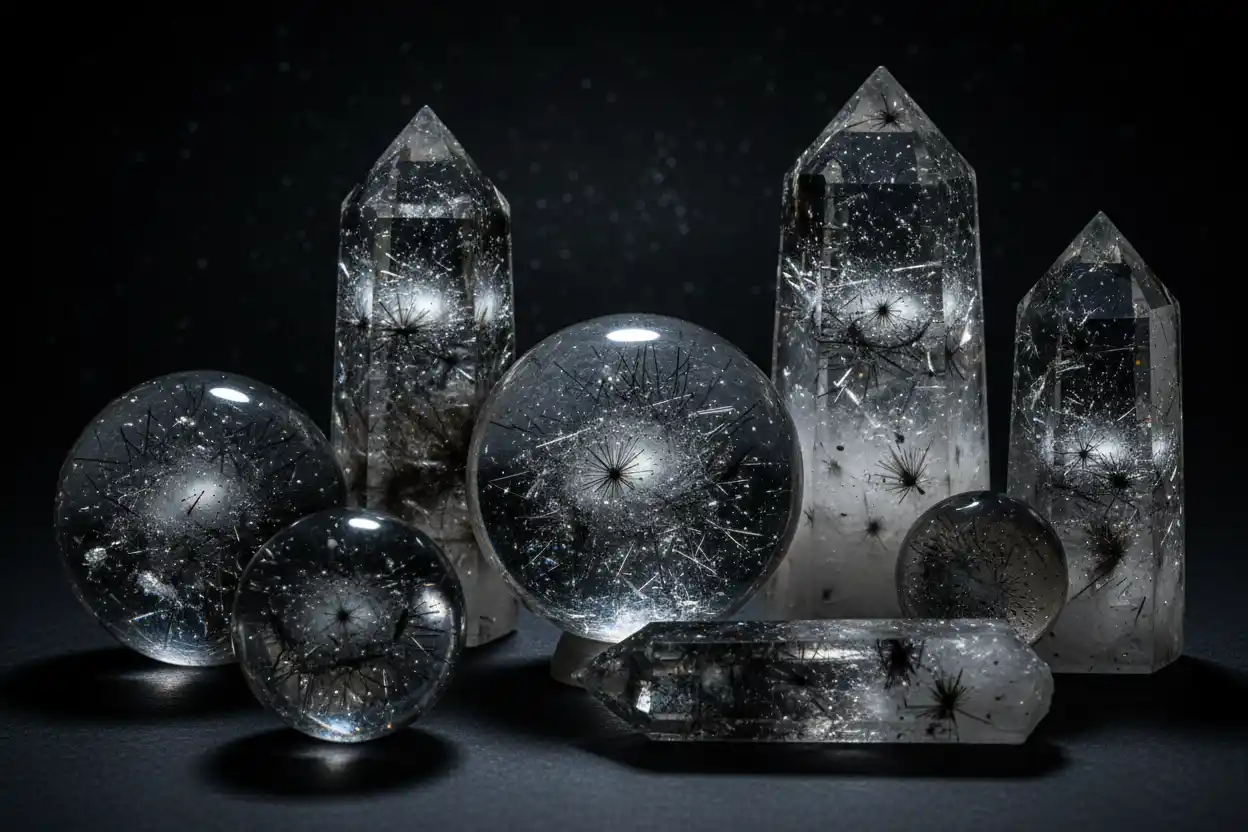
Hollandite Quartz Meaning: Properties, Uses & Symbolism
Hollandite quartz meaning begins with an included quartz crystal, not with a new mineral species called “hollandite quartz.” The host is quartz, SiO₂, while the visually distinctive material consists of dark mineral inclusions traditionally identified in classic Madagascar specimens as hollandite. GIA investigated colorless quartz from central Madagascar containing tiny radiating sprays of black needles, then used scanning electron microscopy with chemical analysis and single-crystal X-ray diffraction to confirm the inclusions as hollandite under the mineral nomenclature used at the time. The material had been marketed with descriptive names such as “Spider quartz” and “Microstar” because the inclusions resemble miniature black stars or spiders suspended inside the quartz.
The host quartz retains ordinary quartz properties. Quartz has Mohs hardness 7, measured density around 2.65–2.66 g/cm³, refractive indices approximately 1.544 and 1.553, positive uniaxial optical character, low birefringence around 0.009, poor or indistinct cleavage, and commonly conchoidal fracture. The inclusions do not convert the host into a new quartz species, nor do they make the whole gemstone chemically equivalent to hollandite. A transparent specimen is more accurately described as quartz with hollandite inclusions when the inclusion identity is supported.
The inclusion name itself deserves another layer of caution. Modern mineral nomenclature defines hollandite as the barium–manganese member of the coronadite group with ideal formula Ba(Mn⁴⁺₆Mn³⁺₂)O₁₆. Older descriptions used a different idealized formula, and the Hollandite Supergroup was later reorganized so that the former type material was reassigned to ferrihollandite while hollandite was redefined as the Ba–Mn³⁺ end member. This means an old laboratory identification can be historically legitimate while its formula notation no longer matches today’s preferred nomenclature.
That history creates the most important boundary for hollandite quartz meaning: the famous black Madagascar star inclusions are genuine mineralogical features, but starburst shape alone cannot prove the exact oxide species in every black-included quartz sold today. Modern GIA work has documented another rare hollandite-supergroup-related mineral, mannardite, as black fibrous or radial inclusions in quartz, showing directly why morphology must not replace analysis.
Readers exploring other material-first references can browse the Gemstone Guides. This page focuses specifically on host identity, inclusion terminology, formation, diagnostic evidence, history, symbolism, and safe ownership without duplicating the specialized pages that examine inclusions, optics, geology, cutting, wear, or conservation in greater depth.
Hollandite Quartz Meaning at a Glance
| Property or question | Evidence-aware summary |
|---|---|
| Host mineral | Quartz |
| Host formula | SiO₂ |
| Inclusion traditionally identified | Hollandite |
| Current hollandite ideal formula | Ba(Mn⁴⁺₆Mn³⁺₂)O₁₆ |
| Hollandite mineral group | Coronadite group, Hollandite Supergroup |
| Quartz crystal system | Trigonal |
| Hollandite crystal system | Monoclinic |
| Quartz hardness | Mohs 7 |
| Hollandite hardness | Approximately 4–6 |
| Quartz specific gravity | About 2.65–2.66 |
| Hollandite specific gravity | About 4.95 |
| Quartz RI | Approximately 1.544–1.553 |
| Typical visual appearance | Colorless to translucent quartz containing gray-black or black radiating needles, sprays, or star-like aggregates |
| Famous commercial names | Spider quartz, Microstar quartz, star-included quartz |
| Classic gem occurrence | Central Madagascar |
| Inclusion identification evidence | SEM/chemical analysis plus single-crystal X-ray diffraction documented for classic Madagascar material |
| Main nomenclature caution | Older hollandite formulae and species concepts differ from current IMA-aligned terminology |
| Main visual-identification caution | Other manganese/titanium oxide minerals can resemble hollandite; radial shape alone is insufficient |
| Modern symbolism | Complexity within clarity, focus, pattern recognition, perspective, integration, deliberate action |
| Scientific status of symbolism | Interpretive rather than demonstrated physiological or supernatural effects |
| Main ownership issue | Quartz host is reasonably durable, but inclusions, fractures, surface-reaching stars, and specimen form can affect integrity |
The table also shows why the familiar phrase “hollandite quartz properties” must be interpreted carefully. Hardness 7 belongs primarily to the quartz host. A tiny hollandite inclusion has its own physical properties, but a person handling a polished included-quartz gem is normally interacting mechanically with quartz rather than with a free-standing hollandite crystal.
What Is Hollandite Quartz?
Hollandite quartz is collector and trade terminology for quartz containing inclusions identified or represented as hollandite. The most recognized examples are colorless or lightly cloudy quartz from Madagascar containing tiny black needle aggregates that radiate from compact centers.
GIA’s examination of the Madagascar material was unusually useful because the investigators did not stop at appearance. They opened rough samples to expose the inclusions, examined the needles by scanning electron microscopy, obtained chemical data showing abundant manganese with barium and smaller amounts of iron and other components, and confirmed hollandite by single-crystal X-ray diffraction.
This is a much stronger identification than saying, “The inclusion looks like a black star, therefore it is hollandite.”
That analytical distinction should remain central whenever the name is used.
Hollandite Quartz Identity Table
| Characteristic | Quartz host | Hollandite inclusion |
|---|---|---|
| Mineral species | Quartz | Hollandite |
| Ideal formula | SiO₂ | Ba(Mn⁴⁺₆Mn³⁺₂)O₁₆ |
| Mineral family | Silica | Manganese oxide, coronadite group |
| Crystal system | Trigonal | Monoclinic |
| Typical color in this material | Colorless, white, lightly smoky, translucent | Gray-black to black |
| Luster | Vitreous | Metallic to submetallic |
| Hardness | 7 | About 4–6 |
| Density | About 2.65–2.66 | About 4.95 |
| Optical behavior | Uniaxial positive | Opaque in typical inclusions |
| Typical observed inclusion form | Host enclosing foreign crystals | Needles, fine sprays, radial/star aggregates |
| Main gemological role | Determines bulk gem behavior | Creates the distinctive visual pattern |
| Identification priority | Standard quartz testing | Microscopy plus spectroscopy/XRD/chemistry when exact species matters |
Mindat gives current hollandite as a silvery-gray to grayish-black or black mineral with metallic luster, hardness approximately 4–6, density about 4.95, and monoclinic symmetry. It also warns that hollandite is visually indistinguishable from several related manganese oxides.
That warning is particularly relevant when the supposed hollandite occurs only as microscopic inclusions.
“Hollandite Quartz” Is Not One Mineral Formula
Writing a formula such as “SiO₂ + Ba(Mn…)O₁₆” can be a useful shorthand for the host-plus-inclusion relationship, but it is not one unified mineral formula.
Quartz and hollandite remain separate crystalline phases.
The quartz formed its own silica lattice.
The included manganese oxide formed its own structure.
One became physically enclosed within the other.
The result is a composite natural specimen at the microscopic scale rather than a new chemical compound.
This distinction is common across included gemstones. Tourmalinated quartz remains quartz containing tourmaline. Rutile quartz remains quartz containing rutile. Hematite-included quartz remains quartz containing hematite.
Hollandite quartz follows the same logic.
What Is Hollandite?
Current mineralogical nomenclature places hollandite in the coronadite group of the Hollandite Supergroup. Its ideal formula is Ba(Mn⁴⁺₆Mn³⁺₂)O₁₆.
Members of the broader Hollandite Supergroup are often described as tunnel oxides. Their structures contain walls of linked metal-oxygen octahedra that define channels or tunnels capable of hosting larger cations. The supergroup includes manganese- and titanium-dominant members, and individual species are distinguished partly by which cations dominate specific structural sites.
That structural complexity matters because a black needle containing manganese and barium may belong near hollandite mineralogically without necessarily being assignable by eyesight to the exact modern species.
A precise name is an analytical conclusion.
Why Older Hollandite Formulas Look Different
Older gemological descriptions of the Madagascar inclusions may give hollandite as approximately Ba(Mn⁴⁺,Mn²⁺)₈O₁₆. GIA’s classic analytical report used the then-current form of the formula while confirming the inclusion by chemistry and X-ray diffraction.
Modern nomenclature later redefined hollandite as the Ba–Mn³⁺ end member, Ba(Mn⁴⁺₆Mn³⁺₂)O₁₆, while material corresponding to the barium–iron member received the ferrihollandite name.
The correct conclusion is not that the older GIA analysis became worthless.
It means mineral nomenclature evolved.
When citing historic analytical work, preserve its identification but use current nomenclature carefully when describing ideal chemistry.
Can Every Madagascar Star Be Called Hollandite?
No mineral name should be assigned solely because a specimen comes from a locality associated with that mineral.
Classic Madagascar star inclusions were analytically confirmed as hollandite. Mindat also documents star-like hollandite in quartz from the Anketsaketsa area in Madagascar.
However, manganese oxide assemblages can contain multiple closely related minerals, and the Hollandite Supergroup itself contains several species with similar habits and colors.
If one individual specimen has never been analyzed, the safest wording may be “quartz with black radiating inclusions represented as hollandite” rather than presenting species identity as laboratory fact.
Why Starburst Shape Is Not Enough
Radial mineral aggregates are a growth habit, not a species fingerprint.
This point has become even more important because GIA has documented quartz containing black fibrous mannardite inclusions arranged in parallel and radial formations. Mannardite is chemically and mineralogically different from hollandite, even though it belongs to the broader structural family associated with hollandite-type tunnel oxides. Raman spectroscopy was needed to identify those microscopic inclusions correctly.
Other manganese oxides can also be difficult to distinguish visually.
Mindat explicitly states that hollandite is visually indistinguishable from cryptomelane and several related manganese oxide minerals.
Therefore:
Star shape can suggest a hollandite-style inclusion habit; it cannot establish the species.
The detailed microscopic decision process belongs in the Hollandite Quartz Microscope Inclusion Notebook.
What Do the Classic Inclusions Look Like?
The classic material contains very fine black needles radiating outward from small centers. Some stars are compact and symmetrical. Others are irregular, incomplete, asymmetric, branching, or partially concealed by cloudy quartz.
GIA described the black inclusions as radiating sprays measuring up to a few millimeters across. SEM examination showed individual protruding needle-like crystals on the order of micrometers in width.
Collector photographs show single stars, multiple stars, overlapping sprays, scattered needles, and stars associated with cloudy zones or other internal features.
A perfect six- or eight-rayed graphic star is therefore not a requirement.
Natural growth is irregular.
Why Are the Inclusions Black?
Hollandite itself is normally gray-black to black and metallic or submetallic.
When very small opaque hollandite needles occur inside transparent quartz, they absorb and reflect light strongly against the colorless host. The contrast makes them appear intensely black even though their actual reflected-light appearance can range through dark gray, steel-gray, or subdued metallic tones.
The quartz usually contributes little body color in the classic material.
The visual effect therefore comes from a transparent silica host surrounding an opaque manganese-oxide inclusion.
Why Do Some Hollandite Stars Look Gray Instead of Black?
Several factors can alter apparent inclusion color:
- extremely fine needles transmit or scatter light differently from thicker ones;
- depth inside the quartz changes contrast;
- cloudy host regions diffuse illumination;
- polished facets can reflect light over the inclusion;
- white or pale coatings can partially cover black needles;
- transmitted versus reflected light produces different appearances;
- camera exposure can lift dark gray into pale gray.
Gem-A has published imagery of gray hollandite needles in quartz from Madagascar with a white birefringent material coating portions of the inclusions, while leaving that coating unidentified in the caption.
That last point matters.
A white coating should not automatically be called calcite merely because another specimen or seller uses that description.
Color of the Quartz Host
The best-known hollandite-included quartz is colorless to translucent.
Some specimens can be cloudy, milky, or show smoky or amethystine areas depending on the quartz and locality context.
If the quartz itself has a lattice-related color, that color mechanism should be explained through quartz rather than through hollandite automatically. Smoky quartz, for example, has a known color-center mechanism unrelated to black solid inclusions.
Likewise, a quartz crystal looking gray because it contains hundreds of black micro-inclusions is not necessarily smoky quartz.
The distinction between host color, inclusion color, reflected light, cloudiness, and surface effects belongs in Hollandite Quartz Optical Properties and Color Behavior.
How Hollandite Quartz Forms
The broad geological sequence is conceptually straightforward: a manganese-oxide phase and quartz occur within the same mineralizing environment, and quartz growth ultimately encloses the oxide crystals.
The precise timing can be more complicated.
Solid inclusions can be protogenetic, meaning they existed before the host crystal grew around them; syngenetic, meaning inclusion and host developed during overlapping growth; or epigenetic, meaning the feature entered or formed after significant host crystallization, often along later fractures.
Simply seeing a star completely enclosed in quartz does not reveal its exact timing.
Growth zoning, inclusion orientation, surface-reaching relationships, associated phases, and host-rock geology are needed to reconstruct the sequence.
The detailed paragenesis and deposit context belong in Hollandite Quartz Formation and Deposit Geology.
Readers wanting the broader geological principles behind mineral crystallization can also use How Are Gemstones Formed? for the larger distinction among igneous, metamorphic, hydrothermal, sedimentary, and alteration processes.
The Madagascar Material
GIA’s analyzed “Spider” quartz came from the Antsirabe region of central Madagascar and contained the distinctive black radiating sprays that prompted the commercial microstar terminology.
Collector and inclusion references also associate star-included quartz with the Ambatofinandrahana/Ambositra region, including Anketsaketsa. Mindat photographs document hollandite stars within quartz from that area.
Locality wording can vary between older dealer descriptions, administrative regions, collection labels, and modern mapping.
For an important specimen, preserve the original locality documentation rather than simplifying it from memory.
Inclusion Sequence Matters
Imagine three possibilities.
A hollandite aggregate forms first. Quartz later nucleates around it and eventually seals the complete star inside.
In another case, manganese-oxide needles and quartz grow during overlapping stages, so some needles remain partially connected with growth surfaces.
In a third, a later fracture introduces manganese-bearing fluids and produces oxide material after the quartz crystal has already formed.
All three can create dark features in quartz.
Only textural and analytical evidence can separate them confidently.
That is why formation should not be described automatically as “hollandite formed first and quartz always grew later.”
Diagnostic Characteristics of the Quartz Host
Confirming the host is usually easier than identifying the inclusion.
Quartz provides a strong conventional gemological profile:
| Test | Typical quartz result |
|---|---|
| Mohs hardness | 7 |
| SG | Approximately 2.65–2.66 |
| RI | nω ≈ 1.544, nε ≈ 1.553 |
| Birefringence | About 0.009 |
| Optic character | Uniaxial positive |
| Luster | Vitreous |
| Cleavage | Poor/indistinct |
| Fracture | Commonly conchoidal |
A clear colorless stone containing black starbursts should therefore first be established as quartz.
Only then should the black inclusion receive a mineral species name.
How to Confirm the Hollandite Inclusion
A reliable hierarchy moves from observation toward analysis.
Macrophotography can document radial morphology.
Microscopy can establish whether the needles are truly internal, whether they have crystal faces, whether they reach fractures, and whether several mineral phases are present.
Raman spectroscopy may identify individual microscopic minerals non-destructively when the inclusion is accessible optically.
SEM-EDS can provide elemental composition.
X-ray diffraction can provide crystal-structure evidence when suitable material can be isolated.
GIA’s classic identification combined chemical information with single-crystal X-ray diffraction rather than relying on visual similarity.
That is the evidentiary standard the trade name should aspire to.
Hollandite Versus Other Manganese Oxides
Manganese oxides are notoriously difficult to identify from color and habit alone.
Hollandite can resemble cryptomelane, coronadite, manjiroite, strontiomelane, and related members of the same broader structural family. Mindat warns explicitly that visual distinction can be impossible.
This creates an important distinction between:
“manganese-oxide inclusion,”
“hollandite-group-looking inclusion,”
and
“analytically confirmed hollandite.”
These are not interchangeable evidence levels.
Hollandite Versus Mannardite Inclusions in Quartz
The modern mannardite example provides perhaps the best warning against appearance-based certainty.
GIA examined quartz with opaque black fibrous inclusions occurring in parallel and radial groups. Raman spectroscopy identified the inclusions as mannardite, Ba(Ti⁴⁺₆V³⁺₂)O₁₆, rather than hollandite.
A casual observer could reasonably describe those inclusions as black needles or stars.
The mineral name required analysis.
Therefore, modern “star quartz” should not inherit a hollandite label merely because the pattern resembles classic Madagascar material.
Hollandite Quartz Versus Tourmalinated Quartz
Tourmalinated quartz commonly contains black schorl tourmaline as long prismatic rods or needles inside quartz.
Schorl crystals are often substantially thicker and more continuous than the extremely fine radiating microstars associated with classic hollandite material. Individual tourmaline rods may traverse large portions of the host crystal rather than radiating from one microscopic center.
However, morphology varies.
A photograph alone may not always be decisive.
Quartz-host identity is the same in both materials; the inclusion species is what changes.
Hollandite Quartz Versus Rutile Quartz
Rutile inclusions commonly form needles within quartz, but rutile is TiO₂ rather than a barium-manganese oxide.
Rutile often appears golden, coppery, reddish, brown, or dark under certain lighting. Needles can intersect at characteristic angles or form dense sprays.
Black rutile-like appearances can overlap visually with other opaque inclusions.
Color therefore cannot be the only distinction.
Microscopy and spectroscopy provide stronger evidence.
Hollandite Quartz Versus Harlequin Quartz
Harlequin quartz generally refers to quartz containing conspicuous red, brown, dark, or metallic iron-mineral inclusions, commonly including hematite.
Hollandite quartz instead centers on dark manganese-oxide stars or sprays.
Both are included quartz.
Neither represents a separate quartz species.
The difference lies primarily in the inclusion population and commercial naming tradition.
Hollandite Quartz Versus Hiddenite
Hiddenite Meaning concerns chromium-bearing stable green spodumene rather than included quartz.
Hiddenite’s green is fundamentally body color within a spodumene crystal, while hollandite quartz usually remains colorless quartz whose visual character comes from a separate opaque inclusion mineral.
The contrast is useful because one stone’s color belongs to the host lattice while the other’s distinctive appearance comes from inclusions.
Those are different gemological mechanisms.
Hollandite Quartz Versus Heulandite
Heulandite Meaning concerns a hydrated zeolite subgroup.
Heulandite is relatively soft, cleavage-prone, commonly pale, and structurally unrelated to either quartz or hollandite. Its name can sound superficially similar to hollandite, but the two minerals belong to entirely different chemical and structural families.
Hollandite is a dense manganese oxide.
Heulandite is a hydrated aluminosilicate zeolite.
Similar spelling is not a mineral relationship.
Hollandite Quartz Versus Honey Calcite
Honey Calcite Meaning concerns yellow-to-honey calcite, CaCO₃.
Calcite is dramatically softer than quartz, strongly cleavage-prone, and displays characteristic double refraction in transparent material. Hollandite-included quartz retains quartz hardness and quartz optical behavior.
The comparison shows why appearance-based crystal terminology should never replace basic mineral tests.
Original Information Gain: Hollandite Quartz Name and Claim Audit
| Name or claim | Evidence-aware interpretation | What should not automatically be assumed | Stronger evidence when needed |
|---|---|---|---|
| Hollandite quartz | Quartz containing inclusions represented or confirmed as hollandite | New mineral species | Identify host and inclusion separately |
| Quartz with hollandite inclusions | Precise when inclusion identity is supported | Every black star is hollandite | Inclusion analysis |
| Spider quartz | Historical/commercial appearance name | One formal mineral variety | Mineralogical description |
| Microstar quartz | Trade description of radiating inclusions | Exact inclusion species | Analytical testing |
| Star hollandite quartz | Collector terminology | All stars are identical hollandite | Microscopy/Raman/XRD |
| Madagascar hollandite quartz | Plausible locality/material description | Every Madagascar black-included quartz contains hollandite | Specimen evidence |
| Black star inclusion | Direct observation | Hollandite automatically | Analysis |
| Manganese-oxide inclusion | Broader mineralogical description | Exact hollandite species | Chemistry/structure |
| Hollandite | Current species Ba(Mn⁴⁺₆Mn³⁺₂)O₁₆ | Old formula remains current ideal formula | Use current nomenclature |
| “Old formula hollandite” | Historical literature usage | Laboratory result was invalid | Interpret in historical nomenclature |
| Ferrihollandite | Related Ba–Fe³⁺ end member | Synonym of modern hollandite | Distinct species |
| Mannardite inclusion | Different tunnel-oxide mineral | Hollandite because it forms radial black fibers | Raman or equivalent analysis |
| White coating on stars | Observable pale secondary phase | Calcite automatically | Raman/optical/chemical identification |
| “Energy star” | Modern symbolic terminology | Measurable emitted energy | No established mechanism |
| “Manifestation quartz” | Metaphysical interpretation | Guaranteed outcomes | Remains symbolic |
| “Detoxifying manganese crystal” | Unsupported wellness claim | Physiological detoxification | Clinical evidence would be required |
The most useful rows are the ones separating observation from identification. “Black radial inclusion” is something a photograph may establish. “Hollandite” is something mineralogical evidence establishes.
Original Specimen and Photo Checklist
| Observation | Photograph can often support | Photograph cannot reliably prove |
|---|---|---|
| Transparent quartz host | Appearance and clarity | RI or exact species |
| Black radiating sprays | Inclusion morphology | Hollandite species |
| Number of star aggregates | Visible distribution | Formation sequence |
| Needle thickness | Relative morphology under magnification | Chemical composition |
| Star depth | Whether inclusion is near surface or deeply enclosed | Exact growth timing |
| White coating | Presence of pale material | Calcite or another phase |
| Cloudy halos | Optical relationship around inclusions | Cause without analysis |
| Smoky host zone | Visible gray body color | Radiation color-center mechanism |
| Fracture touching star | Surface relationship | Whether inclusion formed along fracture |
| Matrix | Associated host-rock appearance | Exact mine |
| Seller “hollandite” label | Claim being made | Laboratory confirmation |
| Seller “untreated” label | Disclosure statement | Treatment history |
| Perfect radial symmetry | Geometry | Natural versus assembled material conclusively |
| “Healing energy” | Nothing objectively measurable | Biological effect |
For a useful specimen record, photograph the quartz under at least three lighting conditions: diffuse reflected light, transmitted light, and oblique side lighting. The black inclusions can shift dramatically in apparent contrast depending on illumination.
A macro image should include a scale.
A microscope image should record field of view where possible.
Keep an unedited neutral-light photograph in addition to any enhanced image used for display.
How to Photograph the Stars Accurately
Black inclusions inside colorless quartz are easy to overprocess.
Strong local contrast can transform soft gray needles into unrealistically solid black lines.
Sharpening can create false branches.
High saturation may produce colored fringes around otherwise neutral inclusions.
Background removal can erase surface-reaching fractures that matter diagnostically.
For documentary photography, use moderate contrast and preserve surrounding quartz texture.
If focus stacking is used, record that fact because stacking can make inclusions at several depths appear as though they occupy one plane.
A Useful Evidence Hierarchy
| Evidence level | Defensible conclusion |
|---|---|
| Naked-eye black star | Distinctive inclusion pattern exists |
| Macro photograph | Radiation pattern and distribution documented |
| Microscope | Needle morphology and host relationship better resolved |
| Quartz RI/SG | Host quartz established |
| Raman spectrum of inclusion | Strong mineral-species evidence where spectrum is diagnostic |
| SEM-EDS | Elemental composition supports candidate inclusion |
| X-ray diffraction | Structural identification |
| Multiple analytical techniques agreeing | Strong basis for exact species name |
| Locality documentation plus analysis | Strongest collector record |
This hierarchy is more useful than a rule such as “eight rays means hollandite.”
Documented History of “Spider Quartz”
The Madagascar material entered gemological attention under descriptive commercial names based on the inclusion pattern. GIA documented “Spider” quartz and “Microstar” terminology for colorless quartz containing radiating black needle sprays and then performed laboratory work to determine what those needles actually were.
This creates an unusually clean distinction between trade history and mineral history.
Spider quartz describes appearance.
Hollandite describes the identified inclusion.
Quartz describes the host.
All three terms can be useful when each is used for the right purpose.
History of the Hollandite Name
Hollandite itself was named in honor of geologist Sir Thomas Henry Holland. Mindat identifies him as a geologist and educational administrator who served as Director of the Geological Survey of India.
The mineral’s modern definition later changed as the broader Hollandite Supergroup was reorganized. Hollandite became the Ba–Mn³⁺ member of the coronadite group, while the Ba–Fe³⁺ end member received the ferrihollandite name.
This history is useful because it demonstrates that mineral names are scientific classifications subject to refinement.
They are not timeless metaphysical labels.
Modern Hollandite Quartz Meaning
Modern hollandite quartz meaning commonly centers on clarity within complexity, pattern recognition, integration, focused action, perspective, resilience, and the idea of finding order inside something visually complicated.
Those themes fit the material aesthetically.
Transparent quartz appears simple at first glance, but closer inspection reveals intricate opaque stars suspended internally. A specimen can therefore function naturally as a metaphor for situations in which the visible surface does not tell the entire story.
The metaphor becomes especially appropriate because correct mineral identification itself requires moving from appearance toward evidence.
Hollandite Quartz and Clarity
Clear quartz often receives modern clarity symbolism.
Hollandite inclusions complicate that idea in a useful way. The stone can remain transparent while containing highly visible dark structures.
A grounded interpretation might use the specimen as a reminder that clarity does not require the absence of complexity.
A person can understand a difficult situation while still recognizing unresolved details.
The quartz does not produce mental clarity neurologically.
The object provides the metaphor.
Hollandite Quartz and Pattern Recognition
The star-like inclusions make pattern recognition one of the most natural symbolic themes.
A useful reflective exercise can ask:
What pattern is actually supported by repeated evidence?
What appears meaningful only because I want it to be?
What would falsify my interpretation?
This is particularly appropriate because mineralogists face the same problem with the specimen itself. A radial pattern suggests possibilities but does not prove species identity.
Pattern recognition is useful only when paired with verification.
Hollandite Quartz and Perspective
A hollandite star looks different depending on the viewing angle.
Rotate the crystal and one spray may become prominent while another disappears behind reflection or cloudiness. A seemingly complete star may reveal that some rays sit at different depths.
That visual behavior can function as a metaphor for perspective.
Changing viewpoint can reveal information that was always present but previously obscured.
The gemstone does not provide supernatural insight.
It reminds the observer to look again.
Hollandite Quartz and Integration
The specimen combines two physically separate mineral phases in one object.
Quartz remains quartz.
Hollandite remains hollandite.
Neither loses its identity merely because one encloses the other.
That provides a responsible integration metaphor: different elements can coexist inside a larger system without needing to become identical.
A person may use that idea when thinking about competing priorities, roles, or perspectives.
Hollandite Quartz and Focus
The tiny star inclusions can serve as natural visual focal points during meditation or observation.
A person might choose one inclusion and examine its individual rays, then return attention to it when distracted.
That is an ordinary attentional practice.
It does not require a claim that hollandite alters brain waves, increases concentration chemically, or stimulates neurological pathways.
Hollandite Quartz and “Manifestation”
Some modern crystal descriptions connect included quartz with manifestation or intention amplification.
There is no established evidence that hollandite quartz changes probability, causes desired events, attracts money, controls another person’s decisions, or makes intentions physically stronger.
A grounded manifestation practice can instead translate a stated intention into a concrete plan: define the outcome, identify controllable actions, set a deadline, track progress, and revise based on evidence.
The stone can mark the intention.
It cannot guarantee the result.
Hollandite Quartz Healing Claims
There is no established scientific evidence that hollandite quartz treats disease, anxiety, depression, cardiovascular problems, hormonal conditions, neurological disorders, pain, infertility, immune dysfunction, infections, sleep problems, or other medical conditions.
The presence of manganese and barium inside a microscopic oxide mineral does not create a nutritional or therapeutic pathway through intact quartz.
Mineral chemistry should not be converted into supplement language.
The broader health boundary used throughout Gems Lore is stated in the Gems Lore Disclaimer.
Manganese in Hollandite Is Not a Supplement
Manganese is an element with biological relevance in appropriate nutritional contexts.
That does not mean manganese inside a stable oxide inclusion transfers through quartz and skin into the body at a therapeutic dose.
The hollandite stars are physically enclosed within SiO₂ in many specimens.
They are not dietary manganese tablets.
Similarly, a mineral containing barium should not be interpreted as providing any beneficial barium exposure.
Chemical composition and nutritional use are different subjects.
Do Not Ingest Hollandite Quartz
Hollandite quartz should not be powdered, swallowed, added to supplements, or deliberately soaked to create gemstone drinking-water preparations.
Quartz processing creates crystalline-silica dust.
The inclusions contain manganese- and barium-bearing oxide material whose precise composition may not even have been established for a particular specimen.
Associated minerals, polishing compounds, surface contamination, adhesives, or fracture residues may also be present.
Symbolic use does not require ingestion.
Safe Ownership of Intact Material
The quartz host gives many specimens useful scratch resistance at Mohs 7.
That does not make every crystal equally durable.
Natural fractures, thin crystal points, contact damage, surface-reaching inclusions, cloudy internal zones, and matrix attachments can create vulnerable areas.
A loose polished quartz cabochon or faceted gem may tolerate normal jewelry use reasonably well.
A delicate natural crystal cluster deserves more conservative handling.
Cutting and Faceting
Hollandite-included quartz can be cut specifically to reveal one or more star inclusions through the finished crown.
Commercial inclusion specialists note that many Madagascar crystals are unsuitable for attractive faceting because the host may lack sufficient transparency or the stars may lie too close to the surface. Selected transparent pieces can be oriented so the inclusion becomes the visual focus.
Cutting also creates a tradeoff.
Removing rough can expose a formerly protected star, intersect a fracture, or destroy the spatial relationship among several inclusions.
The detailed lapidary decisions belong in Hollandite Quartz Cutting, Orientation and Polish.
Jewelry Wear
A faceted included-quartz gem retains quartz’s useful hardness, but internal features still matter.
A deeply enclosed microscopic star normally has little mechanical effect on wear.
A large inclusion intersecting an open fracture or reaching the surface may matter much more.
Sharp corners, thin girdles, exposed crystal points, and heavily fractured material increase impact risk independently of the inclusion’s mineral species.
Those setting and wear questions belong in Hollandite Quartz Setting and Wear Engineering.
Intact Quartz Versus Silica Dust
Handling a polished or natural intact quartz specimen is different from grinding it.
Sawing, faceting, sanding, drilling, or crushing quartz can generate respirable crystalline silica. Appropriate lapidary processing requires suitable wet methods where applicable, engineering controls, eye protection, safe equipment practice, and properly selected respiratory protection when required.
The inclusion should never be ground deliberately for metaphysical use.
Its visual value is greatest while preserved inside the host.
Specimen Conservation
A scientifically interesting specimen can preserve several layers of information simultaneously: quartz crystal habit, inclusion position, matrix, fractures, growth zoning, locality, old labels, previous collection history, and any analytical data identifying the dark stars.
Before cutting or cleaning an important specimen, photograph all sides and record dimensions, weight where useful, inclusion distribution, matrix, reported locality, label wording, and previous ownership.
Do not discard an old handwritten locality label simply because its spelling looks outdated.
The Hollandite Quartz Specimen Conservation Record provides the mapped framework for preserving those details.
Why Provenance Matters
Hollandite quartz is an inclusion-driven collector material.
That makes the story of the specimen unusually important.
A crystal accompanied by an old Madagascar locality label, collection history, or laboratory analysis provides more information than an identical-looking quartz bought without provenance.
A seller’s statement “Madagascar” can be plausible.
A documented collection record is stronger.
An analytical report identifying the inclusion is stronger still.
Value and confidence rise from evidence rather than from a more dramatic product title.
“Rare” Should Be Used Carefully
Facetable transparent quartz displaying attractive well-positioned stars can be much less common than ordinary quartz.
That does not mean all hollandite-included quartz is globally rare in the same way as a scarce mineral species.
Rough, cloudy, fractured, inclusion-rich, facetable, transparent, locality-documented, and analytically confirmed pieces belong to different collector categories.
Use rarity language with the object being described.
Hollandite Quartz and Artificial Assembly
A clear object containing an unusually perfect black star should not automatically be considered natural solely because similar natural inclusions exist.
Potential imitation routes could include glass containing introduced particles, composite material, surface decoration under a cap, or assembled specimens.
Microscopy can determine whether the inclusion genuinely sits inside natural quartz growth, intersects an assembly boundary, or is associated with surface coatings.
A perfect star is not proof of fabrication.
It is simply a reason to inspect carefully.
Original Source-Comparison Framework
| Source type | Best question it answers | Main limitation |
|---|---|---|
| GIA analytical report | What were classic Madagascar black star inclusions identified as? | Applies directly to studied specimens, not every similar stone |
| Current mineral database | What is modern hollandite formula and classification? | Does not authenticate a seller’s quartz inclusion |
| IMA-approved nomenclature research | How did hollandite-supergroup species definitions change? | Classification paper does not identify individual gems |
| Modern Raman inclusion study | Can other radial black minerals occur in quartz? | Material may come from a different locality/system |
| Collector locality database | Where are documented examples reported? | A locality record does not prove provenance of another specimen |
| Inclusion dealer | What material is currently sold and cut? | Seller descriptions are commercial evidence, not independent certification |
| Product photograph | What shape/color is visible? | Cannot establish exact mineral species |
| Metaphysical source | What symbolism is currently practiced? | Cannot establish mineralogy or medical effect |
This framework shows why an analytical GIA report should carry more weight for mineral identity than a retailer’s visual comparison, while a retailer can still provide useful evidence about current faceting practice or trade terminology.
Evidence and Technical Limits
Gems Lore does not claim first-hand collection of Madagascar hollandite quartz, unpublished X-ray diffraction, private SEM analysis, or direct laboratory testing of a reader’s specimen. The broader evidence approach is described on About Gems Lore.
A technically important inclusion may require microscopy, Raman spectroscopy, SEM-EDS, XRD, or another appropriate analytical method. The current hollandite-supergroup nomenclature also means that older labels should be interpreted in context rather than copied mechanically.
The exact timing of inclusion growth relative to quartz, identity of white coatings, locality provenance, treatment history, or species assignment of a tiny black oxide cannot always be solved from photographs.
Readers with documented analytical corrections, locality information, or stronger mineralogical evidence can submit it through Contact Gems Lore. Information submitted through site channels is handled according to the Privacy Policy.
Frequently Asked Questions About Hollandite Quartz Meaning
What is hollandite quartz meaning?
Hollandite quartz meaning combines the material identity of quartz containing dark manganese-oxide inclusions with modern symbolic themes such as clarity within complexity, perspective, pattern recognition, integration, and focused action. Those themes are interpretive rather than scientifically demonstrated physiological effects.
What is hollandite quartz made of?
The host is quartz, SiO₂. Classic black star inclusions in Madagascar material were analytically identified as hollandite, a barium-manganese oxide.
Is hollandite quartz a separate mineral species?
No. It is included quartz. Quartz and hollandite remain separate mineral phases.
What is the current formula of hollandite?
Modern hollandite is ideally Ba(Mn⁴⁺₆Mn³⁺₂)O₁₆.
Why do older sources give a different hollandite formula?
The Hollandite Supergroup nomenclature was revised. Older sources used a previous chemical definition, while modern classification redefines hollandite as the Ba–Mn³⁺ member and recognizes ferrihollandite separately.
Were the Madagascar star inclusions actually tested?
Yes. GIA examined classic “Spider” quartz inclusions chemically using SEM-associated analysis and confirmed hollandite through single-crystal X-ray diffraction.
What is Spider quartz?
Spider quartz is a commercial/descriptive name used for Madagascar quartz containing tiny radiating dark inclusions that resemble spiders or stars.
What is Microstar quartz?
Microstar is another appearance-based trade name for the same broad style of star-included quartz.
Are all black stars inside quartz hollandite?
No. Radial morphology alone is insufficient. Other minerals, including mannardite, have been analytically documented as black fibrous or radial inclusions in quartz.
Can hollandite be distinguished from other manganese oxides by sight?
Not reliably in every case. Mindat notes that hollandite can be visually indistinguishable from several related manganese oxide minerals.
What color is hollandite?
Hollandite itself is generally silvery gray, gray-black, or black with metallic luster.
Why is the host usually colorless?
The classic material is rock crystal quartz, whose SiO₂ host transmits visible light efficiently when it lacks significant lattice color centers or abundant scattering inclusions.
What causes the star shape?
The visual star results from fine mineral needles growing in radial aggregates. Exact nucleation and growth history can vary and should be determined from specimen evidence rather than from shape alone.
Are the white coatings on some stars calcite?
Not automatically. Gem-A has documented a pale birefringent coating on hollandite needles while leaving its identity unspecified in that example.
How hard is hollandite quartz?
The quartz host is Mohs 7. The included hollandite itself is softer, but tiny enclosed inclusions normally do not change the quartz host’s basic scratch-hardness classification.
What is the refractive index of hollandite quartz?
The quartz host has RI approximately 1.544–1.553.
Is hollandite quartz safe for jewelry?
Sound faceted or polished quartz can be used in jewelry. Large fractures, surface-reaching inclusions, exposed crystal points, and thin edges can increase damage risk.
Does hollandite quartz have healing properties?
There is no established scientific evidence that hollandite quartz treats disease or creates specific physiological healing effects.
Does the manganese in hollandite help the body?
Manganese inside a mineral inclusion is not equivalent to dietary manganese and is not delivered therapeutically by wearing quartz.
Can hollandite quartz go in drinking water?
Collector specimens should not be powdered, ingested, or deliberately used to prepare gemstone drinking-water elixirs.
Can I identify hollandite quartz from a photograph?
A photograph can support the presence of black radial inclusions in quartz, but it cannot reliably establish the exact manganese-oxide species. Analytical confirmation may be necessary.
Final Perspective
Hollandite quartz meaning is strongest when the black stars are treated as a mineralogical question before they are treated as a symbol. The host is ordinary quartz, SiO₂, with Mohs hardness 7, density near 2.66, RI around 1.544–1.553, and positive uniaxial optical behavior. The visually distinctive feature is a population of separate opaque inclusions rather than a new quartz chemistry.
Classic Madagascar “Spider” or “Microstar” material has a real analytical foundation. GIA examined the fine black radiating needles chemically and confirmed their hollandite identity by single-crystal X-ray diffraction. That evidence makes hollandite-included quartz more than an invented retail name.
At the same time, modern nomenclature requires precision. Hollandite is now defined as Ba(Mn⁴⁺₆Mn³⁺₂)O₁₆ within the coronadite group, and related tunnel-oxide minerals can be visually difficult or impossible to distinguish. Recent identification of radial black mannardite inclusions in quartz reinforces the lesson that morphology alone cannot name a microscopic mineral.
Modern associations with clarity, complexity, perspective, integration, pattern recognition, focus, and deliberate action can still form a responsible hollandite quartz meaning. The material itself provides an unusually good metaphor: what first appears to be a simple clear crystal contains intricate structures that require closer observation and better evidence to understand.
The responsible approach follows the same sequence. Identify quartz first. Treat the dark stars as inclusions rather than a new host mineral. Use modern hollandite nomenclature. Distinguish historic analytical results from assumptions about untested specimens. Preserve locality and inclusion documentation. Protect important stars from destructive cutting or testing. Avoid ingestion and unsupported manganese-based health claims. Then, if the specimen carries personal symbolic meaning, let that symbolism remain what it is—a human interpretation built upon an already remarkable natural mineral record.