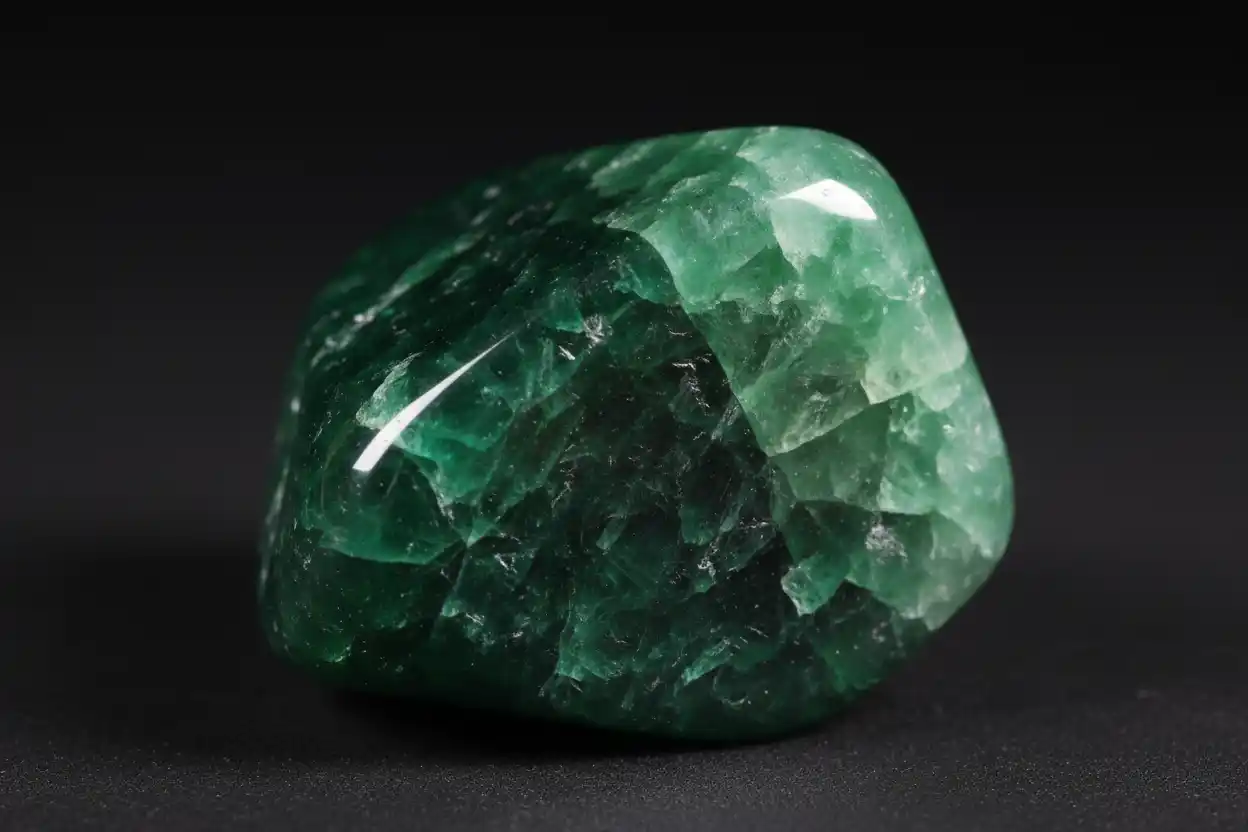
Jadeite Meaning: Properties, Uses & Symbolism
Jadeite meaning begins with material identity. Jadeite is a sodium-aluminum silicate mineral in the pyroxene group, with the ideal composition NaAlSi₂O₆. Gem-quality jadeite commonly occurs not as a single transparent crystal but as a tough, fine-grained metamorphic rock made of tightly interlocking mineral grains. It is one of the principal materials recognized as jade, alongside nephrite and, under certain gemological conditions, green omphacite. GIA gives jadeite jade a typical refractive-index range around 1.666–1.680, specific gravity around 3.34, and Mohs hardness of approximately 6.5–7.
This physical identity has to be separated from the cultural meanings attached to the material. Jadeite has an important history in Mesoamerica and later became highly prized within Chinese jade culture, but earlier Chinese jade traditions were dominated by nephrite. Modern symbolism frequently associates jadeite with prosperity, harmony, purity, protection, success, or emotional balance. Those interpretations can have cultural or personal meaning, yet they are not scientifically demonstrated effects of sodium, aluminum, silicon, trace elements, color, or crystal structure.
A material-first reading keeps those layers clear: mineralogy explains what jadeite is; archaeology and documented cultural history explain how people used and interpreted it; modern metaphysical practice explains contemporary beliefs. The wider Gemstone Guides category contains other mineral-focused references built around the same distinction.
Jadeite at a Glance
| Feature | Evidence-based description |
|---|---|
| Mineral | Jadeite |
| Mineral group | Pyroxene |
| Ideal formula | NaAlSi₂O₆ |
| Crystal system | Monoclinic |
| Gem material | Usually a fine-grained aggregate called jadeite jade rather than one large transparent crystal |
| Common colors | Green, white, lavender, yellow, orange, reddish orange, brown, gray and black |
| Most famous fine color | Vivid, highly translucent green commonly described commercially as Imperial jade |
| Typical refractive index | Approximately 1.666–1.680 |
| Typical specific gravity | Approximately 3.34 |
| Mohs hardness | Approximately 6.5–7 |
| Toughness | Exceptional because of the interlocking aggregate structure |
| Geological setting | High-pressure, relatively low-temperature subduction-zone environments |
| Important color causes | Chromium can produce vivid green; iron can contribute to other greens; manganese is important in lavender jadeite |
| Common commercial concerns | Dyeing, acid bleaching, polymer impregnation, waxing and other treatments |
| Ancient universal meaning? | No; meanings vary by culture, period and object |
| Proven medical effects? | None established from holding or wearing jadeite |
| Safe ownership | Ordinary intact handling is generally straightforward; treatment, damage and processing conditions require separate consideration |
What Jadeite Actually Is
Strictly speaking, jadeite is a mineral species. Jadeite jade is the ornamental or gem material in which jadeite forms a compact interlocking aggregate, often with other pyroxenes or accessory minerals present. GIA emphasizes that jade materials are metamorphic rocks composed of tiny interlocking crystals, a structure that explains why jadeite can withstand considerable impact despite having only moderate hardness compared with sapphire or diamond.
That distinction matters because commercial language often uses “jadeite” as though every object were chemically pure NaAlSi₂O₆. Natural jadeite rocks can contain omphacite, kosmochlor, albite, amphiboles and other associated phases. Some green omphacite can overlap jadeite closely enough in standard gemological properties that GIA notes Raman spectroscopy may be required for confident separation.
Jadeite should also not be confused with nephrite simply because both are called jade. Nephrite is principally a tightly intergrown amphibole material in the tremolite-actinolite series and has different refractive index, density, hardness and microstructure. The visual similarity between the two is a historical reason the distinction took time to establish scientifically.
Jadeite Identity Table
| Property | Jadeite evidence | What it means in practice |
|---|---|---|
| Mineral group | Pyroxene | Different mineral family from nephrite |
| Ideal chemistry | NaAlSi₂O₆ | Sodium-aluminum silicate composition |
| Structure in jade | Interlocking granular aggregate | Contributes to exceptional toughness |
| Refractive index | About 1.666–1.680 | Useful gemological evidence when measured correctly |
| Specific gravity | About 3.34 | Typically higher than nephrite |
| Mohs hardness | 6.5–7 | Reasonably scratch resistant, but not unscratchable |
| Transparency | Opaque to semi-transparent | High translucency can be commercially important |
| Texture | Fine, medium or coarse | Fine texture can improve visual quality |
| Green color | Often related to chromium and/or iron | Color chemistry varies with material |
| Lavender color | Manganese is an important chromophore | Not simply a diluted version of green jadeite |
| Treatment risk | Dye, bleaching and impregnation occur | Appearance alone cannot always prove natural color or untreated status |
| Laboratory distinction | Spectroscopy and other testing may be necessary | Particularly relevant for treated material or jadeite-omphacite overlap |
GIA lists jadeite’s principal gemological constants and stresses that color, transparency and texture dominate visual quality assessment. Its fine-grained aggregate nature also means that one number alone rarely settles every identification question.
How Jadeite Forms
Jadeite forms under geological conditions very different from those responsible for ordinary quartz, feldspar or shallow volcanic gems. It is strongly associated with ancient subduction zones, where oceanic crust is carried deep beneath another tectonic plate. GIA describes jadeite as a high-pressure mineral produced under relatively low-temperature conditions within serpentinite-rich mélanges associated with subduction. Some studied jadeite bodies record formation at depths on the order of tens of kilometres beneath Earth’s surface.
Fluid movement is central to the current geological model. Water-rich fluids moving through deeply subducted and altered rocks can transport sodium, aluminum, silicon and other components, allowing jadeite-rich veins, pods or masses to crystallize within suitable high-pressure environments. The material later has to be exhumed tectonically to reach the surface, which helps explain why gem jadeite deposits are geographically restricted rather than common wherever its constituent elements occur.
Japan provides a well-studied example. GIA research on Itoigawa jadeite places the material within high-pressure, low-temperature metamorphic belts associated with ancient subduction, while Guatemalan jadeite occurs in serpentinite bodies along the Motagua fault system and is likewise linked to fluid-mediated crystallization and metasomatism.
The detailed relationships among serpentinite, fluid chemistry, pressure-temperature conditions, associated minerals and locality differences belong in the dedicated jadeite formation and deposit geology reference rather than being compressed into a single origin story here.
Why Jadeite Can Be Green, Lavender, White, Orange or Black
Jadeite is famous for green, but natural material occurs across a much broader palette. GIA documents jadeite in many greens as well as white, lavender, yellow, reddish orange, brown, gray and black. Color can be distributed uniformly, mottled, veined or concentrated in zones, giving carvers opportunities to incorporate natural patterns into the finished object.
Vivid fine green jadeite is strongly associated with chromium. Modern spectroscopic work shows Cr³⁺ absorption features characteristic of chromium-colored green jadeite, while iron can produce less vivid green coloration in other material. The relationship is not simply “chromium equals all green jadeite”; different deposits and specimens can contain varying mixtures of chromium, iron and additional trace elements.
Lavender jadeite has a different color mechanism. GIA research using spectroscopy and trace-element analysis confirmed manganese as a principal contributor to lavender coloration, while titanium-iron interactions can also influence some violet or bluish material depending on composition.
White jadeite is not necessarily chemically “colorless crystal” in the visual sense. Its polycrystalline aggregate structure, grain boundaries, microscopic inclusions, pores and scattering can produce a milky or white appearance. Dark green or nearly black material can result from stronger absorption and different mineral chemistry or mixtures.
This distinction between measurable color causes and human color symbolism is important. The broader jade tradition is discussed in jade color meaning, while jasper color meaning shows why a different aggregate gemstone requires a different explanation of pigments, mineral inclusions and symbolism rather than reusing jadeite’s color model.
For jadeite specifically, more detailed discussion of absorption, translucency, aggregate scattering and pleochroism limits belongs in jadeite optical properties and color behavior.
Diagnostic Traits: What Can Actually Support Jadeite Identification
Appearance provides clues, but high-confidence jadeite identification depends on a combination of physical and analytical evidence. Fine jadeite may appear smooth, compact, highly polished and semi-transparent, but serpentine, quartz varieties, glass, dyed materials, nephrite and other green stones can imitate aspects of that appearance. Trade names add further confusion because the word “jade” has historically been applied to unrelated ornamental materials. GIA describes jade as one of the gemstone names frequently surrounded by simulants and terminology problems.
A spot refractive-index measurement around the jadeite range can be useful on suitable polished surfaces. Specific gravity near 3.34 provides another line of evidence. Under magnification, jadeite jade commonly shows an interlocking granular texture rather than nephrite’s more fibrous felted structure. Older GIA comparative work illustrates this distinction clearly: jadeite grains appear as intergrown discrete granular crystals, whereas nephrite exhibits more rope-like fibrous intergrowth.
Those observations still have limits. Omphacite-rich jade can overlap jadeite in ordinary visual and gemological properties. Treatment can change surface appearance and apparent transparency. Mounted jewelry may prevent reliable density measurements, while curvature may limit refractometer readings. When ordinary tests conflict, Raman spectroscopy, infrared spectroscopy, UV-Vis-NIR spectroscopy or other laboratory techniques can provide the stronger evidence needed.
Microscopic features, treatment clues and aggregate textures are explored separately in the jadeite microscope inclusion notebook.
Original Jadeite Name and Claim Audit
Jadeite terminology is unusually prone to commercial drift. The table below separates labels that have mineralogical meaning from labels that require qualification.
| Name or claim | What the evidence supports | What the label does not prove |
|---|---|---|
| Jadeite | A specific pyroxene mineral | Gem quality, treatment status, origin or value |
| Jadeite jade | Jade material dominated by jadeite or fitting accepted jadeite-jade usage | That the object is chemically pure jadeite |
| Jade | A broader material name | That the material must be jadeite |
| Nephrite | A different jade material based on amphibole minerals | A lower-quality form of jadeite |
| Green omphacite jade | Certain qualifying pyroxene jade material | Jadeite identity without compositional testing |
| Fei Cui | Trade/cultural terminology used for jadeite and related pyroxene jade materials in some markets | Pure jadeite composition in every use |
| Imperial jade | High-end commercial description for exceptional vivid translucent green jadeite | A separate mineral species or standardized laboratory grade |
| A jade | Treatment terminology for jadeite considered natural or traditionally wax-polished | Top color, transparency or value |
| B jade | Jadeite altered through acid bleaching and polymer impregnation | A naturally improved grade |
| C jade | Jadeite with added color in the common treatment terminology | Natural body color |
| Burmese jadeite | Origin claim relating material to Myanmar | Verified geographic origin without supporting evidence |
| “New jade” | Commercial trade name used inconsistently | Genuine jadeite |
| “Healing jadeite” | Symbolic or marketing wording | Medical efficacy or a special mineral variety |
| “High-vibration jadeite” | Metaphysical terminology | A measurable mineralogical property |
| “Untreated because it feels cold” | Unsupported home-test claim | Reliable treatment determination |
This table is not a grading system. It is a claim filter: each term should be read according to what evidence it can actually support.
Original Specimen and Photo Checklist
A useful jadeite record preserves observations before assumptions are made. The following checklist can be applied to a specimen, carving, cabochon or well-documented listing.
| Observation | What to record | Why it matters |
|---|---|---|
| Overall color | Hue, tone, saturation and distribution | Provides a neutral baseline instead of a seller adjective |
| Lighting | Daylight-balanced, incandescent, fluorescent or unknown | Jadeite color can appear different under different illumination |
| Transparency | Opaque, translucent, semi-transparent | Major visual-quality characteristic |
| Thickness | Measured thickness through viewed area | Thin pieces can appear more transparent than thick ones |
| Texture | Fine, medium, coarse, granular appearance | Important jadeite quality and identification clue |
| Surface | Waxy, vitreous, greasy, dull, polished | Can be affected by polishing or surface treatment |
| Fissures | Number, position and whether color follows them | Relevant to durability and possible dye concentration |
| Color zoning | Diffuse, granular, patchy, vein-like or fracture-controlled | Helps distinguish natural heterogeneity from suspicious alteration |
| Weight | Actual measured weight | Useful with dimensions and density testing |
| Dimensions | Length, width and thickness | Prevents photographic scale distortion |
| UV response | Wavelength and reaction if examined | Supporting evidence only, never proof alone |
| Microscopy | Grain boundaries, inclusions, fillings, surface residues | Can support identity or treatment assessment |
| Treatment statement | Lab-confirmed, seller-stated or unknown | Keeps evidence levels separate |
| Origin statement | Lab-supported, documented provenance, seller-stated or unknown | Prevents locality claims from becoming assumed facts |
| Image processing | White balance, saturation, contrast and backlighting | Essential when evaluating online color |
| Laboratory evidence | Exact result and laboratory name | Stronger than simply saying an item is “certified” |
The checklist deliberately avoids an “authenticity score.” Ten weak visual clues do not become equivalent to one decisive analytical result merely because they can be counted.
Treatment Context Without Turning This Into a Treatment Guide
Jadeite is frequently treated, which means any responsible meaning reference has to acknowledge treatment without duplicating an entire enhancement article. Acid bleaching followed by polymer impregnation is a well-established process used to remove brownish material and improve apparent clarity or color. GIA describes the resulting product as B jade in common trade terminology and notes that infrared spectroscopy is particularly important for detecting polymer impregnation reliably.
Dyeing also occurs, and spectroscopy can separate some natural green absorption patterns from artificial color. GIA’s UV-Vis-NIR research shows characteristic differences between chromium- or iron-colored jadeite and dyed green material.
The important meaning-page boundary is that treatment does not create a new spiritual category. A dyed green jadeite is not scientifically more “prosperous,” and an untreated jadeite is not medically stronger. Treatment status affects disclosure, identification, durability considerations and commercial interpretation—not demonstrated metaphysical potency.
Documented History: Jadeite Before the Modern Mineral Name
Jadeite was used by people long before mineralogists gave it a formal species name. In Mesoamerica, jadeite and related jade materials were used by Maya and other cultures for ornaments, ritual objects and prestige goods. GIA records jadeite’s significance among Maya and Aztec cultures, while archaeological research shows that jadeite working in Central America extends deep into pre-Columbian history.
The Chinese history needs more careful wording because “jade” in early Chinese culture largely meant nephrite rather than jadeite. GIA notes that jade traditions in China extend for thousands of years, while significant jadeite imports from Myanmar became established much later. Its history review places major jadeite arrival in China in the late eighteenth century, after which Qing-period carvers turned highly saturated green material into an important artistic and luxury medium.
Other historical accounts debate exactly how early Myanmar jadeite reached China. GIA research notes that some traditions place occasional material earlier, while an established trade route and large-scale prominence are much clearer in the later period. The safest historical statement is therefore that nephrite dominated China’s ancient jade tradition and Myanmar jadeite became commercially and culturally prominent considerably later.
When Jadeite Became a Distinct Mineral Species
The modern scientific distinction between jadeite and nephrite was established in the nineteenth century. French mineralogist Alexis Damour analyzed bright green jade and demonstrated that it differed chemically and structurally from the amphibole material then commonly recognized as jade. In 1863 he named the distinct pyroxene mineral jadeite. GIA’s historical review of jade nomenclature specifically credits Damour’s analysis with establishing jadeite as separate from nephrite.
This episode illustrates why traditional material names and mineralogical species do not always align neatly. People can recognize, carve and value a material for centuries before chemistry and crystallography provide a modern scientific classification.
Cultural Meaning: What Jadeite Has Represented
Jadeite’s cultural symbolism overlaps with the broader history of jade but should not simply inherit every belief ever associated with nephrite. In China, jade broadly became associated with virtue, refinement, heaven, moral qualities, prosperity, social rank and auspicious motifs. GIA records motifs such as the dragon for power, prosperity and goodness, the butterfly for long life and the bi disc in association with heaven.
When jadeite entered Chinese elite culture, it entered an existing symbolic vocabulary rather than creating an entirely new one from scratch. Brilliant green jadeite could therefore carry established jade associations while developing its own strong connection with luxury, status and Qing-period taste.
Mesoamerican traditions developed independently. Jadeite objects could signify rank, sacred significance, life, fertility, rulership or ritual importance depending on culture and context. Those meanings should be treated historically rather than collapsed into a universal sentence such as “jadeite has always meant abundance everywhere.”
Jadeite Meaning in Modern Symbolism
Modern crystal traditions frequently associate jadeite with harmony, prosperity, emotional balance, good fortune, protection, wisdom, confidence and personal growth. These associations can be meaningful as symbolic prompts. Someone may wear a jadeite object because it represents family continuity, financial discipline, patience, cultural heritage or a personally chosen goal.
Those uses become misleading when symbolism is presented as a measurable physical mechanism. No established gemological evidence shows that jadeite changes hormone levels, treats cardiovascular disease, reduces anxiety or depression, cures pain, improves fertility, strengthens immunity, treats neurological conditions, detoxifies the body or corrects sleep disorders.
The same principle applies to financial and behavioral claims. Jadeite cannot scientifically guarantee wealth, attract a particular romantic partner, force reconciliation, alter another person’s decisions or make manifestation certain.
Other meaning references illustrate why symbolism must stay material-specific. Jasper meaning concerns a silica-rich aggregate with a very different human history, while Jadarite meaning addresses a recently recognized lithium-boron mineral for which claims of ancient tradition would be historically implausible. Similar symbolic vocabulary across crystal websites is therefore not evidence that the underlying minerals possess the same effects.
The Symbolism Boundary
Three evidence categories should remain distinct.
A measurable statement can describe jadeite’s chemistry, refractive index, density, mineral associations, hardness, color-causing elements, texture or treatment response. These are questions for mineralogy and gemology.
A historical statement can document that a culture carved jadeite, buried it with the dead, used it as a prestige object or interpreted jade imagery symbolically. Such evidence tells us what people did and believed within a particular historical setting.
A modern symbolic statement can describe how contemporary individuals or crystal communities interpret jadeite. It can explain a belief without proving that the belief reflects a causal physical property of the mineral.
Confusing those layers is how phrases such as “chromium makes green jadeite prosperous” or “lithium-free jadeite balances the heart” emerge. Neither statement follows from mineral science.
Jadeite Uses
Jadeite’s exceptional toughness allows it to be worked into cabochons, bangles, beads, rings, pendants, earrings, plaques, vessels, sculptures and intricate carvings. Its value as a carving material comes partly from the combination of toughness, fine texture, variable translucency and color zoning. Skilled lapidaries can orient areas of contrasting green, white, lavender or orange to become deliberate parts of a design. GIA notes that artistry is an important evaluation factor because jade is commonly carved rather than faceted in the conventional transparent-gem manner.
Cutting decisions require more than preserving weight. Grain texture, fissures, color distribution, transparency and shape of the rough can determine whether a piece becomes a cabochon, bead, bangle or carving. Those practical decisions are addressed in jadeite cutting, orientation, and polish.
Jewelry design creates another set of considerations. Jadeite is tough, but thin sections, drill holes, hidden fissures, repaired areas and treatment can change how safely a piece handles impact or mounting stress. Those construction questions belong in jadeite setting and wear engineering rather than being reduced to a blanket claim that jadeite is indestructible.
Jadeite Is Tough, but Tough Does Not Mean Invulnerable
Jadeite’s Mohs hardness of approximately 6.5–7 provides useful scratch resistance, yet its most remarkable durability characteristic is toughness. The tightly interlocking grains make the aggregate highly resistant to chipping and breaking compared with many other gem materials. GIA specifically describes both major jade materials as exceptionally tough.
That reputation can lead to overconfidence. Polished jadeite can still scratch against harder materials. Thin carved edges can chip. Strong heat from jewelry repair can damage jade. Existing fractures or treatment can introduce additional weakness. A polymer-impregnated object also should not be treated as if it had exactly the same thermal and chemical stability as untreated material.
Durability should therefore be assessed at the object level, not inferred from the word jadeite alone.
Safe Ownership and Handling
Ordinary intact handling of jadeite jewelry, carvings and mineral specimens is generally different from cutting or grinding the material. A finished cabochon does not expose its owner to the same conditions as a lapidary workshop where rock is sawed, drilled, sanded or polished and fine mineral dust can be generated.
Do not intentionally grind jadeite into powder for ingestion, place powdered material into food, or use jadeite in drinking water to create supposed mineral elixirs. Sodium, aluminum, silicon and trace elements being present in a mineral do not establish medical bioavailability, useful dosage or safety as a supplement.
For ordinary cleaning, GIA identifies warm soapy water as a conservative option for jade because treatment histories vary. It notes that untreated jade can tolerate some professional cleaning methods, but dyeing, bleaching, impregnation, coatings and heat treatment make universal aggressive-cleaning advice inappropriate.
Collector specimens introduce concerns different from jewelry. Labels, old adhesives, associated minerals, weathered surfaces and provenance records can be as important as the jadeite itself. Long-term documentation and preservation considerations are addressed in the jadeite specimen conservation record.
What a Photograph Can and Cannot Prove
A photograph can document color, approximate texture, carving style, surface condition and visible fissures, but it cannot reliably prove jadeite identity, natural color, polymer status or geographic origin. Green saturation can change with white balance, exposure and selective editing. Backlighting can make a thin translucent area look dramatically more transparent than it appears under ordinary viewing conditions.
A strong listing therefore benefits from neutral-light images, dimensions, weight, multiple angles, treatment disclosure and laboratory documentation when the price justifies it. Photographs should be treated as observation records rather than certificates.
The original checklist above is especially useful for comparing listings because it keeps evidence levels visible: “seller states Myanmar origin” is not silently converted into “Myanmar origin confirmed,” and “appears untreated” is not transformed into “laboratory-confirmed A jade.”
When Laboratory or Specialist Review Matters
A qualified gemological laboratory becomes particularly useful when jadeite identity changes the commercial stakes, when treatment status is uncertain, when a seller charges a significant premium for natural color or origin, or when jadeite and omphacite cannot be separated confidently with routine observations. GIA’s jade reporting framework can provide jade type information, and advanced spectroscopy can address questions beyond simple visual examination.
This article does not claim that Gems Lore performed private laboratory testing on the specimens discussed, commissioned unpublished measurements or had an unnamed specialist personally authenticate an individual stone. Technical statements are grounded in published gemological and mineralogical evidence. A specimen-specific identification, treatment conclusion, conservation decision or high-value appraisal should be reviewed by an appropriately qualified gemologist, mineralogist, conservator or laboratory as the question requires.
For general information about the publication itself, the site’s scope is described on About and its educational limits are set out in the Disclaimer. General communication is available through Contact, while the Privacy Policy explains the site’s data-handling practices.
Common Jadeite Misunderstandings
One common error is assuming jadeite and jade are synonyms. Jadeite is jade, but jade can also refer to nephrite and certain omphacite material. A second is assuming that all bright green jadeite is naturally colored. Dyeing occurs, and treatment detection may require laboratory methods. A third is assuming that A jade means the highest quality; the letter primarily addresses treatment status rather than color, transparency or texture.
A fourth misunderstanding treats the phrase Imperial jade as a mineral species. It is a commercial description associated with exceptional vivid green, highly translucent jadeite—not a separate species with a different chemical formula.
A fifth mistake is projecting the entire ancient history of Chinese jade directly onto jadeite. Nephrite dominated Chinese jade culture for millennia before large-scale jadeite imports from Myanmar became important. Jadeite later acquired extraordinary cultural and commercial status, but historical precision matters.
A sixth is assuming cultural symbolism proves medical function. Historical use documents human belief and practice; it does not demonstrate that wearing jadeite treats disease.
Frequently Asked Questions
What is jadeite?
Jadeite is a sodium-aluminum silicate mineral in the pyroxene group with the ideal formula NaAlSi₂O₆. Gem jadeite usually occurs as an interlocking metamorphic aggregate rather than as a single large transparent crystal.
Is jadeite the same as jade?
Jadeite is one type of jade, but jade is broader. Modern gemology applies the term jade principally to jadeite and nephrite and, under certain circumstances, green omphacite.
What color is jadeite naturally?
Natural jadeite can be green, white, lavender, yellow, orange, reddish orange, brown, gray or black. Green is its most famous high-value color, but color alone cannot establish jadeite identity or untreated status.
What makes jadeite green?
Chromium can produce the vivid green associated with fine jadeite, while iron can contribute to other green coloration. Spectroscopic evidence can help distinguish natural chromophores from artificial dyes.
What makes lavender jadeite purple?
Research has confirmed manganese as an important cause of lavender jadeite coloration, with titanium-iron interactions contributing in some materials.
How does jadeite form?
Jadeite is associated with high-pressure, relatively low-temperature metamorphic conditions in subduction zones. Fluid-rock interactions within serpentinite-rich geological environments play an important role in forming jadeite-rich bodies.
Is jadeite very hard?
Jadeite is approximately 6.5–7 on the Mohs scale. That is moderate-to-good scratch resistance, but its exceptional reputation for durability comes primarily from toughness created by tightly interlocking grains.
Is jadeite always untreated?
No. Jadeite can be dyed, acid bleached, polymer impregnated, waxed or otherwise altered. B jade commonly refers to acid-bleached and polymer-impregnated jadeite, while C jade refers to dyed material in common trade terminology.
Does A jade mean top-quality jadeite?
No. A jade refers mainly to treatment status—natural jadeite or material that has received only traditional waxing in the common classification. Color, transparency, texture, fissures and workmanship still determine quality separately.
What does jadeite symbolize?
Historically and culturally, jadeite can participate in broader jade associations involving prosperity, virtue, status, protection, auspiciousness and refinement, particularly in Chinese traditions after jadeite became important there. Modern users may add personal meanings such as balance or growth. These are cultural or symbolic interpretations rather than measurable mineral effects.
Does jadeite have scientifically proven healing properties?
No established evidence shows that holding or wearing jadeite treats medical or psychological disorders. Historical healing beliefs can be documented as cultural history without treating them as clinical proof.
Was jadeite used in ancient China?
Ancient Chinese jade culture was primarily based on nephrite. Jadeite became much more important after material from Myanmar entered China and developed a major role in later jade carving and luxury culture.
Was jadeite used in ancient Mesoamerica?
Yes. Jadeite and related jade materials were important in pre-Columbian Mesoamerica for ornaments, prestige objects and ritual uses. That history developed independently from Chinese jade traditions.
When did mineralogists distinguish jadeite from nephrite?
Alexis Damour demonstrated that the two were mineralogically different and named jadeite as a distinct mineral in 1863.
Can I identify jadeite from a photograph?
Not with high certainty in every case. Photographs can provide useful visual clues, but jadeite can overlap with nephrite, omphacite, simulants and treated materials. Refractive index, density, microscopy, spectroscopy or laboratory testing may be required.
Is jadeite safe to wear?
Ordinary intact jadeite jewelry can be worn normally when the construction and condition are appropriate. Treatment, fractures, thin carving sections and mounting design can change practical durability, so specimen-specific wear questions should be evaluated rather than relying only on jadeite’s reputation for toughness.