Jadarite Meaning: Properties, Uses & Symbolism
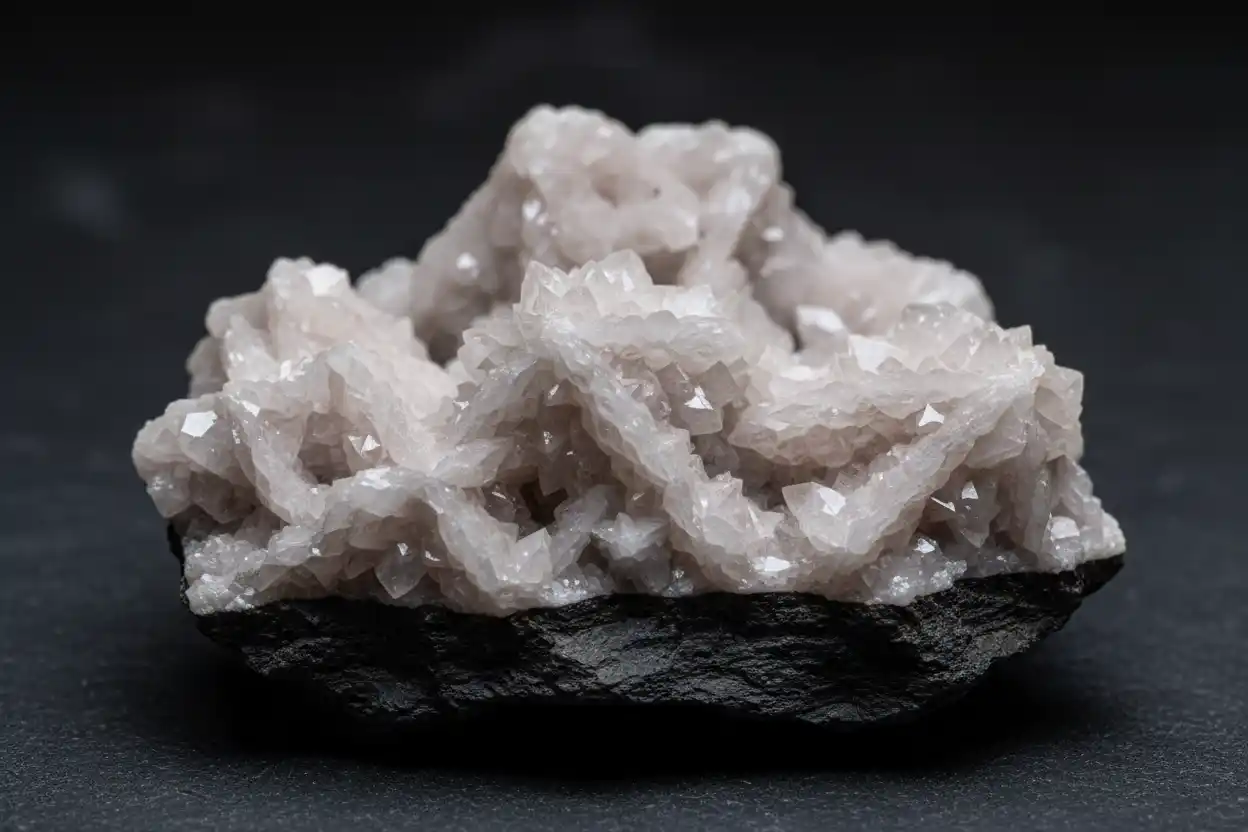
Jadarite meaning begins with an unusual fact: jadarite is not the transparent green fantasy crystal sometimes implied by its popular “kryptonite” association, nor is it a conventional faceted gemstone. It is a real lithium-sodium borosilicate hydroxide mineral with the ideal formula LiNaSiB₃O₇(OH). The original mineral description records it as white, translucent to opaque in aggregate, brittle, relatively soft at Mohs 4–5, and composed of microscopic grains that commonly form massive material rather than attractive macroscopic crystals. Its measured density is about 2.45 g/cm³, and its aggregates have a porcellanous appearance.
The mineral is exceptionally geographically restricted. The Natural History Museum identifies the Jadar Basin in western Serbia as jadarite’s type locality and, based on documented occurrences, its only recorded natural locality. There it occurs in a buried sedimentary lithium-boron deposit associated with an ancient lake system. Current research links its formation to an unusually specific combination of alkaline conditions, volcanic inputs, sedimentary processes, and the availability of lithium, boron, sodium, and silica. Researchers continue to investigate the exact sequence of processes, so simplified claims that jadarite forms through one universally established mechanism go beyond the evidence.
Modern symbolic descriptions of jadarite appeared only after the mineral entered scientific and public awareness. There is therefore no documented ancient jadarite healing tradition comparable to cultural traditions surrounding long-known materials such as jade. Ideas about transformation, discovery, hidden potential, resilience, or technological change may be meaningful as modern metaphors, but they should not be confused with measurable mineral properties. This material-first distinction is the basis of Gems Lore’s broader Gemstone Guides approach.
Jadarite at a Glance
| Feature | Evidence-based description |
|---|---|
| Mineral name | Jadarite |
| Ideal formula | LiNaSiB₃O₇(OH) |
| Mineral type | Lithium-sodium borosilicate hydroxide |
| Crystal system | Monoclinic |
| Typical appearance | White, fine-grained to massive |
| Individual grain size | Commonly microscopic; original description reports grains only several micrometres across |
| Lustre | Porcellanous in aggregate |
| Streak | White |
| Transparency | Translucent in smaller material to opaque in masses |
| Mohs hardness | Approximately 4–5 |
| Tenacity | Brittle |
| Fracture | Uneven to conchoidal |
| Measured density | About 2.45 g/cm³ |
| Pleochroism | None reported |
| UV response | Weak pink-orange fluorescence reported under short- and long-wave ultraviolet radiation |
| Type locality | Jadar Basin, western Serbia |
| Main practical significance | Scientific interest and lithium-boron resource mineral |
| Conventional faceted gemstone? | No |
| Ancient metaphysical tradition? | No documented tradition specific to jadarite |
| Medical properties established? | No |
The original type description provides most of the diagnostic physical values in this table. Its authors documented massive white aggregates, microscopic tabular-to-anhedral grains, brittle behavior, Mohs hardness of 4–5, white streak, density around 2.45 g/cm³, non-pleochroic optical behavior, and weak pink-orange fluorescence.
What Jadarite Actually Is
Jadarite is a distinct mineral species, not a variety of quartz, jade, spodumene, borax, or another familiar lithium mineral. Chemically, its structure incorporates lithium, sodium, silicon, boron, oxygen, and hydroxyl. That composition is important to mineralogy and resource geology, but the presence of lithium or boron does not make jadarite a nutritional source, medicine, supplement, mood treatment, or safe material for ingestion.
The material’s appearance is also very different from the mental image created by many crystal-market photographs. Natural jadarite occurs principally as extremely fine-grained aggregates. The original description reports individual crystallites only about 5–10 micrometres in size and notes that massive white material can occur through substantial sections of drill core. Under polished microscopic examination, the aggregates can have a porous or pitted appearance because they are composed of many minute crystals rather than one large gem crystal.
That microscopic structure is important when evaluating supposed loose “jadarite crystals” sold online. A transparent centimetre-scale faceted stone, vivid green crystal point, glassy polished tower, or large perfectly formed crystal should not be accepted as jadarite solely because a seller uses the name. More detailed microstructural observations belong in the Jadarite microscope inclusion notebook.
Identity Table: Claims Versus Mineralogical Evidence
| Claim | Evidence assessment |
|---|---|
| “Jadarite is a lithium mineral.” | Supported. Lithium is part of its ideal chemical formula. |
| “Jadarite is a boron-bearing mineral.” | Supported. Boron is structurally incorporated into the mineral. |
| “Jadarite is naturally green like kryptonite.” | Not supported by the type description; natural jadarite is documented as white. |
| “Jadarite forms large gem crystals.” | Not characteristic of documented natural material; individual grains are typically microscopic. |
| “Jadarite is a gemstone comparable to emerald.” | Misleading. Natural material is generally fine-grained, massive, and unsuitable for conventional transparent faceting. |
| “Jadarite contains lithium, so wearing it provides lithium.” | Unsupported and biologically inappropriate reasoning. Mineral chemistry does not make an element therapeutically available through skin contact. |
| “Jadarite has ancient spiritual traditions.” | Unsupported. It is a recently recognized mineral species. |
| “Jadarite cures emotional or physical illness.” | Unsupported. No established mineralogical evidence demonstrates such medical effects. |
| “Jadarite and fictional kryptonite are chemically identical.” | False. Their popular comparison comes from a coincidental similarity in a fictional chemical description, not identity. |
| “Jadarite is found throughout the world.” | Not supported by currently documented mineral occurrences; the Jadar Basin remains its recorded natural locality. |
This table is deliberately stricter than ordinary commercial descriptions. A claim is not upgraded merely because it appears repeatedly in shops, blogs, social media posts, or crystal databases. Mineral identity requires evidence that can be tied to chemical composition, crystallography, physical properties, geological occurrence, or reliable analytical work.
How Jadarite Forms
Jadarite occurs within the sedimentary succession of the Jadar Basin, where lithium- and boron-bearing mineralization developed in an ancient continental lake environment. The deposit includes sedimentary rocks, evaporitic components, volcanic-derived material, and several associated minerals. The original mineral description records jadarite with calcite, dolomite, potassium feldspar, rutile, albite, ilmenite, pyrite, muscovite and, in some samples, searlesite, analcime, chlorite, and quartz.
More recent mineralogical work proposes that high-pH lake chemistry played an important part. Jadarite appears to have formed in association with alkaline conditions in which lithium, boron, sodium, and silica could become concentrated and incorporated into unusual borosilicate minerals. Research has linked it particularly with searlesite and sodium-bearing zeolites. Experimental synthesis work has successfully produced jadarite-like material under controlled hydrous alkaline conditions, helping researchers test formation hypotheses without claiming that the laboratory procedure duplicates every geological step that occurred naturally.
The Natural History Museum describes the deposit as unusually difficult to reproduce geologically: several ingredients and environmental conditions appear to have had to coincide. That may help explain why comparable sedimentary basins do not routinely contain jadarite. The dedicated Jadarite formation and deposit geology reference examines that geological problem in greater depth rather than reducing the mineral’s origin to a single formation slogan.
Why Jadarite Is White
The safest answer is more restrained than many crystal descriptions suggest. Published mineralogical descriptions establish that natural jadarite is white, but the primary type description does not justify assigning that appearance to a dramatic trace-element chromophore. Its aggregates are composed of extremely small crystallites, contain some porosity, and produce a porcelain-like white appearance at hand-specimen scale.
In other words, jadarite should not be described as a naturally vivid green, purple, blue, or rainbow mineral merely because such colors make attractive commercial photographs. Color can be altered by host material, associated minerals, surface staining, lighting, camera processing, or treatment. A photograph of a colored object labelled “jadarite” therefore needs supporting identification evidence.
The mineral does show another color-related phenomenon: the type material produced weak pink-orange fluorescence under both short-wave and long-wave ultraviolet radiation. Fluorescence is not the same as ordinary body color, however, and the presence or absence of a visible UV response should not be used as a stand-alone identification test.
The more technical optical measurements and limits of fluorescence as an identification clue belong in Jadarite optical properties and color behavior. Different minerals acquire color through entirely different mechanisms; for contrast, Jade color meaning deals with a material family in which color, mineral identity, treatment, and cultural interpretation require a separate evidence framework.
Diagnostic Traits of Jadarite
The strongest preliminary clue is the combination of context rather than any single visual feature. Authentic jadarite is associated with the Jadar Basin, typically occurs as white massive or nodular fine-grained material, has a porcellanous appearance, gives a white streak, is brittle, and has a relatively modest hardness of 4–5. Its microscopic crystals may be tabular, elongate, subhedral, or anhedral.
These characteristics are not individually unique. Many white minerals are brittle. Numerous mineral aggregates have similar hardness. A porcelain-like surface can occur in other fine-grained materials. Even a supposed Serbian locality is not chemical proof. High-confidence identification therefore depends on analytical consistency rather than a checklist score alone.
The original characterization of jadarite incorporated chemical analysis, infrared spectroscopy, optical measurements, density determination, and X-ray diffraction. Those methods collectively supported recognition of a new mineral species. Modern laboratory work can likewise use appropriate mineralogical techniques when an unknown white aggregate must be distinguished from associated borates, carbonates, silicates, or manufactured substitutes.
A home scratch test should not be treated as definitive identification. Deliberately damaging a specimen only establishes a limited hardness relationship and can destroy surfaces needed for later study. Likewise, burning, acid testing, crushing, heating, or tasting an unknown mineral is inappropriate.
Original Specimen and Photo Verification Checklist
Because authentic jadarite does not have the visually obvious crystal habit many buyers expect, documentation is especially important. This checklist separates observable evidence from assumptions.
| Check | What to document | What the observation can establish |
|---|---|---|
| Overall appearance | Neutral-light photograph of complete specimen | Whether material is consistent with documented white/off-white massive jadarite |
| Scale | Millimetre ruler or verified specimen dimensions | Prevents microscopic textures from being mistaken for large crystals |
| Texture | Macro photograph of broken and polished surfaces | Can reveal massive, porous, pitted, or extremely fine-grained character |
| Host material | Photograph boundaries between white mineral and matrix | Helps document geological rather than manufactured context |
| Grain size | Microscopic image if available | Authentic jadarite is documented as extremely fine grained |
| Streak | Existing documented observation rather than destructive repetition | Published jadarite streak is white |
| Hardness | Laboratory or responsible existing measurement | Published range is approximately Mohs 4–5 |
| Density | Proper measured value on suitable material | Published material is about 2.45 g/cm³ |
| UV response | Short-wave and long-wave images with wavelength recorded | Weak pink-orange fluorescence can support, but cannot prove, identification |
| Locality | Mine/core/sample documentation | Strong provenance evidence when records are traceable |
| Analytical report | XRD, spectroscopy, chemical data where available | Provides far stronger identity evidence than appearance |
| Seller terminology | Preserve screenshot or description | Allows later comparison between marketing claims and analytical evidence |
| Image processing | Record whether saturation or white balance was changed | Prevents edited photographs from becoming false color evidence |
The checklist intentionally avoids a numerical “authenticity score.” Mineral identification is not improved by awarding points to weak clues until they imitate laboratory certainty. A specimen with excellent provenance and analytical data can be compelling even if it lacks dramatic visual features, while a spectacular green crystal labelled “jadarite” can remain unverified despite persuasive marketing.
Documented Discovery and Naming History
Jadarite entered mineralogical science through exploration drill core from Serbia’s Jadar Basin. The newly encountered white material could not initially be matched satisfactorily with established mineral species, prompting detailed examination. Analytical work established a previously undescribed lithium-sodium borosilicate hydroxide, and the mineral and name were subsequently approved through the International Mineralogical Association’s new-mineral nomenclature process. The name honors the Jadar locality where the material was discovered.
The original description also documents formal reference material rather than relying solely on commercial specimens. Holotype material was deposited in the Natural History Museum in London, with parts of the type material also placed in the Canadian national mineral collection. That record is important because a formally recognized mineral species is anchored to studied reference material, analytical data, crystallography, and an approved name—not merely to a popular label.
The Natural History Museum continues to study the Jadar deposit because jadarite is scientifically unusual and potentially important as a lithium-boron resource mineral. Research focuses on why this mineral formed there, how lithium became concentrated in the lake basin, and why comparable geological settings have not produced documented jadarite elsewhere.
The “Kryptonite” Story: What Is True and What Is Not
Jadarite became widely known outside mineralogy because its chemical description happened to resemble a fictional description of kryptonite associated with Superman. The coincidence generated extensive popular attention because both descriptions involved combinations of sodium, lithium, boron, silicon, oxygen, and hydroxyl-related chemistry. The comparison is culturally interesting, but jadarite is not fictional kryptonite.
Most visibly, natural jadarite is white rather than glowing green. It does not exhibit supernatural radiation, remove fictional superpowers, or display the impossible properties attributed to kryptonite in stories. Even the chemistry is not literally identical to every fictional formula that has been used for kryptonite.
The responsible historical interpretation is therefore that the kryptonite comparison belongs to jadarite’s modern media history. It helped an otherwise obscure mineral attract public attention, but it adds nothing to its diagnostic mineralogical properties.
Source and Claim Audit: Where Jadarite Information Becomes Distorted
| Common statement | Evidence category | Better interpretation |
|---|---|---|
| “Rare Serbian lithium-boron mineral” | Strongly supported | Accurate when used for documented jadarite |
| “Only known from the Jadar Basin” | Supported by current museum/mineralogical records | State as the documented natural occurrence, while allowing future discoveries to change the record |
| “Real kryptonite” | Popular-culture shorthand | A chemistry-related media comparison, not literal identity |
| “Natural green crystal” | Contradicted by type description | Documented jadarite is white |
| “Powerful manifestation stone” | Modern belief claim | No mineralogical evidence of causal manifestation effects |
| “Lithium energy calms the mind” | Unsupported medical inference | Structural lithium in a mineral is not a psychiatric dose or transdermal medicine |
| “Ancient Serbian healing crystal” | Historically unsupported | Jadarite was only recognized scientifically in modern mineral exploration |
| “High-vibration crystal” | Non-measurable metaphysical terminology | May describe personal belief, not a defined physical property |
| “Extremely hard gem” | Incorrect | Published hardness is approximately Mohs 4–5 and the material is brittle |
| “Good transparent faceting material” | Inconsistent with documented material | Natural jadarite is typically microscopic-grained and massive |
| “UV glow proves authenticity” | Overstated | Weak pink-orange fluorescence is documented, but fluorescence alone cannot prove identity |
This audit is an original evidence framework rather than a list of phrases that should automatically be trusted or rejected. Its purpose is to ask what kind of evidence a statement would require and whether that evidence actually exists.
What Is Jadarite Used For?
Jadarite’s most significant documented use is not traditional gemstone jewelry. It is scientifically important as a unique mineral species and geologically important as a lithium- and boron-bearing mineral within the Jadar deposit. Researchers study it to understand sediment-hosted lithium systems, borosilicate mineral formation, and the geological conditions that can concentrate elements important to modern technology.
Mineral specimens also have educational and collection value because jadarite illustrates how new species are discovered and characterized. A seemingly unremarkable white aggregate can turn out to possess unusual chemistry and structure when examined analytically. That scientific narrative is arguably more distinctive than attempts to market the material as another colorful crystal.
Conventional lapidary use is constrained by its physical form and properties. Natural jadarite does not normally provide large transparent crystals suitable for ordinary faceting, and its brittle, relatively soft aggregates require realistic expectations. Any experimental lapidary discussion belongs in Jadarite cutting, orientation, and polish, while mounting and exposure questions belong in Jadarite setting and wear engineering.
Jadarite Meaning in Modern Symbolism
Jadarite has no evidence-backed ancient symbolic tradition of its own. Because the mineral became known only through modern exploration and mineralogical characterization, symbolic claims described as ancient, medieval, traditional healing lore, or centuries-old Serbian crystal practice require unusually strong documentation. Without such documentation, they should not be repeated as history.
Modern symbolism can still exist without pretending to be ancient. Jadarite’s discovery story lends itself naturally to themes such as hidden complexity, careful investigation, unexpected discovery, and the difference between surface appearance and underlying structure. Its extreme geographic restriction may inspire personal associations with uniqueness or place. Its role in lithium-resource research may lead some people to use it as a symbol of technological change or society’s changing material needs.
These are metaphors. They do not arise from a demonstrated energy emitted by the mineral, nor do they establish psychological, physiological, financial, or supernatural effects. A similar separation between mineral identity and later interpretation is important in Jadeite meaning and Iris Agate meaning, even though those materials have very different histories and properties.
Symbolism Boundary: What Jadarite Cannot Scientifically Promise
There is no established scientific evidence that holding or wearing jadarite treats anxiety, depression, sleep disorders, pain, neurological disease, hormonal conditions, cardiovascular problems, infertility, immune disorders, or other medical conditions. No reliable mineralogical evidence shows that it changes personality, guarantees motivation, attracts wealth, manifests a desired relationship, alters another person’s behavior, or predicts future events.
The presence of lithium is especially easy to misunderstand. Lithium atoms are part of jadarite’s crystal chemistry. That fact does not mean intact skin contact delivers a therapeutic lithium dose. It does not make the mineral interchangeable with prescribed lithium medications, dietary products, or medically controlled compounds. Elements identified in a mineral formula should never be assumed to function as nutrients or medicines merely because their names are familiar.
Personal symbolic use does not require those claims. Someone can keep a jadarite specimen as a reminder to investigate assumptions, appreciate geological rarity, or reflect on discovery. The distinction between personal interpretation and evidence-based health information is consistent with the limits stated in the site’s Disclaimer.
Durability and Safe Ownership
Published testing places jadarite at about 4–5 on the Mohs hardness scale. It is also described as brittle with uneven to conchoidal fracture. That combination means an exposed specimen can be scratched by harder minerals and chipped or fractured by impact. Hardness should not be confused with toughness: the broader distinction between scratching and breakage is illustrated in Is Garnet Durable, although garnet and jadarite have very different properties.
Ordinary handling of an intact, stable mineral specimen is different from cutting, drilling, grinding, sanding, crushing, or pulverizing it. Those activities generate particulate material and should not be undertaken casually on an unidentified specimen. Avoid deliberately producing or inhaling mineral dust, and use appropriate professional controls when material must be prepared for scientific or lapidary work.
Jadarite should not be swallowed, ground into powder for consumption, placed in drinking water to make a gemstone elixir, or used as a source of lithium or boron. There is no health justification for those practices. The fact that a mineral is naturally occurring does not establish that ingestion is useful or safe.
For collection storage, avoid unnecessary impact, abrasion against harder minerals, unstable mounting materials, and uncontrolled destructive testing. Detailed record-keeping and preservation considerations belong in the Jadarite specimen conservation record.
How to Evaluate a Claimed Jadarite Specimen
Begin with provenance. Authentic documentation linking material to the Jadar Basin is more informative than a generic seller description saying “rare Serbian crystal.” Then examine morphology and scale. Natural jadarite should be consistent with extremely fine-grained white aggregate material rather than a transparent centimetre-scale crystal.
Next, compare measurable properties where non-destructive testing is practical. Published hardness, density, optical behavior, streak, fluorescence, and microscopic texture can support an identification, but none should be isolated from the rest of the evidence. If the sample has significant scientific, financial, or collection importance, X-ray diffraction, spectroscopy, or appropriate chemical analysis provides far stronger evidence than visual inspection.
Do not force a conclusion when the available data conflict. Jadarite occurs with several other minerals in the deposit, and a specimen described as “from Jadar” is not automatically composed principally of jadarite. Locality and identity are different claims.
Evidence Limits and Corrections
This article is based on published mineralogical descriptions, museum research, and peer-reviewed work rather than a claimed mine visit, private laboratory analysis, specimen purchase, or unpublished specialist examination. Gems Lore’s broader approach to evidence and scope is described on the About page. Where definitive identification of an individual specimen is required, laboratory analysis should replace an online visual judgment.
Jadarite research continues, particularly around the precise geological conditions responsible for its unusually restricted natural occurrence. A responsible reference should therefore distinguish established mineral properties from developing formation models rather than freezing every hypothesis into permanent fact.
Documented corrections or evidence relevant to this page can be submitted through Contact. Information submitted through the site is handled under the Privacy Policy.
Frequently Asked Questions
What is jadarite?
Jadarite is a lithium-sodium borosilicate hydroxide mineral with the ideal formula LiNaSiB₃O₇(OH). It is a monoclinic mineral typically occurring as white, extremely fine-grained aggregates rather than large transparent crystals.
What does jadarite look like?
Documented natural jadarite is white, commonly translucent in smaller portions but opaque in massive material, and has a porcelain-like appearance. Its individual crystals are generally microscopic.
Is jadarite real kryptonite?
No. Jadarite is a real mineral that became associated with fictional kryptonite because of a coincidental resemblance between their chemical descriptions. Natural jadarite is white and does not possess the fictional properties of kryptonite.
Where is jadarite found?
Its documented natural occurrence is the Jadar Basin in western Serbia. The Natural History Museum describes this deposit as the type locality and only recorded occurrence of the mineral.
Is jadarite rare?
Geologically, jadarite is exceptionally restricted because its documented natural occurrence is confined to the Jadar deposit. “Rare” should not, however, be converted automatically into a gemstone-value or investment claim.
Is jadarite green?
Natural type material is documented as white. Images of vivid green objects labelled jadarite require independent identification rather than being assumed authentic from color or marketing terminology alone.
Does jadarite fluoresce?
The original mineral description reports weak pink-orange fluorescence under both short-wave and long-wave ultraviolet radiation. Fluorescence can provide supporting evidence but is not sufficient by itself to establish identity.
How hard is jadarite?
Published testing places it at approximately Mohs 4–5. It is also brittle, so a hardness number should not be interpreted as resistance to chipping or fracture.
Can jadarite be faceted into gemstones?
Documented natural jadarite is generally massive and composed of microscopic grains rather than large transparent gem crystals. That makes conventional transparent faceting unlike the normal use of sapphire, quartz, or other crystalline gem materials.
What is jadarite used for?
Its major documented significance is mineralogical research and its role as a lithium- and boron-bearing mineral in the Jadar deposit. It is also of interest to mineral collectors and museums because of its unusual chemistry, restricted occurrence, and discovery history.
Does jadarite have healing properties?
No medical healing effect has been scientifically established for jadarite. Claims that it treats psychological or physical conditions should not be presented as mineralogical fact.
Does the lithium in jadarite affect someone who holds it?
There is no evidence that ordinary contact with intact jadarite delivers lithium therapeutically through the skin. Lithium being part of a mineral’s chemical structure does not make the mineral a medication or supplement.
Can jadarite be used in crystal water or elixirs?
It should not be ingested, powdered, or intentionally placed in drinking water for supposed health effects. Mineral chemistry is not a basis for recommending consumption.
What can jadarite symbolize responsibly?
Because it is a modern mineral discovery without an established ancient symbolic tradition, responsible symbolism is best framed as personal metaphor. Themes such as discovery, hidden complexity, investigation, rarity, or change can be meaningful interpretations, but they are not measurable powers of the mineral.
How can I know whether a specimen is really jadarite?
Provenance, microscopic texture, physical properties, and analytical evidence should agree. For a valuable or scientifically important specimen, laboratory techniques such as X-ray diffraction or appropriate spectroscopy and chemical analysis provide much stronger evidence than appearance or a seller label alone.