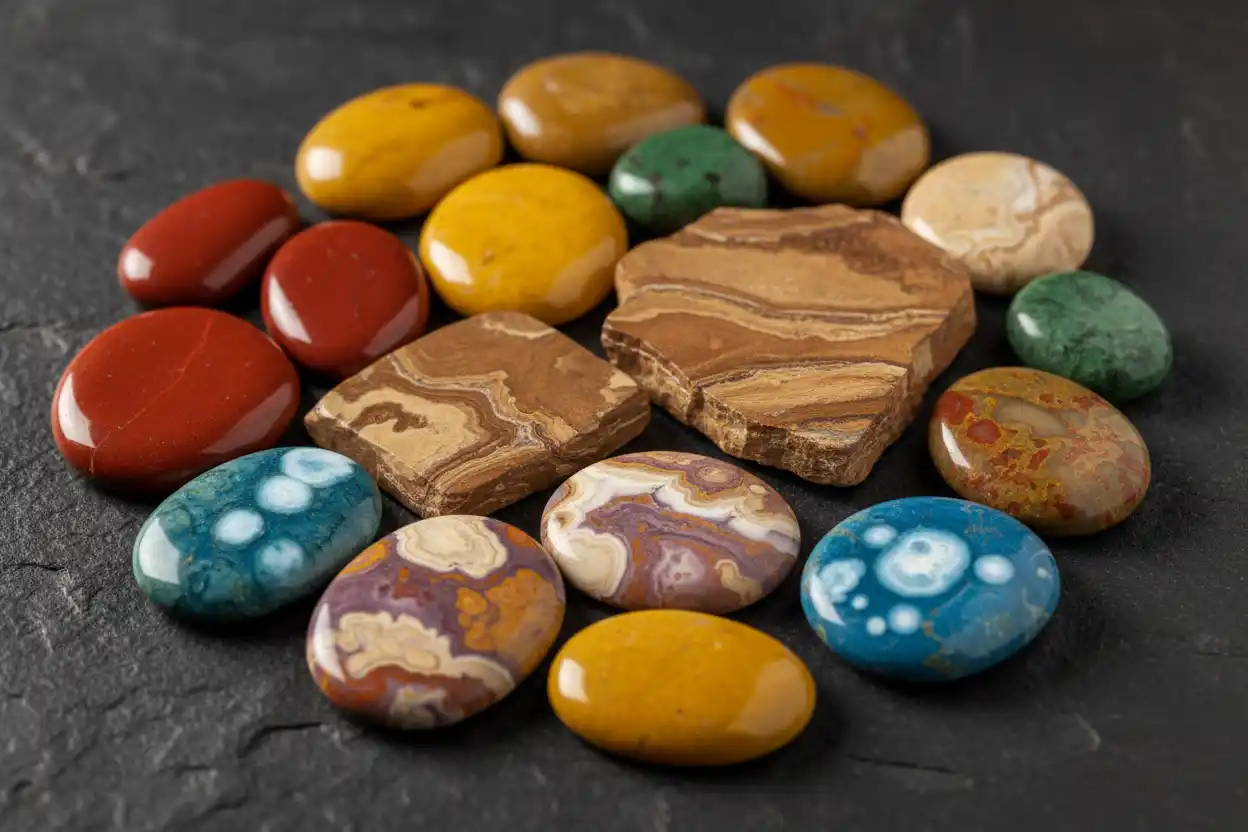
Jasper Color Meaning and Symbolism
Jasper occurs in earthy red, yellow, brown, green, cream, gray and black, along with multicolored patterns that resemble landscapes, breccias, orbs and flowing sediment. Its colors come from mineral inclusions, iron oxidation, alteration and depositional structure rather than from one universal pigment.
Jasper Colors at a Glance
| Property | Jasper Color Characteristics |
|---|---|
| Material type | Opaque to slightly translucent microcrystalline silica material |
| Main composition | Primarily SiO₂ as microgranular quartz, chalcedony or chert, with variable mineral impurities |
| Common colors | Red, yellow, brown, tan, cream, green, gray, black, orange and multicolored |
| Less common colors | Blue, violet, pink and strongly saturated cool tones |
| Primary red colorant | Fine hematite and other ferric iron compounds |
| Primary yellow-brown colorants | Goethite, limonite-type mixtures, clay and iron-rich weathering products |
| Common green contributors | Chlorite, celadonite, amphiboles, epidote-group minerals and iron-bearing silicates |
| Common black contributors | Magnetite, manganese oxides, carbonaceous material and dense dark inclusions |
| Hardness | Usually approximately 6.5–7, depending on composition |
| Transparency | Opaque to slightly translucent |
| Common treatments | Dye, resin filling, surface coating, waxing and occasional stabilization |
| Main buying concern | Trade color names do not guarantee mineral composition, natural color or locality |
What Gives Jasper Its Color?
Jasper is not chemically pure quartz in the same sense as a transparent rock crystal. Instead, it contains fine mineral particles, altered rock fragments, iron compounds, clay and other inclusions distributed through microcrystalline silica.
Pure silica is colorless or white. Consequently, most jasper color comes from material trapped during formation or introduced through later alteration.
Color can develop through:
- Fine iron-oxide particles
- Iron oxyhydroxides
- Manganese oxides
- Chlorite or celadonite
- Dark carbonaceous material
- Included clay
- Magnetite
- Weathering along fractures
- Hydrothermal replacement
- Several minerals acting together
Because jasper has several geological origins, identical-looking colors may have different causes in separate deposits.
For example, one green jasper may contain chlorite, while another derives its color from iron-rich silicates. Similarly, a black pattern might contain magnetite in one stone and manganese oxide in another.
The relationship between jasper and chalcedony is also complex. Some references classify jasper as impure opaque chalcedony, while others emphasize its chert-like or rock-like character. Either way, its fine silica texture provides the background that preserves color and pattern.
Do Jasper Colors Have Fixed Meanings?
No universal system assigns one permanent meaning to every jasper color.
Historical interpretation varies by culture, object type, period and local stone tradition. Furthermore, many modern variety names did not exist in ancient mineral literature.
Current color meanings usually combine:
- General symbolism associated with a color
- Jasper’s long use as a carving and ornamental material
- Modern crystal traditions
- Personal interpretation
- Marketing language
Therefore, red jasper can symbolize resolve or vitality without implying that every culture historically assigned it the same meaning.
The meanings below are best treated as cultural and personal associations rather than scientific effects.
Red Jasper Meaning
Red jasper ranges from brick red and rust to deep brownish red.
Fine hematite particles commonly create the color. Hematite contains ferric iron, which absorbs parts of visible light and leaves red wavelengths dominant.
Red may appear as:
- Solid body color
- Thin bands
- Angular breccia fragments
- Spots within green or cream material
- Veins through yellow or brown jasper
- Red chert layers in iron formations
Modern symbolic associations include:
- Courage
- Persistence
- Physical effort
- Practical confidence
- Commitment
- Stability during change
- Completing difficult work
Its symbolism often emphasizes sustained action rather than sudden excitement.
Bright, even red can add value to ordinary material, particularly when the surface takes a strong polish. However, pattern, locality and carving quality may matter more than color saturation alone.
The red gemstones guide places jasper beside transparent gems such as ruby, spinel and garnet without implying that their optical properties or market values are comparable.
Yellow Jasper Meaning
Yellow jasper includes pale cream-yellow, mustard, ocher, golden yellow and brownish yellow.
Goethite, limonite-type iron mixtures, clay and related weathering products commonly produce these shades.
Yellow areas may form when:
- Iron-bearing minerals weather
- Groundwater introduces oxidized iron
- Red hematite hydrates or alters
- Fine clay becomes enclosed in silica
- Depositional layers contain different iron concentrations
Modern associations include:
- Optimism
- Patience
- Learning
- Confidence
- Practical planning
- Warmth
- Gradual progress
Pure golden yellow with strong polish generally attracts more interest than muddy gray-yellow. Nevertheless, scenic bands and unusual contrasts can make a subdued yellow stone more desirable than a uniformly bright one.
The broader yellow gemstones guide provides comparisons with citrine, topaz and sapphire.
Brown and Tan Jasper Meaning
Brown, beige and tan are among jasper’s most common colors.
Possible contributors include:
- Iron oxides
- Clay
- Organic material
- Weathered volcanic ash
- Sand- and silt-like inclusions
- Mixed red and yellow iron compounds
Modern symbolism frequently connects brown jasper with:
- Reliability
- Connection with place
- Practical judgment
- Simplicity
- Patience
- Consistency
- Resourcefulness
Brown scenic material is often sold as picture or landscape jasper because its bands resemble deserts, cliffs, hills or distant horizons.
Picture jasper receives value from composition and pattern rather than brown color by itself.
The brown gemstones guide helps distinguish ornamental jaspers from smoky quartz, zircon, tourmaline and other brown gems.
Green Jasper Meaning
Green jasper ranges from pale sage and olive to forest green, blue green and nearly black green.
Unlike red jasper, green material has no single dominant colorant across all deposits.
Possible contributors include:
- Chlorite
- Celadonite
- Epidote-group minerals
- Amphiboles
- Iron-bearing silicates
- Fine green volcanic alteration minerals
- Mixed green rock fragments
Modern associations include:
- Renewal
- Adaptability
- Patience
- Responsible growth
- Balance
- Connection with natural environments
- Recovery after change
Trade names require caution.
Dragon Blood Jasper is commonly a green rock with contrasting red areas rather than a standardized jasper mineral variety.
Likewise, Kambaba Jasper is a commercial rock name whose orbicular patterns and mineralogy deserve separate treatment rather than being reduced to “green jasper.”
Green color can be dyed into pale silica materials. Unnaturally even emerald green, pigment collecting in fractures or color concentrated around drill holes should prompt further testing.
The green gemstones guide offers comparison with jade, aventurine, chrysoprase and transparent green gems.
Black and Gray Jasper Meaning
Black, charcoal and gray jasper may contain:
- Magnetite
- Manganese oxides
- Carbonaceous material
- Dark amphiboles
- Dense iron-rich inclusions
- Fine volcanic fragments
- Mixtures of several minerals
Modern interpretations commonly include:
- Self-control
- Privacy
- Resilience
- Boundaries
- Thoughtful decision-making
- Remaining steady under pressure
True black areas often appear beside white, cream or red bands.
Zebra Jasper uses strong black-and-white contrast as its defining visual feature, although stones sold under that name can have different geological identities.
Dalmatian Jasper is another cautionary example. Despite its retail name, the familiar cream rock with black spots is classified as an igneous rock rather than conventional silica-dominant jasper.
Accordingly, a black-and-white pattern does not prove that the material is mineralogically jasper.
The black gemstones guide includes more standardized jewelry materials such as spinel, onyx and tourmaline.
White, Cream and Gray-White Jasper Meaning
White and cream areas contain fewer strongly colored inclusions or abundant pale clay and feldspar-like material.
Modern symbolic associations include:
- Simplicity
- Clarity
- Openness
- Neutral judgment
- Rest
- Beginning again
White jasper is rarely pure white across an entire object. Instead, it commonly forms:
- Veins
- Bands
- Orb centers
- Breccia cement
- Pale backgrounds
- Weathered outer zones
A white area may consist of chalcedony, quartz, opal, calcite or another mineral filling a fracture. Therefore, color does not establish the composition of each band.
Strong white contrast can increase pattern value even when it does not add rarity by itself.
Orange Jasper Meaning
Orange jasper lies between red and yellow material.
Its color commonly reflects mixtures of hematite, goethite and other iron compounds.
Modern associations include:
- Creativity
- Warmth
- Social confidence
- Adaptability
- Motivation
- Enjoyment of practical work
Orange often appears in multicolored scenic material rather than as an even single hue.
Noreena Jasper is known for red, mustard, cream and dark geometric patterns. Meanwhile, some ocean jasper contains orange, yellow, green and white orbs.
Each named material has its own geological and locality context, so orange color alone should not transfer one variety name to another.
The orange gemstones guide provides comparisons with carnelian, hessonite and spessartine.
Blue and Purple Jasper Meaning
Natural blue and purple jasper exists, but strong cool colors are less common than red, yellow and brown.
Potential blue or violet contributors include:
- Fine amphiboles
- Dumortierite or related blue silicates
- Riebeckite-like minerals
- Manganese compounds
- Copper-bearing inclusions
- Mixed gray and red optical effects
- Artificial dye
Modern blue associations include:
- Communication
- Patience
- Reflection
- Perspective
- Calm analysis
Purple associations commonly include:
- Individuality
- Imagination
- Introspection
- Creative judgment
Bright cobalt-blue or uniformly violet commercial pieces deserve careful examination because porous chalcedony and pale jasper can absorb dye effectively.
Color collecting in fractures, pits and drill holes is a strong warning sign.
The purple gemstones guide can help compare rare purple jasper with amethyst, fluorite, sapphire and charoite.
Multicolored Jasper Meaning
Many of the most desirable jaspers contain several colors.
Common structures include:
- Bands
- Orbs
- Breccias
- Dendrites
- Veins
- Flow patterns
- Liesegang rings
- Angular fragments
- Landscape-like layers
Modern symbolism often connects multicolored jasper with:
- Integration
- Adaptability
- Several strengths working together
- Accepting complexity
- Creative problem-solving
- Harmony without uniformity
Orbicular Jasper emphasizes rounded structures, while Picasso Jasper is sold for intersecting dark lines and abstract patterning.
These names describe appearance or locality more often than one strict mineral formula.
The complete types of jasper guide provides the better place to compare named varieties without turning this color article into a directory.
How Color Patterns Develop
Jasper patterns may record several geological stages.
Depositional Banding
Layers of silica-rich sediment, volcanic ash or iron minerals accumulate with different compositions.
Flow Texture
Silica-rich volcanic or hydrothermal material moves before complete hardening, producing swirls and streaks.
Brecciation
Earlier jasper breaks into angular fragments. Later silica fills the gaps and cements the pieces together.
Orbicular Growth
Minerals or silica precipitate around small nuclei, creating rounded structures.
Fracture Filling
New quartz or chalcedony enters cracks, producing contrasting veins.
Weathering
Iron changes oxidation or hydration state near the surface, creating red, yellow and brown rinds.
One polished slab may therefore contain primary depositional color, later fractures and weathered outer material.
Does Color Determine Jasper Value?
Color matters, but pattern, rarity and workmanship often matter more.
Broad retail asking levels include:
| Jasper Material | Typical Asking Range |
|---|---|
| Common tumbling rough | About $3–$15 per pound |
| Better patterned rough | About $15–$50 per pound |
| Fine locality or scenic rough | About $50–$100+ per pound |
| Common commercial cabochon | About $5–$30 |
| Better scenic or orbicular cabochon | About $25–$100 |
| Designer or rare-locality cabochon | About $75–$250+ |
| Polished sphere or freeform | About $20–$300+, depending on size and pattern |
| Fine old-stock slab or collector specimen | Several hundred dollars or more |
These ranges describe asking prices rather than guaranteed resale values.
A common solid-red cabochon may remain inexpensive. Conversely, a rare landscape pattern with documented locality can command a substantial premium even when its colors are muted.
Dyed and Treated Jasper Colors
Jasper can receive:
- Dye
- Resin filling
- Polymer stabilization
- Wax
- Oil
- Clear lacquer
- Surface paint
- Backing
- Composite construction
Dye is most common in pale, porous or fractured material.
Warning signs include:
- Neon color
- Pigment concentrated in cracks
- Colored drill holes
- Color rubbing onto solvent-damp cotton
- Uneven surface-only saturation
- Several identical pieces with the same pattern
- Unnatural blue, pink or purple intensity
The general gemstone treatments guide explains why stabilization and dye require separate disclosure.
The checks in how to spot fake crystals also help identify resin composites, coatings and printed patterns.
Choosing Jasper by Color
Evaluate the stone in neutral light rather than relying on symbolic labels.
Ask:
- Is the color natural?
- Is the piece actually silica-dominant jasper?
- Does the photograph show the exact item?
- Has saturation been digitally increased?
- Is the pattern visible on the back?
- Does dye collect around fractures?
- Is the locality documented?
- Is the polish even?
- Are pits or grain boundaries filled?
- Does the price reflect rarity or only a creative trade name?
The jasper buying guide provides the broader authenticity checklist.
Cleaning Colored Jasper
Most stable untreated jasper can be cleaned with lukewarm water, mild soap and a soft cloth.
Avoid prolonged soaking when the stone is dyed, filled or assembled.
Strong acids, bleach and solvents may change surface polish, attack fillers or affect included minerals.
Ultrasonic cleaning is unnecessary. Hand cleaning reduces the risk of expanding fractures or loosening resin.
Frequently Asked Questions About Jasper Colors
What is the most common jasper color?
Red, brown and yellow are among the most common because iron compounds occur widely in silica-rich rocks.
What causes red jasper?
Fine hematite and other ferric iron compounds commonly produce red color.
What causes yellow jasper?
Goethite, limonite-type mixtures, clay and iron-rich weathering products commonly produce yellow and ocher shades.
Is green jasper naturally green?
Yes. Natural green material exists, but its color can come from several minerals, and dyed products are also common.
Is blue jasper rare?
Natural blue material is less common than red or brown. Strongly saturated blue should be checked for dye or an inaccurate trade name.
Is purple jasper natural?
Natural violet-toned material exists, but many bright purple pieces are dyed or marketed under broad, inconsistent names.
Is black jasper always magnetite rich?
No. Manganese oxides, carbonaceous material, dark silicates and other inclusions can also produce black areas.
Which jasper color is most valuable?
No single color always wins. Rare locality, pattern, translucency, polish, size and natural untreated color determine value.
Is multicolored jasper more valuable?
It can be when the pattern is attractive, unusual and well oriented. Random muddy color does not automatically add value.
Does jasper color fade?
Most natural mineral colors remain stable. Dye, resin and coatings may fade or discolor under prolonged heat or sunlight.
Can sellers dye red jasper?
Yes, although red material is abundant naturally. Dye may strengthen pale red, blue, green, purple or black colors.
Can color identify a jasper variety?
Not reliably. Several varieties overlap in color, while many trade names refer to rocks that are not strict jasper.
Jasper color becomes useful only when it is considered alongside composition, pattern, treatment and locality. The Crystals That Start With J and Gemstones That Start With J directories provide its broader alphabetical context.