Kornerupine Meaning: Properties, Uses & Symbolism
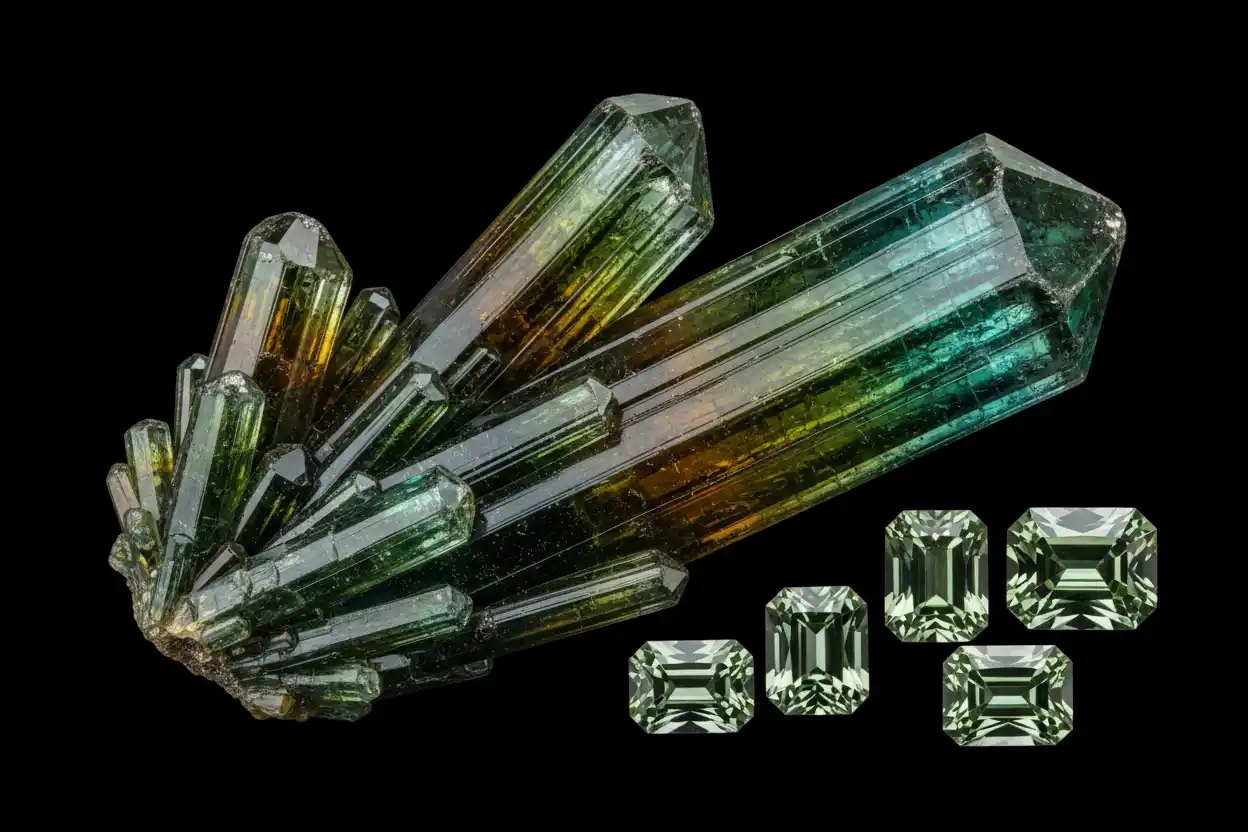
Kornerupine meaning begins with an uncommon magnesium-aluminum borosilicate whose most memorable property is not a metaphysical one but an optical one: strong pleochroism. A transparent kornerupine can appear green from one direction, yellow or yellow-green from another, and brownish to reddish brown from a third because its orthorhombic crystal structure absorbs light differently along different crystallographic directions. Kornerupine is an accepted mineral species with a composition that can incorporate magnesium, iron, aluminum, silicon, boron, hydroxyl, fluorine, and vacancies in varying proportions. Mindat records a current IMA formula of (Mg,Fe²⁺,Al,□)₁₀(Si,Al,B)₅O₂₁(OH,F)₂, Mohs hardness of approximately 6–7, measured density around 3.29–3.35, good cleavage on {110}, and an orthorhombic crystal system.
Gem-quality kornerupine is much less common than ordinary mineral specimens. Transparent material may be faceted when its color and clarity justify cutting, while fibrous or included material can occasionally produce a cat’s-eye effect. GIA’s Gübelin Gem Project documents faceted kornerupines from Kenya, Sri Lanka, and Tanzania, showing that gem material occurs across several geographic sources rather than belonging to one famous deposit. One documented Kenyan green specimen had a refractive index around 1.660–1.670, specific gravity of 3.27, vitreous luster, and yellow-to-green pleochroism.
The cultural and symbolic layer is much more recent and less firmly documented than the mineralogy. Modern crystal descriptions sometimes associate kornerupine with perspective, adaptability, confidence, balance, or clear decision-making, perhaps influenced by its changing directional colors. Those associations can function as personal symbolism, but there is no established evidence that the mineral alters mood, cognition, physical health, relationships, or financial outcomes through a gemological mechanism. This evidence-first distinction is used throughout the Gemstone Guides.
Kornerupine at a Glance
| Feature | Evidence-based description |
|---|---|
| Mineral | Kornerupine |
| Mineral class | Complex magnesium-aluminum borosilicate |
| Current IMA-style formula | (Mg,Fe²⁺,Al,□)₁₀(Si,Al,B)₅O₂₁(OH,F)₂ |
| Crystal system | Orthorhombic |
| Typical habit | Prismatic, columnar, radiating, fibrous or massive |
| Common colors | Colorless, white, green, blue-green, yellow-brown, brown and very dark material |
| Luster | Vitreous |
| Transparency | Transparent to translucent; opaque material also occurs |
| Mohs hardness | Approximately 6–7 |
| Specific gravity | Commonly around 3.29–3.35 |
| Cleavage | Good on {110} |
| Optical character | Biaxial negative |
| Refractive indices | Approximately 1.660–1.684 across the three principal directions |
| Maximum birefringence | About 0.013–0.014 in general reference data |
| Signature optical trait | Strong pleochroism/trichroism in many gem specimens |
| Important color contributors | Iron, chromium and vanadium can contribute depending on composition |
| Closely related mineral | Prismatine |
| Typical geological context | High-grade metamorphic, Mg-Al-rich and commonly boron-influenced environments |
| Gem use | Faceted collector gems and occasional cat’s-eye cabochons |
| Proven medical effects | None established |
What Kornerupine Actually Is
Kornerupine is a mineral species rather than a trade name, rock type, or color variety. Its chemistry is complex because several structural sites can accommodate different proportions of magnesium, iron, aluminum, silicon, boron, hydroxyl, fluorine, and vacancies. This variability explains why older publications may display formulas that look noticeably different from current database notation without necessarily referring to a different mineral. Mindat lists the species as grandfathered under modern IMA classification and records its orthorhombic Cmcm structure.
The mineral usually forms elongated prismatic crystals, but massive, fibrous and radiating habits are also known. Color can range from nearly colorless through green and yellow-brown to very dark brown or black. Gem-quality transparent green material represents only one visually attractive expression of a much broader mineral species.
Kornerupine should therefore not be defined as “a rare green gemstone.” That description describes a desirable commercial subset but excludes opaque specimens, brown material, boron-poor compositions, geological occurrences unsuitable for faceting, and crystals whose scientific importance has nothing to do with gem quality.
Kornerupine Identity Table
| Property or observation | Typical kornerupine evidence | Diagnostic value |
|---|---|---|
| Orthorhombic structure | Required | Strong |
| Mg-Al-rich borosilicate chemistry | Characteristic | Strong |
| Prismatic crystal habit | Common | Moderate |
| Green body color | Common in gem material | Weak alone |
| Yellow-brown material | Common | Weak alone |
| Strong trichroism | Frequent in transparent gems | Strong supporting clue |
| RI around 1.66–1.68 | Compatible | Strong when measured accurately |
| SG near 3.3 | Compatible | Useful supporting evidence |
| Good {110} cleavage | Characteristic | Useful physical clue |
| Mohs 6–7 | Compatible | Insufficient by itself |
| Cat’s-eye effect | Possible in included material | Variety/phenomenon clue, not species proof |
| Raman spectrum | Diagnostic when matched properly | Strong laboratory evidence |
| “Emerald-green appearance” | Possible | Does not make the stone emerald |
| Seller calls it “rare kornerupine” | Commercial claim | No identification value by itself |
No single row should be used in isolation. A transparent green stone with strong pleochroism may suggest kornerupine, but tourmaline, enstatite, sinhalite, diopside, and other gems can overlap in parts of the visual or physical profile.
Kornerupine and Prismatine: Why the Name Can Become Technical
Kornerupine belongs to the kornerupine-prismatine compositional series. Mineralogical research established that boron occupancy within a particular structural site provides a meaningful boundary between the species. Boron-poorer compositions are classified as kornerupine sensu stricto, while sufficiently boron-rich compositions are classified as prismatine. Material whose boron content has not actually been measured may therefore be discussed more broadly within the kornerupine-group context.
This is more than an academic naming issue. Gemological properties can overlap strongly across the series, so ordinary refractive-index and visual examination may establish that a stone belongs to the kornerupine-prismatine family without necessarily determining precise boron occupancy. Modern analytical work on green gem material has shown that specimens marketed broadly as kornerupine from different localities can fall on different sides of this compositional boundary when boron is measured directly.
The practical lesson is not that every buyer needs a boron analysis. It is that the familiar gem-market name can sometimes be less chemically precise than specialist mineralogical nomenclature.
How Kornerupine Forms
Kornerupine is primarily associated with metamorphic environments where unusual combinations of magnesium, aluminum, silicon and, commonly, boron occur at elevated metamorphic grade. Mindat places the species within regional metamorphic environments including amphibolite- and granulite-facies systems, while research on kornerupine-rich Australian rocks documents formation in Mg- and Al-rich compositions during high-grade metamorphism and metasomatic modification.
The type-area material in Greenland occurs within a metamorphosed anorthosite complex associated with minerals including sapphirine, spinel, cordierite, corundum, amphibole and tourmaline. Geological descriptions from Greenland also document unusually large crystals in this broader metamorphic setting.
Other occurrences develop in metamorphosed sedimentary or volcanic precursors and in Mg-Al-rich rocks modified by boron-bearing fluids. The precise assemblage varies with bulk-rock chemistry, pressure, temperature, boron availability and metasomatic history. Kornerupine can therefore be a useful indicator of unusual metamorphic conditions, but one formation story should not be copied indiscriminately from Greenland to Sri Lanka, Madagascar, Africa or Australia.
The deposit-scale reactions, pressure-temperature constraints and associated mineral assemblages belong in Kornerupine formation and deposit geology rather than being compressed into a universal recipe here.
Why Kornerupine Can Be Green, Brown, Blue-Green or Yellow
Kornerupine coloration reflects both major-element composition and trace chromophores. Classic spectroscopic and chemical work on gem material found iron, chromium and vanadium associated with the range from brown and green through bluish green and blue. Individual sources can differ substantially: some attractive green material is strongly influenced by vanadium, while chromium and iron may play larger roles in other specimens.
More recent comparative work on gem-quality green material from several Asian and African sources likewise found different trace-element signatures. Vanadium was identified as a principal color contributor in some yellowish-green stones, while chromium dominated the coloration of other green material.
This means “green kornerupine” is not one chemically uniform variety. Two gems of similar face-up hue may achieve that appearance through different proportions of iron, chromium, vanadium, thickness and crystallographic orientation.
Kornerupine also provides a useful contrast with kyanite color meaning: similar-looking green or blue-green stones can involve different structures and chromophores, so color terminology should not replace material identification.
Pleochroism Is One of Kornerupine’s Strongest Clues
Pleochroism occurs because an anisotropic crystal absorbs different wavelengths differently along its principal optical directions. In kornerupine, this can be visually dramatic. Green stones may display directional combinations of green, yellow, yellow-brown and reddish brown; some blue-green material shows similarly pronounced changes.
A GIA-documented Kenyan gem displayed yellow and green pleochroism together with refractive indices of approximately 1.660 and 1.670. GIA’s older work on Sri Lankan gem material also emphasizes the strong directional color behavior of kornerupine as a useful identification characteristic.
This feature affects appearance as well as identification. A cutter can orient transparent rough so that the most desirable color dominates the face-up view, while poor orientation may emphasize a brown or yellow direction. A photograph of one crystal can also shift noticeably when the stone is rotated even if the lighting remains constant.
The detailed relationship among refractive indices, optical axes, absorption, trichroism and cutting orientation belongs in Kornerupine optical properties and color behavior.
Diagnostic Properties
Mindat gives refractive-index ranges of approximately nα 1.660–1.671, nβ 1.673–1.683 and nγ 1.674–1.684, with maximum birefringence around 0.013–0.014. It lists kornerupine as biaxial negative, with measured density around 3.29–3.35 and hardness between 6 and 7.
Those values provide a useful diagnostic package when combined. A stone showing appropriate RI, density, strong pleochroism and compatible inclusions is far more convincing than a stone identified from green color alone.
Raman spectroscopy can provide stronger species confirmation. Published Raman research found recurring strong spectral features shared across kornerupine and prismatine samples and demonstrated that spectra are sensitive to crystal orientation while retaining characteristic bands useful for identification.
Microscopy adds another layer. GIA’s documented kornerupine gems show features such as fractures, planes of fluid inclusions and numerous parallel growth tubes. These observations can support an identification but should not be treated as a universal checklist that every natural stone must contain.
Detailed specimen-level inclusions and growth structures are handled in the Kornerupine microscope inclusion notebook.
Original Kornerupine Claim-Audit Table
Rare gemstones attract claims that become more confident each time they are copied. The following matrix separates defensible kornerupine statements from oversimplifications.
| Claim | Evidence status | Better interpretation |
|---|---|---|
| “Kornerupine is a magnesium-aluminum borosilicate.” | Supported | Core mineral identity, though natural chemistry varies |
| “Every kornerupine is boron rich.” | Incorrect | Boron occupancy varies substantially |
| “Kornerupine and prismatine are identical names.” | Outdated simplification | They form a compositional series but are distinguished mineralogically by boron occupancy |
| “Kornerupine is always green.” | Incorrect | Colorless, white, green, blue, yellow-brown and dark material occur |
| “Green color always comes from chromium.” | Incorrect | Iron, chromium and vanadium can contribute differently |
| “Strong pleochroism proves kornerupine.” | Too strong | It is an important clue but must agree with other properties |
| “The brown direction means a stone is low quality.” | Oversimplified | Directional brown color is intrinsic to pleochroism in many stones |
| “All green kornerupine has the same optical appearance.” | Incorrect | Source chemistry, cut orientation and thickness alter appearance |
| “Cat’s-eye kornerupine is a separate species.” | Incorrect | Chatoyancy is an optical phenomenon caused by aligned internal features |
| “Any green cat’s-eye is kornerupine.” | Incorrect | Several minerals can produce chatoyancy |
| “Kornerupine has ancient healing traditions.” | Weakly supported | The specific mineral identity belongs to modern mineralogical documentation |
| “Boron in kornerupine provides nutritional boron.” | Unsupported | Structural boron is not a dietary dose |
| “Green kornerupine heals the heart.” | Unsupported medical claim | Modern symbolism is not clinical evidence |
| “Rarity guarantees investment value.” | Unsupported financial claim | Collector scarcity does not ensure liquidity or appreciation |
The point is not to make the mineral seem less remarkable. Its chemistry, metamorphic history and directional colors are already unusual enough without converting uncertainty into folklore.
Original Specimen and Photo Checklist
A reproducible kornerupine record should distinguish what the observer sees from what testing establishes.
| Observation | What to record | Why it matters |
|---|---|---|
| Body color | Green, yellow-green, brown, blue-green, colorless or mixed | Creates a neutral starting description |
| Directional colors | Record each obvious color after rotation | Strong pleochroism can be diagnostically useful |
| Lighting | Daylight-balanced, incandescent or other | Hue can change substantially with illumination |
| Crystal habit | Prismatic, columnar, fibrous, massive, rounded alluvial rough | Adds geological and identification context |
| Transparency | Transparent, translucent or opaque | Separates gem-grade appearance from ordinary specimen material |
| Luster | Vitreous, dull or weathered | Useful condition clue |
| Cleavage/fractures | Position, direction and extent | Relevant to both identification and durability |
| Growth tubes | Present, absent or uncertain under stated magnification | Documented in some gem specimens |
| Chatoyancy | Strong, weak or absent; record light geometry | Prevents a vague “cat’s-eye” claim |
| RI | Exact readings and method | Strong objective evidence |
| Specific gravity | Measurement and method | Helps distinguish look-alikes |
| Pleochroism | Dichroscope or controlled observation | One of the most useful gemological traits |
| Fluorescence | Wavelength and response | Variable supporting evidence |
| Locality | Documented, inherited label, seller-stated or unknown | Color does not prove origin |
| Treatment | Laboratory-supported, seller-disclosed or unknown | Avoids assuming “untreated” from rarity |
| Analytical evidence | Raman, chemistry or diffraction if available | Can resolve species-level uncertainty |
| Photography | Orientation, white balance, magnification and edits | Essential for a strongly pleochroic mineral |
This checklist deliberately avoids assigning a percentage authenticity score. A reliable identification comes from mutually consistent evidence, not from accumulating several weak impressions.
Cat’s-Eye Kornerupine
Some kornerupine contains aligned internal structures capable of producing chatoyancy when cut as a cabochon. GIA has documented a translucent yellowish-green cat’s-eye kornerupine showing intense chatoyancy, a spot RI around 1.67 and specific gravity around 3.32, with Raman spectroscopy confirming the species.
The cat’s-eye effect is optical rather than a separate mineral variety. Parallel tubes, fibers or aligned inclusions can reflect a narrow band of light across a curved polished surface. The quality of the eye depends on inclusion alignment, cabochon orientation, dome geometry, transparency and lighting.
A sharp eye does not prove geographic origin, and chatoyancy itself does not establish kornerupine because other minerals can show the same phenomenon.
Documented Discovery and Naming
The type locality for kornerupine is near the former Fiskenæsset harbor in the Qeqertarsuatsiaat area of Greenland. The mineral was named for Danish geologist, explorer and artist Andreas Nikolaus Kornerup, whose work included expeditions and geological study in Greenland. Mindat retains this locality as the formal type occurrence.
Greenland material also illustrates how mineralogical importance and gem quality can diverge. Much of the classic material is gray-green, brownish or opaque, while some large crystals contain limited areas transparent enough for faceting. Government geological documentation from Greenland records unusually large kornerupine crystals associated with anorthosite-complex metamorphism and minerals including sapphire, ruby, spinel, cordierite and tourmaline.
Gem-quality material later became known from Sri Lanka, Madagascar, Kenya, Tanzania and other regions. The history is therefore primarily one of mineralogical discovery followed by recognition of occasional gem-quality occurrences, not an ancient gemstone tradition stretching unchanged into modern crystal practices.
Gem Kornerupine From Sri Lanka and East Africa
Sri Lanka has supplied important transparent and chatoyant kornerupine from gem-bearing sediments. GIA documents kornerupine among the less common gem minerals recovered from sedimentary deposits, where durable crystals were weathered from their original metamorphic source rocks and later concentrated in secondary deposits.
Historical GIA observations from Sri Lankan gem districts describe green, brownish-yellow and cat’s-eye kornerupine and emphasize its strong directional color. That alluvial context explains why some gem rough is rounded rather than preserving textbook prismatic crystal faces.
Kenya and Tanzania have also produced gem material, including attractive green stones. The GIA Gübelin collection contains multiple documented examples from Kenya and Tanzania, while analytical studies show that different East African materials can vary substantially in vanadium, chromium, iron and boron content.
Origin should nevertheless not be assigned from hue alone. Similar yellow-green or green stones can occur at more than one locality, and chemical provenance studies require considerably more evidence than a photograph.
Kornerupine Uses
Most kornerupine is primarily a mineralogical specimen rather than jewelry material. Well-formed crystals can be valuable to systematic collectors because of the species’ unusual chemistry, high-grade metamorphic context, pleochroism and relationship with prismatine.
Transparent rough can be faceted. Strong trichroism makes orientation especially important because the cutter must decide which directional color will dominate the face-up stone. A green crystal can yield a less attractive brownish gem if orientation prioritizes weight retention over optical direction.
Chatoyant rough is normally cut as a cabochon so that aligned internal structures create a centered eye. These lapidary tradeoffs belong in Kornerupine cutting, orientation, and polish.
Durability and Jewelry Wear
A hardness around 6–7 makes kornerupine substantially more wearable than very soft collector minerals, but it is not immune to abrasion. Quartz-bearing dust and harder jewelry materials can gradually scratch polished surfaces, while good cleavage and existing fractures create separate structural concerns.
The practical risk depends on the cut and setting. A compact pendant receives less impact than a high-set ring. A clean faceted stone behaves differently from a cat’s-eye cabochon filled with aligned tubes and fractures. Corners, girdle exposure, prong pressure and cleavage orientation can all affect durability.
Those construction questions belong in Kornerupine setting and wear engineering rather than being reduced to the statement that “Mohs 7 means safe for everything.”
Safe Ownership and Processing
Ordinary handling of an intact kornerupine gemstone or mineral specimen is different from grinding, drilling or crushing mineral material. A finished stone does not expose its owner to the same particulate conditions created by lapidary processing.
Kornerupine should not be powdered or consumed because it contains magnesium, boron, iron or other elements. A chemical element locked into a mineral structure is not automatically a nutritional source, and the mineral formula does not establish a safe dose or bioavailability.
Likewise, there is no need to use destructive scratch, acid or heat testing on a valuable specimen. Refractive index, specific gravity, optical examination and Raman spectroscopy provide more informative identification routes without deliberately damaging the stone.
Collectors should preserve old labels, locality records and previous collection numbers because taxonomic details such as the kornerupine-prismatine boundary can make historical documentation scientifically valuable. Storage, label preservation and condition monitoring are covered in the Kornerupine specimen conservation record.
Kornerupine Meaning in Modern Symbolism
Modern symbolic interpretations frequently connect kornerupine with adaptability, perspective, confidence, balance, self-knowledge or decision-making. Its powerful directional colors provide a natural metaphor: one object can reveal different appearances according to how it is viewed.
That metaphor can be used constructively. Someone might keep a kornerupine gem as a reminder to examine a difficult question from more than one angle before forming a conclusion. Another collector may simply associate its metamorphic formation with persistence through environmental change.
Neither interpretation requires claiming a physical therapeutic effect. Similar symbolic terms appear around chemically unrelated stones such as kunzite meaning and kinoite meaning, while the deep-earth geology behind kimberlite meaning inspires a different set of modern metaphors. The overlap demonstrates that symbolism is generated by human interpretation rather than by one shared mineralogical mechanism.
Kornerupine cannot scientifically guarantee emotional balance, attract wealth, repair relationships, improve communication, increase confidence or alter another person’s behavior.
The Symbolism Boundary
A mineralogical statement can describe kornerupine’s crystal structure, chemistry, pleochroism, refractive indices, metamorphic setting or Raman spectrum. Those claims can be tested.
A historical statement can document its Greenland type locality, naming and later discovery as gem material.
A symbolic statement can describe contemporary associations with perspective, adaptability or reflection.
Those categories should remain distinct. Strong trichroism does not prove that the mineral changes a person’s perspective. Metamorphic formation does not physically make someone more resilient. Boron, magnesium or iron in the structure does not transform the stone into a nutritional or medical device.
There is no established scientific evidence that wearing or holding kornerupine treats anxiety, depression, cardiovascular conditions, immune disorders, hormone problems, pain, neurological disease, sleep disorders or other health conditions.
Treatment and Authenticity Context
Kornerupine is rare enough that buyers may assume every unusual specimen is untreated simply because treatment is not commonly discussed. That assumption is unsafe as a general rule. GIA has documented dark brown kornerupine beads with an unusual metallic surface coating; Raman spectroscopy confirmed kornerupine beneath the coating, while microscopy showed spotty surface luster and wear along facet junctions consistent with treatment.
The lesson is broader than that particular example. Mineral rarity does not prevent coating, composite construction, misleading descriptions or incorrect identity. A surface that looks unlike normal vitreous kornerupine deserves examination rather than an assumption that the unusual appearance represents a rare natural variety.
This page does not duplicate a separate treatment guide; it establishes the boundary that material identity and surface condition are separate questions.
What Photographs Can and Cannot Establish
A photograph can document body color, crystal shape, face-up pleochroic appearance, fractures, transparency, chatoyancy and some inclusions. Multiple photographs of the same stone after rotation are especially valuable because kornerupine’s directional colors can be pronounced.
A photograph cannot measure boron occupancy, distinguish kornerupine from prismatine, establish refractive index, determine specific gravity or prove geographic origin. It can also misrepresent color if white balance, saturation or orientation differs.
For strongly pleochroic material, a single “true color” photograph is therefore an oversimplification. Good documentation should show the stone under controlled lighting from more than one direction.
When Laboratory Testing Matters
A standard gemological examination can often narrow the identification through refractive index, birefringence, optic character, density and pleochroism. When the material is unusual, highly valuable, treated or chemically important, Raman spectroscopy and compositional analysis can provide stronger evidence.
The kornerupine-prismatine distinction is a good example of routine testing reaching a limit. A gemstone can display the expected visual and optical behavior while precise species assignment within the series depends on boron occupancy that requires appropriate compositional data.
Gems Lore’s general material-first scope is outlined on About, while the Disclaimer defines the limits of educational mineral, health and value information. Administrative questions can use Contact, and the site’s handling of submitted information is described in the Privacy Policy.
Common Kornerupine Misunderstandings
One misconception is that kornerupine is simply a rare green gemstone. It is a mineral species with a much broader range of colors, transparency and geological forms.
Another is that kornerupine and prismatine are interchangeable names. Modern mineralogy distinguishes them using boron occupancy even though they form a closely related series.
A third misconception is that every green kornerupine has the same color cause. Iron, vanadium and chromium can contribute in different proportions.
A fourth is that strong pleochroism alone proves the species. It is highly useful evidence but needs to agree with RI, density and other tests.
A fifth is that cat’s-eye kornerupine is another mineral variety. The eye is an optical phenomenon created by aligned internal structures.
A sixth is that gemstone rarity eliminates the possibility of treatment. Documented coated kornerupine demonstrates otherwise.
A seventh converts the mineral’s boron, magnesium or iron content into healing or nutritional claims. Mineral chemistry does not establish medical bioavailability.
A Practical Evidence Hierarchy
The weakest evidence is a seller name attached to a green photograph. A controlled photograph taken through several orientations adds useful pleochroism information, while a credible locality label adds geological context.
Refractive index, density, optic character and microscopic examination provide much stronger gemological evidence. Raman spectroscopy can confirm mineral identity, while quantitative chemistry becomes particularly important when separating kornerupine from prismatine.
Historical interpretation requires a different evidence hierarchy: type-locality records and mineralogical publications outweigh unsourced stories of ancient gemstone use. Modern symbolic associations can be described as contemporary symbolism without pretending they are part of the mineral’s measurable properties.
Frequently Asked Questions
What is kornerupine?
Kornerupine is an orthorhombic magnesium-aluminum borosilicate mineral with variable iron, boron, fluorine and related substitutions. It occurs as prismatic, fibrous, massive and occasionally transparent gem-quality material.
What color is kornerupine?
Documented colors include colorless, white, green, blue or blue-green, yellow-brown, brown and very dark material. Transparent green and yellow-green stones are especially familiar in the gem trade.
Why does kornerupine change color when rotated?
Kornerupine is strongly pleochroic because it absorbs light differently along different optical directions. A green gem can therefore show yellow, green and brownish or reddish-brown directional colors as it is rotated.
What causes green kornerupine?
Iron, chromium and vanadium can all contribute to kornerupine coloration. Their relative importance differs among specimens and localities, so no one trace element should be assigned to every green stone.
Is kornerupine the same as prismatine?
No. They belong to the same compositional series but are distinguished mineralogically by boron occupancy within the structure. Precise separation can require compositional analysis.
How hard is kornerupine?
Mindat records a Mohs hardness of approximately 6–7. That gives useful scratch resistance, but cleavage, fractures and setting design still affect practical durability.
What is the refractive index of kornerupine?
General mineral data place its three principal refractive indices approximately between 1.660 and 1.684. Exact values vary with composition.
What is the specific gravity of kornerupine?
Measured mineral reference values commonly fall around 3.29–3.35, although individual gem specimens can vary somewhat with composition, inclusions and measurement conditions.
Where was kornerupine first identified?
Its type locality is near the former Fiskenæsset harbor in the Qeqertarsuatsiaat area of Greenland. The mineral was named in honor of Danish geologist and explorer Andreas Nikolaus Kornerup.
Where does gem-quality kornerupine come from?
Important gem material has been documented from Sri Lanka, Kenya, Tanzania and Madagascar, among other sources. GIA’s Gübelin collection contains tested faceted stones from several of these regions.
Does kornerupine occur in alluvial deposits?
Yes. Gem-quality kornerupine is known from secondary gem-bearing sediments, particularly in Sri Lanka, where resistant crystals have been weathered from their original host rocks and concentrated in gem gravels or related sediments.
What is cat’s-eye kornerupine?
Cat’s-eye kornerupine is material containing aligned internal structures that create a moving band of reflected light when cut as a cabochon. GIA has confirmed such material using conventional gemological testing and Raman spectroscopy.
Can kornerupine be treated?
Treatment is not the defining feature of kornerupine, but treated material exists. GIA has documented kornerupine beads carrying an artificial metallic surface coating.
What does kornerupine symbolize?
Contemporary symbolism may associate kornerupine with perspective, adaptability, confidence, balance or reflection. These interpretations are modern personal or metaphysical associations rather than measurable properties of the mineral.
Does kornerupine have healing properties?
No established scientific evidence shows that holding or wearing kornerupine treats physical or psychological illness.
Can boron or magnesium in kornerupine benefit the body?
The presence of an element in a mineral structure does not establish useful absorption, nutritional dosage or medical benefit from wearing the mineral.
Can kornerupine go in drinking water?
Kornerupine should not be intentionally used to make gemstone drinking water or elixirs. Mineral composition does not establish safe ingestion, purity, bioavailability or therapeutic dosage.
Is kornerupine suitable for jewelry?
Transparent kornerupine can be faceted and worn in appropriately protected jewelry. Its hardness is reasonably practical, but cleavage, fractures, rarity and orientation should be considered, especially for rings exposed to repeated impacts.
Can a photograph identify kornerupine?
A photograph can show compatible color, crystal habit and directional appearance, but it cannot establish refractive index, density, boron occupancy or Raman identity. Important or uncertain stones may require gemological or laboratory testing.