Kinoite Meaning: Properties, Uses & Symbolism
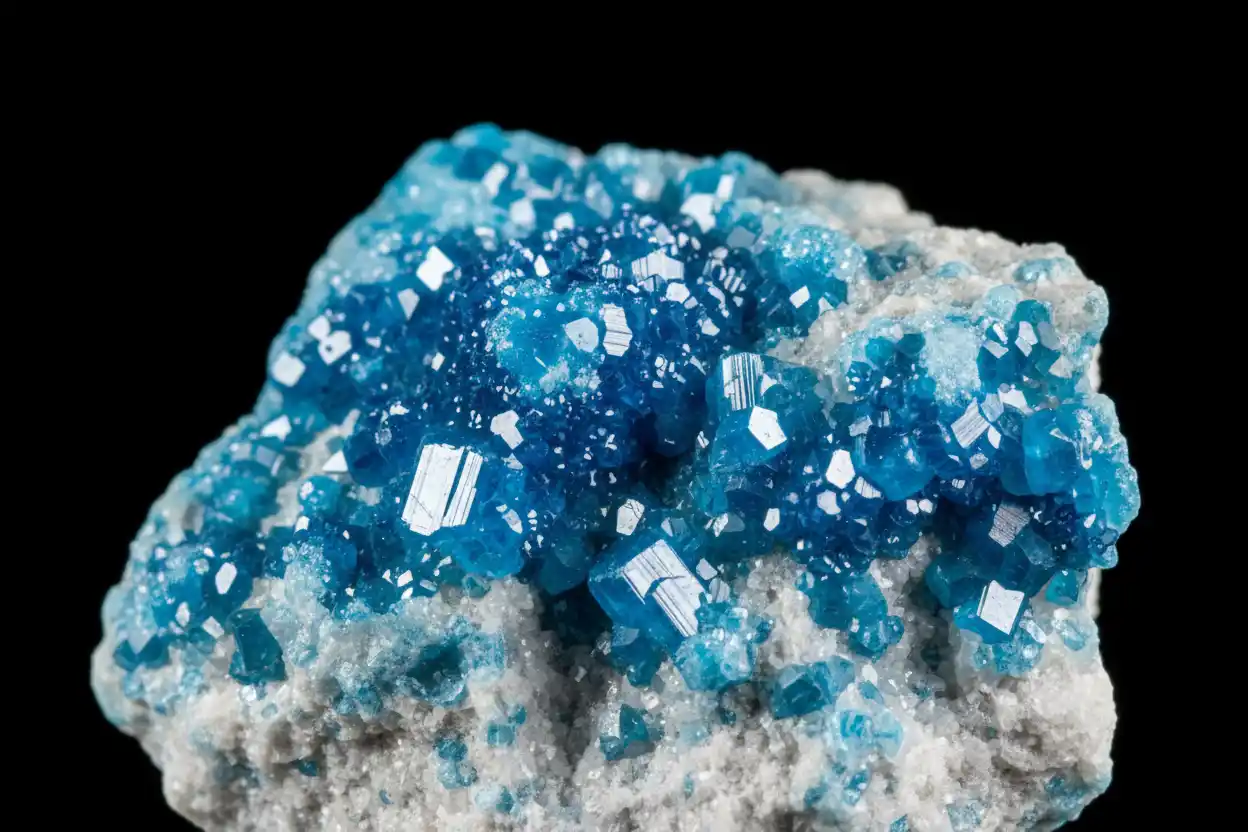
Kinoite meaning begins with a mineral that needs little embellishment to be unusual. Kinoite is an IMA-approved calcium-copper silicate mineral with a hydrated or hydroxyl-bearing structure commonly represented as Ca₂Cu₂Si₃O₁₀·2H₂O, while structural and spectroscopic literature also expresses the composition in hydroxyl-bearing notation. It crystallizes in the monoclinic system and is best known for intense azure to deep blue crystals, commonly forming tiny tabular blades, coatings, veinlets, and fan-like aggregates. Current mineral databases retain kinoite as a valid mineral species rather than a commercial variety name.
Its measurable properties make the identification much more precise than the phrase “rare blue crystal.” Reference data place kinoite near Mohs 4–5, with measured density around 3.16 and strong optical anisotropy. The Handbook of Mineralogy describes transparent-to-translucent kinoite as deep azurite blue, strongly pleochroic from pale greenish blue through blue to deep blue, with refractive indices roughly α 1.638–1.640, β 1.663–1.665, and γ 1.676–1.680.
Those facts should remain separate from symbolism. Contemporary crystal descriptions sometimes associate kinoite with communication, calmness, perspective, emotional expression, or insight. Such ideas can have personal symbolic value, but they are not demonstrated effects of copper, calcium, silicon, water, crystal structure, or blue coloration. The material-first approach used here is consistent with the wider Gemstone Guides collection.
Kinoite at a Glance
| Feature | Evidence-based description |
|---|---|
| Mineral | Kinoite |
| Mineral type | Hydrated calcium-copper silicate |
| Current species status | IMA-approved mineral species |
| Common formula | Ca₂Cu₂Si₃O₁₀·2H₂O |
| Alternative structural notation | Often expressed with hydroxyl groups in mineralogical literature |
| Crystal system | Monoclinic |
| Typical habit | Tiny tabular, bladed, platy crystals; sprays, coatings, veinlets, and massive material |
| Typical color | Azure blue to deep blue |
| Transparency | Transparent to translucent |
| Luster | Vitreous |
| Mohs hardness | About 4–5 |
| Measured density | About 3.16 g/cm³ in reference material |
| Optical character | Biaxial negative |
| Pleochroism | Strong, from pale greenish blue to deeper blue |
| Important geological settings | Copper-bearing skarn and altered basalt cavities |
| Famous specimen locality | Christmas Mine, Arizona |
| Type-area context | Helvetia–Rosemont district of Arizona’s Santa Rita Mountains |
| Common associates | Apophyllite, stringhamite, calcite, native copper, epidote, pumpellyite, chlorite and others depending on locality |
| Main use | Mineral collecting, scientific study, micromounts and occasionally lapidary experimentation |
| Proven medical effects | None established |
What Kinoite Actually Is
Kinoite is a distinct mineral rather than a rock, trade name, or blue variety of another copper mineral. Its structure contains calcium, divalent copper, silicon, oxygen and structurally bound hydrogen-bearing components. PubChem’s mineral record, drawing on IMA information, lists it as approved with the formula Ca₂Cu₂Si₃O₁₀·2H₂O, while crystallographic data identify a monoclinic structure.
The crystals are commonly small. The Handbook of Mineralogy describes well-formed crystals on the millimeter scale, typically tabular and somewhat elongated, although kinoite also occurs as veinlets or massive material. This helps explain why many of the most visually impressive specimens are not dominated by one large crystal but by dense blue coatings or sprays that sparkle across a contrasting matrix.
A collector should therefore be cautious when presented with a large, perfectly transparent, faceted-looking blue crystal sold as natural kinoite. Size alone does not prove a fake, but it should prompt stronger scrutiny because classic kinoite habits and documented specimen material are often much smaller and more delicate.
Kinoite Identity Table
| Property or claim | What evidence supports | Identification significance |
|---|---|---|
| Calcium-copper silicate | Supported | Core chemical identity |
| Monoclinic structure | Supported | Species-level crystallographic evidence |
| Bright blue color | Characteristic | Useful clue, not proof |
| Small tabular/bladed crystals | Common | Strong habit clue |
| Fan-like sprays | Documented | Useful hand-specimen clue |
| Strong blue pleochroism | Supported | Important optical property |
| Mohs 4–5 | Supported | Separates it from several harder blue gems |
| Density near 3.16 | Supported | Useful supporting measurement |
| RI around 1.64–1.68 | Supported | Strong gemological evidence where measurable |
| Perfect or excellent cleavage in one direction | Documented | Important for handling and identification |
| Skarn occurrence | Well documented | Geological support |
| Basalt-cavity occurrence | Also documented | Shows kinoite has more than one formation setting |
| “Every blue coating is kinoite” | Unsupported | Several copper minerals can appear blue |
| “Christmas Mine is the type locality” | Incorrect simplification | The famous specimen mine is not the original type locality |
| “Copper content proves healing ability” | Unsupported | Chemical composition is not medical evidence |
Formula Wording: Why References Can Look Different
One unusual feature of kinoite literature is that chemically equivalent or closely related structural descriptions are not always written in the same way. That can make two reputable references appear to disagree even when they are describing the same recognized species.
| Source context | Formula presentation | What to understand |
|---|---|---|
| Current IMA-linked mineral record | Ca₂Cu₂Si₃O₁₀·2H₂O | Widely used current species formula |
| Handbook of Mineralogy | Ca₂Cu₂Si₃O₈(OH)₄ | Emphasizes hydroxyl representation |
| Vibrational-spectroscopy literature | Discusses both hydrated and hydroxyl-bearing formulations | Raman and infrared evidence confirms hydrogen-bearing structural units |
| Fuka analytical material | Empirical chemistry close to Ca₂Cu₂Si₃O₁₀ with slightly more than two H₂O equivalents | Natural specimens show minor compositional variation |
The spectroscopy literature is especially useful because it directly investigated the hydrogen-bearing part of the structure rather than relying only on conventional formula formatting. Raman and infrared measurements demonstrated hydroxyl-related vibrations and led the authors to discuss both OH and water within kinoite’s structural description.
For readers, the practical conclusion is simple: differing H₂O/OH notation in reputable references does not mean a blue specimen belongs to several unrelated species. Mineral identification should use the complete crystallographic and chemical dataset rather than one formula string in isolation.
How Kinoite Forms
Kinoite occurs in more than one geological environment. The classic Arizona material occurs in copper-bearing skarn or tactite systems where carbonate rocks were altered by heat, chemically active fluids and later retrograde processes. The Handbook records kinoite in vugs and veinlets in skarn from the Santa Rita Mountains, while material associated with the Christmas Mine developed within strongly altered copper-bearing tactite assemblages.
At the Christmas Mine, published mineralogical work describes kinoite in a retrogradely altered environment with minerals including apophyllite, smectite, calcite and xonotlite. The original tactite included garnet, wollastonite and diopside, while later fluid-rock reactions altered parts of the system and created secondary or late-stage mineral assemblages including kinoite.
Kinoite is not restricted to skarn, however. Michigan occurrences demonstrate that it can also form within cavities and veins associated with altered basaltic lava flows in a native-copper district. The Handbook records associations there with quartz, calcite, copper, silver, epidote, pumpellyite and chlorite.
A further occurrence in Japan provides another formation model. Researchers documented flaky to platy kinoite in a vein cutting crystalline limestone and concluded that Cu- and Si-bearing fluids reacting with limestone likely produced the mineral there.
These environments share an important theme—available copper, calcium, silica and fluid activity—but they should not be collapsed into one universal reaction. Local mineral assemblages and fluid histories differ. The detailed locality-by-locality processes belong in Kinoite formation and deposit geology.
Why Kinoite Is Blue
Kinoite’s blue color is tied to copper within its structure. Copper in the divalent state commonly produces strong visible-light absorption in copper minerals, and kinoite’s optical data confirm that its blue is direction-dependent rather than merely a surface pigment.
The Handbook describes strong pleochroism: pale greenish blue along one optical direction, blue along another, and deep blue along the third. Absorption is strongest along the direction displaying the deepest color.
That behavior has practical consequences. Two photographs of one kinoite crystal can show noticeably different shades if the crystal is rotated, illuminated from a different direction or viewed through different thicknesses. Small dense coatings can also appear darker than isolated transparent blades because more blue material lies in the optical path.
Blue intensity therefore should not be used as a locality test. A deep-blue crystal is not automatically from one famous mine, and pale material is not automatically inferior or incorrectly identified.
The detailed relationship among pleochroism, refractive indices, thickness, crystal orientation and lighting belongs in Kinoite optical properties and color behavior.
Diagnostic Traits
A preliminary kinoite identification can begin with color, habit, luster and geological setting. Typical specimens show bright blue tabular or bladed crystals, sometimes arranged in fan-like sprays or forming dense coatings on pale matrix. Transparent crystal edges can show strong vitreous reflections.
Optical measurements provide much stronger evidence. Reference kinoite is biaxial negative with three distinct refractive-index values extending from roughly the high 1.63 range into the high 1.67 range. Density around 3.14–3.16 has been reported from different occurrences, and the combination of these measurements with strong pleochroism narrows the identification considerably.
Cleavage also matters. The Handbook records one excellent cleavage direction and two additional distinct cleavages. A delicate blade can therefore split even though hardness around 4–5 sounds moderate. Hardness and cleavage describe different mechanical properties.
Microscopic examination can reveal growth striations, cleavage, attached apophyllite, mineral inclusions, sprays, vein relationships and other features. Those observations are treated in detail in the Kinoite microscope inclusion notebook rather than being reduced to a claim that one microscopic feature proves authenticity.
Kinoite and Stringhamite: A Particularly Important Look-Alike
Stringhamite deserves special attention because it is another blue calcium-copper silicate and is documented in association with kinoite. At the Christmas Mine, stringhamite occurs among minerals recorded with kinoite, and Japanese kinoite has also been reported with stringhamite in limestone-hosted veins.
Color alone can therefore be especially misleading. A blue calcium-copper silicate collected from an appropriate locality is not automatically kinoite simply because kinoite is famous there. Habit, cleavage, optical properties, diffraction or Raman data may be necessary when the species matters.
Dioptase, chrysocolla, shattuckite and other blue-to-green copper minerals can create additional visual confusion in photographs, although their mineralogy differs substantially. The correct approach is not to memorize one shade of blue but to combine optical, structural and locality evidence.
Original Kinoite Claim-Audit Table
| Common claim | Evidence status | Better interpretation |
|---|---|---|
| “Kinoite is a blue gemstone.” | Partly true but incomplete | It is primarily a rare collector mineral; gem use is highly limited |
| “Kinoite is always dark blue.” | Incorrect | Pale greenish-blue to deep-blue directional colors occur |
| “The Christmas Mine is where kinoite was first defined.” | Incorrect | The type material came from the Santa Rita/Helvetia area |
| “All fine kinoite comes from one locality.” | Incorrect | Several localities are documented, although specimen quality varies |
| “Kinoite only forms in skarn.” | Incorrect | Michigan material occurs in altered basalt cavities |
| “Kinoite has one universally written formula.” | Oversimplified | Reputable references use hydrated and hydroxyl-bearing representations |
| “Every blue blade from a copper mine is kinoite.” | Incorrect | Other copper minerals can resemble it |
| “Stringhamite and kinoite are the same mineral.” | Incorrect | They are separate species |
| “Strong blue color proves high copper content quantitatively.” | Unsupported | Color depends on structure, orientation, thickness and composition |
| “Kinoite is hard enough for normal ring wear.” | Poor conclusion | Hardness is moderate and cleavage creates additional vulnerability |
| “Its copper treats copper deficiency through the skin.” | Unsupported | Mineral-bound copper is not a controlled nutritional dose |
| “Kinoite is an ancient healing crystal.” | Historically weak | Its specific mineral identity belongs to modern mineralogical classification |
| “Blue color scientifically produces calmness.” | Unsupported | Color symbolism is not clinical evidence |
| “Rare means investment-grade.” | Unsupported | Collector rarity does not guarantee resale value |
Original Specimen and Photo Checklist
A useful kinoite record should document the specimen before assigning locality, quality or metaphysical significance.
| Observation | What to record | Why it matters |
|---|---|---|
| Overall color | Pale blue, azure, royal blue, deep blue | Establishes actual appearance |
| Directional color | Note changes when the crystal is rotated | Strong pleochroism is characteristic |
| Habit | Tabular, bladed, platy, fan-like, coating, veinlet | Supports comparison with documented material |
| Crystal size | Measure representative crystals | Kinoite is commonly very small |
| Transparency | Transparent, translucent, dense coating | Influences color intensity |
| Luster | Vitreous, dull, altered | Fresh crystals should not be confused with surface stains |
| Cleavage | Existing flat breaks or plates | Important for condition and identity |
| Matrix | Skarn, limestone, basalt, unknown | Geological context can be highly informative |
| Associated minerals | Record observed species without guessing | Apophyllite and stringhamite are important at some localities |
| Blue coating depth | Surface-only, vein-filling, crystal coating | Helps distinguish mineral growth from paint or dye |
| Fractures | Natural, repaired, stabilized, unknown | Relevant to collection value |
| Locality | Documented, inherited label, seller-stated, unknown | Do not derive locality from color |
| Magnification | Record magnification used | Micromineral appearance changes dramatically with scale |
| Photography | Neutral light, macro lens, stacking, saturation edits | Tiny blue crystals can be heavily exaggerated online |
| Analytical evidence | RI, Raman, XRD, chemistry or other test | Strongest support when species identification matters |
No points-based authenticity score is appropriate. A specimen either accumulates convergent evidence for kinoite or it remains uncertain; a collection of weak visual clues should not be converted into false numerical confidence.
Documented Discovery and Naming
Kinoite’s type material comes from the Helvetia–Rosemont area in Arizona’s Santa Rita Mountains rather than the Christmas Mine that later became famous for exceptionally attractive collector specimens. Mineral records identify a specific drill-hole occurrence in the district as the type locality.
The mineral was named for Eusebio Francisco Kino, a Jesuit missionary, explorer and mapmaker strongly associated with the Sonora–Arizona region. The Handbook preserves that etymology as part of the formal mineral record.
The Christmas Mine subsequently became one of the best-known specimen sources. Its blue kinoite occurs with minerals including apophyllite, stringhamite, gilalite, smectite and junitoite in various assemblages, and published work on junitoite specifically documents the strongly retrograde altered environment in which kinoite-bearing specimens occurred.
Michigan later demonstrated that kinoite was not limited to Arizona-style skarn. There it occurs in the native-copper district within altered basalt cavities and veins. Japanese material extended the geological range further by documenting kinoite in a limestone-cutting vein produced through copper- and silica-bearing fluid interaction.
This history is mineralogical and geological. Claims of a specific ancient spiritual practice centered on kinoite itself are not supported by a comparable documentary record.
Kinoite Meaning in Modern Symbolism
Modern crystal traditions commonly associate kinoite with communication, thoughtful expression, calmness, perspective, self-reflection or emotional honesty. Its intense blue naturally encourages symbolism similar to that applied to other blue minerals, particularly concepts connected with sky, water, openness or communication.
A person can use that symbolism deliberately without turning it into mineral science. A collector might keep kinoite as a reminder to communicate technical information carefully, especially because the mineral itself demonstrates how appearance can mislead when similar blue copper silicates occur together.
Kinoite’s rarity can also inspire ideas about attentiveness or appreciating small details. Many remarkable specimens consist of crystals best appreciated under magnification, which makes careful observation a more material-specific metaphor than generic claims about “high vibration.”
The contrast with nearby reference topics illustrates why symbolism cannot be inferred from chemistry alone. Kornerupine meaning concerns a borosilicate with entirely different structure and optical behavior; Kimberlite meaning concerns a complex ultramafic rock; Kunzite meaning concerns lithium-bearing spodumene; and Kammererite meaning concerns chromium-bearing clinochlore. Similar words such as calmness, insight or transformation appearing across them describe human interpretive habits, not a shared physical mechanism.
Symbolism Boundary
Three kinds of claim should remain distinct.
A mineralogical statement can identify calcium, copper, silicon, crystal structure, refractive indices, cleavage, pleochroism or geological occurrence. Those properties are measurable.
A historical statement can document the mineral’s type locality, naming and collector localities.
A modern symbolic statement can describe contemporary associations with communication, calmness or perspective.
Those categories do not prove one another. Copper producing blue color does not demonstrate emotional healing. Strong pleochroism does not mean the mineral changes a person’s mental state depending on orientation. A specimen being rare does not make it spiritually stronger.
There is no established evidence that holding or wearing kinoite treats anxiety, depression, cardiovascular disease, neurological problems, pain, hormonal disorders, immune conditions, sleep problems or other medical conditions.
Copper Content Does Not Make Kinoite a Supplement
Kinoite contains substantial copper as part of its stable mineral structure. That statement describes chemistry, not a nutritional application.
Ordinary contact with an intact specimen does not establish that copper enters the body in a controlled or therapeutically useful amount. Kinoite should not be ground into powder, consumed, intentionally dissolved or placed in drinking water to make a mineral elixir.
The same caution applies to calcium and silicon in the formula. A mineral containing an element does not automatically provide that element in a biologically useful or medically safe form.
Uses of Kinoite
Kinoite is principally a collector and research mineral. Strongly colored crystals, especially those arranged in sprays or coatings with contrasting colorless associates, can make excellent micromount and cabinet specimens. Its rarity and locality associations also give it value in systematic mineral collections focused on copper silicates, Arizona mineralogy, skarn assemblages or native-copper districts.
Faceting or ornamental cutting is much less common. Crystal size is often restrictive, and good cleavage creates additional risk. A rare crystal can also be more valuable scientifically or aesthetically in its natural form than after substantial material has been removed.
For specimens where cutting is genuinely justified, cleavage orientation, abrasive choice and retention of blue crystal-rich areas require specialist judgment; those questions belong in Kinoite cutting, orientation, and polish.
Durability and Jewelry Use
Kinoite’s approximate Mohs hardness of 4–5 offers only moderate resistance to scratching. More importantly, the mineral has an excellent cleavage direction as well as additional distinct cleavage directions. A small blow at an unfavorable orientation can therefore split or chip a crystal even when the surface does not scratch immediately.
Those properties make everyday ring wear a poor default assumption. A protected collector pendant, enclosed display jewel or carefully mounted specimen is more realistic than a high-set ring exposed to repeated impact and abrasion.
Any jewelry design also has to account for crystal size, matrix stability and whether the blue kinoite forms a coating rather than a robust solid mass. These construction problems are treated separately in Kinoite setting and wear engineering.
Safe Ownership and Cleaning
Stable kinoite specimens can be handled as mineral specimens with ordinary care, but their delicate crystals make physical damage the primary ownership concern. Avoid rubbing crystal surfaces, brushing dense microcrystalline coatings aggressively or allowing harder specimens to contact them during storage.
Unknown cleaning chemicals should be avoided. Acid testing, deliberate scratching and heat are poor identification methods because they can damage a scarce specimen while producing ambiguous results.
Mechanical processing belongs to a different risk category. Cutting, grinding or drilling mineral material generates fine particulate matter from kinoite and its associated matrix. Because a natural specimen can contain several associated minerals, dry dust should not be treated as harmless merely because the principal blue mineral has been identified.
Long-term storage should preserve locality labels, old collection tags, photographs and any analytical documentation. Rare micromineral specimens can lose significant scientific context when the label is separated from the rock. Detailed storage and documentation practices belong in the Kinoite specimen conservation record.
What a Photograph Can and Cannot Establish
A photograph can show blue color, crystal habit, apparent cleavage, matrix, associated minerals, coverage, damage and approximate crystal size if a scale is included. High-quality macro photography is particularly valuable because many kinoite crystals are too small for their form to be obvious to the unaided eye.
Photography cannot measure refractive index, density, crystal structure or chemical composition. It also cannot reliably separate kinoite from every blue copper-silicate look-alike.
Color needs special caution. Strong pleochroism means a crystal can change from lighter greenish blue to deeper blue depending on orientation, while image saturation and white-balance adjustments can intensify that difference further. A specimen should therefore not be assigned a locality or quality tier from one highly saturated photograph.
When Laboratory Testing Matters
For a well-documented specimen from a classic locality with characteristic habit and associated minerals, a collector may have reasonable confidence from provenance and physical examination. When the specimen lacks context, is unusually large, is commercially important or could be another blue copper mineral, laboratory testing becomes much more useful.
X-ray diffraction can establish the crystal structure. Raman spectroscopy provides a powerful vibrational fingerprint and has been used directly to characterize kinoite. Chemical analysis can test calcium-to-copper-to-silicon relationships, while refractive-index and density measurements provide additional physical confirmation where the specimen form allows them.
Research from Japan demonstrates the value of combining several methods: chemical composition, unit-cell measurements, optical properties, hardness and density all agreed with kinoite identification rather than relying on color alone.
Because Kinoite specimens are often small, fragile and provenance-sensitive, this page does not imply that a photograph can replace specimen-level analysis. Gems Lore’s broader publication scope is described on About, while the Disclaimer defines the limits of educational mineral and health information. Contact is an administrative route for site communication, and the Privacy Policy governs information submitted through the website; neither is mineralogical evidence for an individual specimen.
Common Kinoite Misunderstandings
One misconception is that kinoite is a gemstone variety rather than an independent mineral species. Another is that its blue color alone provides enough evidence for identification. Several copper minerals overlap visually, and stringhamite is a particularly relevant comparison because it can occur alongside kinoite.
A third misconception is that the Christmas Mine is the type locality. It became extraordinarily important for collector specimens, but the original type material belongs to a different Arizona occurrence in the Santa Rita Mountains.
A fourth is that kinoite forms only in skarn. Michigan occurrences demonstrate formation in cavities and veins within altered basaltic lava flows, while Japanese material documents fluid interaction with crystalline limestone.
A fifth is that reputable sources contradict one another because they write the formula differently. Hydrated and hydroxyl-bearing structural notations reflect how hydrogen-bearing components are represented and investigated; they do not automatically indicate different species.
A sixth misconception is that hardness around 4–5 makes kinoite suitable for ordinary daily jewelry. Good cleavage and commonly tiny crystal size substantially limit practical wear.
A seventh converts copper content into a healing claim. Copper is fundamental to kinoite’s mineral identity and color, but that does not establish medical efficacy or nutritional delivery through contact.
A Practical Evidence Hierarchy for Kinoite Claims
A marketplace title such as “rare natural kinoite crystal” is weak evidence by itself. A scaled neutral-light photograph adds habit and color information. A reliable locality label adds much more, especially when it connects the specimen with a documented kinoite assemblage.
Optical measurements, density and microscopy provide stronger physical evidence. X-ray diffraction, Raman spectroscopy and chemical analysis can establish species-level identity when the material remains uncertain.
Historical claims require another evidence path: formal mineral descriptions, museum type records and locality literature are stronger than unsourced statements repeated through crystal retail pages.
Modern symbolism can be stated clearly as modern symbolism. It does not need to be presented as an ancient or scientific fact to have personal significance.
Frequently Asked Questions
What is kinoite?
Kinoite is an approved monoclinic calcium-copper silicate mineral commonly represented as Ca₂Cu₂Si₃O₁₀·2H₂O. It typically occurs as small azure-to-deep-blue tabular or bladed crystals, coatings and veinlets.
Is kinoite a real mineral species?
Yes. Kinoite is recognized as a valid mineral species in IMA-linked mineral records rather than being merely a commercial gemstone name.
Why is kinoite blue?
Copper is a structural component of kinoite and is central to its blue appearance. The mineral is also strongly pleochroic, showing lighter greenish-blue through deeper-blue colors according to viewing direction.
Is kinoite always dark blue?
No. Reference descriptions range from lighter greenish or azure blue to deep blue, and strong pleochroism means one crystal can display different blue intensities depending on direction.
How hard is kinoite?
Reference data place kinoite around Mohs 4–5. It also has strong cleavage, so hardness alone does not describe its resistance to breakage.
What is the refractive index of kinoite?
The Handbook gives approximately α 1.638–1.640, β 1.663–1.665 and γ 1.676–1.680. Japanese material produced closely comparable values.
What is the specific gravity of kinoite?
Reference material is around 3.16, while analyzed Japanese material was measured around 3.14. Small variation can reflect composition and measurement conditions.
Where does kinoite form?
Kinoite occurs in copper-bearing skarn and vein systems and has also been documented in altered basalt cavities. Japanese material formed in a vein cutting crystalline limestone through interaction with copper- and silica-bearing fluids.
Is the Christmas Mine the type locality for kinoite?
No. The Christmas Mine is a famous source of fine collector specimens, but the type locality is associated with the Helvetia–Rosemont area of Arizona’s Santa Rita Mountains.
Who was kinoite named after?
The mineral was named for Eusebio Francisco Kino, a Jesuit missionary, explorer and mapmaker associated with the Sonora–Arizona region.
What minerals occur with kinoite?
Associations vary by locality. Documented companions include apophyllite, stringhamite, calcite, native copper, native silver, epidote, pumpellyite, chlorite, smectite, xonotlite and other secondary minerals.
Can kinoite be confused with stringhamite?
Yes. Both are blue calcium-copper silicates and can occur together, so color alone is not enough for confident separation. Optical, structural or spectroscopic evidence can be required.
Can kinoite be faceted?
Exceptional material may be cut experimentally or for collectors, but kinoite’s typically small crystals, moderate hardness and good cleavage make it far less practical than conventional faceting gems.
Is kinoite suitable for everyday jewelry?
Generally not as an exposed stone. Its moderate hardness and cleavage make scratching, chipping and splitting realistic concerns, particularly in rings or other high-impact settings.
What does kinoite symbolize?
Modern symbolic interpretations often connect kinoite with communication, calmness, perspective, self-reflection or thoughtful expression. These are contemporary personal or metaphysical associations, not measurable mineral properties.
Does kinoite have healing properties?
No scientifically established evidence shows that wearing or holding kinoite treats physical or psychological illness.
Does kinoite provide copper to the body?
There is no established basis for treating an intact kinoite specimen as a nutritional copper source. Copper being part of the mineral structure does not establish safe or useful absorption through ordinary skin contact.
Can kinoite go in drinking water?
Kinoite should not be intentionally used for gemstone drinking-water preparations or elixirs. Its mineral composition does not establish safe ingestion, bioavailability or therapeutic benefit.
Can I identify kinoite from a photograph?
A photograph can show color, habit, matrix and associated minerals, but it cannot establish full mineral identity. Because other blue copper minerals can resemble kinoite, important specimens may require optical measurements, Raman spectroscopy, X-ray diffraction or chemical analysis.