

Kimberlite is a volatile-rich, silica-poor, magnesium-rich igneous rock that rises rapidly from Earth’s mantle. It is best known as the principal volcanic transport system that carries natural diamonds toward the surface, although the great majority of kimberlite bodies contain no economically recoverable diamond deposit.
Kimberlite at a Glance
| Property | Kimberlite Characteristics |
|---|---|
| Material type | Ultramafic mantle-derived igneous rock |
| Composition | Highly variable; commonly olivine-rich with carbonate, serpentine, phlogopite, spinel-group minerals, ilmenite and mantle or crustal fragments |
| Colors | Dark gray, blue gray, green gray, black, brown, yellow brown or weathered green |
| Crystal system | None for the rock as a whole |
| Habit or texture | Porphyritic, brecciated, fragmental, volcaniclastic, coherent, pipe-forming or dike-forming |
| Luster | Dull to earthy; individual minerals may be vitreous, metallic or pearly |
| Transparency | Opaque |
| Mohs hardness | Variable, commonly about 3–7 across fresh and altered mineral components |
| Cleavage | No rock-wide cleavage; constituent minerals fracture differently |
| Tenacity | Variable and often weak after serpentinization or weathering |
| Common uses | Diamond ore, geological research, mantle-xenolith study, exploration training, specimens and limited lapidary objects |
| Main care concern | Misleading diamond claims, weak weathered matrix, mixed mineral hardness and dust from altered ultramafic minerals |
What Is Kimberlite?
Kimberlite is a rock, not a mineral.
Its composition combines material crystallized directly from kimberlite magma with crystals and rock fragments collected during the magma’s ascent through the mantle and crust.
Fresh kimberlite commonly contains abundant olivine, although much of that olivine later alters to serpentine and other secondary minerals.
Additional components may include phlogopite, carbonate minerals, perovskite, spinel-group minerals, apatite, ilmenite and numerous mantle xenocrysts.
Because the rock is a variable mixture, it has no single formula, hardness or crystal system.
The appropriate framework in types of gemstones places kimberlite among geological and lapidary rocks rather than conventional gems.
Kimberlite and Diamonds
Kimberlite does not normally create diamonds.
Most natural diamonds formed in the mantle long before the magma that eventually transported them. Some crystallized more than a billion years before their host kimberlite erupted.
Diamond-bearing mantle rocks occur at depths where pressure is high enough for carbon to remain stable as diamond. Kimberlite magma then rises through that mantle and tears loose diamonds, mineral grains and rock fragments.
The crystals become xenocrysts—foreign crystals carried by the magma but not crystallized from it.
Consequently, kimberlite is better described as a delivery system than a diamond parent rock.
Lamproite can also transport diamonds, but kimberlite accounts for the dominant share of known primary diamond deposits.
How Deep Do Diamonds Form?
Many gem diamonds form roughly 150–200 kilometers beneath old continental interiors, although some superdeep diamonds originate at depths extending into the transition zone or lower mantle.
At those depths, stable, cool, ancient continental lithosphere can preserve diamond over immense time.
The kimberlite magma itself may originate deeper than the base of the continental lithosphere and then ascend rapidly through fractures.
Diamonds must reach the surface quickly enough to avoid converting to graphite or dissolving extensively into the magma.
That transport relationship explains why diamondiferous kimberlites are strongly associated with old, thick continental cratons rather than young oceanic crust.
How Kimberlite Forms
Kimberlite begins as a small-volume, volatile-rich melt generated in the mantle.
The melt contains substantial carbon dioxide and water alongside magnesium, calcium, potassium and trace elements. As it rises, pressure decreases and dissolved gases expand.
The ascent can become exceptionally rapid. Magma fractures surrounding rock, incorporates mantle xenoliths and moves through dikes or pipe-shaped conduits.
Near the surface, kimberlite may solidify below ground as coherent or hypabyssal rock. Alternatively, it may erupt explosively and produce volcaniclastic deposits containing ash, fragmented kimberlite and pieces of wall rock.
Erosion later removes the volcanic crater and exposes the deeper carrot-shaped pipe.
No historic kimberlite eruption has been observed directly, so eruption speeds and mechanisms are reconstructed through rock textures, experimental work and physical models.
Kimberlite Pipes, Dikes and Sills
A kimberlite pipe is a steep-sided volcanic conduit that widens toward the upper levels.
The familiar carrot shape results from explosive excavation, wall-rock collapse and deposition within the conduit.
However, not every kimberlite body forms a large pipe. Kimberlite can also occur as narrow dikes that cut older rock or as sheet-like sills emplaced along structural weaknesses.
Exploration and mining methods differ according to geometry. A large pipe can contain millions of tonnes of material, while a thin dike may be too small or irregular for economic extraction.
Volcaniclastic kimberlite contains fragmented volcanic material. Coherent kimberlite crystallized more directly from magma and commonly shows olivine macrocrysts within a finer groundmass.
Kimberlite Mineralogy
Olivine is the dominant visual mineral in many fresh kimberlites. Large rounded or broken olivine grains may represent mantle-derived xenocrysts, while smaller crystals formed from the kimberlite melt.
Phlogopite mica can appear as bronze or brown flakes. Carbonate minerals occupy the fine groundmass and contribute to chemical weathering.
Spinel-group minerals, perovskite, apatite and monticellite may also occur.
Weathering commonly converts olivine and other magnesium-rich minerals into serpentine, clay and iron oxides. As a result, fresh hard blue-gray kimberlite can change into soft yellow-brown ground historically called yellow ground.
The exact assemblage matters because rocks resembling kimberlite can contain overlapping ultramafic minerals.
Mantle Xenoliths and Xenocrysts
Kimberlite is scientifically valuable because it transports material from depths humans cannot reach by drilling.
A xenolith is a rock fragment carried by magma. Kimberlite xenoliths can include peridotite and eclogite that originated in the mantle.
A xenocryst is an individual foreign crystal. Examples include pyrope garnet, chrome diopside, chromite, ilmenite and diamond.
These passengers provide information about mantle temperature, pressure, composition and geological age.
Not every garnet or ilmenite grain signals diamond. Its chemical composition must fall within particular ranges associated with diamond-stable mantle environments.
Diamond Indicator Minerals
Exploration geologists search sediments for minerals that survive weathering and can be traced back toward a kimberlite source.
Pyrope garnet is one of the best-known indicators. Certain chromium-rich, calcium-poor compositions are associated with depleted mantle rocks capable of hosting diamond.
Chrome diopside may indicate mantle-derived ultramafic material, while magnesium-rich ilmenite and chromium-rich spinel provide additional evidence.
Mineral chemistry matters more than color. A purple garnet may come from crustal metamorphic rock, and green diopside can occur outside diamond-bearing environments.
Therefore, laboratories use electron-microprobe analyses rather than visual sorting alone.
Why Most Kimberlite Contains No Economic Diamonds
Finding kimberlite is not equivalent to finding a diamond mine.
The magma must erupt through mantle that actually contains diamonds. Those diamonds must survive transport, remain large enough to recover and occur at a grade capable of supporting mining costs.
The rock body also needs sufficient tonnage, accessible geometry and a diamond-size distribution with enough gem-quality stones.
Many kimberlites are completely barren. Others contain only microscopic or industrial-grade diamonds.
USGS deposit modeling has estimated that only a very small proportion of discovered kimberlite pipes become workable diamond deposits.
Consequently, a retail piece of ordinary kimberlite should never receive a large premium merely because the rock type can carry diamonds.
Important Kimberlite Regions
Kimberley, South Africa
Kimberlite takes its name from Kimberley, where nineteenth-century diamond mining exposed several famous pipes.
The Kimberley Mine, also known as the Big Hole, became one of the most recognizable historic diamond workings.
Cullinan, South Africa
The Cullinan pipe produced the Cullinan diamond, the largest gem-quality rough diamond historically documented.
The mine later transitioned from open-pit to underground extraction.
Botswana
Orapa and Jwaneng are among the world’s major diamond mines and are associated with kimberlite pipes.
Their economic success comes from diamond grade, size, quality and mine-scale geology rather than kimberlite presence alone.
Siberia, Russia
The Siberian craton hosts major kimberlite fields in Yakutia, including pipes associated with Mir, Udachnaya and other mines.
Northwest Territories, Canada
Kimberlite discoveries near Lac de Gras established Canada as a major diamond producer. Glacial sediment made exploration particularly dependent on indicator-mineral trails and geophysics.
Lesotho and Angola
Kimberlite pipes in Lesotho have produced unusually large diamonds, while Angola contains important kimberlite and alluvial diamond districts.
Additional kimberlite fields occur in Tanzania, India, Brazil, the United States, Finland, Greenland and numerous other regions.
Kimberlite vs Lamproite
Kimberlite and lamproite can both transport diamond, but they are chemically and mineralogically distinct rocks.
Kimberlite is generally olivine-rich, volatile-rich and strongly linked with old cratonic settings. Lamproite is potassium- and magnesium-rich and lacks ordinary feldspar.
The Argyle deposit in Australia is the best-known diamondiferous lamproite example.
Visual identification can be difficult because both rocks weather and alter. Whole-rock chemistry, mineral assemblages and groundmass textures provide the reliable distinction.
Kimberlite vs Basalt
Basalt is a common fine-grained volcanic rock formed from relatively silica-poor magma.
However, basalt usually contains plagioclase and pyroxene and lacks kimberlite’s distinctive mantle-derived xenocrysts, volatile-rich groundmass and diagnostic mineral chemistry.
A dark porphyritic rock with green olivine grains is not automatically kimberlite.
Basalt occurs at ocean ridges, volcanic islands and continental lava fields, whereas kimberlite represents a rare deep-mantle magma type.
How to Identify Kimberlite
Field identification begins with context.
Kimberlite commonly occurs as a pipe, dike or breccia within old continental crust. It may weather into a topographic depression filled with soft clay-rich material.
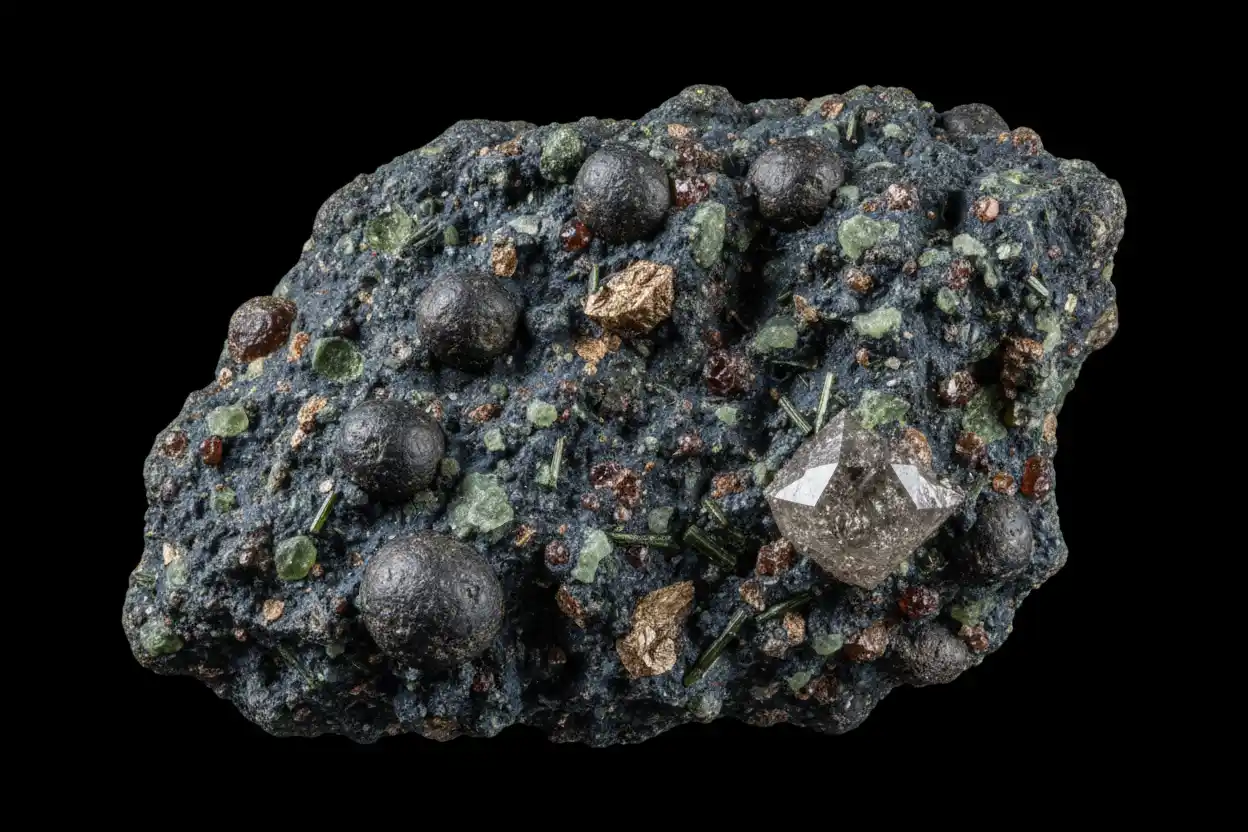
Fresh samples often show rounded olivine grains in a fine dark matrix. Weathered material may appear green, blue gray, brown or yellow.
Under magnification, the rock can contain phlogopite, carbonate, spinel and xenolithic fragments.
Magnetic response varies. Some kimberlites produce clear magnetic anomalies because of iron-bearing minerals, while others are weak or altered.
Petrographic microscopy, whole-rock chemistry and groundmass spinel composition provide stronger confirmation than hand-sample appearance.
The process in how to identify crystals should therefore be adapted for rock texture, geological setting and analytical mineralogy.
Fake Diamond-in-Kimberlite Specimens
Natural diamond crystals in kimberlite matrix exist, but they are much less common in retail trade than ordinary rock.
A seller can glue an industrial diamond, quartz crystal or glass fragment into a drilled cavity. Adhesive around the contact, mismatched weathering and an unnaturally clean exposed crystal provide warning signs.
Some pieces contain no diamond at all but are marketed as “diamond ore” because the kimberlite came from a diamond district.
Other listings use calcite, quartz or pyrite as visible “diamonds.”
The checks in real versus fake diamond help evaluate a suspected crystal, while how to spot fake crystals addresses glue and artificial matrix assembly.
A valuable diamond-bearing matrix specimen should have documented mine provenance and preferably independent confirmation.
Is Kimberlite a Gemstone?
Kimberlite is not a conventional gemstone.
Fresh compact material can be polished into cabochons, spheres, slabs and decorative objects. Some pieces show green olivine, red garnet or dark ilmenite against a fine matrix.
However, many kimberlites are too altered, porous or fractured for a durable polish.
A kimberlite cabochon has value as a geological curiosity rather than for brilliance or transparency.
The rock can also be mounted in educational jewelry, especially when its mine or district is documented. Nevertheless, claims that wearing kimberlite means wearing diamond should be avoided unless the piece contains a verified diamond.
Hardness and Durability
Kimberlite has no single hardness.
Fresh olivine approaches Mohs 6.5–7, while serpentine and carbonate alteration products can fall much lower. Clay-rich weathered kimberlite may crumble under light pressure.
The gemstone hardness chart therefore applies only to identified mineral grains.
Mixed mineralogy and abundant alteration create weak boundaries. The concepts in gemstone toughness versus hardness explain why a hard olivine grain can fall out of a soft weathered matrix.
Polished pieces should be inspected for pits, resin filling and friable edges before jewelry use.
Treatments and Commercial Preparation
Kimberlite specimens may be cleaned, sawn, polished or stabilized.
Resin impregnation can hold altered material together and improve the polish. Clear coating may darken the matrix and prevent loose particles from shedding.
Diamond-bearing matrix can be trimmed to expose a crystal, but aggressive preparation may remove geological context or introduce glue repairs.
The broader treatment framework in gemstone treatments explained helps distinguish stabilization from false diamond assembly.
Diamonds recovered from kimberlite enter a separate treatment and grading market. The article on treated diamond applies to the gem after extraction rather than to the host rock.
Kimberlite Price and Value
Ordinary kimberlite is generally inexpensive. Collector value depends on locality, texture, indicator minerals and verified diamond content.
| Kimberlite Material | Broad Current Asking Range |
|---|---|
| Small rough educational specimen | $5–$25 |
| Better locality specimen | $20–$100 |
| Polished cabochon or slab | $15–$75 |
| Small sphere or decorative object | $75–$250 |
| Large polished sphere or display piece | $200–$500+ |
| Verified diamond-bearing matrix specimen | $200–$2,000+ depending on diamond, provenance and preparation |
| Important historic mine specimen | Highly variable |
A piece from a famous mine can command more than an anonymous fragment, even without visible diamond.
Visible red garnet, green olivine or mantle xenoliths may also create specimen interest. However, those minerals do not prove that the rock is economically diamondiferous.
Diamond price should be evaluated separately through the diamond buying guide or types of diamond rather than assigned from host-rock appearance.
Buying Kimberlite
Ask for a precise locality and whether the specimen comes from a pipe, dike, mine dump or commercial polishing source.
If a diamond is visible, request independent confirmation that it is natural and naturally embedded rather than glued.
The seller should disclose resin, coating, repairs and whether the piece has been searched for diamonds.
“Unsearched kimberlite” does not guarantee that a recoverable diamond remains inside. Commercial mines process enormous quantities of rock because individual gem diamonds are extremely sparse.
A credible educational specimen needs accurate geology more than dramatic marketing.
Cleaning and Storage
Stable solid kimberlite can be dusted with a soft brush or wiped with a barely damp cloth.
Avoid prolonged soaking because carbonate, clay, serpentine and repair resin may respond differently.
Ultrasonic cleaning is inappropriate for altered or xenolith-rich specimens. Vibration can loosen crystals and expand boundaries between hard grains and soft matrix.
Store friable pieces in a closed specimen box. Polished objects should be kept away from harder gems that may scratch the surface or dislodge protruding grains.
Kimberlite Meaning and Symbolism
Kimberlite has no broad ancient gemstone symbolism under its modern geological name.
Contemporary interpretations naturally focus on hidden potential, deep origins and rapid transformation.
Because diamonds may travel within an ordinary-looking dark rock, some people associate kimberlite with recognizing value that is not visible at the surface.
Its mantle fragments can also symbolize learning from material brought up from inaccessible depths. Meanwhile, the fact that most kimberlite contains no economic diamond offers a useful counterpoint: potential should be evaluated through evidence rather than assumption.
These meanings remain personal or modern cultural interpretations. Scientific research does not show that kimberlite attracts wealth, produces resilience or transfers diamond properties to a wearer.
Frequently Asked Questions About Kimberlite
Is kimberlite a mineral?
No. Kimberlite is a variable ultramafic igneous rock containing several minerals and rock fragments.
Does every kimberlite contain diamonds?
No. Most kimberlite bodies contain no economic diamond deposit, and many are completely barren.
Do diamonds form inside kimberlite?
Usually not. Diamonds form in the mantle and are later transported upward as foreign crystals within kimberlite magma.
How deep do diamonds form?
Many form around 150–200 kilometers deep, while some superdeep diamonds originate much farther below.
What does kimberlite look like?
Fresh material may appear dark blue gray, green gray or black with olivine grains. Weathered rock often becomes soft, brown or yellow.
What minerals indicate diamond-bearing kimberlite?
Certain chemical types of pyrope garnet, chromite, chrome diopside and magnesium-rich ilmenite can indicate diamond-favorable mantle conditions.
Is a purple garnet proof of diamonds?
No. Indicator-mineral chemistry must be tested; color alone is insufficient.
Is kimberlite the only diamond source rock?
No. Lamproite can also transport diamonds, and secondary deposits form when erosion moves diamonds into rivers, beaches or marine sediments.
Can kimberlite be polished?
Fresh compact material can be polished, but altered rock may pit, crumble or require stabilization.
How can I tell whether a diamond is naturally embedded?
Examine the contact for glue, drilling and mismatched weathering, then seek independent gemological and geological confirmation.
Is kimberlite valuable without diamonds?
Ordinary material is inexpensive, but famous-locality specimens, mantle xenoliths and well-prepared educational pieces can have collector value.
Can kimberlite go in water?
Brief gentle cleaning may suit stable material. Avoid soaking weathered, resin-filled or carbonate-rich specimens.
Kimberlite belongs in the Crystals That Start With K directory as a geological collector material, but it is a multi-mineral rock rather than a gemstone species.
Safety disclaimer: Kimberlite may contain serpentine, carbonate, mica, clay and other altered ultramafic minerals. Avoid inhaling dust, dry cutting or ingesting particles. Some serpentinite-related material can contain fibrous minerals, so use wet methods, effective extraction, eye protection and suitable respiratory protection during preparation.