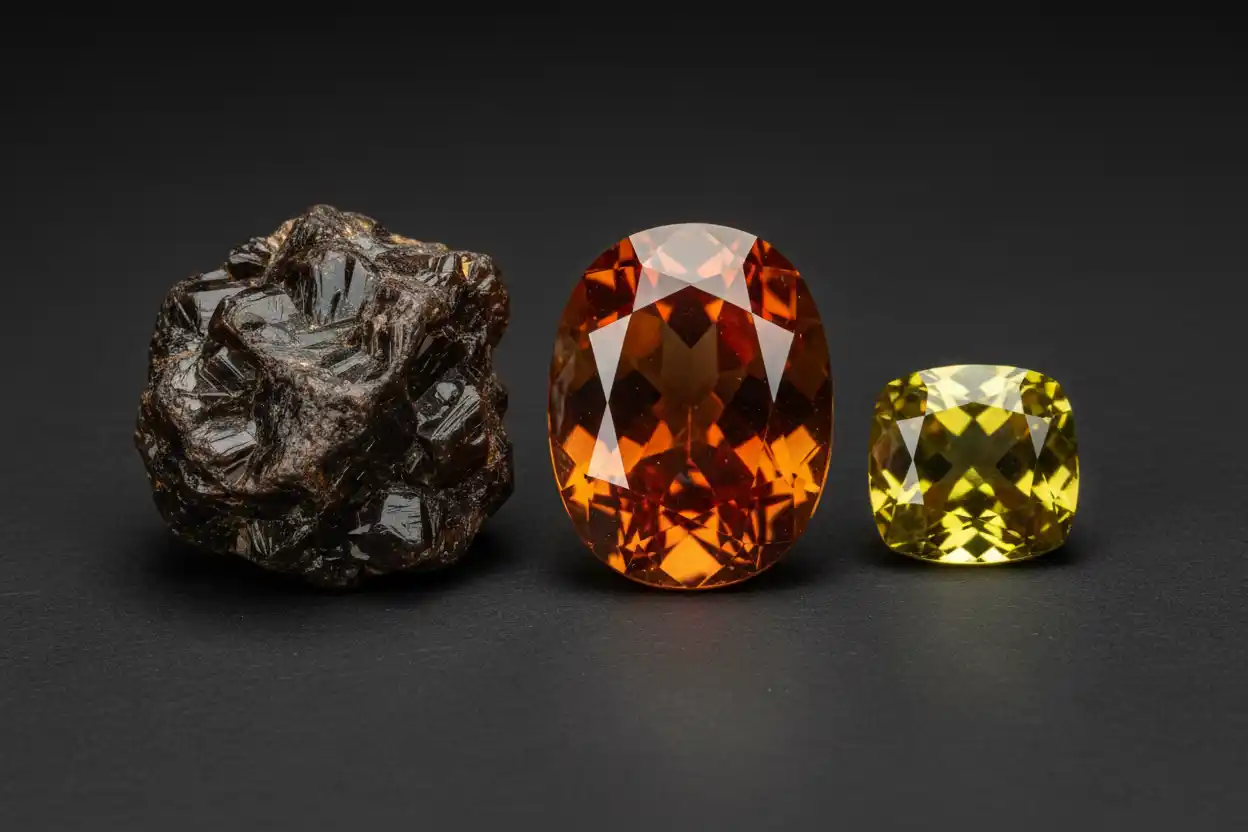
Sphalerite: Meaning, Properties & Symbolism
Sphalerite is a zinc sulfide mineral that serves as the world’s principal zinc ore and, in rare transparent crystals, an exceptionally fiery collector gemstone. Its defining gemological features are an unusually high refractive index, dispersion far stronger than diamond’s, resinous-to-adamantine luster, and perfect cleavage in six directions.
Most sphalerite is brown, black, opaque, or too fractured for cutting. Gem-quality yellow, orange, red, green, and honey-brown material can produce extraordinary brilliance, but its softness and cleavage make it better suited to collections than unrestricted jewelry wear.
Sphalerite at a Glance
| Property | Sphalerite |
|---|---|
| Composition | Zinc sulfide, ideally ZnS, commonly with iron and other substitutions |
| Group or type | Sphalerite-group sulfide mineral |
| Color | Colorless, pale yellow, golden yellow, orange, red, brown, green, grey, black |
| Crystal system or texture | Cubic or isometric |
| Habit | Tetrahedral, dodecahedral, botryoidal, massive, granular, cleavable, twinned |
| Luster | Resinous, adamantine, submetallic, or greasy |
| Transparency | Transparent to opaque |
| Mohs hardness | Approximately 3.5–4 |
| Cleavage | Perfect dodecahedral cleavage in six directions |
| Tenacity | Brittle |
| Common uses | Principal zinc ore, mineral specimens, rare faceted collector gems |
| Primary care concern | Very easy cleavage, scratching, heat, acids, vibration, and potentially hazardous ore-associated dust |
What Is Sphalerite?
Sphalerite is the cubic form of zinc sulfide and the most economically important source of zinc. Its ideal formula is ZnS, although natural specimens commonly contain iron, manganese, cadmium, cobalt, mercury, gallium, germanium, indium, and other trace elements.
The name comes from a Greek word meaning deceptive or treacherous. Early miners found it difficult to identify because sphalerite can resemble several darker metallic ore minerals while lacking their obvious metallic streak.
Older trade and mining names include zinc blende, blende, blackjack, mock lead, ruby blende, and resin jack. These labels may describe appearance or historical mining usage rather than a separate mineral species.
Sphalerite belongs among the sulfide minerals covered in the broader guide to types of gemstones. It also appears in the crystals that start with S and gemstones that start with S directories.
Composition and Crystal Structure
Pure zinc sulfide is colorless or nearly colorless. Natural sphalerite rarely remains chemically pure, and iron commonly replaces part of the zinc.
Its cubic structure contains zinc and sulfur atoms arranged in a framework related to the diamond structure. Despite this symmetry, sphalerite does not share diamond’s hardness or toughness.
Sphalerite is singly refractive because it crystallizes in the cubic system. Therefore, the apparent doubling sometimes seen through a cut stone usually comes from strong dispersion, internal reflection, facet arrangement, or inclusions rather than birefringence.
The mineral can accommodate several technologically important elements. Cadmium, gallium, germanium, and indium may become concentrated within its structure or in microscopic associated phases.
This geochemical flexibility makes sphalerite important beyond zinc production. Ore geologists examine its trace-element chemistry to understand deposit formation, processing behavior, and potential critical-mineral resources.
Why Sphalerite Has So Much Fire
Transparent sphalerite has a refractive index near 2.37, placing it among the most optically dense natural gem materials. More strikingly, its dispersion is approximately 0.156—more than three times diamond’s commonly quoted value.
Dispersion separates white light into spectral colors. In a properly cut sphalerite, bright red, orange, yellow, green, blue, and violet flashes can appear around facet junctions.
Strong fire does not guarantee an attractive gemstone. Dark body color can absorb the spectral flashes, while a windowed or poorly proportioned cut allows light to escape through the back.
The best faceted stones balance medium body color, high transparency, accurate proportions, clean polishing, and enough depth to return light without becoming dark.
Sphalerite is sometimes compared with sphene, another soft collector gem known for intense dispersion. Sphene is doubly refractive and has a different crystal system, composition, density, and cleavage.
Sphalerite Colors and Their Causes
Low-iron sphalerite can appear colorless, pale yellow, lemon yellow, honey, orange, or red. Increasing iron commonly shifts the mineral toward brown, reddish brown, dark brown, and black.
Iron affects both color and transparency. Highly iron-rich sphalerite may develop a submetallic luster and become nearly opaque.
Manganese can contribute yellow, orange, or reddish coloration in some deposits. Cobalt has been associated with green material, while trace-element combinations and structural defects can produce less common colors.
Some transparent Spanish stones show vivid yellow-orange, orange-red, or reddish-brown colors with exceptional brilliance. Mexican, Bulgarian, and other material can display honey, amber, greenish yellow, or red-brown tones.
Gem-quality sphalerite appears naturally in comparisons of yellow gemstones, orange gemstones, and brown gemstones. However, color alone cannot distinguish it from zircon, garnet, sphene, glass, or synthetic substitutes.
Named Varieties and Historic Terms
Cleiophane is a traditional name for pale, low-iron sphalerite. It may appear colorless, yellow, greenish, or light brown and can be transparent enough for faceting.
Marmatite describes dark, iron-rich sphalerite. It usually appears brownish black to black and commonly has a submetallic appearance.
Ruby blende refers to transparent or translucent red, reddish-orange, or reddish-brown material. The term is historical and does not indicate actual ruby.
Blackjack is a mining term generally used for dark, impure, or iron-rich sphalerite. Resin jack refers to yellowish or brown material with a resinous luster.
These names remain useful in historical labels, but modern sellers should still identify the mineral as sphalerite and disclose the exact locality, condition, and gemological quality.
How Sphalerite Forms
Sphalerite develops in several major ore-deposit environments. Hydrothermal fluids transport zinc and sulfur through fractures, porous sediment, volcanic rocks, and carbonate sequences.
When temperature, pressure, acidity, or sulfur activity changes, zinc sulfide precipitates. Sphalerite may grow as individual crystals, massive ore, layered bands, breccia cement, or fine disseminated grains.
Mississippi Valley-type deposits form when warm saline fluids move through carbonate rocks. Sphalerite from these deposits commonly occurs with galena, calcite, dolomite, fluorite, barite, and quartz.
Volcanogenic massive sulfide deposits develop in submarine volcanic environments. There, sphalerite may occur with chalcopyrite, pyrite, galena, and other sulfides.
Sedimentary-exhalative deposits form when metal-bearing fluids enter marine basins and precipitate layered sulfide ores. Skarns, replacement deposits, pegmatites, and high-temperature veins can also contain sphalerite.
The mineral may preserve multiple growth episodes. Color zoning, iron-rich cores, pale rims, chalcopyrite inclusions, healed fractures, and chemical banding record changing fluid conditions.
Crystal Habits and Twinning
Sphalerite commonly forms tetrahedral, dodecahedral, or complex distorted crystals. Curved faces, stepped growth, repeated twinning, and rounded aggregates are frequent.
Twins may create flattened, cyclic, contact, or interpenetrating forms. Complex groups can resemble octahedra even though their underlying crystal geometry differs.
Massive sphalerite often cleaves into shiny, stepped fragments. Fresh cleavage surfaces can reveal resinous brown, yellow, red, or black color beneath weathered crusts.
Botryoidal and stalactitic habits also occur. In polished sections, these forms may show concentric zoning or alternating mineral layers.
Crystal shape varies with locality and associated minerals. Sharp black crystals on white calcite create a different collector market from transparent orange crystals intended for faceting.
Inclusions in Gem-Quality Sphalerite
Transparent sphalerite frequently contains small crystals, fluid inclusions, growth tubes, healed fractures, cleavage traces, and fine particulate clouds.
Chalcopyrite may occur as tiny golden inclusions. Under magnification, some specimens show oriented triangular or three-rayed patterns connected with internal structural features.
Color zoning can follow growth sectors. A pale yellow rim around a darker orange or brown core may influence cutting orientation.
Surface-reaching fractures are important because sphalerite cleaves easily. They can reduce durability and may trap oil, polishing residue, resin, or dirt.
Inclusions are expected in many collector stones. Their effect on value depends on whether they interfere with fire, threaten durability, or provide unusual scientific interest.
Important Sphalerite Localities
The Áliva mining district in Cantabria, Spain, is one of the best-known sources of transparent yellow, orange, and reddish faceting material. Well-cut stones from this area can display exceptionally strong brilliance and dispersion.
The Picos de Europa region also produces attractive crystals with dolomite, calcite, and other carbonate minerals. Precise mine-level provenance increases collector interest.
Naica and Santa Eulalia in Mexico have yielded notable crystals and ore specimens. Mexican material may be honey-colored, brown, reddish, black, or transparent enough for limited cutting.
The Madan ore field in Bulgaria is famous for lustrous crystals associated with galena, quartz, calcite, and rhodochrosite. Trepča in Kosovo has produced important sulfide assemblages and classic sphalerite specimens.
Elmwood and other central Tennessee localities in the United States are known for dark lustrous sphalerite with fluorite, calcite, barite, and galena.
Dalnegorsk in Russia, Huanzala in Peru, Broken Hill in Australia, the Balmat district in New York, and numerous Canadian, Chinese, Romanian, German, and English deposits have also produced significant material.
How to Identify Sphalerite
Visual identification begins with luster, color, density, streak, cleavage, and geological association.
Sphalerite often has a resinous luster that looks different from the metallic surface of galena or the brassy shine of pyrite. Transparent specimens can appear strongly adamantine.
Its streak ranges from white or pale yellow in low-iron material to brown in iron-rich varieties. Streak testing removes material and should not be used on finished gems or valuable specimens.
Specific gravity commonly falls around 3.9–4.1. A transparent stone therefore feels heavier than quartz, feldspar, glass, or many similarly colored gems.
Perfect cleavage in six directions is highly characteristic. A broken specimen can form dodecahedral fragments, although deliberately testing cleavage risks destroying the piece.
A standard refractometer cannot measure many sphalerites because the refractive index exceeds the range of ordinary contact liquids. Gemologists instead use microscopy, specific gravity, spectroscopy, reflectivity, and Raman analysis.
The broader how to identify crystals guide explains why several compatible observations provide more confidence than a single home test.
Sphalerite Lookalikes
Cassiterite can resemble dark brown or black sphalerite. Cassiterite is harder, much denser, and commonly shows different crystal habits and a lighter streak.
Dark garnet may imitate reddish-brown sphalerite. Garnet is harder, lacks sphalerite’s perfect six-direction cleavage, and usually has lower dispersion.
Zircon can show strong fire and yellow, orange, or brown color. It is harder and has different refractive, birefringent, and spectral properties.
Sphene produces intense dispersion but normally shows visible facet doubling, wedge-shaped crystals, and different cleavage.
Synthetic zincite may be orange, yellow, red, or green and can display high brilliance. Its composition, crystal structure, refractive properties, and inclusions differ from sphalerite.
Glass can imitate color but rarely reproduces the combined density, refractive index, fire, cleavage, and natural inclusions.
Treatments and Enhancement
Routine enhancement is uncommon because sphalerite’s low durability makes many treatment processes risky.
Oiling may conceal surface-reaching fractures temporarily. Resin or polymer filling can stabilize fractured material, but such treatment should be disclosed.
Surface coating can alter color or create a stronger metallic appearance. Coatings may show wear along facet edges, scratches, or the girdle.
Specimens may be repaired, reattached to matrix, trimmed, acid-cleaned, or stabilized. Cleaning is especially relevant when calcite, sulfides, or weathered coatings occur together.
Heat treatment is not a standard commercial route for improving faceted sphalerite. High heat could promote fracture, oxidation, sulfur loss, or damage along cleavage.
The gemstone treatments explained guide covers filling, coating, stabilization, and repair terminology.
Synthetic Sphalerite and Imitations
Synthetic zinc sulfide can be produced for optical, electronic, research, and industrial applications. Laboratory material may have sphalerite or wurtzite structure depending on growth conditions.
Commercial synthetic faceted sphalerite is uncommon, partly because natural collector material already occupies a small market and the stone remains too fragile for mainstream jewelry.
Synthetic zincite, cubic zirconia, glass, sphene, zircon, and high-dispersion garnets may be confused with sphalerite.
Marketplace listings occasionally use phrases such as “sphalerite quartz,” “sphalerite-color stone,” or “sphalerite doublet.” These descriptions may refer to an imitation rather than sphalerite.
The distinction among natural gems, laboratory-grown materials, simulants, and assembled stones is explained in lab-grown vs natural gemstones.
Cutting and Faceting Behavior
Faceting sphalerite requires considerable skill. The cutter must work around perfect cleavage, low hardness, fractures, inclusions, dark color, and heat sensitivity.
Preforming pressure must remain light. A small catch on a lap can split the rough along a cleavage plane and destroy most of the expected yield.
Orientation affects both color and light return. Medium yellow-orange rough may produce stronger brilliance than a darker red-brown piece of equal clarity.
Designs with broad mains and carefully controlled angles can showcase dispersion. Overly complex facets may create visual confusion because the stone already produces abundant spectral flashes.
Polishing can be slow and unpredictable. Softness allows rapid material removal, while cleavage causes edge chipping and torn facets if pressure or lap condition is wrong.
Most cut sphalerite should retain a protective girdle rather than an extremely thin edge. Recutting a finished collector stone carries substantial risk.
Durability and Jewelry Suitability
Sphalerite has poor jewelry durability despite its extraordinary appearance. Its hardness of 3.5–4 means ordinary dust and common jewelry materials can scratch it.
Six directions of perfect cleavage create an even greater problem. A sharp blow or uneven setting pressure can split the gem.
Faceted sphalerite is best kept as a loose collector stone. Pendants, brooches, or earrings can work when the gem has a protective setting and receives only occasional wear.
Rings are generally unsuitable, especially for daily use. A raised prong setting exposes both the table and girdle to impact.
A jeweler should examine the stone before any mounting, repair, or resizing. Direct heat, ultrasonic vibration, steam, and aggressive pressure should be avoided.
Sphalerite Value and July 2026 Asking Prices
The workbook contains a dedicated sphalerite price page, so detailed valuation belongs there. Still, current asking prices provide useful context.
As of July 2026, small ordinary mineral specimens commonly appear around $15–$75. Attractive crystals on calcite, quartz, or sulfide matrix often ask $75–$500, while major classic-locality specimens can reach several thousand dollars.
Faceted sphalerite asking prices commonly fall around $40–$200 per carat for marketable yellow, orange, greenish, or reddish stones. Included, dark, poorly cut, or unusually large commercial pieces may sell below that range per carat.
Cleaner precision-cut stones with vivid medium color and strong brilliance can exceed $200 per carat. However, the thin collector market, fragility, and lack of standardized grading make direct comparisons difficult.
Rarity does not automatically create value. A dark stone that hides its dispersion may be less desirable than a smaller, brighter, well-proportioned gem.
The how gemstone prices work guide explains why color, clarity, size, cut, treatment, and market demand must be considered together.
Buying Sphalerite
The dedicated sphalerite buying guide owns detailed purchasing intent. Before buying, determine whether the target is a natural crystal, matrix specimen, faceted loose stone, or finished jewelry.
For a faceted gem, request the weight, dimensions, color in neutral lighting, clarity, treatment disclosure, origin claim, and a rotating video. The video should reveal both spectral fire and any window through the center.
Inspect facet junctions and the girdle for abrasion or chips. A bright stone can still have serious cleavage-related damage.
Ask whether fractures have been oiled or filled. A seller should also disclose coatings, repairs, doublets, or synthetic substitutes.
For mineral specimens, obtain the exact mine or district, overall dimensions, crystal size, condition, and restoration history. The words “Spanish sphalerite” are less useful than a documented Áliva or Picos de Europa provenance.
General transaction checks appear in how to buy gemstones online.
Cleaning and Storage
Clean a stable faceted sphalerite with a barely damp soft cloth. When necessary, use lukewarm water and a small amount of mild soap, then dry it immediately.
Avoid soaking. Water can enter surface-reaching fractures and affect associated minerals, resin, glue, or weathered ore material.
Do not use acids, bleach, ammonia, abrasive polish, steam, or sudden temperature changes. Acids may attack sulfide surfaces or associated carbonates.
Ultrasonic cleaning is inappropriate. The guidance on gemstones in ultrasonic cleaners is especially relevant because vibration can trigger cleavage or enlarge hidden fractures.
Store faceted sphalerite individually in a padded gem box. Keep it away from quartz, topaz, corundum, diamond, and metal edges.
Specimens should remain in fitted boxes that support the matrix rather than individual crystals. Limit unnecessary handling of dark, earthy, or altered ore material.
Sphalerite Meaning and Symbolism
Sphalerite has a stronger mining and scientific history than an ancient gemstone tradition. Its modern symbolism often draws from its hidden fire, variable appearance, and historic reputation as a deceptive mineral.
Collectors and contemporary crystal traditions may associate it with discernment, recognizing misleading appearances, practical judgment, and separating useful information from distraction.
Its relationship with zinc mining can inspire themes of resourcefulness, adaptability, and finding value within material that initially appears ordinary or dark.
Transparent orange and yellow stones are sometimes connected symbolically with confidence, creativity, motivation, and curiosity. Dark sphalerite may represent grounded analysis or caution.
These interpretations remain personal and spiritual beliefs. Scientific evidence does not show that sphalerite treats disease, corrects zinc deficiency, changes metabolism, or produces guaranteed emotional effects.
Frequently Asked Questions
1. Is sphalerite a gemstone or an ore?
It is primarily the world’s most important zinc ore. Rare transparent crystals are faceted as collector gemstones.
2. Why does sphalerite show more fire than diamond?
Its dispersion is much higher, so it separates white light into spectral colors more strongly when the cut and transparency allow it.
3. What color is pure sphalerite?
Chemically pure ZnS is colorless or nearly colorless. Iron and other substitutions produce most natural colors.
4. What is ruby blende?
Ruby blende is a historical name for reddish, orange-red, or red-brown transparent sphalerite, not a type of ruby.
5. What is marmatite?
Marmatite is an iron-rich, dark brown-to-black variety of sphalerite.
6. Why does sphalerite cleave so easily?
Its crystal structure contains preferred bonding planes that allow perfect dodecahedral cleavage in six directions.
7. Can sphalerite be worn in an engagement ring?
No. Low hardness and perfect cleavage make it unsuitable for unrestricted daily ring wear.
8. Is Spanish sphalerite naturally orange?
Yes. Gem material from northern Spain naturally occurs in yellow, orange, red-orange, brown, and related shades.
9. How can sphalerite be distinguished from sphene?
Sphalerite is cubic and singly refractive, while sphene is monoclinic, strongly doubly refractive, and has different density and cleavage.
10. Is synthetic sphalerite common?
Laboratory zinc sulfide exists for technical uses, but synthetic faceted sphalerite is uncommon in ordinary jewelry commerce.
11. Can sphalerite go in an ultrasonic cleaner?
No. Ultrasonic vibration can enlarge fractures or cause cleavage-related breakage.
12. What information should accompany valuable sphalerite?
A serious listing should include identity, weight or dimensions, exact locality, condition, treatment or repair disclosure, and laboratory documentation when appropriate.
Sphalerite is most rewarding when treated as a precision-cut optical specimen rather than a conventional durable jewel. Its exceptional fire can be fully appreciated only when the stone’s cleavage, condition, and limitations remain clearly understood.
Sphalerite and its host rock may contain cadmium, lead, arsenic, mercury, or other potentially hazardous ore-associated elements. Do not ingest the material, prepare drinking water with it, or inhale dust created by cutting, drilling, sanding, or weathered specimens. Lapidary work requires wet methods, local exhaust ventilation, eye protection, suitable respiratory protection, and controlled waste handling.