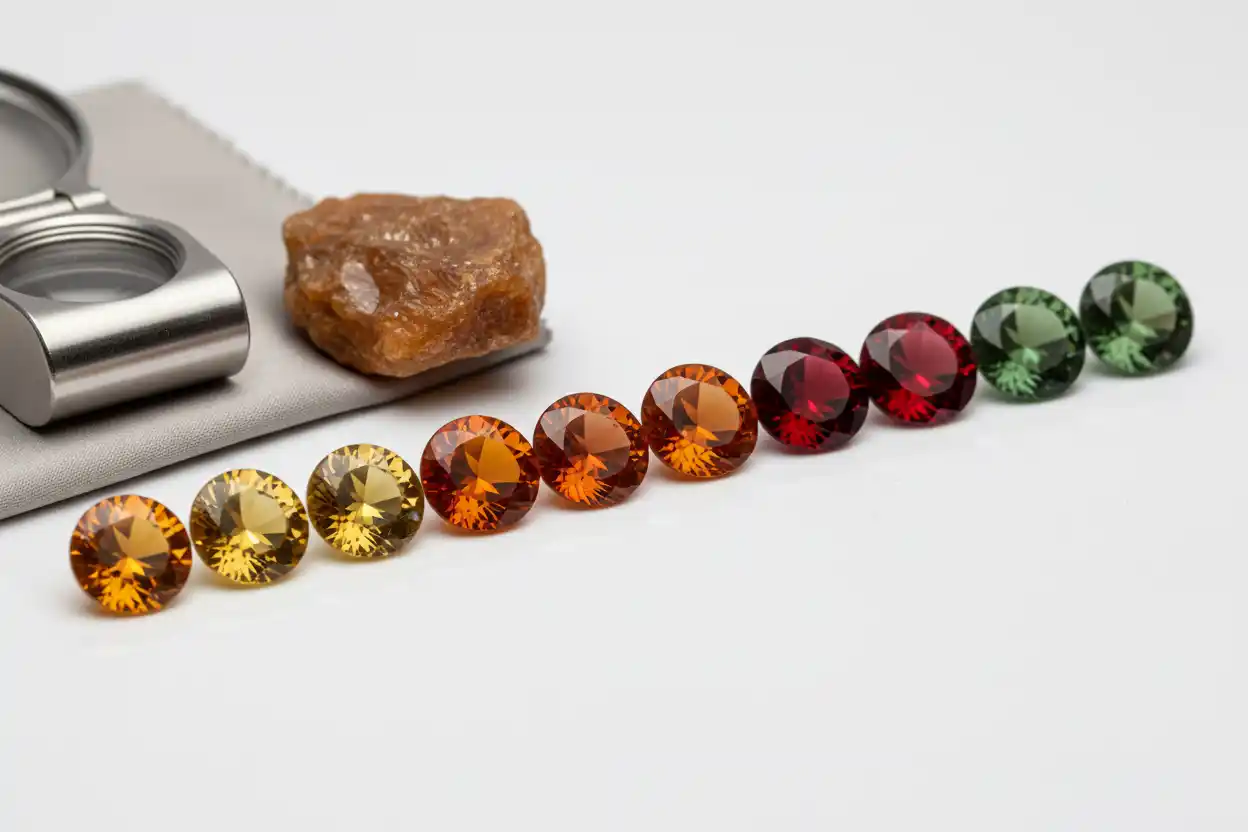
Sphalerite Price: Value Drivers, Condition, Quality & Rarity
Sphalerite price is determined by a highly specialized combination of gem-quality rarity, transparency, bodycolor, extreme dispersion, cutting difficulty, carat weight, origin, condition, and collector demand. The mineral itself is not rare in an industrial sense because sphalerite is the principal ore of zinc, but transparent facetable material represents only a tiny fraction of ordinary production. GIA describes pure sphalerite as colorless and explains that iron progressively shifts color through yellow, red, brown, and eventually submetallic black, while cobalt can create green. Most importantly for gem valuation, sphalerite combines a refractive index near 2.37 with dispersion greater than 0.150, producing remarkable brilliance and fire when properly cut.
The market is constrained by fragility as much as scarcity. Sphalerite is only Mohs 3.5–4, has brittle tenacity, and shows perfect cleavage, properties that make high-quality cutting technically difficult and finished gems vulnerable to scratches, chips, and breakage. A beautifully precision-cut transparent stone can therefore command far more than ordinary sphalerite rough because the buyer is paying for rare optical-quality material plus specialized lapidary skill. At the same time, large size alone is not enough to establish exceptional value because GIA reports that Spanish deposits can produce orange and red sphalerite weighing hundreds of carats.
Sphalerite Price At a Glance
| Value Driver | What Usually Raises Sphalerite Price | What Can Lower Sphalerite Price |
|---|---|---|
| Gem Quality | Transparent facet-grade material | Ordinary opaque ore material |
| Color | Bright yellow, golden, orange, red-orange, rare clean green | Muddy brown, excessively dark, near-opaque color |
| Transparency | High transparency | Cloudiness, fractures, opacity |
| Dispersion | Strong visible spectral fire | Poor cut that suppresses fire |
| Brilliance | Excellent light return | Large window, extinction, weak polish |
| Cut | Expert precision cutting | Poor symmetry, damaged facets, careless polishing |
| Carat Weight | Larger fine transparent stone | Size without quality |
| Spanish Origin | Fine documented Cantabria material | Unsupported origin claims |
| Green Color | Credibly identified cobalt-related green | Seller-only trace-element story |
| Natural Origin | Confirmed natural sphalerite | Synthetic ZnS when compared with natural |
| Condition | Sharp facet junctions and pristine polish | Scratches, chips, cleavage damage |
| Cleavage Integrity | No visible cleavage breaks | Existing splits or structural weakness |
| Mineral Specimen Quality | Sharp crystal form and provenance | Broken or repaired ordinary ore material |
| Documentation | Independent identification | Generic seller certificate |
| Liquidity | Strong specialist collector interest | Very narrow resale market |
Transparent Gem Quality Is the First Major Price Separation
The most fundamental sphalerite price distinction is between ordinary mineral material and transparent facetable rough. GIA explicitly states that sphalerite is rarely gem quality despite being an important zinc ore mineral. A brown or black opaque crystal can be perfectly genuine sphalerite yet belong to a mineral-specimen or industrial category rather than the high-value faceted market.
This distinction explains why online prices can appear contradictory. One seller may offer a large dark natural crystal inexpensively while another asks a much stronger price for a tiny transparent yellow or orange stone. The mineral species is the same, but the optical quality and lapidary potential are not.
Color Matters Because It Controls Both Beauty and Light Transmission
Pure sphalerite is colorless, while iron progressively introduces yellow, red, brown, and eventually black appearance. As iron increases, the stone can become richer in bodycolor but also darker and less transparent, creating a tradeoff between saturated color and the brilliance required to display dispersion effectively.
The strongest market typically rewards stones that retain enough transparency to show their famous fire. Yellow, golden, orange, and red-orange material can be particularly attractive because warm bodycolor combines with spectral flashes without becoming too dark. Brown and near-black stones may still have collector value but generally lose much of the faceted-gem appeal when light transmission becomes weak.
Colorless Sphalerite Can Display Maximum Spectral Fire
Low-iron sphalerite can approach colorless or very pale appearance. Mindat uses the cleiophane variety name for low-Fe colorless, white, or green material. Without strong bodycolor masking spectral separation, a well-cut near-colorless gem can display extraordinary rainbow fire.
Colorless material does not automatically command the highest price because collectors may prefer saturated warm colors, but exceptional transparency combined with precise cutting can make it highly desirable. Identification also becomes particularly important because a colorless faceted stone provides fewer obvious visual clues to species.
Golden and Yellow Sphalerite Balance Color With Dispersion
Yellow gemmy sphalerite is often called golden sphalerite. Fine material can look intensely bright because the yellow bodycolor remains transparent enough for spectral fire to flash across the stone.
This balance can make golden sphalerite one of the most commercially attractive categories. A vivid yellow stone with high transparency and precision cutting can deserve a stronger premium than a larger dark brown stone because the buyer sees both bodycolor and dispersion clearly.
Orange and Red Sphalerite Can Reach Strong Collector Values
GIA’s Spanish sphalerite study describes Cantabria material producing orange and red stones, including very large crystals suitable for exceptional faceting. Saturated orange-red with high transparency can therefore command strong collector interest, particularly when cutting reveals both warm bodycolor and intense dispersion.
The strongest price should still correspond to optical quality. A dark red-brown stone that absorbs much of the returning light should not automatically cost more than a brighter golden-orange gem merely because the hue sounds rarer.
Green Sphalerite Can Create a Specialized Premium
GIA states that cobalt can produce green sphalerite, while Mindat describes green crystals as very rare relative to ordinary brown and black material. A transparent green specimen can therefore occupy a specialized collector category, especially if chemical analysis supports the color origin.
The premium should not be based solely on a seller writing cobalt on an invoice. Trace-element claims used to justify substantial prices deserve analytical evidence, particularly because other green transparent minerals can resemble sphalerite in photographs.
Dispersion Is One of Sphalerite’s Defining Value Drivers
GIA reports dispersion above 0.150, an extraordinarily high figure that allows faceted sphalerite to produce intense spectral separation. This “fire” differentiates gem sphalerite from many yellow, orange, and red stones that may share similar bodycolor but lack comparable optical performance.
A sphalerite price premium is therefore most defensible when the cut actually displays that advantage. A poorly polished, windowed, or overly dark stone may possess high intrinsic dispersion but fail to show it visually, much like a poorly cut diamond can suppress properties that exist physically in the material.
Cut Quality Can Be Worth More Than Additional Carat Weight
Sphalerite’s softness, brittleness, and perfect cleavage make it difficult to facet and polish successfully. GIA’s Spanish example emphasizes the role of an experienced artisan capable of working around these vulnerabilities while positioning the color pattern effectively.
This makes precision cutting a genuine economic contributor. A ten-carat stone with sharp polished facets, strong brilliance, and spectacular fire can deserve more than a fifteen-carat gem whose surfaces are scratched, proportions leak light, or cleavage-related damage remains visible.
Poor Polish Is Particularly Expensive on a High-RI Gem
Sphalerite’s high refractive index can create exceptional brilliance only when facet surfaces are polished cleanly enough to transmit and reflect light effectively. Fine scratches, polishing drag, rounded facet junctions, and surface abrasion reduce that performance immediately.
Because Mohs hardness is only 3.5–4, even an originally superb polish can deteriorate more quickly than on sapphire or spinel if the gem is worn carelessly. Condition therefore becomes a much larger resale-price factor than buyers accustomed to harder gemstones may expect.
Windowing Can Destroy Much of the Optical Premium
A shallow sphalerite may display a transparent window across the center where the observer sees directly through the stone. This sacrifices both brilliance and spectral fire, the two properties that justify buying faceted sphalerite in the first place.
Weight-retention cutting should therefore be penalized when it creates a large window. A smaller, properly proportioned stone can command a stronger per-carat value because more of its surface contributes to the optical effect.
Excessive Depth Can Hide Carat Weight
Deep pavilions can preserve rough but reduce visible spread and may intensify bodycolor enough to make the stone appear darker. A twenty-carat sphalerite with substantial hidden depth can consequently look smaller than a well-cut fifteen-carat stone and may display less balanced fire.
Price comparisons should always include millimeter dimensions, not merely carat weight. This principle becomes especially important in dense material such as sphalerite, whose specific gravity is around 3.9–4.1.
Large Fine Sphalerite Exists
GIA states that Spanish deposits can yield orange and red stones weighing hundreds of carats, while Gemdat’s contributed records include faceted examples above 300 carats. This proves that large sphalerite is possible and prevents simplistic claims that every ten- or twenty-carat specimen must be extraordinarily rare.
The premium belongs to large size combined with transparency, attractive color, expert cutting, and pristine condition. A massive dark opaque crystal and an enormous transparent precision-cut gem are economically different products.
Cantabria, Spain, Is an Important Facet-Grade Benchmark
GIA identifies Santander in Cantabria as a source known for producing exceptional facet-grade sphalerite. Fine Spanish provenance can therefore add marketability, particularly to large orange or red stones whose characteristics align with the material for which the region is famous.
Origin should still be documented and should not override the individual gem. A scratched, fractured, or poorly cut Spanish stone may be worth less than a smaller exceptional sphalerite from another locality.
Natural and Synthetic Sphalerite Have Different Price Structures
Gemdat documents synthetic sphalerite, or laboratory-grown ZnS, in transparent colorless, green, and yellow material. Synthetic ZnS can be optically impressive but lacks the geological rarity and mining history of natural gem sphalerite.
A laboratory-grown specimen can be an excellent demonstration material or affordable optical collector piece when accurately disclosed. It should not receive a natural-gem premium merely because its chemistry closely matches the natural mineral.
Natural Origin Should Be Confirmed When Price Is Significant
An unusually clean, bright, high-dispersion gem can look convincing regardless of whether it formed in the earth or in controlled conditions. Independent gemological testing is therefore worthwhile when the asking price reflects natural rarity.
A generic invoice stating “natural sphalerite” is useful but weaker than a laboratory report from an institution capable of identifying unusual colored gemstones and separating synthetic material where necessary.
Treatment Is Not the Main Market Hierarchy
Current authoritative references emphasize natural composition, color-causing trace elements, physical properties, and synthetic material rather than describing a standardized routine enhancement industry for sphalerite. This means the sphalerite market does not currently mirror ruby’s heating hierarchy or emerald’s fracture-filling hierarchy in ordinary consumer discussion.
That does not prove treatment is impossible. Sellers should disclose any known modification, but buyers should focus first on natural-versus-synthetic identity, transparency, cutting, and condition rather than paying large premiums solely for an unsupported “untreated” claim.
Softness Reduces Wearability and Influences Price
Mohs 3.5–4 means sphalerite can be scratched by many common jewelry materials and abrasive particles. A faceted stone intended for frequent wear will therefore accumulate surface damage more readily than quartz, garnet, spinel, sapphire, or diamond.
This practical limitation can restrict mainstream jewelry demand even when the gem’s optical properties are spectacular. Collector demand rather than bridal or daily-wear demand consequently plays a larger role in sphalerite pricing.
Perfect Cleavage Creates Additional Breakage Risk
GIA and Mindat both document perfect cleavage, and GIA specifically connects sphalerite’s softness, brittleness, and cleavage with the difficulty of cutting and polishing the gem. A sharp impact can therefore produce serious damage even when the blow would leave a tougher gemstone intact.
Existing cleavage-related damage lowers value significantly because repair may require substantial recutting and weight loss. Corners, culets, girdles, and areas around visible fractures deserve careful inspection.
Condition Can Change Secondhand Value Dramatically
A pristine precision-cut sphalerite and an otherwise similar stone with facet scratches, chipped edges, or cleavage damage should not be valued equally. Surface damage directly interferes with brilliance and dispersion, while structural damage can make future setting risky.
Repolishing is possible but can be technically challenging because the material is soft and cleavable. A repair may also alter the original facet design that made the stone desirable.
Jewelry Setting Quality Matters More Than Usual
Sphalerite should not be tension set or exposed unnecessarily to impacts. A protective pendant or earring design can preserve the gem much more effectively than a high-set everyday ring. The value of a well-designed mounting therefore includes practical protection rather than decoration alone.
A luxury ring containing sphalerite may cost considerably more than the loose stone because custom protective engineering, metalwork, and side stones contribute to the finished price. Those components should be separated when comparing loose sphalerite prices.
Sphalerite Price Versus Spessartite Garnet Price
Gems Lore’s spessartite garnet price guide covers another vivid orange market but with far greater jewelry durability. Garnet hardness is roughly 6.5–7.5 and toughness fair to good, whereas sphalerite is only 3.5–4 with perfect cleavage.
Sphalerite can deliver much stronger dispersion and extraordinary fire, while spessartine is a better practical choice for everyday jewelry. Their prices therefore reflect different combinations of rarity, optics, and utility.
Sphalerite Price Versus Citrine Price
The Gems Lore citrine price guide covers a much more abundant quartz market. Citrine is harder and easier to maintain but has dramatically lower dispersion, while sphalerite can look optically explosive when expertly cut.
The rarity premium for sphalerite is consequently understandable only when the stone is genuinely transparent, well cut, and in excellent condition.
Sphalerite Price Versus Fire Opal Price
Fire opal price reflects bodycolor, transparency, play-of-color where present, origin, treatment, and durability. Sphalerite instead derives much of its visual impact from refractive index and dispersion.
Both can be delicate relative to sapphire or garnet, but their optical attractions are fundamentally different and should not be compared by orange color alone.
Sphalerite Price Versus Heliodor Price
Golden heliodor is beryl, substantially harder and more practical for jewelry than sphalerite. Fine heliodor can occur clean and large, while sphalerite’s rarity premium is driven more strongly by scarce transparent rough and extreme optical fire.
A collector seeking unusual optics may prefer sphalerite, while a wearer prioritizing durability may prefer heliodor.
Sphalerite Price Versus Scapolite Price
The Gems Lore scapolite price guide covers another relatively niche faceted mineral, but scapolite’s hardness and optical behavior differ markedly. Sphalerite’s much higher refractive index and dispersion give it a visually distinctive advantage, while its softness and cleavage create stronger ownership limitations.
Both markets reward precise identification because unusual collector gemstones are easier to mislabel than mainstream gems.
AAA and AAAA Do Not Standardize Sphalerite Price
No universal laboratory AAA or AAAA quality scale exists for sphalerite. An expensive gemstone should instead be described through natural-versus-synthetic identity, hue, tone, transparency, inclusions, dispersion display, cut, dimensions, weight, origin, condition, and documentation.
A factual report plus detailed video is more useful than an undefined “AAAA+ museum quality” label.
Retail Price and Resale Value Can Differ Greatly
Sphalerite has a specialized buyer base. Retailers may hold exceptional stones for a long time, incur cutting and certification costs, and charge margins that reflect slow inventory turnover. An owner attempting immediate resale may therefore receive a substantially lower offer even when the gem is objectively rare and beautiful.
This difference demonstrates that rarity does not guarantee liquidity. Fine sphalerite can be difficult to replace yet still require the right collector to achieve a strong resale price.
What Usually Raises Sphalerite Price?
Sphalerite price generally rises with confirmed natural origin, high transparency, attractive yellow, golden, orange, red-orange, or rare green color, exceptional visible dispersion, strong brilliance, expert precision cutting, pristine polish, larger size with optical quality maintained, credible Spanish or other important provenance, absence of cleavage damage, and independent gemological documentation.
What Usually Lowers Sphalerite Price?
Opaque appearance, muddy brown or near-black tone in a faceted gem, heavy fractures, cleavage damage, poor polish, large windows, excessive depth, weak spectral fire because of poor cutting, synthetic material represented as natural, unsupported provenance, scratches, chips, ordinary ore material marketed as facet-grade rarity, and undefined seller grades can all reduce value substantially.
How to Compare Sphalerite Prices Fairly
Compare transparent faceted stones only with other transparent faceted sphalerites and align natural-versus-synthetic origin, hue, tone, transparency, clarity, visible fire, cut, polish, dimensions, weight, cleavage condition, provenance, report status, and transaction type. A 10 ct Spanish orange precision-cut sphalerite, 100 ct opaque brown crystal, synthetic colorless ZnS, green cobalt-bearing specimen, citrine, fire opal, and spessartine garnet should never be combined into one universal per-carat average.
Conclusion
Sphalerite price reflects an unusual tradeoff between spectacular optics and severe physical fragility. GIA describes gem-quality sphalerite as rare and reports a refractive index near 2.37 with dispersion above 0.150, properties capable of producing exceptional brilliance and rainbow fire. Fine Spanish material can occur in very large sizes, so weight alone cannot explain value; transparency, color, precision cutting, and condition are more important.
The stone’s softness and perfect cleavage shape the market just as strongly. Mohs hardness of only 3.5–4, brittle tenacity, and perfect cleavage make sphalerite vulnerable to scratches, chipping, and breakage that would be much less serious in garnet or sapphire. A pristine expertly cut gem consequently deserves a craftsmanship and condition premium.
Synthetic sphalerite also exists, so natural-origin documentation matters for expensive specimens. The strongest valuation therefore begins with species and origin verification, then evaluates transparency, bodycolor, fire, cutting, carat weight, provenance, condition, and the specialized nature of the collector market rather than relying on generic rare-gem pricing claims.
Frequently Asked Questions
How much is sphalerite worth per carat?
There is no universal sphalerite price per carat because ordinary opaque mineral material, transparent facet-grade gemstones, precision cuts, rare colors, and synthetic ZnS occupy different markets.
Why is gem-quality sphalerite valuable?
GIA states that sphalerite is rarely gem quality, while fine transparent stones can show exceptional brilliance and dispersion.
What sphalerite colors are most valuable?
Bright transparent yellow, golden, orange, red-orange, and unusual green can attract strong collector interest. Value depends on transparency and cutting as much as hue.
Why does sphalerite show so much fire?
Its refractive index is around 2.37 and dispersion exceeds 0.150, producing powerful spectral flashes when the stone is cut effectively.
Is Spanish sphalerite expensive?
Fine Cantabria material can command strong premiums because GIA identifies the region as an important source of exceptional facet-grade orange and red sphalerite. The individual stone’s quality remains decisive.
Does sphalerite become very expensive at large sizes?
Large transparent fine stones can be valuable, but Spain has produced material weighing hundreds of carats, so size alone does not create an automatic extreme scarcity premium.
Is green sphalerite rare?
Mindat describes green sphalerite as very rare and associates the color with cobalt. Significant premiums should still be supported by reliable identification.
Is colorless sphalerite valuable?
Transparent colorless or near-colorless material can display remarkable dispersion because little bodycolor masks the spectral fire. Value depends heavily on natural origin, clarity, cut, size, and condition.
Can sphalerite be synthetic?
Yes. Gemdat documents synthetic transparent ZnS in colorless, green, and yellow material.
How hard is sphalerite?
Sphalerite is only Mohs 3.5–4.
Why is sphalerite difficult to wear?
It is soft, brittle, and has perfect cleavage, making it prone to scratches, chips, and splitting under impact.
Does condition strongly affect sphalerite price?
Yes. Surface scratches, poor polish, chips, and cleavage damage directly reduce brilliance, fire, and structural confidence in a gem prized for optical performance.
Does sphalerite have an official AAA grade?
No universal AAA or AAAA laboratory grading system exists for sphalerite. Evaluate measurable quality and documentation instead.
Does sphalerite hold its retail value?
There is no guaranteed retention percentage. Its specialist collector market can support strong prices for exceptional stones but can also produce limited resale liquidity.
Is sphalerite a guaranteed investment?
No. Rare optical quality does not guarantee appreciation, rapid resale, or recovery of the original retail price.