5 Critical Sphalerite Buying Checks: Safe Choices & Costly Mistakes
If you want to buy sphalerite, choose it first as a collector gem and only secondarily as a jewelry stone. Fine transparent sphalerite can produce spectacular flashes of spectral color because its dispersion is exceptionally strong, but the same gem has a Mohs hardness of only about 3.5 to 4, brittle tenacity, and perfect cleavage. That unusual combination makes sphalerite visually impressive yet much less forgiving than familiar jewelry gems such as sapphire, spinel, garnet, or quartz.
A good purchase therefore depends on more than finding the brightest photograph. Confirm natural identity, study color and transparency, inspect the cut and facet condition, understand the durability limitations, and make sure the seller clearly states weight, dimensions, origin claims, treatment status, and return conditions. Current loose-stone prices can range from modest commercial levels to well over $100 per carat for certain cleaner, finely cut, or collector-oriented examples, so the sphalerite price makes sense only after the quality of the individual stone has been established.
Sphalerite Identity: Confirm Natural Zinc Sulfide Before Buying
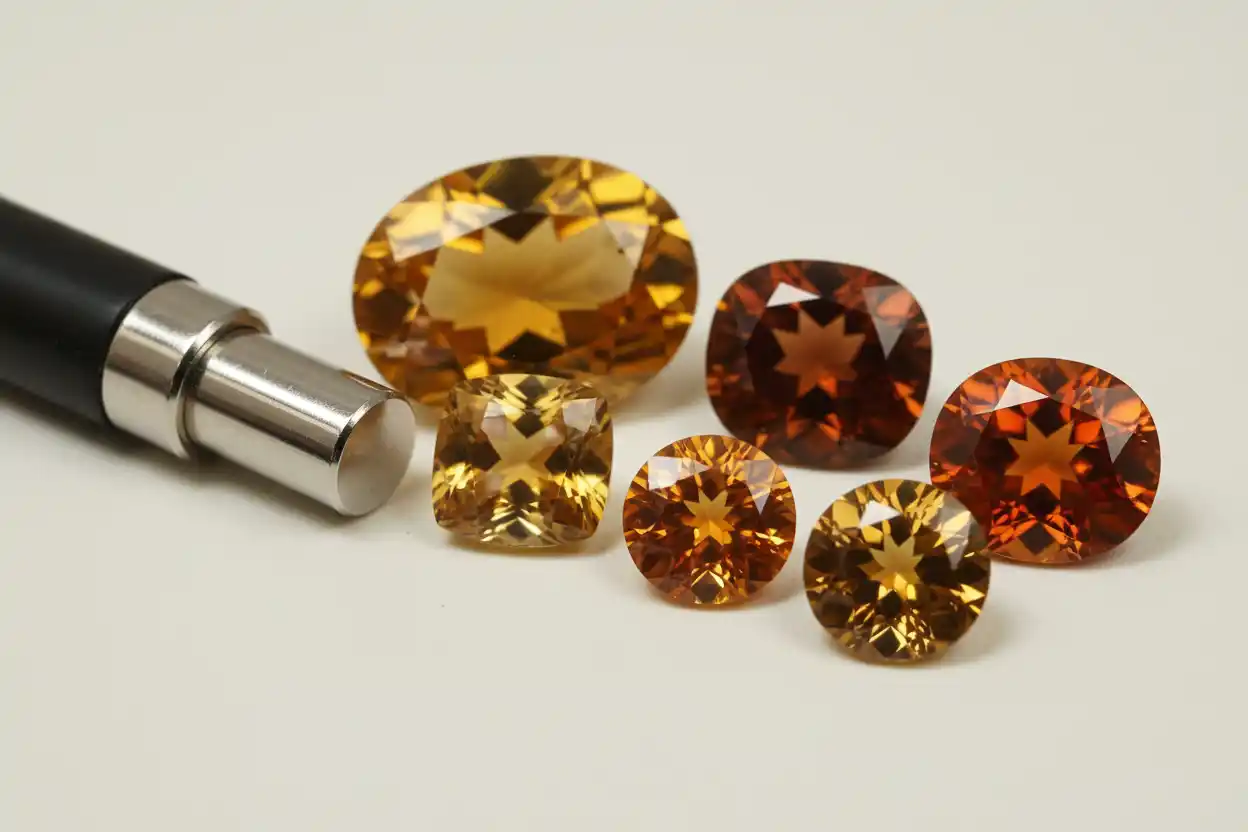
Sphalerite is zinc sulfide, commonly written as ZnS, although iron and other elements can influence its color and appearance. Transparent gem-quality crystals are much less common than the opaque or translucent sphalerite encountered as an important zinc ore. Fine faceted examples may be yellow, golden yellow, orange, reddish orange, red, green, brown, or combinations of these colors.
Its optical properties are distinctive. Sphalerite has a refractive index around 2.37 and extremely strong dispersion, which separates white light into spectral colors. A well-cut stone can therefore show intense red, orange, yellow, green, and blue flashes as it moves. This fire is one of sphalerite’s strongest attractions, but photographs taken under concentrated lighting can exaggerate it. Always distinguish between the gem’s actual body color and the rainbow flashes generated by dispersion.
Natural sphalerite also deserves separation from synthetic sphalerite and other yellow or orange gems that can appear superficially similar. Identity should never be decided through body color alone. For a costly collector stone, an independent gemological report adds more confidence than a seller-created certificate. The gemstone certification decision becomes particularly important when a listing carries an unusual origin claim, exceptional clarity claim, significant price premium, or description such as museum quality.
Sphalerite Color and Fire: Brightness Should Not Hide Weak Body Color
Color is one of the first features buyers notice, but sphalerite creates an unusual challenge because dispersion can compete visually with body color. Pale yellow and golden stones can display dramatic spectral fire because more light passes through them, while orange and reddish-orange stones may offer richer body color. Neither look is automatically superior. The better choice depends on whether you value intense rainbow flashes, saturated warm color, or a balance between both.
Examine the gem under diffused daylight as well as directional indoor light. Strong spot lighting can make nearly any well-faceted sphalerite look explosive, while neutral daylight reveals whether the underlying color remains attractive without theatrical illumination. A bright yellow stone with strong transparency may look exceptionally lively, whereas an overly dark orange or brown stone can suppress some of the optical display despite possessing attractive saturation.
Color zoning also deserves attention. Some Spanish sphalerites show different yellow, orange, and red areas within one stone. Attractive zoning can create distinctive character, especially in collector gems, but uneven dark zones can reduce brightness if they dominate the face. Judge the overall appearance rather than assuming that more colors automatically mean higher quality.
The sphalerite quality grading should therefore consider hue, saturation, tone, transparency, clarity, cutting, polish, and overall light return together. Sphalerite has no single universal consumer grading scale in which a seller’s AAA or top-grade label settles those questions.
Sphalerite Clarity and Inclusions: Transparency Has a Major Effect on Fire
Transparent sphalerite is prized because clarity allows its exceptional dispersion and high refractive index to become visually obvious. Inclusions are common, particularly as stones become larger, so a clean-looking faceted gem can command a meaningful premium. That does not mean every visible inclusion is unacceptable. The more important question is whether inclusions reduce transparency, interrupt light return, weaken the visual center of the gem, or reach the surface.
Inspect the stone face up at normal viewing distance before using magnification. A gem that looks bright and attractive without a loupe may remain a strong collector choice even when small internal features appear under magnification. By contrast, dense clouds, prominent fractures, dark inclusions, or heavily included areas can reduce brilliance enough to defeat the reason many people buy sphalerite in the first place.
Surface-reaching fractures require extra caution because sphalerite is already brittle and has perfect cleavage. A fracture near a corner, point, or thin girdle can create greater practical risk during handling or setting. If buying online, request clear images from the crown, pavilion, and side rather than relying only on a face-up glamour photograph. Video is especially useful because it shows whether fire travels throughout the stone or appears only at carefully selected angles.
Clarity descriptions such as VS, SI, and I1 can help organize listings, but colored-stone sellers do not always apply these terms identically. Compare the actual appearance rather than assuming that two stones labeled VS have equivalent transparency.
Sphalerite Cut Quality: Precision Faceting Can Transform Its Optical Performance
Cut is unusually important in sphalerite because the gem’s high refractive index and powerful dispersion reward skilled faceting. An expert cutter can create intense brilliance and fire, while weak proportions or poor polishing can leave an otherwise promising stone looking dull. At the same time, sphalerite is difficult to facet because softness, brittleness, and perfect cleavage complicate cutting and polishing. Fine craftsmanship can therefore become a genuine component of collector value.
Study whether the facet junctions appear crisp, the outline is balanced, and the polish looks bright rather than scratched or hazy. Fine polish matters greatly because sphalerite’s surface can abrade more easily than harder gems. Worn facet edges, polishing scratches, chips, and bruised corners can noticeably reduce the appeal of an otherwise impressive stone.
Large windowing through the center also deserves attention. A window allows the viewer to see through the stone instead of receiving strong reflected light, weakening brilliance. Extinction creates the opposite problem, with excessively dark areas that remain black as the gem moves. A successful cut balances brightness, fire, body color, and weight retention rather than maximizing carat weight alone.
Compare millimeter dimensions with carat weight before buying. Sphalerite has relatively high density, so a stone can weigh more than its visible dimensions might suggest. A heavy gem that carries excessive depth beneath the girdle may offer less face-up presence than another stone with a more efficient cut.
Sphalerite Hardness and Cleavage: Why Daily-Wear Rings Are a High-Risk Choice
Durability is the buying factor that should never be minimized. Sphalerite measures only about 3.5 to 4 on the Mohs scale, which means many common objects and harder gemstones can scratch it. The crystal hardness chart helps put that number in context, but hardness is only part of the problem. Sphalerite is also brittle and has perfect cleavage, so a sharp impact can cause chipping or splitting.
For that reason, sphalerite is far better suited to a protected collection, display, pendant, brooch, or carefully worn earrings than to an everyday ring. A ring exposes the stone to desks, door handles, countertops, tools, bags, and countless accidental contacts. Even a protective bezel cannot change the gem’s fundamental resistance to scratching and cleavage.
If you still want sphalerite in a ring, treat it as occasional jewelry rather than a daily piece. Avoid exposed points and thin corners, and use a setting that protects as much of the perimeter as practical. A competent jeweler should know the stone is sphalerite before attempting setting, repair, polishing, or resizing work because normal pressure and heat procedures used around harder gems may be inappropriate.
Storage is equally important. Keep sphalerite separate from quartz, corundum, diamond, and other harder stones. Do not wipe a dusty surface aggressively because dust can contain particles hard enough to scratch the polish. Gentle soapy water and a soft cloth are preferable for cleaning, while steam and ultrasonic methods should be avoided.
Sphalerite Treatment and Origin Claims: Ask for Written Disclosure
Sphalerite is commonly offered without enhancement, but buyers should still request treatment information in writing. An untreated statement is more useful when it is attached to the exact stone on the invoice or laboratory report rather than appearing only as general website language. If the seller cannot explain whether the gem has been treated, factor that uncertainty into the buying decision.
Origin receives particular attention because Spain is famous for exceptional transparent sphalerite, especially yellow, orange, and reddish-orange gems from Cantabria. Spanish stones can show remarkable fire and have a strong collector following. Other localities also produce sphalerite, however, and country of origin should never replace examination of actual color, clarity, cutting, and condition.
A Spanish label can support collector interest when the provenance is credible, but it should not automatically justify a large premium. Compare the stone against other Spanish examples of similar color, size, transparency, and cutting. If a seller emphasizes a specific mine or locality as the reason for a high price, ask what documentation supports that statement.
Sphalerite Price Per Carat: Compare Similar Stones Instead of Chasing the Cheapest Listing
Current listings show how misleading a single average can be. Commercial orange and yellow stones can appear around $30 to $50 per carat, while cleaner or more carefully cut examples may move closer to $60 to $100 per carat. Certain precision-cut, eye-clean, or strongly collectible Spanish stones can exceed $100 per carat. Large included examples do not necessarily rise in price per carat simply because they are heavy.
The sphalerite price per carat should therefore be used as a comparison tool rather than a fixed tariff. Match color, transparency, clarity, cutting, polish, origin, size, and seller terms before deciding that one stone is inexpensive or overpriced. A $30-per-carat stone with noticeable inclusions and ordinary cutting is not equivalent to a $100-per-carat stone with precision faceting, strong transparency, rich color, and documented Spanish origin.
Remember that very large sphalerites can be surprisingly affordable on a per-carat basis. Large crystals exist, but exceptional transparency and cutting become harder to maintain as size increases. Size alone should never outweigh condition and optical beauty.
Seller Photos, Return Policies, and Condition Checks for Online Sphalerite
Online buying makes sphalerite especially dependent on seller presentation. Its fire responds dramatically to lighting, so photographs under intense LEDs can look different from the stone under ordinary room light. Ask whether images have been adjusted for saturation or contrast, request neutral daylight views, and seek a short video that rotates the stone slowly. You should be able to see body color, transparency, facet condition, inclusions, and light return without relying on one carefully staged frame.
Condition is critical because soft facet edges can show wear even when the gem remains technically intact. Inspect the girdle and corners for chips and examine the crown for abrasions. On an older collector stone, slight wear may be acceptable if disclosed and reflected in price. On a newly presented premium gem, a crisp polish should be expected.
A practical return period is valuable because no photograph can completely reproduce sphalerite’s optical display. Confirm whether returns are accepted, whether there is a restocking fee, who pays return shipping, and whether independent inspection affects eligibility. A strong seller should also provide exact dimensions and weight, not only a general size description.
Is Sphalerite a Good Gemstone to Buy for Investment or Resale?
Sphalerite is primarily a specialist collector gem rather than a standardized investment asset. Fine Spanish examples, exceptional precision cuts, strong transparency, rare colors, and historically interesting provenance can attract collectors, but liquidity is limited compared with diamonds, sapphire, ruby, or emerald. The pool of buyers who appreciate sphalerite is smaller, and resale price can depend heavily on presentation, documentation, condition, and access to the right collector market.
The question do gemstones hold value is particularly important with sphalerite because retail scarcity does not guarantee easy resale. A beautiful collector gem may remain desirable for decades while still selling below its original retail asking price if it must be liquidated quickly. Buy it because its fire, rarity, locality, cutting, or mineralogical interest appeals to you, not because a seller promises guaranteed appreciation.
Conclusion
To buy sphalerite confidently, prioritize natural identity, attractive body color, strong transparency, skilled cutting, clean facet condition, realistic durability expectations, and clear seller documentation. Its extraordinary fire makes fine sphalerite one of the most visually distinctive collector gems, but softness, brittleness, and perfect cleavage make careless jewelry use a serious risk. The strongest purchase is a stone whose optical beauty, condition, provenance, price, and intended use all make sense together.
FAQs
Is sphalerite a real gemstone?
Yes. Transparent gem-quality sphalerite can be faceted into striking collector stones, although much sphalerite occurs in forms unsuitable for gem cutting.
What colors of sphalerite are most desirable?
Yellow, golden yellow, orange, and reddish orange are especially popular because they can combine attractive body color with strong dispersion. The best choice depends on brightness, transparency, and personal preference.
Why does sphalerite show so much rainbow fire?
Sphalerite has extremely strong dispersion, which separates white light into spectral colors. A well-proportioned faceted stone can display this effect very strongly.
Is sphalerite harder than quartz?
No. Sphalerite is only about 3.5 to 4 on the Mohs scale, while quartz is substantially harder. This makes sphalerite much easier to scratch.
Can sphalerite be worn in an engagement ring?
It is a risky choice for daily ring wear because it is soft, brittle, and has perfect cleavage. Sphalerite is better suited to collecting or protected jewelry worn occasionally.
Is Spanish sphalerite more valuable?
Fine Spanish sphalerite has strong collector recognition and can command premiums, particularly when transparency, color, cutting, and provenance are excellent. Origin alone does not guarantee high quality.
Is sphalerite usually treated?
Many sphalerites are sold as untreated. Buyers should still request disclosure for the individual stone rather than assuming that every listing has the same treatment status.
Should sphalerite have a laboratory report?
An inexpensive stone may not need one, but independent identification becomes more useful for costly gems, significant origin claims, unusual colors, or collector-level purchases.
How should sphalerite be cleaned?
Use gentle soapy water and a soft cloth, rinse carefully, and avoid harsh chemicals, steam, ultrasonic cleaning, abrasive wiping, and hard impacts.
Is an eye-clean sphalerite worth more?
Often yes, especially when good clarity occurs together with attractive color and expert cutting. Transparency allows sphalerite’s brilliance and dispersion to show more effectively.