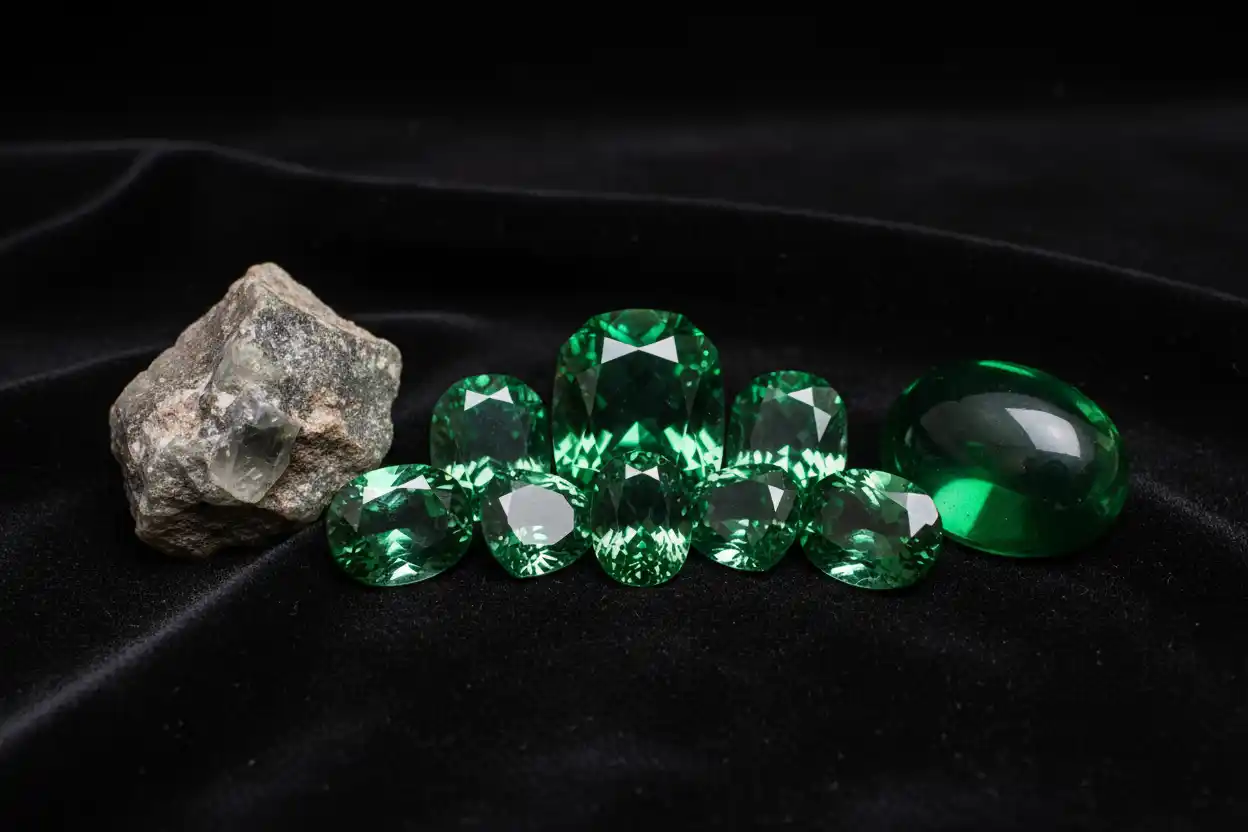
Tsavorite: Meaning, Properties & Symbolism
Tsavorite is the vivid green-to-bluish-green gem variety of grossular garnet, colored mainly by vanadium with a smaller chromium contribution in many stones. It is prized for saturated color, high brilliance, good hardness, lack of routine treatment, and a refractive character that gives well-cut gems a lively appearance.
Its finest deposits occur in East Africa, especially Kenya and Tanzania. Crystals above one or two carats become progressively scarce, making size a much stronger value factor than it is for many common garnets.
Tsavorite at a Glance
| Property | Tsavorite |
|---|---|
| Composition | Calcium aluminum silicate, Ca₃Al₂(SiO₄)₃ |
| Group or type | Green vanadium- and chromium-bearing grossular garnet |
| Color | Yellow-green, grass green, vivid green, emerald green, bluish green, dark green |
| Crystal system or texture | Cubic or isometric |
| Habit | Dodecahedral, trapezohedral, rounded crystals, nodules, fragments, alluvial grains |
| Luster | Vitreous to subadamantine |
| Transparency | Transparent to translucent |
| Mohs hardness | Approximately 7–7.5 |
| Cleavage | None |
| Tenacity | Brittle |
| Common uses | Faceted rings, earrings, pendants, necklaces, bracelets, collector crystals |
| Primary care concern | Impact, hidden fractures, excessively dark cutting, imitation, and unsupported treatment or origin claims |
What Is Tsavorite?
Tsavorite is a green variety of grossular garnet, whose ideal composition is calcium aluminum silicate.
Grossular occurs in many colors, including colorless, yellow, orange, brown, pink, green, and red-brown. Only strongly green vanadium- or chromium-bearing material is normally called Tsavorite.
The name derives from the Tsavo region of Kenya. Tiffany & Co. promoted the commercial name during the 1970s after geologist Campbell Bridges had discovered gem-quality green grossular in East Africa.
Tsavorite belongs to the larger garnet family. It shares the cubic crystal structure and lack of cleavage characteristic of other garnets, while retaining a distinct color chemistry, rarity profile, and market.
The variety appears in crystals that start with T and gemstones that start with T, but its family relationships are more important than the alphabetical label.
What Gives Tsavorite Its Green Color?
Vanadium is the dominant coloring element in many Tsavorites. Chromium commonly contributes and can intensify green saturation.
The balance among vanadium, chromium, iron, titanium, and other elements influences hue and tone.
Yellow-green stones may contain weaker blue absorption or more iron-related modification. Bluish-green material can appear closer to fine Emerald.
Too much iron or excessive crystal thickness can make the stone dark, especially under weak indoor lighting.
The most desirable color usually lies between medium and medium-dark tone with vivid saturation. A stone should look green rather than blackish, grey, brownish, or strongly yellow.
Color appearance also depends on cut. Deep pavilions can darken a gem, while shallow cutting creates a window that weakens saturation.
Tsavorite’s position among green gemstones is therefore based on a balance of hue, tone, saturation, light return, and size.
Discovery and Naming
Campbell Bridges discovered green grossular in Tanzania in 1967. Early material came from the Komolo area and related metamorphic deposits.
Later discoveries near Kenya’s Tsavo National Park provided additional commercial material.
Tiffany & Co. president Henry Platt introduced the name Tsavorite, derived from Tsavo, during the 1970s.
The new name distinguished vivid green gem grossular from less saturated green grossulars and from the broader mineral family.
Bridges later developed important Kenyan mines, including the Scorpion Mine area. His work helped establish Tsavorite as one of the leading modern colored gemstones.
Historical discovery stories add context but do not determine the value of an individual stone. Color, size, clarity, cut, treatment, and documentation remain more important.
How Tsavorite Forms
Tsavorite forms in unusual calcium-, aluminum-, vanadium-, and chromium-bearing metamorphic environments.
East African deposits commonly occur within graphitic gneiss, schist, marble, and calc-silicate rocks altered during high-grade regional metamorphism.
Fluids move through fractures and reaction zones, allowing calcium- and aluminum-rich grossular to incorporate vanadium and chromium.
Graphite frequently coats rough crystals or occurs in the surrounding host rock. Black graphite can make an uncut nodule look unremarkable until the green interior is exposed.
The deposits are often narrow, folded, faulted, and discontinuous. Miners may follow small veins through hard metamorphic rock without finding a large continuous body.
This geology contributes to sporadic production and small crystal sizes. Large clean rough is unusual because crystals commonly fracture during tectonic deformation.
The wider processes are explained in how gemstones are formed, while Tsavorite remains a particularly restricted metamorphic example.
Important Sources
Kenya remains one of the most important Tsavorite producers. The Taita-Taveta and Tsavo regions are historically central to the variety’s identity.
The Scorpion Mine and surrounding deposits have produced vivid green material, important crystals, and high-quality faceting rough.
Tanzania is equally significant. Merelani, Lemshuko, Komolo, and related northern Tanzanian districts have yielded Tsavorite alongside Tanzanite, graphite-rich rocks, and other metamorphic gems.
Madagascar has produced green grossular and Tsavorite from deposits such as Itrafo. Some stones show lighter yellow-green color, while others approach classic East African saturation.
Smaller or less consistent occurrences have been reported elsewhere, but Kenya and Tanzania remain the dominant high-profile sources.
A laboratory can confirm grossular and often analyse color chemistry. Geographic origin may be more difficult and is not offered reliably for every stone.
Crystal Form and Rough Appearance
Tsavorite commonly forms as dodecahedral or trapezohedral garnet crystals, rounded nodules, irregular fragments, and broken crystal sections.
Rough surfaces may carry graphite, mica, quartz, calcite, or host-rock coatings.
A dark graphite rind can conceal vivid green gem material. Miners and cutters may open a small window to assess color and transparency before planning the cut.
Crystals are often fractured because the deposits experienced substantial geological pressure and deformation.
Transparent sections can be limited to narrow zones between cracks and inclusions. Cutting yield is therefore frequently low.
Natural crystal shape may be valuable independently of faceting potential. A well-formed Tsavorite crystal on matrix can command a collector premium even if it contains inclusions.
Tsavorite Clarity and Inclusions
Tsavorite is often cleaner than Emerald, but fine stones are not always flawless.
Common inclusions include graphite, apatite, calcite, quartz, mica, zircon, sulfides, fluid inclusions, healed fractures, fingerprints, and small mineral crystals.
Graphite can appear as black plates, grains, or clouds. In attractive crystal specimens, it may provide useful geological context.
Needle-like inclusions and growth tubes can occur, although they should not be compared automatically with Demantoid’s horsetail inclusions.
Eye-visible fractures reduce value and durability. A clean-looking stone should still be examined under magnification because filled or surface-reaching cracks may be difficult to see in photographs.
For larger Tsavorites, minor inclusions are more acceptable because clean crystals become extremely scarce as size increases.
Clarity should therefore be evaluated together with color and carat weight rather than through a diamond-style standard.
Tsavorite Versus Emerald
Tsavorite and Emerald can occupy a similar vivid green color range, but they belong to different mineral groups.
Emerald is chromium- or vanadium-bearing beryl. Tsavorite is vanadium- and chromium-bearing grossular garnet.
Tsavorite generally has higher brilliance, stronger dispersion, no cleavage, and fewer eye-visible inclusions than many Emeralds.
Emerald commonly receives oil or resin treatment to reduce the visibility of fractures. Tsavorite is usually untreated.
Emerald is harder on the Mohs scale but often more fractured and less tough in practical wear. Tsavorite is slightly softer but generally more resistant to cleavage-related damage because garnet has no cleavage.
The dedicated Tsavorite vs Emerald guide owns the detailed comparison of appearance, value, treatments, durability, and buying decisions.
Tsavorite Versus Other Green Garnets
Demantoid is green andradite garnet. It has higher refractive index and dispersion than Tsavorite and may show distinctive horsetail inclusions.
Tsavorite usually displays a cleaner, more saturated green with less visible spectral fire. Its color is primarily associated with vanadium and chromium rather than iron-rich andradite chemistry.
Green grossular that lacks sufficient saturation may be called mint garnet, light green grossular, or simply green grossular rather than Tsavorite.
Mali Garnet is commonly a grossular-andradite mixture with yellow-green, brown-green, or golden color. Its chemistry and market identity differ from Tsavorite.
Uvarovite is chromium-rich green garnet that usually forms small crystals on matrix rather than facetable gems. It has a separate family intent.
The types of garnet guide owns the wider comparison among these varieties.
How to Identify Tsavorite
Tsavorite is cubic and singly refractive. A polariscope should generally show no true double refraction, although strain may create anomalous reactions.
Refractive index commonly falls around 1.73–1.76, with variation according to composition.
Specific gravity is usually approximately 3.55–3.75.
Garnet’s hardness of 7–7.5 can scratch ordinary glass, although scratch testing should never be used on a finished stone.
A spectroscope may show vanadium- and chromium-related absorption. Chromium-bearing material can fluoresce weakly or show a reddish reaction, while iron may suppress fluorescence.
Magnification helps identify inclusions, fractures, coatings, filling, doublets, and synthetic substitutes.
Raman spectroscopy and chemical analysis confirm grossular and distinguish it from Emerald, Spinel, Tourmaline, Peridot, glass, and synthetic materials.
The dedicated real vs fake garnet guide owns broad garnet authenticity, while expensive Tsavorite should receive an independent gemological report.
Treatments
Most Tsavorite is sold without routine enhancement. Its natural color and clarity are major parts of its appeal.
Heating is not a standard commercial treatment and generally offers little benefit.
Unsubstantiated reports have occasionally suggested diffusion or other color modification, but such treatment has not become an established Tsavorite market practice.
Fracture filling with oil, resin, or glass is possible in any surface-reaching crack, though it remains uncommon.
Coatings can create a greener appearance on glass, Garnet, or another pale stone. Wear along facet edges may reveal the underlying material.
A seller should disclose filling, coating, assembly, dye, irradiation, and any laboratory-detected treatment rather than relying on the general statement that Tsavorite is normally untreated.
Synthetic Tsavorite and Imitations
Laboratory-grown grossular-type materials can be produced for research, but synthetic Tsavorite is not a major commercial jewelry category.
Green YAG, GGG, synthetic Spinel, synthetic Sapphire, glass, Cubic Zirconia, and synthetic Emerald can imitate its color.
Natural Chrome Diopside, Green Tourmaline, Peridot, Demantoid, and Emerald can also be misidentified.
A doublet can combine a natural Garnet crown with a coloured glass or synthetic pavilion. The join may become visible through immersion or magnification.
A report should identify natural grossular Garnet rather than merely state “natural green gemstone.”
Cutting and Brilliance
Tsavorite accepts a bright polish and can display strong brilliance because of its refractive index and lack of cleavage.
Oval, cushion, round, pear, emerald, trillion, and mixed cuts are common.
Cutters must balance weight retention with color. Rough is scarce, so overly deep pavilions and irregular shapes sometimes preserve more carat weight than face-up beauty.
A shallow cut produces a pale window through the centre. Excessive depth makes a medium-dark stone appear nearly black.
Fine cutting aligns the table with the most attractive color region and removes obvious graphite or fracture zones where possible.
Large rough requires especially careful planning because losing one corner can remove several carats of valuable material.
Durability and Jewelry Suitability
Tsavorite has good jewelry durability. Its hardness resists ordinary abrasion better than Quartz and Feldspar.
Garnet has no cleavage, reducing the risk of a clean split along one structural plane.
Nevertheless, Tsavorite remains brittle. A sharp impact can chip the girdle, facet junctions, or pointed corners.
Rings can perform well in a secure setting. The dedicated Tsavorite ring guide owns setting, style, and daily-wear choices.
Pendants and lower-impact pieces are covered on the Tsavorite necklace page, while Tsavorite earrings receive relatively little physical contact.
Bracelets experience more impact and abrasion, so the Tsavorite bracelet guide should be used for link, setting, and wear considerations.
The broader is Garnet durable page explains how Garnet hardness and brittleness interact.
Tsavorite Value and July 2026 Asking Prices
Detailed valuation belongs on the dedicated Tsavorite price page.
As of July 2026, attractive sub-carat stones commonly carry asking prices around $300–$800 per carat, depending on color and clarity.
Fine eye-clean stones between one and two carats often appear around $1,000–$2,500 per carat.
Fine two-to-three-carat gems commonly ask approximately $2,000–$4,000 per carat.
Vivid clean stones between three and five carats may reach $3,000–$6,000 per carat, while exceptional larger gems can exceed $8,000 per carat.
Current market reporting indicates that fine stones above one carat remain scarce and that prices have risen materially in recent years.
These broad asking levels should not replace stone-specific evaluation. A dark, windowed, included three-carat gem may cost less per carat than a vivid, clean, well-cut one-carat stone.
Buying Tsavorite
The dedicated Tsavorite buying guide owns detailed purchase intent.
View the exact gem in daylight-equivalent and warm indoor lighting. It should remain lively rather than turning black or strongly yellow.
Request weight, dimensions, depth, clarity, treatment disclosure, origin claim, and a rotating video.
Compare face-up measurements with carat weight. An unusually heavy stone for its visible size may have an excessively deep pavilion.
Inspect the girdle and pointed corners for chips. Surface-reaching fractures should be disclosed and checked for filling.
For higher-value stones, obtain an independent laboratory report confirming natural grossular Garnet and detectable treatment.
Tsavorite is a strong option among green engagement ring stones, but the setting should still protect the girdle from impact.
General transaction and return-policy checks appear in how to buy gemstones online.
Cleaning and Storage
Detailed care instructions belong on how to clean Tsavorite jewelry.
For routine cleaning, use lukewarm water, mild soap, and a soft brush. Rinse briefly and dry with a lint-free cloth.
Avoid sudden temperature changes, harsh acids, bleach, and abrasive cleaners.
Untreated sound Garnet may sometimes tolerate ultrasonic equipment, but hand cleaning remains safer when fractures, filler, glue, or delicate settings are present.
Steam should be avoided when the stone’s treatment and fracture status are uncertain.
Store Tsavorite separately from Diamond, Sapphire, Ruby, and other harder gems that could scratch it.
Tsavorite Meaning and Symbolism
Tsavorite is a modern gemstone name, so its specific symbolism developed more recently than the long historical traditions surrounding red Garnet.
Its vivid green color commonly inspires themes of renewal, growth, confidence, opportunity, vitality, and maintaining hope through difficult periods.
The stone’s emergence from dark graphite-coated rough can serve as a metaphor for qualities that remain hidden until the surrounding material is carefully removed.
Its East African origin may carry personal meaning connected with landscape, geological heritage, responsible mining, or travel.
As a member of the traditional January birthstone family, Tsavorite offers a green alternative to the better-known red Garnets.
These interpretations belong to cultural, spiritual, and personal belief systems. Scientific evidence does not show that Tsavorite treats disease, creates prosperity, changes metabolism, or guarantees emotional outcomes.
Frequently Asked Questions
1. Is Tsavorite a type of Garnet?
Yes. It is the vivid green vanadium- and chromium-bearing variety of grossular Garnet.
2. What gives Tsavorite its green color?
Vanadium is usually the main coloring element, with chromium contributing in many stones.
3. Where was Tsavorite discovered?
Campbell Bridges discovered gem-quality green grossular in Tanzania in 1967, with important deposits later developed in Kenya.
4. Why is it called Tsavorite?
The name comes from Kenya’s Tsavo region and was promoted commercially by Tiffany & Co.
5. Is Tsavorite rarer than Emerald?
Fine Tsavorite, especially above two or three carats, is extremely scarce, although rarity comparisons depend on quality and size.
6. Is Tsavorite normally treated?
No routine enhancement is established; most market material is expected to be untreated.
7. How does Tsavorite differ from Emerald?
Tsavorite is grossular Garnet with higher brilliance, no cleavage, and usually no oil treatment; Emerald is green Beryl and commonly contains more fractures.
8. Is Tsavorite suitable for an engagement ring?
Yes. Its hardness and lack of cleavage make it practical in a protective setting, though it can still chip under impact.
9. Why are large Tsavorites expensive?
The deposits usually produce small fractured crystals, so clean vivid stones above one or two carats become progressively rarer.
10. Can Tsavorite be synthetic?
Experimental synthetic grossular exists, but synthetic Tsavorite is not a common jewelry product; simulants are a greater concern.
11. Is dark green Tsavorite always better?
No. Excessively dark material may appear black in ordinary lighting, while medium vivid green often provides better face-up beauty.
12. What most affects Tsavorite value?
Color, tone, saturation, clarity, carat weight, cut, treatment, condition, origin documentation, and market demand determine value.
Tsavorite succeeds as a gemstone because it combines vivid natural color with strong brilliance and practical wearability. Its premium should come from genuine grossular identity, balanced green color, skilled cutting, and dependable disclosure—not from an unsupported grade printed on a seller’s card.